

Body Scan Meditation Script: A Guide for Classrooms
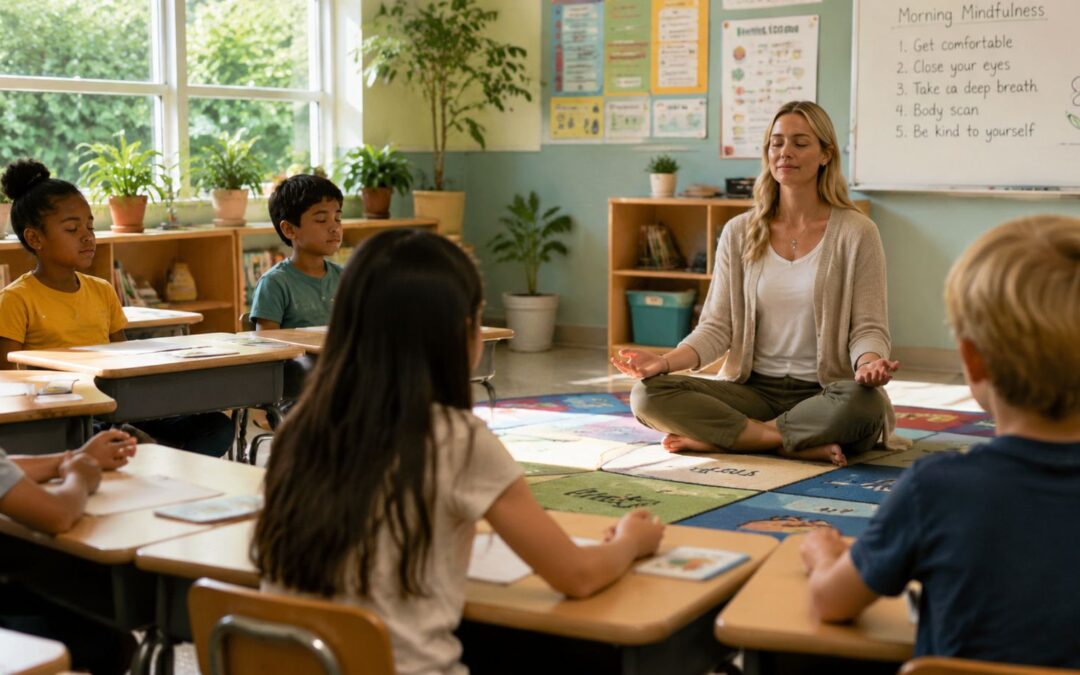
Right after recess, the room can feel full of unfinished sentences, wiggly legs, and one child who's already bracing for the math check-in. Just before a test, the same room can swing the other way, quiet on the surface but tight underneath. A body scan meditation script gives you a way to meet that energy without adding more noise, and in K-8 settings that matters because calm doesn't arrive by accident.
A 2022 meta-analysis of 14 trials found that body scan meditation produced a small but statistically significant increase in mindfulness, with Hedges' g = 0.27, a 95% confidence interval of 0.03 to 0.50, and p < .05 (PubMed). That's a modest effect, not a magic fix, but it's exactly the kind of grounded evidence school teams can work with when they're choosing an SEL tool for real classrooms. For many educators, a body scan fits because it can be delivered in a brief guided format of about 20 minutes or less and still stay useful in school rhythms.
This practice can settle a room without turning it into a performance. The children who need movement can stay seated and track sensations instead. The children who need reassurance can notice the floor under their feet, the chair under their hips, or the breath moving in and out. For a companion exercise that uses a similar steady rhythm, a step-by-step PMR guide can help you compare how body awareness and muscle relaxation differ in practice. If you're also looking for a simple grounding companion, Soul Shoppe's grounding techniques for kids pairs naturally with this work.
Grounding Your Classroom with the Body Scan
A third grader once told me, right before a spelling quiz, that her stomach felt like “a washer on spin.” Another student at the same table was kicking the chair legs and smiling too hard, which usually means the nerves are already in charge. In moments like that, a body scan works because it gives students a job that's internal, structured, and quiet enough to fit the room.
The practice isn't complicated, but it is deliberate. The body scan has become a core entry practice in mainstream mindfulness because it needs no equipment, can be done sitting or lying down, and is easy to script for children, caregivers, and school staff. Public guidance also shows how flexible the format is, with some scripts spending 20 to 30 seconds per area and others offering a 20-minute version (Berkeley Greater Good). That range matters in schools, where a teacher may need a fast reset after lunch or a deeper practice during SEL time.
Practical rule: if the room is dysregulated, make the script simpler, not longer.
A body scan also gives children a vocabulary for self-awareness. Instead of asking, “How do you feel?” and getting shrugs, you can ask, “What do you notice in your shoulders?” or “Is your jaw tight, loose, or somewhere in between?” Those prompts are concrete, which helps younger learners, and they're also calm enough to use before transitions, after conflict, or when winding down.
If you're deciding whether to use this practice or a more movement-based one, a body scan meditation script can sit alongside breathing or grounding tools, not replace them. That's the mindset that keeps SEL practical. You're not trying to create perfect silence, you're giving students a repeatable way to come back to themselves.
Three Ready-to-Use Body Scan Scripts
Shorter mindfulness practices have become more common because classrooms and homes need something that fits the day, not something that competes with it. Public resources now offer 3-, 5-, and 10-minute body scan versions, which reflects how often educators need quick, integrated practices instead of long standalone sessions (Mindful). A good body scan meditation script works best when the timing matches the moment.
3-Minute Reset for Transitions
Use this when students are coming in from recess, lining up for lunch, or shifting after a loud activity. Keep your voice steady and your instructions short.
Sit with both feet on the floor or lie down if there's space.
Take one slow breath in and out.
Notice your feet.
Notice your legs.
Notice your belly.
Notice your shoulders.
Notice your hands.
Notice your face.
If any part feels busy, you don't have to change it. Just notice it and move on.
Take one more breath.
Feel the room around you.
Open your eyes when you're ready.
10-Minute Standard Scan for SEL Time
Use this when you have a little more room for focus, especially before writing, testing, or after a difficult social moment.
Find a comfortable position, sitting or lying down.
Let your breath be slow and easy.
Bring attention to your toes.
Move to your feet.
Notice your ankles and lower legs.
Notice your knees and thighs.
Notice your hips and belly.
Notice your chest and back.
Notice your hands and arms.
Notice your shoulders, neck, and face.
Notice the top of your head.
If you lose track, come back to the last place you remember.
If a spot feels unclear, neutral, or too much, skip it.
End by noticing the room, the chair or floor, and one thing you can hear.
Kid-Friendly Imagery Scan for Younger Learners
Use this with K-2 students who need something playful and concrete.
Put your body in a quiet shape.
Imagine warm sunshine on your toes.
Check your feet like you're looking for tiny treasure.
Notice your legs, like tree trunks resting on the ground.
Feel your tummy like it's a balloon gently floating.
Notice your arms and hands, like they're sleeping on a cloud.
Check your shoulders. Can they melt a little?
Let your face be soft like a calm pond.
Now notice the air around you.
When you're ready, wiggle your fingers and toes.
| Script Type | Duration | Best For | Key Feature |
|---|---|---|---|
| 3-Minute Reset | 3 minutes | Transitions, calming a noisy room | Fast, simple, low-demand |
| 10-Minute Standard Scan | 10 minutes | SEL lessons, pre-test focus, deeper settling | More complete attention path |
| Kid-Friendly Imagery Scan | Flexible | K-2 and mixed-age groups | Playful language, easier engagement |
If your team is building a wider mindfulness library, it helps to think the same way some creators do when they solve podcast scripting bottlenecks. A clear script template removes hesitation, especially when you're trying to lead a class and keep the practice consistent. For a broader child-centered mindfulness approach, you can also connect this work with teaching mindfulness to children.
How to Lead a Body Scan Meditation
The strongest body scan script can fall flat if the delivery feels rushed or hesitant. Students read your pacing immediately, especially if they're already keyed up. A calm, even voice tells them there's no hidden test in the practice, only a chance to notice what's happening inside.
A standard body scan usually starts with a comfortable position, either sitting or lying down, which makes it flexible enough for classrooms where students stay at their desks (The Wellness Society). That's one reason it has become so useful in school-based programs. You don't need mats, special lighting, or a room full of silence to begin.
Facilitator note: the body scan works best when your tone says, “Notice,” not “Fix.”
Start with the breath, then move through the body in a clear sequence. Adults often make the mistake of talking too much while trying to guide the process. Better results usually come from short cues, small pauses, and a pace that gives the brain time to follow. A cue like “notice your feet” works better than three or four instructions piled together.
The posture choice matters too. Some children settle faster in a chair with both feet grounded, while others relax more easily on a carpet square or mat. If a child looks stiff, you can offer, “You can keep your eyes open or closed,” or, “You can stay right where you are.” For a simple companion resource on breath settling, belly breathing technique can be paired with this practice before the scan begins.
A strong classroom flow often looks like this:
- Ask students to get still in a way that feels manageable.
- Invite one or two slow breaths.
- Move attention from feet upward, or from head downward, using the same order each time.
- Pause briefly between body regions.
- Close by returning attention to the room.
That structure gives children predictability. Predictability lowers the amount of mental effort needed to stay with the practice, which is useful when attention is already stretched thin.
Adapting Scripts for Children and Classrooms
The same script can land very differently in a first-grade room and an eighth-grade advisory. Younger children need concrete images and short attention steps. Older students usually do better when you talk plainly about sensation, focus, and stress, without making the practice sound babyish.
A detailed anatomical order helps a lot here. Published guidance commonly moves attention from the toes up toward the head, or in the reverse direction, and that kind of structure gives children specific anchors like “now notice your knees” or “feel the air on your face” (APA-linked mindfulness text). That's more effective than the vague instruction to “scan your body,” which leaves too much room for drift.
In K-2, keep the language playful but not chaotic. “Warm, sleepy sunshine on your toes” works because it's sensory and calm. “Spidey-senses” can work with some groups too, especially if the class already uses that metaphor for noticing clues in the body. The trick is to use one image at a time, then move on.
With grades 3-5, I shift toward simpler factual language. “Notice your shoulders,” “check your jaw,” and “feel your belly rise and fall” are usually enough. If the room gets giggly, I don't stop the practice to call it out unless the laughter is spreading. Lower your voice, slow the pace, and keep going.
Middle schoolers deserve respect in the language. They respond well when you frame the practice as a focus tool, a brain break, or a way to notice stress before it spills into behavior. They do not need a long explanation about mindfulness theory in the moment. They need something clear enough to use without feeling singled out.
For parents and teachers who want a broader support system around calm routines, Daily Powers supplements for children is one example of how families sometimes look for additional calming supports outside school. In the classroom, though, the practical work still comes back to wording, pacing, and whether the practice feels age-appropriate.
Creating a Safe and Trauma-Informed Practice
A body scan asks children to pay attention to the inside of their bodies. For some students, that's comforting. For others, especially children with trauma histories, it can feel too exposed, too quiet, or too close. That's why a trauma-informed script isn't a special add-on, it's the safer version of the practice.
One major U.S. review estimates that about two-thirds of children report at least one traumatic event by age 16, which helps explain why a “simple” mindfulness exercise can land very differently across a classroom (VA Whole Health Library). If you ignore that reality, some students will opt out by shutting down, joking, fidgeting, or checking out mentally. If you plan for it, you can keep the practice open without forcing participation.

The safest scripts give choice at every turn. You can say, “If you'd like, bring your attention to your feet,” which leaves room for a student to observe without pressure. You can also say, “You can focus on the feeling of your breath or on a comforting spot in the room.” That external anchor matters because not every child is ready to go inward for long.
Supportive language lowers pressure. Choice lowers resistance.
I also use permission language before the practice starts. “You can keep your eyes open or closed.” “You can skip any part.” “You can just listen if that feels easier.” Those phrases do more than soothe, they give students control. Control is often the missing piece in generic mindfulness scripts, and without it, the practice can feel like one more adult demand.
The teaching strategy matters as much as the wording. If a child looks activated, don't push them to describe it out loud. Let them focus on the floor, the chair, or the sound of your voice. For a fuller educator lens on this approach, trauma-informed teaching strategies is a helpful companion resource. The goal is not to force internal awareness. The goal is to make internal awareness optional, supported, and safe enough to try.
Integrating Body Scans into Your Daily Routine
A body scan only helps if students know it as part of the day. When it shows up in predictable moments, children start to recognize the routine and settle into it with less resistance. In classrooms, that predictability matters because students are already managing transitions, emotions, and attention shifts.
Use it at times when the room already needs a reset:
- After recess: students come in buzzing, and a short scan helps them shift from movement to seated focus.
- Before a test or quiz: the practice gives children a quiet way to notice tension before it turns into panic.
- After lunch: a brief body check can help the class re-enter learning without carrying over cafeteria noise.
- After conflict: a scan gives students a nonverbal path back to regulation before discussion.
- At dismissal: a calmer ending can reduce the chaos that sometimes follows the last bell.
The practical challenge in classrooms is not whether students can follow the script. It is whether they can do it without feeling boxed in. If a child refuses, let them sit in silence and listen. If the group gets restless, shorten the scan instead of stretching it out. If time is tight, use the 3-minute version rather than skipping the practice entirely.
A few troubleshooting moves help in almost every setting:
- If kids giggle: lower your voice, keep going, and avoid turning the giggles into a big event.
- If attention drifts: return to a single body part and use the same cue again.
- If a student seems uncomfortable: offer feet, breath, or room sounds as an outside anchor.
- If the class is overtired: make the script shorter and more concrete.
- If the room is highly activated: start with feet on the floor and one slow breath before any scan begins.
The routine gets easier when adults treat it as a normal classroom tool, not a special performance. A one-minute feet-to-breath check after lunch can change the tone of the whole transition. The class learns that this is notice time, not chaos time.
Soul Shoppe helps school communities build the shared language, safety, and connection that make practices like this easier to use every day. If you want support bringing mindfulness, empathy, and regulation into your classroom or campus, visit Soul Shoppe and explore the programs, tools, and trainings that fit your school community.