

A Sentence a Day: SEL Journaling for K–8
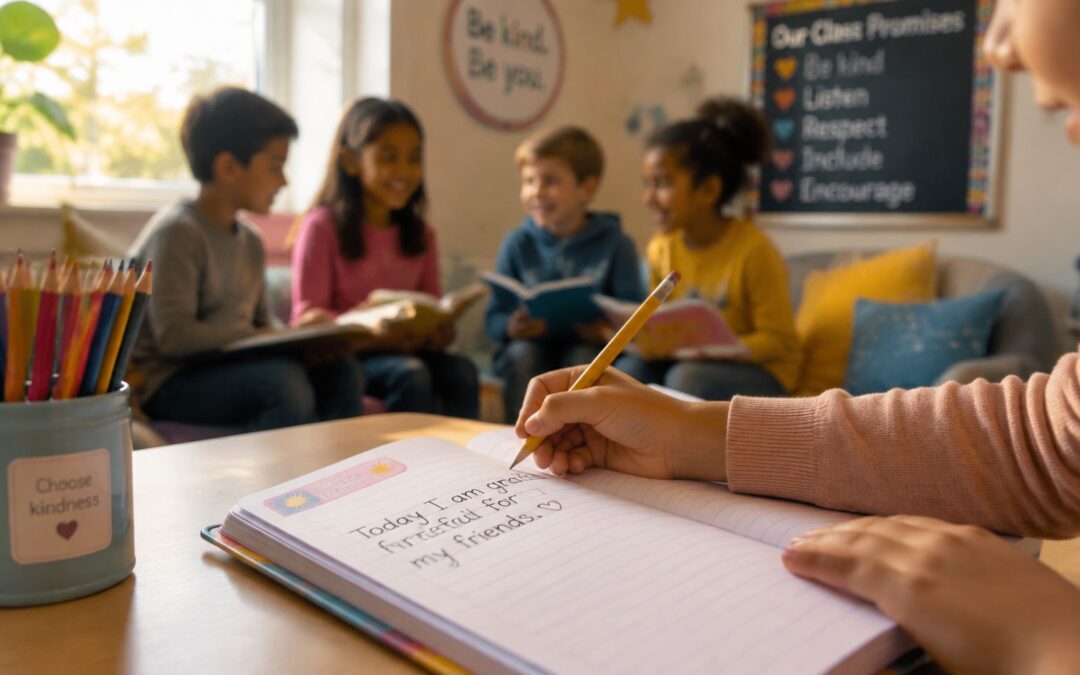
You know the moment. The room is noisy, someone's backpack is half-open on the floor, and a child who's been bright and chatty all morning suddenly goes quiet during writing time. At home, it's the same kind of shift at the dinner table, one word answers, shoulders tight, eyes on the plate. A sentence a day works in those moments because it gives children one small, predictable place to land, with language that's short enough to manage and meaningful enough to matter.

Why One Sentence Can Change a School Day
A lot of adults want a big opening, a full journal page, or a deep conversation before kids feel safe enough to share. Most children don't start there. They start with one thought, one feeling, or one small observation, and a sentence a day gives that first step a place to go without asking for a performance.
In a classroom, that can look like a morning meeting where the teacher writes, “I felt nervous before I came in, but I'm glad I stayed,” and invites students to respond with their own line. At home, it can be the child who usually says “fine” at bedtime suddenly offering, “I felt left out when my friends picked teams.” That single sentence doesn't solve everything, but it gives the adult something real to respond to, and that changes the emotional tone fast.
Practical rule: If a child can say it once, don't make them say it five different ways. The goal is connection, not repetition.
A sentence a day also works because it's small enough to feel safe. Kids who are unsure about sharing, or who shut down when asked to “talk more,” often do better when the task is narrow and familiar. They can focus on naming a feeling, a moment, or a need, then move on with the day instead of getting stuck in it.
The true SEL value is the rhythm. Children learn that emotions can be named, not hidden, and that adults will notice patterns without turning every feeling into a crisis. That predictable check-in helps build psychological safety in classrooms and homes, especially for kids who need a gentle way to enter communication.
The Research Behind Daily Sentence Practice

The reason this routine feels manageable is partly linguistic. English sentences used to run much longer, with research summarized in linguistic studies showing averages of about 63 words in 1525, 41.41 words by 1595, around 26 words in the 1820s, and roughly 14.4 words by 1950. A later corpus study found a decline from 33 words in 1876–1900 to 27 words in 1976–2000 (arxiv.org/pdf/2502.04321v1.pdf). The long arc points toward brevity, clarity, and compact expression, which is exactly why a one-sentence format feels so accessible for younger writers and busy families.
Why the format fits real life
Daily speech has also shrunk. A 2026 analysis of audio recordings from more than 2,000 people found that the average person uttered about 16,600 words per day in 2005, and that figure fell to below 12,000 words per day by 2019, a decline of about 28% over 14 years (Time). The researchers estimated the drop at roughly 330 fewer words spoken per day for each year in that period, about 120,000 fewer words per year. In plain terms, kids and adults are often carrying more of their inner life in shorter bursts, texts, and fragmented conversations, so a short written sentence can become a useful bridge back to reflection.
That bridge matters in SEL because language shapes regulation. A child who can name “frustrated,” “left out,” or “relieved” is already doing more emotional work than a child who only says “bad.” One sentence gives room for that naming without overwhelming the writer or the listener.
There's also a steadying effect in the format itself. It asks for just enough effort to create a habit, but not so much that adults abandon it after a busy week. That's why the routine can support belonging, self-awareness, and calm without needing to become a full journaling unit.
A short daily sentence doesn't replace deeper writing. It lowers the door so more children can walk through it.
Setting Up a Low-Lift Daily Routine
The first question teachers ask is usually practical, and it should be. If a routine adds copying, chart prep, and new management headaches, it won't last. A sentence a day works best when it fits inside something you already do, like morning meeting, advisory, arrival, dismissal, dinner, or bedtime.
Start with one visible place and one repeated cue. A chart paper on the wall, a notebook at the family table, or a shared digital doc can do the job. The point is not to create a polished system, it's to create a repeatable one that takes the least amount of thinking from the adult.
Keep the setup simple
Use one prompt for the whole day, or one weekly theme with tiny daily variations. If you're a teacher, write the sentence stem before students arrive. If you're a parent, put the notebook next to the dish soap, the coffee mug, or the bedtime lamp so you're not hunting for it when energy is low. For families who like extra support, tips for a writing journal can help you think through materials, spacing, and keeping the routine visible without overdoing it.
The structure should feel light enough to survive busy weeks. A child can dictate to an adult, write independently, or draw first and then turn the drawing into one sentence. The adult's job is to keep the routine moving, not to correct every detail in the moment.
A simple weekly flow looks like this:
- Monday: Model a sentence about a feeling or event.
- Tuesday: Let children answer the same kind of prompt in their own words.
- Wednesday: Invite a partner share or quick read-aloud.
- Thursday: Ask for one revision, maybe a clearer verb or a stronger feeling word.
- Friday: Read back one sentence from the week and notice growth.
A few materials go a long way. Chart paper, sticky notes, pencils, a class notebook, or a phone note can all work. If you want a broader routine anchor for emotionally steady classrooms, this overview on routines for kids that help children feel emotionally grounded pairs well with a sentence a day because it treats predictability as a support, not a burden.
For teachers worried about prep, the hidden win is that repetition reduces decisions. Once the sentence frame is familiar, students spend less time asking what to do next, and more time thinking.
Prompts and Templates for Every Age Group
A sentence a day gets stronger when the prompt matches the child. Younger students need concrete language and a lot of modeling. Older students can handle perspective, conflict, and reflection, but they still need a frame that doesn't feel like a test.
The easiest way to keep it fresh is to rotate the type of prompt across the week. Use one day for a feeling, one for an event, one for a relationship, one for a problem, and one for a small success. That pattern keeps the routine stable while giving students new content to work with.
Sample A Sentence a Day Prompts by Grade Band
| Grade Band | Prompt Example | Expected Response |
|---|---|---|
| K–2 | “Today I felt ___ when ___.” | “Today I felt proud when I tied my shoes.” |
| K–2 | “My favorite part of today was ___.” | “My favorite part of today was reading with my partner.” |
| 3–5 | “A kind choice I saw today was ___.” | “A kind choice I saw today was when Maya shared her markers.” |
| 3–5 | “One hard moment today was ___, and I handled it by ___.” | “One hard moment today was losing my page, and I handled it by asking for help.” |
| 6–8 | “I noticed myself reacting by ___, and next time I want to ___.” | “I noticed myself reacting by shutting down, and next time I want to ask a question first.” |
| 6–8 | “A situation I want to understand better is ___ because ___.” | “A situation I want to understand better is group work because I get frustrated when roles aren't clear.” |
For K–2, keep the choices tight and concrete. A teacher might say, “Finish this sentence, ‘I felt __ when __.’” A child might answer, “I felt nervous when it was my turn,” or “I felt happy when my buddy smiled at me.” That's enough.
For 3–5, the sentence can stretch a little farther. A student might write, “I noticed I calmed down after I took a breath,” or “I felt included when my group saved me a spot.” At this age, kids start seeing the social pattern behind the feeling.
For 6–8, the best prompts invite reflection without becoming a lecture. Try, “What happened, what did you notice in yourself, and what do you want to do next time?” One student might write, “I got loud when I felt ignored, and next time I want to wait before I speak.” That kind of line is useful because it names behavior and choice in the same breath.
A useful companion resource for older students and home routines is journal entry prompts, especially when you want ideas that move beyond gratitude and toward self-awareness, perspective-taking, and conflict repair.
Keep the language specific. “Good day” tells you almost nothing. “I was proud when I asked for help” gives you a doorway into conversation.
Assessing Growth Without Killing the Joy
A sentence a day should not feel like a graded assignment with red ink waiting at the end. If students think every line will be scored, they'll start writing for approval instead of honesty. The better move is to watch for patterns that show growth over time and use those patterns to support conversation.
Notice change in the small things
Look for shifts in emotional vocabulary, willingness to share, and how much support a child needs to get started. A child who once wrote “mad” might later write “frustrated,” “disappointed,” or “embarrassed.” Another child may move from copied sentence stems to original thoughts, or from silence to one honest line in the notebook.
That kind of progress is easier to catch when you keep lightweight notes. A teacher might mark the date, the prompt, and one quick observation in a log. A parent might jot a note after bedtime, like “needed help starting” or “used a feeling word without prompting.” That's enough to see trends without turning the practice into paperwork.
For students who benefit from seeing their own growth, a short reflection every few weeks helps. Ask, “Which sentence felt most like you?” or “What's one word you use more now than you did before?” These questions keep the focus on voice, not compliance.
If you want a more formal lens, it can help to think about the practice as part of a broader outcome picture, especially when you're connecting SEL and literacy goals. This overview on outcome measurement is useful for educators who want to track change without flattening the relationship piece.
Use reflection, not pressure
Try one simple check-in every few weeks:
- Student reflection: “What's easier to say now?”
- Family reflection: “What do you notice your child talks about more often?”
- Teacher reflection: “Who is participating more, and who still needs a model?”
Those questions help adults notice whether the routine is opening communication or becoming mechanical. If the sentences are getting shorter because the child is tired, that's useful information too. It may mean the prompt needs to be simpler, the time of day needs to shift, or the adult needs to model a little more.
Integrating the Practice Into Schoolwide SEL
A sentence a day works best when it lives inside a shared SEL language, not off to the side as one more isolated activity. If a school already uses advisory, community meetings, or a common calm-down framework, the daily sentence can echo those routines in a form students already recognize. That lowers the lift for teachers and families, because they are not building a separate system from scratch.

Make the routine part of the ecosystem
At the school level, the strongest use is as a low-lift routine builder. It gives students one shared place to practice vocabulary from assemblies, classroom agreements, peer support efforts, or bullying prevention work. That matters because public-facing materials for sentence routines often explain the steps, the chart paper, and the five daily segments, but they rarely answer the question busy educators ask first, how much prep and management this adds to an already full day.
That concern is real. A routine can look appealing on paper and still be hard to keep going if it depends on repeated copying or heavy teacher modeling every day. The version that lasts is modest, steady, and easy to repeat, so teachers can use it without turning it into another prep-heavy literacy task.
A schoolwide version can look like this:
- Advisory: One shared prompt each week that matches the advisory theme.
- Classrooms: A quick daily sentence that uses the same emotional vocabulary.
- Families: A home version that mirrors the school prompt at dinner or bedtime.
- Digital tools: A simple app or shared document for students who need typing or audio support.
For administrators, the main question is not whether the routine is flashy. It is whether students hear the same language in more than one place so the skill sticks. When a child practices naming feelings in class, then again in advisory, then again at home, the language starts to feel normal instead of academic. For a broader view of how structured SEL programs support this kind of routine, see our overview of social-emotional learning programs for schools.
Used this way, a sentence a day supports community without trying to replace deeper SEL lessons, counseling, or conflict resolution work. It works like a small daily thread that helps those larger systems hold together.
If you want a school partner that understands how small daily routines can strengthen belonging, self-regulation, and shared language, visit Soul Shoppe and explore programs that help kids and grownups practice connection in real classrooms and homes. Their SEL approach fits naturally with a sentence a day because it treats consistency, empathy, and community as daily habits, not one-time events.