

How to Launch Peer Mentoring Programs That Build Belonging
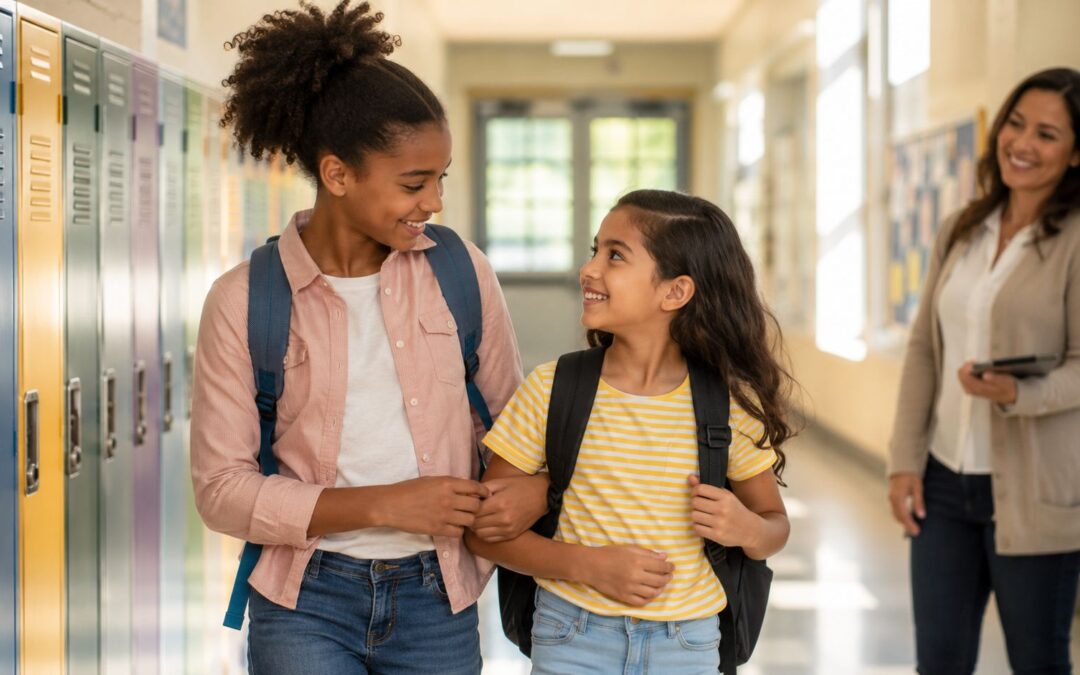
It's the first week of school, and a fifth grader is walking a nervous new second grader to the classroom door, showing her where to put her backpack, how to line up for lunch, and which bathroom pass to grab if she needs it. That tiny exchange can look ordinary from the hallway, but it often does more for a child's sense of safety than a pile of posters about kindness ever will. Peer mentoring programs work because they turn those small, repeated moments into a structure schools can rely on.
The strongest versions aren't casual buddy systems. They're planned SEL systems with trained mentors, adult supervision, and regular check-ins that help students feel known before anyone expects grades or behavior to shift. A recent systematic review found that formal peer mentoring programs were most consistently linked with positive academic outcomes when participation was voluntary, mentors were trained, matches were made with a formal model, programs had institutional support, and faculty were involved systematic review. That matters in a real school, because the difference between “we paired them up” and “we built a support loop” is usually the difference between a program that fades and one that sticks.
For a school counselor, the question isn't whether students like helping each other. They usually do. The question is whether the adults have built enough structure so the helping stays safe, useful, and equitable. That's what makes peer mentoring feel less like an add-on and more like part of the school's belonging strategy.
What Peer Mentoring Looks Like in a K-8 School
A second grader tears up at the backpack hooks on Monday morning. A fifth grader, wearing a mentor badge, walks over, kneels down, and says, “I'll show you where our class line starts.” That's peer mentoring in a K-8 building, not a flashy leadership program, just an older student offering advice, support, and knowledge to a younger one in a way that feels close enough to trust and simple enough to use peer mentoring definition.
The model works especially well in elementary and middle school because kids often listen differently to a near-age peer than they do to an adult. A trained sixth grader can remind a fourth grader how to organize a binder, where to go after dismissal, or what to do when a friend says something hurtful. That's not counseling, and it's not remediation. It's a relationship with clear limits that helps a child settle into the day.
Practical rule: If the match is doing heavy emotional work, the adult system is too far back. Mentors can listen and notice, but they can't carry a peer's crisis alone.

What it is not deserves equal attention. It's not a substitute for counseling, so a student in grief, panic, or family instability still needs a licensed adult's response. It's not a remediation track for the students who are “behind.” And it's not an unstructured buddy system where two kids are told to be nice and figure it out.
A better way to think about it is as a predictable school relationship with three structural ingredients, a trained older mentor, a consistent meeting rhythm, and a supervising adult. When those pieces are present, the program has a chance to support belonging instead of just adding another meeting to the calendar. For a clear parallel to schoolwide peer support language, this overview of peer support programs is worth a look alongside the planning work.
If your staff includes licensed clinicians or counselors who want to sharpen the mental-health side of the work, it can also help to browse continuing education for licensed clinicians from Be Your Best Self & Thrive Counseling, PLLC. That kind of training is useful when mentors need to recognize the line between supportive listening and a concern that belongs with an adult.
The cleanest K-8 programs usually sound like one another in practice. A mentor greets a younger student, follows a routine, asks one or two focused questions, and ends on time. The routine is what makes the relationship feel safe enough for a child to return to it next week.
Choosing the Right Program Model for Your Campus
A principal doesn't need a perfect model. She needs the one her building can supervise on a Tuesday afternoon when testing schedules, parent pickups, and a substitute shortage collide. The right choice depends on what problem you're trying to solve first, social adjustment, academic scaffolding, or a small, steady space for SEL practice.
Here's the simplest way to sort the options. Cross-age buddies fit best when younger students need help with routines, transitions, and school confidence. Near-peer tutors fit when students need academic language and a model that feels close to their own experience. Small-group circles fit when a counselor wants students to practice friendship skills, stress regulation, or respectful problem-solving in a more structured space.
| Comparing Peer Mentoring Models for K-8 Schools | Grade Pairing | Best For | Supervision Load |
|---|---|---|---|
| Cross-age buddies | Older and younger students, often 2 or more grades apart | Routines, belonging, school navigation | Moderate |
| Near-peer tutors | One to two grade levels apart | Academic scaffolding and homework habits | Moderate to high |
| Small-group circles | Mixed grades, usually four to six students | Friendship, SEL skills, and shared problem-solving | High |
A counselor I worked with on a busy elementary campus used cross-age buddies for morning arrival and reading time. The older students loved having a role, but the key win was that the younger children stopped treating the building like a maze. That was enough to justify the structure, because the school's biggest need was not tutoring, it was making the day feel predictable.
Near-peer tutoring looks different. A sixth grader sitting beside a fourth grader can explain how to break a long assignment into smaller parts, but the adult still needs to watch for skill mismatch. If the tutor is only two steps ahead academically, the pair can work beautifully. If the gap is too wide, the mentor slips into teacher mode and the relationship gets stiff.
For schools that want SEL practice more than academic support, small-group circles often make the most sense. They are less personal, more supervised, and easier to align with a schoolwide language around emotions and conflict. If you're weighing whether a peer mediation layer belongs on campus, this school-based mediation guide pairs well with the model decision.
Before you choose, run a short leadership-team check. Ask which grade span is most stable, which staff member can supervise consistently, and whether your students need connection, academic help, or both. If the answer is fuzzy, start smaller. A reliable pilot beats an ambitious rollout every time.
Decision filter: If you can't explain who supervises, how often they meet, and what outcome comes first, the model isn't ready yet.
Recruiting Mentors and Matching Mentees With Care
Recruitment is where many programs get stuck, because adults assume the “good kids” will volunteer and the rest will sort themselves out. That's backwards. The strongest mentor pools come from a broad invitation, clear expectations, and a short screening process that looks for empathy and reliability, not perfect behavior or top grades.
Start with a schoolwide announcement that names the job in plain language. Then ask teachers for nominations, but give them a simple prompt so they don't default to the most visible students in the room. A nomination note can say, “Name students who are kind, steady, curious about younger children, and able to follow directions.” That keeps the process from turning into a popularity contest.
A short mentor interview can be just five questions. Ask, “Why do you want to do this?” “What would you do if your mentee got upset?” and “How will you remember your weekly meeting?” A good answer doesn't have to be polished. It has to show the student can listen, show up, and ask for help when needed. For schools that want a platform-style workflow to manage applications and matching, these features tutoring businesses actually need are a useful reminder of how much the right system can simplify scheduling, communication, and follow-through.
Family note: “Your child has been invited to participate in a peer mentoring program that pairs students for regular, adult-supervised support. The meetings are designed to build belonging, confidence, and school routines. Mentors are trained to listen, keep boundaries, and get an adult when a concern is bigger than the program.”
Matching works best when you weigh shared interests, language needs, and social context instead of just who's available. A student who loves drawing and a younger child who talks nonstop about animals may connect quickly, even if they aren't in the same homeroom. A mismatch often shows up by week three, when one child does all the talking, the other goes quiet, or the pair can't settle into a routine. Re-pairing isn't failure. It's part of the design.
A family welcome note should explain what a mentee will experience in concrete terms. Parents want to know who is meeting their child, how often, and who to contact if the pairing feels off. The clearer you are at the start, the less likely you are to spend week four repairing confusion.

A practical matching rubric keeps the process honest. Give shared interests one check, language or family context another, and schedule fit a third. If the rubric says a pair is weak in two or more areas, pause before matching them and look again.