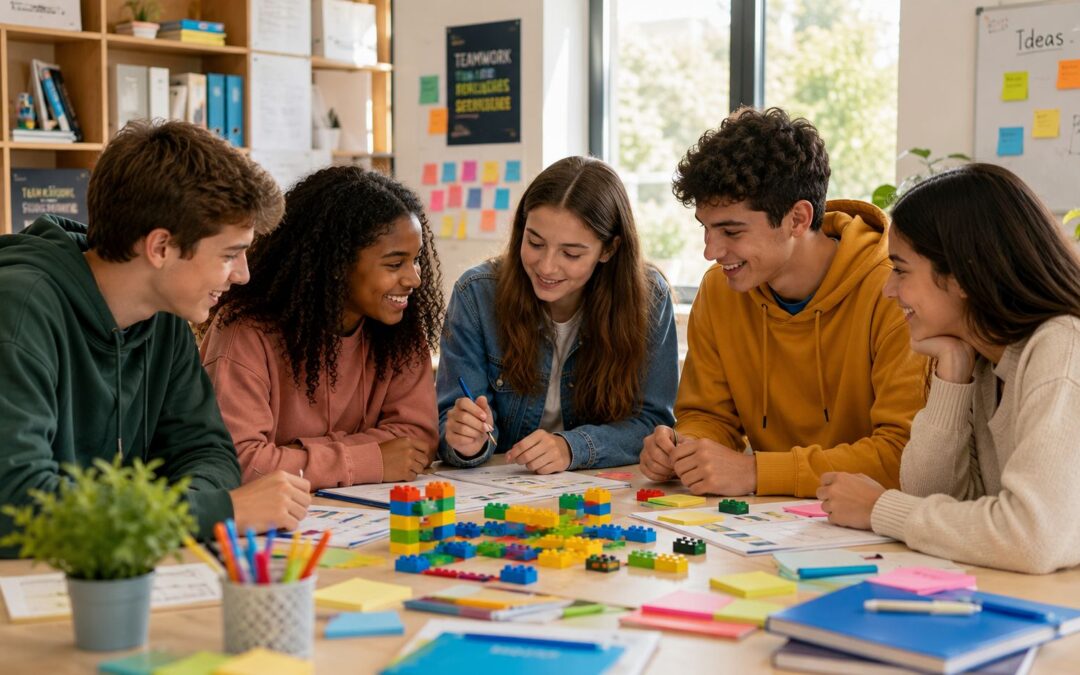
You can see the setup already. A teacher has ten minutes before advisory starts. A counselor needs something better than “just talk it out.” A parent wants teens to do more than sit side by side on their phones and call that hanging out. The usual fallback is pizza, a game with unclear rules, or an icebreaker that feels younger than the group in front of you.
That's why meaningful group activities for teens matter. The best ones don't just fill time. They give young people a structure for speaking, listening, moving, solving problems, repairing conflict, and feeling like they belong. That matters in a moment when many teens are spending huge amounts of time online. A 2023 Gallup survey found that U.S. teens spend an average of 4.8 hours per day on social media, and 51% report using it at least four hours daily, according to Gallup's reporting on teen social media use.
Offline groups have to offer something stronger than “come participate.” They need to feel safe, active, and worth showing up for. In practice, that means less forced fun and more intentional design. The strongest group activities teens respond to usually share three traits. They have clear expectations, a real role for everyone, and a short reflection that helps teens connect the activity to real life.
This guide gets straight to usable options. Each activity includes what it builds, how to run it, examples you can picture using, and the adaptations that keep it from falling flat. Some work best in classrooms. Some fit counseling groups, youth programs, lunch clubs, or family routines at home. All of them can help teens build empathy, communication, self-regulation, and resilience without making the experience feel like a lecture.
1. Circle Discussions for Emotional Check-Ins
Circle discussions are one of the simplest group activities teens can do, and one of the easiest to get wrong. When adults make them too deep too fast, teens shut down. When adults keep them too shallow forever, teens treat them like a script and stop investing.
Done well, a circle creates predictable structure and psychological safety. Everyone can see everyone else. Turn-taking is clear. Listening becomes part of the activity, not an optional courtesy. A seventh-grade advisory might begin Monday with one prompt such as, “What's one word for your energy today?” A counselor might use a monthly circle after social conflict to help students name impact without turning the space into a debate.
How to facilitate it well
Start with low-risk prompts. Ask about energy, weather moods, small wins, or one thing students need today. Save prompts about grief, exclusion, or conflict for groups that already trust the format.
A strong circle has a pass option every time. Teens should know they can say “pass,” “not today,” or “I want to come back to that.” That one norm does more for honesty than pushing participation ever will. Schools using restorative practices often build this structure into community-building routines, and restorative circles in schools offer a useful model for that approach.
Practical rule: Never treat silence as defiance. In circles, silence is often regulation.
At home, parents can use a dinner-table version with siblings. Try “rose, thorn, bud,” or “one hard thing, one helpful thing.” The key is not solving every answer. Teens stay engaged when adults listen first and advise second.
A few details make a big difference:
- Post norms visibly: Keep reminders short, such as listen fully, no fixing, confidentiality with safety exceptions, and pass is allowed.
- Model the tone yourself: If the adult shares with some honesty, teens usually match that level more than they match the prompt itself.
- Keep groups manageable: Smaller circles usually feel safer when you're introducing the routine.
What this builds
Circle check-ins strengthen emotional vocabulary and belonging. That matters because many mainstream activity lists focus on games but skip emotional skill-building, even though Playmeo's team-building discussion highlights a gap in anxiety-aware design. In school and at home, circles help bridge that gap without making the activity feel clinical.
2. Collaborative Problem-Solving Games and Escape Room Challenges
Some teens who won't talk much in a circle come alive when there's a puzzle on the table and a timer on the board. That's why collaborative problem-solving games work so well. They externalize the challenge. Instead of “share your feelings,” the group faces a task together.
A sixth-grade math teacher might create a simple classroom escape room where teams solve equations to reveal clues in envelopes. An after-school program might rotate commercial kits once a month so teens work with peers outside their usual friend group. At home, parents can make a scavenger-hunt mystery with a coded note, three hidden objects, and a final reward everyone earns together.
Place the setup where students can see it.
Why they work better than generic team games
The activity gives every teen a legitimate entry point. One student notices patterns. Another keeps track of clues. Another notices the team is spiraling and says, “Let's restart.” That last contribution matters as much as solving the lock.
Organized youth activities are especially strong contexts for practicing initiative, problem solving, effort, and time management, according to findings described in the Illinois study on what adolescents learn in organized youth activities. Escape-room style tasks fit that pattern well because they require students to plan, adapt, and persist under mild pressure.
If you want a model for the mindset behind these tasks, collaborative problem-solving approaches can help adults frame challenge as shared work rather than a test of who's smartest.
How to keep the room from turning chaotic
The difference between productive struggle and a meltdown is usually in the briefing. Tell teams the goal, the time limit, how many hints they can request, and what collaboration should sound like.
Use mixed-ability groups on purpose. If all the confident students end up together, one team dominates and another stalls. I also like assigning one non-solver role per group, such as recorder, clue manager, or morale coach, so quieter teens aren't sidelined.
A short video can help adults picture the setup before trying it:
For larger events, some programs borrow ideas from party game rentals and adapt them into low-stakes team stations, but the important piece is still the debrief. Ask, “Who helped us move forward?” and “What happened when we got stuck?” That's where the SEL learning becomes visible.
3. Peer Mentorship and Buddy Programs
The first month of school often tells you who is likely to disappear socially. A younger student eats fast, avoids asking questions, and acts like they should already know the routine. A well-run buddy program catches that early by giving the student one reliable peer connection before isolation hardens into avoidance.
Peer mentorship works because teens often test advice differently when it comes from someone close to their age. Adults still set the frame, train the mentors, and monitor the match. The peer role is to model calm, belonging, and help-seeking in ways that feel credible to another student.
A middle school transition program might pair eighth graders with sixth graders for a semester or full year. The older students can help with lockers, schedules, lunch routines, and the small social questions that drain a young teen's energy, like where to sit, how to join a game, or what to say after a misunderstanding. In a homeschool co-op, an older teen might check in with a younger student during reading blocks or project time. The format matters less than the consistency.
What makes a buddy system actually work
Start with the SEL targets. A good mentorship program builds relationship skills, social awareness, and responsible decision-making. It can also strengthen self-management if mentors practice naming stress, planning next steps, and using support before a problem grows.
Selection matters. Grades and popularity are weak filters for this job. Choose students who can listen without taking over, keep appropriate boundaries, and follow through on small commitments. I have seen quiet, steady students do better than highly visible student leaders because younger teens often trust someone who feels safe more than someone who feels impressive.
Training needs to be concrete. Mentors should practice how to open a conversation, how to ask a follow-up question, how to respond without judgment, and when to get an adult. Peer support program guidance is useful for setting up roles, routines, and referral expectations. Pair that with short regulation routines, such as mindfulness group exercises for teens, so mentors have simple ways to settle themselves before they try to support someone else.
Good mentors do not rush to fix. They help younger students feel less alone while they figure out the next step.
Keep meetings short and predictable. Ten minutes once a week is often enough to build trust if the structure is steady. One week, buddies can compare stress points before tests and list two coping options. Another week, they can rehearse what to say if a group project feels unfair or if lunch feels awkward. In a neighborhood homework club, an older teen could greet their buddy, review one goal for the session, and close by noticing one success.
That kind of routine builds belonging through repetition, not hype.
Boundaries matter
Mentorship is supportive, not therapeutic. Student mentors need plain language about what is inside their role and what is not. If a mentee shares bullying, self-harm thoughts, abuse, safety concerns, or serious family distress, the mentor's job is to stay calm, listen briefly, and bring in the designated adult right away.
Adults also need a supervision plan. Check mentor logs, hold brief debriefs, and rematch pairs when the fit is off. Some matches are warm but inconsistent. Others are consistent but flat. Both issues can be improved when adults review what is happening instead of assuming peer relationships will sort themselves out.
Done well, buddy programs give teens a structured way to practice care, responsibility, and help-seeking. They also make transitions less lonely, which is often the difference between a student who withdraws and a student who starts to participate.
4. Mindfulness and Movement Group Sessions
Third period starts, two students are still irritated from the hallway, one teen is half-asleep, and another is talking too fast to settle into the lesson. A well-run mindfulness and movement session gives the group a shared reset before anyone is asked to focus, collaborate, or talk through a problem.
That is the practical value here. Teens often need regulation before reflection. Breathing, grounding, stretching, walking, or a short repeated movement pattern can lower the temperature in the room enough for real participation.
That makes this one of the most useful group activities teens can practice at school, in after-school programs, or at home. The format can stay short and still work. A teacher might open class with three minutes of box breathing and shoulder rolls. A counselor might lead a lunch group with yoga mats, clear choices, and the same sequence each week. A caregiver might use ten minutes of stretching and a sensory check before homework.
What to do in the room
Use concrete prompts. “Notice your feet on the floor” is easier to follow than “clear your mind.” Choice also matters, especially for teens who feel self-conscious or dysregulated. Offer eyes open or closed, sitting or standing, hands quiet or holding a fidget.
Many teens already search for coping tools online. Act for Youth reports that 87% of teens and young adults use online channels to access health information about stress, anxiety, and depression, and 49% of teens use mobile health apps to manage those concerns. Group sessions work best when they match that preference for usable skills. Teach one strategy at a time, explain when to use it, then give students a chance to try it while calm. Good starter options include paced breathing, a 5-4-3-2-1 sensory scan, or a one-minute body reset from head to toe.
Predictability helps. I have seen resistant groups cooperate once they know the routine will not drag on or turn into a public performance. A simple structure works well: one minute to arrive, two minutes of movement, one minute of breathing, one minute to notice what changed.
What adults often get wrong
Adults often make these sessions too long, too quiet, or too exposed. A teen who refuses to close their eyes, laughs during breathing, or keeps bouncing a leg is not necessarily opting out. That student may still be practicing co-regulation in a way that feels safe enough.
Start with three to five minutes. For groups that do not tolerate stillness well, lead with movement. Wall pushes, shoulder rolls, shake-outs, cross-body taps, or a slow walking loop usually work better than asking everyone to sit silently from the start. These mindfulness group exercises for kids and teens can help adults choose options that fit the age and energy of the group.
A few facilitation moves make a big difference:
- Name the SEL goal: Say what students are practicing, such as self-management, impulse control, or recognizing body cues linked to stress.
- Explain the purpose in plain language: Teens engage more when they hear, “This helps your body come down from stress so your brain can focus.”
- Normalize mixed responses: Some students feel calmer quickly. Others feel awkward, restless, or irritated at first.
- Practice outside conflict: Use these routines when the room is already steady, so the skill is available during arguments, transitions, or test anxiety.
Mindful movement also gives teens a body-based way to participate together without the pressure of constant conversation. That matters for students who shut down in discussion-heavy settings, for groups carrying stress into the room, and for adults who need a realistic reset they can teach and repeat.
5. Cooperative Art and Creative Projects
Art projects can become either a beautiful collaboration or a quiet power struggle with paint. The difference is whether the adult plans for shared decision-making. If one student designs everything and everyone else colors inside the lines, you don't have cooperation. You have helpers.
A sixth-grade class might create a mural around the question, “What does kindness look like here?” An after-school group might build a recycled sculpture for the library. A parent and teen might make a family values collage with images, colors, and phrases that represent what matters at home. Creative work gives teens something to talk through together without forcing constant face-to-face conversation.
How to structure the process
Start with a project charter. That sounds formal, but it can fit on one page. Include the shared vision, deadlines, roles, materials, and how the group will handle disagreement. If the group can't decide between voting and consensus, settle that before anyone opens the paint.
A practical example: in a student podcast project about belonging, one teen interviews, one handles music, one edits, and one writes intro copy. Rotate leadership at each stage. The product improves, and so does everyone's sense of ownership.
Students in social-emotional learning programs have shown stronger academic outcomes. One CASEL-related summary reported an 11 percentile-point gain in academic achievement for participants. Cooperative creative projects aren't the only path to that kind of growth, but they naturally build turn-taking, communication, and perspective-taking that support classroom learning.
What to watch for
Creative groups often hide conflict under politeness. You'll hear “whatever is fine” long before you hear the actual disagreement. Build in brief pauses to ask who hasn't spoken yet, what trade-off the group is making, and whether anyone is going along without actually agreeing.
Facilitator reminder: If a conflict shows up in the middle of making something, don't rush past it. That's often the lesson.
A school-wide mural is a strong example. One group wants bold slogans. Another wants symbolic imagery. Instead of deciding for them, the adult can teach a compromise process. Each group presents the reason behind its idea, then they look for overlap. That's SEL in action, not a delay from the “real” project.
Display the finished work publicly when you can. Teens take collective work more seriously when the audience is real.
6. Peer-Led Conflict Resolution and Mediation Training
Some schools rely on adults to referee every disagreement. That's understandable, but it can leave students with very little practice handling conflict themselves. Peer mediation changes that when it's trained carefully and backed by adults.
A middle school might train a small group of eighth graders to serve as peer mediators during lunch or advisory. A classroom teacher might teach the full conflict-resolution process to everyone, then identify a few students as rotating facilitators for low-stakes disputes. These are useful group activities teens can grow into because the training itself builds listening, perspective-taking, and impulse control.
Training before mediating
Don't hand students a script and call them mediators. They need repeated practice with neutral language, paraphrasing, confidentiality boundaries, and what to do when one person dominates the conversation.
Role-play common situations. Two friends are frozen out after a rumor. A group project falls apart because one student feels bossed around. A sports team conflict spills into class. Let mediators practice opening the conversation, clarifying what each person wants, and checking whether any safety concern means an adult has to step in.
- Choose trusted students carefully: Calm presence matters more than popularity.
- Use clear referral routes: Students and staff need to know when mediation is appropriate and when it isn't.
- Debrief every session: Mediators need adult support after difficult cases.
Why this belongs in SEL, not just discipline
Conflict resolution is a communication skill, not a punishment add-on. When students learn to stay regulated, summarize what they heard, and name the underlying issue under the argument, they carry those skills into class, family life, sports, and online interactions.
In practice, the strongest programs make the process visible. Students know where to request mediation, what confidentiality means, and what outcomes are possible. Adults stay available as backup rather than taking over by default.
This is also one of the clearest ways to teach self-regulation in a social context. A mediator may need to pause a conversation, ask both students to breathe, or separate facts from interpretations. That's far more useful than telling teens to “be more respectful” after a conflict has already escalated.
7. Community Service and Social Action Projects
Teens are often more invested when the activity matters beyond the room. Community service and social action projects tap that instinct. They replace passive participation with visible contribution.
A middle school class might restore a neglected garden and donate the produce. A group of seventh graders might organize kindness kits with toiletries, notes, and snacks for community distribution. A school might build a tutoring program where older students support younger readers. The strongest version starts with one question: what do you want to change or help with here?
Service that feels real, not staged
Teens can tell when a project is tokenistic. If adults pick the cause, design the steps, and assign the reflection, students may comply but they won't own it. Start by inviting them to identify a concern they notice. That might be litter on campus, new students feeling isolated, animals needing support, or peers being excluded at lunch.
Youth clubs have shown meaningful developmental benefits over time. One summary noted that teens who attended youth clubs regularly were less likely to truant from school and less likely to drink alcohol in the short term, with positive changes persisting into age 20, according to a write-up discussing group-based youth support. Structured service projects can create a similar sense of purpose and accountability when they're ongoing rather than one-off events.
Reflection is part of the work
Don't end service at cleanup. Ask what the group noticed, who benefited, what felt uncomfortable, and what they'd change next time. If students assembled care packages, discuss dignity and assumptions. If they ran peer tutoring, ask what made younger students feel relaxed enough to learn.
A practical home version works too. A parent and teen could volunteer monthly at an animal shelter, then debrief over dinner. Which tasks felt easy? Which felt hard? What did they notice about stress in the animals or the staff? That reflection deepens empathy.
Service becomes developmental when teens can connect action, impact, and identity.
Recurring projects are better than one-day heroics. A weekly food pantry shift, monthly neighborhood cleanup, or semester-long tutoring partnership builds responsibility and relationships at the same time.
8. Structured Team Sports and Recreation Activities
A teen misses two easy passes in the first five minutes, then stops calling for the ball. The rest of practice becomes damage control unless the adult in charge has built a culture where mistakes stay manageable and every player still has a role. That is why sports and recreation can be excellent group activities for teens, or one more place they feel judged.
Used well, team sports build self-management, communication, perspective-taking, and responsible decision-making. Used poorly, they sort teens by confidence and skill, then reinforce the pecking order. The difference is structure.
A recreational volleyball night, futsal club, climbing session, or cooperative field game works best when the SEL goal is named in advance. If the goal is communication, require teammates to call the play and give one specific piece of encouragement each round. If the goal is self-regulation, pause after a tense moment and have players reset with one breath before restarting. If the goal is belonging, rotate partners and small groups so students are not locked into existing friendships.
The activity matters less than the climate
Research discussed earlier in the article links team-based activities and adolescent well-being. In practice, the mechanism is easy to see. Teens come back when they feel known, useful, and safe enough to try again after messing up.
Coaches and youth leaders often overfocus on drills and underplan transitions. I would rather see a five-minute opening routine done consistently than one more scrimmage. A buddy warm-up is one reliable option. Pair students, give them a shared task, and end with a quick prompt such as, “What is one strength your partner brought today?” That simple routine lowers social friction and gives quieter teens a predictable entry point.
If you want practical ideas for team bonding, how to create emotional connection is a useful reminder that trust grows through repeated small interactions, not speeches about teamwork.
Facilitation choices that help
Sports become more inclusive when adults design for participation instead of assuming participation will happen on its own.
- Modify rules to keep everyone active: Use smaller teams, shorter rounds, skill-based stations, or touch requirements so one strong player cannot dominate possession.
- Rotate status roles: Let different teens lead stretches, track team points, model drills, or captain short practice segments.
- Praise specific prosocial behaviors: Name the player who encouraged a frustrated teammate, invited someone into the play, or recovered calmly after an error.
- Debrief without blame: Ask, “What did the team need there?” or “What helped us reset?” instead of singling out who failed.
- Build in reflection: End practice with one prompt. What was hard today? When did you feel supported? What helped you stay composed?
These details matter more for mixed-skill groups than many adults expect. In open recreation, the strongest teens often get more touches, more social status, and more forgiveness for mistakes. Newer or less confident players get the opposite. Good facilitation interrupts that pattern.
Adaptations for teens who do not identify as “sports kids”
Not every teen wants competitive play. Keep recreation broad. Walking clubs, dance-based games, cooperative relays, outdoor adventure challenges, pickleball, frisbee, yoga with partner tasks, and non-elimination gym games can all meet similar SEL goals.
This also helps with access. Some teens avoid sports because of body image, previous embarrassment, sensory overload, or fear of public mistakes. A lower-pressure format with clear norms, role options, and no public ranking often gets better participation than a traditional competitive setup.
Physical activity remains an important part of adolescent health, as noted earlier. The practical lesson for parents, schools, and youth programs is straightforward. Offer movement-based group experiences that teens will want to return to, then shape those experiences around belonging, emotional safety, and shared responsibility.
9. Digital Collaboration Projects and Social Media-Positive Initiatives
A teen group can look fully engaged on screens and still be barely collaborating. One student writes everything, another disappears, and a third posts before anyone checks tone or privacy. Digital group work needs the same intentional structure as any in-person activity, with clearer roles and tighter guardrails.
Done well, these projects give teens a real setting to practice SEL skills that now show up online every day. They learn perspective-taking while editing a peer's script, self-management when a group chat gets tense, and responsible decision-making before anything is shared publicly.
A student-led podcast on stress and belonging works well because it combines planning, listening, interviewing, revision, and audience awareness. A school media team might create an Instagram campaign with student quotes about inclusion, short videos on coping before exams, or posts that highlight ways to welcome new students. In class or after school, shared Google Docs, Canva presentations, and short audio or video projects can all serve the same purpose if the task is specific and the reflection is built in.
Why digital work needs active facilitation
Online collaboration surfaces social dynamics fast. Tone gets misread. Confident students can dominate. Quiet students may contribute strong ideas in writing but get overlooked in verbal planning. Adults need to teach those patterns directly instead of assuming teens will sort them out on their own.
Start with roles that make participation visible. One student researches, one drafts, one designs, one edits, and one monitors comments or audience responses with adult oversight. Rotate those roles on the next project so teens practice different skills, not just the ones they already prefer.
I have found that digital projects go better when the success criteria include process, not just the final product. Grade or review the planning notes, peer feedback, revision choices, and communication habits. That shift reduces the usual problem of polished work produced by one or two students while everyone else coasts.
What to teach before anything goes live
Use a short digital citizenship agreement before the project starts. Cover respectful feedback, consent for images and personal stories, what stays private, how to disagree without public shaming, and who approves posts before publication. If adults skip this step, they usually end up correcting problems after trust has already been strained.
A practical example helps. A leadership group creating first-month-of-school reels can draft three message categories in advance: welcome, coping, and community norms. They can review sample captions for tone, identify language that sounds performative or excluding, and decide what kind of comment moderation is needed. That is SEL instruction, not just media production.
Families can use the same approach on a smaller scale. A private shared photo-and-caption project about gratitude, routines, or family values gives teens practice with audience awareness and thoughtful communication without the pressure of a public post.
For adults working on how to create emotional connection in online spaces, warmth helps, but it does not replace boundaries. Teens need both.
Facilitation tips and adaptations
Keep group size small. Three to five teens is usually easier to manage than a large content team. Use checklists for each role, short deadlines, and one review point before publishing. If a teen is uncomfortable appearing on camera, offer alternatives such as scriptwriting, caption editing, design, or audio production.
This format can be especially useful for teens who communicate better in writing than in fast discussion. It also supports mixed-skill groups because contribution can be broken into clear, manageable tasks. The goal is not to chase trends. The goal is to teach judgment, collaboration, and care in a setting that feels real to teens.
Reflection should stay concrete. Ask what miscommunication showed up in messages or shared documents, what helped the group repair it, and how audience awareness changed their choices. Those questions turn digital activity into social-emotional practice instead of simple screen time.
10. Discussion Groups and Book Clubs Focused on Identity and Social-Emotional Themes
Some teens need a slower format. Not every meaningful group experience should be high energy. Discussion groups and book clubs give adolescents time to think, connect ideas to their own lives, and hear perspectives they might not encounter in casual conversation.
A school counselor might run a mental health discussion group using short articles, song lyrics, or TED-style talks. A middle school could host a belonging-focused book club built around young adult novels with identity, friendship, or conflict at the center. At home, a parent and teen might read the same book and set one evening a week to talk, not quiz.
Choosing the right material
Pick material that accurately reflects the students in front of you. Teens participate more fully when they can recognize themselves, their families, or their questions in the text. If the content is heavy, shorten the reading and deepen the discussion instead of assigning more pages.
This format is also useful for inclusive design. The IDVSA report on access for underserved rural youth discusses the need for active adult partners and adaptive pacing. That matters for neurodivergent teens, autistic students, and anyone who finds fast verbal exchanges overwhelming. Discussion groups can offer visual supports, written response options, clear turn-taking, and lower sensory load.
Participation should have options
Not every teen will jump into verbal discussion, especially around identity or mental health. Offer alternatives. Students can annotate a passage, answer in writing, place a sticky note on a theme chart, or submit a thought digitally before the group meets.
- Use open prompts: Ask “What stood out to you?” or “Where did this feel real?” instead of hunting for one correct interpretation.
- Create norms together: Confidentiality, respectful disagreement, and an “ouch/oops” repair process help a lot.
- Leave time to settle: Don't rush from hard content straight into dismissal.
A parent can use the same method at home. If a teen doesn't want a face-to-face talk, ask them to mark one quote that bothered them and one quote they liked. Start there. Often the conversation becomes easier once the focus is on the text rather than directly on the teen.
10-Point Comparison: Teen Group Activities
| Activity | Implementation complexity | Resource requirements | Expected outcomes | Ideal use cases | Key advantages |
|---|---|---|---|---|---|
| Circle Discussions for Emotional Check-Ins | Low–medium (needs facilitation skills) | Minimal materials (talking piece, space); trained facilitator preferred | Improved emotional literacy, trust, equal voice | Short daily/weekly check-ins, conflict processing, building classroom culture | Quick to start, low cost, promotes psychological safety |
| Collaborative Problem-Solving Games & Escape Rooms | Medium–high (design + logistics) | Materials, space, prep time; optional commercial kits | Strong teamwork, communication, problem-solving under pressure | Team-building days, curriculum-linked challenges, icebreakers | Highly engaging, appeals to diverse learners, memorable bonding |
| Peer Mentorship & Buddy Programs | Medium (matching, training, oversight) | Coordinator time, mentor training, scheduling | Increased belonging, leadership in mentors, support for mentees | Transition years, literacy help, ongoing socioemotional support | Builds leadership, sustainable peer support, low financial cost |
| Mindfulness & Movement Group Sessions | Low–medium (facilitator expertise matters) | Minimal space, optional mats/music; trained leader preferred | Better self-regulation, reduced stress, increased focus | Classroom transitions, anxiety management, brief daily routines | Research-backed, accessible, quick calming effects |
| Cooperative Art & Creative Projects | Medium–high (planning, coordination) | Art materials, space, time; possible specialist support | Enhanced collaboration, creative expression, tangible outcomes | Long-term projects, school murals, cross-curricular work | Produces lasting artifacts, high engagement, supports diverse skills |
| Peer-Led Conflict Resolution & Mediation Training | High (multi-session training, supervision) | Trainer, curriculum, supervision time, safe space for mediations | Reduced punitive referrals, improved conflict skills, leadership | Restorative justice initiatives, peer-managed disputes | Empowers students to resolve conflicts, scalable cultural change |
| Community Service & Social Action Projects | Medium–high (partnering, logistics) | Coordination with partners, materials, transport; reflection time | Increased empathy, agency, community impact, project management skills | Service learning, advocacy campaigns, community partnerships | Meaningful real-world impact, highly motivating for teens |
| Structured Team Sports & Recreation Activities | Medium (coaching, scheduling, facilities) | Equipment, facilities, trained coaches, safety protocols | Physical health, teamwork, resilience, social bonds | After-school programs, intramurals, inclusive recreation | Builds camaraderie and physical wellbeing, transferable skills |
| Digital Collaboration & Social Media-Positive Initiatives | Medium (platforms + moderation) | Devices, reliable internet, collaboration tools, moderation | Digital literacy, positive online culture, broad reach | Podcasts, campaigns, asynchronous group projects | Meets teens digitally, scalable, develops media skills |
| Discussion Groups & Book Clubs on Identity/SEL | Low–medium (facilitation + materials) | Curated texts, facilitator, comfortable space | Deepened empathy, critical thinking, shared language on identity | Small-group SEL work, identity exploration, literacy integration | Low cost, fosters vulnerability and perspective-taking |
Putting It All Together: Cultivating Connection and Growth
Good group work with adolescents rarely happens by accident. It comes from adults choosing activities with a clear purpose, setting the room up carefully, and paying attention to what helps teens feel safe enough to participate. That's the key difference between a forgettable time-filler and a meaningful group experience. One keeps everyone busy. The other helps young people practice how to be with themselves and with each other.
Across these ten options, a few patterns show up again and again. Teens do better when expectations are clear. They do better when participation has multiple entry points, not just talking quickly in front of everyone. They do better when adults allow choice, especially a pass option, alternative roles, and different ways to contribute. And they do better when the group pauses long enough to reflect on what happened instead of treating the activity as complete the moment the game ends or the project is finished.
That reflection matters because the skill isn't the circle itself, the puzzle itself, or the mural itself. The deeper skill is naming a feeling, listening without interrupting, staying present when frustrated, repairing conflict, making room for someone else's idea, or noticing that your contribution matters to a group. Those are the kinds of social-emotional habits that transfer. They show up in class discussions, on sports teams, in friendships, in sibling conflict, and eventually in workplaces and communities.
Parents and teachers often ask which activity to start with. The honest answer is the one your group can succeed with this week. If your students are dysregulated and skeptical, start with movement or a simple collaborative challenge. If they need more trust, start with circles and low-stakes prompts. If they're ready for ownership, try service, peer leadership, or digital creation. Matching the format to the group is more useful than chasing the most impressive idea.
It also helps to accept trade-offs. Circle discussions build depth, but some teens need time before they'll talk. Escape rooms create excitement, but they need careful group composition. Team sports build energy and belonging, but only if adults keep inclusion ahead of status. Digital projects can be highly engaging, but they require strong boundaries. None of these approaches is magic on its own. They work because of facilitation.
For schools that want outside support, Soul Shoppe is one relevant option. The organization works with school communities on social-emotional learning practices that include self-regulation, mindfulness, communication, conflict resolution, and belonging. That kind of support can be especially useful when a school wants shared language across classrooms, counseling spaces, and family engagement.
Start small, then stay consistent. One weekly circle is better than a single elaborate SEL event no one revisits. A short team reflection after practice is better than assuming sports automatically teach character. A monthly service project with strong debriefing often does more than a one-time assembly. Teens notice what adults repeat. Repetition tells them this matters here.
When group activities teens join are designed with care, they stop feeling like extras. They become one of the main ways young people learn how to connect, cope, contribute, and grow.
If you want support building more connected, emotionally safe school communities, explore Soul Shoppe for workshops, assemblies, and practical SEL resources that help students and adults build empathy, communication, self-regulation, and healthy peer relationships.