

10 Top Social Skills Worksheets for Kindergarten
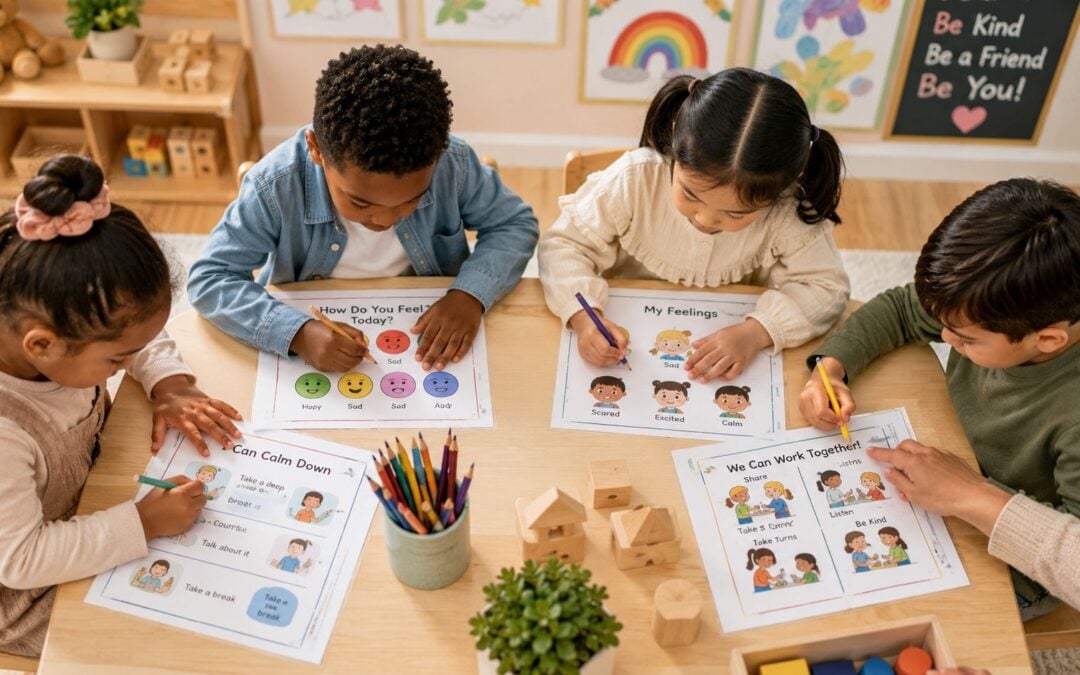
Two children reach for the same red block. One grabs it, the other shouts, and suddenly your calm morning tubs turn into a full-class lesson on waiting, words, and hurt feelings. Across the room, a quieter child circles the dramatic play area but doesn't know how to ask, “Can I play too?” A few minutes later, someone says something unkind and now you're helping both children name feelings they can barely describe.
These moments aren't side issues. They are kindergarten curriculum.
That's why strong social skills worksheets for kindergarten matter. They give children simple language, visual supports, and a repeatable structure for practicing empathy, turn-taking, self-control, and conversation. Used well, a worksheet isn't the lesson by itself. It's the launch point for modeling, role-play, and real interaction. If you're also building out content-area support for families, this parent guide for Iowa social studies is a useful example of how home-school connections can stay practical and simple.
Social-emotional learning programs that use structured activities such as worksheets are associated with average academic gains of 11 percentile points, according to K5 Learning's SEL overview. In kindergarten, that structure matters even more because young children need visual cues and predictable routines before they can apply a skill independently.
1. Cool Tools For Schools Digital

Soul Shoppe's Cool Tools For Schools Digital stands out because it treats worksheets as part of a wider relationship-building system, not as isolated printables. That difference matters in kindergarten. A page about conflict resolution helps more when the whole class already shares words for feelings, calming down, listening, and repair.
Soul Shoppe's approach is especially strong for schools that want consistency across classrooms, counselor support, and family reinforcement. The organization has more than 20 years of research-based, experiential work behind it, and that shows in the way the tools are designed for actual school routines rather than one-off activities.
How It Works Best in Kindergarten
Use this when you want a short, repeatable SEL block that can fit into morning meeting, a transition, or a reset after recess. Instead of handing out a worksheet and hoping the lesson sticks, pair the printable or digital prompt with a concrete classroom action.
For example, if children complete a page about taking turns, don't stop at circling the “right choice.” Hand one child a red ball and coach the exchange physically. For preschool and kindergarten ages, visual prompts and brief sessions work best when adults read the prompt aloud and let children point, color, or draw rather than write, as described in this practical worksheet guidance for preschool social skills.
Practical rule: In kindergarten, the worksheet should name the skill. The adult should stage the moment where the child practices it.
This is also where Soul Shoppe aligns with a community-centered SEL model. If a class uses shared phrases for conflict, calming down, and belonging, the worksheet becomes a reminder of something children already experience in live interactions.
Trade-Offs to Know
- Best for shared language: It works well when a school wants common routines across teachers, counselors, and families.
- Best with facilitation: Adults still need to model, prompt, and revisit the skill during the day.
- Less ideal for grab-and-go only: If you want random free pages with no planning, this is more intentional than that.
- Stronger as part of a system: It pairs naturally with schoolwide workshops, assemblies, and other Soul Shoppe supports.
One practical extra. If you're assembling packets for classroom, counseling, and home use, a simple PDF splitting tool helps break larger files into shorter skill-based sets.
2. K5 Learning

K5 Learning is one of the easiest places to start if you need free social skills worksheets for kindergarten today, not next week. The pages are simple, picture-supported, and easy to send home without a lot of explanation.
That simplicity is the strength and the limitation. You can grab an emotions worksheet or friendship page quickly, but you'll need to build the actual lesson sequence yourself.
Best Classroom Use
Use K5 Learning for one-skill practice. A good example is an “identifying feelings” page during arrival. Set up a small feelings check-in area by the door with emotion cards, a mirror, and name sticks or magnets. Children complete the page or point to a face, then move their name to the feeling that matches how they arrived. That routine mirrors the kind of visual emotion check-in described in this teaching social skills routine guide.
If you want a broader lesson around the page, pair it with a hands-on mini lesson from these social-emotional learning activities for kindergarten.
- Works well for: Morning work, take-home reinforcement, centers, sub plans
- Less strong for: Full-unit pacing, differentiation, neurodivergent adaptations
- Helpful pattern: Print one page, model one sentence stem, then practice in pairs
K5 also fits schools where budget matters. Print-based supplemental SEL materials remain a primary low-cost entry point for over 70% of K-5 classrooms, according to K5 Learning's worksheet overview. That tracks with classroom reality. Teachers need materials they can copy, explain fast, and use again tomorrow.
3. Twinkl (USA)
Twinkl USA is for the teacher who wants options. Lots of them. If you're building a week on friendship, a month on classroom community, or a whole set of turn-taking visuals for centers, Twinkl gives you enough pieces to make the unit feel coherent.
The risk is overload. A huge library can save time or waste it, depending on how clear you are about the skill you're teaching.
Where Twinkl Shines
Twinkl is especially useful when you want matching materials across formats. You might print a sharing worksheet for table work, add a social story for read-aloud, and use a visual prompt card in the block area. That consistency helps children connect the same idea across settings.
A practical kindergarten example is a “joining play” sequence. Start with a picture-based page showing children entering a game. Then model the exact phrase, “Can I play with you?” Finally, send children into choice time with a visual card on a lanyard for the students who still need the sentence starter.
Worksheets help children recognize a skill. Real play shows whether they can use it.
Twinkl is also a good fit for teachers who need U.S. curriculum filters and want materials that look polished without creating everything from scratch.
What Doesn't Work as Well
- Too much browsing: If you don't narrow by one SEL target, you can lose planning time.
- Membership barrier: Full access requires a subscription.
- Needs adult transfer: The worksheet alone won't move the skill into recess or centers.
If your team likes building thematic units with matching visuals, Twinkl is a practical choice. If you want a tighter, prebuilt SEL sequence, another platform may feel easier.
4. Education.com
Education.com is one of the better mixed-format choices because it gives you printable and digital options in the same ecosystem. That's useful when one teacher wants paper at the small group table and another wants a tablet-based center.
Its kindergarten social skills content covers familiar territory such as feelings, kindness, class rules, and taking turns. The design tends to be kid-friendly and accessible, which matters when children need immediate visual clarity.
A Good Fit for Home and School
This platform works well when you want a worksheet to travel between classroom and home. A teacher can introduce “kind words versus hurtful words” in class, then send a companion printable home with a simple note asking families to role-play two examples at dinner.
For conversation skills, don't let children just fill in bubbles or draw lines. Teach the “throwing it back” pattern. If one child asks, “Do you have a pet?” the responding child answers and asks a question back. That reciprocal mechanic is explained clearly in this conversation worksheet guide from Positive Psychology, and it's one of the fastest ways to make a page become an actual social exchange.
Pair those activities with broader teaching moves from this guide on how to teach social skills.
Trade-Offs
- Strong mix: Printable and digital options make it flexible.
- Teacher support: Companion lesson materials help if you don't want to build every prompt yourself.
- Free limits: The free tier restricts downloads.
- Best features cost more: Unlimited access sits behind membership.
If you're teaching in a hybrid environment, sharing with families, or rotating between paper and screen, Education.com is one of the more practical platforms on this list.
5. Scholastic Teachables
Scholastic Teachables feels familiar to many teachers for a reason. The visuals are polished, the materials are classroom-ready, and the literacy connection is usually stronger than in generic worksheet libraries.
That's the big advantage here. Social skills don't have to sit in a separate bin labeled “SEL.” You can fold them into read-aloud response, mini-books, and discussion pages that still feel age-appropriate.
Best Use for Whole Group
Scholastic Teachables works well for a whole-group mini lesson followed by a small-group extension. For example, read a book about sharing, pause at a conflict point, then use a related printable where students identify what each character could say next.
This is especially helpful for children who understand social ideas better through story than through direct explanation. If a child can say, “The bear should ask for a turn,” that's often the bridge to saying, “Can I have a turn when you're done?” during centers.
- Best for: Teachers who like literacy-linked SEL
- Best setting: Whole-group introduction with small-group reteaching
- Less ideal for: People looking for fully free, fully open access
- Watch for: Site navigation takes a little practice
Scholastic is a strong middle-ground option. It doesn't reinvent kindergarten SEL, but it packages it in ways teachers can use without much cleanup.
6. Centervention

Centervention is practical, especially if you want quick one-page supports for counseling groups, morning meeting, or a classroom reset after a rough transition. The free library is broad enough that most teachers can find something usable without a long search.
The worksheets tend to be direct. That makes them easier to plug into a school day, even if they don't create a full kindergarten SEL pathway by themselves.
How I'd Use It in a Busy Week
Centervention is a good “I need something for tomorrow morning” resource. Say your class has had repeated trouble with teamwork at the block center. Pull a one-page cooperation worksheet, use it during morning meeting, and then revisit the same language before center time.
You can keep the transfer concrete by naming the center expectation before children move. “Today in blocks, teamwork means one person builds, one person passes pieces, then you switch.” Kindergarteners need that level of plain, visible structure.
A lot of teachers also appreciate that these pages can pair with game-based extensions if they want to go further later.
What to Keep in Mind
- Fast implementation: Good for one-day or one-week skill reinforcement
- Counselor-friendly: Easy for short push-in or pull-out sessions
- Not a full sequence: You'll still need your own pacing map
- Extensions may point to paid content: The free library sometimes acts as a doorway into the larger platform
If your current need is simple, clear social skills worksheets for kindergarten that you can use immediately, Centervention earns its spot.
7. Everyday Speech

Everyday Speech is one of the stronger choices when you know a worksheet alone won't be enough. Its value comes from the combination of modeling, games, and printable supports. That combination matters because many kindergarten social skills resources still lean too heavily on static individual tasks and don't explain how to move a skill into real play, a gap noted in this Everyday Speech discussion of kindergarten interactive learning.
That's where this platform is different. It's built for teaching, not just printing.
Best for Skill Transfer
If a child can identify “sharing” on paper but still melts down during dramatic play, use Everyday Speech to bridge the knowing-doing gap. Start with a targeted worksheet or visual. Then show a model, practice the script, and move into a short role-play.
A concrete example: children complete a page about asking to join a game. Then two students and an adult act out a pretend kitchen scene. One child practices, “Can I cook with you?” The others practice either welcoming or offering a role.
Don't let the page be the finish line. Use it as rehearsal before the social moment children actually struggle with.
Trade-Offs
- Strong modeling: Helpful for SLPs, counselors, and teachers who want examples children can imitate
- Low-prep lessons: Easier than building every role-play from scratch
- Subscription required for full access: The best breadth sits behind paid access
- May be more than one classroom needs: The library is wide, so some teams will only use part of it
For students who need explicit practice beyond coloring and circling, Everyday Speech is one of the more complete choices.
8. Emotional ABCs (Classroom)

Emotional ABCs Classroom is a good option for teachers who want a sequence, not just a stack of printables. The program organizes feelings recognition, self-regulation, and relationship skills in a way that feels accessible for early childhood classrooms.
Its print library is easy to use, which matters more than it sounds. If you only have a few minutes before class, you need to find the right support fast.
Strong for Routine Building
This platform works well with repeated kindergarten structures. One example is an “all about me” and “all about my feelings” sequence at the start of the year. Students complete a simple identity page, then connect that to a class feelings routine and a regulation tool they can use during the day. This All About Me kindergarten activity guide pairs naturally with that kind of launch.
For younger children, brevity still matters. Effective kindergarten worksheet design often fits a short attention window and benefits from interactive matching or coloring components. In one benchmarking summary, curriculum developers reported stronger engagement when pages included interactive coloring or matching rather than text-only formats, as noted in this Vedantu worksheet overview.
Limits to Expect
- Best with routines: The printables make more sense when the class already uses the program language
- Good for early childhood: The visuals and sequence are approachable
- Premium tiers hold the deeper library: Free sampling won't show the full system
- Less useful as random standalone pages: It's more coherent when used as intended
If you want social skills worksheets for kindergarten that connect to a clear emotional vocabulary and predictable classroom routines, Emotional ABCs is worth a close look.
9. Second Step (Committee for Children)
Second Step is a district-friendly choice. Many school leaders recognize the name, and that matters when you're trying to get buy-in across classrooms, specialists, and administration.
The materials are structured and sequenced, which helps teams that don't want every teacher inventing SEL from scratch. For kindergarten, that usually means explicit lessons on empathy, listening, sharing, and problem-solving with printable pages that reinforce the script.
Best for Consistency Across a School
Second Step fits schools that want common routines and common language. If every kindergarten teacher introduces the same feeling words, the same calm-down process, and the same conflict steps, children experience less confusion moving between classrooms and support staff.
A practical example is using a feelings visual from a classroom pack during arrival, then revisiting it after recess. If a child points to “frustrated,” the teacher can prompt a coping tool and connect it to a class feelings chart. This feelings chart for kids works as a complementary visual for that kind of routine.
Second Step also aligns with recognized SEL competencies, which helps if your district wants a framework that can be discussed clearly with families and leadership.
Possible Friction Points
- Easy to justify in a district setting: The structure supports adoption
- Free samples help: You can test activity packs before a full commitment
- Scripts can feel rigid: Some teachers will adapt the wording
- Requires implementation planning: A sequence is only useful if staff uses it consistently
This is a strong choice for schools that value system-wide alignment over teacher-by-teacher improvisation.
10. Random Acts of Kindness (Kindness in the Classroom)
Random Acts of Kindness offers something many schools need more of. Free resources that are usable, values-centered, and broad enough to support kindness, empathy, inclusion, and respect without feeling shallow.
The design is less flashy than some commercial kindergarten products, but don't mistake that for weakness. The content is often clear, practical, and easy to adapt for classroom community lessons.
Where It Helps Most
This is a strong pick for morning meeting and class culture work. A kindergarten teacher can use a kindness reflection page on Monday, model one class kindness goal, and revisit it during Friday circle with examples from the week.
It also supports bilingual access through English and Spanish downloads, which can make home reinforcement easier. That's useful when you want caregivers to use the same simple kindness language children hear at school.
One important caveat is inclusion. Many social skills worksheets still assume a neurotypical baseline and don't build in enough support for children with developmental differences. Helpful Professor notes that current worksheet content often fails to address the needs of the 15 to 20% of kindergarteners with developmental differences, and that gap matters when you're choosing or adapting materials for belonging and psychological safety in the classroom, as discussed in this social skills worksheet review.
How to Adapt It Better
- Use literal language: Replace abstract prompts with direct choices and visual examples.
- Add movement: If the page is about asking for help, act out walking to the teacher and raising a hand.
- Trim the task: One page is often enough for this age.
- Avoid isolation: Use the worksheet before partner practice or cooperative play, not instead of it.
For schools that want kindness-centered social skills worksheets for kindergarten without a major budget lift, this is one of the strongest free options.
Top 10 Kindergarten Social Skills Worksheets Comparison
| Product | Key features | Best for | Strengths / Unique selling points | Price / Access |
|---|---|---|---|---|
| Cool Tools For Schools (Digital) | Classroom-ready digital SEL toolkit; short repeatable practices; integrates with app/workshops | Schools, teachers, counselors seeking schoolwide routines | Research-based (20+ yrs), scalable, cohesive with Soul Shoppe offerings | Paid license; needs adult facilitation; not a full substitute for in-person coaching |
| K5 Learning | Free printable one-page SEL worksheets with picture support | Teachers needing quick downloads, take-home practice | Truly free, kindergarten-friendly layouts, no account required | Mostly free PDFs |
| Twinkl (USA) | Grade-banded SEL library: worksheets, mini-books, visuals; curriculum filters | Teachers assembling units and seasonal packs | Very broad selection, consistent design, U.S. alignment filters | Membership required for full access (paid) |
| Education.com | Printable + interactive SEL worksheets, lesson plans, custom creator | Centers, blended digital/classroom activities | Mix of printable & interactive content, many teacher tips | Freemium; limited free downloads, premium for unlimited |
| Scholastic Teachables | Publisher-quality packs, mini-lessons, lesson organization | Whole-group or small-group teachers integrating literacy & SEL | Trusted publisher, high-quality visuals and structure | Subscription needed for full access |
| Centervention | Open library of 90+ K–2 one-page SEL printables; pairs with games | Counselors, morning meetings, quick classroom routines | Free, practical, low-prep worksheets | Free library; some paid program extensions |
| Everyday Speech | Structured lessons, video modeling, games, downloadable toolkits | SLPs, counselors, small-group social-skill instruction | Evidence-informed, strong modeling and low-prep materials | Paid subscription / license for full access |
| Emotional ABCs (Classroom) | Sequential workshop sequence, extensive print library, teacher guides | Early childhood / primary classrooms building routines | Purpose-built for K, easy-to-navigate print resources | Premium tiers unlock deeper content |
| Second Step (Committee for Children) | Research-grounded, developmentally sequenced lessons, printable packs | Districts and schools adopting a comprehensive SEL curriculum | Widely adopted, CASEL-aligned, free SEL Day samples | Full curriculum purchase required; some free samples |
| Random Acts of Kindness (Kindness in the Classroom) | Standards-aligned K–5 curriculum, K units, English/Spanish resources | Classrooms seeking free kindness/empathy units | Entire curriculum largely free, clear pacing and reflection pages | Free downloadable curriculum; teacher organization required |
Cultivating a Classroom Community, One Skill at a Time
Building strong social skills in kindergarten takes repetition, modeling, patience, and a lot of small course corrections. No worksheet can do that job by itself. What a good worksheet can do is give children a visual anchor, a few clear words, and a predictable starting point when feelings are big and social situations move fast.
That's why the best resources on this list don't just offer cute pages. They help adults turn a page into a routine, a role-play, a partner exchange, or a calmer way to solve a conflict. In practice, that might look like an emotions page paired with a morning check-in board, a turn-taking sheet followed by passing a red ball, or a conversation prompt turned into a “throw it back” game with a classmate.
Kindergarten teachers know what works and what doesn't. What works is short, visual, concrete instruction. What works is practicing one skill at a time. What works is revisiting the same language in block center, on the rug, at lunch, and during dismissal. What doesn't work is expecting a child to color a picture about kindness at 9:00 and independently resolve a friendship conflict at 10:15 without adult coaching.
That matters even more for children who need extra support. For neurodivergent learners, the strongest social skills worksheets for kindergarten use literal language, clear visuals, and direct modeling. They also connect immediately to action. If a child sorts “telling a teacher” versus “yelling” on paper, the next step should be acting that moment out with an adult, rather than moving on. Practical implementation guidance for neurodivergent learners emphasizes pairing printables with physical objects or movement rather than using the worksheet in isolation, as described in this adaptation guide for kids' social skills worksheets.
Schools also need to think beyond individual classrooms. A strong SEL culture grows faster when students hear the same vocabulary from teachers, counselors, specialists, and families. That's where a more connected approach becomes valuable. Some teachers will do well with free one-page resources from K5 Learning, Centervention, or Random Acts of Kindness. Others will want a more structured pathway from platforms like Second Step, Everyday Speech, or Emotional ABCs.
For schools ready to build a deeper culture of connection, belonging, and psychological safety, Soul Shoppe's programs such as Cool Tools For Schools can help embed these skills into daily life across classrooms and campuses. The goal isn't more paper. The goal is a classroom where children know how to join a game, repair hurt feelings, wait for a turn, and ask for help with confidence. That kind of classroom feels kinder because it is more teachable, more connected, and more human.
If your school is ready to move from isolated SEL activities to a shared culture of empathy, connection, and practical conflict resolution, explore Soul Shoppe. Their workshops, digital tools, and schoolwide supports help students and adults build the common language and everyday routines that make social skills stick.