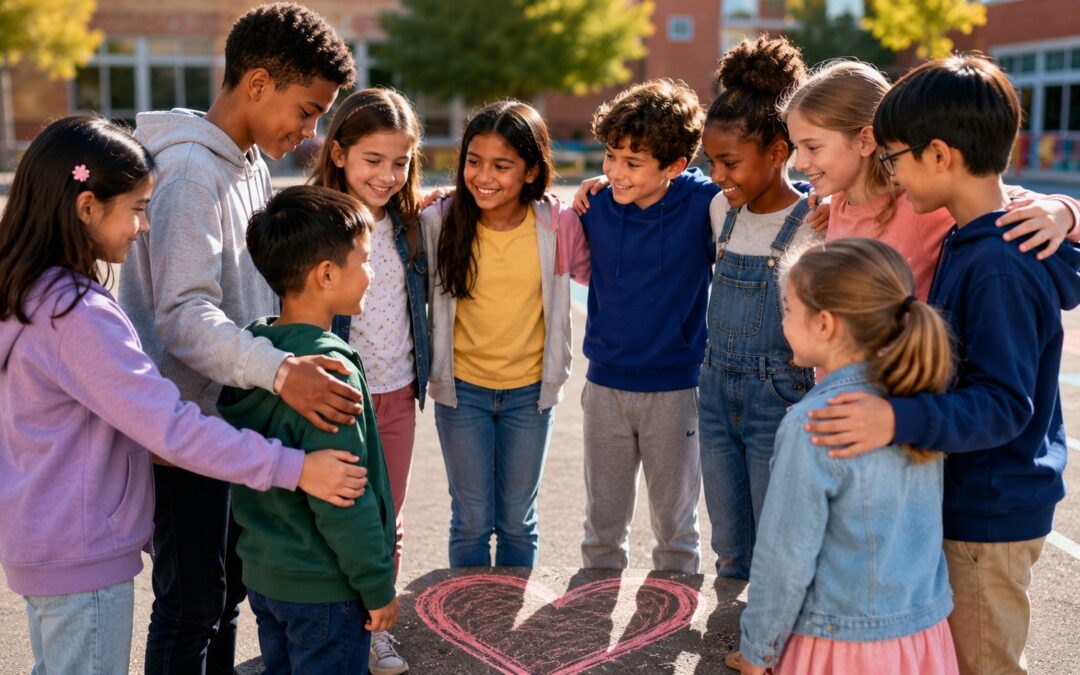
A recess soccer game falls apart in under two minutes. One student insists the ball crossed the line. Another says it didn't. A third storms off because nobody listened. By the time the teacher gets there, the argument isn't about the goal anymore. It's about loyalty, fairness, embarrassment, and who gets blamed in front of peers.
That scene is ordinary in K to 8 schools. So is the hallway misunderstanding, the lunch table exclusion, the new student who doesn't know where to sit, and the child who says “I'm fine” while clearly not being fine. Adults can't catch every moment at the exact second it starts. Students are often the first people to notice when something is going sideways.
That's where peer support programs matter. When schools teach students how to listen, include, de-escalate, and bring in adults at the right moment, everyday friction stops turning into culture-wide distrust. Students learn that helping a classmate isn't a popularity move. It's part of how the community works.
In strong schools, this doesn't happen by accident. It happens because adults build structures that make empathy visible, safe, and consistent.
From Conflict to Connection An Introduction
A second grader is crying near the blacktop. Two classmates hover nearby, unsure whether to help or back away. In many schools, that moment ends with an adult stepping in after the child has already felt alone for several minutes. In a school with a thoughtful peer support structure, one student sits beside the child, another goes to get a recess supervisor, and the interaction stays calm because everyone knows their role.
That's the shift. Peer support programs turn scattered acts of kindness into a practiced school skill.
In K to 8 settings, the need is constant. Younger students are learning how to share space, words, and feelings. Older elementary students start managing friendship groups and exclusion. Middle school students are sorting through identity, status, and social pressure. The conflicts change shape by grade level, but the underlying need stays the same. Students need tools for connection.
Students usually reach one another before adults do. A good program teaches them what to do with that access.
The schools that do this well don't treat peer support as a vague kindness campaign. They build a routine. Students learn how to notice distress, invite someone in, solve small problems, and involve adults when a situation is too big for peers to handle.
A practical example helps. A fourth-grade teacher might assign rotating welcome partners for new students, then teach those partners three simple tasks: greet the student at arrival, sit with them at lunch, and walk them through recess expectations. A parent can mirror the same idea at home by helping their child practice simple phrases like, “Do you want to play with us?” or “Want me to come with you to ask the teacher?”
When children rehearse support, they use it.
Schools also need honesty about what can go wrong. Programs fail when they're launched with enthusiasm and no supervision, when only the most polished students are chosen, or when students are expected to handle emotional situations beyond their training. The strongest programs are warm, visible, and adult-backed.
What Are Peer Support Programs in Schools
At school, peer support isn't therapy. It isn't informal counseling with no guardrails. It isn't asking children to carry adult-sized emotional weight.
It's a structured system where students are trained to support other students in age-appropriate ways. That support might look like welcoming a new classmate, helping mediate a minor conflict, noticing when someone seems isolated, or guiding a peer toward a trusted adult.
The simplest way to think about it
Think of peer supporters as social-emotional first responders. They don't diagnose. They don't keep risky secrets. They don't solve every problem. They help slow things down, make connection possible, and bring in adult support when needed.
That works because peer relationships carry real influence in school. Students often test ideas, emotions, and belonging with one another before they ever speak to an adult. If a school wants a healthier climate, it helps to teach students how to use that influence responsibly.
A widely used definition captures the heart of it. Peer support is voluntary, mutual, and reciprocal support with equally shared power, focusing on strengths, transparency, and person-driven action, where peer supporters are open-minded, empathetic, honest, and direct, facilitating change through shared experience and trusted communication in the Peer Support Program Toolkit.
What peer support is and what it is not
A lot of implementation problems begin with fuzzy boundaries. Clear programs teach those boundaries from day one.
- It is relationship-based: Students use listening, inclusion, and guided problem-solving.
- It is supervised: Adults train students, monitor patterns, and step in when needed.
- It is skill-driven: Students learn scripts, protocols, and referral rules.
- It is not therapy: Peer supporters should never be positioned as mental health providers.
- It is not secret-keeping: If safety is involved, students must tell an adult.
- It is not a status club: The work belongs to a diverse group of students, not only the most outspoken leaders.
For a third-grade class, this may look like “kindness partners” who practice noticing who is left out. For a middle school campus, it may involve trained student mediators who help classmates talk through lunchroom or group-project disputes.
Practical rule: If a student peer supporter hears something involving self-harm, abuse, threats, or ongoing bullying, their next move is adult referral, not independent problem-solving.
Peer-to-peer approaches also help schools build mental health literacy. Programs can teach students how to recognize signs of distress in friends, reduce stigma, and connect classmates to support services through shared experiences and school-based guidance, as described in this overview of social-emotional learning programs for schools.
For parents, the home version is simple and useful. Practice one script a week. “You look upset. Want to talk or want me to sit with you?” gives children a concrete way to offer support without taking over.
The Evidence-Based Benefits for Your School Community
The benefits of peer support show up differently depending on who you're looking at. The student receiving help often feels immediate relief. The student offering support builds maturity and leadership. The school gains a more stable and connected climate.
A helpful visual can make that easier to see.
For students receiving support
The first win is often belonging. Students who feel confused, excluded, or overwhelmed usually respond well when another student meets them with calm attention. That doesn't replace adult care. It lowers the barrier to receiving it.
Research also points to meaningful shorter-term outcomes in education settings. Peer mentoring programs in education have been proven to improve shorter-term well-being outcomes, specifically increasing academic retention because peer mentors provide emotional support, connect students to resources, and address concerns about belonging, according to this ASPE review on promoting employment and well-being.
In practice, a fifth grader who checks in with a fourth grader during morning arrival may help that student get settled faster, ask for help sooner, and avoid the slow withdrawal that often shows up before attendance or engagement problems.
Peer support groups also help students build stronger informal networks and better relationships. That matters in schools because many children don't need a dramatic intervention. They need more chances to feel understood and connected. A weekly lunch group for students dealing with friendship stress or anxiety can give them a place to practice naming feelings, hearing similar experiences, and trying coping routines.
For peer leaders
Students who serve as supporters grow too. They learn how to listen without dominating, how to hold boundaries, and how to recognize the difference between helping and rescuing.
A concrete school example is a sixth grader trained to welcome incoming students from another campus. That student learns to greet, explain routines, notice signs of discomfort, and check in with an advisor. A parent might see the same growth at home when that child starts using more patient language with younger siblings.
Later, when teachers want to strengthen regulation and empathy skills in the classroom, simple tools can support that work. Classroom calming bins, role-play cards, or tactile resources can help younger students practice turn-taking and emotional language. If teachers or families want examples, this roundup of social emotional toys for kids offers age-appropriate ideas that fit many elementary settings.
For the school community
A school-level benefit is cultural consistency. Students start hearing and using the same language around conflict, inclusion, and repair. Adults spend less time reacting to preventable social breakdowns and more time coaching.
Here's a useful companion resource for schools working on that larger culture shift. Conflict resolution for schools becomes much easier when students already know how to listen, restate, and seek fair next steps.
This short video is also a practical discussion starter for staff teams considering a student support model.
Outside schools, peer support has also shown strong results in behavioral health systems. A meta-analysis found statistically significant improvement in self-efficacy for individuals with severe mental illness, with one intervention group showing a 2.9-point increase from baseline to 6-month follow-up compared with a 1.6-point improvement in the control group in this peer support meta-analysis. K to 8 schools shouldn't copy clinical models directly, but the broader lesson is useful: when people receive support from peers in a structured setting, confidence and self-management can improve.
Choosing the Right Peer Support Model for Your School
The right model depends on your students, your staffing, and your biggest pain points. A school dealing with frequent playground conflicts needs a different setup than a school focused on helping new students settle in. Start with the problem you're trying to solve, not the program name.
Four common models in K to 8 schools
Peer mentoring works well when students need guidance, confidence, or a sense of belonging over time. Older or more experienced students support younger students through regular check-ins.
Example: A fifth grader meets weekly with a second grader during reading time. They read together, talk about recess, and practice how to join group activities. This model is strong for transition years and for students who need a steady relationship.
Peer mediation fits schools where low-level conflict keeps interrupting the day. Students are trained as neutral helpers who guide peers through a simple resolution process.
Example: Two seventh graders disagree over a group project and stop cooperating. A trained eighth-grade mediator helps each student explain what happened, identify what they need, and agree on a next step. If your campus wants a deeper look at this structure, this article on what is peer mediation gives a school-centered overview.
Peer counseling is more delicate. In K to 8 schools, this should usually mean supervised listening and support, not anything resembling independent counseling. Students can learn to offer empathy, ask good questions, and connect peers with adults.
Example: A middle school student volunteer staffs a supervised lunch table where classmates can talk about friendship stress or worries about school. The student listener knows the script, the limits of confidentiality, and exactly when to involve an adult.
Buddy systems are the simplest entry point. They pair students so nobody has to find their way in a new environment alone.
Example: A new third grader gets a buddy for the first two weeks. The buddy walks them to specials, sits with them at lunch, and introduces them to game options at recess.
Comparison of Peer Support Models
| Model | Primary Goal | Example Activity | Best For |
|---|---|---|---|
| Peer Mentoring | Build belonging and guidance over time | Older student checks in weekly with younger student | Grade transitions, confidence, school connection |
| Peer Mediation | Resolve low-level disputes | Student mediator helps peers talk through a conflict | Recess issues, classroom disagreements, lunch conflicts |
| Peer Counseling | Provide supervised emotional support | Listening station during advisory or lunch | Older students who need a safe place to talk |
| Buddy System | Help students acclimate quickly | New student partner for arrival, lunch, and recess | New enrollments, shy students, classroom transitions |
How to choose without overcomplicating it
A principal can usually narrow the choice by asking three questions:
- Where are problems showing up most often: Recess, transitions, arrival, lunch, or classrooms?
- What age group needs the most support: Primary grades, upper elementary, or middle school?
- How much adult supervision can you provide: Daily, weekly, or only during specific blocks?
If a school has limited staffing, start with a buddy system or mentoring model. If staff can supervise consistent protocols, mediation can be highly useful. If students are carrying a lot of emotional stress, build a referral-rich mentoring model before attempting anything that looks like counseling.
Pick the smallest model that solves a real problem well. Expansion is easier than repair.
A Roadmap to Implement Your Peer Support Program
Most peer support programs don't fail because the idea is weak. They fail because the rollout is loose. Schools pick students before defining roles, announce the program before training adults, or assume student goodwill can substitute for supervision.
A workable rollout needs phases.
Phase 1 Planning and design
Start with a small design team. Include an administrator, counselor or mental health lead, at least one classroom teacher, and a parent or caregiver voice if possible. In a K to 8 school, include representatives from both lower and upper grades because needs differ.
Then identify the actual student need. Don't guess. Look at discipline patterns, counselor referrals, attendance concerns, transition stress, recess conflict, and teacher observations. A school might learn that the biggest issue isn't bullying language in general. It's repeated fallout during unstructured times.
A practical example: If lunch recess is where most social breakdowns happen, design for that environment first. You might build a recess buddy and mediation hybrid rather than a broad campuswide initiative.
Use this phase to write simple boundaries:
- What students can help with: Inclusion, listening, minor conflict, orientation, guided check-ins.
- What always goes to adults: Safety concerns, harassment, threats, self-harm disclosures, abuse, repeated targeting.
- Where support happens: Playground bench, buddy table, advisory room, welcome walk, lunch circle.
- Who supervises: Named adults, not “staff in general.”
Phase 2 Recruitment and training
Don't recruit only the students who already shine in public. Some of the most effective peer supporters are calm, observant, and steady rather than charismatic. Look for empathy, reliability, follow-through, and diversity across grade, identity, language, and social groups.
Training should be explicit and repetitive. Younger students need simple scripts and modeling. Older students can handle role-play, reflection, and scenario analysis.
A useful training sequence includes:
- Listening basics: Face the speaker, stay calm, don't interrupt, reflect back what you heard.
- Boundary language: “I want to help, and I need to get an adult for this part.”
- Problem-solving steps: What happened, how do you feel, what do you need, what's one next step?
- Inclusion moves: Invite, notice, accompany, introduce.
- Referral practice: Students rehearse how to bring in a teacher, counselor, or recess supervisor.
For a fourth-grade cohort, role-play a lunch exclusion. For middle schoolers, practice a rumor scenario where the correct move is referral, not mediation.
If your program involves volunteers beyond school staff, protect the process early. Schools often need a clear intake and vetting system for family or community helpers. A practical resource on a criminal background check for volunteers can help teams think through that part of implementation.
Phase 3 Launch and supervision
Launch on a small scale before you launch loudly. Test the routines with one grade level, one recess block, or one student group. Fix the weak spots before rolling the program out schoolwide.
The most important protection here is adult oversight. The critical supervision gap in peer support programs is a primary barrier to efficacy; research indicates that without strong clinical oversight and structured supervision, peer mentors risk burnout and programs fail to deliver meaningful mental health improvements, as noted in this report on peer counseling access gaps for youth.
That finding matches what schools experience. Students need regular debriefs. They need adults to review patterns, catch overload early, and reinforce boundaries. A fifth grader who helps peers every day without check-ins can start carrying worries they don't know how to process.
Adult supervision isn't a side task. It's the structure that keeps the program safe.
Set a check-in schedule before launch. Weekly is a good starting point for active student supporters. The meeting can be brief. Review what came up, what felt hard, where an adult stepped in, and whether any student needs a break from the role.
This is also the right place to connect peer support to the broader leadership life of the school. Student service, welcoming roles, conflict helpers, and recess leaders shouldn't operate in separate silos if they're all teaching the same habits. Schools looking for simple structures can pull ideas from student leadership activities.
Phase 4 Evaluation and refinement
Evaluation doesn't need to be complicated to be useful. The point is to learn whether the system is being used, whether it feels safe, and whether adults see a difference in the target area.
Use a mix of quick tools:
- Student feedback forms: Did they feel heard, welcomed, or supported?
- Teacher observations: Are certain conflicts resolving faster?
- Supervisor notes: What types of issues are peers handling well, and what keeps getting referred?
- Family input: Has a child talked about feeling more connected or more comfortable at school?
A home example matters here too. Parents can ask concrete questions after launch: “Who do kids go to if they're upset at recess?” or “What are you supposed to do if a friend tells you something big?” If children can answer clearly, training is landing.
If the system feels fuzzy after the first month, simplify. Reduce the role, narrow the setting, retrain the students, and tighten adult check-ins. A smaller program with real boundaries beats a larger one that drifts.
Troubleshooting and Sustaining Your Program
The schools that keep peer support programs alive treat them as part of culture, not a short campaign. Problems will show up. That doesn't mean the model is wrong. It usually means the structure needs attention.
When student leaders start to tire
Burnout is predictable when students absorb emotion without enough adult support. Watch for students who start avoiding meetings, acting overly responsible, or trying to solve issues that aren't theirs.
Use a simple response plan:
- Require check-ins: Every peer supporter should meet with a supervising adult on a regular schedule.
- Rotate responsibilities: Don't keep the same students on high-intensity roles all year.
- Normalize pause requests: A student should be able to step back without shame.
- Build decompression in: End meetings with reflection, breathing, or a short reset activity.
When students don't use the program
Low use often means low visibility, not low need. Students need to know who peer supporters are, where to find them, and what kinds of help they can ask for.
Try practical visibility moves:
- Classroom introductions: Peer supporters visit homerooms and explain their role in plain language.
- Predictable locations: A buddy bench, welcome table, or mediation corner makes access concrete.
- Teacher prompts: Teachers can remind students, “This is the kind of problem a peer mediator can help with.”
- Family communication: Send home a simple one-page overview so caregivers can reinforce the language.
A sustainable program also needs shared tools across the campus. One example is Soul Shoppe, which offers school-based workshops, assemblies, and coaching focused on conflict resolution, self-regulation, communication, and peer connection. In practice, that kind of support can help schools keep common language in place as student cohorts change.
The long-term goal isn't just to maintain a student team. It's to create a school where students routinely notice one another, use respectful language during conflict, and trust adults enough to loop them in when something is too big to hold alone.
Schools that want stronger peer support systems often need more than a launch plan. They need shared language, student practice, and adult guidance that lasts. Soul Shoppe provides SEL workshops, assemblies, and coaching that help school communities teach conflict resolution, empathy, self-regulation, and peer connection in practical ways for K to 8 settings.