

How to Reduce Bullying: Practical Steps for Schools and Parents
Let’s be honest: the old ways of dealing with bullying just don’t work. For years, schools have relied on “No Bullying Zone” posters and rigid zero-tolerance policies. The intent was good, but the results? Not so much.
These traditional methods fall short because they’re reactive. They focus on punishment after the fact, missing the bigger picture entirely. They treat the symptom, not the cause.
Bullying isn’t just a discipline problem; it’s a relationship problem. It happens when a student doesn’t have the emotional tools to handle feelings like frustration, insecurity, or anger. It thrives in a school culture where empathy and kindness aren’t actively taught and modeled.
The Real Cost of Outdated Methods
The fallout from these failed tactics is staggering. At one point, old-school anti-bullying campaigns were so ineffective that 160,000 students were staying home from school every single day just to avoid being harassed. For the kids who did show up, the constant stress and anxiety caused their GPAs to tank by an average of 10-15%.
The data is clear: simply punishing kids who bully does little to support the students being targeted or to actually change the school’s climate for the better. You can see more on why these tactics failed over at Defeat The Label’s website.
This is exactly why we need a new playbook. The problem isn’t a lack of rules; it’s the need for a deep, cultural shift—one that puts emotional intelligence and community connection front and center.
Moving from Punishment to Prevention
The solution is to move away from a punitive mindset and embrace a proactive, educational one. Instead of just telling kids “don’t bully,” we need to actively teach them how to be kind, empathetic, and resilient.
This is the heart of Social-Emotional Learning (SEL).
SEL isn’t just another box to check on a teacher’s to-do list. It’s the framework for building a positive, supportive school culture from the ground up. It focuses on teaching five core skills:
- Self-Awareness: Knowing your own emotions and thoughts. Example: A student recognizing, “I’m feeling angry because I did poorly on that quiz.”
- Self-Management: Learning to regulate those emotions and behaviors. Example: Instead of lashing out, the angry student takes three deep breaths to calm down.
- Social Awareness: Understanding others’ perspectives and showing empathy. Example: Noticing a classmate sitting alone at lunch and thinking, “They might be feeling lonely.”
- Relationship Skills: Building and keeping healthy, positive connections. Example: Listening to a friend’s opinion during a group project, even if it’s different from their own.
- Responsible Decision-Making: Making thoughtful choices about your actions. Example: Choosing to tell a teacher about a mean comment online instead of retaliating.
When we weave these skills into the school day, we’re giving students the tools to handle social challenges constructively. This proactive approach is a key part of what makes restorative practices in education so effective, as it focuses on repairing harm and strengthening the entire community.
“When we teach children how to handle their emotions, we give them the power to handle conflict. We aren’t just stopping a negative behavior; we are building a positive skill that lasts a lifetime.”
The table below breaks down this fundamental shift in thinking.
Shifting from Reactive Punishment to Proactive Prevention
| Attribute | Traditional Approach (Reactive) | SEL Approach (Proactive) |
|---|---|---|
| Core Philosophy | Zero tolerance, punishment-focused | Skill-building, community-focused |
| Timing | Responds after an incident occurs | Builds skills before conflict arises |
| Focus On | The negative behavior (the “what”) | The underlying causes (the “why”) |
| Key Tools | Suspensions, detentions, posters | Classroom routines, SEL curriculum, peer support |
| Student Role | Passive rule-follower or rule-breaker | Active participant in building a positive culture |
| Outcome | Fear of punishment, resentment, unresolved issues | Empathy, resilience, stronger relationships |
This isn’t about ignoring harmful behavior. It’s about getting smarter and more effective in how we address it.
Ultimately, figuring out how to reduce bullying isn’t about finding the perfect punishment. It’s about creating an environment where bullying struggles to take root in the first place. This guide will walk you through the practical, actionable steps to make that vision a reality in your school.
Building a Foundation of Psychological Safety
To really get a handle on bullying, schools need to shift from just reacting with punishments to proactively building a culture where every kid feels seen, valued, and secure. This foundation is called psychological safety—an environment where students feel safe enough to be themselves, ask for help, and even make mistakes without being shamed. It’s the absolute bedrock of a thriving, bully-proof community.
This kind of cultural shift doesn’t happen on its own. It has to be intentionally designed and consistently modeled by leadership, starting right at the top. When administrators champion psychological safety, everyone from teachers to bus drivers gets the clear message: our kids’ well-being is the top priority.
From Mission Statement to Morning Announcements
Weaving psychological safety into the school starts by making it part of the very fabric of the day. This is about more than a generic mission statement; it’s about defining clear, positive behaviors that everyone understands and lives by.
Instead of a long list of “don’ts,” zero in on a few core values like “Be Kind,” “Be Respectful,” or “Be an Ally.” These aren’t just rules; they’re active principles for how to be a community.
- Weave it into your official language: Look at your school’s mission statement or student handbook. Can you revise it to explicitly mention values like empathy, belonging, and respect? Practical Example: Instead of “We prohibit bullying,” try “We are a community dedicated to building empathy and ensuring every student feels they belong.”
- Talk about it constantly: Use morning announcements to put a spotlight on a specific value each week. Practical Example: A principal could say, “This week, let’s focus on being an ally. That might look like inviting someone new to join your game at recess or speaking up when you see something that isn’t right.”
- Make it visible: Reinforce these ideas with visual cues that go beyond generic posters. Practical Example: Display student-created art that illustrates kindness, or post quotes from students about what makes them feel safe at school.
Leadership Sets the Tone
For any of this to stick, school leaders have to be visibly and vocally on board. Staff and students need to see that creating a safe environment is more than just a passing initiative—it’s how the school operates, period.
A really powerful way administrators can model this is by starting staff meetings differently. Instead of jumping right into the agenda, begin with a quick connection activity. Practical Example: A principal could ask everyone to share one small win from their week or one thing they appreciate about a colleague. This simple act builds trust and psychological safety among the adults, who then carry that mindset into their classrooms.
A school’s culture is a direct reflection of its leadership’s priorities. When administrators consistently model and reward empathy, connection, and vulnerability, they give everyone else permission to do the same. This creates a powerful ripple effect that can transform the entire school climate.
This infographic really nails the shift in thinking required to make a real dent in bullying.
As you can see, just putting up posters doesn’t work. It’s the strategic shift in approach that ultimately leads to a positive, successful student community.
Extending Safety Beyond the Classroom
Psychological safety shouldn’t stop at the classroom door. Every adult who interacts with students is part of this ecosystem of support. That includes cafeteria staff, custodians, and bus drivers, who often see social dynamics that teachers miss.
Administrators can lead by offering simple training for all staff on how to spot and respond to exclusionary behavior. Practical Example: A bus driver can be coached to praise students who make room for others (“Great job making space for Maria, James!”) or to gently step in if they overhear unkind language (“Hey folks, on this bus we use respectful words.”). When a student sees that every adult is reinforcing the same values, the message becomes deeply ingrained.
You can discover more strategies and learn how to create a safe space for students in our detailed guide.
By making psychological safety a school-wide commitment—led from the top and embraced by all—you create an environment where kindness is the norm and bullying struggles to find a foothold.
Weaving SEL into Your Daily Classroom Routines
A positive school culture isn’t built overnight. It’s built moment by moment, in the small, consistent interactions happening inside your classroom every single day. This is where Social-Emotional Learning (SEL) stops being a buzzword and starts being a lived reality for your students.
The good news? Weaving SEL into your day isn’t about adding a complicated new curriculum to an already packed schedule. It’s about making small, intentional shifts in your existing routines. These simple practices build the core skills—like self-awareness and empathy—that stop bullying before it even has a chance to start.
When these skills become as natural as turning in homework, you’ll see a real shift in your classroom climate. The goal is to make emotional intelligence just part of the air your students breathe.
Start the Day with an Emotional Check-in
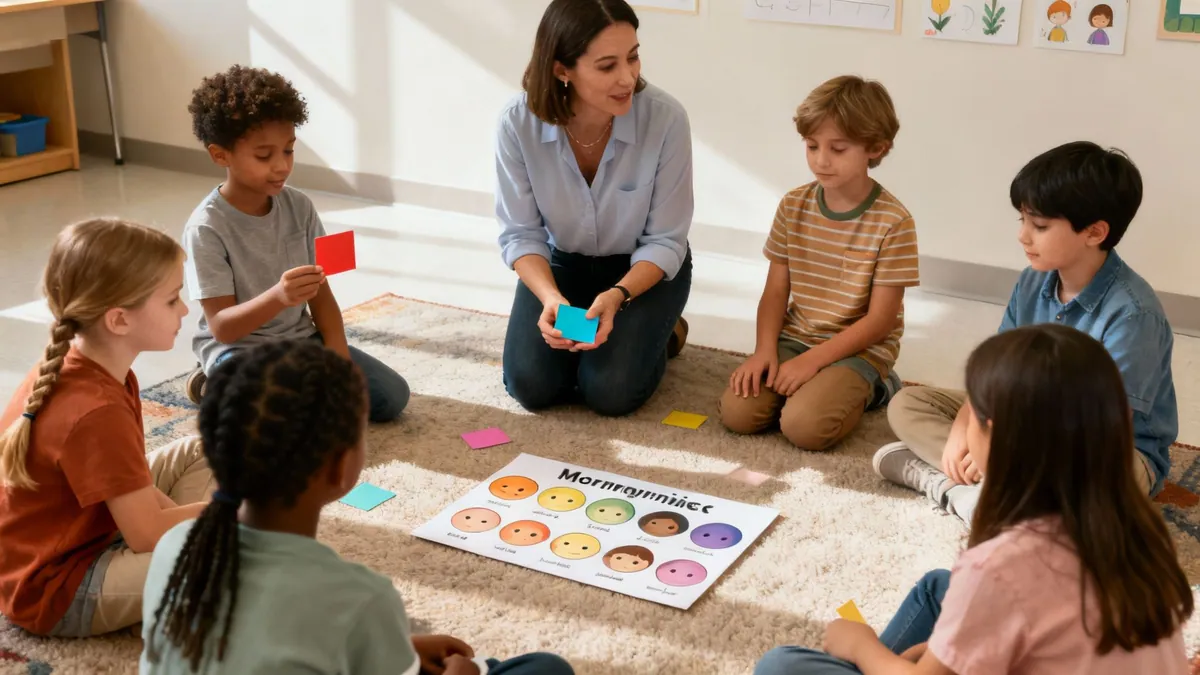
One of the most powerful things you can do is start each day with a ‘feelings check-in.’ It’s a simple routine that normalizes talking about emotions and gives you an instant read on your students’ headspaces. This doesn’t need to be complex or take up a ton of time.
For younger students, a “feelings forecast” board is a great tool where students place their name magnet under a sun (happy), a sun-and-cloud (okay), a cloud (sad/worried), or a thundercloud (angry).
Here’s a practical example for older students:
Use a digital tool like a Google Form or a quick journal prompt: “On a scale of 1-5, how are you feeling today? In one sentence, what’s on your mind?” This gives them privacy while still giving you valuable insight.
During your morning meeting, you can acknowledge the overall mood:
“Good morning, everyone. Looking at our check-in, I see a mix of feelings today. That’s totally normal. Remember, if you’re having a tough morning, it’s okay to take a quiet moment in our calm-down corner if you need it. I’m here to support you.”
This tiny act does so much. It validates every child’s feelings, teaches emotional vocabulary, and opens a door for kids to ask for help. It sends a quiet but powerful message: “How you feel matters here.”
Foster Deeper Connections with Weekly Circles
Daily check-ins are great for building individual awareness, but weekly connection circles are where you build the muscle of social awareness and empathy. These are structured, safe conversations where students practice active listening and learn from each other’s perspectives.
Connection circles are a cornerstone of many successful social emotional learning programs for schools because they build genuine community. The trick is to start with low-stakes topics to build trust before you ever get to the more sensitive stuff.
Here’s an easy framework to follow:
- Use a talking piece: Only the person holding a special object (like a small ball or a smooth stone) can speak.
- Set the ground rules: We listen with respect. No interruptions. What’s shared in the circle stays in the circle.
- Offer a prompt: Pose a question that gets students reflecting and sharing.
Example Prompts for Connection Circles:
| Grade Level | Prompt Idea |
|---|---|
| K–2 | “Share about a time someone was a good friend to you.” |
| 3–5 | “What does it feel like when your feelings are hurt, and what helps?” |
| 6–8 | “Talk about a time you disagreed with a friend. How did you work it out?” |
These circles help students realize they aren’t alone in their feelings. That shared humanity is a powerful antidote to the isolation that often fuels bullying. They start to see the person behind the classmate.
Use Mindful Minutes to Manage Big Emotions
Conflict often blows up when students get hijacked by big emotions they don’t know how to handle. A ‘mindful minute’ is a proactive tool that teaches self-regulation when things are calm, giving students a skill they can pull out when things get stressful. This isn’t discipline; it’s building emotional resilience.
You can lead this after recess, before a test, or anytime the energy in the room feels a little frantic. It can be as simple as guiding students through a few slow, deep breaths.
A Practical Example (Box Breathing):
“Okay, team, let’s reset with some box breathing. We’ll breathe in for four counts, hold for four, breathe out for four, and hold for four. Ready? (Trace a square in the air or on your desk). Breathe in… 2… 3… 4… Hold… 2… 3… 4… Breathe out… 2… 3… 4… Hold… 2… 3… 4. Let’s do that one more time.”
This simple practice helps students connect their breath to their feelings, empowering them to find their own sense of calm. For more ideas and concrete examples, exploring these practical social emotional learning activities can give you even more tools for your toolbox.
By embedding these small but mighty routines into your classroom, you’re actively teaching the skills that dismantle bullying from the ground up and creating a space where empathy and respect are the default.