Soul Shoppe's work is made possible by donors and partners who care deeply about the young people in their communities! We can't do this work without you. Support our work in classrooms and on playgrounds across the nation by donating here.
A child comes home tense after school, and the first thing you try is the simplest thing you've got. Maybe you turn on a calm playlist during homework, or you tap a steady beat on the table while they breathe. That instinct makes sense, because music can help students settle, name feelings, and reconnect with the adults around them. The key is knowing when music is just background comfort and when it becomes a structured support that can shape student outcomes.
For K–8 educators and parents, that distinction matters. The research behind music therapy benefits points to real changes in anxiety, mood, attention, and connection, but the strongest results come from intentional, relationship-based practice, not random songs in the room. If you've ever wondered whether a short drumming circle, a lyric discussion, or a breathing routine with music can really help, the answer is yes, when it's used with purpose and consistency.
What Music Therapy Actually Is in Schools
A second grader is melting down after recess. A teacher puts the class into a short rhythm-and-breath reset, tapping a slow pattern on the desk and inviting the children to match it with their hands and shoulders. Ten minutes later, the room is quieter, but that doesn't mean the teacher has done “music therapy” in the clinical sense. It means the teacher has used a music-based regulation tool.
Music therapy is a health profession that uses music within a therapeutic relationship to address physical, emotional, cognitive, and social needs. The U.S. National Center for Complementary and Integrative Health describes it that way, and that definition matters because it separates intentional intervention from casual background listening (NCCIH overview). In practice, that looks more like guided singing, songwriting, rhythm work, or structured listening with a goal than like playing soft music during independent work.
Why the distinction matters
A person doesn't get stronger just because a gym exists nearby. Progress comes from a planned set of movements, a professional relationship, and repeated work toward a goal. Music therapy follows the same logic.
Practical rule: if the music activity has a clear purpose, a repeatable structure, and a way to observe change, you're getting closer to intervention than entertainment.
That distinction also helps schools set realistic expectations. A classroom playlist can support the mood of the day. A music-based therapeutic routine, or a counselor-led intervention, can support a student who needs help with regulation, expression, or connection. The latter is where the music therapy benefits research becomes especially useful for educators who want SEL tools they can trust.
For families and schools trying to separate hype from help, a useful starting point is a broader SEL framework. This article on social-emotional learning programs for schools pairs well with music-based support because the goal is the same, helping children practice skills they can use all day, not just during a single calming activity.
Research-Backed Music Therapy Benefits for Mental Health
A student who arrives at school already tense may not have the words to explain what is happening inside. A familiar song, a steady beat, or a guided music activity can give that feeling a shape that adults can observe and respond to. That is one reason the research on music therapy benefits matters for K–8 educators and parents who want practical SEL tools, not just comforting ideas.
The clearest evidence begins with emotional health. A 2013 Cochrane systematic review found that listening to recorded music significantly reduced anxiety in people waiting for surgery, and the review included 26 studies and 2,051 participants (NCCIH science digest). For school teams, that matters because it shows music can influence measurable stress responses in a setting where anxiety is already high.
A later depression review found music therapy was significantly more effective than controls at reducing depressive symptoms, with a standardized mean difference of -0.97 and a 95% confidence interval from -1.23 to -0.71 (systematic review and meta-review on PMC). The same review also reported that music therapy could be recommended to help control depressive symptoms and anxiety, while improving quality of life and sleep quality, even though the evidence quality was rated low. That combination of promise and caution is useful for school counselors and classroom teachers, because it helps set realistic expectations.
What the broader psychiatric evidence suggests
A transdiagnostic meta-review in BJPsych Open reported measurable benefits across psychiatric conditions, including an effect size of 0.83 for reduced overall symptom severity in 575 participants, an odds ratio of 1.60 for global improvement in 583 participants, and effect sizes of 0.43 for anxiety and 0.27 for depression across diagnoses (meta-review PDF). The same review also reported standardized mean differences of 0.57 for depression, 0.47 for anxiety, and 0.47 for quality of life in music therapy contexts.
Those findings matter because they point to more than one pathway. Music therapy may help a child settle after dysregulation, stay with a group activity, and feel more connected to others, not just feel calmer for a moment. In school settings, that makes music-based support especially relevant for students who show stress through behavior, shutdown, or avoidance.
The strongest results tend to come from structured, ongoing work guided by a trained professional. Research is still emerging for school-adjacent uses that are less formal, which is why educators should treat classroom music routines as support tools, not as a substitute for therapy. For teams building healthier daily routines, a helpful companion resource is this guide on mental health activities, since the best SEL plans often combine music, reflection, and predictable structure.
Five Core Benefit Areas for K–8 Students
A fifth grader who won't speak during morning meeting may still hum along to a rhythm. A third grader who blurts and fidgets all afternoon may sit still long enough to keep a steady beat with peers. These moments are not proof that music solves everything, but they do show why music therapy benefits often appear first in everyday school behavior before they show up in testable outcomes.
Social-emotional regulation
Music gives children a rhythm to follow when their own internal rhythm feels scattered. A kindergarten teacher can use a slow clap-and-breath pattern after recess, and a counselor might pair drumming with naming feelings for a student who shuts down when upset. The goal isn't performance. It's helping the child borrow structure until self-regulation starts to stick.
Peer connection and belonging
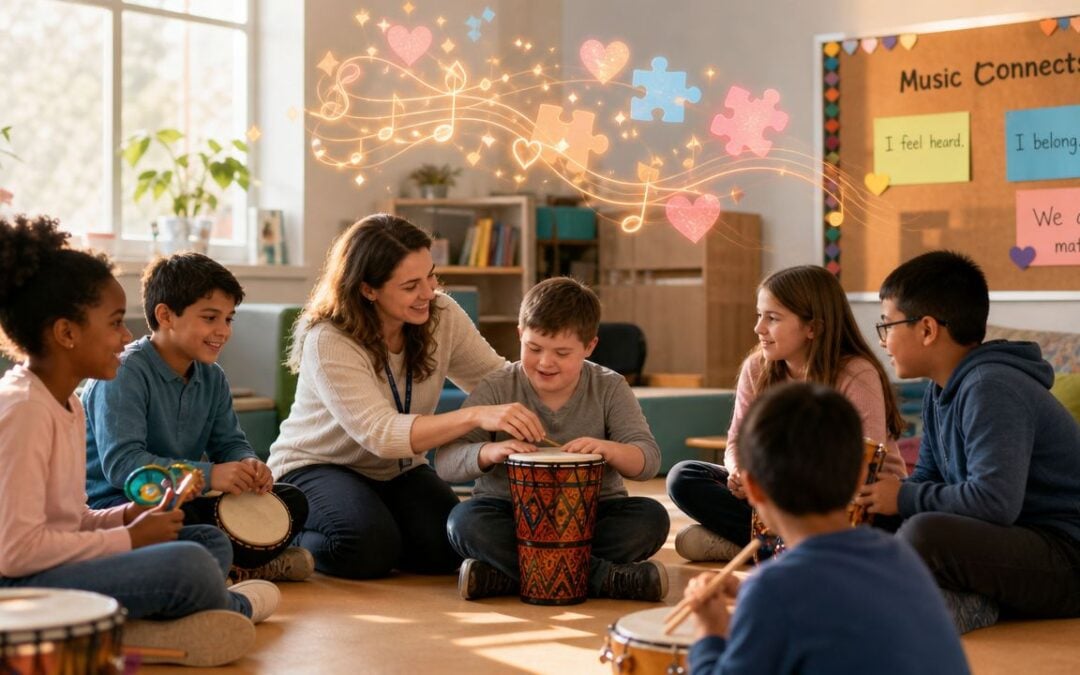
Group music activities make turn-taking visible. In a drumming circle, one child leads, another responds, and everyone waits for the shared cue. That kind of pattern helps students practice belonging without a lecture about kindness, which is especially useful for children who resist direct social coaching.
Sustained attention and focus
Music can create an anchor for attention. A parent might play a short lyric-based routine before homework, or a teacher might use a simple auditory cue to signal transition time. When the routine stays consistent, the music becomes a signal that helps students shift gears without a power struggle.
Language and communication
Lyrics, call-and-response, and songwriting give students a lower-pressure way to speak. A withdrawn sixth grader may not answer “How are you feeling?” but may choose a line in a group song that reveals more than a worksheet ever could. That's one reason music-based work can support speech, expressive language, and confidence.
Trauma-informed emotional safety
Some children don't trust direct questions about their feelings. Music can soften that pressure. A middle school counselor might invite students to choose a song that matches their mood, then discuss why they picked it. That creates distance, safety, and a path into conversation, which can matter a lot for students carrying stress from outside school.
Music-based activities work best when they stay predictable, voluntary, and brief enough that students can succeed before they feel exposed.
For families and classroom teams looking to connect these habits to broader SEL language, the framework in the five core SEL competencies explained is a useful companion. Music often supports the same skills, just through sound, rhythm, and shared timing instead of discussion alone.
How Session Frequency and Duration Affect Outcomes
A single music activity can change a moment. It usually won't change a pattern by itself. That's where dosage matters, because the evidence suggests the length of engagement shapes how much students may benefit.
A systematic review found a dose-effect relationship in severe mental disorders, with small effects appearing after 3 to 10 sessions and larger effects generally requiring 16 to 51 sessions (dose-effect review). For school teams, that's a reminder to stop overpromising from one assembly or one appreciation week. Music-based support tends to work better when it becomes part of the schedule.
What that looks like in a school week
A weekly 20-minute SEL circle, a counseling group that meets regularly, or a short advisory routine repeated across the term gives students enough repetition to learn the pattern. A one-time event may inspire them, but it won't usually build the same kind of skill memory. Consistency is what helps the brain and body recognize the cue.
This is also why administrators should think about music-based support as part of the school day, not as an extra. If an intervention lives only in the “nice to have” category, it usually disappears when the calendar gets tight. When it's attached to a regular block, like advisory, morning meeting, or a small-group counseling rotation, it has a better chance of becoming part of student habits.
A simple way to judge fit
Practical rule: if you can't repeat it, you can't really evaluate it.
That doesn't mean every activity has to be long. It means the same structure should return often enough that staff can notice patterns in participation, regulation, or peer interaction. A teacher tracking whether a student enters class more calmly after a song-and-breath routine is already doing the kind of observation that makes school-based intervention useful.
For teams that want a strong implementation lens, this resource on outcome measurement pairs well with music programming, because schools don't need perfect data to notice whether students are more settled, more engaged, or quicker to recover after transitions.
Integrating Music-Based Interventions Into SEL Programming
The easiest way to use music in SEL is to connect it to a goal you already care about. If the goal is calm bodies, choose a rhythm and breath routine. If the goal is belonging, use shared musical choices. If the goal is expression, bring in lyrics, drawing, or simple songwriting. The music is the tool, not the whole lesson.
Start with the SEL target
A kindergarten class coming in from recess needs regulation. A fifth-grade group dealing with friendship drama needs language for identity and belonging. An eighth-grade advisory group navigating conflict may need structured reflection. Once you know the need, you can match the music activity to the moment instead of choosing a song at random.
Match the activity to the age group
Young children respond well to predictable rhythm and movement, such as tapping, clapping, or singing a short call-and-response before lining up. Upper elementary students often do well with collaborative choices, like building a class playlist that reflects a feeling or theme. Middle schoolers usually need more voice, which makes lyric discussion, beat-making, and songwriting more useful than simple sing-alongs.
Use music as a bridge into conversation
A melody can open a door that a direct question leaves shut. For example, a counselor working with a student who is angry about peer conflict might ask which lyric line fits the week, then talk through why that choice feels right. That's where reflection turns a music moment into an SEL moment.
If you're looking for ready-to-use ideas that support fostering resilient children, music fits beautifully alongside breathwork, naming emotions, and collaborative problem-solving.
Measure what changes
Keep the measurement simple. Note whether students enter the room more calmly, stay with the group longer, or use fewer reminders to rejoin the task. Teachers can also ask students to rate, in plain language, whether the routine helped them feel ready to learn. The point is to look for movement you can see and hear, not just a polished performance.
A useful implementation pattern looks like this:
Map the skill: Decide whether you're targeting regulation, connection, expression, or attention.
Choose one repeatable routine: Keep the structure short enough that students can learn it quickly.
Invite participation without pressure: Let students opt in at a level that feels safe.
Reflect briefly: Ask what they noticed in their body, mood, or focus.
Track the pattern: Watch for repeated changes across days, not just one good moment.
That approach keeps music grounded in SEL instead of turning it into an activity that feels fun but unfocused. It also makes it easier for teachers and parents to use the same language across settings, which helps students carry the skill from one room to another.
Real School Success Stories With Music and SEL
An elementary counselor in a K–5 building noticed that a small group of students kept clashing at recess and then carrying the tension into afternoon class. She introduced a weekly drumming circle in which each child had a turn to lead a rhythm, follow a peer, and end with a short reflection on what it felt like to wait, listen, and respond. Over the semester, the adults around the group saw more cooperative behavior and fewer blowups during shared tasks, because the students had a practice that made turn-taking feel concrete.
A middle school teacher took a different route. During morning advisory, she used songwriting prompts tied to identity, belonging, and conflict, giving students a low-pressure way to put words to what was happening in their lives. One quiet student began sharing a few lines each week instead of shutting down, and the class settled faster at the start of the day because students expected a clear routine. The lesson for the teacher was simple, consistency mattered more than musical polish.
What these examples have in common
Neither school needed a full performance program. They needed a repeatable structure, a caring adult, and a clear purpose. The music didn't replace counseling or classroom management, it supported both.
What made the difference was the match between the activity and the need. Drumming helped with peer regulation because rhythm gives students a shared pace. Songwriting helped with emotional expression because lyrics let students say things they weren't ready to say outright. Those are the kinds of school-based music therapy benefits that make sense to teachers and parents because they show up in behavior, tone, and participation.
Common Misconceptions and How to Move Forward
One common misconception is that music therapy only helps students with diagnosed conditions. In reality, schoolwide SEL routines can benefit many children, including those who aren't receiving special services. Another misconception is that it requires expensive instruments or a dedicated music room. A desk, a voice, and a steady pattern can be enough to begin.
People also worry that music is too soft to matter. The research says otherwise. Music-based interventions can affect anxiety, depressive symptoms, and quality of life, and the practical school examples above show how those changes can support learning and behavior in real classrooms. The work doesn't have to be dramatic to be meaningful.
Start small and observe
Choose one routine this week. Maybe it's a 60-second breathing rhythm after lunch, a lyric reflection in advisory, or a simple drumming pattern before group work. Watch what happens to transitions, attention, and student tone, then keep what helps.
The best entry point is not perfect programming. It's a small, thoughtful practice that you can repeat. That's how schools move from curiosity to real use, and that's where the strongest music therapy benefits begin to matter for children every day.
If you're ready to bring more connection, regulation, and practical SEL into your school or home, visit Soul Shoppe to explore programs, tools, and ideas that help children build the skills they need to thrive. Their approach fits naturally with music-based routines because it centers belonging, self-regulation, and shared language. Start with one step, and build from there.
Think about the moments that truly define a school’s culture. It’s not just about test scores or academic achievements. It’s about how students navigate the playground, how they handle disagreements in group projects, and how they bounce back from frustration. This is where social emotional learning programs for schools come in.
These aren’t just another set of abstract theories. They are hands-on toolkits that give students practical, lifelong skills for managing their emotions, building healthy relationships, and making choices they can be proud of. A strong SEL program helps build the emotional foundation for a safer, more connected school climate—one where real learning can actually happen.
What Are Social Emotional Learning Programs for Schools
Picture a classroom where a student can name their frustration before an outburst, or a hallway where a conflict is resolved with thoughtful words instead of shoves. That’s the reality SEL programs work to create. They go beyond traditional academics to give students the internal skills they need to navigate life’s inevitable ups and downs. A practical example is teaching students the “Stop, Think, Act” model. Before reacting to a frustrating situation, they learn to pause, consider the consequences of different actions, and then choose the most constructive one.
The best programs provide a shared language and consistent strategies for the entire school community—from students and teachers to administrators and parents. Instead of feeling like an “add-on,” effective SEL is woven right into the fabric of the school day, from morning meetings to math class.
The Proven Value of Teaching Emotional Skills
The benefits of these programs are far from anecdotal. For over 20 years, a massive body of research has consistently shown just how powerful they are. Evidence-based SEL programs, often delivered by classroom teachers, lead to big wins in key areas: stronger social-emotional skills, more positive social behavior, fewer discipline issues, and less emotional distress among students. The data from research behind school-based SEL programs is clear and compelling.
This solid research confirms what educators have known for a long time: investing in a child’s emotional well-being pays huge dividends. When students feel safe, understood, and equipped to handle their feelings, they are simply better prepared to learn, engage, and grow.
The Five Core Competencies of SEL
At the heart of almost every quality SEL program, you’ll find five interconnected skills. Think of them as the foundation for a lifetime of well-being and success. Getting a handle on these five areas is the first step to seeing how SEL really comes to life in a school.
If you want to go deeper, our guide that explains the five core SEL competencies is a great resource for understanding their role in student development.
The table below breaks down these five pillars, showing how abstract concepts become concrete, everyday actions in a K-8 classroom.
The Five Core Competencies of Social Emotional Learning
Core Competency
What It Means for Students
Example in Action
Self-Awareness
Recognizing one’s own emotions, values, strengths, and limitations.
A 3rd grader identifies feeling “frustrated” with a math problem and asks for a short break.
Self-Management
Regulating one’s emotions, thoughts, and behaviors in different situations.
A 7th grader takes three deep breaths to calm their nerves before giving a class presentation.
Social Awareness
Understanding the perspectives of and empathizing with others from diverse backgrounds.
A 5th grader listens to a classmate’s point of view during a group project, even if they disagree.
Relationship Skills
Establishing and maintaining healthy and rewarding relationships with diverse individuals.
A 4th grader uses an “I-statement” (e.g., “I feel upset when…”) to resolve a conflict.
Responsible Decision-Making
Making caring and constructive choices about personal behavior and social interactions.
A middle schooler weighs the consequences before deciding not to participate in online gossip.
As you can see, these aren’t just “soft skills.” They are the essential building blocks that help children become capable, kind, and resilient individuals, both inside the classroom and out.
The Real-World Impact of SEL in Your School
It’s one thing to understand the building blocks of SEL, but what really matters is seeing those skills come to life in your school community. The effects of well-implemented social emotional learning programs for schools aren’t just abstract concepts on a poster. They show up in the hallways, classrooms, and on the playground, every single day.
When you invest in these skills, you kickstart a positive ripple effect that touches everyone.
Imagine a school where students have real tools to manage big emotions. Instead of lashing out, a student feeling anxious before a test uses a mindfulness technique to calm down, allowing them to focus and actually show what they know. Picture a playground where kids use conflict-resolution skills—like taking turns speaking and actively listening to each other’s side of the story—to solve a disagreement over a game, freeing up teachers to focus on teaching instead of playing referee.
Boosting Academic Performance and Attendance
There’s a common myth that SEL takes valuable time away from core academics. But anyone who’s seen it in action knows the opposite is true. SEL creates the very conditions needed for kids to learn and thrive. When students feel safe, supported, and connected, their brains are primed and ready to engage.
This isn’t just a feel-good idea; the data backs it up. Study after study shows a direct link between strong SEL skills and better academic outcomes. Schools that make SEL a priority often see significant improvements in key areas like:
Attendance Rates: Kids who feel like they belong and have friends actually want to come to school.
Classroom Engagement: Skills like self-management and responsible decision-making help students stay on task and participate in a meaningful way.
Overall Grades and Test Scores: When emotional distress goes down, focus and academic performance go up. It’s that simple.
The evidence is clear: nurturing SEL skills alongside academics leads to greater long-term success, including higher graduation rates. A 2023 synthesis of 424 studies found that strong SEL initiatives dramatically improve the entire school climate, resulting in better relationships, less bullying, and a greater sense of safety for everyone. You can discover more about these SEL research findings and what they mean for students.
Creating a Safer, More Positive School Climate
Beyond the test scores, the most powerful impact of SEL is on a school’s culture. It’s about systematically building a community grounded in empathy, respect, and mutual support. In real terms, this means fewer discipline issues and a feeling of safety that you can sense the moment you walk on campus.
When students learn to understand their own emotions and empathize with others, they are less likely to engage in bullying or disruptive behavior. This shift creates a positive feedback loop: a safer environment encourages more students to take social and academic risks, leading to deeper learning and stronger relationships.
This is where a dedicated program can truly make its mark. It’s amazing to see how Soul Shoppe’s impactful programs help schools create these very changes, building an environment where every single student feels seen, heard, and valued.
Ultimately, this foundation of psychological safety allows both students and educators to bring their best selves to school each day. It’s the difference between a school that’s constantly managing behavior and one that’s focused on nurturing growth—where every person in the community is truly ready to learn.
How to Choose the Right SEL Program
Walking into the world of social emotional learning programs for schools can feel a bit like navigating a packed stadium. Everyone is shouting, promising amazing results, and it’s hard to know where to look. So, how do you cut through the noise and find the program that will actually click with your students, your staff, and your school’s unique personality? It starts with looking past the glossy brochures and asking the right questions.
A good decision begins with getting really clear on what you need. Are you trying to cool down conflicts on the playground? Help students stay focused in class? Or maybe you’re aiming to build a genuine sense of belonging across the entire school. The right program won’t feel like just another thing to do; it will feel like a natural part of who you are.
Critical Questions to Ask Vendors
Before you sign on the dotted line, you need to play detective. A few direct questions can reveal whether a program is built to last and if the provider is ready to be a true partner in your journey.
A great way to get started is by seeing what’s out there. Exploring a variety of resources for schools implementing SEL can give you a solid feel for what a strong, supportive partnership really looks like.
Keep this checklist handy when you’re talking to potential providers:
Is the program evidence-based? Ask for the research. A quality provider won’t just throw jargon at you; they’ll be able to clearly explain the principles behind their program and share real results from schools just like yours.
Does it provide ongoing coaching and professional development? A one-and-done training day rarely sticks. You want a program that offers continuous support and coaching, giving your teachers the time and tools they need to feel confident.
Can it be adapted to our school’s unique culture? SEL isn’t a cookie-cutter solution. The program has to be flexible enough to respect your school’s values, your community’s needs, and the specific challenges your students face.
Does it include resources for parents and families? When the language of empathy and respect is spoken both at school and at home, that’s when the magic happens. Ask if they offer newsletters, workshops, or simple activities for families to do together. For example, do they provide take-home conversation starters like, “What was one kind thing you did for someone today?”
A principal in San Diego hit the nail on the head: “We chose a program with strong parent resources because we wanted our students to hear the same language about empathy and conflict resolution at the dinner table that they were hearing in the classroom. That consistency has been a game-changer for our community.”
Comparing Different SEL Program Models
The how is just as important as the what. As interest in SEL has exploded, so has the market. Industry experts estimate the global SEL market is floating around $3.47–$4.0 billion in 2024, with some projecting it could hit $27.73 billion by 2033. All that growth means you have more options than ever, from simple apps to campus-wide transformations. As you can learn more about SEL market trends, it’s vital to understand what these different models actually offer.
Each approach has its own vibe and is designed for different goals, budgets, and school cultures.
To help you sort through the options, here’s a quick look at the most common delivery models. Think of it as a guide to finding the right fit for your school’s needs right now.
Comparing Social Emotional Learning Program Models
Program Model
Key Features
Best For…
Considerations
Digital Apps & Platforms
Game-based lessons, mood check-ins, and individual student progress tracking.
Schools seeking a supplemental tool or programs for older, independent learners.
May lack the in-person interaction needed to build deep relationship skills.
One-Off Assemblies & Workshops
High-energy, engaging events that introduce key SEL concepts to a large group.
Schools looking to generate initial excitement or address a specific, timely issue.
Impact may fade without ongoing reinforcement and classroom integration.
Curriculum-in-a-Box
Scripted, grade-specific lessons and materials for teachers to deliver.
Districts needing a standardized approach with clear, easy-to-follow lesson plans.
Can feel rigid and may not easily adapt to unique classroom needs or moments.
Whole-School Approach
A comprehensive model involving professional development, parent engagement, and school-wide integration.
Schools committed to deep, sustainable cultural change and embedding SEL into their identity.
Requires a significant investment of time, resources, and long-term staff buy-in.
At the end of the day, picking the right program comes down to finding the perfect fit for your school’s story. By asking thoughtful questions and understanding the different ways SEL can come to life on your campus, you can choose a partner who will help you build a more connected, supportive, and successful community for everyone.
Your Roadmap for Successful SEL Implementation
Bringing a social-emotional learning program into your school community is a journey, not just a destination. Real success isn’t found in a single training day or a binder full of new curriculum. It’s built through a thoughtful, phased approach that earns trust, builds confidence, and creates lasting change. A deliberate plan is what separates an initiative that fizzles out from one that becomes a core part of your school’s identity.
Think of it like building a house. You wouldn’t just start putting up walls without a solid foundation and a clear blueprint. In the same way, a strong SEL launch needs careful planning, starting with a united team and a shared vision.
Phase 1: Build Your Team and Gain Buy-In
Your first move? Assemble a dedicated SEL committee. This team needs to be a real cross-section of your school: administrators, teachers from various grade levels, support staff like counselors, and even parents. A diverse team ensures all perspectives are heard and helps everyone see the program as a school-wide effort, not some top-down mandate.
Once your team is in place, the focus shifts to getting authentic buy-in from the rest of the staff. The absolute best way to do this is to let them experience SEL for themselves. Instead of just talking about empathy or self-awareness in a staff meeting, lead them through a powerful, short activity that brings the concept to life. A practical example is a “Two-Minute Mindful Listening” exercise where teachers pair up, one speaks, and the other listens without interrupting, then they switch. This simple activity demonstrates the power of feeling truly heard.
When teachers feel the positive impact of an SEL practice for themselves, they become its most passionate advocates. This experiential approach transforms skepticism into genuine enthusiasm far more effectively than any data sheet or presentation ever could.
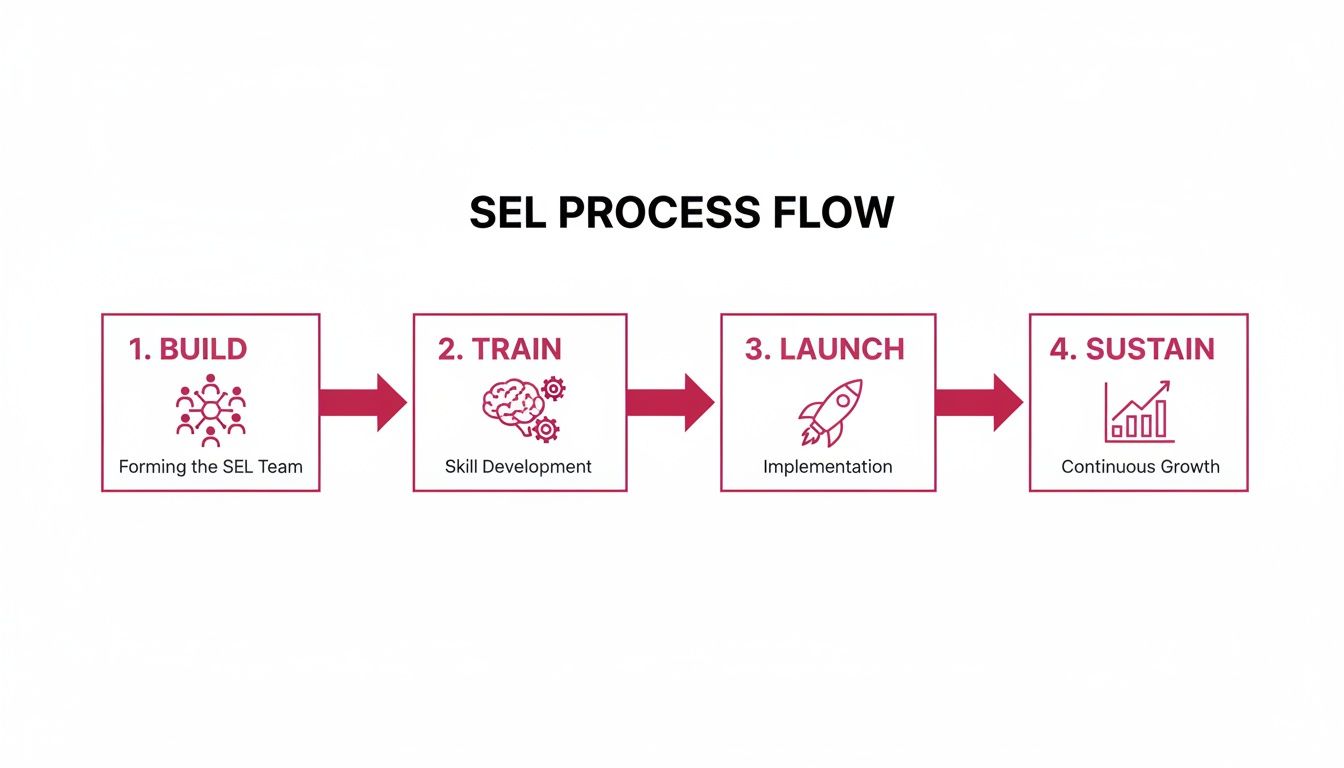
This visual shows the four key stages for successfully implementing social emotional learning programs for schools.
This process flow makes it clear that implementation is a continuous cycle, moving from building a team all the way to sustaining momentum for the long haul.
Phase 2: Meaningful Professional Development
With buy-in secured, the next phase is providing high-quality training. Effective professional development has to move beyond theory and give teachers practical, classroom-ready strategies they can use tomorrow. This training should be ongoing, not a one-off event.
Research consistently shows that continuous coaching and collaborative learning are far more effective. Teachers need opportunities to practice new skills, share what’s working, and get feedback in a supportive environment. The goal is to build teacher confidence so they can weave SEL seamlessly into their daily instruction. For a comprehensive look at what this entails, exploring a well-structured professional development program for educators can provide valuable insights.
Phase 3: Launch and Integrate Into School Life
Now it’s time to bring SEL to the students! A strong launch is more than just starting the first lesson. It means creating a school-wide kickoff that generates real excitement, like a themed assembly or a week of activities focused on a core skill like kindness.
But integration is the key to making SEL stick. Encourage teachers to connect SEL concepts to their academic subjects. It’s easier than it sounds.
In Literature: Discuss a character’s motivations and feelings (Social Awareness). For example, “How do you think Katniss felt when she volunteered for the Hunger Games? What clues does the author give us?”
In History: Analyze the perspectives of different groups during a historical event (Empathy). For example, when studying the American Revolution, students could write a journal entry from the perspective of a British soldier.
In Science: Practice perseverance and managing frustration during a challenging experiment (Self-Management). A teacher might say, “It’s okay to feel stuck. Let’s take three deep breaths and look at the problem from a new angle.”
Phase 4: Monitor, Adapt, and Sustain Momentum
Finally, successful implementation is an ongoing process of monitoring and adapting. You can’t improve what you don’t measure. When mapping out your SEL implementation, it’s essential to include all the supporting infrastructure, including tools for internal communication. Platforms like communication software for universities can help streamline feedback collection and keep your team coordinated.
Gather feedback and data regularly to see what’s working and where you need to adjust. Use a mix of methods:
School Climate Surveys: Ask students, staff, and parents about their sense of safety and belonging.
Discipline Data: Track changes in office referrals, suspensions, and bullying incidents.
Qualitative Feedback: Hold focus groups with students and have informal check-ins with teachers.
Use this information to celebrate your wins and make targeted improvements. This ensures your SEL program continues to meet the very real, evolving needs of your school community.
Bringing SEL to Life in the Classroom and Beyond
This is where the rubber meets the road—where social-emotional learning moves from a concept on paper into the living, breathing heart of a school. The most powerful social emotional learning programs for schools don’t just teach ideas; they build experiences that actually stick with kids.
Imagine a school where every student and staff member shares the same language for talking about emotions and conflict. That kind of consistency is a game-changer. It’s built not through a single lesson, but through interactive workshops, engaging school-wide assemblies, and simple daily routines that weave SEL skills into the fabric of school life.
Case Study: A Middle School Peer Mediation Program
A local middle school was wrestling with constant hallway arguments and small conflicts that were eating up teachers’ time and energy. They decided to try a peer mediation program, training a group of student volunteers in active listening, finding common ground, and brainstorming solutions.
Within just a few months, the results were impossible to ignore. Disciplinary referrals for minor conflicts plummeted by over 30%. But more importantly, students started using the mediation skills on their own, stopping disagreements before they could even escalate.
One 8th-grade mediator put it this way:
“Before, if someone had a problem, it was all about who was right or wrong. Now, we know how to find the ‘win-win.’ It makes you feel powerful to solve your own problems instead of just getting a teacher to fix it.”
Making SEL Concepts Stick
For social-emotional learning to become part of a school’s DNA, it has to be felt, not just taught. An experiential approach is key, turning abstract ideas like empathy and self-regulation into something tangible that students can remember and use. This is about moving beyond worksheets and into hands-on activities.
This approach helps create a unified culture where students feel safe, seen, and connected. Ultimately, a major outcome of effective SEL is creating a positive learning environment, which is the foundation for both well-being and academic success.
Here are a few practical ideas that any teacher can adapt:
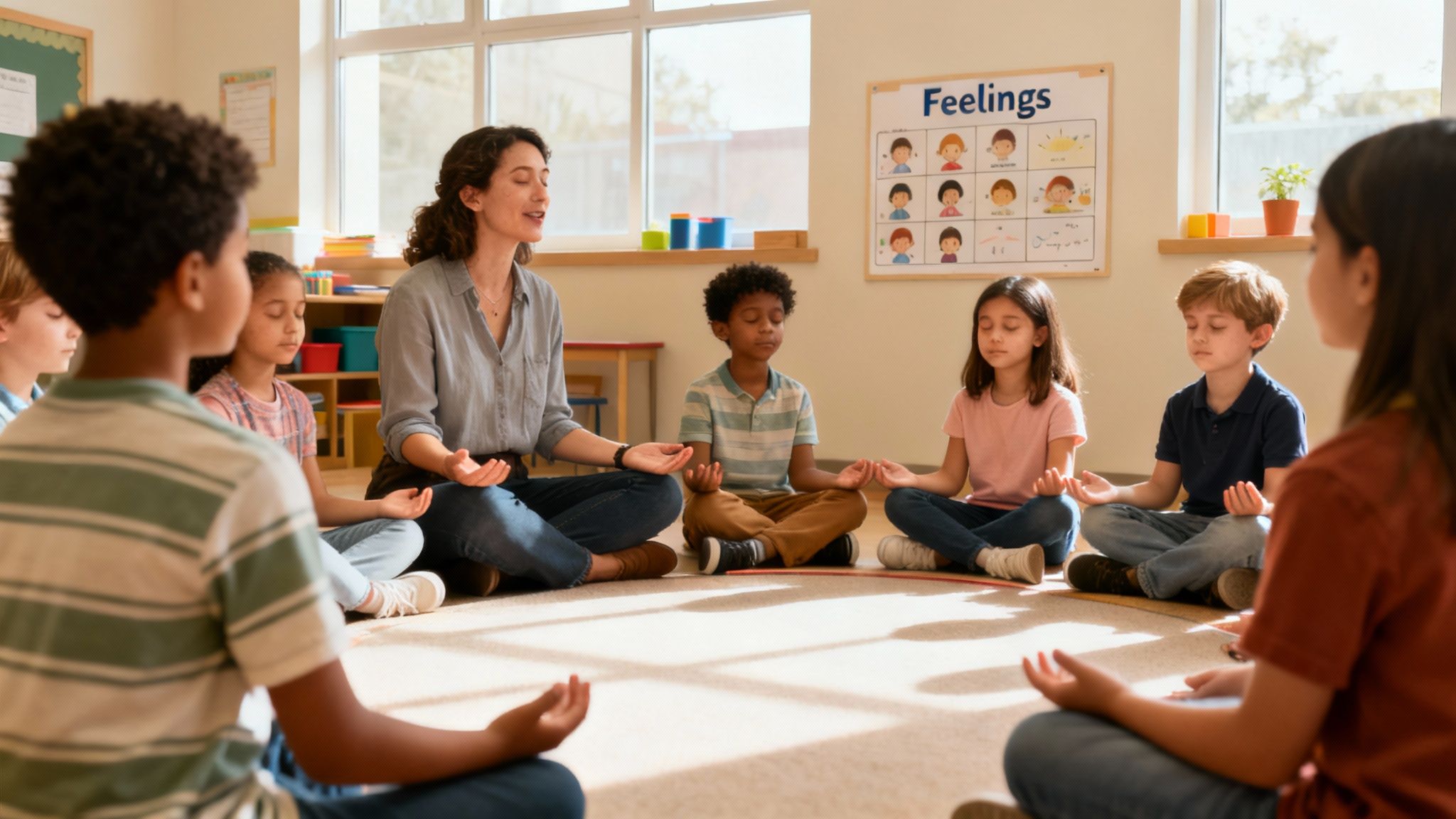
Daily Emotion Check-Ins: An elementary teacher started each day with a “feelings circle.” Using a color-coded chart, students shared one word describing how they felt. This simple ritual normalized talking about emotions, calmed the room, and gave the teacher a quick read on who might need extra support.
“Mistake Memos”: To build resilience, a 4th-grade teacher set up a bulletin board for students to anonymously post “mistake memos.” They’d write down a mistake they made that week and what they learned from it. It completely reframed errors as learning opportunities, dialing down the anxiety around being perfect.
School-Wide Assemblies: Instead of being passive lectures, assemblies can become interactive workshops. An assembly on empathy could have students role-play different scenarios, allowing them to physically and emotionally step into someone else’s shoes for a moment.
These examples show that when SEL is active, engaging, and consistent, it doesn’t just change student behavior—it has the power to transform an entire school culture.
When schools start exploring social emotional learning, it’s completely normal for everyone—administrators, teachers, and parents—to have some practical questions. Getting these concerns out in the open is the best way to build confidence and lay the groundwork for a program that really works.
Here are a few of the most common questions we hear, along with some straight answers.
How Much Instructional Time Will SEL Take?
This is usually the first question on every educator’s mind. The great news is that effective social emotional learning programs for schools aren’t about cramming another subject into an already packed day. It’s about integration.
Think of it as weaving these skills into the fabric of what you already teach. A history lesson can become a powerful exercise in social awareness by asking students to consider an event from multiple perspectives. A collaborative science project? That’s a real-time opportunity to practice relationship skills and navigate disagreements. A practical example for parents is asking their child at dinner, “What was something you and your group worked on together today? How did you make sure everyone had a chance to share their ideas?” SEL doesn’t replace core instruction; it makes it richer.
How Can We Measure the Return on Investment?
The ROI of SEL shows up in two ways: in the numbers and in the school’s culture. You absolutely can, and should, track key metrics to see the concrete impact of your efforts. This data is invaluable for showing stakeholders what’s working.
Disciplinary Referrals: A significant drop in office referrals is often one of the first things schools notice.
Bullying Incidents: You’ll see a measurable decrease in reported bullying and peer conflict.
Absenteeism Rates: When kids feel safer and more connected to their school community, they show up more often. It’s that simple.
But beyond the data, you can feel the difference. It shows up in positive school climate surveys, in the stories students and teachers share, and in a genuine sense of belonging that you can sense just by walking through the halls.
The real return is a culture where students are ready to learn and teachers have more time to teach. Fewer classroom disruptions mean more time on task, which benefits every single student.
How Can We Get Parents Involved?
Getting parents on board is a game-changer for making SEL skills stick. When the language used in the classroom is echoed in the living room, the learning becomes deeply ingrained.
The best way to do this is by providing simple, consistent resources that bridge that school-home connection. Imagine sending home a short weekly email that explains a concept like empathy. You could include a couple of conversation starters for the dinner table, like, “Tell me about a time you understood how a friend was feeling today.” It’s a small effort that reinforces learning and builds a powerful partnership.
Is SEL Appropriate for All Age Groups?
Absolutely. The beauty of a well-designed SEL program is that it’s scaffolded to meet students where they are developmentally. The core concepts—like self-awareness or responsible decision-making—stay the same, but how they are taught evolves as children mature.
In kindergarten, it might look like using a “feelings chart” with smiley and frowny faces to help little ones put a name to their emotions. By the time those same students are in middle school, the lessons have deepened into navigating complex friendships, making ethical choices online, and setting meaningful personal goals.
Ready to build a more connected and empathetic school community? Soul Shoppe offers experiential programs that equip students and staff with practical tools for a lifetime of well-being. Discover how we can support your school.