CHECK OUT OUR 2026-27 SCHOOL YEAR PROGRAMMING

A child comes home tense after school, and the first thing you try is the simplest thing you've got. Maybe you turn on a calm playlist during homework, or you tap a steady beat on the table while they breathe. That instinct makes sense, because music can help students settle, name feelings, and reconnect with the adults around them. The key is knowing when music is just background comfort and when it becomes a structured support that can shape student outcomes.

For K–8 educators and parents, that distinction matters. The research behind music therapy benefits points to real changes in anxiety, mood, attention, and connection, but the strongest results come from intentional, relationship-based practice, not random songs in the room. If you've ever wondered whether a short drumming circle, a lyric discussion, or a breathing routine with music can really help, the answer is yes, when it's used with purpose and consistency.

What Music Therapy Actually Is in Schools

A second grader is melting down after recess. A teacher puts the class into a short rhythm-and-breath reset, tapping a slow pattern on the desk and inviting the children to match it with their hands and shoulders. Ten minutes later, the room is quieter, but that doesn't mean the teacher has done “music therapy” in the clinical sense. It means the teacher has used a music-based regulation tool.

Music therapy is a health profession that uses music within a therapeutic relationship to address physical, emotional, cognitive, and social needs. The U.S. National Center for Complementary and Integrative Health describes it that way, and that definition matters because it separates intentional intervention from casual background listening (NCCIH overview). In practice, that looks more like guided singing, songwriting, rhythm work, or structured listening with a goal than like playing soft music during independent work.

An infographic contrasting common misconceptions about school music therapy with actual evidence-based practices and therapeutic goals.

Why the distinction matters

A person doesn't get stronger just because a gym exists nearby. Progress comes from a planned set of movements, a professional relationship, and repeated work toward a goal. Music therapy follows the same logic.

Practical rule: if the music activity has a clear purpose, a repeatable structure, and a way to observe change, you're getting closer to intervention than entertainment.

That distinction also helps schools set realistic expectations. A classroom playlist can support the mood of the day. A music-based therapeutic routine, or a counselor-led intervention, can support a student who needs help with regulation, expression, or connection. The latter is where the music therapy benefits research becomes especially useful for educators who want SEL tools they can trust.

For families and schools trying to separate hype from help, a useful starting point is a broader SEL framework. This article on social-emotional learning programs for schools pairs well with music-based support because the goal is the same, helping children practice skills they can use all day, not just during a single calming activity.

Research-Backed Music Therapy Benefits for Mental Health

A student who arrives at school already tense may not have the words to explain what is happening inside. A familiar song, a steady beat, or a guided music activity can give that feeling a shape that adults can observe and respond to. That is one reason the research on music therapy benefits matters for K–8 educators and parents who want practical SEL tools, not just comforting ideas.

The clearest evidence begins with emotional health. A 2013 Cochrane systematic review found that listening to recorded music significantly reduced anxiety in people waiting for surgery, and the review included 26 studies and 2,051 participants (NCCIH science digest). For school teams, that matters because it shows music can influence measurable stress responses in a setting where anxiety is already high.

A later depression review found music therapy was significantly more effective than controls at reducing depressive symptoms, with a standardized mean difference of -0.97 and a 95% confidence interval from -1.23 to -0.71 (systematic review and meta-review on PMC). The same review also reported that music therapy could be recommended to help control depressive symptoms and anxiety, while improving quality of life and sleep quality, even though the evidence quality was rated low. That combination of promise and caution is useful for school counselors and classroom teachers, because it helps set realistic expectations.

What the broader psychiatric evidence suggests

A transdiagnostic meta-review in BJPsych Open reported measurable benefits across psychiatric conditions, including an effect size of 0.83 for reduced overall symptom severity in 575 participants, an odds ratio of 1.60 for global improvement in 583 participants, and effect sizes of 0.43 for anxiety and 0.27 for depression across diagnoses (meta-review PDF). The same review also reported standardized mean differences of 0.57 for depression, 0.47 for anxiety, and 0.47 for quality of life in music therapy contexts.

Those findings matter because they point to more than one pathway. Music therapy may help a child settle after dysregulation, stay with a group activity, and feel more connected to others, not just feel calmer for a moment. In school settings, that makes music-based support especially relevant for students who show stress through behavior, shutdown, or avoidance.

The strongest results tend to come from structured, ongoing work guided by a trained professional. Research is still emerging for school-adjacent uses that are less formal, which is why educators should treat classroom music routines as support tools, not as a substitute for therapy. For teams building healthier daily routines, a helpful companion resource is this guide on mental health activities, since the best SEL plans often combine music, reflection, and predictable structure.

Five Core Benefit Areas for K–8 Students

A fifth grader who won't speak during morning meeting may still hum along to a rhythm. A third grader who blurts and fidgets all afternoon may sit still long enough to keep a steady beat with peers. These moments are not proof that music solves everything, but they do show why music therapy benefits often appear first in everyday school behavior before they show up in testable outcomes.

An infographic illustrating five core benefits of music therapy for K-8 students, featuring various icons and text.

Social-emotional regulation

Music gives children a rhythm to follow when their own internal rhythm feels scattered. A kindergarten teacher can use a slow clap-and-breath pattern after recess, and a counselor might pair drumming with naming feelings for a student who shuts down when upset. The goal isn't performance. It's helping the child borrow structure until self-regulation starts to stick.

Peer connection and belonging

Group music activities make turn-taking visible. In a drumming circle, one child leads, another responds, and everyone waits for the shared cue. That kind of pattern helps students practice belonging without a lecture about kindness, which is especially useful for children who resist direct social coaching.

Sustained attention and focus

Music can create an anchor for attention. A parent might play a short lyric-based routine before homework, or a teacher might use a simple auditory cue to signal transition time. When the routine stays consistent, the music becomes a signal that helps students shift gears without a power struggle.

Language and communication

Lyrics, call-and-response, and songwriting give students a lower-pressure way to speak. A withdrawn sixth grader may not answer “How are you feeling?” but may choose a line in a group song that reveals more than a worksheet ever could. That's one reason music-based work can support speech, expressive language, and confidence.

Trauma-informed emotional safety

Some children don't trust direct questions about their feelings. Music can soften that pressure. A middle school counselor might invite students to choose a song that matches their mood, then discuss why they picked it. That creates distance, safety, and a path into conversation, which can matter a lot for students carrying stress from outside school.

Music-based activities work best when they stay predictable, voluntary, and brief enough that students can succeed before they feel exposed.

For families and classroom teams looking to connect these habits to broader SEL language, the framework in the five core SEL competencies explained is a useful companion. Music often supports the same skills, just through sound, rhythm, and shared timing instead of discussion alone.

How Session Frequency and Duration Affect Outcomes

A single music activity can change a moment. It usually won't change a pattern by itself. That's where dosage matters, because the evidence suggests the length of engagement shapes how much students may benefit.

A systematic review found a dose-effect relationship in severe mental disorders, with small effects appearing after 3 to 10 sessions and larger effects generally requiring 16 to 51 sessions (dose-effect review). For school teams, that's a reminder to stop overpromising from one assembly or one appreciation week. Music-based support tends to work better when it becomes part of the schedule.

What that looks like in a school week

A weekly 20-minute SEL circle, a counseling group that meets regularly, or a short advisory routine repeated across the term gives students enough repetition to learn the pattern. A one-time event may inspire them, but it won't usually build the same kind of skill memory. Consistency is what helps the brain and body recognize the cue.

This is also why administrators should think about music-based support as part of the school day, not as an extra. If an intervention lives only in the “nice to have” category, it usually disappears when the calendar gets tight. When it's attached to a regular block, like advisory, morning meeting, or a small-group counseling rotation, it has a better chance of becoming part of student habits.

A simple way to judge fit

Practical rule: if you can't repeat it, you can't really evaluate it.

That doesn't mean every activity has to be long. It means the same structure should return often enough that staff can notice patterns in participation, regulation, or peer interaction. A teacher tracking whether a student enters class more calmly after a song-and-breath routine is already doing the kind of observation that makes school-based intervention useful.

For teams that want a strong implementation lens, this resource on outcome measurement pairs well with music programming, because schools don't need perfect data to notice whether students are more settled, more engaged, or quicker to recover after transitions.

Integrating Music-Based Interventions Into SEL Programming

The easiest way to use music in SEL is to connect it to a goal you already care about. If the goal is calm bodies, choose a rhythm and breath routine. If the goal is belonging, use shared musical choices. If the goal is expression, bring in lyrics, drawing, or simple songwriting. The music is the tool, not the whole lesson.

An infographic illustrating five steps for integrating music interventions into Social Emotional Learning in a classroom.

Start with the SEL target

A kindergarten class coming in from recess needs regulation. A fifth-grade group dealing with friendship drama needs language for identity and belonging. An eighth-grade advisory group navigating conflict may need structured reflection. Once you know the need, you can match the music activity to the moment instead of choosing a song at random.

Match the activity to the age group

Young children respond well to predictable rhythm and movement, such as tapping, clapping, or singing a short call-and-response before lining up. Upper elementary students often do well with collaborative choices, like building a class playlist that reflects a feeling or theme. Middle schoolers usually need more voice, which makes lyric discussion, beat-making, and songwriting more useful than simple sing-alongs.

Use music as a bridge into conversation

A melody can open a door that a direct question leaves shut. For example, a counselor working with a student who is angry about peer conflict might ask which lyric line fits the week, then talk through why that choice feels right. That's where reflection turns a music moment into an SEL moment.

If you're looking for ready-to-use ideas that support fostering resilient children, music fits beautifully alongside breathwork, naming emotions, and collaborative problem-solving.

Measure what changes

Keep the measurement simple. Note whether students enter the room more calmly, stay with the group longer, or use fewer reminders to rejoin the task. Teachers can also ask students to rate, in plain language, whether the routine helped them feel ready to learn. The point is to look for movement you can see and hear, not just a polished performance.

A useful implementation pattern looks like this:

  • Map the skill: Decide whether you're targeting regulation, connection, expression, or attention.
  • Choose one repeatable routine: Keep the structure short enough that students can learn it quickly.
  • Invite participation without pressure: Let students opt in at a level that feels safe.
  • Reflect briefly: Ask what they noticed in their body, mood, or focus.
  • Track the pattern: Watch for repeated changes across days, not just one good moment.

That approach keeps music grounded in SEL instead of turning it into an activity that feels fun but unfocused. It also makes it easier for teachers and parents to use the same language across settings, which helps students carry the skill from one room to another.

Real School Success Stories With Music and SEL

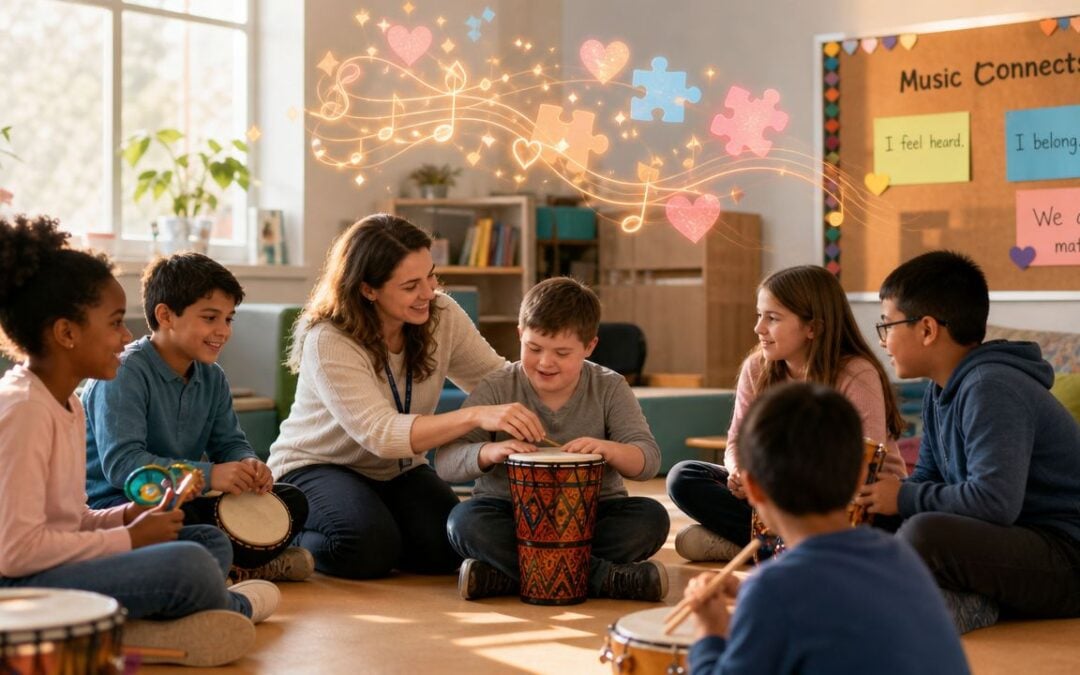
An elementary counselor in a K–5 building noticed that a small group of students kept clashing at recess and then carrying the tension into afternoon class. She introduced a weekly drumming circle in which each child had a turn to lead a rhythm, follow a peer, and end with a short reflection on what it felt like to wait, listen, and respond. Over the semester, the adults around the group saw more cooperative behavior and fewer blowups during shared tasks, because the students had a practice that made turn-taking feel concrete.

A middle school teacher took a different route. During morning advisory, she used songwriting prompts tied to identity, belonging, and conflict, giving students a low-pressure way to put words to what was happening in their lives. One quiet student began sharing a few lines each week instead of shutting down, and the class settled faster at the start of the day because students expected a clear routine. The lesson for the teacher was simple, consistency mattered more than musical polish.

What these examples have in common

Neither school needed a full performance program. They needed a repeatable structure, a caring adult, and a clear purpose. The music didn't replace counseling or classroom management, it supported both.

What made the difference was the match between the activity and the need. Drumming helped with peer regulation because rhythm gives students a shared pace. Songwriting helped with emotional expression because lyrics let students say things they weren't ready to say outright. Those are the kinds of school-based music therapy benefits that make sense to teachers and parents because they show up in behavior, tone, and participation.

Common Misconceptions and How to Move Forward

One common misconception is that music therapy only helps students with diagnosed conditions. In reality, schoolwide SEL routines can benefit many children, including those who aren't receiving special services. Another misconception is that it requires expensive instruments or a dedicated music room. A desk, a voice, and a steady pattern can be enough to begin.

People also worry that music is too soft to matter. The research says otherwise. Music-based interventions can affect anxiety, depressive symptoms, and quality of life, and the practical school examples above show how those changes can support learning and behavior in real classrooms. The work doesn't have to be dramatic to be meaningful.

Start small and observe

Choose one routine this week. Maybe it's a 60-second breathing rhythm after lunch, a lyric reflection in advisory, or a simple drumming pattern before group work. Watch what happens to transitions, attention, and student tone, then keep what helps.

The best entry point is not perfect programming. It's a small, thoughtful practice that you can repeat. That's how schools move from curiosity to real use, and that's where the strongest music therapy benefits begin to matter for children every day.


If you're ready to bring more connection, regulation, and practical SEL into your school or home, visit Soul Shoppe to explore programs, tools, and ideas that help children build the skills they need to thrive. Their approach fits naturally with music-based routines because it centers belonging, self-regulation, and shared language. Start with one step, and build from there.