Soul Shoppe's work is made possible by donors and partners who care deeply about the young people in their communities! We can't do this work without you. Support our work in classrooms and on playgrounds across the nation by donating here.
It’s 9:12 a.m. A third grader is under a table because recess ended badly. Two students are arguing over who “started it.” One child is staring at a math page and hasn’t written a thing. The teacher is trying to move the lesson forward while also protecting the room’s emotional temperature.
Most K-8 educators know this moment. So do principals. So do parents at 6:30 p.m. when homework ends in tears over something that looks small on the surface but isn’t small to the child living it.
That’s where social emotional learning tools matter. Not as an extra program you squeeze in if time allows, but as the practical supports that help kids name feelings, manage impulses, repair harm, ask for help, and stay connected enough to learn. If you want calmer classrooms, fewer repeat conflicts, stronger student relationships, and better carryover between school and home, the tools you choose matter.
Why Social Emotional Learning Tools Are No Longer Optional
A lot of schools are trying to solve behavior, engagement, attendance, and belonging as if they’re separate problems. In practice, they overlap all day long.
A student who can’t identify frustration may shut down during writing. A child who doesn’t know how to re-enter play after conflict may spend the rest of recess isolated. A class with no shared language for feelings often swings between disruption and silence. Teachers then spend huge amounts of energy reacting instead of teaching.
That’s why social emotional learning tools are no longer nice-to-have materials. They’re the routines, prompts, assessments, discussion structures, visual supports, and family practices that help adults respond early, consistently, and with less guesswork.
Schools are treating SEL as core infrastructure
This isn’t a passing trend. The global SEL market was valued at approximately USD 5.3 billion in 2025 and is projected to reach USD 47.1 billion by 2035, a projected 24.3% CAGR, according to Future Market Insights’ SEL market report. That growth signals something educators already feel on the ground. Schools are investing because they need systems that support the whole child.
The important shift is this. SEL isn’t only about a weekly lesson on kindness. It’s about building a school ecosystem where students practice self-awareness before conflict escalates, use communication tools during conflict, and reflect afterward in a way that teaches a new skill.
Practical rule: If a tool only works during a scripted lesson but disappears during transitions, lunch, recess, or homework, it isn’t enough.
What leaders and teachers need now
New principals often ask, “Where do we even start?” Teachers ask, “Do I need a curriculum, an app, or just better routines?” Parents ask, “How do I support this at home without turning dinner into therapy?”
Those are the right questions.
A useful starting point is understanding the broader benefits of social emotional learning, then getting very concrete about which tools belong in classrooms, which belong in leadership systems, and which belong in family routines.
The schools that make progress usually do three things well:
Choose tools on purpose that match student needs and staff capacity.
Implement them consistently across classrooms and home communication.
Measure what changes so SEL stays tied to real outcomes, not wishful thinking.
Understanding Your SEL Toolkit
Think of SEL like a carpenter’s toolbox. You wouldn’t use one screwdriver for every repair in a building. In the same way, schools shouldn’t expect one app or one lesson series to carry the full emotional life of a campus.
A strong SEL toolkit includes different kinds of supports for different jobs. Some tools help students identify feelings. Others help them calm their bodies, repair peer conflict, or bring families into the same language.
Research on evidence-based elementary SEL programs gives us a helpful blueprint. Analysis found that components like identifying others’ feelings (100% of programs), identifying one’s own feelings (92.3%), and behavioral coping skills (91.7%) are foundational, as described in this systematic analysis of elementary SEL programs. That matters because it tells us what effective social emotional learning tools should teach.
Four kinds of tools most schools need
Some educators hear “SEL tools” and think only of digital platforms. That’s too narrow. The toolkit is broader.
Digital apps and platforms
These tools help with check-ins, reflection, student self-assessment, mood tracking, or guided regulation.
A classroom example: a fifth grade teacher starts the day with a digital feelings check-in. Students select a feeling word and a readiness level before math. The teacher notices three students flagging frustration and pulls them for a quick preview before independent work starts.
At home, a parent might use a simple app-based mood check after school and ask, “Was that feeling about work, friendship, or energy?”
Digital tools are useful when you need:
Quick visibility into how students are doing
Consistent data collection across classrooms
Easy access for students, staff, and sometimes families
They’re less useful when staff haven’t built routines around what happens after the data comes in.
Formal curricula and programs
These are structured lesson sequences, often aligned to CASEL competencies, that teach skills such as empathy, self-regulation, listening, conflict resolution, and decision-making.
Example: a second grade class practices role-play around joining a game at recess. Students rehearse language like, “Can I join?” and “What role can I take?” That sounds simple, but for many children, direct practice changes what happens outside.
This category gets overlooked, even though it’s where SEL often becomes real. Morning meetings, calm corners, partner shares, repair circles, breathing routines, and transition scripts all count.
A kindergarten peace corner might include:
Feelings visuals so students can point before they have the words
Breathing prompts for body regulation
A reflection card with “What happened?” and “What do I need?”
A middle school advisory routine might open with, “What’s one challenge you handled well this week?” That builds reflection without forcing disclosure.
A tool becomes powerful when students can use it independently, not only when an adult prompts it.
Family engagement practices
If school and home use completely different language, students often don’t transfer skills well. Family engagement tools close that gap.
Examples include:
Dinner table prompts like “When did you feel included today?”
Take-home conflict scripts such as “I felt __ when __. Next time I need __.”
Brief family workshops where caregivers try the same calming routine students use at school
A fourth grader who learns “pause, breathe, say what you need” in class can use the same sequence before a sibling conflict at home if adults reinforce it.
Comparing Categories of Social Emotional Learning Tools
Tool Type
Primary Use Case
Pros
Cons
Digital Apps and Platforms
Check-ins, tracking, reflection, screening
Easy to scale, fast data access, useful across classrooms
Can become passive if staff don’t respond to results
Low cost, immediate impact, easy to embed into the day
Quality depends on adult consistency
Family Engagement Practices
Home-school carryover
Extends SEL beyond campus, helps parents reinforce skills
Needs simple communication and family-friendly design
A simple way to think about fit
If your biggest issue is constant peer conflict, don’t buy only a dashboard. If your staff lacks shared language, routines alone may not be enough. If families feel disconnected, a strong classroom plan still won’t travel home by itself.
Most schools need a mix. The goal isn’t to collect tools. It’s to build a system where each tool has a job.
How to Choose the Right SEL Tools for Your School
The wrong way to choose SEL tools is to start with the flashiest demo.
The better way is to start with your school’s friction points. Where are students getting stuck? Where are adults losing time? Which moments feel predictable in the worst way?
A principal might say, “Our classrooms are calm during lessons, but lunch and recess keep unraveling the day.” That school may need conflict-resolution routines, adult supervision scripts, and student practice with peer repair. Another school may say, “Our students can talk about feelings, but they fall apart during academic frustration.” That points more toward self-management tools and coping routines.
Match the tool to the problem
Before you purchase anything, name the problem in plain language.
Try prompts like these with your team:
Where do students struggle most? During transitions, partner work, unstructured time, or independent tasks?
What do students need more of? Emotion vocabulary, impulse control, empathy, conflict repair, or help-seeking?
What do adults need more of? Shared language, usable routines, clearer data, or family communication supports?
A practical example: if fourth graders keep escalating minor social misunderstandings into office referrals, a weekly empathy lesson alone probably won’t solve it. They may need sentence stems for disagreement, brief restorative routines after conflict, and adult coaching in the moment.
Developmental fit matters
Not every tool works for every age. A first grader needs concrete language, visuals, and repeated modeling. An eighth grader usually needs more privacy, more autonomy, and less “performing feelings” in front of peers.
Look for signs of developmental fit:
K-2 tools should be visual, repetitive, embodied, and brief.
Grades 3-5 tools should blend direct teaching with reflection and practice.
Grades 6-8 tools should respect dignity, choice, and social complexity.
For instance, a feelings chart works in first grade because it helps children locate emotion quickly. In middle school, a private reflection form or advisory prompt may work better because students don’t want to announce vulnerability publicly.
Capacity beats ambition
A school can buy a strong program and still fail if staff can’t use it consistently.
Ask hard questions early:
How much training does this require?
Can teachers use it inside a normal school day?
Will counselors, recess staff, and classroom teachers all understand it the same way?
Does it create one more initiative, or does it simplify what adults already do?
If your staff is stretched thin, low-burden options may be wiser. The Wallace Foundation has highlighted low-cost, low-burden SEL “kernels” as flexible strategies for specific behaviors, which is why schools under pressure should consider routines and short practices, not just full programs.
Equity cannot be an afterthought
Many schools make a costly mistake by choosing tools that appear neutral but don’t reflect students’ lived experience, community context, or the ways bias shapes behavior interpretation.
Black SEL raises an important challenge to standard programs. It argues that many mainstream approaches overlook systemic issues and cultural context, making culturally affirming approaches necessary for Black and marginalized students. That perspective is described on the Black SEL about page.
What does that mean in practice?
It means asking:
Whose communication style does this tool assume is “appropriate”?
Do examples, stories, and role-plays reflect our students and families?
Does the tool build belonging, or does it reward compliance without context?
A school serving diverse communities might adapt scenarios so students discuss real peer dynamics they recognize, not generic workbook conflicts. Family nights might include multilingual materials and examples that reflect actual home routines.
If students don’t see themselves in the tool, adults often misread resistance as lack of skill.
Don’t ignore low-cost options
A tight budget doesn’t mean you can’t do strong SEL work. Many high-impact practices are routines, scripts, and habits.
A school with limited funds might start with:
Daily check-in circles
Calm-down menus in every room
Peer conflict scripts posted at student eye level
Weekly family conversation prompts
Brief advisory lessons using existing staff
If you want classroom-ready ideas to pair with a broader plan, Kuraplan’s roundup of social emotional learning activities offers practical examples educators can adapt.
One example from the field: some schools use a conflict pathway tool so students can talk through what happened, how each person feels, and what repair looks like. Soul Shoppe offers a Peace Path with Tutorial that fits that kind of practical, skill-based conflict resolution approach.
A procurement checklist leaders can actually use
Bring this checklist into vendor meetings or planning sessions.
Problem fit Does this tool solve a problem we’ve clearly named?
Age fit Will our students use it, from primary grades through middle school where applicable?
Cultural fit Does it reflect our students’ identities, experiences, and community realities?
Staff fit Can teachers, counselors, and support staff use it without heavy overload?
Family fit Is there a simple way for caregivers to reinforce the same language at home?
Measurement fit Can we tell whether it’s helping through observations, assessments, or behavior patterns?
Sustainability Will this still work after the launch excitement fades?
Schools rarely need the most complicated option. They need the clearest one.
If your team is choosing among full-school approaches, this guide to SEL programs for schools can help frame the decision around implementation reality, not just features.
A Guide to Implementing SEL Tools School-Wide
The best SEL tool can still fail in a school that launches too fast, trains too little, or treats implementation like a one-time event.
School-wide SEL works when adults share a common approach, students experience it in predictable ways, and families hear language that matches what happens in classrooms.
Research gives leaders one more reason to stay committed. A thorough synthesis of SEL research found that students participating in SEL programs achieved an average 11 percentage point gain in academic performance compared with peers, as summarized in this SEL research synthesis article. For principals trying to balance behavior support with instructional goals, that matters.
Start with a small leadership team
Don’t put implementation on one counselor and hope for the best.
Build a team that includes:
An administrator who can align decisions and remove barriers
Classroom teachers from different grade bands
Student support staff such as counselors or psychologists
A family-facing voice such as a parent liaison or community coordinator
This group should answer practical questions. Where will SEL happen daily? Which routines are essential? What language will adults use during conflict? How will families hear about it?
A good launch feels organized, not crowded.
Train adults on use, not just philosophy
Teachers don’t need another abstract lecture on why emotions matter. They need language, modeling, and repetition.
Useful staff training sounds like this:
What do I say when two students interrupt each other in conflict?
How do I run a two-minute reset without losing the lesson?
What should a calm corner include?
How do I respond when a student refuses the SEL routine?
Practice the routine exactly as students will experience it. If the tool is a check-in, teachers should do the check-in. If the tool is a repair conversation, staff should role-play the script.
Adults need the same thing students need. Clear language, repeated practice, and a low-stakes chance to get it wrong before the real moment arrives.
Pilot before going school-wide
A pilot gives your school room to learn. Choose a grade span, a few classrooms, or one common setting like advisory or morning meeting.
During the pilot, watch for:
What students use independently
Which routines teachers can sustain
Where confusion shows up
What families understand right away and what needs translation into simpler language
For example, a pilot in grades 2 and 5 might reveal that younger students use feelings visuals easily, while older students respond better to journal prompts and partner processing.
That kind of feedback saves schools from rolling out something polished on paper but clumsy in real life.
Build SEL into the existing day
SEL works best when it’s embedded where students already are.
Try structures like these:
In classrooms
A teacher opens class with a one-minute emotional weather report. Students show “sunny,” “cloudy,” or “stormy” with fingers or cards. The teacher doesn’t turn it into a full discussion every time. The point is awareness.
During reading, students pause and ask, “What might this character be feeling, and what clues tell us that?” That turns literacy into empathy practice.
During conflict
A recess aide uses a short script:
What happened?
What were you feeling?
What do you need now?
What can repair look like?
The script matters because adults often improvise differently under stress. Students benefit when the process is predictable.
During transitions
A fourth grade class practices one shared reset. Feet still. One breath in. Long breath out. Eyes on the next task. The routine takes less time than repeated redirection.
If school climate is part of the larger goal, this article on how to improve school culture pairs well with implementation planning.
Bring families in early and simply
Parents and caregivers don’t need a stack of theory. They need a few doable ways to reinforce the same skills.
Good family implementation often includes:
A one-page SEL language guide with terms students are using
Take-home prompts for dinner or bedtime
Short workshops where caregivers try the routines themselves
Teacher messages that describe the tool in plain language
Example take-home prompt for K-2: “What was one feeling you had today? What helped you?”
Example for grades 4-8: “When did you disagree with someone today? How did you handle it?”
Later in the rollout, it helps to give families something concrete to watch and discuss.
A strong school-to-home connection creates shared language. When a child hears “pause, name it, choose your next step” at school and then hears a similar prompt at home, the skill sticks faster.
Keep the rollout calm
Not every classroom will look identical, and that’s fine. The goal is consistency in essentials, not robotic sameness.
Pick a few school-wide anchors:
One common check-in approach
One shared conflict repair process
One or two family-facing routines
A regular way for staff to reflect on what’s working
That creates enough structure for coherence and enough flexibility for teachers to sound like themselves.
Measuring the Impact of Your SEL Investment
Schools often measure SEL in one of two weak ways. They either rely only on anecdotes, or they chase numbers that don’t tell the story.
Better measurement combines both. You want to know what adults and students are experiencing, and you want to know whether patterns are shifting over time.
Start with what people notice
Qualitative data matters because SEL often shows up first in daily interactions.
Look for evidence in:
Teacher observation notes about student regulation, peer interaction, and participation
Student reflections or focus groups that reveal whether tools feel useful
Family feedback on home carryover
School climate surveys that surface belonging, safety, and connection
A teacher might report, “Students are using the conflict script without waiting for me.” A parent might say, “My child now tells me she needs a break instead of slamming the door.” Those aren’t soft signals. They’re signs that the skill is generalizing.
Pair stories with trackable indicators
Quantitative indicators help leaders see whether change is broad enough to matter across a school.
Common school indicators include:
Discipline referrals
Attendance patterns
Bullying or conflict reports
Classroom removal patterns
Participation trends
You don’t need to claim that every shift comes only from SEL. School life is more complex than that. But you can look for movement that aligns with your implementation. If a grade level uses a shared reset and conflict script consistently, do adults report fewer repeated escalations? Are students returning to learning more quickly?
Use assessment tools carefully
Some schools also need direct measures of student competency growth. That’s where structured SEL assessments can help.
ERB’s SelfWise Inventory is one example of a web-based self-assessment aligned to CASEL competencies. According to ERB’s overview of measuring and analyzing social-emotional skills, tools like SelfWise provide actionable data by measuring student self-perception on competencies and helping schools track progress and identify where interventions are needed.
That kind of tool is helpful when you want to answer questions like:
Are students reporting stronger self-awareness over time?
Which grade levels need more support with relationship skills?
Are classroom practices connecting to what students say about themselves?
Build a usable data routine
The mistake isn’t collecting too little data. It’s collecting too much and doing nothing with it.
A practical school routine might look like this:
Data Type
What to Review
What to Ask
Teacher observations
Use of calming and conflict tools
Are students using the skill independently or only with prompting?
Student self-assessments
Self-awareness, social awareness, relationship indicators
Which skills appear strongest, and where are gaps?
Behavior patterns
Referrals, repeated conflicts, removals
Are problem moments changing in frequency or intensity?
Family feedback
Carryover at home
Do caregivers understand and use the language?
Turn results into a story stakeholders understand
Boards, families, and staff need a simple narrative.
It might sound like this: “We introduced common check-in and repair routines, trained staff, and gave families matching language. Teachers report more student independence in problem-solving. Student self-assessment data points us to a continued need in relationship skills. Behavior incidents during unstructured time are where we’re watching next.”
Measure whether students can do something new, not just whether adults delivered the lesson.
That’s the essential return on investment. Better SEL measurement helps schools improve supports, protect time, and make future decisions with more confidence.
Real-World Examples from Thriving Schools
The schools below are fictional, but the situations are familiar. They reflect what many K-8 teams see when they put social emotional learning tools into daily use.
Jefferson Elementary and the reset that changed mornings
Jefferson’s primary classrooms started each day with scattered energy. Students came in carrying bus drama, family stress, and the rough edge of rushed mornings. Teachers spent the first block redirecting, soothing, and trying to get everyone ready to learn.
The school didn’t begin with a full new program. They started with two routines. A morning feelings check-in and a short class circle where students practiced naming one need for the day.
Within weeks, teachers noticed a shift in tone. Students who used to act out early were more likely to say, “I’m upset,” or “I need a minute.” The morning wasn’t perfect, but it became more predictable. Adults spent less time guessing what was wrong.
Oakwood Middle School and private stress tools
Oakwood had a different issue. Students didn’t want to talk publicly about feelings, especially before tests or presentations. Teachers knew anxiety was showing up, but whole-group discussions fell flat.
The school added a digital self-reflection routine during advisory. Students completed a quick private check-in and selected a coping option before high-stress academic moments. Advisors then knew which students needed a quiet nudge, a breathing prompt, or a quick one-on-one.
The key wasn’t the technology by itself. It was privacy plus follow-through. Students felt less put on the spot, and teachers had a clearer path to support.
Willow Creek and the family language bridge
Willow Creek’s staff felt good about classroom SEL, but parents said they weren’t sure how to continue it at home. Students used school language during the day, then lost it by evening when sibling conflict or homework stress hit.
So the school began sending home one family prompt each week. Nothing fancy. One question for the dinner table, one calming strategy, and one sentence stem for conflict.
A third grade parent later shared that “What do you need right now?” had replaced “What is your problem?” in their home. That one language shift changed the feel of hard moments.
What these examples have in common
None of these schools tried to fix everything at once.
They chose tools that matched the problem in front of them. They kept routines simple enough for adults to use under pressure. And they made sure students could practice the same skills in more than one setting.
That’s what thriving schools usually do. They make SEL visible in ordinary moments.
Your Next Steps in Building an SEL-Powered School
Strong SEL work follows a simple cycle. Choose carefully. Implement steadily. Measure accurately.
That sounds straightforward, but it requires discipline. Schools need tools that match real student needs, adults who can use them consistently, and a way to tell whether the work is changing daily life for kids.
For some schools, the next step is an audit. What tools are already in place, and where are the gaps? For others, it’s a pilot with one grade band, one shared conflict routine, or one family engagement practice. For others still, it’s getting clearer on measurement so SEL doesn’t stay stuck in the category of “good intentions.”
The most effective school leaders I’ve seen don’t ask, “Which tool will solve everything?” They ask, “Which tools will help our adults and students respond better in the moments that matter most?”
That’s where outside partnership can help. Organizations that focus on experiential SEL, educator coaching, and practical student tools can support schools that want to move from isolated lessons to a more connected school-wide approach.
If your team is serious about building a calmer, more connected, more teachable school environment, start small but start clearly. Pick one tool, one routine, and one measure of success. Then build from there.
If you want support turning these ideas into a school-wide plan, Soul Shoppe offers experiential SEL programs, educator coaching, and practical tools that help schools and families build shared language for self-regulation, communication, empathy, and conflict resolution.
The demand for effective social emotional learning (SEL) has never been higher. As educators and parents navigate the complexities of supporting student well-being, choosing the right tools is critical. This guide cuts through the noise, offering a deep dive into 12 of the best social emotional learning resources available today for K-8 schools and families.
Instead of a simple list, we provide a detailed analysis of each option. You'll find practical examples for implementation in the classroom and at home, honest assessments of strengths and weaknesses, and direct links to each resource. For instance, when searching for tools that support older students, you might prioritize platforms offering structured guidance on specific skills, such as these practical social skills activities for teens that focus on conversational strategies.
Our goal is to equip school leaders, teachers, and caregivers with the clear insights needed to select and implement programs that foster genuine connection, build resilience, and create environments where every child can thrive. We will explore everything from comprehensive, whole-school programs like Soul Shoppe and CharacterStrong to targeted assessment and check-in tools like Panorama Education. This article is your roadmap to finding the right fit for your specific grade levels, school context, and student needs, ensuring your investment in SEL has a meaningful and lasting impact.
1. Soul Shoppe
As a veteran in the field with over two decades of experience, Soul Shoppe offers a deeply integrated, whole-school approach to social emotional learning. It stands out by moving beyond one-off lessons to cultivate a sustainable campus-wide culture of safety and belonging. The organization provides research-based, experiential programs that equip K-8 students, staff, and families with a shared language and practical skills for real-world challenges.
What makes Soul Shoppe a premier choice is its focus on creating psychological safety and peer support systems. Instead of just delivering content, its model is built to change school dynamics. Programs are designed to be interactive and memorable, teaching concrete tools for self-regulation, communication, and conflict resolution that students can apply immediately. For example, during their Peacemaker Program, students are trained to mediate playground disputes. When two younger students are arguing over a ball, a trained 5th-grade Peacemaker can guide them through a script to help them share their feelings and find a solution, reducing yard-duty escalations.
Key Takeaway for Administrators: Soul Shoppe acts as a long-term strategic partner, not just a curriculum vendor. The goal is to build a lasting, positive school climate by embedding SEL skills into daily interactions, which can lead to measurable reductions in conflict and improved student well-being.
Key Features & Program Highlights
Experiential Learning: Soul Shoppe uses interactive workshops and assemblies that actively involve students. A practical example is their "I-Message" activity, where students practice using "I feel…" statements to express needs without blaming others, a foundational skill for resolving peer conflicts. For example, instead of saying "You always take the good swing," a student learns to say, "I feel frustrated when I don't get a turn on the swing."
Flexible Delivery: Programs are available through on-site visits, live virtual sessions, and a library of digital resources, including an app and online courses for families. This mixed-model delivery makes it adaptable for various school budgets and logistical needs.
Whole-School Implementation: The approach extends to staff coaching and family engagement events. By providing a common vocabulary, such as tools for "peace corners" or "brave talks," everyone in the community learns to reinforce the same positive behaviors. A parent might use the "brave talk" script at home to help their child address a conflict with a sibling.
Community Credibility: With a 20+ year track record, significant partnerships like the Junior Giants' "Strike Out Bullying" campaign, and founder Vicki Abadesco's TEDx talk, the organization demonstrates proven expertise and public trust.
Implementation & Access
Best for: K-8 schools and districts seeking a comprehensive, campus-wide SEL program. It is particularly effective for schools aiming to build a common language around conflict resolution and emotional regulation.
Cost: Pricing is not publicly listed. Schools and districts must contact Soul Shoppe directly for a customized quote based on program selection and implementation scale.
Pros:
Focuses on practical, lasting skills like self-regulation and conflict resolution.
The whole-school model fosters a consistent and supportive environment.
Established credibility with over two decades of experience and community partnerships.
Cons:
The need to request a quote adds a step to the evaluation process.
Primarily designed for K-8, requiring adaptation for high school settings.
2. CASEL District Resource Center + Program Guide (Collaborative for Academic, Social, and Emotional Learning)
CASEL stands as the authoritative source for districts planning and executing systemic social emotional learning. Rather than providing a single curriculum, its website offers a free, research-backed framework for leaders to audit their current SEL efforts, select evidence-based programs, and plan multi-year implementations. For a school leader, this is the starting point for making informed decisions that align with long-term school improvement goals.
The platform's core strength lies in its Program Guide, a searchable database that helps schools compare vetted, evidence-based SEL programs. This neutral tool saves administrators countless hours of research and reduces the risk of adopting a program that isn't a good fit. For instance, a middle school principal can use the Guide to filter programs specifically designed for grades 6-8, view their evidence rating (like "SELect" or "Promising"), and see how each one addresses CASEL's five core competencies. This allows them to compare three top-rated programs based on their approach to relationship skills before scheduling demos, helping in choosing from a variety of social-emotional learning programs for schools with confidence.
Key Considerations
Cost & Access: The District Resource Center and Program Guide are completely free to access. However, it's a planning tool, not a curriculum. Schools must still purchase the specific programs they select, and CASEL does not list pricing information; you must contact vendors directly.
Best For:
District and school leaders building a strategic, system-wide SEL plan.
SEL committees tasked with evaluating and recommending curricula.
Educators seeking to understand the research behind effective SEL implementation.
Limitations: The sheer volume of information can be a lot for a single teacher or parent to process. It is best used by teams at the school or district level.
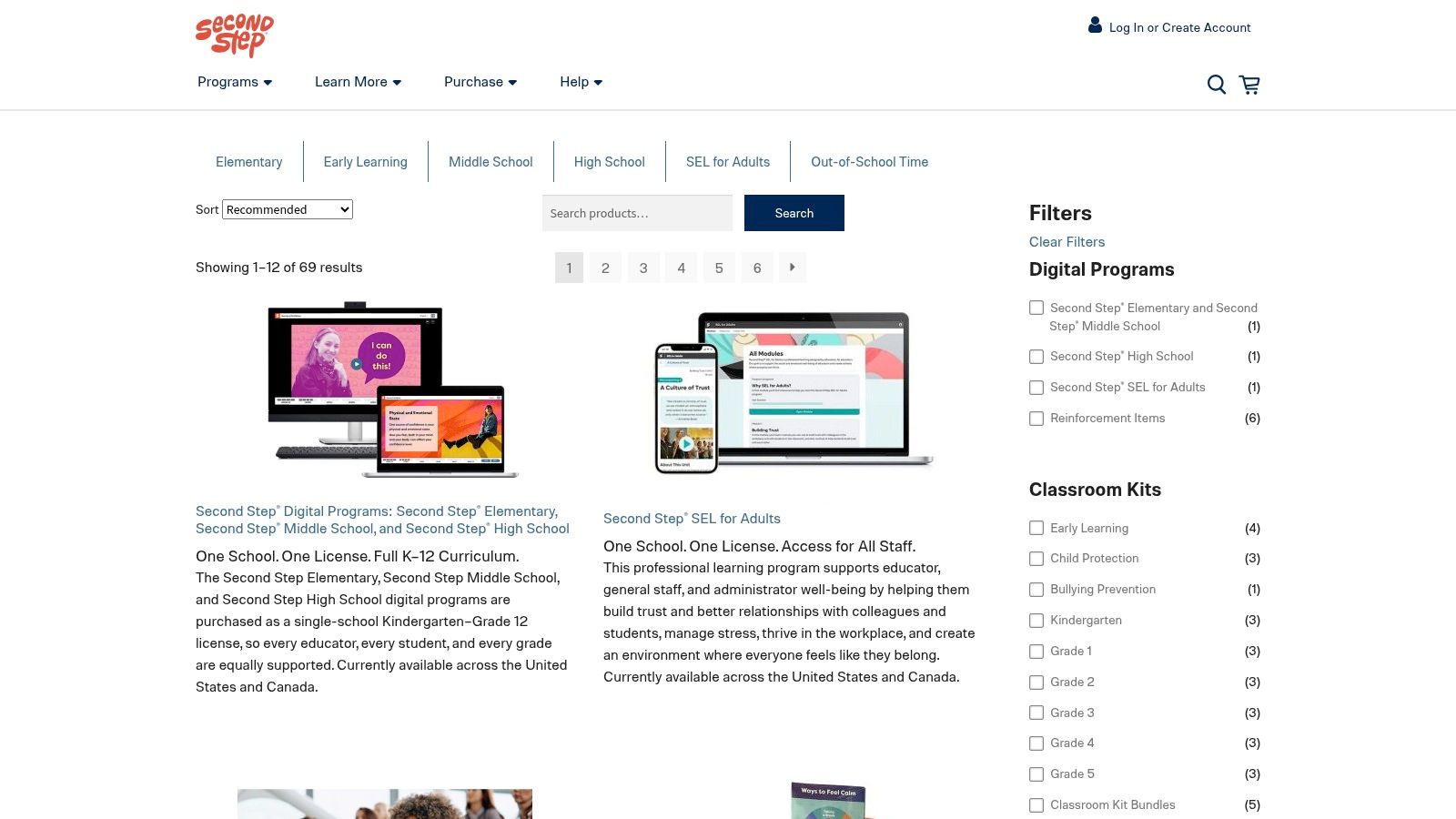
Second Step is a widely adopted, research-based K–8 digital SEL curriculum known for its clear, sequential lesson plans. Committee for Children provides a fully built-out program with grade-banded materials, making it a turnkey solution for schools seeking a structured approach to social emotional learning resources. Its digital format includes multimedia, student handouts, and scripted lessons that ensure consistent delivery across classrooms.
The program’s core strength is its scripted, grade-specific lessons that build skills year over year. A third-grade teacher, for example, can use a ready-made digital lesson on empathy that includes a short video of a relatable scenario, like one child feeling left out at recess. The lesson then provides guided questions for discussion ("How do you think Maria felt when no one asked her to play?") and a partner activity where students practice inviting someone new to join a game. For administrators, the leader dashboard offers a schoolwide view of implementation progress, while optional add-ons for bullying prevention and child protection create a more comprehensive safety net for students.
Key Considerations
Cost & Access: Second Step is a subscription-based program. Pricing is tiered and depends on the number of students and grade levels, which may require careful budgeting for smaller schools. Access is through an online portal after purchasing a school or district license.
Best For:
Schools and districts wanting a complete, ready-to-implement K-8 curriculum.
Teachers who prefer structured, scripted lessons with all materials provided.
Administrators looking for data-driven tools to monitor SEL implementation.
Limitations: The highly scripted nature, while ensuring fidelity, can feel restrictive to some educators who prefer to create or adapt their own lessons. Local adaptation may be needed to make scenarios more relevant to a specific student population.
RULER is a whole-school social emotional learning approach from the Yale Center for Emotional Intelligence, grounded in decades of emotion science. The acronym stands for Recognizing, Understanding, Labeling, Expressing, and Regulating emotions. Instead of a standalone curriculum, RULER focuses on shifting the entire school climate by prioritizing adult SEL skills first, then equipping staff with concrete tools to embed emotional intelligence into daily routines and academic instruction.
The system’s power comes from its practical tools that become part of the school's shared language. For example, classrooms create a Charter, a collaboratively developed document outlining how everyone wants to feel at school, and the Mood Meter helps students and staff identify and label their feelings throughout the day. A teacher might use the Mood Meter during morning meeting, asking students to point to where they are on the grid (e.g., "high energy, low pleasantness" in the red quadrant) and discuss why. A student might share they are in the red quadrant because they are anxious about a test, which creates an opportunity for support. This builds a foundation for meaningful emotional intelligence activities for kids. The Meta-Moment tool teaches a six-step process for pausing and making better choices during emotionally charged situations. These are valuable social emotional learning resources for any school community.
Key Considerations
Cost & Access: RULER requires a two-year training and implementation package for a school-based team, with transparent pricing published on their website for both online and in-person models. This includes access to the RULER Online platform. It is a significant investment in professional development and system-wide change, not a one-off curriculum purchase.
Best For:
Schools and districts committed to a deep, long-term culture shift around emotional intelligence.
Leaders who believe adult SEL is a prerequisite for student SEL.
Educators looking for practical, research-backed tools to integrate into existing school structures.
Limitations: The model requires substantial buy-in and active participation from the entire staff, as it's not a simple lesson-based program. The upfront cost and time commitment for training can be a barrier for some schools.
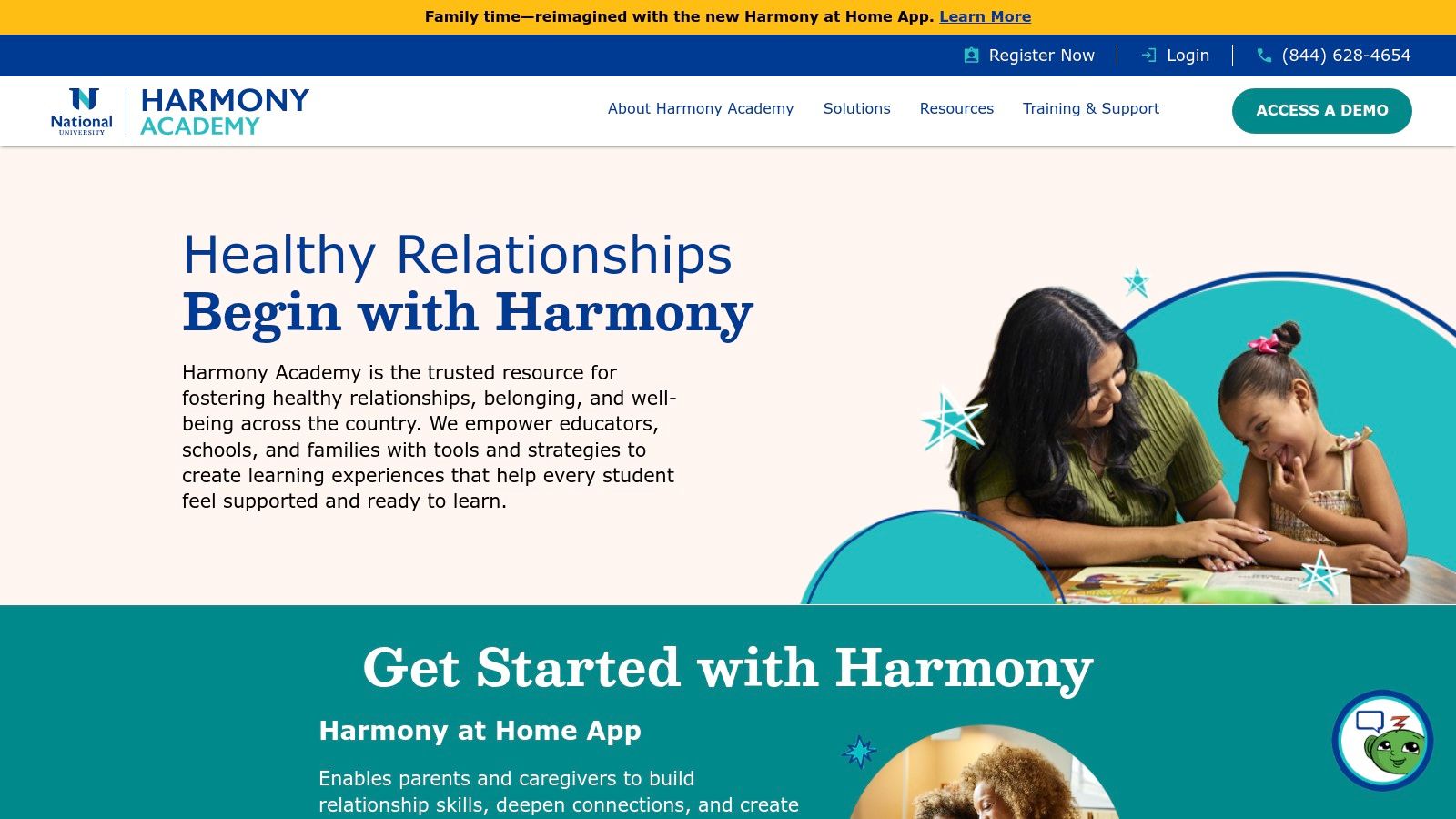
Harmony Academy offers a complete PreK-6 social emotional learning curriculum at no cost, making it a powerful resource for schools looking to implement a high-quality, research-based program without straining their budget. The digital platform provides everything an elementary teacher needs to get started, from lesson plans and activity guides to interactive games. Its design is focused on fostering positive peer relationships, empathy, and effective communication from an early age.
The curriculum's strength is its ready-to-use, practical structure. A second-grade teacher, for example, can use the "Meet Up" and "Buddy Up" activities to build community and practice problem-solving skills daily. In a "Buddy Up" activity, pairs of students might discuss a question like, "What is one way you can show a classmate you care?" before sharing their ideas with the class. Interactive "Harmony Games" provide a fun, digital way for students to apply concepts like diversity and inclusion. Furthermore, the inclusion of at-home resources makes Harmony one of the more family-inclusive social emotional learning resources, helping to reinforce classroom lessons with parents and caregivers.
Key Considerations
Cost & Access: The entire digital curriculum, including all lessons, activities, and training materials, is completely free after a simple registration. Physical material kits may have associated costs, but the core program is accessible without a financial investment.
Best For:
Elementary school teachers and principals looking for a comprehensive, no-cost SEL curriculum.
Schools with limited budgets that need a CASEL-aligned program.
Out-of-school-time programs seeking structured activities that build social skills.
Limitations: The curriculum is designed specifically for PreK-6. Middle schools will need to find a different program for older students. While digital access is excellent, schools that prefer extensive physical materials may need to supplement the program.
6. Responsive Classroom (Center for Responsive Schools)
Responsive Classroom is an evidence-informed teaching approach that weaves social emotional learning into the fabric of daily school life. Rather than providing a separate, weekly SEL lesson, it offers practical strategies for integrating SEL competencies into every interaction and academic task. This approach focuses on creating a positive, engaging classroom climate where students feel safe, valued, and ready to learn, making it a foundational piece for proactive behavior management and academic engagement in K-8 settings.
The platform's strength is its collection of applicable, day-to-day practices like the Morning Meeting, a cornerstone routine that builds community through greeting, sharing, group activities, and a morning message. A teacher can use this 20-minute daily structure to explicitly model and practice listening, empathy, and cooperation. For example, during the "sharing" component, one student shares about their weekend while another student practices active listening by paraphrasing what they heard. Other core strategies include using specific teacher language to reinforce positive behaviors ("I see you're using a quiet voice during independent reading") and interactive modeling to explicitly teach procedures, from how to turn in homework to how to join a group discussion respectfully. These tools make it one of the most practical social emotional learning resources for immediate classroom use.
Key Considerations
Cost & Access: The website offers free articles and introductory information. However, full implementation requires purchasing books, resource kits, and professional development courses. Multi-day workshops (both virtual and in-person) have clear, published fees, and schoolwide training packages are available by quote.
Best For:
K-8 classroom teachers looking for concrete strategies to improve classroom management and culture.
School leaders aiming to build a consistent, schoolwide approach to discipline and community.
New educators seeking a structured framework for establishing a positive learning environment.
Limitations: This is not a scripted, "open-and-go" curriculum for explicit SEL skill instruction. Schools may want to pair it with another program that teaches specific SEL concepts more directly. Effective implementation also depends on staff buy-in and investment in professional training.
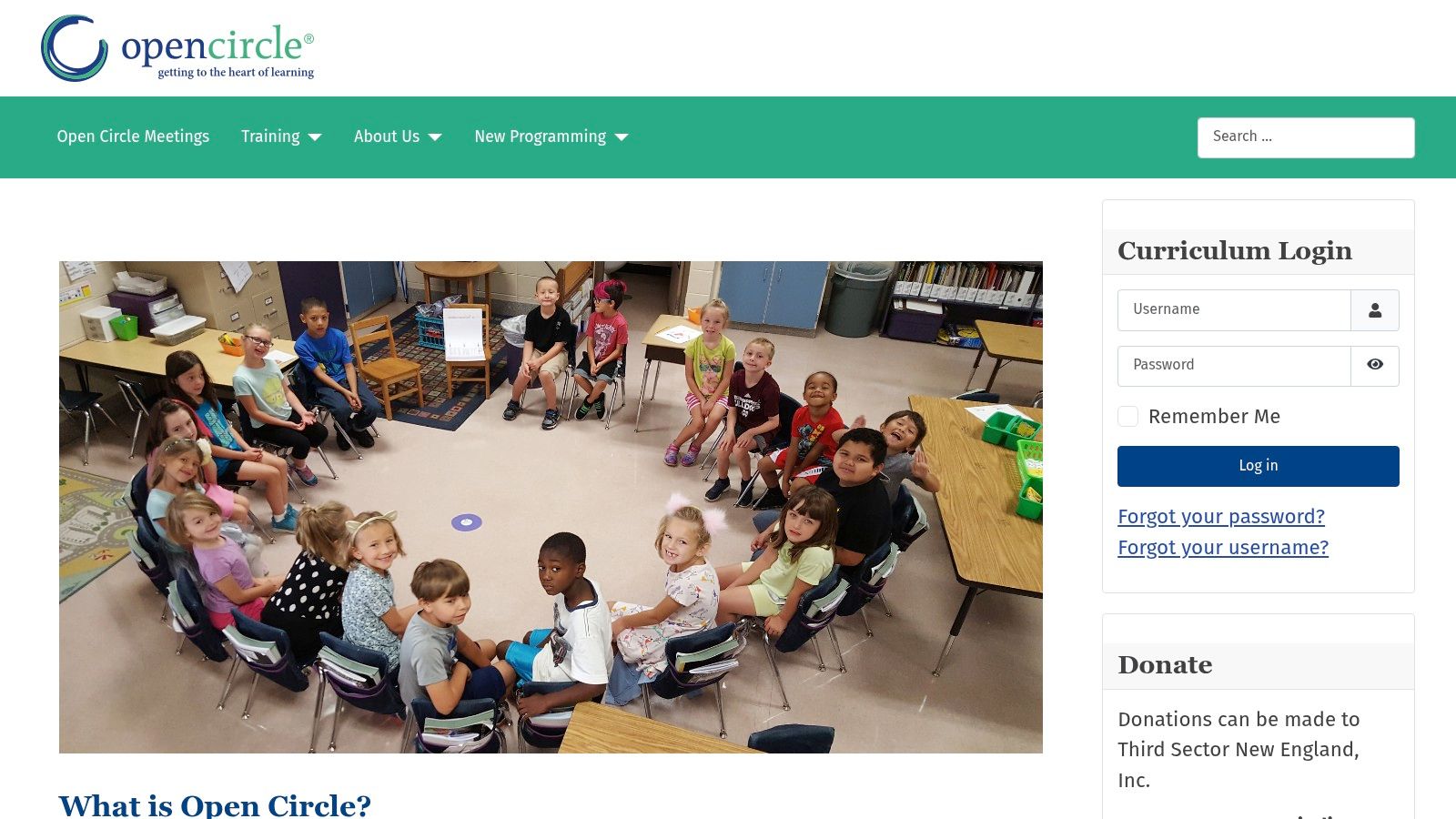
Open Circle is a well-established, evidence-based social emotional learning program specifically designed for elementary schools. Rather than just offering a set of lessons, it provides a comprehensive K–5 curriculum built around structured classroom meetings. This approach focuses on creating routines that embed SEL directly into the school day, making it a foundational part of the classroom culture. For an elementary principal, this program offers a clear path to building a safe, communicative community from the ground up.
The program's core strength is its emphasis on practical routines and teacher training. The classroom meetings provide a consistent format for students to practice self-awareness, relationship skills, and responsible decision-making in a group setting. For example, a second-grade class might use the Open Circle meeting structure to collectively brainstorm solutions to a recurring playground conflict. The teacher would pose the problem, "What can we do when multiple people want to use the same swing at once?" and facilitate as students offer and evaluate ideas like taking turns or setting a timer. This consistent practice makes social problem-solving a familiar and expected part of their day. With its focus on direct instruction and application, the curriculum offers a wealth of kids' social skills activities that are directly tied to classroom life.
Key Considerations
Cost & Access: Program details and pricing are provided after submitting a training inquiry on their website. Open Circle is not a free resource; it is a full curriculum and professional learning package that requires a school or district-level purchase.
Best For:
Elementary school leaders aiming to implement a whole-school SEL model in grades K-5.
K-5 teachers who want a structured, routine-based approach to teaching SEL.
Districts looking for a program with a long history and strong evidence of effectiveness in early grades.
Limitations: The program is specifically designed for the K-5 grade band, meaning middle schools would need to find a different solution. Its effectiveness is closely tied to the professional learning component, so simply buying the materials without the training would not be sufficient.
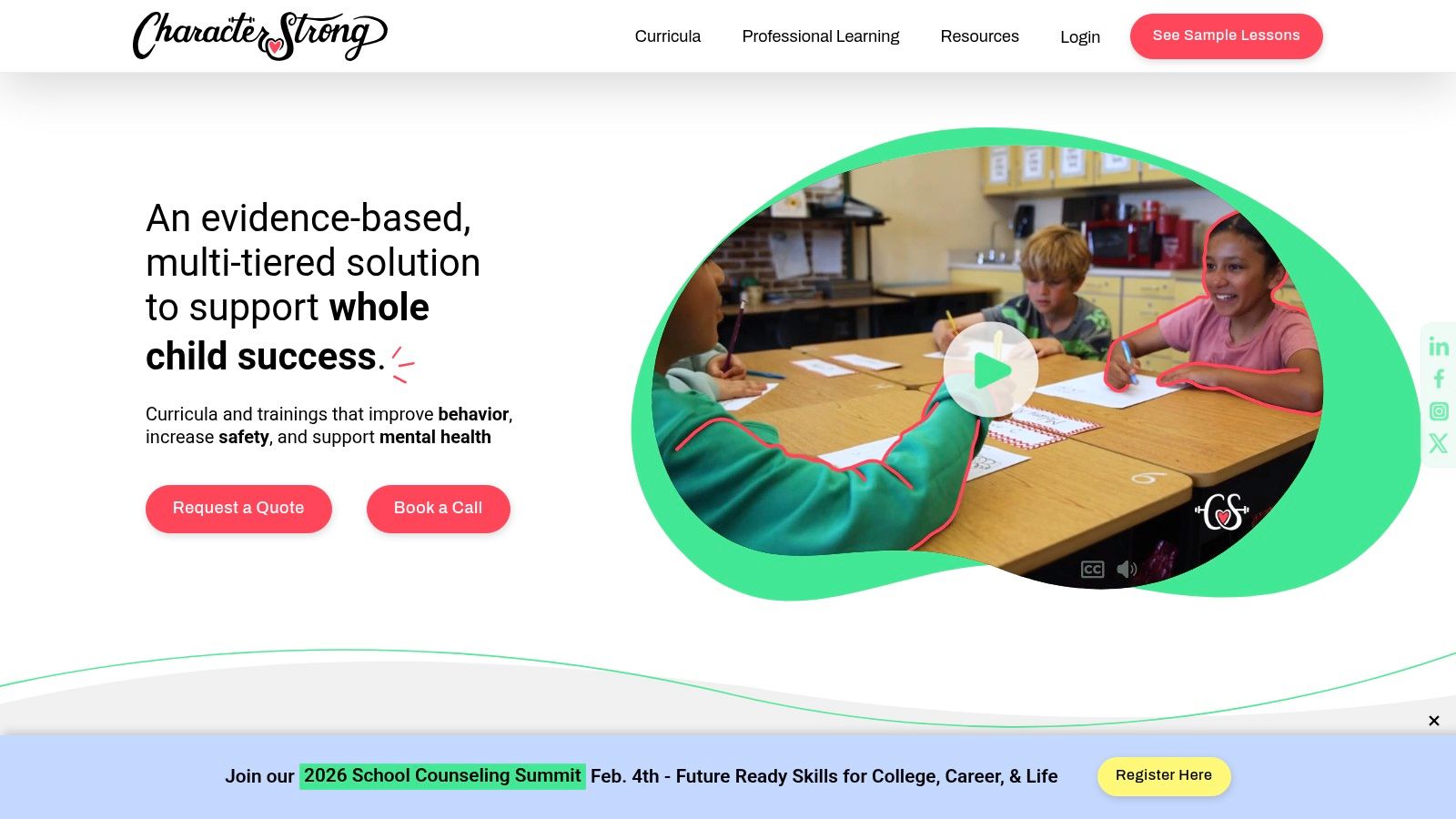
CharacterStrong provides a comprehensive PreK-12 curriculum suite focused on integrating social emotional learning with character development. Rather than being just another set of lesson plans, it offers a vertically aligned framework designed to create a common language and consistent culture across an entire school or district. This whole-child approach bridges elementary, middle, and high school experiences, ensuring students build upon SEL skills year after year.
The platform’s strength is its dual focus on Tier 1 universal instruction and Tier 2 targeted interventions. For example, a 7th-grade advisory teacher can use the core secondary curriculum for weekly lessons on empathy and responsible decision-making. If a counselor identifies a small group of students struggling with conflict, they can use CharacterStrong's specific Tier 2 small-group curriculum to work on those particular skills. A practical activity might involve role-playing a scenario where one friend posts an embarrassing photo of another, and the group practices how to respond assertively and respectfully. This layered support helps schools meet diverse student needs within one system, an essential component for building resilience in children. The inclusion of family newsletters and implementation resources also helps extend learning beyond the classroom.
Key Considerations
Cost & Access: Access is provided through a school or district-level license. Pricing is not publicly listed and requires schools to request a quote. This model simplifies budgeting for administrators by covering an entire site rather than charging per student.
Best For:
Schools and districts seeking a unified, PreK-12 SEL and character curriculum.
Counselors in need of structured Tier 2 small-group intervention materials.
SEL leadership teams aiming to build a consistent, school-wide culture and vocabulary.
Limitations: The curriculum is designed for regular, structured implementation, not as a drop-in resource. Schools that prefer fully scripted, daily SEL lessons may find they need to supplement CharacterStrong’s advisory or weekly model.
Move This World delivers a dynamic, video-based SEL curriculum for grades PreK-12, built around short, daily practices. Its core philosophy is that emotional wellbeing is built through consistent, manageable routines rather than occasional, lengthy lessons. For teachers juggling packed schedules, the platform offers a "plug-and-play" solution that integrates social emotional learning into the school day with minimal preparation, making it an accessible entry point for school-wide implementation.
The platform’s standout feature is its library of on-demand, high-energy videos designed as daily rituals. A second-grade teacher, for example, could start the day with a 3-minute "Emotion Motion" video where students physically act out feelings like excitement or frustration, helping them build an emotional vocabulary through movement. A practical application for parents could be using a similar "calm down" video from the family resources to help a child manage big feelings at home before bedtime. By providing these consistent micro-practices, Move This World helps schools establish a shared language and routine around emotional health, which is a key component of effective social emotional learning resources.
Key Considerations
Cost & Access: Access requires a school or district-level subscription, and pricing is provided via a custom quote. It is not available for individual teacher or parent purchase. Reliable internet bandwidth and classroom devices are necessary to stream the video content.
Best For:
Schools seeking a low-prep, daily SEL routine that is easy to implement consistently.
Teachers who prefer guided video content over creating lessons from scratch.
Districts aiming to build a common emotional language across all grade levels.
Limitations: The reliance on video may not suit all teaching styles or student needs. Schools looking for deep, project-based SEL work might find the micro-practice format less extensive than other curricula.
Aperture Education offers a strengths-based approach to SEL data, moving beyond simply identifying deficits to actively measuring and growing student competencies. Its platform is built around the well-regarded Devereux Student Strengths Assessment (DESSA), providing schools with a robust system for universal screening, progress monitoring, and targeted intervention planning. This is an essential tool for districts aiming to implement a data-driven Multi-Tiered System of Supports (MTSS) for social emotional well-being.
The platform’s standout feature is the direct link between assessment data and actionable strategies. After a teacher completes a DESSA rating for a student, the system generates a report highlighting areas of strength and need. More importantly, it provides a "strategy playbook" with specific, evidence-based activities to address those needs. For example, if a student’s assessment shows a need in self-management, the platform might suggest a "stop-and-think" breathing exercise or a goal-setting worksheet. The teacher can then implement that strategy for two weeks and use the platform's progress monitoring tool to see if it's making a difference, directly connecting data to practical classroom support. This integration makes it a valuable collection of social emotional learning resources.
Key Considerations
Cost & Access: Access to the DESSA System is subscription-based, with pricing dependent on district size and package selection. Schools must contact Aperture Education directly for a quote. While the platform is a paid service, the company often provides free webinars and resources.
Best For:
School counselors and psychologists implementing data-driven SEL interventions within an MTSS framework.
District leaders seeking a valid, reliable tool for universal screening and program evaluation.
Teachers who need practical, data-informed strategies to support individual student needs in the classroom.
Limitations: Aperture Education provides the assessment and strategy framework, not a core Tier 1 SEL curriculum for daily instruction. Schools will need to pair it with a separate instructional program to build foundational skills for all students.
The Zones of Regulation is a widely adopted self-regulation framework that provides a systematic, cognitive-behavioral approach to teaching emotional control. Its core strength is a simple, visual system using four color-coded zones to help students identify their feelings and level of alertness. It offers a structured curriculum and professional learning that gives schools a common, non-judgmental language to discuss emotions and the tools needed to manage them, making it one of the most practical social emotional learning resources for immediate classroom use.
The platform provides a digital curriculum subscription with extensive implementation guides and fidelity checklists to ensure proper school-wide rollout. For example, a teacher can introduce the Blue Zone (sad, sick, tired) and have students identify what that feels like in their bodies. Then, the class co-creates a list of tools to use when in the Blue Zone, like getting a drink of water, taking a brief rest in the calm-down corner, or asking to talk to an adult. At home, a parent can create a similar "Zones" poster and help their child identify they are in the "Yellow Zone" (frustrated, anxious) before a challenging homework assignment, and then practice a calming strategy together. This concrete connection between an internal state (the Zone) and an actionable strategy is what makes the framework so effective for students across general and special education populations.
Key Considerations
Cost & Access: The website offers many free resources and samples to get started. The full curriculum, books, and posters require purchase. A digital subscription is available with per-user licenses, which can become costly for larger staff teams without institutional pricing. Professional learning is also offered in on-demand bundles and live training formats for an additional fee.
Best For:
Special and general education teachers needing a concrete visual system for self-regulation.
School counselors using a common language in small groups or individual sessions.
Schools aiming to build a tiered system of support (MTSS) for behavior and emotional management.
Limitations: The framework is most effective when integrated with broader SEL instruction on empathy, relationship skills, and responsible decision-making. It is a tool for self-regulation, not a complete SEL program on its own.
12. Panorama Education (Surveys, Check-Ins, and Playbook)
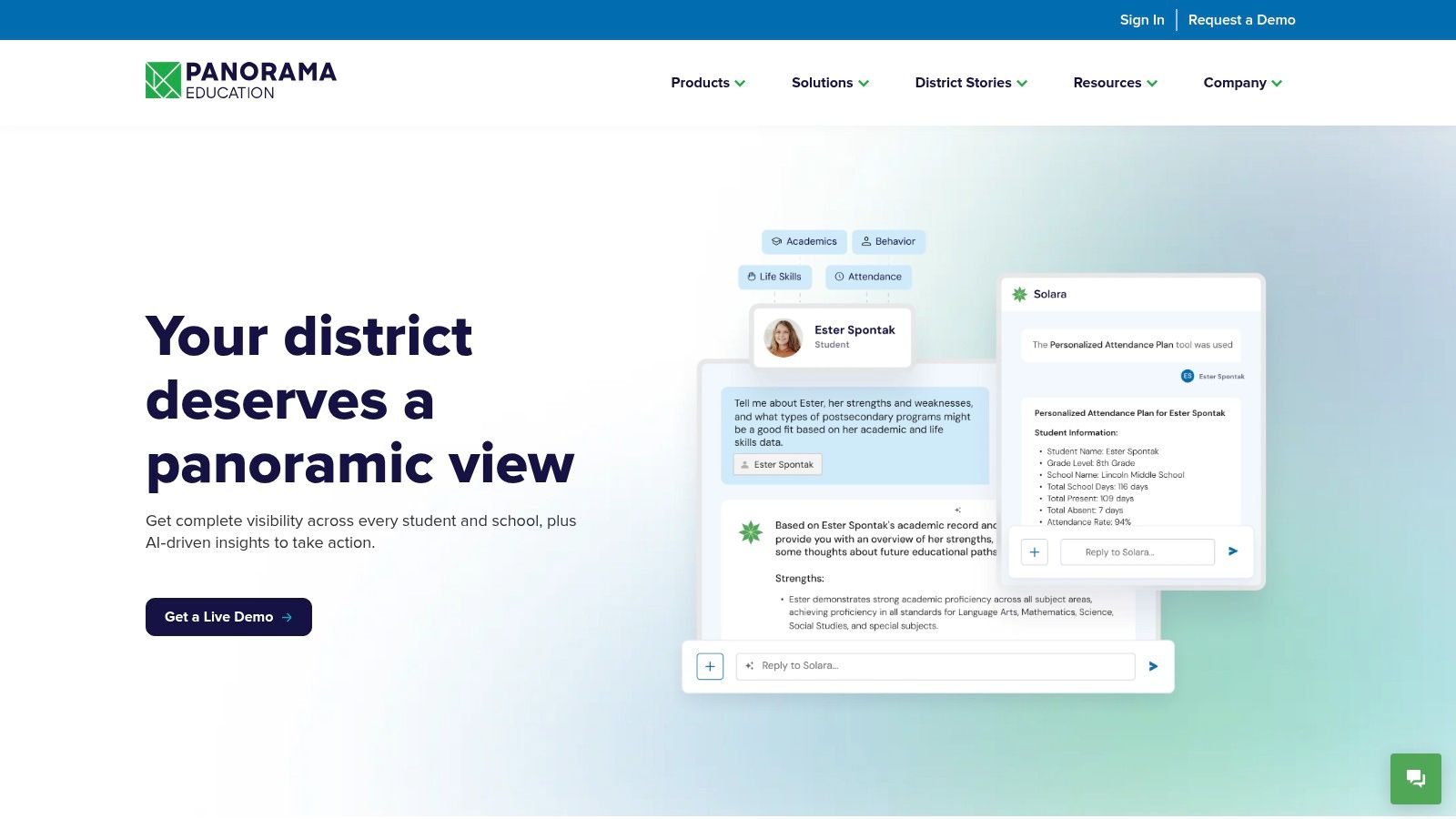
Panorama Education is a data platform designed for K-12 districts to measure, understand, and act on social emotional learning and school climate information. Instead of providing a direct SEL curriculum, it offers a suite of tools that help leaders gather perception data from students, families, and staff. For a district administrator, this is the engine for a data-driven approach, allowing them to pinpoint needs, monitor progress, and provide targeted support at a systemic level.
The platform’s standout feature is its combination of robust, research-backed Surveys with actionable tools. For example, after a district-wide survey reveals that 7th-grade students are struggling with self-management, a teacher can use Quick Check-Ins to get real-time feedback from specific students on that topic. A student might respond to a prompt like, "How well were you able to manage your time this week?" The integrated Playbook then suggests evidence-based strategies, like a "Two-Minute Check-In" activity or a "Weekly Goal Setting" worksheet, that a teacher can immediately use to support those students. This makes it a powerful resource among social emotional learning resources for connecting large-scale data to individual student support.
Key Considerations
Cost & Access: Access is priced at the district level and requires a custom quote based on student enrollment and selected modules. While the platform itself is a paid service, Panorama makes its validated survey instruments available open-source for any educator to use.
Best For:
District leaders implementing a large-scale SEL and school climate measurement strategy.
Principals and school counselors looking to connect student data to MTSS/intervention tiers.
Teachers seeking quick, data-informed ways to support individual student well-being.
Limitations: This is a measurement and response tool, not a standalone SEL curriculum. It tells you what to address but does not provide the core instructional lessons to teach SEL skills comprehensively.
Evidence‑informed approach; national trainings and resources
Training fees published; full staff onboarding requires time/cost
Open Circle (Wellesley Centers for Women)
K–5 curriculum focused on classroom meetings, routines, relationship skills
Grade-banded lessons + teacher professional learning
Elementary schools building safe, caring classroom communities
Longstanding use; external evidence reviews support effectiveness
Program/pricing via training inquiry; details by request
CharacterStrong
PreK–12 SEL + character development suite with tiered interventions
Digital curricula, Tier 2 small-group materials, family newsletters
PreK–12 schools seeking continuity across grades
CASEL-aligned maps; regular content updates
License model (often per site); pricing by quote
Move This World
Short video-based daily rituals for emotional vocabulary & regulation
On‑demand videos, micro‑practices, coaching for rollout
Schools wanting low‑prep, consistent daily SEL routines
Practical implementation focus; classroom‑friendly format
Quote-based pricing; depends on district scale and bandwidth needs
Aperture Education (DESSA System)
SEL assessment + playbook: universal screening, progress monitoring
DESSA assessments, staff dashboards, strategy playbook, PD
Districts using MTSS/data-driven SEL to target supports
Widely recognized, strengths‑based assessment suite
Package pricing varies by district; quotes required
The Zones of Regulation
Visual self‑regulation framework using color "zones" and strategies
Digital curriculum subscription, fidelity supports, trainings
General and special education; MTSS tiers from whole-class to small groups
Widely used; extensive free samples and training options
Per-user licenses for digital content; costs scale with staff size
Panorama Education
Survey & analytics platform for student/family/staff well‑being
Validated surveys, Quick Check‑Ins, Playbook strategies, multilingual support
Districts measuring climate, SEL, family engagement at scale
Research-backed instruments; robust reporting and disaggregation
Enrollment/module-based pricing; quotes required
Putting It All Together: Building a Thriving School Community
Navigating the extensive landscape of social emotional learning resources can feel like an overwhelming task. This guide has presented a curated collection, from comprehensive programs like Second Step and CharacterStrong to specialized tools like The Zones of Regulation and assessment systems from Aperture Education. The goal was not simply to list options but to provide a clear framework for selecting and implementing the right resources for your unique school community.
The central takeaway is that there is no single "best" SEL resource. The most successful schools often create a mosaic of tools, blending a foundational curriculum with school-wide cultural initiatives and targeted support systems. An effective SEL strategy is not an add-on; it is woven into the very fabric of the school day.
From Selection to Successful Implementation
Choosing the right tool is just the beginning. The real work lies in thoughtful implementation, which requires a clear understanding of your starting point. Before committing to a program, consider what your specific data tells you.
For schools noticing increased conflicts on the playground: A program like Soul Shoppe, which focuses on peer mediation and conflict resolution skills through assemblies and workshops, could be a powerful, high-impact intervention.
For educators wanting to integrate SEL into daily academics: Methodologies like Responsive Classroom offer practical strategies for morning meetings and academic choice that build community without requiring a separate block of instruction time.
For administrators seeking a data-driven approach: Using Panorama Education's surveys to gather baseline student voice on school climate can pinpoint specific areas of need, such as a sense of belonging or emotion regulation, guiding your selection of a targeted program like RULER or Harmony.
Successful implementation also depends on buy-in and support. It is essential to provide teachers with high-quality professional development, ongoing coaching, and the time to collaborate. When educators feel confident and equipped, they are better able to model SEL skills for their students, creating a ripple effect throughout the school.
The Critical Home-School Connection
A truly supportive ecosystem for children extends beyond the classroom walls. For students to truly thrive in a school community, a supportive home environment is crucial. When SEL principles are reinforced at home, the skills students learn in school become more deeply ingrained.
Families can play a significant role by actively setting family goals that improve communication and connection, fostering social-emotional skills from a young age. This partnership is vital. Consider hosting parent workshops or sharing resources that help caregivers understand the language and concepts being taught at school. When a child uses a term like "being in the blue zone," a parent who understands the framework can provide more effective support.
Ultimately, the journey of building a thriving, emotionally intelligent school community is a continuous one. It requires patience, collaboration, and a commitment to seeing every student as a whole person. The social emotional learning resources detailed in this article are powerful tools, but their true potential is only unlocked when wielded by dedicated educators and engaged families who believe in the profound importance of teaching skills for life, not just for the classroom. By taking a strategic and heartfelt approach, you can create a place where every child feels seen, heard, and equipped to navigate their world with kindness, confidence, and resilience.
Ready to move from resource selection to cultural transformation? Soul Shoppe provides the assemblies, parent workshops, and on-site support to unite your entire community around a shared language of empathy and respect. See how we can help build a climate of kindness and psychological safety at your school by visiting Soul Shoppe.
In today’s elementary schools, the need for robust social-emotional learning (SEL) has never been more apparent. Moving beyond a simple classroom management tool, effective SEL is foundational to building a thriving school culture where students feel safe, understood, and equipped to succeed. It directly impacts academic achievement, reduces behavioral issues, and provides children with essential life skills like self-awareness, empathy, and responsible decision-making. The core challenge for principals, counselors, and district leaders is navigating the crowded market of sel programs for elementary schools to find one that genuinely aligns with their community’s unique needs, budget, and implementation capacity.
This guide is designed to solve that exact problem. We will provide a clear, comprehensive roundup of seven leading programs, moving beyond marketing claims to offer actionable insights. For each program, you’ll find a concise profile, key features, and practical examples that teachers and parents can use to support students. We’ll explore how one program might use a puppet to teach conflict resolution in kindergarten, while another might use digital scenarios to help fifth graders practice responsible social media use. While fostering this environment primarily involves robust programming, schools also often utilize complementary tools to build community, such as exploring strategic uses of promotional products for schools to reinforce core values.
Our goal is to equip you with the specific information needed to make a confident and informed decision for your students. To help you compare options as you read, we’ve organized the key data for each program into a scannable comparison matrix at the end of the article. Let’s dive in.
1. Soul Shoppe
Soul Shoppe stands out as a comprehensive and deeply experienced partner for schools seeking to build a resilient, empathetic, and communicative campus culture. With over two decades of dedicated work in K-8 schools, this organization offers one of the most robust and flexible sel programs for elementary schools, combining research-backed curriculum with dynamic, experiential learning. Their approach moves beyond simple lesson plans, focusing on creating a shared language and practical tools that students, staff, and families can use to navigate complex social and emotional landscapes.
The core of Soul Shoppe’s methodology is its focus on whole-community transformation. They understand that for SEL to be effective, it must be integrated into every aspect of the school day. This is achieved through a multi-faceted delivery model that includes interactive student workshops, powerful school-wide assemblies, and ongoing professional development and coaching for educators. This ensures that the principles of self-regulation, conflict resolution, and empathy are not just taught, but consistently modeled and reinforced by all adults in the community.
Key Features and Practical Applications
Soul Shoppe excels in translating SEL theory into actionable, everyday skills. Their programs are designed to be immediately applicable, equipping students with tools to handle real-world challenges.
Experiential Learning: Instead of passive instruction, students engage in role-playing and interactive activities. For example, in a workshop on conflict resolution, students might practice using “I-statements” to express their feelings during a simulated disagreement over a playground game, learning to say, “I feel frustrated when I don’t get a turn,” instead of, “You’re hogging the ball!”
Flexible Delivery Formats: Schools can choose the level of engagement that fits their needs and budget, from a single, high-impact assembly to kick off an anti-bullying campaign, to a year-long, embedded coaching program for teachers. They also offer a digital app and online courses, making SEL accessible for at-home reinforcement.
Whole-Community Focus: Soul Shoppe provides resources for parents and hosts community-building events like the Peaceful Warriors Summit. This extends the learning beyond the classroom, creating a cohesive support system for children. For instance, parents might receive a newsletter with conversation starters about empathy, such as asking, “How do you think your friend felt when you shared your snack today?” mirroring the language their child is learning in school.
Strong Credibility: The organization’s impact is backed by a 20+ year track record and recognized thought leadership, including a TEDx talk by founder Vicki Abadesco and partnerships with respected initiatives like the Junior Giants. You can explore more ideas on their blog, which details a variety of social-emotional learning activities for elementary students.
Implementation Insight: For a school just beginning its SEL journey, a great starting point with Soul Shoppe is their “Peacemaker Program” assembly. This single event can introduce core concepts and a common vocabulary school-wide, creating immediate momentum and buy-in from both students and staff for deeper programming later.
Program Details and Considerations
Category
Details
Grade Band
Kindergarten–8th Grade
Delivery Format
On-site (assemblies, workshops, coaching), Digital (app, online courses), Hybrid models
Cost Range
Customized pricing. Schools and districts must contact Soul Shoppe for a quote based on specific needs, number of students, and delivery format.
Evidence Level
Research-based and evidence-informed. Backed by over 20 years of implementation data and positive school climate outcomes.
Pros:
Proven, research-based curriculum with a long history of success.
Highly flexible delivery options cater to diverse school needs and budgets.
Focuses on building psychological safety and empathy for the entire school community.
Exceptional credibility through founder expertise and high-profile partnerships.
Cons:
Pricing is not publicly listed, requiring direct contact for a quote, which can slow down initial budget planning.
Primarily designed for K-8, so high schools may need to seek more age-specific resources.
Soul Shoppe is an excellent choice for elementary and middle schools ready to invest in a holistic, relationship-centered SEL partner. Its blend of direct instruction, community engagement, and flexible programming makes it one of the most effective and adaptable sel programs for elementary schools available today.
As one of the most widely recognized and research-backed SEL programs for elementary schools, Second Step from the Committee for Children offers a robust, turnkey solution for schools seeking a structured and comprehensive curriculum. The platform is designed for easy implementation, providing educators with everything they need to deliver consistent, high-quality social-emotional instruction right out of the box.
Second Step stands out for its clarity and ease of use. Each lesson is meticulously scripted and supported by engaging songs, puppets (for younger grades), and short video clips that capture student attention. This structured approach ensures fidelity of implementation across classrooms and grade levels, a key factor for achieving school-wide impact.
Key Features and Implementation
The program is organized into grade-specific units that align with core SEL domains. For example, a kindergarten lesson might feature a puppet who is feeling angry. The teacher guides students to help the puppet identify the feeling (“He’s mad!”) and then practice a calming strategy together, like taking “belly breaths.” This directly builds self-awareness and self-management skills.
Delivery Formats: Schools can choose between grade-banded physical classroom kits (Early Learning–Grade 5) or a more flexible digital license (K–8). The digital format includes streaming media, online training, and easier access to materials.
Specialized Units: Beyond the core curriculum, Second Step offers crucial add-on units for Bullying Prevention and Child Protection, allowing schools to address specific safety concerns within the same framework.
Language Support: Recognizing diverse student populations, the program provides Spanish-language resources for students and families from Early Learning through Grade 3.
Practical Tip: Use the provided family communication letters (available in multiple languages) after completing each unit. For instance, after a unit on problem-solving, a parent might get a letter suggesting they ask their child, “What was a problem you solved at school today? What steps did you take?” This reinforces learning by connecting classroom skills to home life.
Program Details
Feature
Description
Grade Band
Early Learning–Grade 8
Format
Physical classroom kits (PK–5) or school/district-wide digital license (K–8)
Cost Range
Kits start around $300-$500 per grade; digital licenses are tiered by enrollment and term (request a quote).
Evidence
Strong (ESSA Level 1). Meets CASEL’s “SELect” program designation.
Best Fit For
Schools and districts looking for a proven, structured, and easy-to-implement program with extensive support resources.
While the upfront cost for a full-school implementation can be significant, the program’s strong evidence base and comprehensive support often provide a clear return on investment. The website allows for single-site purchases of kits, but district leaders should contact the sales team directly for quotes on digital licenses or multi-site discounts to navigate the various product bundles effectively. Understanding the foundational concepts of SEL can also help educators maximize the program’s impact; you can explore the five core SEL competencies to deepen your team’s knowledge.
3. Harmony Academy (National University) – Harmony SEL
Harmony SEL, offered through National University’s Harmony Academy, presents an incredibly accessible and relationship-focused approach to social-emotional learning. What makes this program a standout choice is its no-cost digital curriculum, removing the significant financial barrier that can prevent schools from adopting high-quality SEL programs for elementary schools. It is designed to foster positive peer relationships and build an inclusive classroom environment from the very start.
The program’s core philosophy centers on connection and communication, using specific routines and activities to build community. Rather than just teaching concepts, Harmony SEL integrates practices like “Meet Up” and “Buddy Up,” which are daily and weekly routines where students engage in structured, collaborative conversations and activities. This emphasis on peer-to-peer interaction makes the learning practical and immediately applicable.
Key Features and Implementation
Harmony’s lessons are built around five key themes: Diversity and Inclusion, Empathy and Critical Thinking, Communication, Problem Solving, and Peer Relationships. For example, a “Buddy Up” activity might pair students to discuss a story where a character feels misunderstood. They would use provided question cards like, “How could the other character have listened better?” to practice active listening and perspective-taking, directly building empathy and communication skills.
Delivery Formats: The primary format is a comprehensive, no-cost digital curriculum for Pre-K–6, accessible after a simple online registration. This includes lesson plans, activities, stories, and games.
Professional Development: Harmony Academy offers a wealth of support, including live and on-demand online training sessions and product demos. This ensures educators feel confident implementing the curriculum with fidelity.
University Backing: Being part of National University, the program is grounded in research and benefits from district-facing initiatives and partnerships for schools seeking deeper engagement.
Practical Tip: Fully commit to the “Meet Up” and “Buddy Up” routines. For “Meet Up,” start each day with a greeting and a sharing question like, “What is one thing you are looking forward to today?” This simple, consistent ritual builds community and gives every student a voice, setting a positive tone for learning.
Program Details
Feature
Description
Grade Band
Pre-K–Grade 6
Format
No-cost digital curriculum and online portal. Print materials are also available for purchase.
Cost Range
Free for the core digital Pre-K–6 curriculum and online training. Deeper, customized professional development for districts may have associated costs.
Evidence
Promising (ESSA Level 3). Recognized by CASEL as a “Promising Program.”
Best Fit For
Schools and districts seeking a high-quality, research-informed, no-cost core SEL curriculum, especially those prioritizing community-building and peer relationships.
The low barrier to entry makes Harmony SEL an excellent choice for any school, but particularly for those with limited budgets. The focus on building a strong classroom community is a core strength; you can find more ideas for classroom community-building activities that pair well with Harmony’s philosophy. While the program is free, schools should plan to invest time in the provided training to maximize its impact and understand its relationship-centered approach.
The PATHS (Promoting Alternative Thinking Strategies) Program is a highly respected, evidence-based curriculum recognized as one of the cornerstone SEL programs for elementary schools. It provides a comprehensive, classroom-based model designed to promote emotional literacy, self-control, and positive interpersonal problem-solving skills, all critical components for a healthy school climate.
PATHS stands out for its deep focus on emotional vocabulary and a structured problem-solving framework. The curriculum uses concrete tools like “Feeling Faces” cards and fully scripted lessons that guide teachers through complex topics with clarity and confidence. This structured approach helps ensure that all students receive consistent instruction in core emotional regulation and social skills.
Key Features and Implementation
The program is delivered through grade-specific classroom implementation packages that contain all necessary materials. A typical first-grade lesson might involve introducing a new feeling like “frustrated” using a Feeling Face card. The teacher then reads a story about a character feeling frustrated and guides students to practice the “Control Signals” technique (a three-step process of stopping, taking a long deep breath, and saying the problem) before discussing a solution.
Delivery Formats: The program is primarily sold as physical grade-level classroom implementation packages, which include manuals, posters, feeling cards, and other hands-on materials.
Training Included: Every classroom package now includes access to a self-paced online instructor training module, removing a common barrier to effective implementation. Optional on-site workshops can be purchased for more in-depth, hands-on professional development.
Bilingual Resources: To support diverse classroom communities, the program offers home-connection resources and other materials in both English and Spanish.
Practical Tip: Consistently use the “Problem-Solving Steps” posters during class meetings and even for minor classroom conflicts. When students have a disagreement on the playground, guide them through the steps on the poster: 1. Stop and calm down, 2. Say the problem and how you feel, 3. Set a positive goal, etc. This repetition embeds the framework into their daily interactions.
Program Details
Feature
Description
Grade Band
Preschool–Grade 5
Format
Grade-specific physical classroom kits with included online training; optional on-site professional development available.
Cost Range
Classroom kits are priced per grade, typically ranging from $700-$900. Purchases can be made directly from the website’s e-commerce store.
Evidence
Strong (ESSA Level 1). Meets CASEL’s “SELect” program designation.
Best Fit For
Schools seeking a structured, evidence-based curriculum with tangible, hands-on materials and a strong focus on emotional vocabulary.
While a full-school implementation requires purchasing multiple grade-level packages, the inclusion of online training adds significant value and lowers the initial barrier to entry. The program’s emphasis on explicit instruction makes it an excellent choice for building foundational skills. Educators can enhance this learning by incorporating supplemental emotional intelligence activities for kids to provide even more opportunities for practice.
Learn more at: shop.pathsprogram.com
5. Positive Action
Positive Action offers a unique, philosophy-driven approach among SEL programs for elementary schools, framing social-emotional learning through the intuitive concept that positive thoughts lead to positive actions, which in turn lead to positive feelings. This Pre-K through Grade 6 curriculum is delivered via comprehensive, ready-to-use classroom kits, making it a straightforward choice for schools that prefer tangible, hands-on materials for daily instruction.
What sets Positive Action apart is its spiraling curriculum built around six core units: Self-Concept, Positive Actions for Body and Mind, Managing Yourself Responsibly, Treating Others the Way You Like to be Treated, Telling Yourself the Truth, and Improving Yourself Continually. The lessons are brief (around 15 minutes), scripted, and designed for easy integration into the school day, ensuring teachers can consistently reinforce these foundational concepts.
Key Features and Implementation
The program is structured with grade-specific kits that include everything from teacher’s manuals and posters to puppets and activity sheets. For example, a first-grade lesson might involve reading a story from the kit about being a good friend. The teacher then facilitates a discussion about the positive action of sharing, connecting it to the positive feeling of happiness that comes from making a friend feel included. This concrete, action-oriented approach helps young learners internalize complex social skills.
Delivery Formats: The primary format is physical classroom kits (Pre-K–6), available as starter, combo, or refresher packages. Select kits also include access to Pasela, the embedded digital license for supplementary online resources.
Transparent Purchasing: The website is designed for school procurement, with clear, itemized pricing and district-friendly options like purchase order acceptance and multi-address shipping.
Comprehensive Support: Beyond the materials, the program is backed by strong customer support via phone and email, with clear policies for returns and exchanges posted online.
Practical Tip: Use the program’s “reinforcement activities,” like the provided coloring sheets or take-home notes, to create a bridge between school and home. When a student demonstrates a positive action, like helping a classmate clean up a spill, a teacher can send home a pre-made “Positive Action Note” celebrating it. This provides powerful positive reinforcement and keeps parents informed and engaged.
Program Details
Feature
Description
Grade Band
Pre-K–Grade 12 (with a strong focus on elementary Pre-K–6)
Format
Physical classroom kits with hands-on materials. An embedded digital license (Pasela) is included with some kit options.
Cost Range
Kits are priced per grade, starting around $400 for a refresher kit to over $1,200 for a deluxe combo kit. Pricing is transparent on the website.
Evidence
Strong (ESSA Level 1). Listed on the National Registry of Evidence-based Programs and Practices (NREPP).
Best Fit For
Schools and districts seeking a scripted, kit-based program with a strong evidence base and a simple, unifying philosophy that is easy for students and staff to grasp.
While purchasing full K-6 coverage requires buying multiple individual kits, the transparent pricing and clear kit contents on the website simplify the budgeting process for administrators. The structured, 15-minute lessons make it highly adaptable for teachers with packed schedules, ensuring that consistent SEL instruction can happen without significant disruption to core academic time.
6. CharacterStrong (PurposeFull People for Elementary)
CharacterStrong offers a dynamic and holistic approach to social-emotional learning, integrating character development directly into its framework. Their elementary curriculum, known as PurposeFull People, is designed to build not just SEL competencies but also essential character traits like kindness, respect, and perseverance. This dual focus makes it one of the most comprehensive SEL programs for elementary schools for leaders aiming to cultivate a positive and proactive school culture.
The digital curriculum is built around a clear, vertically aligned scope and sequence from Pre-K to 5th grade, ensuring that skills are scaffolded year after year. CharacterStrong stands out by providing ongoing support, professional development, and continuous product updates, treating implementation as a long-term partnership rather than a one-time purchase. This model supports whole-school adoption and helps sustain the program’s impact over time.
Key Features and Implementation
PurposeFull People delivers daily, bite-sized lessons that are easy for teachers to integrate into their existing routines. For example, a first-grade lesson on courage might involve a short “Courageous Conversation” prompt where students share a time they felt brave, such as trying a new food or speaking in front of the class. This is followed by a brief activity practicing how to support a friend who is feeling scared, such as saying, “You can do it!”
Delivery Format: The curriculum is fully digital and sold via a per-building (site) license, which includes access for all staff, implementation support, and professional development resources.
Tiered Support: The platform includes tools and strategies for both Tier 1 (universal) and Tier 2 (targeted) interventions, helping schools meet the needs of all students.
Whole-Child Focus: Lessons explicitly connect SEL skills (like self-awareness) with character traits (like honesty), providing a more rounded approach to student development.
Practical Tip: Utilize the “Character Dares” included in the curriculum. These are simple, actionable challenges (e.g., “Give a genuine compliment to three different people today”) that encourage students to practice character traits in authentic ways throughout the school day, moving learning beyond the lesson itself.
Program Details
Feature
Description
Grade Band
Pre-K–Grade 5 (with separate curricula for Middle and High School)
Format
Digital curriculum delivered through a school-wide site license.
Cost Range
Pricing is based on school enrollment and requires a custom quote from the sales team. It is not available for single-classroom purchase.
Evidence
Promising (ESSA Level 3). Has an evidence profile available through the Evidence for ESSA clearinghouse.
Best Fit For
Schools and districts committed to a whole-school implementation model that pairs SEL with character development and values ongoing support.
The site-license model makes CharacterStrong less suitable for individual teachers seeking a resource, but it is an excellent fit for school leaders who want to build a unified, campus-wide culture. Because pricing is not publicly listed, administrators should connect with the CharacterStrong team to get a detailed quote and discuss the robust implementation support and professional development included in the package.
Built on a foundation of mindset-based learning, 7 Mindsets offers a distinct approach to social-emotional development. Unlike programs that focus solely on discrete skills, this platform integrates SEL into a framework of empowering beliefs, making it one of the more unique SEL programs for elementary schools. It is designed as a digital-first, teacher-led curriculum that requires minimal prep time, allowing educators to focus more on delivery and student connection.
7 Mindsets stands out for its cohesive Pre-K to 12th-grade pathway, which provides districts with a vertically aligned SEL language and framework. For elementary schools, the digital portal is packed with engaging, age-appropriate video content, lesson plans, and supplemental activities that are easy to access and implement. The focus is on inspiring students with core principles like “Everything is Possible” and “Live to Give.”
Key Features and Implementation
The program is structured around its seven core mindsets, with each grade level exploring them through targeted lessons. For example, a second-grade lesson on the “100% Accountable” mindset might involve watching a short animated video where a character blames others for a spilled drink. The teacher then leads a discussion about taking responsibility, followed by a role-playing activity where students practice saying, “It was my mistake, and I can help clean it up.” This directly builds self-management and responsible decision-making skills.
Delivery Format: The curriculum is fully digital, with a robust online portal that houses all lessons, videos, activities, and teacher resources.
Minimal Prep Time: Lessons are intentionally designed for quick preparation, often requiring just 10 minutes for a teacher to review before delivery. The platform also includes a large library of supplemental activities for extension.
Data and Progress Monitoring: School and district leaders can use the Leader Dashboard to track implementation fidelity, view usage data, and monitor progress on key SEL competencies.
Practical Tip: Leverage the “Mindset of the Month” school-wide theme. For the “Live to Give” mindset, a school could organize a simple canned food drive or have students make thank-you cards for cafeteria staff. This translates an abstract concept into concrete, community-building actions.
Program Details
Feature
Description
Grade Band
Pre-K–12 (with specific K–5 courses)
Format
Fully digital, web-based curriculum with a comprehensive resource library
Cost Range
Quote-based. Schools and districts must contact the sales team for a live demo and customized pricing based on enrollment.
Evidence
Moderate (ESSA Level 2). Meets CASEL’s “SELect” program designation.
Best Fit For
Districts seeking a vertically aligned K-12 solution and schools that prefer a digital-first, low-prep, mindset-based approach.
While the quote-based pricing requires direct contact, this allows for a tailored implementation plan. The branded language of the “seven mindsets” may require some initial professional development to align with a district’s existing SEL vocabulary. However, for schools ready to embrace a positive, asset-based framework, 7 Mindsets provides a comprehensive and engaging digital solution that supports both students and educators.
Integrated SEL and character education across grades Pre-K–6
Districts requiring clear pricing and procurement-friendly ordering
Transparent, itemized pricing and district-friendly purchasing options
CharacterStrong (PurposeFull People)
Moderate — site licensing for whole-school digital curriculum
Per-building license, PD and implementation supports; pricing by quote
Grade-aligned SEL plus character traits, supports Tier 1/2 implementation
Schools/districts planning whole-school adoption with ongoing updates
Evidence profile (Evidence for ESSA), continuous product improvements, site licensing model
7 Mindsets
Low–Moderate — teacher-led digital lessons with minimal prep
Digital curriculum license (quote), leader dashboard and assessment tools
Mindset-focused SEL growth, measurable progress and K–12 pathway
Districts wanting low-prep lessons, data monitoring and K–12 alignment
Short teacher prep, large content library, progress monitoring/dashboard tools
Making Your Choice: Next Steps for a More Connected Campus
Navigating the landscape of SEL programs for elementary schools can feel overwhelming, but the journey to find the right fit is a critical investment in your students’ futures. We’ve explored a range of powerful options, from the experiential, peer-led model of Soul Shoppe to the structured, research-backed curricula of Second Step and the PATHS Program. We’ve seen how programs like Harmony SEL foster peer relationships, while Positive Action and CharacterStrong integrate character development into daily academics. Finally, 7 Mindsets offers a unique approach focused on shifting student perspectives toward resilience and success.
The most important takeaway is this: the “best” program doesn’t exist in a vacuum. The most effective SEL initiative is the one that seamlessly aligns with your school’s unique culture, student demographics, staff capacity, and community values. A curriculum is just a tool; real change happens when that tool is wielded with intention by a committed and well-supported team. True social-emotional learning transcends lesson plans and becomes woven into the very fabric of your school’s environment, visible in every hallway interaction, classroom discussion, and playground resolution.
Your Action Plan for Selecting an SEL Program
Choosing a program requires a thoughtful, collaborative process. Rushing this decision can lead to poor adoption and wasted resources. Instead, treat it as a strategic initiative. Here is a step-by-step guide to help your team move forward with clarity and confidence.
Assemble a Diverse SEL Committee: Your first step is to gather a team that represents your entire school community. This should include administrators, classroom teachers from various grade levels, school counselors, support staff (like paraprofessionals or cafeteria monitors), and, crucially, parents. This diversity ensures that the chosen program will address needs from multiple perspectives and gain widespread buy-in.
Define Your “Why” and Identify Core Needs: Before looking at any specific curriculum, your committee must clarify your school’s goals. Are you primarily focused on reducing disciplinary incidents and bullying? Do you need to improve classroom management and on-task behavior? Or is your goal to build a more profound sense of belonging and empathy among students?
Practical Example: A school might find that post-recess conflicts are their biggest challenge. Their “why” becomes “to equip students with the skills to solve minor peer conflicts independently.” This focus immediately helps them evaluate programs based on their conflict-resolution components.
Assess Your School’s Capacity and Resources: Be realistic about what your school can support. This assessment involves several key factors:
Budget: Consider not just the initial purchase price but also ongoing costs for training, materials, and potential renewals.
Time: How much instructional time can you realistically dedicate to SEL each week? Some programs require daily 15-minute lessons, while others are more flexible.
Staffing: Who will lead the implementation? Is it the classroom teacher, the counselor, or a dedicated SEL coordinator? Ensure you have the personnel to support the program effectively.
Training: Evaluate the professional development offered. Does the program provide initial training, ongoing coaching, and resources for new staff members? Strong training is non-negotiable for successful implementation.
Shortlist and Deeply Evaluate Programs: Using your defined needs and capacity assessment, narrow your choices to two or three top contenders from this list or others you discover. Request demos, review sample lessons, and speak with representatives. Ask for references from schools with similar demographics to yours. This is the time to dig into the details and see how each program would look and feel in your classrooms.
Pilot the Program (If Possible): The best way to know if a program works is to try it. Consider running a small-scale pilot with a few volunteer teachers across different grade levels. This allows you to gather direct feedback from staff and students, identify potential implementation challenges, and make a final, evidence-based decision before a full-scale rollout. This step can prevent costly mistakes and ensure your chosen program truly resonates with your school community.
Ultimately, selecting one of the many available SEL programs for elementary schools is the first step on a transformative journey. The real work begins with implementation, creating a culture where every adult in the building models empathy and every child feels seen, heard, and valued. This commitment is what turns a curriculum into a catalyst for a more connected, compassionate, and successful campus.
Ready to bring an SEL program to your school that focuses on empathy and conflict resolution through powerful, student-centered experiences? Soul Shoppe offers dynamic in-school programs and assemblies that empower students with practical tools to stop bullying and build a kinder school climate. Explore how Soul Shoppe can help you create a more peaceful and connected community.