Soul Shoppe's work is made possible by donors and partners who care deeply about the young people in their communities! We can't do this work without you. Support our work in classrooms and on playgrounds across the nation by donating here.
By the time many students walk into class, their nervous systems are already busy. One child is still upset about the rushed morning at home. Another is replaying a conflict from recess. A third looks calm on the outside but can’t settle enough to start independent work. Teachers and parents feel this too. You can see it in the fidgeting, the blurting, the shutdowns, and the tears that seem to come out of nowhere.
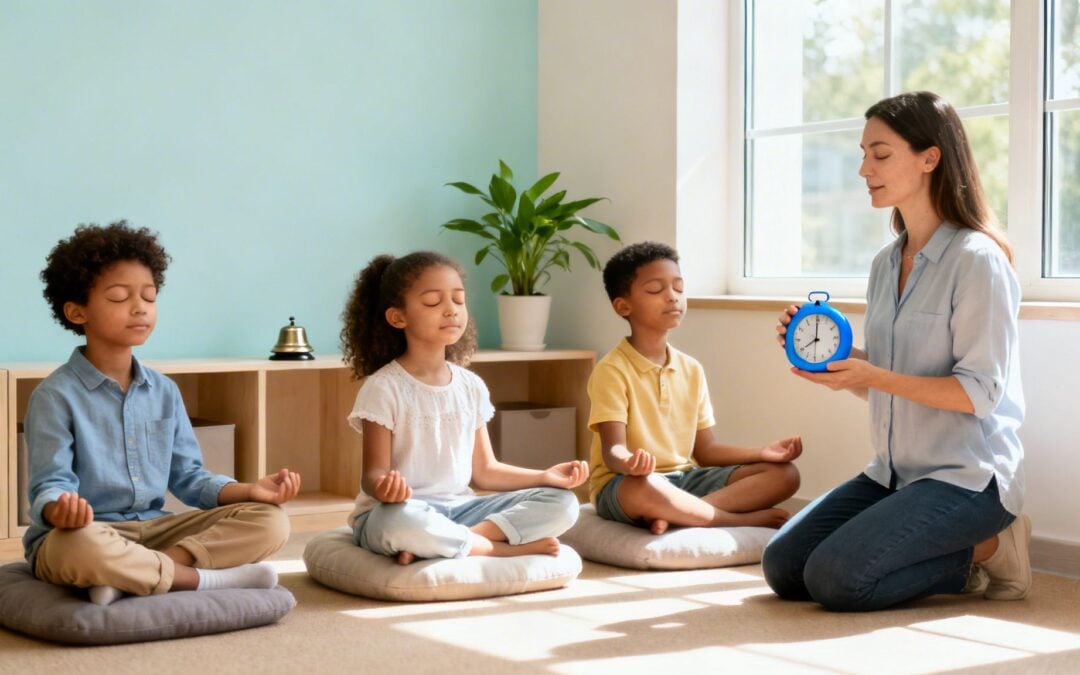
That’s why mindfulness for students matters so much right now. In K-8 settings, mindfulness isn’t about making kids sit perfectly still or turning school into a silent retreat. It’s about teaching children how to notice what’s happening inside them, slow down enough to choose a response, and return to the moment in front of them.
When adults use the same language and simple routines at school and at home, kids learn faster. They stop hearing self-regulation as one more rule and start experiencing it as a tool they can use.
Why Mindfulness Is Essential for Today's K-8 Students
A student snaps when a classmate bumps their chair. Another stares at the math page and says, “I can’t do this,” before trying. These moments are easy to label as behavior problems or lack of effort. Often, they’re signs that a child’s stress response is running the show.
Mindfulness gives students a way back. It helps them notice, “My body feels tight,” or “My thoughts are racing,” before those feelings spill into the room. That pause matters in every grade level. A kindergartener may need it before circle time. A fifth grader may need it before a quiz. A seventh grader may need it after a text message from a friend changes their whole mood.
What mindfulness looks like in real school life
In plain language, mindfulness means paying attention on purpose to what’s happening right now. For students, that can be as simple as:
Noticing the breath before answering when frustrated
Feeling both feet on the floor during transitions
Listening for one sound at a time to settle a busy mind
Naming an emotion instead of acting it out
These aren’t extras. They support the basic conditions children need in order to learn. When students can settle their bodies and identify their feelings, they’re more available for instruction, peer interaction, and problem-solving.
A useful classroom mindset is this: behavior is communication, and mindfulness helps students read the message before it gets louder.
What the research tells us
A landmark MIT study of sixth-graders found that an eight-week mindfulness program reduced students’ self-reported stress and decreased activation in the amygdala, a brain region involved in fear and emotional processing. The same body of work also linked higher mindfulness with better grades, fewer absences, and reduced suspensions in students, as described in the MIT McGovern Institute summary of mindfulness benefits for middle school students.
That matters because schools don’t need one more trend. They need practices that help children feel safe enough to learn, connect, and recover after hard moments.
Practical rule: If a strategy helps a student get calm, focused, and connected in under two minutes, it belongs in your daily toolkit.
Many educators already use pieces of mindfulness without calling it that. A quiet breathing reset before a lesson. A check-in circle after recess. A pause before conflict repair. If you want more examples of how this fits naturally into teaching, this piece on mindfulness in the classroom offers a helpful starting point.
Creating a Mindful Classroom Culture with Daily Routines
Mindfulness works best when it’s ordinary. Not rare. Not saved for a rough day. Not pulled out only after the room has already tipped into chaos.
Kids regulate better when the rhythm is predictable. A short routine at the start of the day, another during transitions, and a third before a demanding task can change the feel of a classroom without taking much time.
Why short routines matter more than long lessons
A common misunderstanding is that mindfulness has to be long to be effective. In schools, consistency matters more. Neurobiological research summarized by MIT shows that sustained mindfulness practice, even for a few minutes daily over eight weeks, can reduce amygdala reactivity to stressful stimuli, supporting better well-being and lower stress in students, as explained in this MIT News overview of student mindfulness and brain function.
That’s why I encourage teachers to think in micro-habits. One minute done daily teaches more than ten minutes done occasionally.
If you’re already using cooperative rituals and connection games, mindfulness can sit right beside them. Many teachers pair these practices with classroom community building activities so regulation and belonging grow together.
Routine one, the Mindful Morning Minute
This works well as students arrive or right after attendance.
Teacher script
“Put both feet on the floor.”
“Let your hands rest on your desk or in your lap.”
“Take one slow breath in.”
“Breathe out even slower.”
“Notice one sound you can hear.”
“Notice how your body feels right now.”
“Choose one word for how you’re arriving today.”
Why it helps
Students begin the day by locating themselves in their bodies, not just in the schedule. It gives the class a shared starting place. You’ll often notice fewer scattered starts and fewer emotional surprises in the first lesson.
Variation for younger students
Use visual prompts: “Feel your shoes. Notice your belly. Listen for the farthest sound.”
Routine two, Belly Breathing Transitions
This routine is useful after recess, before tests, and anytime energy is jagged.
Tell students to place one hand on the belly and one on the chest. Ask them to breathe in so the belly hand moves first, then breathe out slowly like they’re fogging a window.
Try this script:
Breath one: “We’re leaving the last activity.”
Breath two: “We’re arriving here.”
Breath three: “Our brains and bodies are getting ready.”
This can take less than a minute. What matters is the cue. Over time, students begin to associate the breathing pattern with shifting gears.
For children who don’t like hands on their bodies, offer options. They can watch a paper square rise and fall on the desk, trace a finger up and down the other hand, or count the breaths to themselves.
Routine three, Silent 60
Older students often resist anything that feels babyish. They usually respond better to a straightforward challenge.
Invite the class to try sixty seconds of stillness. No one has to close their eyes. They sit, soften their gaze, and notice what comes up without talking.
You can say:
“Your job isn’t to have an empty mind. Your job is to notice when your mind wanders and come back.”
Afterward, ask two brief reflection questions:
What helped you stay present?
What distracted you?
This builds self-awareness without turning the moment into a lecture.
A short guided practice can help introduce the routine before students try it independently:
How to make routines stick
A mindfulness routine fails when it feels optional, random, or disconnected from the day. It succeeds when students know exactly when it will happen and what it sounds like.
Use this quick implementation checklist:
Routine element
What it looks like in practice
Predictable timing
Same moment each day, such as arrival, post-recess, or pre-writing
A Practical Toolkit of Age-Specific Mindfulness Activities
The best mindfulness activities match children’s development. A first grader usually needs movement, images, and sensory anchors. A fourth grader can handle reflection if it stays concrete. A middle schooler wants privacy, relevance, and choice.
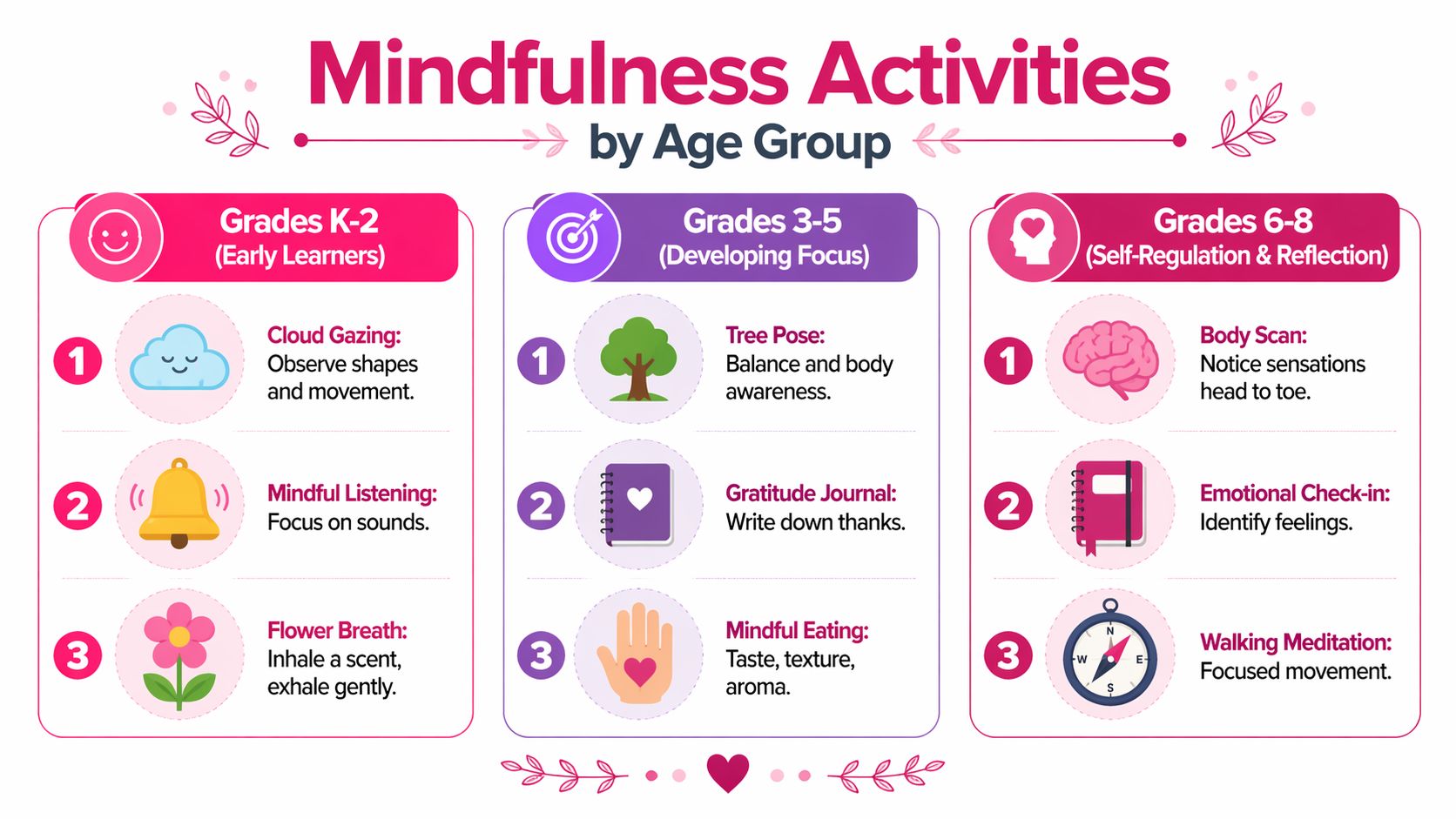
Grades K-2 and playful sensory practice
Young children learn mindfulness best when it feels like noticing, pretending, and moving.
Listen to the bell
Materials: A chime, bell, or soft tone on a device.
How to do it
Ring the bell once.
Ask students to raise a quiet hand when they can’t hear it anymore.
After the sound ends, invite them to notice one other sound in the room.
Teacher script
“Let your ears do the work. We’re listening all the way until the sound disappears.”
Expected outcome
This activity strengthens attention and helps children practice waiting without rushing. It’s especially useful before read-aloud or whole-group instruction.
Flower breath and candle breath
This classic works because it gives breathing a story.
How to do it
Hold one hand like a flower.
Pretend to smell the flower with a slow inhale.
Hold up one finger like a candle.
Blow out the candle with a long gentle exhale.
Teacher script
“Smell the flower. Blow out the candle. Slow and soft.”
Expected outcome
Children begin to lengthen the exhale without needing a technical explanation. That longer exhale often helps the body settle.
Spider-Man senses
You can rename this for any classroom theme, but students love the idea of using “super senses.”
Ask them to notice:
5 things they can see
4 things they can feel
3 things they can hear
2 things they can smell
1 thing they can taste
Use fewer steps for kindergarten if needed.
“When a child is flooded, don’t start with a long conversation. Start with the senses.”
This is one of my favorite reset tools after noisy transitions because it grounds children in the immediate environment.
Grades 3-5 and naming what’s happening inside
Upper elementary students are ready for a little more language. They can connect body cues, emotions, and choices if the activity stays concrete.
The weather report
Students describe their inner world like weather. This gives distance from the feeling without denying it.
How to do it
Ask, “What’s your weather inside right now?”
Let students respond with words like sunny, foggy, stormy, windy, or mixed.
Ask, “What do you need for today’s weather?”
Teacher script
“You are not the weather. You are the sky noticing the weather.”
Some students will say, “I’m stormy because I argued with my friend.” Another might say, “I’m foggy because I’m tired.” Once they name it, they can choose support.
Expected outcome
Students build emotional vocabulary and self-awareness. Teachers also get quick data without asking students to disclose more than they want to.
Heartbeat check
This works well after movement or before returning to seats.
How to do it
Have students put a hand on the chest or wrist.
Ask them to notice their heartbeat for a few moments.
Then invite three slow breaths.
Ask, “Did anything change?”
Teacher script
“Your body gives you information all day. Right now we’re listening.”
Expected outcome
Students learn that feelings and energy shifts show up physically. That awareness supports self-regulation later in conflict or frustration.
Mindful eating
Use a raisin, cracker, orange slice, or any simple snack allowed in your setting.
How to do it
Look at the food before eating it.
Notice texture, color, and smell.
Take one small bite.
Chew slowly and pay attention to taste and texture.
Teacher script
“We’re not eating fast. We’re investigating with our senses.”
This activity is memorable because it makes attention visible. It also helps students understand that mindfulness isn’t limited to breathing.
If you want a larger bank of ideas for this age group, this collection of mindfulness activities for kids can support planning across settings.
Grades 6-8 and reflection with choice
Middle school students need practices that respect their growing independence. They’ll engage more if you normalize wandering minds, offer options, and avoid forced sharing.
Thought traffic
Students notice thoughts like cars passing by. They don’t chase each one.
How to do it
Ask students to sit comfortably and look at a spot on the floor or desk.
Invite them to notice each thought that pops up.
Instead of judging it, they mentally label it: planning, worry, memory, annoyance, random.
After a minute or two, they return attention to the breath or the feeling of their feet on the floor.
Teacher script
“You don’t have to stop the traffic. Just notice what kind of thought is passing.”
Expected outcome
Students learn that thoughts are events in the mind, not commands. This is powerful for anxiety, social stress, and test pressure.
Mindful walking
This is ideal for students who resist seated practices.
How to do it
Clear a simple path in the room or hallway.
Ask students to walk slowly.
They notice heel, foot, toe.
Then they notice the shift of weight.
Then they notice the urge to speed up.
Teacher script
“Walk like your feet are teaching your brain how to slow down.”
Expected outcome
Students practice attention through movement. It’s often effective after lunch or before advisory conversations.
Two-line journal check-in
Some students will write more, but keep the baseline small.
Prompts:
“Right now my mind is…”
“One thing I need today is…”
Or:
“A thought I keep having is…”
“One way I can support myself is…”
Teacher script
“This isn’t graded. It’s a private reset.”
Expected outcome
Students organize internal noise into language. That alone can reduce escalation and increase readiness to participate.
A quick age-level comparison
Age group
Best entry point
What to avoid
Strong fit
K-2
Senses, pretend play, movement
Long lectures
Bell listening, flower breath
3-5
Concrete reflection, body cues
Abstract language without examples
Weather report, mindful eating
6-8
Choice, privacy, relevance
Forced vulnerability
Thought traffic, journaling, walking
One note matters across all ages. Some children don’t want to close their eyes, sit still, or focus inward for long. That’s okay. Offer soft eyes, drawing, standing, or object focus instead. Mindfulness should feel supportive, not controlling.
Designing a Mindfulness Lesson Plan and Pacing Guide
A strong mindfulness program has sequence. Students do better when the skills build in an order that makes sense. First they notice the body. Then they notice the breath. Then they notice feelings, thoughts, and choices in relationships.
A helpful principle from the research is fidelity. A systematic review of 77 school-based mindfulness interventions found the strongest evidence in programs with better implementation conditions, including longer duration, trained facilitators, and strong attendance. The same review noted that after a 5-week program, teachers rated significant improvements in attention span and self-control, as summarized in this review of school-based mindfulness interventions in PMC.
A sample four-week pacing guide
This shorter pacing guide can work as a launch plan. If your school continues beyond four weeks, repeat and deepen each layer rather than racing ahead.
Week
Focus
Sample activities
Student goal
Week 1
Body awareness
Feet on floor, posture check, bell listening
Notice physical cues
Week 2
Breath and settling
Flower breath, belly breathing, Silent 60
Use breath to reset
Week 3
Feelings and naming
Weather report, emotion check-in, journal prompts
Name internal experience
Week 4
Relationships and response
Mindful listening pairs, pause before speaking, repair reflection
Choose a response with awareness
What each lesson needs
Teachers often over-plan mindfulness. Keep the structure lean.
A reliable lesson can have four parts:
Arrival practice Thirty seconds to two minutes. Students settle into the space.
Mini-teaching One simple idea, such as “Feelings show up in the body” or “A pause helps the brain make choices.”
Active practice One guided activity with teacher modeling.
Reflection A quick share, drawing, or sentence stem.
That same frame works in classrooms, counseling groups, after-school programs, and family workshops.
Keep it teachable: If students can explain the practice in one sentence, you’ve probably hit the right level.
Pacing decisions that help, and those that hurt
Mindfulness lessons go off track when adults pack in too many concepts at once or treat the practice like a reward after “real learning.” Students read that message quickly.
What helps instead:
Start small so success comes early
Repeat core practices until students recognize them
Use shared language across adults in the building
Plan for choice for students who need alternatives
Reflect briefly so the routine stays doable
If you want support with the nuts and bolts of making a lesson plan, that resource can help you think through objectives, flow, and pacing in a practical way.
A final note from experience. If your school wants measurable change, don’t hand mindfulness to unprepared staff and hope for the best. Adults need modeling, common language, and time to practice too. Students can tell when a routine is grounded and when it’s performative.
Bridging the Gap Between School and Home
A child who learns to breathe through frustration at school still needs help remembering that skill at home. That’s where many good efforts fall apart. Students hear one set of words in the classroom and another at home, so the tool never becomes part of daily life.
Research points to this gap clearly. A Berkeley Greater Good in Education summary notes that while school-based mindfulness shows promise, families are rarely given specific strategies. It also reports that 93.2% of students are open to continuing mindfulness at home, which makes the lack of parent guidance a real missed opportunity, as described in this Greater Good in Education overview of mindfulness for students.
What parents actually need
Parents usually don’t need a long explanation of the nervous system at 7:15 in the morning. They need a short practice that fits between breakfast, backpacks, and finding one missing shoe.
The most useful home routines are:
Brief
Predictable
Easy to repeat
Shared by adults and children
That’s why I encourage families to attach mindfulness to moments that already happen.
Four low-effort family practices
The one-breath doorway pause
Choose one doorway in the home. Every time family members pass through it during a certain part of the day, they pause for one slow breath.
Examples:
Bedroom door before homework
Front door after school
Bathroom mirror before bedtime
This helps children shift from one environment to another without needing a lecture.
The dinner table mindful bite
Once during dinner, everyone takes one bite in silence and notices taste, texture, and smell. That’s it. No one has to make it fancy.
You can ask:
What did you notice that you usually miss?
Was it crunchy, soft, warm, or cool?
This creates a calm shared moment that doesn’t feel like an assignment.
Gratitude jar
Keep slips of paper and a jar in a visible spot. Family members add one short note whenever they want. At the end of the week, read a few aloud.
Children often write simple things:
“My brother shared with me.”
“I liked when grandma called.”
“I finished something hard.”
The practice builds attention toward connection and positive moments.
Bedtime body scan
At lights-out, guide your child through a brief body check.
Try: “Notice your forehead. Let it soften.” “Notice your shoulders.” “Notice your hands.” “Notice your feet.” “Take one slow breath and let the bed hold you.”
This works especially well for children whose thoughts speed up at night.
One shared language between adults helps
When teachers say, “Take a belly breath,” and parents say the same thing, children learn faster. When school uses “name the feeling” and home uses that same phrase, the child doesn’t have to translate.
For families who want a little more support, one option is Soul Shoppe, which offers school and family-facing SEL resources, including an app, workshops, and written guidance focused on self-regulation, mindfulness, communication, and connection. Parents may also find practical ideas in this article on teaching mindfulness to children.
Home practice doesn’t need to look impressive. It needs to be repeatable.
That’s the bridge. Not perfection. Repetition.
Assessing Impact and Building a Sustainable Program
If mindfulness is going to last in a school, adults need to see what’s changing. Not just in a vague sense, but in observable ways. The good news is that you don’t need a complicated evaluation system to begin.
A 2024 meta-analysis found a statistically significant correlation between mindfulness and academic achievement in students (r = 0.594). The same research summary also points to related school outcomes, including improved attention in grades 1-3 and reduced absenteeism and rule infractions in high school students, as reported in this PMC meta-analysis on mindfulness and academic achievement.
What to track in classrooms and schools
Start with two kinds of data: what adults notice and what the school already measures.
Qualitative indicators
Use a simple observation log once or twice a week. Teachers can note:
Settling time after transitions
Student language during frustration
Conflict recovery after peer issues
Willingness to re-engage after mistakes
A counselor or SEL lead can also collect short staff reflections such as, “Students needed fewer reminders before independent work,” or “More students used the calm corner without prompting.”
Quantitative indicators
Look at measures your school already values.
A practical tracking set might include:
Indicator
What to watch for
Attendance
Are students missing less instructional time?
Behavior referrals
Are repeated incidents shifting over time?
Classroom disruptions
Do transitions become smoother?
Work completion
Are students able to return to tasks more consistently?
If your team wants a more organized way to track student progress, a simple data tool can help centralize notes, attendance patterns, and academic markers without creating extra paperwork.
What makes a program sustainable
Schools lose momentum when mindfulness depends on one enthusiastic adult. It lasts when the practice is woven into the culture.
That usually means:
Shared routines across classrooms
Staff modeling so adults use the tools too
Common language for emotions and regulation
Ongoing reflection instead of one-time training
Connection to SEL goals the school already values
Mindfulness shouldn’t sit in isolation. It belongs inside a broader approach to safety, empathy, communication, and belonging. When schools treat it that way, students don’t experience mindfulness as one more program. They experience it as part of how their community works.
If your school or family wants support building a more connected, emotionally safe culture, Soul Shoppe offers research-based SEL programs, workshops, and practical tools that help students and adults practice mindfulness, communication, and self-regulation together.
In today’s fast-paced world, children navigate a landscape of constant stimulation and high expectations. The ability to pause, breathe, and connect with the present moment isn’t just a nice-to-have; it’s a foundational skill for emotional regulation, focus, and resilience. This article moves beyond theory, offering a practical, evidence-informed toolkit of 10 mindfulness exercises for kids.
Designed for parents, teachers, and caregivers, each activity is broken down into simple, actionable steps, complete with age-appropriate adaptations and real-world examples. From calming anxious minds before a test to building empathy in the classroom, these exercises are more than just activities. They are building blocks for social-emotional learning (SEL) that equip children to thrive both academically and personally.
This comprehensive guide provides everything you need to introduce these powerful practices into your home or classroom. You will find step-by-step instructions, time guidance, and specific tips for adapting each exercise for different age groups and settings. For those looking to deepen their understanding and supplement these activities, exploring curated lists of books about social emotional learning can provide valuable narratives and frameworks to reinforce these concepts.
We will explore a variety of techniques, including:
Belly Breathing to manage stress.
Mindful Listening to improve focus.
Gratitude Practices to foster a positive outlook.
Body Scan Meditations to build self-awareness.
Each section is structured for quick reference and immediate implementation, helping you cultivate a more peaceful and attentive environment for the children in your care. By integrating these mindfulness exercises, you are giving kids a superpower: the ability to understand and manage their inner world with confidence.
1. Belly Breathing (Diaphragmatic Breathing)
Belly breathing, also known as diaphragmatic breathing, is a cornerstone of mindfulness exercises for kids. This foundational practice teaches children to take slow, deep breaths that originate from the diaphragm, causing the belly to rise and fall. This simple action directly engages the parasympathetic nervous system, our body’s natural relaxation response, helping to lower heart rate and reduce feelings of anxiety or stress.
Unlike shallow chest breathing, which is common during stressful moments, belly breathing provides an immediate and tangible tool for self-regulation. It is one of the most accessible self-regulation strategies for students and can be used anywhere, anytime.
How to Guide Belly Breathing
To introduce this technique, have children lie down comfortably or sit with a straight spine. Instruct them to place one hand on their chest and the other on their belly. Cue them to breathe in slowly through their nose, feeling the hand on their belly rise like a balloon filling with air, while the hand on their chest stays relatively still. Then, they should exhale slowly through their mouth, feeling their belly deflate.
Key Cue: “Imagine you have a small balloon in your belly. When you breathe in, you are slowly filling it up with air. When you breathe out, the balloon gently deflates.”
Practical Implementation and Tips
Make it Visual: Place a small stuffed animal or a “breathing buddy” on the child’s belly while they lie down. Their goal is to make the buddy gently rise and fall with each breath. For example, a child upset about a scraped knee can lie down with their favorite teddy bear on their tummy and focus on giving it a slow ride up and down.
Use Counting: Guide children through a simple counting pattern, such as breathing in for four counts, holding for four counts, and exhaling for four counts. This adds a focal point for their attention.
Integrate into Routines: A teacher might lead a two-minute belly breathing session after recess to help the class transition calmly to the next lesson. A parent can use it as part of a bedtime routine to promote restful sleep.
Normalize the Practice: Introduce belly breathing when children are calm and regulated. For example, practice for one minute during a morning meeting at school. This ensures they build muscle memory for the skill, making it easier to access during moments of frustration, anger, or nervousness before a big game.
2. Body Scan Meditation
The Body Scan Meditation is a guided exercise that encourages children to bring gentle, nonjudgmental attention to different parts of their body, one at a time. This practice helps kids develop a stronger mind-body connection, teaching them to notice physical sensations like warmth, tingling, or tension without feeling the need to react to them. It is a powerful tool for building body awareness and helping children recognize how emotions can manifest physically.
Pioneered in modern mindfulness by Jon Kabat-Zinn, this technique is not about changing or fixing sensations, but simply noticing them. For children, this fosters an ability to sit with discomfort and understand the transient nature of physical feelings, which is a key component of emotional resilience. It’s one of the most effective mindfulness exercises for kids to connect with their inner world.
How to Guide a Body Scan Meditation
Have children lie down comfortably on their backs with their eyes closed or with a soft, downward gaze. In a calm voice, guide their attention sequentially through the body, starting from the toes and moving slowly up to the head. Invite them to notice any sensations in each part without judgment.
Key Cue: “Bring your attention to your toes. You don’t have to move them, just notice how they feel. Are they warm or cool? Tingly or still? Whatever you feel is perfectly okay.”
Practical Implementation and Tips
Keep it Brief and Playful: For younger children, start with a 3-5 minute scan. You can call it a “Tingle Tour” or “Flashlight Focus,” imagining a gentle beam of light scanning their body. For example, a kindergarten teacher could say, “Let’s shine our magic flashlight onto our feet. What do you notice?”
Allow for Movement: It’s natural for kids to fidget. Offer “wiggle breaks” between body parts. You might say, “Now let your feet have a little wiggle before we move our attention to our legs.”
Use Inclusive Language: Frame invitations gently. For instance, “Notice your left hand… or if you prefer, just think about that space.” This is especially important for children with diverse physical abilities or sensitivities.
Integrate into Daily Transitions: A guidance counselor might use a short body scan with an anxious student to help them ground themselves before returning to class. A parent can lead a calming scan as part of a bedtime routine to release the day’s tension and promote sleep. For example, a parent could say, “Let’s notice if our legs feel tired from all that running today. Now let’s see how our tummy feels.”
3. Mindful Movement & Brain Breaks (Yoga, Short Movement Breaks)
Mindful movement combines gentle physical activity with present-moment awareness, making it one of the most engaging mindfulness exercises for kids. Practices like children’s yoga or short, structured “brain breaks” bridge the mind-body connection, helping children release physical tension, improve focus, and regulate their energy levels. This approach is especially effective for kinesthetic learners who thrive when they can move their bodies.
Unlike traditional exercise, the goal is not performance but awareness. Children learn to notice how their bodies feel during movement, connecting with their breath and physical sensations. These embodiment practices for kids empower them with tools to reset their attention and manage restlessness, both in the classroom and at home.
How to Guide Mindful Movement
Begin by creating a safe, non-competitive space. For yoga, use storytelling to guide poses, like becoming a tall, strong tree or a stretching cat. For a brain break, simply ask children to stand up and “shake out the wiggles” or “stretch toward the sky.” The key is guiding them to pay attention to the physical sensations as they move.
Key Cue: “As you stretch your arms up high, notice how your sides feel. Can you feel your muscles waking up? Now, as you shake your hands out, imagine you are shaking off any wiggly or tired feelings.”
Practical Implementation and Tips
Use Storytelling: Frame movements within a narrative. For example, a librarian leading a yoga session could guide children through an imaginary journey to the jungle, having them become a hissing snake (Cobra Pose) or a roaring lion (Lion’s Breath).
Schedule Brain Breaks: Integrate short (2-5 minute) movement breaks between academic subjects. A teacher might use a GoNoodle video or lead a quick “animal walks” session—like crab walking or frog hopping—to transition from math to reading.
Focus on Feeling, Not Form: Emphasize that every child’s pose will look different. The goal is to notice what their own body feels like, not to achieve a perfect posture.
Pair with Breathing: Connect breath to movement. For example, in a “Balloon Breath” break, a teacher can instruct students to breathe in while raising their arms overhead (filling the balloon) and breathe out while lowering them (letting the air out).
4. Mindful Listening Circles
Mindful Listening Circles are a structured and powerful practice that teaches children the art of deep, non-judgmental listening. In this exercise, participants sit in a circle, and one person speaks at a time without interruption. This simple format creates a safe container for sharing, fostering empathy, strengthening communication skills, and building a profound sense of community and psychological safety.
This practice transforms listening from a passive activity into an active, mindful engagement. By focusing entirely on the speaker, children learn to quiet their own inner chatter and offer their full, respectful attention. This is one of the most effective mindfulness exercises for kids because it directly builds social awareness and relationship skills, which are core components of social-emotional learning.
How to Guide a Mindful Listening Circle
To begin, gather the children in a circle where everyone can see each other. The facilitator establishes clear expectations and introduces a “talking piece,” which can be any object like a special stone, a small stuffed animal, or a decorated stick. Only the person holding the talking piece is allowed to speak.
The facilitator poses a prompt, and the talking piece is passed around the circle. Each child has the option to share their thoughts related to the prompt or to simply pass the piece to the next person without speaking. The core rule is that everyone else listens silently and respectfully until the speaker is finished and passes the piece.
Key Cue: “When you are not holding the talking piece, your only job is to listen with your ears, your eyes, and your heart. Listen to understand, not to reply.”
Practical Implementation and Tips
Establish Clear Ground Rules: Before starting, co-create and review essential rules: One person speaks at a time (the one with the talking piece), listen respectfully, what is shared in the circle stays in the circle, and it is always okay to pass.
Use a Talking Piece: A physical object makes the speaker role tangible and clear. It prevents interruptions and helps children visually track whose turn it is to speak. For example, a “listening shell” could be used, where students imagine it holds the speaker’s voice.
Start with Low-Risk Prompts: Build trust by beginning with light, fun prompts like, “Share one thing that made you smile this week,” or “If you could have any superpower, what would it be?” Gradually move to deeper topics as the group’s comfort level grows.
Model Mindful Listening: The facilitator’s role is crucial. They must model attentive, non-judgmental listening, validate children’s contributions with a nod or a simple “thank you,” and hold the emotional space for the group. For more ideas, explore other powerful listening skills activities.
Integrate into Routines: A teacher can use a circle for a morning meeting to check in on how students are feeling. For example, using a prompt like, “Share one word that describes your mood today.” This can become a cherished ritual for building classroom community.
5. Gratitude Practice and Journaling
Gratitude practice is a powerful mindfulness exercise that trains children to actively notice and appreciate the positive aspects of their lives. This intentional focus on thankfulness helps shift a child’s perspective away from challenges or what is lacking, building emotional resilience and fostering a more optimistic outlook. By regularly acknowledging people, experiences, and even small objects they are grateful for, children develop a deeper awareness of the good that surrounds them daily.
This practice is not about ignoring difficulties but about balancing one’s worldview. It has been popularized by positive psychology researchers who have demonstrated its strong link to increased happiness and well-being. By making gratitude a conscious habit, we equip children with a tool to counteract negative thought patterns and cultivate a sense of connection and contentment.
How to Guide a Gratitude Practice
Introduce gratitude in a simple, accessible way. Start by asking children to think of one thing that made them smile that day. The goal is to make it a low-pressure, reflective moment rather than a task. You can guide them with prompts that encourage specificity, helping them move from general statements to meaningful reflections.
Key Cue: “Let’s think of three specific things we are thankful for right now. It could be a person who was kind, a food you enjoyed, or the feeling of the sun on your skin during recess.”
Practical Implementation and Tips
Create a Gratitude Jar: In a classroom or at home, decorate a jar. Have children write or draw one thing they are grateful for on a small slip of paper each day and add it to the jar. For example, a child might write, “I’m grateful for when my friend shared their crayons with me.” Read the slips together at the end of the week.
Start a Journal: For older children, a dedicated gratitude journal can be a personal space for reflection. For younger kids or those who benefit from written reflection, exploring mental health journaling prompts can be a wonderful way to cultivate self-awareness and gratitude. Even drawing pictures of things they are thankful for is effective.
Integrate into Routines: Incorporate a gratitude share into daily routines. For example, a family can make it a dinnertime ritual where each person shares one “rose” (a positive thing) from their day. Discover more impactful gratitude activities for kids to keep the practice fresh.
Model Authenticity: Adults should participate and model genuine gratitude. For example, a teacher could say, “I’m grateful for how hard everyone worked on their math problems today.” This shows that gratitude is a valuable practice for everyone.
6. Mindful Eating
Mindful eating is a powerful practice that transforms meal or snack time into a rich sensory experience. It teaches children to slow down and use all five senses to explore their food: noticing colors, textures, smells, sounds, and, finally, flavors. This intentional engagement anchors them in the present moment, fostering a healthier relationship with food and a greater awareness of their body’s hunger and fullness cues.
This exercise is particularly valuable as it counters the rushed, distracted eating habits that are common today. By turning a routine activity into an opportunity for mindfulness, it helps children develop appreciation, self-regulation, and body awareness without needing extra time in their schedule. It is a foundational practice for building lifelong healthy habits.
How to Guide Mindful Eating
Choose a simple food item like a raisin, a slice of apple, or a cracker to start. Guide children through a sensory exploration before they even take a bite. Prompt them to observe the food as if they have never seen it before, noticing its shape, weight, and texture in their hands. Encourage them to smell it, listen to it, and finally, to take one small, slow bite, chewing deliberately to discover all its flavors.
Key Cue: “Let’s become food detectives! Before you eat, let’s use our senses. What does the cracker look like? Can you hear a sound when you break it? What does it smell like? Now, take a tiny bite and see how many flavors you can discover.”
Practical Implementation and Tips
Start Small: Begin with a “mindful minute” during snack time, focusing on just the first bite of a food item. For example, a teacher can guide the class to mindfully eat one Goldfish cracker, noticing its salty taste and crunchy sound.
Five Senses Exploration: Explicitly guide children through their senses. Ask questions like, “What colors do you see on your orange slice?” or “What does the yogurt feel like on your tongue?”
Slow Down the Chew: Encourage children to chew their food more than usual, perhaps counting to ten before swallowing. This aids digestion and helps them recognize when they are full.
Eliminate Distractions: At home, try having one screen-free meal a day. In the classroom, ensure snack time is a calm period without other competing activities.
Connect to Gratitude: Talk about where the food came from. For example, while eating strawberries, a parent could say, “Let’s thank the sun and the rain for helping these berries grow.” This builds a sense of connection and appreciation.
7. Guided Imagery and Visualization
Guided imagery, also known as visualization, is a powerful mindfulness practice that taps into a child’s natural gift for imagination. This exercise involves a guide leading children through a detailed, imaginary journey to a peaceful and safe place, using rich sensory language to make the scene feel real. This process activates the brain’s relaxation response, helping to reduce anxiety, manage stress, and build a portable mental sanctuary they can access anytime.
Visualization works by shifting a child’s focus from external stressors or internal worries to a calming, internally-generated experience. By engaging their senses in this imagined world, children can effectively quiet the mind and regulate their emotional state. It is a highly effective and engaging mindfulness exercise for kids who thrive on creativity and storytelling.
How to Guide Visualization
To begin, have children find a comfortable position, either sitting up or lying down, and gently close their eyes. Use a calm, slow voice to describe a peaceful setting, focusing on what they might see, hear, smell, feel, and even taste. Encourage them to immerse themselves fully in the scene you are creating.
Key Cue: “Picture yourself walking on a soft, sandy beach. Feel the warm sun on your skin and listen to the gentle sound of the waves. What colors do you see in the sky? Can you smell the salty air?”
Practical Implementation and Tips
Offer Choices: Empower children by allowing them to choose their own “calm place,” whether it’s a magical forest, a cozy fort, or a favorite real-life spot. This increases their sense of ownership and safety.
Use Rich Sensory Language: Incorporate details that appeal to all senses. For example, instead of “imagine a forest,” say “imagine you can smell the damp earth and pine needles, and feel the bumpy bark of a tall tree.”
Integrate into Transitions: A teacher can lead a five-minute guided imagery session before a test to ease anxiety. For example, “Imagine a calm, blue light filling your mind, helping you remember everything you’ve learned.”
Create Recordings: Record your own guided imagery scripts or use resources from apps like Calm or Headspace Kids. Having recordings available allows children to use this tool independently when they need it, such as at bedtime to help with sleep.
Debrief the Experience: After the visualization, gently guide children back to the present moment. Ask questions like, “How does your body feel now compared to before we started?” This helps them connect the practice to its calming physical effects.
Mindful sensory activities, often called the “5 Senses Grounding” technique, are a powerful way to anchor children in the present moment. This exercise guides a child to deliberately engage each of their five senses to notice their immediate surroundings, pulling their attention away from overwhelming thoughts, anxieties, or big emotions. By focusing on tangible, neutral information, this practice helps interrupt worry spirals and activates a state of calm awareness.
This technique is a cornerstone of trauma-informed care and is highly effective for managing anxiety. It provides children with an immediate, concrete strategy to use when their thoughts feel chaotic, grounding them in the safety of the here and now. The structure of the exercise is simple, making it one of the most practical mindfulness exercises for kids to learn and use independently.
How to Guide the 5 Senses Grounding Technique
To begin, invite the child to take a slow, deep breath. Guide them through a sequential process of noticing their environment using the popular 5-4-3-2-1 format. Encourage them to name each item aloud or silently to themselves. The goal is not to judge what they sense, but simply to notice it.
Key Cue: “Let’s use our super senses to get to know this moment. We are going to find things around us right now. First, can you find 5 things you can see?”
Practical Implementation and Tips
Teach the 5-4-3-2-1 Method: Explicitly guide children through the sequence: notice 5 things you can see, 4 things you can feel or touch, 3 things you can hear, 2 things you can smell, and 1 thing you can taste.
Create Sensory Kits: A school counselor can create a “grounding kit” with items of different textures (a smooth stone, soft fabric), distinct scents (a lavender sachet), and quiet sounds (a small rain stick) to make the practice more engaging.
Integrate Before Transitions: A teacher could lead the class through a quick 5 Senses scan before a test or after a noisy lunch period to help students settle their minds and focus.
Practice When Calm: Introduce this technique when children are regulated. For example, a parent can play the “5 Senses Game” with their child in the car, asking “What are 5 things you can see right now?” This helps them build proficiency so they can access it more easily during moments of distress.
9. Loving-Kindness Meditation (Metta)
Loving-kindness meditation, often called Metta, is a powerful mindfulness practice designed to cultivate compassion, connection, and empathy. This exercise guides children to mentally send wishes of well-being, safety, and happiness to themselves and others. The practice follows an expanding circle of care, starting with the self, moving to loved ones, then to neutral people, and eventually even to those with whom they have difficulty.
This exercise directly builds social-emotional learning (SEL) skills by training the heart and mind to be kinder. It helps reduce negative self-talk, diminishes feelings of anger or resentment toward others, and fosters a more inclusive and caring classroom environment. By regularly practicing, children learn that kindness is a skill they can strengthen, just like a muscle.
How to Guide Loving-Kindness Meditation
Begin by having children sit in a comfortable, quiet posture with their eyes gently closed or looking softly at the floor. Guide them to place a hand over their heart to connect with the feeling of warmth. Then, lead them through a series of simple, repeatable phrases directed toward different people.
Key Cue: “Silently in your mind, repeat after me. First, let’s send these kind wishes to ourselves: May I be happy. May I be safe. May I be healthy and strong.”
Practical Implementation and Tips
Start with Self-Love: Always begin the practice by directing kindness inward. Many children find it difficult to be kind to themselves, so this is a crucial first step. Progress to people they love easily, like family or pets, before moving to others.
Keep Phrases Simple: Use short, memorable phrases that are easy for children to repeat in their minds. You can adapt them to feel more authentic, such as, “I wish myself happiness,” or “I hope I have a good day.”
Use for Conflict Resolution: A school counselor can use this meditation in a restorative circle after a conflict between students. For example, guiding both children to send kind wishes to themselves and then silently to each other can help repair the relationship and build empathy.
Gradual Expansion: Introduce the concept of sending kindness to a “neutral” person (like a mail carrier) and, when ready, to a “difficult” person. Frame this not as forgiving bad behavior but as freeing oneself from holding onto anger. For example, explain that sending kind wishes is like sending a balloon into the sky—it makes you feel lighter, no matter who it’s for.
Nature-based mindfulness, often inspired by the Japanese practice of Shinrin-yoku or “forest bathing,” is an immersive exercise that encourages children to connect with the natural world through their senses. This practice involves intentionally slowing down in an outdoor setting to observe, listen, touch, and smell the environment. By focusing their attention on the sights, sounds, and textures of nature, children can anchor themselves in the present moment, which significantly reduces stress and promotes a sense of calm and belonging.
This powerful mindfulness exercise for kids leverages our innate connection to nature, known as biophilia, to soothe the nervous system and enhance well-being. It moves mindfulness from an abstract concept into a tangible, sensory-rich experience that is highly engaging for young learners.
How to Guide Nature-Based Mindfulness
Take children to an outdoor space like a park, schoolyard, or even a single tree. Encourage them to walk slowly and quietly, without a specific destination in mind. Guide their awareness to each of their senses, one by one. Ask them to notice the different shades of green, the feeling of the breeze on their skin, the sounds of birds or rustling leaves, and the smell of the soil or flowers. The goal is simply to notice without judgment.
Key Cue: “Let’s use our ‘owl eyes’ and ‘deer ears.’ What can you see without moving your head? What is the quietest sound you can hear if you listen very carefully?”
Practical Implementation and Tips
Sensory Scavenger Hunt: Instead of a list of items to find, create a list of sensory experiences: “Find something smooth,” “Listen for a bird’s song,” or “Find something that smells like pine.”
Pair with Journaling: After a mindful walk, have children draw or write about one thing they noticed. For example, a teacher can ask, “Draw the most interesting leaf you saw today and describe how it felt in your hand.”
Integrate into Academics: A teacher can take a science lesson outdoors, asking students to mindfully observe an insect or a plant for five minutes before discussing its life cycle. This enhances both focus and learning.
Start Small: This practice doesn’t require a forest. For example, a parent and child can mindfully observe a spider spinning a web outside their window or listen to the sound of rain on the roof. The key is intentional, focused awareness.
10 Mindfulness Exercises for Kids — Quick Comparison
Practice
Implementation complexity
Resource requirements
Expected outcomes
Ideal use cases
Key advantages
Belly Breathing (Diaphragmatic Breathing)
Low — quick to teach, brief instruction needed
None — tactile cues or props (stuffed animal) optional
Outdoor space (garden, yard, park), variable time (10+ minutes)
Reduced stress, attention restoration, connection to nature and belonging
Outdoor classes, school gardens, walking meditations, nature journaling
Strong evidence for stress reduction; combines physical activity and mindfulness
Bringing It All Together: Weaving Mindfulness into Daily Life
Throughout this guide, we have explored a diverse collection of ten powerful mindfulness exercises for kids, from the calming rhythm of Belly Breathing to the expansive awareness of Nature-Based Mindfulness. Each activity serves as a unique tool, designed to help children navigate the complexities of their inner and outer worlds with greater calm, clarity, and compassion. The goal is not to perfect every exercise, but to build a rich and accessible toolkit that children can turn to whenever they need it.
The journey of integrating mindfulness is one of patience, consistency, and adaptation. By introducing these practices, you are planting seeds of emotional intelligence that will flourish for a lifetime. Children learn to recognize their feelings without being overwhelmed by them, develop a stronger sense of empathy for others, and build the resilience needed to face challenges with a centered mind.
Key Takeaways and Actionable Next Steps
To make mindfulness a sustainable part of your home or classroom, focus on integration rather than addition. The most effective approach is to weave these practices into the natural flow of the day, transforming routine moments into opportunities for mindful awareness.
Here are some practical next steps to get started:
Start Small and Be Consistent: Don’t try to implement all ten exercises at once. Choose one or two that feel most accessible. For example, you might commit to a two-minute Body Scan before bedtime or start each morning meeting with a round of Mindful Listening. Consistency is more impactful than intensity.
Model the Behavior: Children are incredibly perceptive. When they see you taking a few deep breaths when you feel stressed or expressing gratitude for a small joy, they learn that mindfulness is a valuable, real-world skill. Your practice gives them permission and a clear example to follow.
Connect to Daily Routines: Link mindfulness exercises to existing schedules. A Mindful Eating moment can be part of the first five minutes of lunch. A brief Gratitude Practice can become a beloved dinnertime ritual. A quick Mindful Movement break can be used to transition between academic subjects, helping to reset focus and energy.
Create a “Peace Corner” or “Calm-Down Kit”: Designate a physical space where a child can go to practice these skills. Stock it with items that engage the senses, like a soft blanket, a glitter jar, or headphones with guided visualizations. This empowers children to self-regulate when they feel big emotions.
The Lasting Impact of Mindful Kids
The value of teaching mindfulness exercises for kids extends far beyond immediate stress reduction. When children learn to tune into their bodies, listen with intention, and cultivate kindness, they are developing the core competencies of social-emotional learning (SEL). They become better problem-solvers, more empathetic friends, and more engaged, self-aware learners.
Imagine a classroom where students can use Belly Breathing to manage test anxiety or a home where siblings use Loving-Kindness Meditation to resolve conflicts. These are not abstract ideals; they are tangible outcomes of a consistent mindfulness practice. By equipping children with these internal resources, we are not just helping them get through a tough day. We are empowering them to build a foundation for a mentally and emotionally healthy life, enabling them to show up in the world with confidence, connection, and a deep understanding of themselves and others. Your commitment to this practice is a profound gift that will continue to grow with them.
Ready to bring a structured, school-wide approach to social-emotional learning to your campus? Soul Shoppe provides dynamic, evidence-based programs that teach students the skills of empathy, respect, and emotional regulation through experiential assemblies and curriculum. Discover how you can build a more positive and connected school climate by visiting Soul Shoppe today.