By the time many students walk into class, their nervous systems are already busy. One child is still upset about the rushed morning at home. Another is replaying a conflict from recess. A third looks calm on the outside but can’t settle enough to start independent work. Teachers and parents feel this too. You can see it in the fidgeting, the blurting, the shutdowns, and the tears that seem to come out of nowhere.

That’s why mindfulness for students matters so much right now. In K-8 settings, mindfulness isn’t about making kids sit perfectly still or turning school into a silent retreat. It’s about teaching children how to notice what’s happening inside them, slow down enough to choose a response, and return to the moment in front of them.

When adults use the same language and simple routines at school and at home, kids learn faster. They stop hearing self-regulation as one more rule and start experiencing it as a tool they can use.

Why Mindfulness Is Essential for Today's K-8 Students

A student snaps when a classmate bumps their chair. Another stares at the math page and says, “I can’t do this,” before trying. These moments are easy to label as behavior problems or lack of effort. Often, they’re signs that a child’s stress response is running the show.

Mindfulness gives students a way back. It helps them notice, “My body feels tight,” or “My thoughts are racing,” before those feelings spill into the room. That pause matters in every grade level. A kindergartener may need it before circle time. A fifth grader may need it before a quiz. A seventh grader may need it after a text message from a friend changes their whole mood.

What mindfulness looks like in real school life

In plain language, mindfulness means paying attention on purpose to what’s happening right now. For students, that can be as simple as:

  • Noticing the breath before answering when frustrated
  • Feeling both feet on the floor during transitions
  • Listening for one sound at a time to settle a busy mind
  • Naming an emotion instead of acting it out

These aren’t extras. They support the basic conditions children need in order to learn. When students can settle their bodies and identify their feelings, they’re more available for instruction, peer interaction, and problem-solving.

A useful classroom mindset is this: behavior is communication, and mindfulness helps students read the message before it gets louder.

What the research tells us

A landmark MIT study of sixth-graders found that an eight-week mindfulness program reduced students’ self-reported stress and decreased activation in the amygdala, a brain region involved in fear and emotional processing. The same body of work also linked higher mindfulness with better grades, fewer absences, and reduced suspensions in students, as described in the MIT McGovern Institute summary of mindfulness benefits for middle school students.

That matters because schools don’t need one more trend. They need practices that help children feel safe enough to learn, connect, and recover after hard moments.

Practical rule: If a strategy helps a student get calm, focused, and connected in under two minutes, it belongs in your daily toolkit.

Many educators already use pieces of mindfulness without calling it that. A quiet breathing reset before a lesson. A check-in circle after recess. A pause before conflict repair. If you want more examples of how this fits naturally into teaching, this piece on mindfulness in the classroom offers a helpful starting point.

Creating a Mindful Classroom Culture with Daily Routines

Mindfulness works best when it’s ordinary. Not rare. Not saved for a rough day. Not pulled out only after the room has already tipped into chaos.

Kids regulate better when the rhythm is predictable. A short routine at the start of the day, another during transitions, and a third before a demanding task can change the feel of a classroom without taking much time.
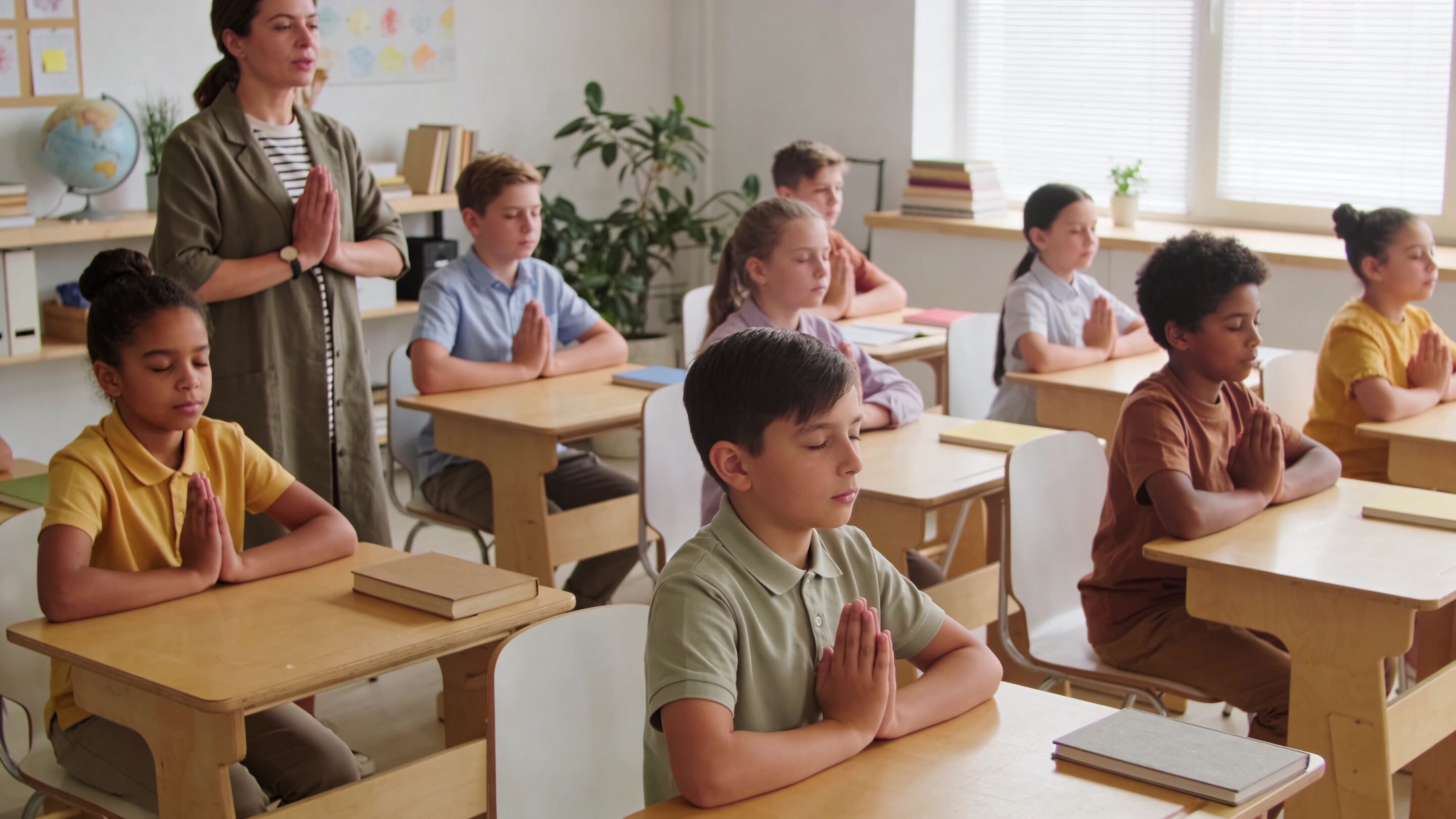
A teacher leads a diverse group of students in a mindfulness meditation exercise in a classroom setting.

Why short routines matter more than long lessons

A common misunderstanding is that mindfulness has to be long to be effective. In schools, consistency matters more. Neurobiological research summarized by MIT shows that sustained mindfulness practice, even for a few minutes daily over eight weeks, can reduce amygdala reactivity to stressful stimuli, supporting better well-being and lower stress in students, as explained in this MIT News overview of student mindfulness and brain function.

That’s why I encourage teachers to think in micro-habits. One minute done daily teaches more than ten minutes done occasionally.

If you’re already using cooperative rituals and connection games, mindfulness can sit right beside them. Many teachers pair these practices with classroom community building activities so regulation and belonging grow together.

Routine one, the Mindful Morning Minute

This works well as students arrive or right after attendance.

Teacher script

  1. “Put both feet on the floor.”
  2. “Let your hands rest on your desk or in your lap.”
  3. “Take one slow breath in.”
  4. “Breathe out even slower.”
  5. “Notice one sound you can hear.”
  6. “Notice how your body feels right now.”
  7. “Choose one word for how you’re arriving today.”

Why it helps

Students begin the day by locating themselves in their bodies, not just in the schedule. It gives the class a shared starting place. You’ll often notice fewer scattered starts and fewer emotional surprises in the first lesson.

Variation for younger students

Use visual prompts: “Feel your shoes. Notice your belly. Listen for the farthest sound.”

Routine two, Belly Breathing Transitions

This routine is useful after recess, before tests, and anytime energy is jagged.

Tell students to place one hand on the belly and one on the chest. Ask them to breathe in so the belly hand moves first, then breathe out slowly like they’re fogging a window.

Try this script:

  • Breath one: “We’re leaving the last activity.”
  • Breath two: “We’re arriving here.”
  • Breath three: “Our brains and bodies are getting ready.”

This can take less than a minute. What matters is the cue. Over time, students begin to associate the breathing pattern with shifting gears.

For children who don’t like hands on their bodies, offer options. They can watch a paper square rise and fall on the desk, trace a finger up and down the other hand, or count the breaths to themselves.

Routine three, Silent 60

Older students often resist anything that feels babyish. They usually respond better to a straightforward challenge.

Invite the class to try sixty seconds of stillness. No one has to close their eyes. They sit, soften their gaze, and notice what comes up without talking.

You can say:

“Your job isn’t to have an empty mind. Your job is to notice when your mind wanders and come back.”

Afterward, ask two brief reflection questions:

  • What helped you stay present?
  • What distracted you?

This builds self-awareness without turning the moment into a lecture.

A short guided practice can help introduce the routine before students try it independently:

How to make routines stick

A mindfulness routine fails when it feels optional, random, or disconnected from the day. It succeeds when students know exactly when it will happen and what it sounds like.

Use this quick implementation checklist:

Routine element What it looks like in practice
Predictable timing Same moment each day, such as arrival, post-recess, or pre-writing
Simple language Short prompts students can remember and repeat
Low prep No special materials required
Adult modeling The teacher does the practice too
Gentle consistency No pressure, no shaming, just repetition

Many teachers find that emotional grounding improves when mindfulness sits inside broader classroom structure. This article on routines for kids helping children feel emotionally grounded offers ideas for building that steady frame.

A Practical Toolkit of Age-Specific Mindfulness Activities

The best mindfulness activities match children’s development. A first grader usually needs movement, images, and sensory anchors. A fourth grader can handle reflection if it stays concrete. A middle schooler wants privacy, relevance, and choice.

An infographic displaying various mindfulness activities categorized by grade levels from kindergarten to middle school.

Grades K-2 and playful sensory practice

Young children learn mindfulness best when it feels like noticing, pretending, and moving.

Listen to the bell

Materials: A chime, bell, or soft tone on a device.

How to do it

  1. Ring the bell once.
  2. Ask students to raise a quiet hand when they can’t hear it anymore.
  3. After the sound ends, invite them to notice one other sound in the room.

Teacher script

“Let your ears do the work. We’re listening all the way until the sound disappears.”

Expected outcome

This activity strengthens attention and helps children practice waiting without rushing. It’s especially useful before read-aloud or whole-group instruction.

Flower breath and candle breath

This classic works because it gives breathing a story.

How to do it

  • Hold one hand like a flower.
  • Pretend to smell the flower with a slow inhale.
  • Hold up one finger like a candle.
  • Blow out the candle with a long gentle exhale.

Teacher script

“Smell the flower. Blow out the candle. Slow and soft.”

Expected outcome

Children begin to lengthen the exhale without needing a technical explanation. That longer exhale often helps the body settle.

Spider-Man senses

You can rename this for any classroom theme, but students love the idea of using “super senses.”

Ask them to notice:

  • 5 things they can see
  • 4 things they can feel
  • 3 things they can hear
  • 2 things they can smell
  • 1 thing they can taste

Use fewer steps for kindergarten if needed.

“When a child is flooded, don’t start with a long conversation. Start with the senses.”

This is one of my favorite reset tools after noisy transitions because it grounds children in the immediate environment.

Grades 3-5 and naming what’s happening inside

Upper elementary students are ready for a little more language. They can connect body cues, emotions, and choices if the activity stays concrete.

The weather report

Students describe their inner world like weather. This gives distance from the feeling without denying it.

How to do it

  1. Ask, “What’s your weather inside right now?”
  2. Let students respond with words like sunny, foggy, stormy, windy, or mixed.
  3. Ask, “What do you need for today’s weather?”

Teacher script

“You are not the weather. You are the sky noticing the weather.”

Some students will say, “I’m stormy because I argued with my friend.” Another might say, “I’m foggy because I’m tired.” Once they name it, they can choose support.

Expected outcome

Students build emotional vocabulary and self-awareness. Teachers also get quick data without asking students to disclose more than they want to.

Heartbeat check

This works well after movement or before returning to seats.

How to do it

  • Have students put a hand on the chest or wrist.
  • Ask them to notice their heartbeat for a few moments.
  • Then invite three slow breaths.
  • Ask, “Did anything change?”

Teacher script

“Your body gives you information all day. Right now we’re listening.”

Expected outcome

Students learn that feelings and energy shifts show up physically. That awareness supports self-regulation later in conflict or frustration.

Mindful eating

Use a raisin, cracker, orange slice, or any simple snack allowed in your setting.

How to do it

  1. Look at the food before eating it.
  2. Notice texture, color, and smell.
  3. Take one small bite.
  4. Chew slowly and pay attention to taste and texture.

Teacher script

“We’re not eating fast. We’re investigating with our senses.”

This activity is memorable because it makes attention visible. It also helps students understand that mindfulness isn’t limited to breathing.

If you want a larger bank of ideas for this age group, this collection of mindfulness activities for kids can support planning across settings.

Grades 6-8 and reflection with choice

Middle school students need practices that respect their growing independence. They’ll engage more if you normalize wandering minds, offer options, and avoid forced sharing.

Thought traffic

Students notice thoughts like cars passing by. They don’t chase each one.

How to do it

  1. Ask students to sit comfortably and look at a spot on the floor or desk.
  2. Invite them to notice each thought that pops up.
  3. Instead of judging it, they mentally label it: planning, worry, memory, annoyance, random.
  4. After a minute or two, they return attention to the breath or the feeling of their feet on the floor.

Teacher script

“You don’t have to stop the traffic. Just notice what kind of thought is passing.”

Expected outcome

Students learn that thoughts are events in the mind, not commands. This is powerful for anxiety, social stress, and test pressure.

Mindful walking

This is ideal for students who resist seated practices.

How to do it

  • Clear a simple path in the room or hallway.
  • Ask students to walk slowly.
  • They notice heel, foot, toe.
  • Then they notice the shift of weight.
  • Then they notice the urge to speed up.

Teacher script

“Walk like your feet are teaching your brain how to slow down.”

Expected outcome

Students practice attention through movement. It’s often effective after lunch or before advisory conversations.

Two-line journal check-in

Some students will write more, but keep the baseline small.

Prompts:

  • “Right now my mind is…”
  • “One thing I need today is…”

Or:

  • “A thought I keep having is…”
  • “One way I can support myself is…”

Teacher script

“This isn’t graded. It’s a private reset.”

Expected outcome

Students organize internal noise into language. That alone can reduce escalation and increase readiness to participate.

A quick age-level comparison

Age group Best entry point What to avoid Strong fit
K-2 Senses, pretend play, movement Long lectures Bell listening, flower breath
3-5 Concrete reflection, body cues Abstract language without examples Weather report, mindful eating
6-8 Choice, privacy, relevance Forced vulnerability Thought traffic, journaling, walking

One note matters across all ages. Some children don’t want to close their eyes, sit still, or focus inward for long. That’s okay. Offer soft eyes, drawing, standing, or object focus instead. Mindfulness should feel supportive, not controlling.

Designing a Mindfulness Lesson Plan and Pacing Guide

A strong mindfulness program has sequence. Students do better when the skills build in an order that makes sense. First they notice the body. Then they notice the breath. Then they notice feelings, thoughts, and choices in relationships.

A student thoughtfully reviews a mindfulness lesson plan organized in a binder on a clean desk.

A helpful principle from the research is fidelity. A systematic review of 77 school-based mindfulness interventions found the strongest evidence in programs with better implementation conditions, including longer duration, trained facilitators, and strong attendance. The same review noted that after a 5-week program, teachers rated significant improvements in attention span and self-control, as summarized in this review of school-based mindfulness interventions in PMC.

A sample four-week pacing guide

This shorter pacing guide can work as a launch plan. If your school continues beyond four weeks, repeat and deepen each layer rather than racing ahead.

Week Focus Sample activities Student goal
Week 1 Body awareness Feet on floor, posture check, bell listening Notice physical cues
Week 2 Breath and settling Flower breath, belly breathing, Silent 60 Use breath to reset
Week 3 Feelings and naming Weather report, emotion check-in, journal prompts Name internal experience
Week 4 Relationships and response Mindful listening pairs, pause before speaking, repair reflection Choose a response with awareness

What each lesson needs

Teachers often over-plan mindfulness. Keep the structure lean.

A reliable lesson can have four parts:

  1. Arrival practice
    Thirty seconds to two minutes. Students settle into the space.

  2. Mini-teaching
    One simple idea, such as “Feelings show up in the body” or “A pause helps the brain make choices.”

  3. Active practice
    One guided activity with teacher modeling.

  4. Reflection
    A quick share, drawing, or sentence stem.

That same frame works in classrooms, counseling groups, after-school programs, and family workshops.

Keep it teachable: If students can explain the practice in one sentence, you’ve probably hit the right level.

Pacing decisions that help, and those that hurt

Mindfulness lessons go off track when adults pack in too many concepts at once or treat the practice like a reward after “real learning.” Students read that message quickly.

What helps instead:

  • Start small so success comes early
  • Repeat core practices until students recognize them
  • Use shared language across adults in the building
  • Plan for choice for students who need alternatives
  • Reflect briefly so the routine stays doable

If you want support with the nuts and bolts of making a lesson plan, that resource can help you think through objectives, flow, and pacing in a practical way.

A final note from experience. If your school wants measurable change, don’t hand mindfulness to unprepared staff and hope for the best. Adults need modeling, common language, and time to practice too. Students can tell when a routine is grounded and when it’s performative.

Bridging the Gap Between School and Home

A child who learns to breathe through frustration at school still needs help remembering that skill at home. That’s where many good efforts fall apart. Students hear one set of words in the classroom and another at home, so the tool never becomes part of daily life.

Research points to this gap clearly. A Berkeley Greater Good in Education summary notes that while school-based mindfulness shows promise, families are rarely given specific strategies. It also reports that 93.2% of students are open to continuing mindfulness at home, which makes the lack of parent guidance a real missed opportunity, as described in this Greater Good in Education overview of mindfulness for students.

A father and his young daughter sit on a couch together, happily reading a book at home.

What parents actually need

Parents usually don’t need a long explanation of the nervous system at 7:15 in the morning. They need a short practice that fits between breakfast, backpacks, and finding one missing shoe.

The most useful home routines are:

  • Brief
  • Predictable
  • Easy to repeat
  • Shared by adults and children

That’s why I encourage families to attach mindfulness to moments that already happen.

Four low-effort family practices

The one-breath doorway pause

Choose one doorway in the home. Every time family members pass through it during a certain part of the day, they pause for one slow breath.

Examples:

  • Bedroom door before homework
  • Front door after school
  • Bathroom mirror before bedtime

This helps children shift from one environment to another without needing a lecture.

The dinner table mindful bite

Once during dinner, everyone takes one bite in silence and notices taste, texture, and smell. That’s it. No one has to make it fancy.

You can ask:

  • What did you notice that you usually miss?
  • Was it crunchy, soft, warm, or cool?

This creates a calm shared moment that doesn’t feel like an assignment.

Gratitude jar

Keep slips of paper and a jar in a visible spot. Family members add one short note whenever they want. At the end of the week, read a few aloud.

Children often write simple things:

  • “My brother shared with me.”
  • “I liked when grandma called.”
  • “I finished something hard.”

The practice builds attention toward connection and positive moments.

Bedtime body scan

At lights-out, guide your child through a brief body check.

Try:
“Notice your forehead. Let it soften.”
“Notice your shoulders.”
“Notice your hands.”
“Notice your feet.”
“Take one slow breath and let the bed hold you.”

This works especially well for children whose thoughts speed up at night.

One shared language between adults helps

When teachers say, “Take a belly breath,” and parents say the same thing, children learn faster. When school uses “name the feeling” and home uses that same phrase, the child doesn’t have to translate.

For families who want a little more support, one option is Soul Shoppe, which offers school and family-facing SEL resources, including an app, workshops, and written guidance focused on self-regulation, mindfulness, communication, and connection. Parents may also find practical ideas in this article on teaching mindfulness to children.

Home practice doesn’t need to look impressive. It needs to be repeatable.

That’s the bridge. Not perfection. Repetition.

Assessing Impact and Building a Sustainable Program

If mindfulness is going to last in a school, adults need to see what’s changing. Not just in a vague sense, but in observable ways. The good news is that you don’t need a complicated evaluation system to begin.

A 2024 meta-analysis found a statistically significant correlation between mindfulness and academic achievement in students (r = 0.594). The same research summary also points to related school outcomes, including improved attention in grades 1-3 and reduced absenteeism and rule infractions in high school students, as reported in this PMC meta-analysis on mindfulness and academic achievement.

What to track in classrooms and schools

Start with two kinds of data: what adults notice and what the school already measures.

Qualitative indicators

Use a simple observation log once or twice a week. Teachers can note:

  • Settling time after transitions
  • Student language during frustration
  • Conflict recovery after peer issues
  • Willingness to re-engage after mistakes

A counselor or SEL lead can also collect short staff reflections such as, “Students needed fewer reminders before independent work,” or “More students used the calm corner without prompting.”

Quantitative indicators

Look at measures your school already values.

A practical tracking set might include:

Indicator What to watch for
Attendance Are students missing less instructional time?
Behavior referrals Are repeated incidents shifting over time?
Classroom disruptions Do transitions become smoother?
Work completion Are students able to return to tasks more consistently?

If your team wants a more organized way to track student progress, a simple data tool can help centralize notes, attendance patterns, and academic markers without creating extra paperwork.

What makes a program sustainable

Schools lose momentum when mindfulness depends on one enthusiastic adult. It lasts when the practice is woven into the culture.

That usually means:

  • Shared routines across classrooms
  • Staff modeling so adults use the tools too
  • Common language for emotions and regulation
  • Ongoing reflection instead of one-time training
  • Connection to SEL goals the school already values

Mindfulness shouldn’t sit in isolation. It belongs inside a broader approach to safety, empathy, communication, and belonging. When schools treat it that way, students don’t experience mindfulness as one more program. They experience it as part of how their community works.


If your school or family wants support building a more connected, emotionally safe culture, Soul Shoppe offers research-based SEL programs, workshops, and practical tools that help students and adults practice mindfulness, communication, and self-regulation together.