

Value of Community in K–8 Schools: A Practical Guide
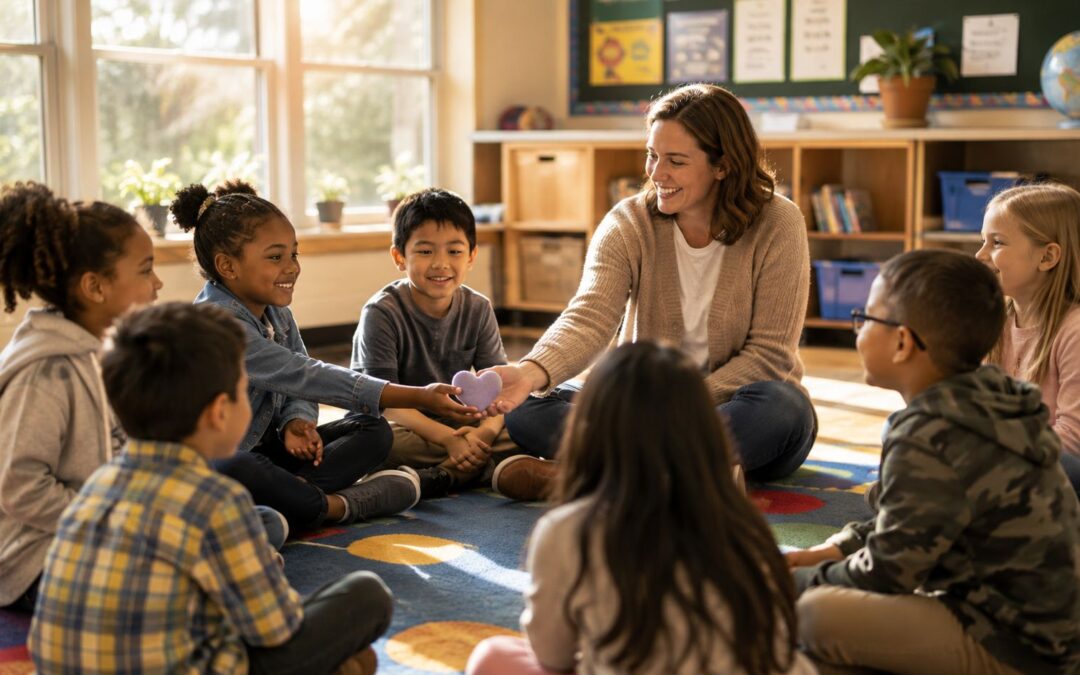
A Monday morning can reveal more about a school’s community than a polished mission statement. A third grader arrives anxious, keeps their backpack on, and avoids eye contact. A classmate says hello by name. The teacher gathers everyone for a five-minute circle, where students name how they’re arriving and listen without interruption. Later, two children disagree over a game, then use the class’s shared language to explain what happened and repair the problem.
Those moments may look small, but they shape attendance, behavior, emotional safety, and learning. The value of community in K–8 schools isn’t an abstract ideal or a pleasant extra. It’s a practical intervention built through repeated routines, adult responses, student leadership, and family partnership. The useful question isn’t whether community matters. It’s which daily actions make it visible, and how a school can tell whether those actions are working.
What a Strong K-8 Community Actually Looks Like
A strong community doesn’t depend on having unusually outgoing teachers or naturally cooperative children. It comes from structures that make connection predictable, especially on difficult days.
In the classroom above, the greeting tells the anxious student, “You were noticed.” The circle gives every child a regular chance to be heard. The conflict language prevents a small disagreement from becoming a social wound. None of this requires a dramatic event. It requires adults to repeat the same expectations until students can use them without waiting for rescue.
The daily signals students can feel
Across a school day, belonging appears in ordinary details:
- Predictable greetings: Adults and peers use students’ names and acknowledge their arrival.
- Inclusive norms: The class defines what listening, disagreement, participation, and repair look like.
- Shared problem-solving language: Students can say, “I felt left out,” “I need a reset,” or “How can we make this right?”
- Peer-helper roles: Children have meaningful ways to welcome, guide, explain, and support one another.
- Responsive adults: Staff notice withdrawal, conflict, or distress and respond before the student has to escalate.
A younger student might choose a feelings card during morning meeting. An older student might use a structured conversation after a group-project disagreement. The language changes with age, but the underlying message stays steady: everyone belongs, everyone has responsibilities, and conflict can be addressed without humiliation.
A school without these structures often feels inconsistent. One teacher may welcome students warmly while another treats connection as a distraction. A lunch conflict may be ignored until it becomes a referral. A child may sit alone for weeks because no routine helps peers notice or include them. When community is assumed rather than built, the most socially confident students usually benefit first, while quiet, new, anxious, or isolated students remain on the edge.
Practical rule: If a community practice only works when a particular adult is present, the school has a helpful person, not yet a dependable system.
School leaders can use guidance on improving school culture to examine whether expectations, routines, and adult language reinforce one another. The central test is simple: Can a student predict how people will greet them, handle harm, invite participation, and respond when they ask for help?
Community is the infrastructure underneath instruction. When it’s reliable, teachers spend less energy managing avoidable social confusion, and students have more capacity to participate. When it’s missing, academic strategies often have to work against isolation, mistrust, and unresolved conflict.
Defining the Value of Community in Schools
The value of community is the measurable benefit students, staff, and families gain from consistent caring relationships and shared norms within a school. That definition matters because it moves community away from vague language. A school can ask whether students feel known, whether adults respond consistently, whether families can participate, and whether those conditions connect with attendance and behavior.
Four layers overlap.
Social-emotional development
Students practice self-regulation, empathy, communication, and conflict skills inside relationships. A second grader who learns to pause before grabbing a toy is developing a skill. A sixth grader who can name harm, listen to another perspective, and agree to repair is applying that skill in a more complex setting.
These abilities grow through repeated practice, not a single assembly. Teachers need shared phrases and predictable responses so students hear the same expectations in the classroom, hallway, cafeteria, and playground.
Academic engagement
Belonging supports the conditions students need to attend, participate, persist through difficulty, and ask for help. A child who expects ridicule may hide confusion. A child who trusts the teacher and peers is more likely to attempt a challenging task, recover from an error, and return after a difficult day.
A 2020 meta-analysis of secondary education found a small positive relationship between school belonging and academic achievement, r = .18, and a small negative relationship with absence or dropout, r = -.16. Links with motivational, social-emotional, and behavioral outcomes were stronger, approximately r = .30 to .39 in the review (2020 meta-analytic review).
Physical and emotional safety
Safety isn’t only the absence of physical danger. Students also need predictable responses to bullying, exclusion, teasing, and conflict. A community teaches children that adults will listen, investigate, protect privacy where possible, and help repair harm.
Belonging
Belonging means feeling known, valued, included, and accepted as a participating member of the group. “School connectedness” is a research term for a student’s sense that people at school care about them and their learning. “Collective efficacy” describes adults’ shared belief that they can work together to support students. In plain language, students experience connectedness, while staff build the adult cooperation that makes connectedness dependable.
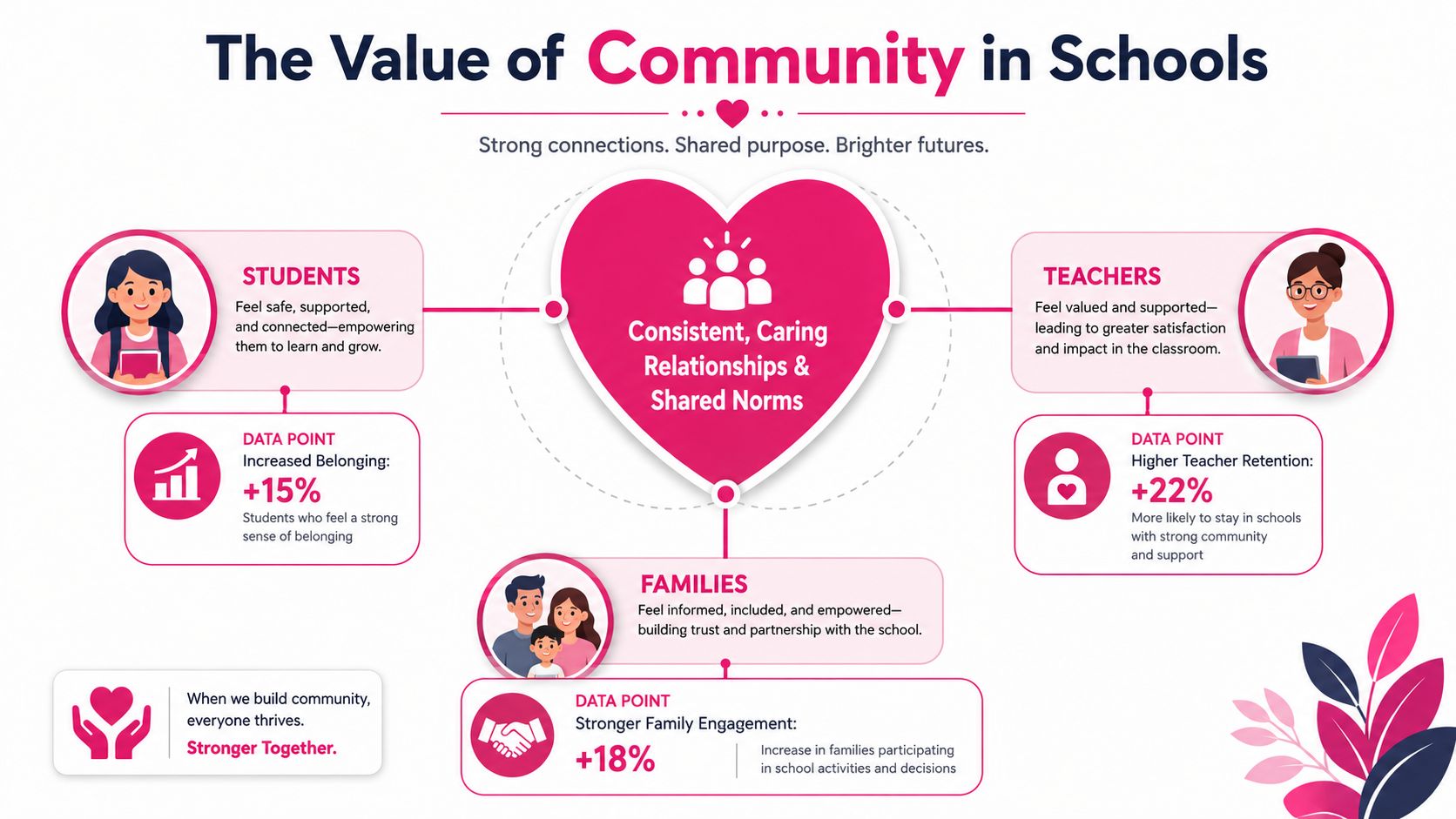
These layers don’t operate separately. A student who feels safe can focus. A student who feels known is more likely to request support. A family that trusts the school is more likely to share information before a concern becomes a crisis. Schools actively build these conditions through language, schedules, relationships, and follow-through.
What the Research Says About Belonging and Outcomes
A student who stops attending, avoids group work, or reacts sharply to correction may be showing a connection problem, not just a motivation problem. Research cannot prove that every community-building program causes better outcomes, but it does show that belonging is related to health, learning, attendance, and social-emotional measures. The effect also varies by age, setting, and program design.
A Canadian population health analysis found that 64% of Canadians reported a strong sense of community belonging in 2005, including 17% who described it as very strong and 47% as somewhat strong. Close to two-thirds of people with very strong or somewhat strong belonging reported excellent or very good general health, compared with about half of those with very weak belonging. The association remained after accounting for age, socioeconomic status, and other confounders (Statistics Canada population health study).
A newer Canadian cohort study found that young adults with a somewhat weak sense of belonging had a 76% higher relative risk of premature mortality than those reporting somewhat strong belonging, with RR 1.76 and a 95% confidence interval of 1.27 to 2.43 (Canadian cohort study). Among middle-aged adults in the weaker-belonging group, the pattern differed, with RR 0.82 and a 95% confidence interval of 0.69 to 0.98. For educators, the lesson is modest but useful: belonging matters, yet its effects should be interpreted in context rather than treated as a universal guarantee.
What the school evidence tells us
| Outcome area | Research finding | What educators can track |
|---|---|---|
| Academic achievement | Secondary-school belonging has a small positive relationship with achievement, r = .18 (meta-analysis) | Assignment completion, grades, and student-reported belonging |
| Absence and dropout | Belonging has a small negative relationship with absence or dropout, r = -.16 | Attendance patterns, late arrivals, and withdrawal from school activities |
| Motivation and social-emotional outcomes | Associations are stronger than the academic relationship, approximately r = .30 to .39 | Help-seeking, participation, peer connection, and classroom behavior |
| Primary-school achievement | A 2025 quasi-experimental study found stronger evidence that belonging preceded later achievement than the reverse direction (Oxford statement) | Changes over time, not a single survey result |
A survey response can reflect a supportive teacher, close friendships, or a generally successful school experience. An advisory period, peer mediation system, or family-engagement routine creates opportunities for connection, but the routine alone cannot guarantee that a lonely student feels included. Use the sense of belonging guide to clarify what students may be describing when they say they feel connected or left out.
Evidence also limits broad claims. A 2025 APA review found improvements in several social-connection outcomes, but pooled analyses among young adults did not show a statistically significant overall reduction in loneliness (APA review). Connection and loneliness are different measures. A busy school may offer many activities while a student still lacks one trustworthy relationship.
Schools can therefore treat community as a measurable K–8 intervention. Track routines, language, family practices, attendance, behavior, and belonging together, then adjust the supports when the pattern shows that a student is present but not participating.
Everyday Practices That Build Community at School
At 8:15, Ms. Rivera stands at the classroom door. She greets each student by name and offers three choices: wave, fist bump, or verbal hello. Once everyone is seated, students point to a check-in card showing how they’re feeling. One child chooses “tired,” and Ms. Rivera says, “You can participate in a low-key way today, and I’ll check back with you after reading.”
The routine takes little time, but it gives the teacher useful information and gives students a safe way to be seen.
During the first lesson, students work in pairs with rotating roles. One explains the task, one records the thinking, and both must ask a question before requesting adult help.
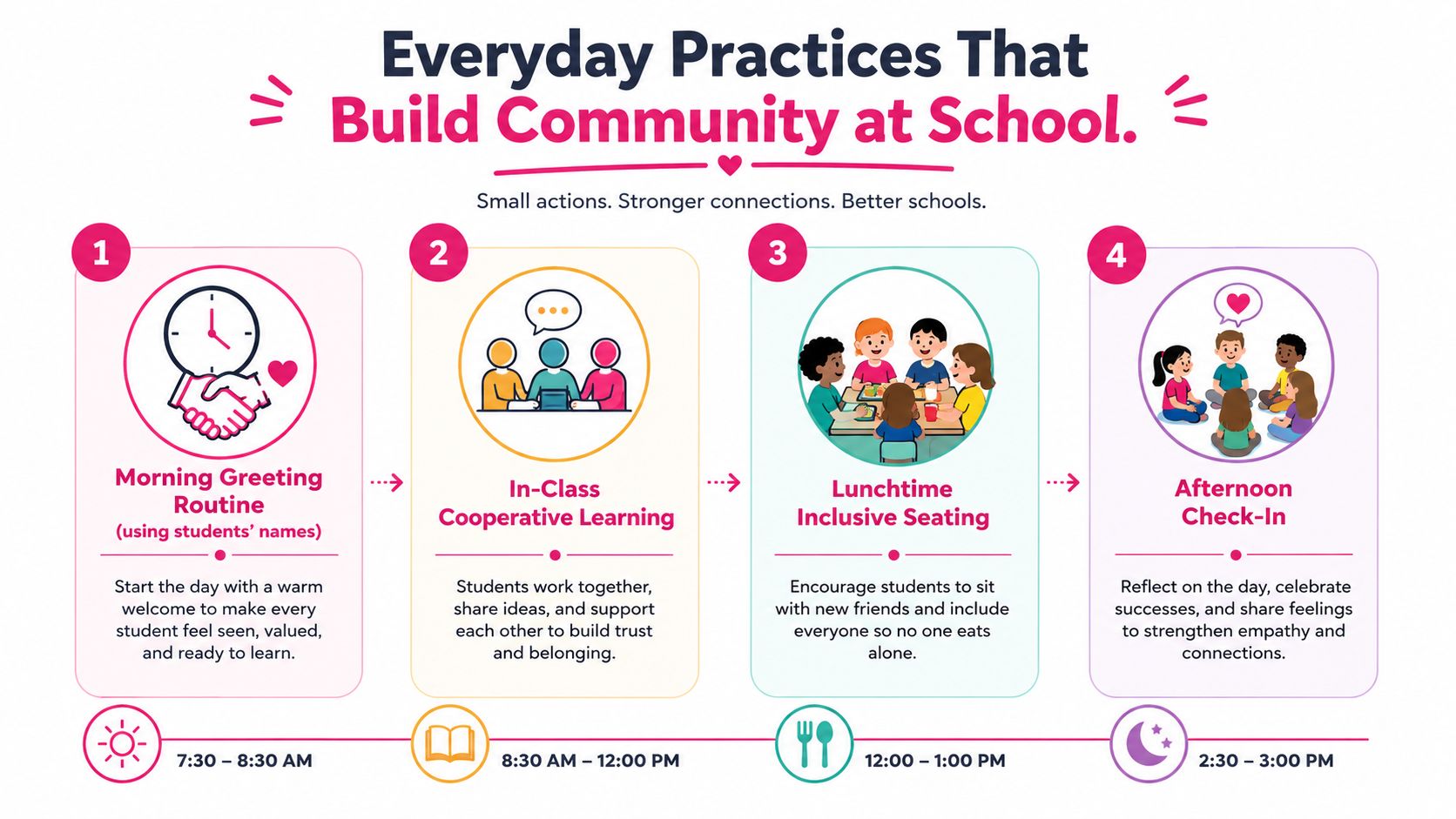
A transition ritual keeps the room settled between subjects. Students pause, name the next expectation, and thank a partner who helped them. At lunch, staff protect inclusive seating rather than allowing the same social hierarchy to determine every table. A recess buddy system gives new or isolated students a clear invitation without labeling them as a problem.
Language shift: Replace “I need you to calm down” with “We’re going to reset together so everyone can learn.”
The afternoon closes with a brief check-in. Students complete the sentence, “Today I contributed by…” or “Tomorrow I may need…” A teacher can use the responses to identify a child who needs a private conversation, not a public correction.
Families can mirror the same rhythm without recreating school at home. At dinner, try a high-low-share: one good moment, one difficult moment, and one thing the child hopes for tomorrow. During pickup or bedtime, ask, “Who helped you feel included today?” or “Was there a moment when someone needed help?”
These questions work better than “How was school?” because they invite a story. Parents can also use the school’s shared repair language: “What happened, who was affected, and what would help make it better?” Consistency between home and school helps children experience community as a way of treating people, not merely as a classroom activity.
Here’s a short video that can help teams visualize cooperative routines in practice:
Program Examples That Bring Community to Life
A principal may begin with a whole-school workshop on conflict language. Students practice identifying the difference between an accident, an unkind choice, and harm that needs adult support. Staff learn the same terms, then use them in the cafeteria and during math-group disagreements. Families receive a short version of the language so a child hears familiar prompts at home.
That’s the useful role of a structured program. It turns an appealing idea into scheduled practice with a common vocabulary.
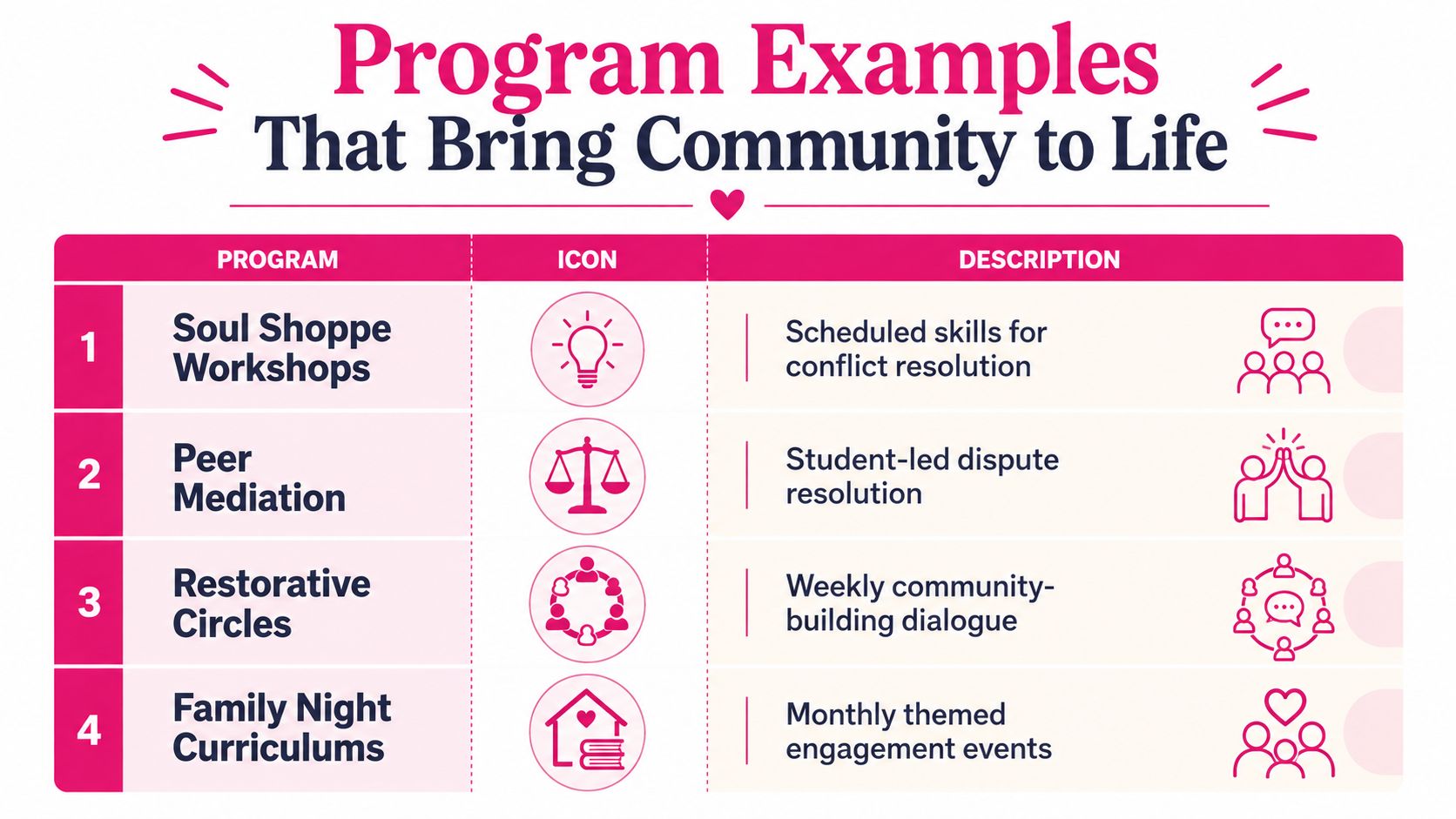
A school might use Soul Shoppe workshops and assemblies to teach communication, conflict resolution, and community-building skills across students, staff, and families. Its Peacemaker approach trains adults to support student peer leadership and conflict-resolution practices. Schools should still define their own success measures, because a well-run workshop is a starting condition, not proof that belonging has improved.
Matching the approach to the school
- Workshops and coaching: External facilitators can introduce shared skills, model lessons, and coach adults. This option helps when staff need a common launch, but leaders must schedule follow-up practice.
- Peer mediation: Trained students help peers use a defined process for manageable disputes. Adults still handle safety concerns, bullying, and situations involving a power imbalance.
- Restorative circles: A weekly circle can build relationships before conflict occurs. It may include appreciation, problem-solving, or repair after harm.
- Family nights: A themed evening can demonstrate listening, calming, and conflict tools that families can use immediately at home.
Community schools research offers stronger evidence for integrated approaches than for isolated feel-good events. A 2017 review of 143 studies found that well-implemented community schools improved student and school outcomes, with attendance and chronic absence changes often appearing first. Grades and test scores also improved, and math gains were strongest when implementation had been in place for several years (community schools review).
Lighter options can work when staffing is limited. A buddy-class partnership, teacher-led morning meeting, or student welcome team costs little, but each needs an owner, a schedule, and a review point. If a school also wants to deploy a campus safety app, leaders should position it as one part of a broader safety and communication system, not as a substitute for trusted adults and responsive relationships.
The strongest model combines adult coaching, student roles, family-facing tools, and leadership review. Leaders can also draw on school-community partnership guidance when deciding how outside partners, families, and school staff will share responsibility.
Measuring Whether Your School Community Is Working
A community initiative needs a measurement plan that staff can sustain. Start with four sources of information, then review them together instead of treating a single survey as the truth.
Four measures that belong together
Attendance shows whether students are arriving and remaining connected to school. Review regular attendance and chronic absence patterns by grade and student group. Attendance may move before academic results, as the community-schools review found (community schools evidence).
Connectedness surveys capture whether students feel welcome, known, respected, and supported. Keep them brief, use age-appropriate wording, and tell students what adults will do with the results. A survey that disappears into a report can reduce trust.
Behavior trends show where conflict or exclusion may be concentrated. Review incidents by grade, location, time, and type, but don’t interpret fewer referrals as automatic improvement. A teacher may refer less because behavior improved, or because students stopped reporting and adults stopped documenting.
Student voice adds context. Ask a few children, “Where do you feel most included?” “When do students get left out?” and “Which adult helps when something goes wrong?” Short interviews, exit tickets, and suggestion routines can reveal patterns that numbers miss.
| Measure | What it shows | Who owns it | Cadence |
|---|---|---|---|
| Attendance | Access, participation, and possible disengagement | Administrator and attendance team | Regular team review |
| Connectedness survey | Students’ experience of belonging and support | Counselor or SEL lead | Repeated pulse checks |
| Behavior incidents | Conflict, safety, and response patterns | Administrator and grade teams | Monthly review |
| Student voice | Explanations behind patterns | Teachers, counselors, and student leaders | Ongoing short prompts |
A healthy baseline isn’t a perfect score. It’s a clear picture of who feels included, who doesn’t, where incidents happen, and which grades need attention. Leaders should disaggregate results so a school-wide average doesn’t hide students who remain isolated.
Measurement warning: Don’t collect belonging data once a year and call the work evaluated. Ask, respond, and show students what changed.
At 60 days, the team can ask which routine students recognize and which groups still report weak connection. At 90 days, compare patterns, examine implementation, and adjust one or two practices. Resources on outcome measurement can help schools connect activities with observable results rather than counting events.
A Practical Checklist for Administrators, Teachers, and Parents
Community becomes durable when each adult knows their part. The timeline below keeps the work manageable and gives schools opportunities to correct course before a promising idea fades.
Administrators
By day 30, align the mission, staff language, and improvement plan around belonging. Protect time for morning meetings or advisory, identify the staff member who will coordinate the work, and establish a baseline using attendance, behavior, connectedness, and student voice.
By day 60, schedule common planning time so teachers can compare routines and problem-solve together. Review discipline and attendance data by grade, then pilot one evidence-informed program or internal practice with clear measures.
By day 90, ask: Which students report stronger connection? Which students still remain on the margins? Which adult practices are consistent across settings, and what needs coaching?
Teachers
Start tomorrow with a greeting at the door and a short closing circle. Post shared agreements in student-friendly language, use restorative questions during manageable conflicts, and send families a weekly note that includes one community practice students are learning.
At day 60, use a quick pulse question such as, “I have an adult at school I can go to when I need help.” Review responses privately and follow up with students who need a stronger connection. At day 90, ask whether the routine changed participation, peer interaction, or help-seeking, and revise the practice with students.
Parents and caregivers
Create predictable pickup, homework, and bedtime routines. Spend five minutes each day asking an open question, such as, “When did you feel included today?” Attend two school events during the year, volunteer once per quarter if possible, and reinforce the same agreements used at school.
At day 60, ask your child which school routine helps them feel comfortable and which moment feels hardest. At day 90, share that pattern with the teacher and agree on one support to continue at home and school.
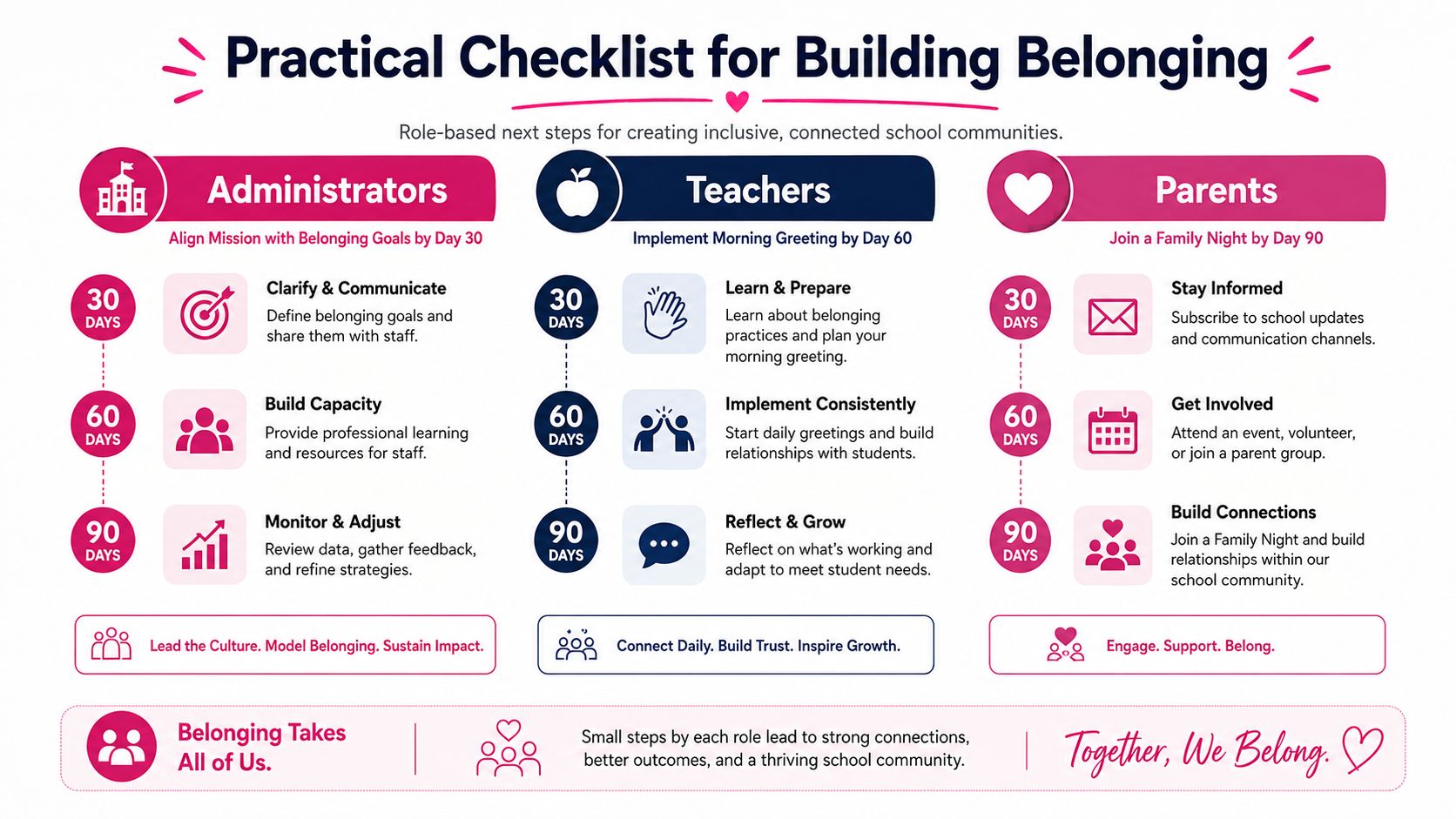
A useful question for every role: What will a student experience differently because we chose to build community on purpose?
Community-building isn’t finished when the posters go up or the assembly ends. It’s working when students can name where they belong, adults respond with shared language, families know how to reinforce the work, and the school uses evidence to support the children who are still waiting at the edge.
Soul Shoppe offers workshops, assemblies, coaching, and family tools that help K–8 communities practice communication, empathy, self-regulation, and conflict resolution. Visit Soul Shoppe to explore practical ways to turn belonging into daily school and home routines.