

School Community Partnerships: A Practical Guide for K-8
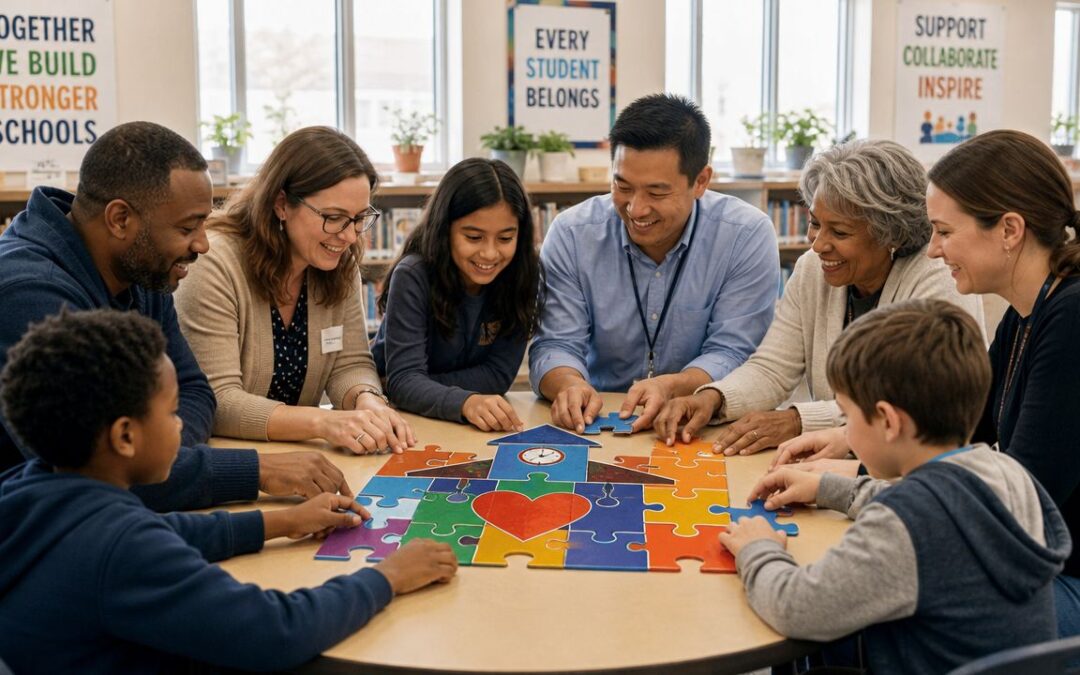
You know the moment. The bell has rung, the inbox is full, a parent is asking for support, and a teacher is trying to keep five moving parts steady before lunch. In that kind of week, school community partnerships can feel like either a lifeline or one more thing to manage.
The difference usually comes down to structure. When schools treat partnerships as a coordinated system, not a one-off event, families, staff, and community partners can share the load in ways that help students feel safer, more connected, and more ready to learn.
What School Community Partnerships Actually Look Like
A fifth grade teacher at a K-8 school can usually tell when the building is running on goodwill alone. The reading interventionist is juggling attendance calls, the counselor is helping students regulate after recess conflicts, and family engagement depends on whoever happens to have extra time that week. In that setting, a real partnership changes the rhythm of the school day.
A true school community partnership is not a volunteer sign-up sheet or a fundraiser that happens once a year. It is a coordinated relationship among the school, families, nonprofits, local businesses, and community members that supports both academic and nonacademic student needs, which matches the Institute of Education Sciences definition of K-12 community partnerships as collaborative relationships aimed at improving student outcomes and addressing those broader needs (IES definition and guidance).
What makes it feel different in real life
In practice, the school and its partners share language, routines, and responsibilities. A counselor might coordinate a referral process with a local mental health provider, a parent liaison might help caregivers understand when and how to access services, and a community partner might support a lunch bunch, family workshop, or attendance follow-up.
Practical rule: if the relationship only shows up when someone needs a favor, it's an activity. If it has shared goals, repeated touchpoints, and a plan for follow-through, it's a partnership.
That distinction matters for school culture too. Soul Shoppe's approach to school culture and belonging fits naturally here because its SEL work gives adults and students a shared way to talk about safety, empathy, and conflict. If you want a simple companion piece on that side of the work, this overview on how to improve school culture is a useful reference point.
What a parent and principal should be able to say
If a parent asks what the school is trying to build, the answer should be simple: “We're creating a support network around students, so learning, behavior, and family connection aren't handled in separate silos.” That's the heart of it.
A partnership is working when the school can point to clear roles, shared routines, and support that reaches students before problems become crises. If the only evidence is a pile of flyers, a few guest visits, or a seasonal event, the school probably has outreach, not a partnership.
Why Partnerships Improve SEL, Attendance, and Belonging
A principal sees it first in the hallway. A family calls about transportation, a teacher is trying to de-escalate a conflict, and a counselor is already juggling several student needs. school community partnerships help schools respond without making every support request start from zero. When a school can connect families to counseling, food support, mentoring, after-school help, or caregiver guidance through a shared system, students face fewer barriers to learning. That matters most in schools where staff are stretched thin and one counselor is carrying too many needs at once.
A historical marker shows how large this work became. The U.S. Partnerships 2000 survey found that 69% of districts nationwide were engaged in partnership activities, up from 51% in 1990, and estimated that more than 35 million students benefited, alongside about 3.4 million volunteers contributing roughly 109 million hours of work, an amount described as equivalent to about 52,000 full-time staff and valued at approximately $2.4 billion in combined resources (ERIC report). Those numbers matter because they show partnerships were never just an extra event calendar. They became part of the support system schools depended on.

Why the SEL piece is not separate
SEL is the thread that keeps the partnership from feeling like paperwork. A student may learn self-regulation in a classroom circle, then need the same language from adults when a conflict spills into the hallway or home. Experiential, community-based SEL programming gives students and adults a shared way to practice empathy, repair, and calm-down strategies together, so the support feels consistent instead of disconnected.
A 2024 study on sustainable partnerships found that 90% of respondents identified a common purpose as an important strategy for establishing partnerships, and it also highlighted trust, accountability, monitoring, and shared responsibility (2024 sustainable partnership study). That matches what happens in schools. If caregivers, teachers, and community providers are all reinforcing different norms, students get mixed messages. If they share the same purpose, the same words, and the same response to problems, students get steadier support. The operational side matters too, because shared purpose works better when the school has clear roles, a basic memorandum of understanding, and a simple plan for who can share what information, with whom, and for what reason.
Belonging is part of the same picture. For a plain-language overview, see what sense of belonging looks like in school communities. When students feel known, supported, and included, they are more likely to stay connected to school routines instead of drifting away after one hard moment.
Who benefits most
Partnerships matter for every student, and the equity angle is especially important for underserved communities. A 2025 U.S. public-health study found that established school partnerships can be mobilized to reach underserved populations more efficiently than building entirely new systems (2025 public-health study). That matters when families are dealing with language barriers, transportation issues, mental health access gaps, or uneven access to information.
A partnership reduces friction. It does not replace family effort or staff effort, it makes both easier to carry.
The strongest partnerships do more than engage families for a night or two. They remove obstacles, coordinate services, and make belonging visible in daily routines. That is why attendance, SEL growth, and school climate often move together when the school and community stop working in parallel and start working as one support system.
Partnership Models That Fit K–8 Schools
Not every school needs the same kind of partnership first. A building with serious attendance challenges may need service-aligned support before it needs a big enrichment calendar. A school with decent external programming but weak family connection may need caregiver workshops and home-school bridges. The right model depends on what's missing.
| Model | Typical Partners | Primary Outcomes | Best Fit For |
|---|---|---|---|
| Service-aligned partnerships | Counselors, mental health providers, food banks, family support agencies | Access to help, removal of barriers, student stability | Schools with basic needs, attendance, or support gaps |
| Program-embedded partnerships | SEL providers, coaches, assembly facilitators, classroom trainers | Shared language, self-regulation, conflict resolution | Schools building culture and Tier 1, Tier 2 SEL support |
| Family-capacity partnerships | Caregivers, family liaisons, parent educators, community advocates | Stronger home-school communication, caregiver confidence | Schools with inconsistent family engagement |
| Community-enrichment partnerships | Youth programs, local businesses, neighborhood groups, mentoring organizations | Belonging, exposure, real-world learning | Schools seeking engagement beyond the classroom |
Service-aligned partnerships
These partnerships connect the school to actual supports. A food bank can help a family stabilize basics, a counseling provider can extend mental health access, and an after-school tutoring partner can support students who need more time and practice. These are the partnerships that often show their value fastest because they answer a concrete need.
The National Center for School Mental Health recommends mapping services across Tiers 1, 2, and 3, using MOUs to spell out prevention, promotion, and intervention responsibilities, and defining staffing arrays based on need (NCSMH guidance). That kind of clarity keeps support from becoming random or duplicated.
Program-embedded partnerships
SEL providers, coaching, assemblies, and staff training fit this need. Soul Shoppe belongs in this category because its interactive workshops and assemblies help schools build shared language around safety, communication, and conflict resolution. It's one example of a program that can sit inside the school day instead of hovering around the edges.
If peer support is already a goal at your school, peer support programs can give leaders a way to think about student-to-student connection without leaving adults out of the equation.
Family-capacity and community-enrichment partnerships
Family-capacity work often starts with the basics, like caregiver workshops on boundaries, routines, or emotional regulation at home. Community-enrichment work is broader, including mentoring, career exposure, service learning, and school events that give students a wider circle of adults who know their names.
A simple way to choose:
- If students need access to services, start with a service-aligned model.
- If adults need a shared SEL language, build a program-embedded model.
- If family trust feels thin, invest in caregiver-facing support.
- If students need more connection to the world outside school, add enrichment partners.
The goal isn't to collect partner logos. It's to build the right mix for the needs your students have.
Readiness Checklist and Stakeholder Roles
Before launching anything new, ask whether the school can hold the work. A partnership collapses quickly when the principal is enthusiastic but nobody knows who schedules meetings, who shares data, or who follows up with families. Readiness is mostly about clarity.

The roles that need to be named early
A site-based leadership team should include school leaders, teachers, families, administrative or support staff, and community partners who meet regularly to plan, implement, and evaluate the partnership, which aligns with Institute of Education Sciences guidance (IES guidance). That team is not decorative. It carries the work.
Here's how the roles usually break down:
- Principal or assistant principal: gives the partnership permission to exist, clears barriers, and keeps it tied to school priorities.
- Counselor or SEL coordinator: connects the partnership to student needs, staff language, and service coordination.
- Teacher representative: checks whether the plan works in real classrooms, not just on paper.
- Family liaison or parent leader: keeps communication understandable and culturally responsive.
- Community partner lead: brings services, staffing, and limits into the planning so the school knows what is realistic.
Practical rule: if two adults can't answer the question “Who owns this step?” the system is already too vague.
What readiness looks like before launch
A school is in better shape when it has a needs assessment, a communication path, a leadership team, and a legal path for any data sharing that might be required. The Institute of Education Sciences also recommends continuous improvement routines, including collecting data, analyzing trends with descriptive statistics, and reviewing results with stakeholders to decide what to do next (IES continuous improvement guidance).
If the school does not have that foundation yet, the right move may be to start small instead of starting fast. A single pilot partnership with clear meetings and one outcome is more workable than a broad launch no one can sustain.
For teams building the SEL side of readiness, this SEL programs for schools overview can help leaders think about how a partnership and a schoolwide SEL effort fit together.
A quick self-check helps:
- Start now if the school has clear leadership, a real partner, and a narrow goal.
- Start small if the partnership idea is strong but roles and routines need testing.
- Pause and prepare if no one can name the data, the meeting cadence, or the owner of the work.
Readiness protects students and staff alike. It also keeps goodwill from turning into confusion.
Implementation Steps That Prevent Staff Burnout
A partnership should reduce strain, not add hidden tasks to every teacher's plate. The cleanest way to do that is to phase the work, formalize expectations, and keep the school from becoming the default storage bin for everything that goes wrong. When the implementation is sloppy, burnout shows up fast.

Start with one need and one partner
Begin with a needs assessment that points to a specific student problem, not a vague wish list. If attendance is the issue, find a partner who can help with attendance follow-up or family support. If students need self-regulation practice, choose a partner who can work inside the SEL routine already in place.
The National Center for School Mental Health recommends using MOUs to define responsibilities, payment processes, duration, and termination terms, which is what keeps service work from becoming improvised (NCSMH guidance). A school can also use one standard MOU template across different partners, then adjust the details for each program instead of starting from scratch every time.
Build the legal and communication pieces early
For data sharing, districts should create templates for agreements and help schools and partner organizations through the legal process of creating and maintaining them (ERIC report on data-sharing agreements). That matters when partners need attendance data, referral status, or progress updates to do their jobs well.
A school might use one template for a food bank, another for a counseling provider, and a third for an after-school tutoring program. The point is to clarify what can be shared, who can access it, and how updates move over time.
The school should also set a regular checkpoint. One guide recommends agreed-upon status checks so partners can verify whether the relationship is meeting shared objectives and renegotiate if it isn't, such as a monthly review between a school and a youth center checking whether an attendance-support program is reaching students who miss 10 or more days (WiseWays guide).
Use templates so the work can breathe
A good implementation cycle usually looks like this:
- Assess one need with the leadership team.
- Pilot one partnership with a narrow scope.
- Write the MOU and data-sharing agreement before launch.
- Review the results regularly with the people doing the work.