

How to Track Student Progress with Confidence
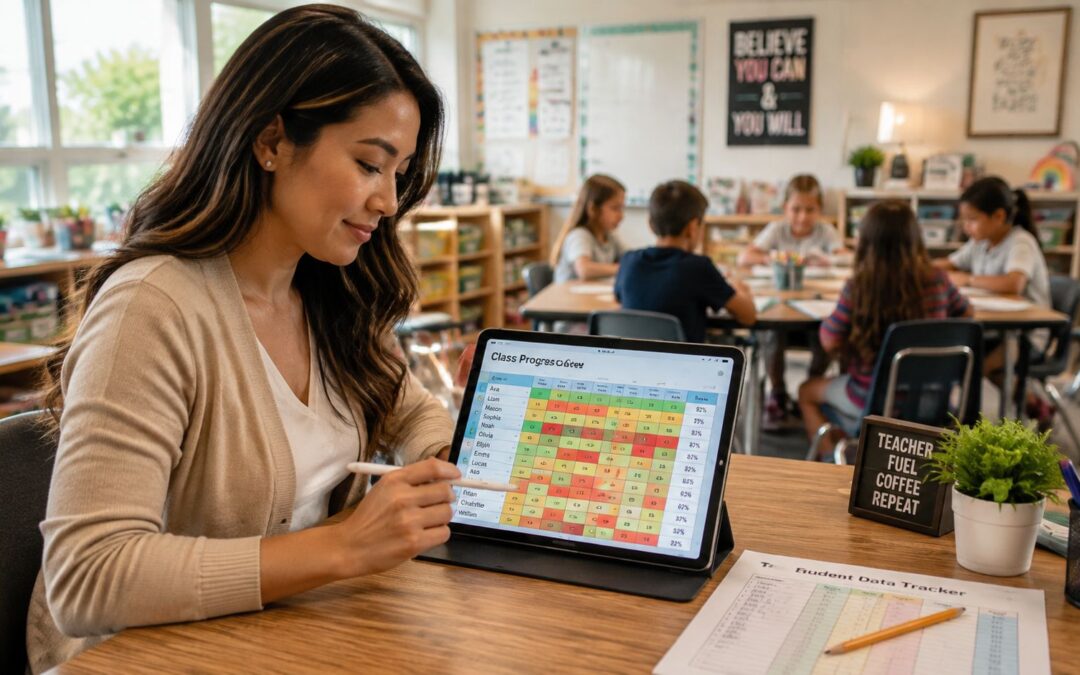
On Monday morning, a teacher may have plenty of information and still lack a clear answer. The gradebook shows completed assignments, the reading group has finished another lesson, and a family has asked whether their child is “doing okay.” Yet the most useful evidence may be a short reading probe, a work sample, and a child avoiding partner work.
Learning how to track student progress means building a small, dependable system that shows both movement and the conditions around that movement. Academic evidence tells you what a student can do. Social-emotional learning, or SEL, evidence can help explain whether confidence, attendance, belonging, self-regulation, or classroom relationships are helping or interfering with learning.
Why Tracking Student Progress Matters More Than You Think
At 8:10 on a Monday, Mrs. Alvarez gathers four fourth graders for reading. Before opening the next lesson, she glances at last week's fluency chart. Two students have slipped below their aimline after spring break. She doesn't assume they've lost the skill. She listens to each child read, checks attendance, and asks what feels difficult about getting back into the routine.
That small pause changes the lesson. One student needs a brief review of multisyllabic words. The other is reading accurately but hesitating because she's worried about reading aloud. A report-card grade would eventually record the outcome, but it wouldn't have shown Mrs. Alvarez what to do that morning.
Formative assessment is powerful because it gives teachers evidence during instruction, rather than only after a unit or term has ended. A K-12 meta-analysis synthesized 258 effect sizes from 118 primary studies and found an overall effect size of 0.25, Hedges' g, with a similar 0.22 effect in U.S. studies. The results were consistent across self-assessment, peer assessment, and teacher-led approaches, as well as English language, mathematics, and science. The meta-analytic review of formative assessment supports a daily cycle of evidence, feedback, and instructional adjustment.
The problem with vague tracking
Grades arrive too late to guide many immediate decisions. A single test score can also hide whether a student misunderstood the content, rushed, lacked sleep, missed instruction, or felt unsafe participating.
SEL signals can disappear just as easily. A child's unfinished work may reflect avoidance, confusion, attendance disruption, or difficulty managing transitions. A dual-lens tracker helps teachers ask two questions:
- What is changing academically? Look at skills, work quality, fluency, accuracy, or understanding.
- What may be shaping that change? Look at participation, self-regulation, belonging, attendance, peer interaction, and classroom climate.
This approach helps teachers intervene earlier, hold more honest family conversations, and avoid labeling a child from one assessment window. The rest of the work is practical: define the goal, select manageable measures, collect them consistently, interpret patterns, and share the next step.
Setting Clear Academic and SEL Goals With Success Criteria
A broad goal such as “improve reading” gives a teacher good intentions but poor decision-making. A useful goal names the skill, the conditions, the evidence, and the point at which you'll review progress.
Use a SMART-I goal, meaning specific, measurable, achievable, relevant, time-bound, and inclusive. The inclusive part matters because the goal should allow the student to participate in defining success and showing what they know.
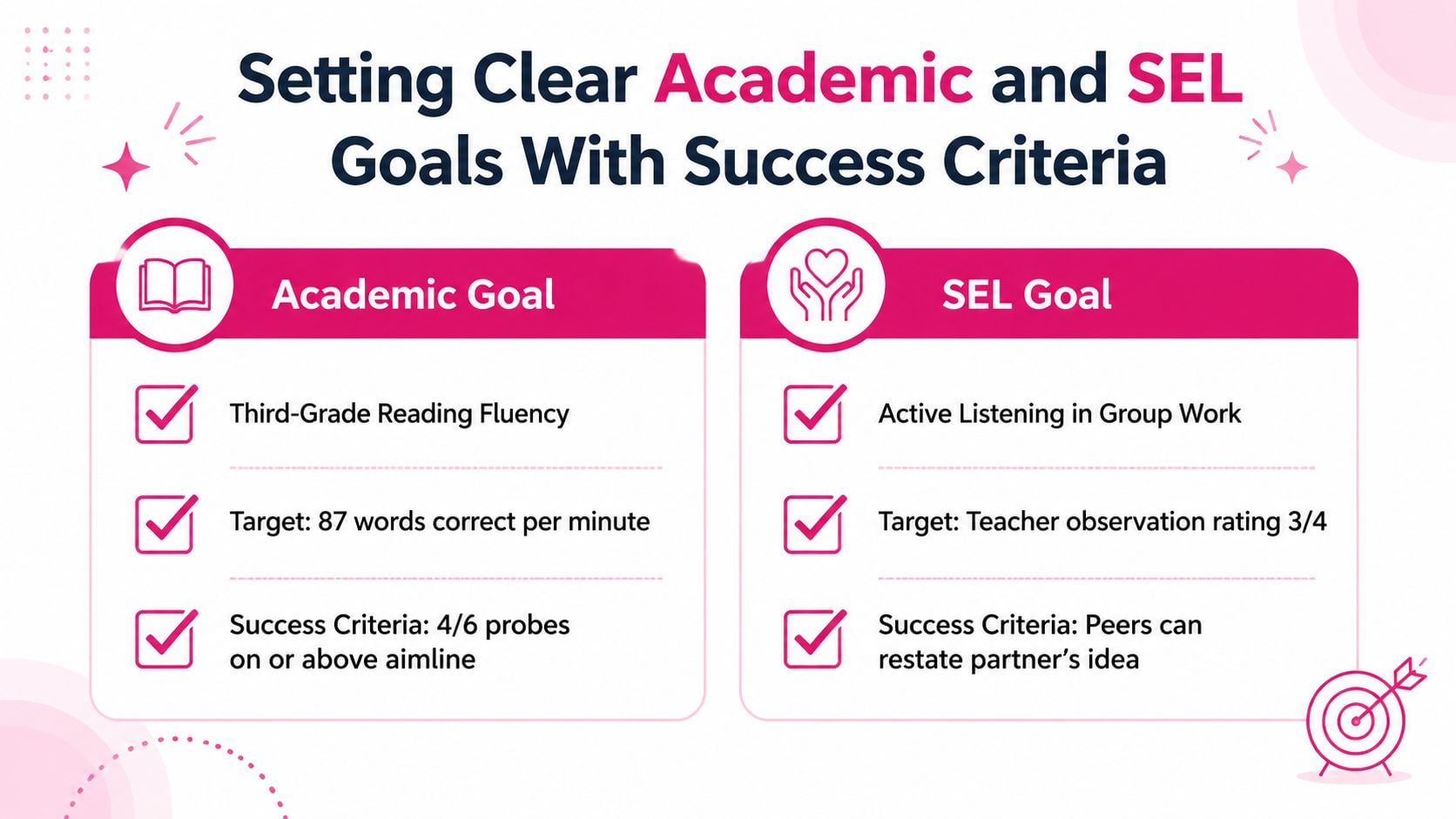
For example, a third-grade reading goal might be: “By week 8, the student will read grade-level passages at 87 words correct per minute with 95% accuracy.” Those numbers are useful only when paired with clear evidence, such as a repeated probe and an aimline. The student should also understand the goal in child-friendly language: “I'll read smoothly, keep my words accurate, and check that my reading makes sense.”
SEL goals need the same care. “Improve behavior” is too broad. A fifth-grade goal could be: “Before transitions, the student will independently use a self-regulation checklist on 4 of 5 observed days.” Success criteria might include noticing the signal, choosing a calming strategy, and joining the next activity without adult prompting.
Make success visible to children
A child should be able to recognize progress without waiting for an adult to announce it.
- Kindergarten self-management: “When I feel upset, I will point to a feeling card and choose one calming tool before returning to the activity.” Evidence might be a brief teacher checklist.
- Seventh-grade math fluency: “I will solve assigned integer operations accurately and explain one strategy.” Evidence could include a short skills check and a written explanation.
- Active listening in group work: “I will face the speaker, wait for a pause, and restate the partner's idea.” A peer or teacher can use a simple rubric.
Write criteria that another adult could score without asking you what you meant. If a substitute teacher can look at the work, observation record, or probe and make a reasonable judgment, the goal is probably clear. Teachers who want more student-friendly language can also use this resource on goal setting for students.
Choosing the Right Measures for Your Classroom
No single measure can carry the whole story. Grades summarize performance across assignments, but they can mix learning with completion, attendance, support, and late work. Standardized scores offer useful comparison points, but they may not tell you what to reteach tomorrow.
A balanced classroom system usually includes a few different views:
| Measure | What It Reveals | Blind Spots | Best Used For |
|---|---|---|---|
| Exit ticket | Immediate understanding of a lesson objective | Captures a narrow moment | Planning the next lesson |
| End-of-unit assessment | Performance across taught content | May come too late for reteaching | Summative review |
| Curriculum-based measure | Skill performance under consistent conditions | Can narrow attention to one skill | Frequent progress checks |
| Observation or anecdotal note | Engagement, strategy use, and interaction | Can become subjective without criteria | SEL and classroom routines |
| Rubric | Quality of project-based work | Requires shared scoring expectations | Writing, speaking, and projects |
| Student self-assessment | Metacognition and student perspective | Younger students may need modeling | Reflection and goal ownership |
| Portfolio or work sample | Change in authentic work over time | Takes organization to compare fairly | Writing, art, and problem-solving |
Build a sustainable mix
Start with one general academic measure, such as an exit ticket or short assessment. Add one curriculum-based probe, such as an oral reading fluency measure or timed math fact screen. Include one rubric-based performance check for a richer task and one weekly SEL signal, such as participation in group work or use of a regulation strategy.
The best measure is one you'll collect and interpret. A complicated platform that requires extensive training may look impressive but fail during report-card season. A clipboard, spreadsheet, or simple digital form can work well if the columns stay consistent and the teacher knows what decision each measure supports.
A useful comparison is not “paper or technology.” It's “Will this evidence arrive often enough, clearly enough, to change what I do?” Teachers developing a broader measurement plan can review outcome measurement guidance while keeping the classroom system focused on usable evidence.
Building a Weekly Data Collection Routine That Sticks
A tracking system survives busy weeks only when the routine is smaller than the resistance to using it. Teachers don't need to enter every observation, assignment, or conversation. They need a fixed schedule, a short tracker, and a protected time to look for patterns.
A practical cadence might look like this:
| Day | Quick Action | Time Needed | Tracker Column |
|---|---|---|---|
| Monday | Check a baseline skill or review the prior trend | Brief check | Baseline or starting point |
| Tuesday | Record a targeted observation during instruction | A few minutes | Strategy or SEL signal |
| Wednesday | Use an exit ticket tied to the day's objective | Brief check | Understanding |
| Thursday | Confer with a student or review a work sample | Short conference | Student reflection |
| Friday | Give a probe or complete an observation entry, then review | Protected review slot | Score, trend, next action |
The exact time will vary, but a 10-minute Friday data huddle can be enough for a small group. Keep a clipboard or digital tracker with fixed columns: date, skill, score or rating, context, student comment, and next action. If a form will reduce repeated typing, a teacher might use a form builder replacing Google Forms to collect consistent entries.
A worked reading example
Suppose a second-grade student begins with an oral reading fluency score below the expected aimline. The teacher records four weekly scores, such as 42, 47, 49, and 53 words correct per minute, and plots each score against the goal line. The point isn't to celebrate every increase or panic over one dip. The teacher studies whether the trend is moving toward the line and whether the student's accuracy and comprehension are holding steady.
The teacher might notice that the score rises during quiet individual practice but falls during a noisy group rotation. That context belongs in the tracker because it may explain the variation. The next step could be a quieter practice location, a short decoding review, or a check of whether the passage difficulty is consistent.
Keep entry from taking over
Batch similar tasks. Enter reading scores together, then add one concise note about the instructional response. Use a calendar reminder for the Friday review and keep the active tracker limited to current goals. The IRIS Center guidance on progress monitoring recommends defining the measurable skill, selecting the metric, collecting it consistently, and using frequent schedules such as weekly or every two weeks. A once-per-term check is too infrequent for timely instructional changes.
Reading the Data to Adjust Instruction and Interventions
A single low score is information, not a verdict. Teachers make stronger decisions by reading the shape of the data, checking the context, and comparing several evidence sources.
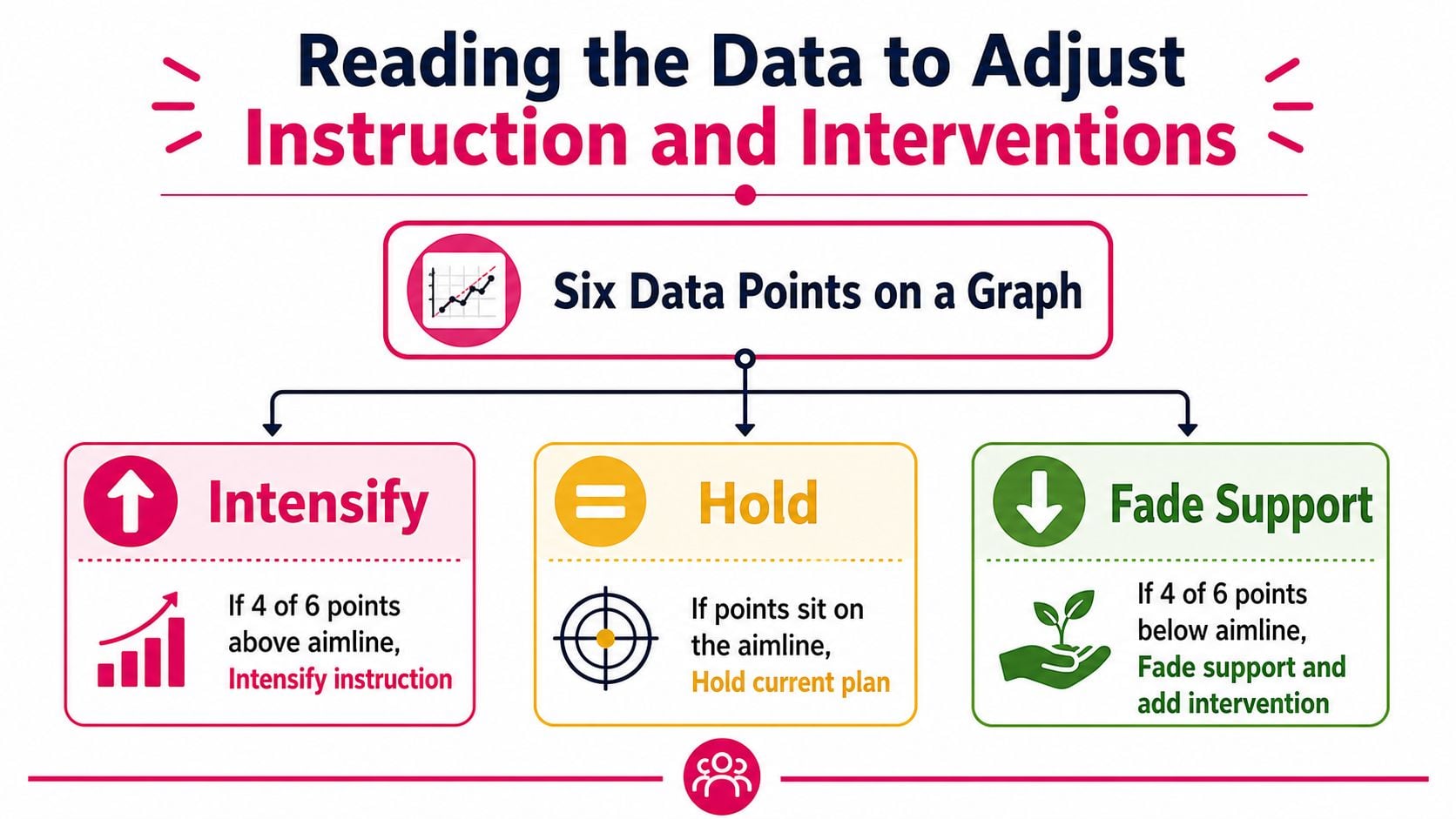
Use the aimline as a decision aid. If 4 of 6 points fall above the aimline, intensify or extend the successful instruction because the student may be ready for a stronger challenge. If points sit on the line, hold the current plan and continue monitoring. If 4 of 6 points fall below the aimline, change the intervention, examine barriers, or provide more targeted support.
Triangulate before you change course
Suppose a student's vocabulary quiz scores are flat, reading work samples show strong ideas, and an SEL check shows reluctance to speak in groups. The problem may not be vocabulary knowledge alone. The student might understand the words but avoid demonstrating that understanding publicly.
Compare:
- Academic evidence: quizzes, probes, written responses, and work samples.
- Instructional evidence: which strategy was taught, how often it was practiced, and whether directions were clear.
- Student evidence: confidence, self-assessment, effort, and explanation of the difficulty.
- Context evidence: attendance, behavior shifts, peer relationships, and changes at home or school.
A recent K-12 reading meta-analysis included 48 studies and 116,051 students and found a positive average formative-assessment effect of 0.19 standard deviations. It also reported an effect of 0.13 SD when differentiated instruction was paired with formative assessment, and found that teacher-and-student-directed assessment outperformed teacher-only approaches. The reading assessment meta-analysis reinforces the value of combining teacher judgment with student self-monitoring.
For practical ideas, teachers can browse Keybaki's assessment techniques.