

8 Worksheets for Problem Solving: K–8 SEL Resources for 2026
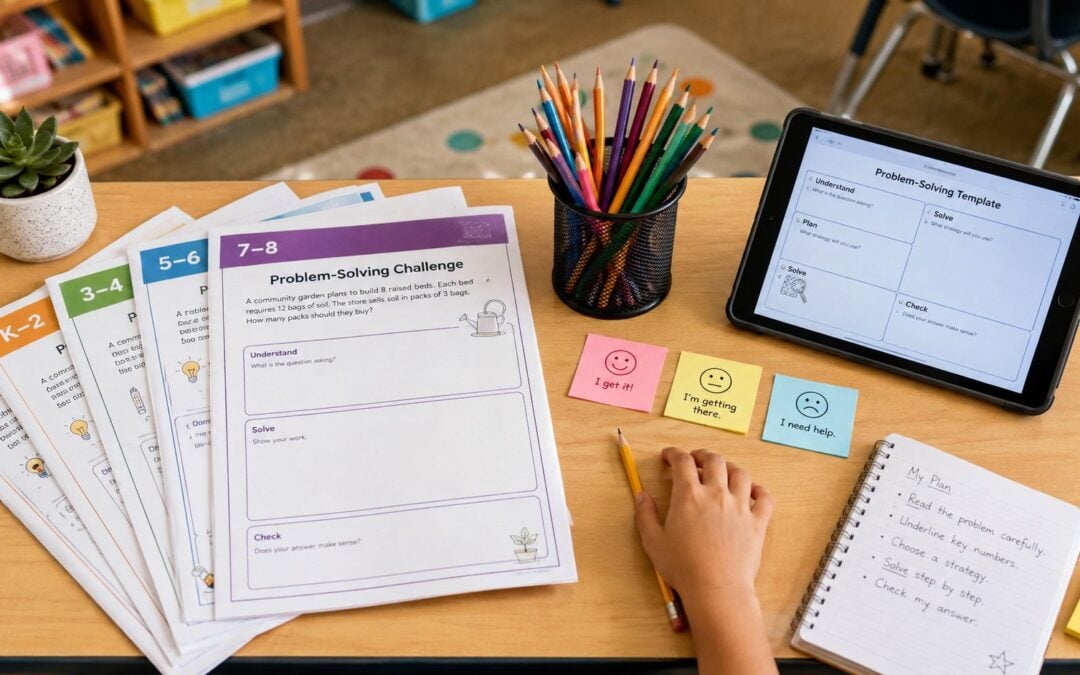
The student at your table isn't always stuck on the math. Sometimes they're stuck on the group partner who won't share materials, the recess conflict still simmering in their head, or the worry that they're about to get in trouble if they speak up. That's why worksheets for problem solving work best when they do more than ask for an answer. They help kids name the feeling, see the choices, and practice the words and steps they'll use in real moments. For educators and parents, that's the difference between busywork and a tool that changes behavior in the room, at home, and on the playground. If you want a simple companion to that mindset, the idea behind practical problem solving mindsets fits well with the kind of SEL-rich practice kids need every day.
The strongest worksheets don't treat problem solving like a single blank page. They guide students through self-awareness, relationship skills, and responsible decision-making, then connect those skills to classroom realities like peer conflict, group work, worry, and repair after harm. They also reflect the broader direction of curriculum materials that move from isolated computation toward real-world reasoning, like statistics worksheets that now lean into applied scenarios and step-by-step support with answers and printable formats. Here are eight worksheet categories that help K-8 students build the habits they need, not just the right response on paper.
1. Social-Emotional Learning Problem-Solving Worksheets with Real-World Scenarios
A worksheet becomes useful fast when a child sees their own day inside it. A 3rd grader who feels left out at recess, a 6th grader frustrated by uneven group work, or a K-1 student who wants the same toy as another child can all use the same basic routine, notice the problem, name the feeling, think through choices, and predict what each choice might change.
Why these worksheets work
These worksheets connect self-awareness with relationship skills by asking students to name feelings before they pick an action. That matters because children usually need to sort out the emotion first, the same way you would clear a cluttered desk before finding the right pencil. Once the feeling has a name, the next step gets easier to see. Students can choose talking, sharing, waiting, asking for help, or switching to another activity, and they can practice more than one safe response instead of relying on a single answer.
Practical rule: If a student can name the feeling, they are more ready to choose the next step.
That same idea works well in a classroom routine or at home. The problem-solving activity resource fits naturally beside these worksheets because it gives students another way to practice the same thinking with real situations.
A 3rd grade example might read, “Your friend did not invite you to their birthday party, but you see them playing with someone else at recess. What are you feeling? What could you do?” A child can sort through talking to the friend, joining another game, or checking in with a trusted adult. A 6th grade version might ask, “Your teammate is not doing their part. How could you address this while keeping the friendship?” That version asks for more careful judgment, because older students are ready to practice direct, respectful communication instead of shutting down or assigning blame.
The grade-level shift matters. Younger students usually need shorter prompts, more visual support, and one clear choice at a time. Older students can handle a fuller scenario, compare options, and explain why one response is better than another.
Teachers can model the first example with the whole class, then send a copy home so families can use the same language after sibling conflict or frustration during play. Parents can use the worksheet in a calm kitchen-table conversation, where the child has a chance to talk through the situation without feeling rushed. Side by side, teacher and parent support gives children repeated practice with the same skill, so problem solving starts to feel like part of daily life instead of a school-only task.
2. Conflict Resolution Step-by-Step Worksheets with Communication Scripts
Conflicts feel bigger to students when they don't have words for what happened. Step-by-step worksheets make the problem manageable by breaking it into chunks like what happened, how I felt, how they felt, and what I want to happen. That structure gives children a path from emotion to communication without forcing them to improvise in the middle of a tense moment.
The strongest versions include sentence starters so students can practice saying something like, “I felt upset when… because… I'd like to…” instead of freezing or blurting. For younger learners, the prompt may be visual and simple, with pictures or icons they can point to before they speak. For middle school students, the worksheet can shift into a continuum, from a mild disagreement to a more serious conflict, then offer matching language for each level.
The I-statements for kids resource pairs naturally with this kind of structure because it gives students a usable script for real conversations. A child who borrows a classmate's marker without asking can learn to say, “I felt frustrated when you took it because I was using it. Can I have it back now?” That's not just conflict resolution, it's relationship skill in action.
For parents, the move is simple, ask the child to use the worksheet before you jump in with advice. For teachers, it helps to keep a folder of completed sheets so patterns become visible over time. You'll often see the same triggers repeat, and once they do, you can coach earlier and more effectively.
Completed worksheets become more powerful when students see that they're not just solving one problem, they're learning a repeatable communication routine.
3. Critical Thinking and Decision-Making Worksheets with Consequences Mapping
Some choices look easy in the moment and messy later. That's exactly where consequences mapping helps. These worksheets push students to weigh options, consider values, and think through short-term and long-term outcomes before they act, which is the heart of responsible decision-making.
A 4th grader might see the prompt, “Your friend wants to copy your homework. What are your choices?” The student can list options like letting them copy, saying no, or offering help instead. Then the worksheet can ask what happens right away, what happens later, and what values are involved, like honesty, friendship, and responsibility. That shifts the task from obedience to judgment.
A 6th grade scenario might focus on peer pressure, where classmates want a student to exclude someone. The worksheet can ask, “What's the decision? How would each person feel? What happens after? What matters most here?” That kind of prompt helps kids notice that a popular choice isn't always a wise one. It also gives them a structure they can reuse when the situation is social, digital, or academic.
For teachers, this works best when you start with lower-stakes scenarios and use anonymized dilemmas from the classroom. For parents, a quick conversation can sound like, “What could happen if you do? What could happen if you don't? Which person do you want to be?” That keeps the discussion concrete instead of preachy.
The School Safety Solutions guide fits here as a useful reference point for educators who want to connect decision-making with broader safety thinking. When students practice mapping consequences, they get better at pausing, comparing options, and choosing actions that match their values instead of the loudest voice in the moment.
4. Collaborative Problem-Solving Worksheets for Group Projects and Team Challenges
Group work exposes every weakness in a child's problem-solving routine. One student wants to lead, another doesn't know the job, and a third is frustrated but hasn't said a word. Collaborative worksheets help teams surface those issues early, which protects both the project and the relationships.
Start with roles and expectations
A strong group worksheet asks, “What are we making or learning? What jobs do we need? Who wants which job and why? How will we make decisions? What might be hard?” That sequence gives students a chance to negotiate before the project turns into conflict. It also supports relationship skills because kids have to listen, explain, and adjust.
In elementary science, one team might assign researcher, builder, recorder, and reporter. Midway through, they can revisit the sheet and ask whether everyone is doing their job or whether the group needs a reset. In middle school history, team members can complete a short reflection first, things like their strength, what frustrates them about group work, and how they want a teammate to bring up a problem. That simple pre-work often lowers tension before it starts.
Parents can use the worksheet language when a child comes home upset about group work. Ask whether the problem is unclear roles, uneven effort, or disagreement about the approach. Teachers can teach turn-taking and appreciation language before the project begins, then use the worksheet as a check-in tool rather than a rescue tool.
The what is collaborative problem solving framing is especially useful here because it reminds adults that the goal isn't just a finished product. It's a team that can think together, course-correct, and stay respectful while doing it. That's a skill students will keep using long after the poster board gets turned in.
5. Empathy and Perspective-Taking Problem-Solving Worksheets
Kids solve problems better when they can see the situation from another person's side. Perspective-taking worksheets build that habit by asking students to name what someone else may have been thinking, feeling, or needing before they decide what to do.
A younger student might work through a bullying or exclusion scenario by identifying “what the person doing the excluding was thinking,” “how the left-out person felt,” and “what the left-out person might need.” That can move the student from a simple blame story to a more useful one, like, “Maybe they weren't trying to be mean, they were just thoughtless, so we need a way to include people.” That's relationship skills and responsible decision-making working together.
Older students can go deeper. If a middle schooler thinks a teacher was unfair, the worksheet can ask, “What do you think the teacher wants for this class? What makes teaching hard? What might they have been dealing with that day?” That doesn't erase the student's frustration. It just adds enough perspective to make a calmer conversation possible.
People don't always agree on what happened, but they can still be right about their own experience.
In class, literature offers a low-pressure way to practice this skill before kids use it in real life. At home, a sibling disagreement becomes a chance to ask what the other child might have been trying to do. The key is to keep the tone curious, not corrective. If a child hears, “What do you think they needed?” often enough, that question starts showing up in their own internal dialogue.
6. Self-Regulation and Impulse-Control Problem-Solving Worksheets
When kids are upset, they don't need a lecture first. They need a way to get regulated enough to think. That's where self-regulation worksheets come in, because they help students notice triggers, body signals, and the exact moment a reaction starts to take over.
For K-2 students, the page can show common triggers like not getting a turn, someone taking a toy, or a mean comment. The child then labels what happens in the body, maybe tight fists, a hot face, or tears, and picks a calming strategy like breathing, movement, squeezing, drawing, or asking an adult for help. For grades 3-5, the worksheet can map the sequence from annoyed to frustrated to yelling or leaving, then teach where to interrupt the pattern. For grades 6-8, the work can get more nuanced with a stress scale and a plan tied to a specific emotion and intensity.
The impulse-control worksheets resource aligns well with this practice because it treats regulation as something you can rehearse, not a trait a child either has or doesn't have. That matters in classrooms where transitions, noise, or peer tension can push students over the edge quickly.
Teachers should teach these pages when students are calm, not in the middle of a blowup. Parents can make the same move at home, especially if they notice predictable trigger points like homework time or sibling squabbles. Build a small calming toolkit, keep it accessible, and praise the exact behavior you want to see, such as pausing, breathing, or asking for help before reacting.
Here's a video that can support that kind of practice with students who need a slower, more guided entry.