

Conflict Resolution Skills Training: A K–8 School Guide
The recess bell has barely finished ringing when two students arrive at your side, both talking at once, both sure they were wronged. One says, “He took the ball.” The other says, “She never passes.” You can solve the immediate problem by separating them, giving a consequence, and sending everyone on. Most schools do that all day.
But that approach teaches compliance, not repair.
In K to 8 settings, conflict happens where development is happening. Children are learning impulse control, language, fairness, identity, and belonging all at the same time. A disagreement over a ball, a seat, a partner, or a group project isn't just misbehavior. It's a live lesson in communication, regulation, and community. That's why conflict resolution skills training belongs inside the school day, not off to the side as a nice extra.
Schools that treat conflict as teachable build more than calmer hallways. They build shared language, safer classrooms, and routines students can carry from recess to home to online spaces. The work is practical. It starts with a plan, gets stronger with age-appropriate lessons, depends on adult facilitation, and becomes sustainable when schools measure whether students are applying the skills.
From Playground Disputes to Peacemaking Skills
A second grader shouts, “That's mine.” Another child shouts back, then pushes the marker bin off the table. The teacher steps in, settles the room, and asks the usual question: “Who started it?”
Nothing gets better from there.
The children defend themselves. The louder student dominates. The quieter student shuts down. The class learns that conflict is about blame, speed, and adult verdicts. By the end, the materials are picked up, but the relationship is still damaged.
Now change the adult move. The teacher kneels and says, “One at a time. Tell me what happened from your point of view. Then tell me what you need next.” The room shifts. Students still feel upset, but they're now in a structure that teaches responsibility and listening.
Conflict isn't the interruption. In a school, it's part of the curriculum whether adults plan for it or not.
That's the lens I use in K to 8 classrooms. A conflict resolution lesson shouldn't begin after a major incident. It should already live in the routines of morning meetings, partner work, transitions, and recess repair. Students need repeated practice with naming feelings, listening without interrupting, using clear statements, and repairing harm after a mistake.
What students are really learning
When children work through conflict well, they practice several skills at once:
- Emotional naming: “I felt left out when you changed the rules.”
- Perspective taking: “I thought you were joking, but now I see you weren't.”
- Problem solving: “Next time we choose teams a different way.”
- Repair: “I can fix this by returning it and checking in later.”
What doesn't work for long
Reactive systems usually fail in predictable ways:
- Punishment without reflection: Students stop briefly, then repeat the pattern.
- Forced apologies: Kids say “sorry” before they understand impact.
- Adult over-talking: Teachers solve the problem for students, so students don't build the muscle themselves.
Peacemaking skills grow when adults slow the moment down, make the process visible, and treat conflict as a social skill that can be taught as clearly as handwriting or number sense.
Designing Your Conflict Resolution Program
A strong schoolwide program starts with consistency. If one teacher says “use an I-statement,” another says “talk it out,” and a third says “ignore it,” students don't get a skill set. They get mixed signals.
A useful blueprint is grounded in SEL and simple enough that every adult on campus can use it. Students should hear the same language in classrooms, on the playground, in counseling sessions, and during family communication.

Start with shared learning goals
Keep the first set of goals visible and teachable. I'd start with these:
Identify feelings and body signals
Students need language for what's happening before they can solve it. “Mad” isn't enough. Teach frustrated, embarrassed, excluded, worried, and overwhelmed.Use direct, respectful language
This includes sentence frames, turn-taking, and requests. Students should know how to say what happened, how it affected them, and what they want now.Listen to understand
Not waiting to talk. Not collecting evidence. Actual listening.Generate more than one solution
Children often latch onto the first fix that benefits them. Teach brainstorming before deciding.Repair harm
A repaired conflict may include apology, restitution, changed behavior, space, or adult support.
Build a campus-wide language set
Post and practice a small set of repeatable phrases:
- “I felt…” for impact
- “I need…” for next steps
- “What happened from your side?” for perspective
- “What can make this more fair?” for problem solving
- “How will we know this is fixed?” for accountability
This is also where peer structures matter. A school introducing student-led repair can align that work with a peer mediation model for schools so students and adults use the same process.
Plan for the issue schools often miss
Most programs teach turn-taking and compromise. That's useful, but incomplete. Most conflict resolution training overlooks how to address power asymmetries, which is a critical component for protecting vulnerable students in K-8 settings where imbalances between students or with authority figures are common, as noted in Georgetown's discussion of why conflict resolution training matters.
That matters in everyday school life. A kindergartener and a fifth grader don't enter conflict with equal power. Neither do a socially dominant student and a child who is new to the class. Neither do a student and an adult.
Practical rule: Don't teach “both sides” as if both sides always carry equal risk.
A strong program includes safeguards:
- Teach adults to spot imbalance: Who has status, age, social capital, or institutional authority?
- Adjust the process: Some students need a private pre-conference before shared dialogue.
- Name rights clearly: Safety, dignity, and the right to pause are paramount.
- Protect voice: Quiet students often need structured turn time and sentence stems.
Choose implementation routines
A plan works when it lives in routines, not binders.
- Morning meeting use: Model one short conflict script each week.
- Recess integration: Train yard staff on the same prompts teachers use.
- Classroom visuals: Post the repair steps at student eye level.
- Referral criteria: Define when a teacher facilitates, when a counselor steps in, and when administration handles safety concerns.
That's the difference between a lesson and a culture.
Age-Appropriate Activities and Lesson Sequences
Children can't use skills they've only heard once. They need rehearsal. The right activity depends less on the conflict topic than on developmental readiness. Younger students need concrete modeling. Older students can tolerate ambiguity, hidden motives, and layered social dynamics.
One structure works across age bands: a structured 15-minute role-play where students discuss a conflict scenario, followed by 10 minutes to select a final solution with equal speaking time, effectively teaches that listening is more critical than speaking in resolving disputes. The timing matters because it prevents endless debate and forces students to listen before deciding.
Conflict resolution activities by grade level
| Grade Band | Activity Example | Learning Goal |
|---|---|---|
| K-2 | Puppet conflict over sharing crayons | Name feelings and practice simple repair language |
| K-2 | Picture book pause-and-talk | Identify fair and unfair behavior |
| 3-5 | Peace Corner with sentence stems | Use structured dialogue and solution choices |
| 3-5 | Role-play on recess rule changes | Listen, restate, and negotiate |
| 6-8 | Peer mediation practice | Distinguish positions from needs |
| 6-8 | Social conflict case discussion | Handle exclusion, rumors, and group pressure |
Kindergarten to grade 2
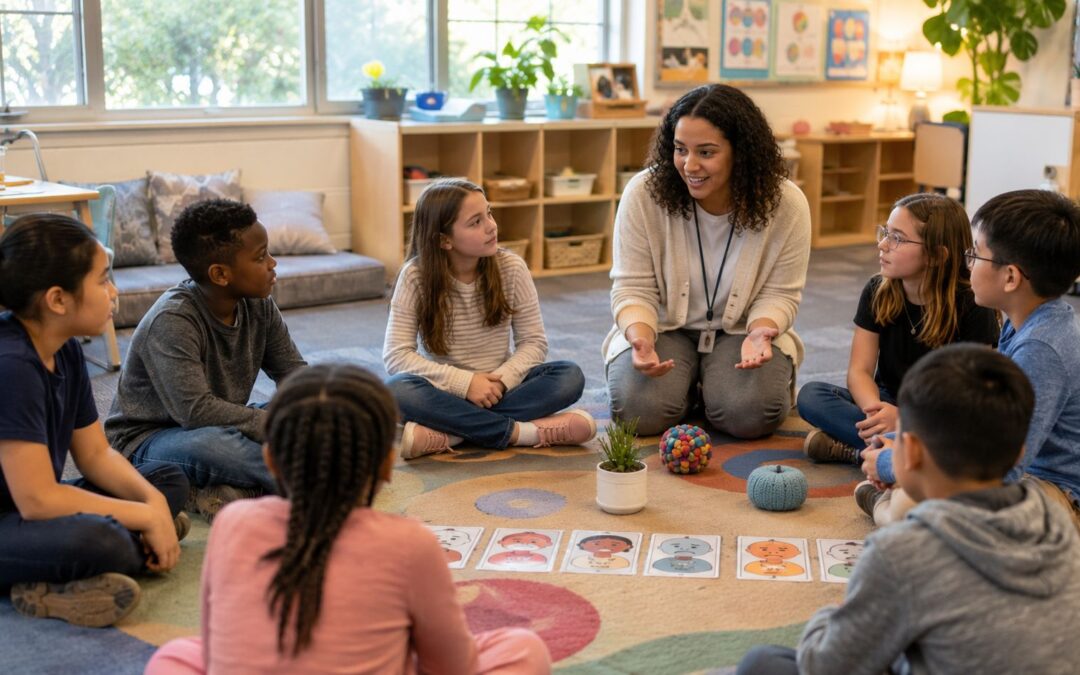
At this age, concrete beats abstract every time. Use puppets, visual feeling cards, and brief role-plays tied to familiar settings like line-up, sharing, and partner work.
A simple lesson sequence:
- Warm-up: Show two puppet characters arguing over one glue stick.
- Pause question: “What are their feelings?”
- Model sentence: “I felt upset when you grabbed it.”
- Student practice: Students repeat the sentence with a partner.
- Repair choice: Return item, take turns, ask for help, or choose another material.
Keep the language short. Keep the turns short too.
A useful teacher script is, “Your job isn't to prove you're right. Your job is to make the problem smaller.”
Grades 3 to 5
Upper elementary students can handle more structure and more perspective taking. This is a good age for a Peace Corner with posted prompts, reflection cards, and a visible sequence. If you want a bank of classroom-ready examples, this roundup of conflict resolution activities for kids is useful for adapting role-play and partner practice.
Try a weekly lesson cycle like this:
- Day 1: Mini-lesson on one skill, such as paraphrasing
- Day 2: Partner practice with low-stakes disagreements
- Day 3: Teacher-led role-play using a class scenario
- Day 4: Independent use in the Peace Corner
- Day 5: Reflection on what worked and what didn't
Example scenario: two students both want to lead the science demo. One says the other “always gets picked.” The teacher has them name the problem, list three solutions, and agree on one plan for this week and one for next time.
Ask for at least three possible solutions before students choose one. The first solution is often a demand, not a resolution.
If your staff creates short digital SEL explainers for families or advisory periods, a resource on an AI video workflow for creators can help turn common school scenarios into simple visual teaching clips without making every teacher start from scratch.
Grades 6 to 8
Middle school conflict is less about materials and more about belonging, reputation, tone, and public embarrassment. Students need space to unpack what was said, what was implied, and what happened online or in front of peers.
Good activities here include:
- Peer mediation rehearsal: One student mediates while two others role-play a conflict.
- Value questions: “What matters most to you in this disagreement?”
- Social dilemma discussions: Exclusion from a group chat, copied work, or sarcasm in a team project.
A useful sequence is to move from private reflection to structured dialogue to written agreement. Don't start with public sharing if emotions are hot. Give students a note-catcher first: What happened? What assumption did I make? What do I need now?
What works better than a one-off lesson
Conflict resolution skills training sticks when students experience all of these in combination:
- Repeated vocabulary
- Predictable routines
- Visible adult modeling
- Practice in calm moments
- Repair after real conflict
Assemblies can inspire. Classroom repetition changes behavior.
Facilitator Scripts and In-the-Moment Coaching
Adults set the tone long before students solve anything. If the adult enters with urgency, blame, or visible frustration, students mirror it. If the adult stays neutral and steady, students borrow that regulation.

One of the most reliable moves is creating a named space for repair. Call it a Peaceful Dialogue Zone, a Reset Table, or a Repair Spot. The label matters less than the ritual. Effective conflict resolution training requires facilitators to establish ground rules like “no interrupting” and “validate feelings” to create a safe space, and then guide discussion using active listening and empathy to repair relationships, as described in this guide to conflict resolution training practices.
Scripts that lower defensiveness
When two students are upset, avoid questions that invite argument.
Instead of:
- “Who started it?”
- “Why did you do that?”
- “What were you thinking?”
Use:
- “Tell me what happened from your point of view.”
- “What feels unfair here?”
- “What do you want the other person to understand?”
- “What needs to happen next so this feels repaired?”
Those prompts shift the interaction from prosecution to problem solving.
Here's a script for opening a repair conversation:
“We're going to slow this down. One person speaks at a time. No interrupting. Your job is to help the other person understand your experience, not to win.”
A classroom mini-scenario
A fourth grader mutters, “She always leaves me out.” The other student rolls her eyes and says, “Because you're bossy.” The teacher could lecture both students about kindness. That usually produces silence, not insight.
A better sequence:
- Regulate first: “Take one breath. Put both feet on the floor.”
- State the frame: “We're solving one problem at a time.”
- Hear each side: “What happened before the eye roll?”
- Reflect impact: “What did you hear her say she felt?”
- Ask for repair: “What can you do in the next hour to make this better?”
For students who need more language support, sentence stems help. A bank of classroom-ready I-statement examples for kids can save teachers from inventing scripts on the fly.
Coaching your own regulation
Adults need scripts for themselves too.
- Lower your volume: Students match your nervous system.
- Cut the audience: Move conflicts a few feet away from peers when possible.
- Name observable facts: “I saw the folder drop and heard shouting.”
- Pause before solving: If you rush, students perform for the adult instead of engaging with each other.
Later in the day, this kind of modeled facilitation is worth revisiting with staff teams.