

ADHD Classroom Accommodations a Practical Guide for 2026
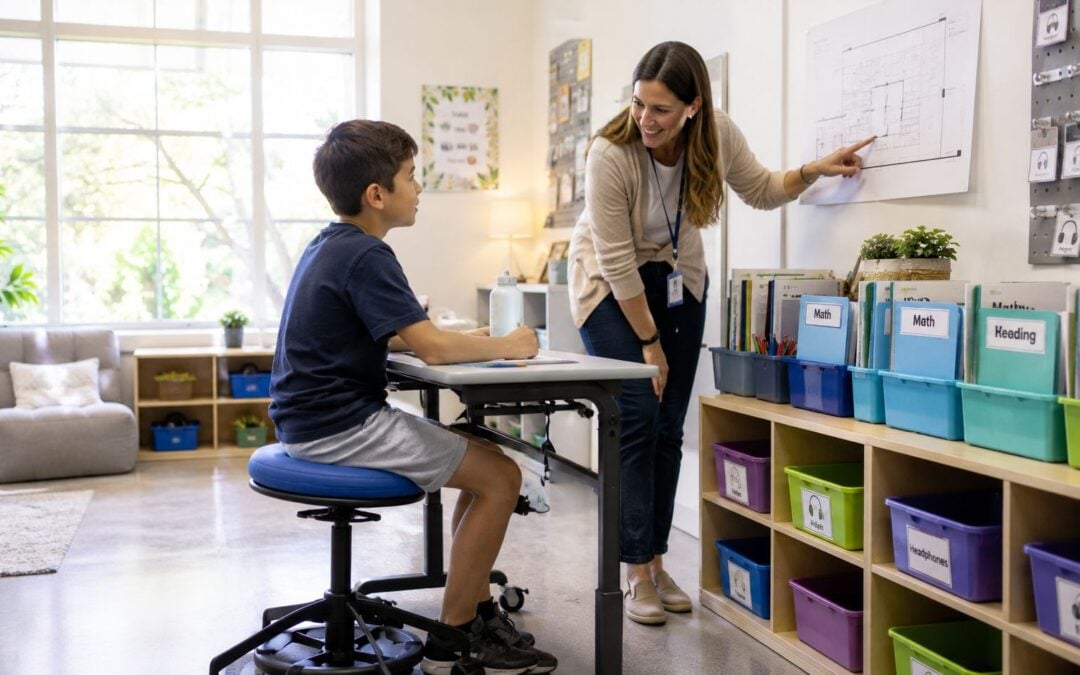
A student is staring at a worksheet that should take ten minutes. Pencils are on the floor, the directions are half-read, and the child who can explain the lesson out loud suddenly looks lost. You might be the teacher trying to keep the room steady while also helping that student restart. You might be the parent hearing, “I know it, I just can't do it right now.”
That moment is where ADHD classroom accommodations matter most.
In schools, ADHD often shows up as distractibility, impulsive blurting, unfinished work, or a backpack that seems to swallow every important paper. Adults sometimes read those behaviors as lack of effort. In practice, they're often signs that the student's brain is working harder than the environment allows. The issue isn't that the child doesn't care. The issue is fit.
Good accommodations don't lower expectations. They remove friction so a student can reach the expectation. They make it easier to start, stay with a task, recover after losing focus, and feel safe enough to try again tomorrow.
Setting the Stage for Student Success
Marcus is bright, funny, and full of ideas. During read-aloud, he catches details other students miss. During independent work, he forgets step two by the time he finishes step one. His desk looks like a recycling bin, his pencil breaks at the worst moment, and if the class shifts routines without warning, his whole body seems to tighten.
I've taught many students like Marcus. They are not “lazy.” They are not “choosing chaos.” They are often trying to hold too many things in mind at once.
That's why ADHD classroom accommodations work best when we treat them as supports, not exceptions. A visual checklist isn't a crutch. A movement break isn't a reward for poor behavior. Flexible seating isn't about making school easier. Each one is a way to reduce the extra load that ADHD places on attention, memory, and self-control.
A child can be willing, capable, and overwhelmed all at the same time.
There's also an emotional layer adults can miss. When a student hears “try harder” all day, they start to build an identity around struggle. They may stop asking for help because help feels embarrassing. They may avoid work not because they don't want success, but because they're tired of failing in public.
That's why I think about accommodations and belonging together. A child is more likely to use supports when the classroom feels safe, predictable, and respectful. If you want a deeper look at that connection, this piece on the benefits of social-emotional learning helps show why emotional safety and academic access can't really be separated.
What this looks like in real life
A few examples make the difference clear:
- Instead of “Sit still and finish” a teacher says, “Do the first three problems, then bring it to me.”
- Instead of calling out disorganization a parent uses one bright folder labeled “Return to School.”
- Instead of waiting for a meltdown a counselor teaches the student how to notice, “My body feels buzzy. I need a reset.”
Those are accommodations in spirit, even before they become formal paperwork. They tell the child, “We see the barrier, and we're going to help you around it.”
Understanding Your Support Options IEPs and 504 Plans
Parents and teachers often hear IEP and 504 Plan and feel like they've walked into a meeting where everyone else got the glossary ahead of time. The simplest way to think about them is this.
An IEP is like a custom blueprint for a student's learning house. It's built when a student needs specialized instruction, not just access supports.
A 504 Plan is more like adding ramps, railings, and other access features to an existing building. The student follows the general program, but needs accommodations to use it fairly.

A simple comparison
| Plan | Best basic analogy | Usually includes |
|---|---|---|
| IEP | A custom blueprint | Specialized instruction, goals, services, accommodations |
| 504 Plan | Access features added to the building | Accommodations that support equal access |
A national study found that 47.3% of students diagnosed with ADHD have an Individualized Education Program, while 4.2% have a 504 Plan. In contrast, 7.2% of students without ADHD receive an IEP according to the Journal of the American Academy of Child and Adolescent Psychiatry study. In school terms, ADHD is a major reason families seek formal supports.
How families and schools usually sort this out
If a student needs changes like extended time, movement breaks, seating adjustments, or alternate ways to show learning, the school team may consider a 504 Plan. If the student also needs specially designed instruction because ADHD is substantially affecting educational performance, an IEP may be the better fit.
The process usually starts with a concern stated clearly and early. A parent might say, “My child understands material orally but can't sustain attention long enough to finish independent tasks.” A teacher might bring classroom observations and work samples. A counselor or psychologist may add evaluation data.
A strong first step is to frame the concern around access, not blame.
- Name the barrier: “He loses track during multistep directions.”
- Name the impact: “She isn't finishing what she knows how to do.”
- Name the setting: “This happens most during independent writing.”
- Ask for evaluation or review: “Can we discuss whether a formal support plan is appropriate?”
Practical rule: Speak in patterns, not labels. “During writing, he starts but doesn't sustain attention” is more useful than “He's unmotivated.”
Schools that already use layered support systems often start with classroom strategies, then document what helps. This overview of MTSS Tier 1 is useful if your team is trying to understand what should happen in general classroom support before or alongside formal plans.
Families also ask whether medication belongs in this conversation. It can. It's not the same thing as accommodations, but it may be one part of a broader support plan. For families who want a plain-language overview, this complete ADHD medication guide can help them prepare better questions for their medical provider.
The Four Pillars of ADHD Accommodations
Once supports are on the table, people often get overwhelmed by long lists. I've found it easier to organize ADHD classroom accommodations into four pillars. That gives teachers and families a mental map instead of a pile of unrelated ideas.

The CDC and CHADD guidance summarized here identifies accommodations such as flexible seating, movement breaks, and alternative assessment methods as standard parts of IEPs and 504 Plans that improve academic focus and behavioral outcomes for students with ADHD. Those supports fit neatly into these four pillars.
Environmental supports
This pillar changes the where.
The goal is to shape the physical space so it asks less of the student's attention system. That can mean seating near the teacher, fewer visual distractions, a quiet work area, or access to flexible seating.
A student who keeps turning toward hallway noise may not need a lecture on self-control. They may need a desk moved six feet.
Instructional supports
This pillar changes the how.
Instructional accommodations adjust the way information is delivered. Teachers might give shorter directions, present one step at a time, use visual models, or check for understanding before independent work begins.
For a student with ADHD, hearing five directions in a row can feel like trying to carry water in open hands. Smaller amounts hold better.
Organizational supports
This pillar changes the system around the task.
These supports reduce the planning and tracking load. Think labeled folders, desk organizers, checklists, visual schedules, or a routine for turning in work. This is often the difference between “I did it” and “I got credit for doing it.”
Behavioral supports
This pillar changes the feedback loop.
Behavioral accommodations help the student stay connected to expectations through prompts, reinforcement, predictable routines, and opportunities to reset. This includes positive feedback, behavior report cards, break cards, and structured choices.
Here's a quick way to remember the framework:
- Environmental: Change the space.
- Instructional: Change the delivery.
- Organizational: Change the system.
- Behavioral: Change the feedback and regulation supports.
The most useful accommodation is the one that matches the barrier. A wobble seat won't fix unclear directions. Extra time won't fix a missing system for turning work in.
When teams think in pillars, they stop reaching for one favorite strategy and start matching support to the actual problem.
Practical Classroom Strategies for Each Pillar
It is 9:07 a.m. The class has opened math folders, one student is already under the table looking for a pencil, another is staring at the page, and a third is asking, “What are we doing?” again. Nothing is wrong with those students. The room is asking for more regulation, organization, and clarity than some nervous systems can supply on demand.
That is why practical accommodations matter. Good supports do more than remove obstacles. They also give students repeated practice with SEL skills such as noticing stress, asking for help, restarting after a mistake, and feeling successful enough to stay connected to the class.

Environmental strategies that calm the room
The physical setup often decides whether a student spends their energy on learning or on filtering distractions. A seat near direct instruction, away from traffic patterns, can reduce the number of times attention gets pulled off task. After a few days, check the fit with the student. “Is this spot helping you focus?” teaches self-awareness, not just compliance.
Flexible seating can help, too, if the expectations are concrete. A standing desk, seat cushion, or stability ball works best when the rule is simple: movement should support learning, not replace it. Students are more likely to use these tools well when adults name the purpose out loud. “Your body may need motion so your brain can stay with the lesson.”
Lowering visual clutter helps many students settle faster. Clear pathways, fewer materials on desks, and calmer wall space near work areas reduce the amount the brain has to sort through before it can begin.
One setup I recommend often is a point-of-performance station. It works like a landing pad. The student should not have to hunt for the tools needed to start.
A simple version includes:
- pencil cup on the desk
- mini checklist taped to the desktop
- one folder labeled “Now”
- one folder labeled “Done”
- only current materials visible
The Point-of-Performance guidance here describes the same core idea. Place supports where the task happens. That small shift often reduces frustration before the work even begins.
Instructional strategies that reduce overload
Many students with ADHD lose momentum in the middle, not the beginning. They start with good intentions, then the task stretches longer than their attention can hold.
A shorter work cycle helps. Give a small amount, pause for a quick check, then release the next part. “Do these five problems. Show me number two when you're done.” That kind of pacing gives the student a visible finish line and a chance to recover before the brain drifts.
Teacher language matters here. Clear phrasing lowers stress and strengthens self-regulation because the student knows exactly what to do first.
Useful scripts include:
- Before directions: “Listen for the first step.”
- Before work time: “Tell me what you are starting with.”
- Mid-task: “Show me where you stopped. We'll find the next step together.”
- After confusion: “You are not behind. You need the next small part.”
Shorter chunks also teach a hidden SEL lesson. Big tasks can feel like failure before they begin. Small tasks let students experience, “I can start this. I can finish this. I can keep going.”
For educators working with older students who struggle with planning beyond the elementary years, resources on Fluidwave's neurodivergent support can also spark ideas about time management language and systems that translate well into middle school supports.
Organizational strategies that make work retrievable
Some students are doing the academic work but losing it somewhere between the desk, backpack, and turn-in bin. That is not a motivation problem. It is a system problem.
The goal is to reduce decisions. The fewer steps a student has to remember, the more likely the work makes it from start to finish.
Try a few of these:
- Color-coded folders: one for homework, one for classwork, one for take-home papers
- Visual turn-in routine: a sign by the bin that says “Name. Date. Turn in.”
- End-of-day reset: two minutes to pack, check planner, and match papers to folders
- Desk map: a taped photo showing where materials belong inside the desk
One bright folder change the tone of a family's morning. A single neon folder labeled “Back to School” gave one student one place to check instead of six. The skill underneath that routine was not “be more responsible.” It was learning how to create a predictable path for the brain to follow.
Later in the week, this kind of quick demonstration can help students see accommodations in action: