

8 Essential Mindfulness Group Exercises for Thriving K-8 Classrooms in 2026
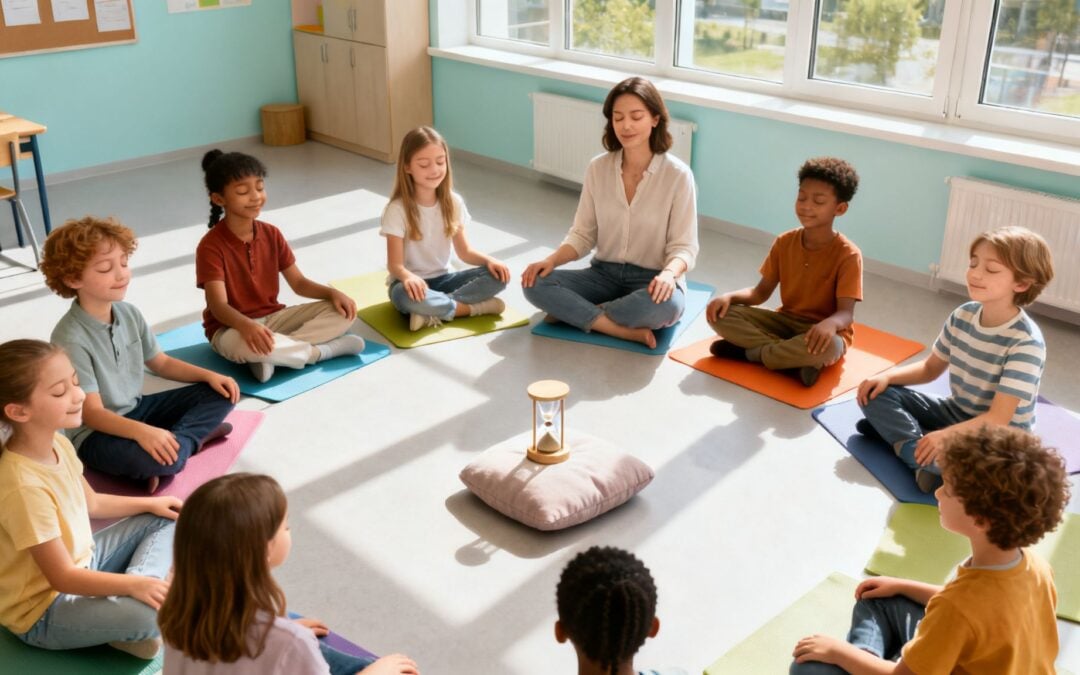
In today’s dynamic K-8 classrooms, fostering focus, empathy, and emotional regulation is more critical than ever. Teachers and parents are constantly seeking practical, engaging tools to help students navigate their inner and outer worlds. Mindfulness group exercises offer a powerful solution, moving beyond individual practice to create a shared culture of calm and connection within a learning community.
These activities are not just about quiet time; they are structured social-emotional learning (SEL) experiences designed to build tangible skills. By participating together, students learn to manage stress, improve their attention, and develop compassion for themselves and their peers. The shared nature of these exercises helps reduce feelings of isolation and builds a foundation of psychological safety, making the classroom a more inclusive and supportive environment for everyone. These practices directly equip students with lifelong tools for self-awareness, effective communication, and resilience in the face of challenges.
This article provides a comprehensive roundup of eight essential mindfulness group exercises, specifically designed and adapted for school settings. Each entry includes detailed step-by-step instructions, grade-level modifications, and classroom management tips. You’ll find practical examples, such as how to guide a second-grader through a body scan versus an eighth-grader, ensuring you can implement these transformative practices immediately and effectively. Whether you’re a teacher aiming to build a more peaceful classroom, a counselor leading SEL initiatives, or a parent supporting your child’s well-being, these exercises provide a clear roadmap to cultivate a community where every student can learn, connect, and thrive.
1. Guided Group Body Scan Meditation
The Guided Group Body Scan is a foundational mindfulness practice where a facilitator guides students to bring gentle, non-judgmental attention to different parts of their body. Participants typically lie down or sit comfortably with their eyes closed as the guide uses a calm, soothing voice to direct their focus, moving systematically from their toes up to their head. The core purpose isn’t to change or relax sensations, but simply to notice them as they are, cultivating a powerful connection between mind and body. This practice is one of the most effective mindfulness group exercises for building interoception, the awareness of internal bodily states.
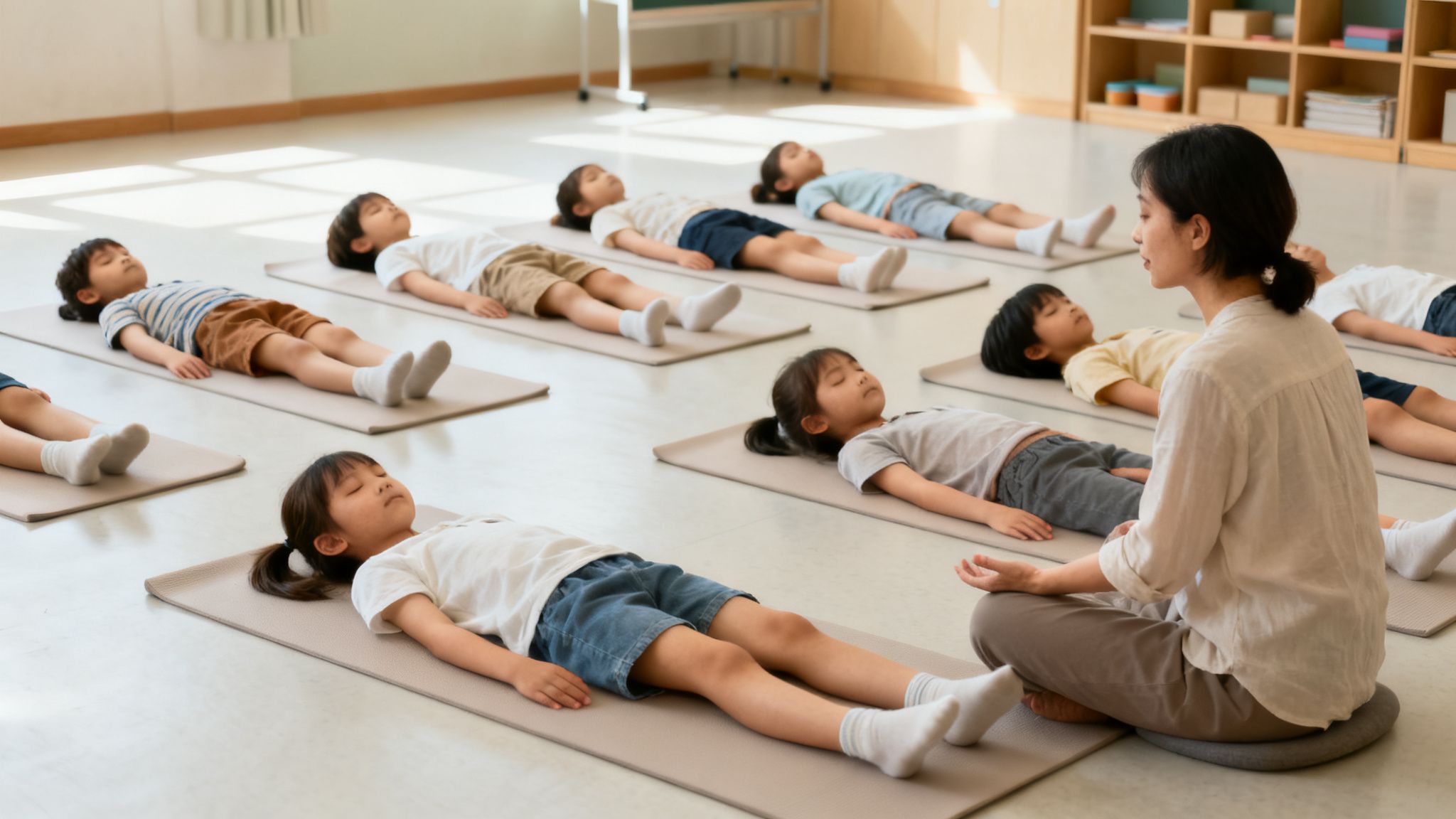
This exercise helps students recognize physical signals of stress, anxiety, or excitement before they escalate into overwhelming emotions, providing a crucial first step toward self-regulation. By practicing the body scan, students learn to inhabit their bodies with a sense of curiosity and kindness, which is essential for developing emotional intelligence.
Implementation and Classroom Tips
- Create a Safe Space: Dim the lights and minimize distractions. Allow students to choose their position: lying on a mat, resting their head on their desk, or sitting comfortably in a chair. Emphasize that there is no right or wrong way to feel.
- Use Invitational Language: Instead of commanding relaxation (“relax your feet”), use gentle invitations like, “See if you can bring your attention to your feet” or “Notice any sensations you feel in your toes, perhaps warmth, coolness, or tingling.”
- Start Small: For younger students (K-2), begin with very short, 3-5 minute sessions focusing on just a few body parts (e.g., “Wiggle Your Toes,” “Feel Your Hands,” “Notice Your Belly Breathing”). Gradually increase the duration and complexity for older students.
- Follow with Reflection: After the scan, provide a few moments for quiet reflection. You might ask students to privately notice how they feel or offer an optional journal prompt, such as, “What did you notice in your body today?”
Practical Examples for K-8 Settings
- For K-2 (“Sleeping Statues”): A kindergarten teacher makes it a game. “Let’s pretend we are statues lying down. Can your statue feel its toes? Can it feel its knees? What about its nose?” This playful approach keeps young children engaged.
- For 3-5 (Pre-Test Grounding): A 4th-grade teacher leads a 7-minute body scan before a math test. They say, “Notice if you feel any butterflies in your stomach. Just notice them, and then see if you can feel your feet on the floor. Your feet are steady, even if your tummy is busy.” This validates their anxiety while giving them a tool to ground themselves.
- For 6-8 (Post-Conflict Cooldown): After a heated debate in a social studies class, a 7th-grade teacher guides students through a 10-minute body scan. The focus is on noticing areas of tension. “Bring your attention to your jaw. Is it tight? See if you can soften it just a little. Now, what about your shoulders? Are they up by your ears?” This helps students physically release the stress of the conflict.
The body scan is a versatile tool that enhances students’ self-awareness and provides them with a tangible method for managing their internal states. For more ideas on developing these skills, explore these other powerful mindfulness exercises for students.
2. Mindful Breathing Circle (Structured Breath Work)
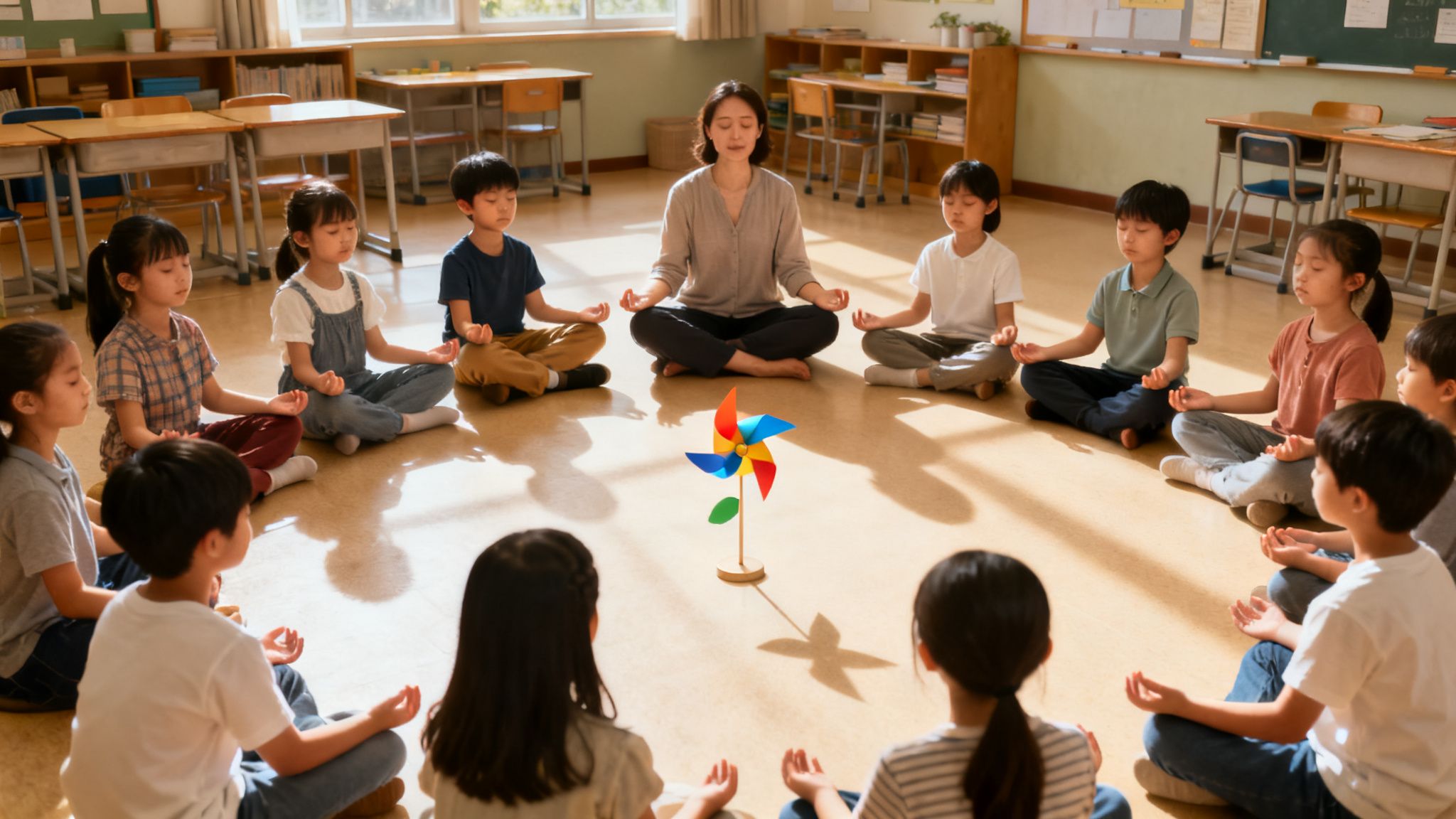
The Mindful Breathing Circle is a powerful and accessible practice where students sit together, often in a circle, and are guided by a facilitator to synchronize their breathing. Using structured techniques like box breathing (inhaling for 4 counts, holding for 4, exhaling for 4, and holding for 4) or belly breathing, participants learn to consciously regulate their breath. The facilitator’s role is to provide a steady rhythm and gentle guidance, helping students anchor their attention to the physical sensation of their breath. This exercise makes the abstract concept of self-regulation tangible, transforming the breath into a reliable tool for calming the nervous system. As a result, it is one of the most foundational and effective mindfulness group exercises for building emotional regulation.
This practice directly teaches students how to activate their parasympathetic nervous system, responsible for the “rest and digest” response. By learning to slow their breathing, they can intentionally shift out of a “fight or flight” state, which is crucial for managing big emotions, reducing anxiety, and improving focus before academic tasks. Practicing together in a circle also fosters a sense of community and shared experience, reducing feelings of isolation.
Implementation and Classroom Tips
- Model and Participate: Demonstrate the breathing technique clearly before starting. It is essential to practice with the students rather than just instructing them. This modeling shows vulnerability and reinforces that it is a shared, supportive activity.
- Use Visual and Auditory Cues: For younger students, visual aids are key. Use a pinwheel that spins with the exhale, a Hoberman Sphere that expands and contracts, or an animated breathing guide on a screen. Soft background sounds like rain or waves can also help mask self-consciousness about audible breathing.
- Frame it as ‘Brain Training’: Present the exercise as a way to strengthen their brain’s “focus muscle” or “calm-down power.” This framing makes the practice feel empowering and purposeful, rather than like a chore or a punishment.
- Offer Opt-Outs: Always provide a choice. Students who are not ready to participate can sit quietly and observe, place a hand on their chest to feel their breath, or simply rest. This maintains a sense of safety and autonomy.
Practical Examples for K-8 Settings
- For K-2 (“Belly Buddies”): A 1st-grade teacher has students lie on their backs and place a small stuffed animal (“belly buddy”) on their stomachs. They instruct, “Let’s give our buddies a slow ride. Breathe in and watch your buddy rise, then breathe out and watch your buddy go down.”
- For 3-5 (Recess Reset): A 3rd-grade teacher gathers students for “square breathing” after they come in from recess. They draw a square in the air with their finger: “Breathe in as we go up, hold as we go across, breathe out as we go down, and hold at the bottom.” This helps them transition from a high-energy state to a calm, ready-to-learn mindset.
- For 6-8 (Managing Big Emotions): In a 7th-grade health class discussing peer pressure, the teacher anticipates the topic might be stressful. They pause and say, “This is a tough subject. Let’s all try a 4-7-8 breath. Breathe in for 4, hold for 7, and a long, slow exhale for 8. This tells our brain we are safe.”
3. Walking Meditation (Mindful Walking in Groups)
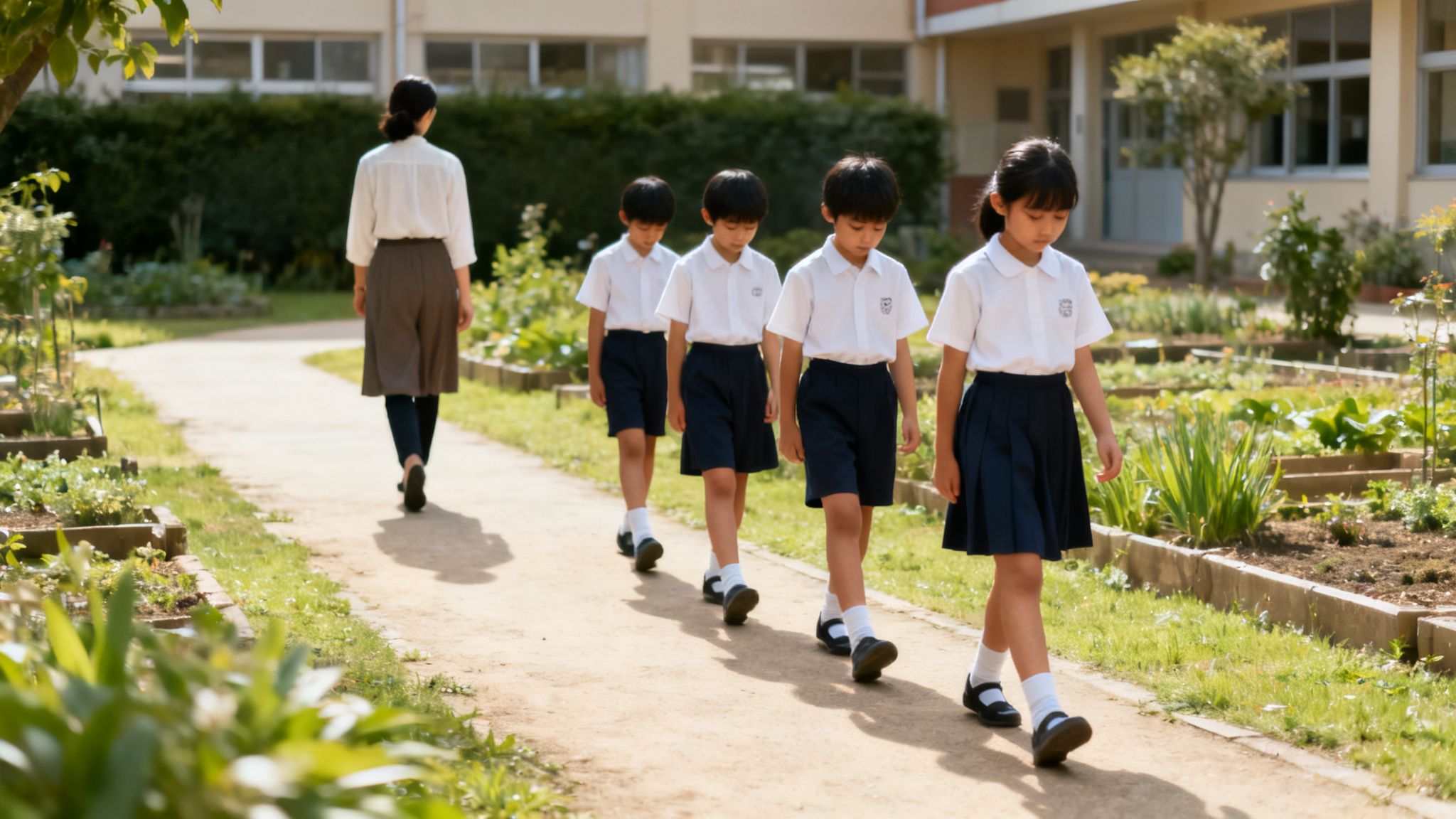
Walking Meditation is a dynamic mindfulness practice where students walk slowly and intentionally, paying close attention to the physical experience of movement. Instead of focusing on a destination, the group’s awareness is guided to the sensations of their feet connecting with the ground, the rhythm of their breath, and the motion of their bodies. This exercise, often practiced in a line or circle, brilliantly merges mindfulness with physical activity, making it one of the most accessible mindfulness group exercises for kinesthetic learners and students who struggle with sitting still.
The practice teaches students how to find stillness and presence even while in motion, a crucial skill for managing restlessness and impulsivity. By grounding their attention in the simple, repetitive act of walking, students can calm an overactive mind and transition from high-energy states to a more focused and settled mindset. This exercise is especially effective for improving focus, body awareness, and emotional regulation.
Implementation and Classroom Tips
- Set the Pace and Intention: Explain that this walk is different. It’s about “walking just to walk,” not to get somewhere. Model an exaggeratedly slow pace so students understand the goal is deliberate movement, not speed.
- Use Gentle Verbal Cues: Guide students’ attention with simple, repetitive prompts. Phrases like, “Lifting… moving… placing,” or “Notice your feet touching the floor,” help anchor their focus on the physical sensations.
- Create a Clear Path: Whether indoors or outdoors, ensure the walking path is clear and safe. In a classroom, students can walk in a large circle around the desks. Outdoors, a designated loop in a garden or on a playground works well.
- End with Stillness: Conclude the walk with one or two minutes of standing or sitting in silence. This allows students to integrate the experience and notice the shift in their internal state before transitioning to the next activity.
Practical Examples for K-8 Settings
- For K-2 (“Animal Walks”): A 2nd-grade teacher introduces mindful walking with animal themes. “Today, we’re going to walk like turtles, very slow and steady. Feel your shell on your back. Now let’s walk like herons, lifting one leg high and placing it down softly.” This turns the exercise into imaginative play.
- For 3-5 (Mindful Nature Walk): A 5th-grade science class incorporates walking meditation into a school garden visit. The teacher instructs, “As you walk, notice three different textures with your feet—the smooth pavement, the soft grass, and the crunchy gravel. Pay attention to how each one feels.”
- For 6-8 (Hallway Transitions): An 8th-grade history teacher turns the walk to the school library into a mindful moment. They challenge the class: “Let’s walk to the library in complete silence, and your only job is to count your steps. No talking, just counting. See who can accurately count their steps when we get there.” This transforms a typically chaotic transition into a focused, calming activity.
4. Loving-Kindness Meditation (Compassion Circle)
The Loving-Kindness Meditation, also known as a Compassion Circle, is a powerful guided practice where participants extend feelings of goodwill and warmth to themselves and others. A facilitator guides the group to silently repeat phrases like, “May you be happy, may you be healthy, may you be safe, may you be at ease.” This practice systematically directs these kind wishes inward to oneself, then outward to a loved one, a neutral person, a difficult person, and finally to all living beings.
This exercise directly cultivates empathy, compassion, and a sense of interconnectedness, making it one of the most impactful mindfulness group exercises for improving classroom climate and reducing bullying. By “training the brain for kindness,” students develop the capacity to respond to social situations with understanding rather than reactivity. This practice strengthens the emotional regulation and relationship skills that are foundational to social-emotional learning.
Implementation and Classroom Tips
- Frame the Purpose: Explain to students that this is an exercise to strengthen their “kindness muscle.” Emphasize that sending kind wishes doesn’t mean you have to like someone’s behavior, only that you are practicing compassion.
- Use Age-Appropriate Phrases: For younger students (K-2), simplify the phrases to something concrete like, “May I be happy, may I be healthy.” For older students, you can use the more traditional phrases.
- Sequence with Care: Always begin with sending kindness to oneself, then a cherished friend or family member. This builds a foundation of warmth before moving on to neutral or difficult individuals, which can be more challenging.
- Offer an Opt-Out: Acknowledge that sending kindness to a difficult person can be hard. Give students permission to stay with sending kindness to a loved one or themselves if they feel uncomfortable.
- Debrief the Experience: After the meditation, facilitate a brief, optional sharing circle. Ask questions like, “What did it feel like to send kind wishes to yourself?” or “Was it easy or hard to send kindness to someone you don’t know well?”
Practical Examples for K-8 Settings
- For K-2 (“Sending Happy Thoughts”): A 1st-grade teacher uses a visual. “Put your hands over your heart and think of someone you love. Now let’s send them a big, warm, happy thought. Imagine you are beaming it to them like a flashlight.” They then extend this to everyone in the class.
- For 3-5 (Bullying Prevention): A 5th-grade teacher incorporates a compassion circle into their weekly class meeting. After discussing a conflict on the playground, they guide students: “First, send kindness to yourself. Now, bring to mind the person you had the conflict with. You don’t have to agree with them, but just for one minute, send them the wish to be happy.” This helps build empathy.
- For 6-8 (Restorative Justice): Following a group conflict, a school counselor uses loving-kindness in a restorative circle. They guide the students: “Let’s start by sending kindness to ourselves. Now, bring to mind someone in this circle. Silently repeat: ‘May you be safe. May you be at peace.’ This helps soften hearts and prepares everyone to listen to each other with more compassion.”
Loving-kindness meditation is a transformative practice for fostering a positive and inclusive school environment. For more ways to nurture these prosocial skills, check out these related emotional intelligence activities for kids.
5. Mindful Listening Circles (Paired Listening Practice)
Mindful Listening Circles are a structured group practice where students pair up and take turns speaking and listening without interruption, judgment, or advice. One person shares for a set amount of time while their partner offers complete, non-judgmental attention. Then, they switch roles. The core purpose is to cultivate deep listening skills, empathy, and the profound sense of being heard, which are foundational for creating psychological safety and building healthy relationships. This practice is one of the most powerful mindfulness group exercises for developing strong communication and community bonds.
This exercise helps students understand the difference between hearing and truly listening. By practicing the role of the listener, they learn to quiet their own internal chatter and be fully present for someone else. This builds critical social-emotional skills, reduces interpersonal conflicts, and fosters a classroom environment where every student feels seen and valued.
Implementation and Classroom Tips
- Set Clear Guidelines: Before starting, explicitly state the rules: “Your job is only to listen with kindness. Do not offer advice, share your own story, or interrupt.” This creates a safe container for sharing.
- Model the Practice: Ask for a volunteer and model the process for the entire class. Demonstrate what active, compassionate listening looks like before asking students to try it themselves.
- Use Sentence Starters and Timers: For younger students or those new to the practice, provide prompts like, “Something I’m proud of is…” or “One thing that felt challenging today was…”. Use a timer to ensure each partner gets an equal, dedicated amount of time (e.g., 60-90 seconds each).
- Facilitate a Debrief: After the pairs have finished, bring the group back together. Ask reflection questions like, “What did it feel like to be truly listened to?” and “What was challenging about just listening without responding?”
Practical Examples for K-8 Settings
- For K-2 (“Listening Ears”): A 2nd-grade teacher uses a “talking stick” (or any special object). When paired up, only the person holding the stick can talk for 60 seconds. The prompt is simple: “My favorite part of the day so far was…” The listener is instructed to put on their “super listening ears.”
- For 3-5 (Building Community): A 4th-grade teacher uses this during morning meeting with the prompt, “Share one hope you have for this week.” After the paired sharing, the teacher asks, “Who can share what their partner’s hope was?” This reinforces that listening was the goal.
- For 6-8 (Deepening Discussions): After reading a challenging chapter in a novel, a 7th-grade ELA teacher puts students in pairs. The prompt is, “For two minutes, share your gut reaction to this character’s decision. Your partner’s only job is to listen.” This allows students to process complex ideas without fear of immediate judgment, leading to richer full-class discussions later.
6. Silent Sitting Meditation (Mindfulness Sits)
Silent Sitting Meditation is a foundational practice where students sit quietly together, bringing their attention to a specific anchor like the breath, bodily sensations, or a visual focal point. Unlike guided meditations, this exercise involves minimal verbal instruction, challenging students to sit with their own internal experience. The goal is to build internal focus, resilience, and the capacity to be with discomfort without reacting. This makes it one of the most powerful mindfulness group exercises for strengthening self-regulation and impulse control.
This practice teaches students that their minds will naturally wander, and the real “work” is gently and repeatedly returning their focus to their anchor. This repeated action builds the mental muscles needed for concentration and emotional balance, helping students manage anxiety, impulsivity, and distractions.
Implementation and Classroom Tips
- Start Small and Build Gradually: Begin with very short sits, such as 2-3 minutes for younger students (K-2), and slowly increase the duration as their focus stamina grows. The key is consistency over length.
- Explain the “Why”: Frame the practice clearly. You might say, “We are training our attention muscle, just like an athlete trains their body. When your mind wanders, that’s normal. The exercise is gently bringing it back.”
- Model the Practice: Sit with your students, not apart from them. Your genuine participation demonstrates the value of the practice and creates a shared, respectful experience. When facilitating, the environment plays a crucial role; effectively creating quiet environments can significantly deepen the focus for everyone involved.
- Use Gentle Transitions: Use a soft chime, bell, or singing bowl to signal the beginning and end of the sit. This is much less jarring than a verbal command or a harsh alarm.
Practical Examples for K-8 Settings
- For K-2 (“Bell Listening Game”): A kindergarten teacher uses a singing bowl. “Close your eyes and listen to the bell. Keep listening until you can’t hear the sound anymore. When you can’t hear it, raise your hand.” This gives them a concrete anchor and a clear endpoint, making silence less intimidating. The “sit” only lasts as long as the sound.
- For 3-5 (Building Focus Stamina): A 4th-grade class starts with a 3-minute sit each morning. The teacher says, “Your only job is to notice your breath. Your mind will have lots of thoughts—that’s what minds do! Just notice the thought and come back to your breath. It’s like a push-up for your brain.” They gradually add 30 seconds each week.
- For 6-8 (Pre-Test Focus): A 7th-grade science teacher offers a 5-minute silent sit before a big test. They frame it as a choice: “You can use this time to review your notes one last time, or you can join me in a few minutes of quiet sitting to clear your mind. A calm mind often remembers things better than a stressed one.” This respects their autonomy while promoting the practice.
Silent sitting is a cornerstone of mindfulness that equips students with an internal tool for focus and calm they can use anywhere. To explore more ways to integrate these practices, discover these other mindfulness activities for students.
7. Grounding and Sensory Awareness Exercises (5-4-3-2-1 Technique)
The 5-4-3-2-1 Technique is a powerful grounding exercise that brings students out of anxious thought patterns and into the present moment by engaging their five senses. A facilitator guides participants to systematically and non-judgmentally notice their immediate environment. The core of this practice is to identify 5 things they can see, 4 things they can physically feel, 3 things they can hear, 2 things they can smell, and 1 thing they can taste. This sensory-focused process powerfully interrupts the brain’s tendency to ruminate on past worries or future anxieties, making it one of the most effective mindfulness group exercises for de-escalation and anxiety management.
This exercise provides students with a tangible, portable coping skill they can use anytime they feel overwhelmed. By anchoring their attention to concrete sensory details, they learn to redirect focus away from internal distress and ground themselves in the reality of their surroundings. This practice directly builds self-management and self-awareness skills, empowering students to regulate their nervous systems independently.
Implementation and Classroom Tips
- Model First: Before asking students to try it, model the process aloud. For example, say, “I see the blue recycling bin, I see the clock on the wall…” This clarifies that they are noticing real things, not imagining them.
- Practice During Calm: Introduce and practice the 5-4-3-2-1 technique when students are calm and regulated. This helps build the neural pathways so the skill becomes automatic and accessible during moments of high stress.
- Adapt for Sensitivity: Be mindful of students with sensory sensitivities. Allow them to skip a sense (like smell or taste) or modify the count. The goal is grounding, not rigid adherence to the numbers.
- Silent or Shared: The exercise can be done silently as an individual tool or shared aloud in a small group to build connection and co-regulation. Sharing what they notice can also help students feel less alone in their experience.
Practical Examples for K-8 Settings
- For K-2 (“Spy” Game): A 1st-grade teacher calls it “Mindful Spy.” They say, “I spy with my mindful eye… five blue things. Now, let’s feel four things. Can you feel your feet in your shoes? Your hair on your neck?” This turns it into an engaging, familiar game.
- For 3-5 (Classroom Transition Tool): A 3rd-grade teacher uses this to refocus the group after a chaotic activity. “Everyone, freeze. Silently, in your own head, find 5 things you can see, 4 things you can feel, 3 things you can hear, 2 things you can smell, and 1 thing you can taste. Go.” This quick, silent reset brings the group’s energy down.
- For 6-8 (Managing Social Anxiety): A school counselor teaches the 5-4-3-2-1 technique to a group of 8th graders worried about the transition to high school. “When you are in a crowded hallway and feel overwhelmed, you can do this without anyone knowing. No one needs to see you looking for 5 red things. It’s your secret tool to calm your nervous system right there in the moment.”
The 5-4-3-2-1 method is a versatile and accessible tool that equips students with an immediate strategy for managing overwhelming feelings. To discover more ways to integrate sensory engagement, check out these other mindfulness activities for kids.
8. Group Sound Bath and Resonance (Singing Bowls, Bells, Chanting)
A Group Sound Bath is a deeply immersive sensory practice where a facilitator uses instruments like Tibetan singing bowls, chimes, or bells to create a rich soundscape. Students typically lie down or sit comfortably with their eyes closed, allowing the resonant vibrations to wash over them. The goal is not to listen to music but to feel the sound, which engages auditory and proprioceptive systems to calm the nervous system. This unique approach is one of the most memorable and effective mindfulness group exercises for promoting whole-group regulation and deep relaxation.
This exercise provides a powerful, non-verbal way to reduce stress and anxiety. The vibrations can have a tangible physical effect, helping students release tension they may not even be aware of, which supports emotional regulation and a feeling of collective calm.
Implementation and Classroom Tips
- Set the Environment: Create a tranquil atmosphere by dimming the lights, using comfortable mats or cushions, and minimizing all potential distractions. The environment is key to the experience’s success.
- Invest in Quality Instruments: The quality of the sound is crucial. Authentic, well-made singing bowls produce more profound and effective resonant vibrations than cheap alternatives. Learn proper techniques for playing them to maximize their benefit.
- Offer Choices: Allow students to either lie down or sit comfortably in a chair. Acknowledge that lying down with eyes closed can feel vulnerable for some, and provide safe, upright alternatives.
- Plan a Quiet Transition: The moments after a sound bath are critical. Avoid immediately returning to demanding academic work. Instead, allow for a few minutes of quiet, personal reflection or a gentle transition activity.
- Use Sparingly for Impact: To maintain its special quality, offer a sound bath as a monthly or quarterly event rather than a daily practice. This helps it remain a highly anticipated and impactful experience.
Practical Examples for K-8 Settings
- For K-2 (“Magic Bell”): A kindergarten teacher uses a single chime or small bell. “Let’s lie down and listen to the magic bell. See if you can feel the sound tickle your ears.” The short, pure tone is engaging and not overwhelming for young children.
- For 3-5 (Mindfulness Finale): A 5th-grade teacher who runs a mindfulness club concludes each semester with a special 15-minute sound bath using singing bowls. It becomes a highly anticipated reward and a culminating experience that integrates all the calming skills they’ve learned.
- For 6-8 (Wellness Room Resource): A middle school’s wellness or counseling room has a set of crystal singing bowls. When a student comes in feeling dysregulated or overwhelmed, the counselor offers them a choice: “Would you like to talk, draw, or listen to the bowls for five minutes?” This provides a powerful, non-verbal option for students to co-regulate.
8-Point Group Mindfulness Exercises Comparison
| Practice | Implementation complexity | Resource requirements | Expected outcomes | Ideal use cases | Key advantages | Key limitations |
|---|---|---|---|---|---|---|
| Guided Group Body Scan Meditation | Low–Medium (facilitator skill needed) | Minimal: quiet space, mats or chairs | Increased body awareness, reduced stress, better emotion regulation | Morning meetings, test prep, transitions, assemblies | Easy to implement, accessible K-8, builds group calm and connection | Needs quiet; may trigger trauma; some uncomfortable lying down |
| Mindful Breathing Circle (Structured Breath Work) | Low (simple instructions; modeling required) | Minimal: optional visual aids (pinwheel, app) | Rapid calming, teachable self-regulation tool | Transitions, test anxiety, morning rituals, behavioral resets | Immediate effects, portable, fosters group synchrony | Respiratory issues, audible breathing self-consciousness, less effective if highly dysregulated |
| Walking Meditation (Mindful Walking in Groups) | Medium (requires facilitation and pacing) | Space or path; indoor or outdoor setting | Improved focus, proprioception, engagement, regulation | Arrival routines, post-lunch reset, nature lessons, conflict de-escalation | Engages kinesthetic learners, reduces stigma, supports movement needs | Requires space, weather-dependent outdoors, unusual pace may feel awkward |
| Loving-Kindness Meditation (Compassion Circle) | Medium (sensitivity and sequencing needed) | Minimal: quiet space and facilitator guidance | Increased empathy, prosocial behavior, reduced bullying/anxiety | Anti-bullying initiatives, restorative justice, community-building, staff wellness | Directly cultivates compassion and belonging; adaptable by age | Can trigger trauma during self-phase, resistance from some students, needs careful facilitation |
| Mindful Listening Circles (Paired Listening Practice) | Medium–High (time and strong facilitation norms) | Minimal: prompts, timers, facilitator oversight | Improved communication, empathy, psychological safety | Class meetings, restorative circles, peer mentoring, conflict resolution | Builds active listening, belonging, and SEL skills | Time-intensive, may surface difficult disclosures, requires clear norms |
| Silent Sitting Meditation (Mindfulness Sits) | Medium (consistency and student buy-in needed) | Minimal: calm, distraction-free space | Enhanced concentration, resilience, emotional regulation | Daily routines, test prep, assemblies, staff wellness | Foundational for long-term mindfulness benefits; easy to scale | Challenging for beginners, can feel boring or intimidating, needs regular practice |
| Grounding & Sensory Awareness (5-4-3-2-1) | Low (simple protocol to teach) | None special: portable | Rapid anxiety reduction, present-moment grounding | Crisis support, test anxiety, transitions, classroom tool | Fast, concrete, usable independently across settings | May overwhelm sensory-sensitive students; depends on environment |
| Group Sound Bath & Resonance (Singing Bowls, Bells) | Medium–High (trained facilitator and setup) | Instruments (bowls/chimes), quiet space; some cost | Deep relaxation, nervous system regulation, memorable group bonding | Assemblies, wellness rooms, special events, staff retreats | Strong multisensory impact, measurable calming effects, high engagement | Equipment cost, sound sensitivity for some students, less portable, requires skilled facilitation |
From Exercises to Culture: Building a Mindful School Community
Integrating the mindfulness group exercises detailed in this guide, from the stillness of a Group Body Scan to the shared resonance of a Sound Bath, is a powerful first step. However, the true transformation happens when these individual practices evolve from isolated activities into the foundational pillars of your school’s culture. The goal is not simply to “do” mindfulness but to cultivate a mindful community where empathy, self-awareness, and emotional regulation are woven into the very fabric of daily interactions.
This shift from practice to culture hinges on consistency and intention. A one-off Mindful Breathing Circle is a valuable experience, but a weekly practice creates a reliable anchor for students. It builds a shared language and a predictable routine that students can turn to during moments of stress, anxiety, or conflict, both inside and outside the classroom.
Moving Beyond the Activities: Key Takeaways
The real value of these mindfulness group exercises lies in their collective power to build a supportive and psychologically safe environment. As you implement these practices, remember these core principles:
- Scaffolding is Crucial: Start with shorter, more structured exercises like the 5-4-3-2-1 Grounding Technique before moving to more abstract practices like Loving-Kindness Meditation. For younger students, a 2-minute Silent Sit is a significant achievement that builds the foundation for longer sessions later on.
- Modeling is Everything: Your own participation and genuine engagement are the most powerful endorsements. When students see teachers, counselors, and administrators practicing mindful listening or participating in a Walking Meditation, it removes stigma and demonstrates a community-wide commitment to well-being.
- Connect to Daily Life: The ultimate goal is for students to apply these skills independently. After a Mindful Listening Circle, you might say, “Remember how carefully we listened to our partners? Let’s try to bring that same focused listening to our group work in science today.” This bridges the gap between the exercise and its real-world application.
Actionable Next Steps for Lasting Impact
To ensure these practices take root and flourish, consider a strategic, phased approach. Avoid overwhelming students and staff by introducing everything at once.
- Start Small and Build Momentum: Choose one or two exercises that align with your immediate goals. If your focus is on improving classroom focus, begin with the Mindful Breathing Circle. If you aim to build empathy, start with the Loving-Kindness Meditation.
- Create a Predictable Schedule: Designate specific times for practice, such as the first five minutes after morning announcements or the transition period after lunch. This predictability helps establish mindfulness as a non-negotiable part of the school day. For example, “Mindful Mondays” could be dedicated to a group breathing exercise, while “Thoughtful Thursdays” could feature a brief compassion practice.
- Empower Student Leaders: As students become more comfortable, invite them to lead parts of the exercises. A middle schooler could guide the 5-4-3-2-1 exercise for their peers, or a group of fourth-graders could lead the striking of a singing bowl to begin a moment of silence. This fosters ownership and transforms students from passive participants into active leaders of their own well-being.
By championing these mindfulness group exercises, you are providing more than just coping mechanisms. You are equipping your students with a versatile toolkit for navigating the complexities of life with greater awareness, compassion, and resilience. You are modeling a commitment to holistic well-being that benefits every student and adult on campus, creating a fertile ground for both academic achievement and lifelong emotional intelligence. The journey from a series of exercises to a thriving, mindful culture begins with a single, shared breath.
Ready to build a comprehensive, school-wide culture of empathy and emotional safety? Soul Shoppe provides research-based programs that embed these essential skills directly into your community, offering tools and support to make mindfulness a sustainable part of your school’s identity. Explore how Soul Shoppe can help you transform your school environment.