

Bullying Prevention Programs for Schools: Practical Ways to Protect Students

Bullying prevention programs are far more than just a set of rules; they are frameworks designed to build a school community that is safe, respectful, and genuinely connected. Instead of simply reacting after the fact, these programs proactively teach kids essential skills like empathy, conflict resolution, and what it means to be a responsible bystander. They work to stop bullying before it ever gets a chance to start.
The most effective programs pull the entire school community into the effort—students, staff, and families—to build a lasting culture of kindness.
Moving Beyond Discipline to Build a Safer School
From playground scuffles to tension in the classroom, it’s clear that old-school discipline models just aren’t cutting it anymore. School leaders are shifting their focus from reacting to incidents to proactively building a culture where every single student feels safe, seen, and supported. This guide is your practical roadmap for choosing and implementing bullying prevention programs for schools that truly work to foster empathy, conflict resolution, and self-regulation.
The stakes couldn’t be higher. Globally, the numbers are staggering: nearly one in three students—that’s 33%—report being physically attacked at school at least once a year. Bullying touches another third of students every single month, and now, cyberbullying affects one in ten kids. These aren’t just statistics; they represent young people who are twice as likely to struggle with severe loneliness, insomnia, and even suicidal thoughts, derailing both their learning and their mental health. You can find more details in the full UNESCO report on these findings.
A successful prevention strategy isn’t a one-and-done event. It’s a continuous cycle.
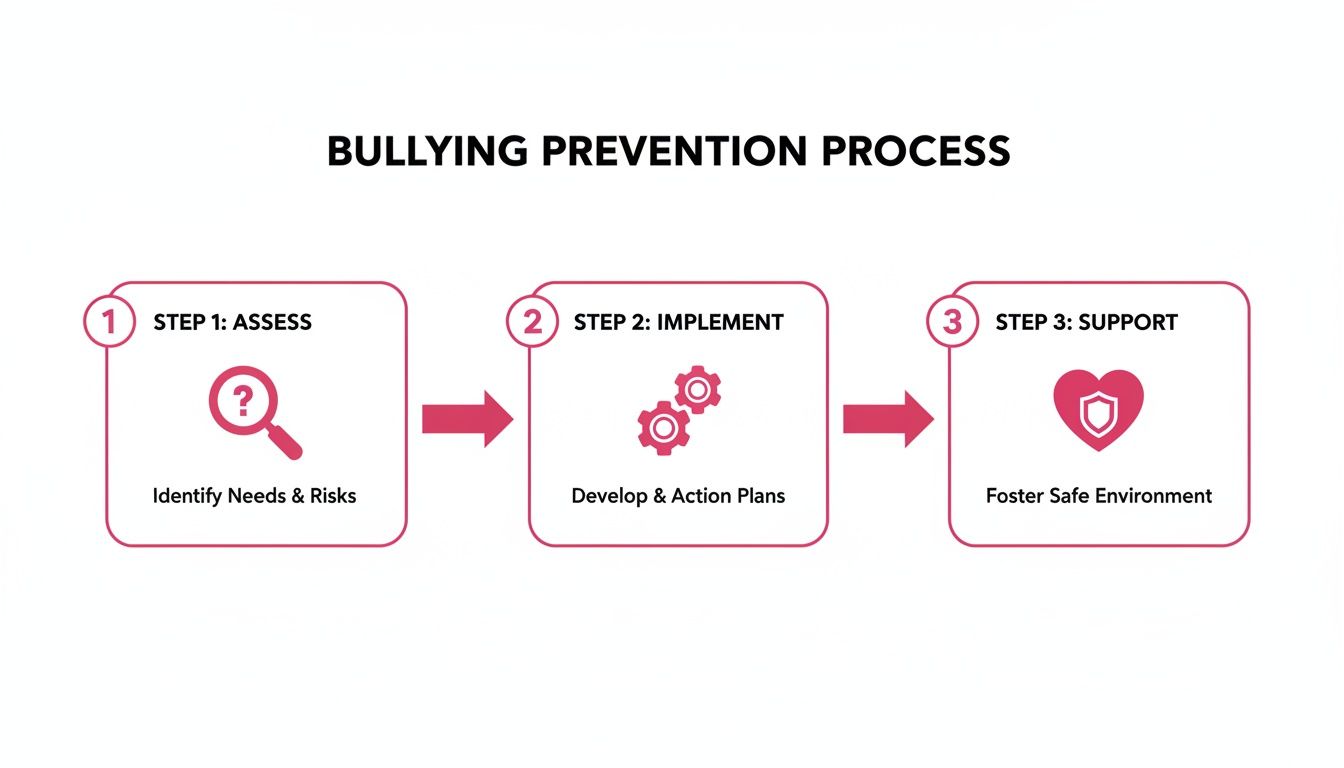
As you can see, the process flows from assessing your school’s unique needs, to implementing thoughtful strategies, and finally, to providing the ongoing support that makes a safe environment sustainable.
The Shift to a Whole-School Approach
A real solution takes more than an anti-bullying assembly or a few posters in the hallway. The programs that create lasting change adopt a whole-school approach, weaving prevention into the very fabric of the campus culture. This means everyone—and I mean everyone—has a part to play.
Here are the core components of this approach:
- Social-Emotional Learning (SEL): This is where we explicitly teach students how to manage their emotions, show empathy for others, and build healthy relationships. A practical example is a teacher using “I-statements” to help students express their feelings without blaming others (e.g., “I feel upset when I’m interrupted,” instead of “You always interrupt me.”).
- Consistent Staff Training: Every adult on campus, from teachers to bus drivers to cafeteria staff, needs to be equipped with the same language and tools to identify and de-escalate bullying. For example, all staff could be trained to use the same three-step response: 1. Stop the behavior. 2. Support the students involved. 3. Report the incident. This ensures a student gets a consistent, supportive response no matter who they talk to.
- Family and Community Engagement: Parents and caregivers need to be partners in this work. You can bring them on board by providing resources and workshops that reinforce the skills being taught at school. For example, send home a handout explaining the “Peace Path” conflict resolution model students are learning, so parents can use the same steps to resolve sibling squabbles at home.
The core idea is simple but powerful: instead of just punishing bad behavior, we must actively teach and model the good behavior we want to see. This transforms the school environment from a place of rules to a community of shared values.
This proactive stance aligns perfectly with restorative practices, which focus on repairing harm and rebuilding relationships rather than just assigning blame. You can learn more by exploring our detailed guide on what restorative practices in education look like. By embracing this mindset, you equip your entire school with the tools to cultivate a supportive community where learning and kindness can truly thrive.
Assessing Your School’s Unique Climate and Needs
Choosing the right bullying prevention program doesn’t start with a catalog or a sales pitch. It starts with holding up a mirror to your own school. Before you can find a solution that sticks, you have to get a clear, honest picture of the social and emotional landscape on your campus. Relying on assumptions is a recipe for a failed initiative; gathering real data is the only way to make sure you’re solving the problems you actually have.
This whole process has to begin with listening to your students. They are the undisputed experts on their own social world—they know where they feel unsafe, what kinds of conflicts pop up most often, and what keeps them from speaking up. A well-designed, anonymous survey is one of the best tools for uncovering these truths.

Gathering Actionable Data From Students
A truly effective survey goes way beyond a simple “Are you being bullied?” checkbox. It digs deeper to uncover the context and patterns behind what your students are experiencing every day.
Think about including questions that pinpoint specific challenges:
- Where is it happening? “Where do you feel the least safe on campus? (e.g., hallways between classes, the back of the school bus, the cafeteria).”
- When is it happening? “During which part of the school day do you see the most pushing, shoving, or mean words?”
- Why isn’t it being reported? “What’s the main reason you might not tell an adult if you or a friend were being bothered? (e.g., ‘I’m worried it will make things worse,’ ‘I don’t know who to tell,’ ‘The adults don’t do anything about it’).”
This kind of data can lead to some surprising revelations. I once worked with a middle school principal who discovered that the vast majority of conflicts were erupting in the chaotic three minutes between classes. That single insight led to a simple yet powerful change: adding more adult supervision in the hallways and training peer mediators to de-escalate tension during those transitions. The problem wasn’t a lack of rules; it was a lack of structure in a very specific time and place.
Uncovering Hidden Patterns in Existing Reports
Your school already has a goldmine of data sitting in filing cabinets: incident reports. Instead of letting them collect dust, start treating them like a dataset. When you analyze them together, you can spot patterns that a single write-up would never reveal.
Look for trends. For example, a teacher might notice that a specific group of students is frequently involved in conflicts during recess. By analyzing the reports, they realize these incidents almost always happen near the basketball court over rule disputes. The solution could be as simple as teaching a mini-lesson on sportsmanship and providing a clear set of rules for the game. This kind of analysis helps you shift from a reactive, disciplinary mindset to a proactive, preventative one. As you develop your strategies, it’s also smart to consider inclusive design principles to ensure your solutions work for every student.
By treating incident reports as data points rather than just records of misconduct, you can identify the root causes of conflict and design targeted interventions that address the underlying issues.
Facilitating Honest Conversations With Focus Groups
While surveys give you the “what,” focus groups give you the “why.” These small, structured conversations are a powerful way to hear the real stories behind the numbers from students, teachers, and parents. The goal is simply to create a safe space for honest dialogue.
For students, this might mean separating groups by grade and having a trusted, neutral facilitator lead the chat. For teachers, it’s a chance to share what they see firsthand in the classroom and on the playground. And for parents, focus groups can uncover concerns about communication and reveal how school conflicts are spilling over into life at home.
To get the ball rolling, try some open-ended prompts:
- For Students: “Describe a time you saw someone being a really good friend to another student. What did that look like? What happened that made it a positive moment?”
- For Teachers: “What’s the biggest social challenge your students are facing this year that we might not see on paper? Can you share a specific (anonymous) example?”
- For Parents: “What kind of support would help you feel more confident talking to your child about kindness and respect? For example, would a list of conversation starters or a workshop on social media be helpful?”
Pulling together this comprehensive data—from surveys, reports, and real conversations—builds the foundation for your entire prevention strategy. It’s what ensures the program you ultimately choose is a perfect fit for your school’s unique needs. If you want a quick pulse-check on where your school stands right now, taking a brief online school safety quiz can be a great place to start.
Evaluating Evidence-Based Bullying Prevention Programs

Once you’ve pinpointed your school’s unique needs, the next step is sorting through the sea of bullying prevention programs for schools. It’s a crowded market out there, and it can be tough to tell the difference between a program with a flashy brochure and one that actually creates lasting change.
The secret is to cut through the noise and focus on strategies backed by solid evidence. Effective programs aren’t just about discipline; they’re about proactively building skills and shaping your school’s entire culture.
What to Look For in an Effective Program
The best programs I’ve seen all share a few non-negotiable features. They go way beyond a one-off assembly or a few posters in the hallway and instead weave prevention into the very fabric of the school day. This isn’t a small task—it requires a multi-layered approach that gets everyone on campus involved.
As you evaluate your options, keep an eye out for these key elements:
- A Whole-School Approach: This is a big one. It means every single adult, from the principal to the bus driver, gets trained and uses the same language to talk about and address bullying. A practical example is having everyone on staff use the same definition for bullying (e.g., “It’s intentionally hurtful, it’s repeated, and there’s a power imbalance.”) so there’s no confusion.
- Explicit Skill-Building: The program should actively teach skills like empathy, self-regulation, and how to resolve conflicts peacefully. This often falls under the Social-Emotional Learning (SEL) umbrella. For instance, a program might include a lesson where students practice identifying emotions on flashcards and then discuss a time they felt that way.
- Clear and Safe Reporting Procedures: Students absolutely must know how to report bullying and feel confident that their concerns will be taken seriously and handled with care. A practical example is a school creating a simple online form or a designated “reporting box” in the library, giving students multiple, low-pressure ways to speak up.
A program’s true strength lies in its consistency. A one-off event might create a temporary buzz, but a long-term, integrated strategy is what transforms a school’s climate for good.
The Power of Consistent Implementation
Long-term commitment is where the real magic happens. Take the Olweus Bullying Prevention Program (OBPP), which has been studied for over 40 years. Schools using OBPP saw significant drops in students bullying others after just one year. But the longer they stuck with it, the better the results.
In fact, students in schools without the program were nearly 40% more likely to be bullied. The data also showed that when schools stopped using the program, bullying rates crept back up. It’s powerful proof that consistency is the secret sauce. You can read more about the long-term effectiveness of the Olweus program and its impact.
This really drives home how important it is to pick a program your school can stick with not just for one year, but for many. It’s about making prevention a core part of your school’s identity.
To help you sift through your options, I’ve put together a checklist of what to look for. Think of this as your guide to evaluating and comparing different programs based on what we know works.
Key Features of Effective Bullying Prevention Programs
| Essential Feature | Why It Matters | What to Look For in a Program |
|---|---|---|
| Whole-School Buy-In | Ensures consistent messaging and responses from all staff, creating a united front against bullying. | Training modules for teachers, administrators, support staff (e.g., cafeteria workers, bus drivers), and parents. |
| Data-Driven Approach | Uses school-specific data (surveys, incident reports) to identify problems and measure progress. | Tools for conducting anonymous student climate surveys before and after implementation. |
| Social-Emotional Skill Building | Teaches core competencies like empathy, impulse control, and conflict resolution that reduce aggressive behavior. | Dedicated lessons or integrated activities focused on recognizing emotions, perspective-taking, and problem-solving. |
| Positive School Climate Focus | Aims to build a supportive, inclusive community where bullying is less likely to take root. | Activities that promote positive peer relationships, inclusivity, and a sense of belonging. |
| Clear Policies & Reporting | Establishes transparent, well-communicated rules and procedures for addressing bullying. | Clear, accessible reporting systems for students and defined protocols for staff investigation and response. |
| Bystander Empowerment | Trains students who witness bullying to intervene safely and effectively. | Teaches specific, actionable strategies for bystanders, such as speaking up, distracting, or getting an adult. |
| Family & Community Engagement | Involves parents and caregivers as partners in reinforcing anti-bullying messages at home. | Parent workshops, newsletters, and resources that explain the school’s approach and how they can support it. |
Using a framework like this helps ensure you’re choosing a program with the right DNA—one that’s built for sustainable, positive change.
Comparing Different Program Models
Bullying prevention programs aren’t one-size-fits-all. They often fall into a few different categories, each with its own focus. Knowing these models will help you find the best fit for the needs you uncovered in your assessment. To really dig into a program’s potential impact, it helps to have a structured way to think about it; a practical guide to using a logic model for program evaluation can be an excellent tool for this.
Here’s a quick breakdown of the common types:
- Curriculum-Based: These programs focus on explicitly teaching social skills and anti-bullying lessons right in the classroom. Think of a 4th-grade class doing a weekly lesson on identifying feelings, followed by role-playing how to handle a disagreement without yelling or pushing.
- Bystander Intervention: The goal here is to empower students who witness bullying to step in safely or get help. For example, a middle school program might teach students to create a group chat to support a classmate who is being excluded online, or to privately tell the targeted student, “That wasn’t okay, and I’m here for you.”
- Restorative Practices: This approach is about repairing harm and rebuilding relationships after a conflict. Instead of just giving a suspension, students involved might participate in a “restorative circle” with a trained facilitator to talk about what happened, how it affected everyone, and what needs to be done to make things right.
One common thread you’ll see in the strongest models is the integration of SEL. When students learn to manage their emotions and understand others, you’re building the foundation for a kinder school from the ground up. For more on this, check out our guide on powerful social-emotional learning programs for schools.
By carefully weighing these approaches against your school’s unique climate, you can find a program that does more than just fix today’s problems—it builds a safer, more connected community for years to come.
Gaining School-Wide Buy-In for Your New Program
You can have the most amazing program on paper, but it’s doomed to fail if it doesn’t have genuine support from the people who will live with it every day. The real success of bullying prevention programs for schools comes down to building momentum and commitment from your staff, students, and families.
This isn’t just about sending a memo. It’s about making everyone feel like a valued partner in creating a safer, kinder school community. The launch is a critical moment that sets the tone for everything to follow. Without that school-wide buy-in, even the best-designed program feels like just another top-down mandate.
Earning Teacher and Staff Support
Your teachers and support staff are on the front lines. Their enthusiasm is non-negotiable.
The best way to get them on board? Involve them from the very beginning. When staff feel they have a voice in choosing the program, they develop a sense of ownership that you just can’t manufacture after the fact.
Then, ditch the dry, lecture-style training. Make professional development interactive and immediately useful by focusing on practical tools they can implement the next day.
- Host a role-playing session where teachers practice using specific, calm language to intervene when they see teasing. For example, they could practice saying, “I’m hearing words that could be hurtful. Let’s talk about this a different way.”
- Share simple, 5-minute activities like a “compliment circle” that can be woven into morning meetings to build community and positive peer relationships.
- Provide clear, concise guides on how to respond to and report incidents. A flowchart showing the exact steps to take—from the initial conversation to filling out a report—can remove ambiguity and empower staff to act confidently.
When training is hands-on and relevant, teachers see the program as a support system, not another box to check. Investing in high-quality training is essential, and a well-structured professional development program for teachers makes all the difference.
Empowering Students as Leaders
Students are more than just recipients of a bullying prevention program—they are its most powerful champions. When they take an active role, the entire school culture can shift. The goal is to move from a program that is done to them to one that is done with them.
Think about creating opportunities for students to lead the charge. This not only builds their own skills but also ensures the program’s message resonates authentically with their peers.
Key Takeaway: Student-led initiatives create a powerful ripple effect. Peer-to-peer influence is often more impactful than adult directives, making students essential partners in building a positive school climate.
Here are a few practical ways to get students involved:
- Create a Peer Leadership Team: Train a group of students to act as “upstanders” and mediators. A practical example is teaching them to spot a classmate who is eating alone and inviting that student to join their table.
- Plan Student-Led Assemblies: Let students design and run an assembly to kick off the program. They can create skits showing real-life scenarios, like how to respond when a friend starts a mean rumor, and present the core ideas in a way that truly connects.
- Establish a Student Advisory Council: Form a group that meets regularly with school leaders to give feedback. For instance, they could identify “hotspots” on campus where they feel unsafe and brainstorm solutions with the principal, like adding a new game to the recess area to reduce conflict.
Turning Families into Active Partners
Parents and caregivers are your most important allies for extending the program’s values beyond school hours. Engaging them means turning them into genuine partners who understand the goals and can reinforce the same lessons at home.
A deep NIH review of interventions found that programs with strong parent involvement were significantly more successful in reducing bullying. It’s clear that a comprehensive strategy that includes families is a key component of what works.
Host parent workshops that are practical and engaging. Instead of just presenting information, share a common language for discussing empathy and respect. Give them simple tools they can use right away. For example, a workshop could focus on teaching parents how to ask open-ended questions like, “What was something kind you did for someone today?” instead of “How was school?”
When parents feel equipped and included, they become powerful advocates for the school’s efforts.
Measuring Success and Sustaining Long-Term Impact

Launching a new program is a huge accomplishment, but the real work starts after the rollout. How do you know if your efforts are actually making a difference? And how do you keep the momentum going year after year?
Measuring success isn’t just about hoping for the best; it’s about tracking real progress. This means moving beyond a one-and-done initiative and building an ongoing cultural commitment. To get the full picture of your school’s climate, you’ll need a mix of hard data and human stories. This continuous feedback loop is what makes bullying prevention programs for schools truly stick.
Blending Quantitative and Qualitative Data
The most effective way to see your impact is to use two kinds of information. Quantitative data gives you the numbers—the measurable shifts in behavior and perception. This is the evidence that often speaks loudest to stakeholders and school boards.
But numbers alone don’t tell the whole story. That’s where qualitative feedback comes in. These are the stories, observations, and personal experiences that provide context. They help you understand the why behind a trend, offering rich insights into how students and staff are really feeling.
Here’s how you can gather both:
- For Quantitative Metrics (The “What”):
- Incident Reports: Are disciplinary referrals for pushing on the playground down by 20% compared to last semester? Tracking this over several months is a powerful indicator.
- School Climate Surveys: Run an anonymous survey before the program starts and again at the end of the year. Look for a measurable increase in the percentage of students who answer “Agree” to the statement, “There is at least one adult at school I can talk to if I have a problem.”
- Attendance Records: Bullying is a common reason for absenteeism. If you see an uptick in overall attendance, it can be a sign that students feel safer coming to school.
- For Qualitative Feedback (The “Why”):
- Student Focus Groups: Get a small, diverse group of students together for an informal chat. Ask open-ended questions like, “Can you tell me about a time you used one of the ‘peace tools’ we learned this year to solve a problem with a friend?”
- Teacher Observation Notes: Encourage staff to jot down specific examples of students using the program’s skills—like a third-grader who uses an “I-statement” to tell a classmate they feel left out of a game.
- Parent-Teacher Conference Comments: Listen for anecdotal feedback from families. A parent mentioning their child seems happier or is using new emotional vocabulary at home is a huge win. For example, “He told his little sister he needed some ‘cool-down time’ instead of yelling at her. I’ve never heard him say that before!”
Creating a Cycle of Continuous Improvement
A program can’t be set in stone; it has to evolve with your school. The data you collect is only useful if you act on it. This is how you create a powerful cycle of continuous improvement.
For example, imagine your surveys show that while physical bullying has decreased, online incidents are ticking up. That data gives you a clear road map. The practical response might be to work with the student advisory council to create a student-led campaign on responsible social media use or add a new lesson on cyberbullying for your middle schoolers.
This process isn’t about finding flaws. It’s about staying responsive to what your community needs right now.
By scheduling regular check-ins to review your data, you transform your bullying prevention program from a static curriculum into a living, breathing strategy that grows with your school.
Practical Steps for Long-Term Sustainability
Keeping the energy alive requires a clear plan. Without ongoing attention, even the most amazing programs can lose steam.
Here are a few simple, actionable steps to keep your program strong for the long haul:
- Schedule Annual Refresher Trainings: Staff turnover is a reality in any school. Start each year with a brief but engaging refresher. For example, dedicate 30 minutes of the first staff meeting to role-playing how to respond to common bystander scenarios.
- Integrate It Into Onboarding: Make program training a non-negotiable part of the onboarding process for every new hire. Give them a “buddy” who is an experienced staff member they can ask questions about the school’s culture of respect.
- Celebrate Successes Publicly: Share positive data points and success stories in the school newsletter, at assemblies, or on social media. When the community sees the program is working, their buy-in deepens. For example, you could feature a “Kindness Corner” in the newsletter with shout-outs to students who have been caught being exceptionally helpful or inclusive.
By measuring what matters and adapting based on what you learn, your bullying prevention efforts can build a kinder, more supportive school community that truly lasts.
Common Questions About Bulking Prevention Programs
Even with the best roadmap, launching a new school-wide initiative is going to bring up questions. Practical hurdles are just part of the process. Getting ahead of them is much easier when you have clear, honest answers ready to go.
Think of this as your field guide to troubleshooting the most common concerns we hear from administrators, teachers, and parents when they’re getting a bullying prevention program off the ground.
How Do We Get Funding for a Bullying Prevention Program?
Let’s be honest: the budget is often the first and biggest hurdle. The trick is to frame the program not as another expense, but as a critical investment in your school’s academic success and emotional health.
Start by looking for federal and state grants that are focused on school safety, mental health, or creating positive school climates. You’d be surprised how many are designed specifically to support this kind of work. Your local community is another powerful resource.
- Partner with your PTA or PTO. They can run dedicated fundraising drives, like a “Fun Run for Friendship,” where proceeds go directly to funding the program’s materials and training.
- Look into local community foundations. Many businesses and corporate sponsors want to invest in their local schools. A local real estate agency, for example, might be willing to sponsor a “Kindness Week” in exchange for being recognized as a community partner.
- Let your data do the talking. This is where your needs assessment becomes your most powerful tool. Show them the numbers—the survey results, the incident reports. This isn’t just an abstract idea; you’re showing them a tangible problem and exactly how this program will create a better, safer learning environment for every single student.
How Should We Handle Parent Pushback on a New Program?
Hesitation from parents almost always comes from a place of uncertainty. They don’t have enough information, or they’re worried about what a new program really means. The best way to get them on board is with proactive, transparent communication that positions them as partners from day one.
Don’t wait for resistance to build. Before you even think about launching, host an info night—offer both in-person and online options—to walk families through the “why” and “how.” Share the key findings from your needs assessment so they see the specific challenges you’re trying to solve.
When parents see that a program is about teaching life skills like empathy and conflict resolution—not just punishment—they are far more likely to become your biggest advocates.
Give them simple, practical tools that connect what’s happening at school to what happens at home. A one-page handout with a few conversation starters or calming techniques taught in the program can make all the difference. For example, provide a magnet for the fridge that shows the “Stop, Walk, and Talk” strategy for handling conflicts, so parents can use the exact same language their kids are learning in class.
Our Staff Is Already Overwhelmed. How Do We Add This Without Causing Burnout?
This is the big one. If you ignore this concern, the program is doomed before it starts. The only way this works is if the program you choose integrates into the school day, not feel like one more thing piled onto a teacher’s already-full plate.
The secret is to pick a program that actually makes a teacher’s job easier. Look for curriculum with flexible, short “teachable moments” that can be woven into a morning meeting or advisory period. A five-minute breathing exercise to start the day or a quick de-escalation phrase can save a teacher 30 minutes of classroom management later.
Here’s how you make sure the program supports your staff instead of straining them:
- Focus on practical training. Professional development shouldn’t be theoretical. It needs to give teachers tools that save time and reduce friction in the classroom. When a teacher learns a simple technique like the “two-minute reset” that peacefully resolves a dispute in seconds, they’ll see the program as a win, not a burden.
- Give them a voice in the selection process. When teachers help choose the program, they can advocate for one that feels manageable and relevant to their classroom. This creates a sense of ownership right from the start.
- Start small. You don’t have to roll out every single component at once. Phase the implementation. For example, in the first semester, focus only on implementing morning meetings. Once that becomes a comfortable routine, you can introduce peer mediation in the second semester.
By tackling these common hurdles with thoughtful planning and clear communication, you can build the broad support your program needs to create real, lasting change in your school.
At Soul Shoppe, we provide schools with the tools, training, and support needed to build a culture of kindness and safety from the ground up. Explore our programs and see how we can help your school thrive at https://www.soulshoppe.org.