

Classroom Management Strategies for Teachers: Practical Techniques
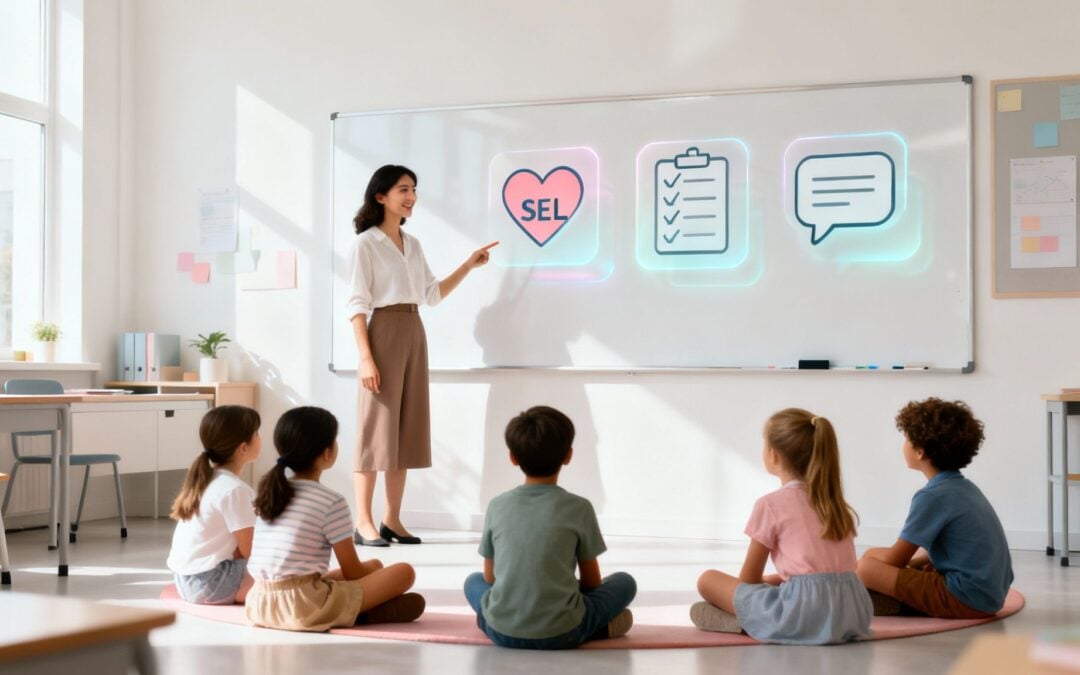
Welcome, educators and parents. We know that a peaceful, engaged classroom is the foundation of all learning, but achieving it often feels like an endless cycle of redirecting, reminding, and reacting. What if we shifted our focus from simply managing behavior to proactively building connection, resilience, and emotional intelligence? This guide offers powerful, research-informed classroom management strategies for teachers that do just that.
Rooted in social-emotional learning (SEL) principles, these aren’t just quick fixes. They are transformative approaches to creating a learning environment where every student feels safe, seen, and ready to thrive. Moving beyond traditional discipline, the strategies outlined here help cultivate a classroom ecosystem built on mutual respect, empathy, and collaboration. When students understand their emotions and can communicate their needs constructively, disruptions decrease and engagement naturally increases.
This article provides a curated collection of ten practical, actionable techniques designed for immediate implementation. For each strategy, you will find:
- A clear explanation of the concept and why it works.
- Step-by-step guidance for introducing it in your K-8 classroom.
- Classroom scripts and practical examples that you and parents can adapt.
- Troubleshooting tips for common challenges.
- Measurement ideas to help you track impact and progress.
Our goal is to equip you with a comprehensive toolkit to foster a more responsive and positive community, reducing the need for reactive discipline and creating more time for what matters most: teaching and learning. Let’s explore the strategies that can help you build that thriving classroom.
1. Restorative Practices and Circles
Restorative practices shift the focus of classroom management from punishment to community building and healing. Instead of asking “What rule was broken and who is to blame?”, this approach asks, “What happened, who has been affected, and what do we need to do to make things right?”. This powerful reframe transforms discipline into a learning opportunity, fostering empathy, accountability, and stronger relationships.
This strategy is highly effective because it addresses the root causes of behavior rather than just the symptoms. By giving every student a voice, it validates their experiences and teaches them to resolve conflicts constructively, making it one of the most impactful classroom management strategies for teachers aiming to build a truly inclusive and supportive learning environment.
How to Implement Restorative Circles
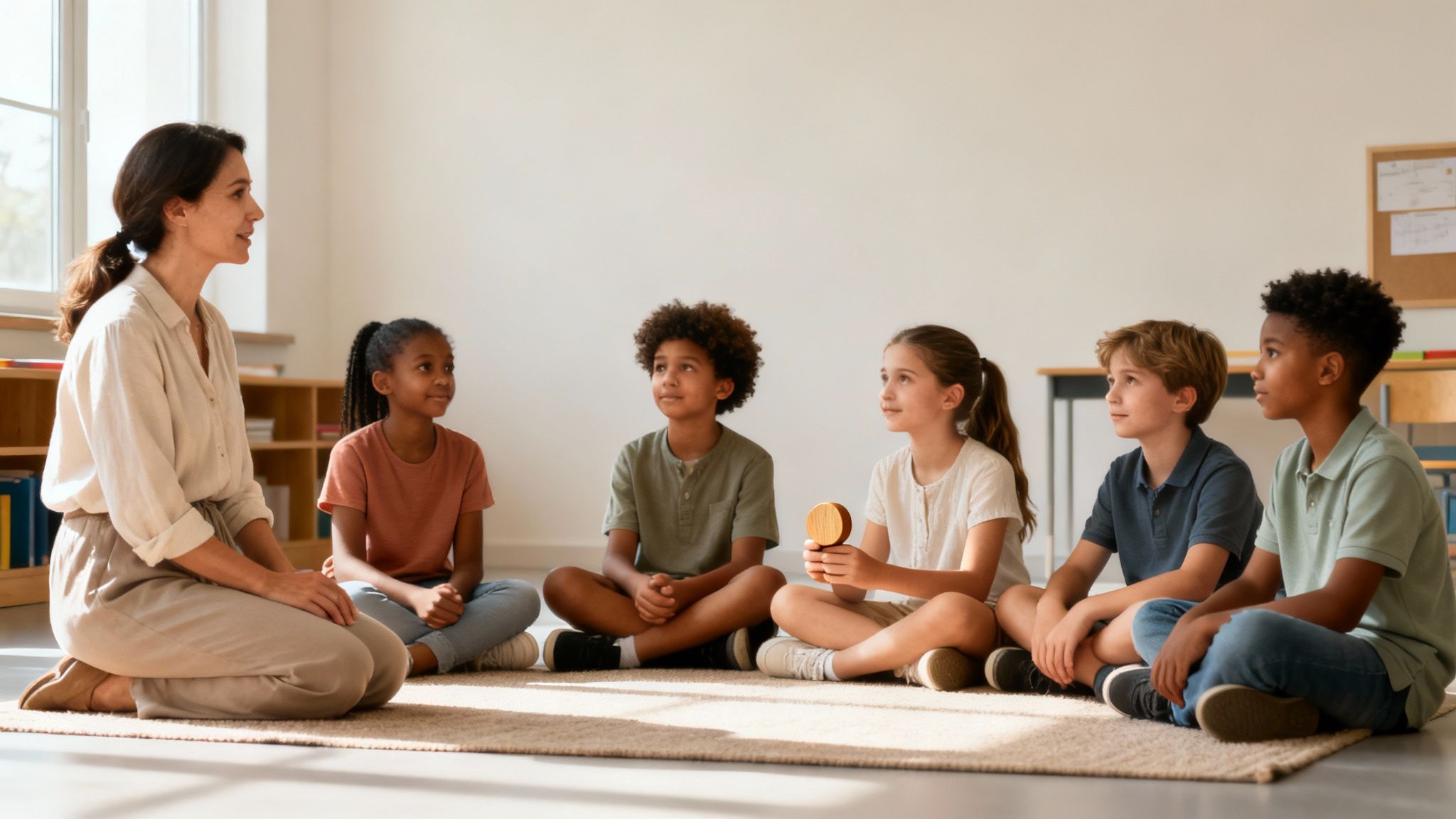
- Start Small with Community Building: Begin with low-stakes “check-in” circles. Use a talking piece (an object that gives the holder the exclusive right to speak) and go around the circle, asking students to share their name and answer a simple prompt.
- Practical Example: On Monday morning, say, “Let’s start with a check-in. Our prompt is: ‘Share one thing you’re looking forward to this week.’ I’ll start…”
- Establish Clear Norms: Co-create agreements with your students for how you will engage in circles. Norms often include: Respect the talking piece, Speak from the heart, and Listen with respect. Post these norms visually.
- Introduce Restorative Questions: Once community is established, you can use circles to address harm.
- Practical Example: Two students, Sam and Alex, argue over a shared tablet. Gather them and say, “Let’s have a restorative chat. Sam, what happened from your perspective?” After Sam speaks, turn to Alex: “Alex, what happened from your view?” Then ask both: “Who else was affected by this? How can we make this right so you can both continue learning?”
Troubleshooting and Measurement
Quick Tip: If students are reluctant to share, model vulnerability by answering the prompt first. Keep initial circles short and predictable to build safety and routine. If a conflict is too intense for a student-led circle, facilitate it yourself or with a counselor.
Track Your Impact: Monitor the frequency and nature of classroom conflicts over time. You can use a simple log to note incidents. Look for a decrease in repeated negative behaviors and an increase in students using “I-statements” and resolving minor issues independently.
2. Mindfulness and Self-Regulation Practices
Mindfulness practices teach students to pause and observe their thoughts and feelings without judgment, helping them develop the crucial skills of self-awareness and emotional regulation. Instead of reacting impulsively, students learn to choose intentional responses. This approach builds a foundation for a calm, focused, and respectful classroom culture where students feel equipped to manage their internal states.
This strategy is transformative because it empowers students with lifelong tools for managing stress and navigating social situations. By integrating short, consistent mindfulness exercises, you are implementing one of the most proactive classroom management strategies for teachers. This approach reduces disruptive behavior by addressing its root causes, such as anxiety or frustration, and fosters an environment conducive to learning.
How to Implement Mindfulness Practices
- Start with Mindful Breathing: Begin each day or class period with a simple one-minute breathing exercise.
- Practical Example: Say, “Class, let’s have a mindful minute. Place your feet flat on the floor and a hand on your belly. Let’s take three slow ‘balloon breaths’ together. Breathe in and feel your belly expand like a balloon, and breathe out slowly as it deflates.”
- Use a Mindfulness Chime: Ring a bell or chime and instruct students to listen silently until they can no longer hear the sound. This is a powerful tool for regaining focus.
- Practical Example: After a noisy group activity, say, “I’m going to ring the chime. Let’s see if we can listen quietly until the sound is completely gone. When you can’t hear it anymore, please look at me.”
- Integrate Mindful Movement: Introduce short, guided movement breaks.
- Practical Example: Say, “Let’s do a quick stretch. Stand up and reach for the sky like a tall tree. Wiggle your branches. Now, feel your feet rooted to the ground. Let’s take one deep breath here.”
Troubleshooting and Measurement
Quick Tip: If students find it hard to sit still, start with very short practices (30-60 seconds) and gradually increase the time. Offer variety like body scans, mindful walking, or visualizations to keep them engaged. Remember to model the practice yourself to show its importance.
Track Your Impact: Keep a simple log of the number of classroom disruptions or focus-related redirections needed each day. As you consistently implement mindfulness practices, look for a decrease in these incidents. Also, note any increase in students independently using calming strategies, like taking a deep breath when they feel upset.
3. Positive Behavioral Interventions and Supports (PBIS)
Positive Behavioral Interventions and Supports (PBIS) is a proactive, data-driven framework that improves school climate and student behavior. Instead of waiting for misbehavior to occur, PBIS focuses on explicitly teaching, modeling, and reinforcing positive behavioral expectations. This school-wide system creates a predictable and safe environment where expectations are clear, and positive behavior is the norm.
This approach is highly effective because it treats behavior as a skill that can be taught, just like reading or math. By establishing a shared language and consistent positive reinforcement, it reduces disciplinary incidents and increases instructional time. This makes PBIS one of the most foundational classroom management strategies for teachers aiming to build a positive and productive school culture from the ground up.
How to Implement PBIS in Your Classroom
- Define and Teach Expectations: Collaborate with your school to establish 3-5 simple, positively stated expectations, such as “Be Respectful, Be Responsible, Be Safe.”
- Practical Example: For “Be Respectful,” create a T-chart with students. On one side, list what respect looks like (e.g., “eyes on the speaker,” “waiting your turn”). On the other, list what it sounds like (e.g., “please and thank you,” “quiet voices”).
- Create a Reinforcement System: Develop a system to acknowledge students who meet expectations.
- Practical Example: Give students “Caught Being Good” tickets when you see them being responsible. They can put these tickets in a jar for a weekly drawing for a small privilege, like being the line leader.
- Establish a Clear Consequence System: Create a flowchart of predictable, logical consequences for misbehavior. For example, a minor disruption might result in a verbal reminder, followed by a brief time-out to reflect, ensuring responses are consistent and fair.
- Use Data to Make Decisions: Track minor and major behavior incidents. Use this data to identify patterns, such as a specific time of day when conflicts arise, and then reteach expectations or adjust support accordingly.
Troubleshooting and Measurement
Quick Tip: Aim for a ratio of at least four positive interactions for every one corrective interaction (4:1). If a whole class is struggling, pause the lesson and do a quick 2-minute “refresher” on the target expectation, modeling both what it looks like and what it doesn’t look like.
Track Your Impact: Use a simple behavior tracking form or a digital tool to monitor the frequency of specific behaviors. Look for a decrease in office referrals and an increase in the number of positive acknowledgments you are giving out each week. Celebrate class-wide progress toward behavioral goals.
4. Trauma-Informed Classroom Practices
Trauma-informed practices are founded on the understanding that many students’ behaviors are not willful defiance but survival responses rooted in adverse experiences. This approach prioritizes creating a physically and emotionally safe environment where students feel seen, connected, and supported. Instead of asking, “What’s wrong with you?”, a trauma-informed teacher asks, “What happened to you, and how can I help?”
This shift from a punitive to a compassionate lens is transformative. It recognizes that trauma can impact brain development, learning, and self-regulation. By focusing on building trust and predictability, these classroom management strategies for teachers help calm students’ nervous systems, making them more available for learning and positive social interaction.
How to Implement Trauma-Informed Practices
- Prioritize Predictability and Routine: Post and review a daily visual schedule. Give students verbal and non-verbal cues before transitions.
- Practical Example: Before cleanup, say, “In two minutes, we will finish our writing and get ready for math. I will ring the chime when it’s time to put your notebooks away.” This prevents abrupt changes that can be jarring.
- Offer Choices and Control: Provide students with simple, structured choices throughout the day.
- Practical Example: Say, “For this assignment, you can choose to work at your desk with a partner or find a quiet spot to work alone. Which would help you do your best work?”
- Create a Calming Space: Designate a corner of the classroom as a “peace corner” or “calm-down corner.” Equip it with sensory tools like stress balls, soft pillows, or noise-reducing headphones where students can go to self-regulate without shame or punishment. For more ideas, you can explore additional trauma-informed teaching strategies.
Troubleshooting and Measurement
Quick Tip: Before addressing a student’s behavior, regulate yourself first. Take a deep breath. A calm adult is a dysregulated child’s best resource. When a student is escalated, use a calm, quiet tone and simple language, assuring them, “You are safe here. I will help you.”
Track Your Impact: Monitor the use of the calming space and note which students use it most frequently. Track office referrals for behavior, looking for a decrease over time. You can also use short, informal student check-ins or exit tickets asking, “How safe did you feel in class today on a scale of 1-5?” to gauge the emotional climate.
5. Collaborative Problem-Solving and Empathy Building
This student-centered approach shifts classroom management from adult-imposed solutions to a collaborative process. Instead of simply enforcing rules, teachers guide students to understand different perspectives, listen deeply to one another, and work together to solve problems. The focus is on building empathy and finding mutually beneficial solutions to classroom challenges, from sharing resources to resolving peer conflicts.
This strategy is powerful because it equips students with essential social-emotional skills for life. It transforms discipline into an opportunity for growth, teaching students how to communicate their needs, consider others’ feelings, and take ownership of their community. Using collaborative problem-solving is one of the most effective classroom management strategies for teachers who want to develop compassionate, responsible, and independent thinkers.
How to Implement Collaborative Problem-Solving
- Teach and Model Active Listening: Explicitly teach skills like making eye contact, not interrupting, and paraphrasing.
- Practical Example: During a morning meeting, practice with a fun topic. Say, “Juan, please share your favorite part of the weekend. Maria, your job is to listen and then say, ‘What I hear you saying is…’ to show you were listening.”
- Use Sentence Stems: Provide students with language to express themselves constructively. Post stems like, “I felt ___ when ___ because I need ___.” or “I understand you feel ___ because ___.” This helps students separate the person from the behavior.
- Facilitate Problem-Solving Conferences: When a conflict arises, bring the involved students together.
- Practical Example: A ball is taken during recess. You gather the students. Step 1: “Maya, please share what happened.” Step 2: “Leo, please share your side.” Step 3: “It sounds like the problem is we only have one ball and you both want it. What are some ideas to solve this?” Step 4: Students might suggest taking turns with a timer. You help them agree on a plan.
Troubleshooting and Measurement
Quick Tip: If a conflict is emotionally charged, give students a cool-down period before bringing them together. For younger students, use puppets or drawings to help them explain their perspectives. Always validate all feelings, even if you don’t agree with the behavior that resulted from them.
Track Your Impact: Keep a simple log of conflicts that require your intervention. Over time, look for a decrease in the frequency of these incidents. You should also see an increase in students independently using sentence stems, “I-statements,” and attempting to solve minor disagreements on their own before seeking adult help.
6. Clear Expectations, Consistency, and Routines
Establishing clear expectations and predictable routines is the bedrock of a well-managed classroom. When students know exactly what is expected of them and can anticipate the flow of their day, it creates a sense of psychological safety that allows their brains to focus on learning instead of navigating uncertainty. This strategy involves explicitly teaching behaviors, consistently reinforcing them, and building efficient routines for every part of the school day.
This approach is one of the most fundamental classroom management strategies for teachers because it proactively prevents misbehavior. Popularized by educators like Harry Wong, this method builds a structured environment where students can thrive. It reduces anxiety, minimizes downtime and transitions, and empowers students with the confidence that comes from knowing how to be successful in their environment.
How to Implement Expectations and Routines
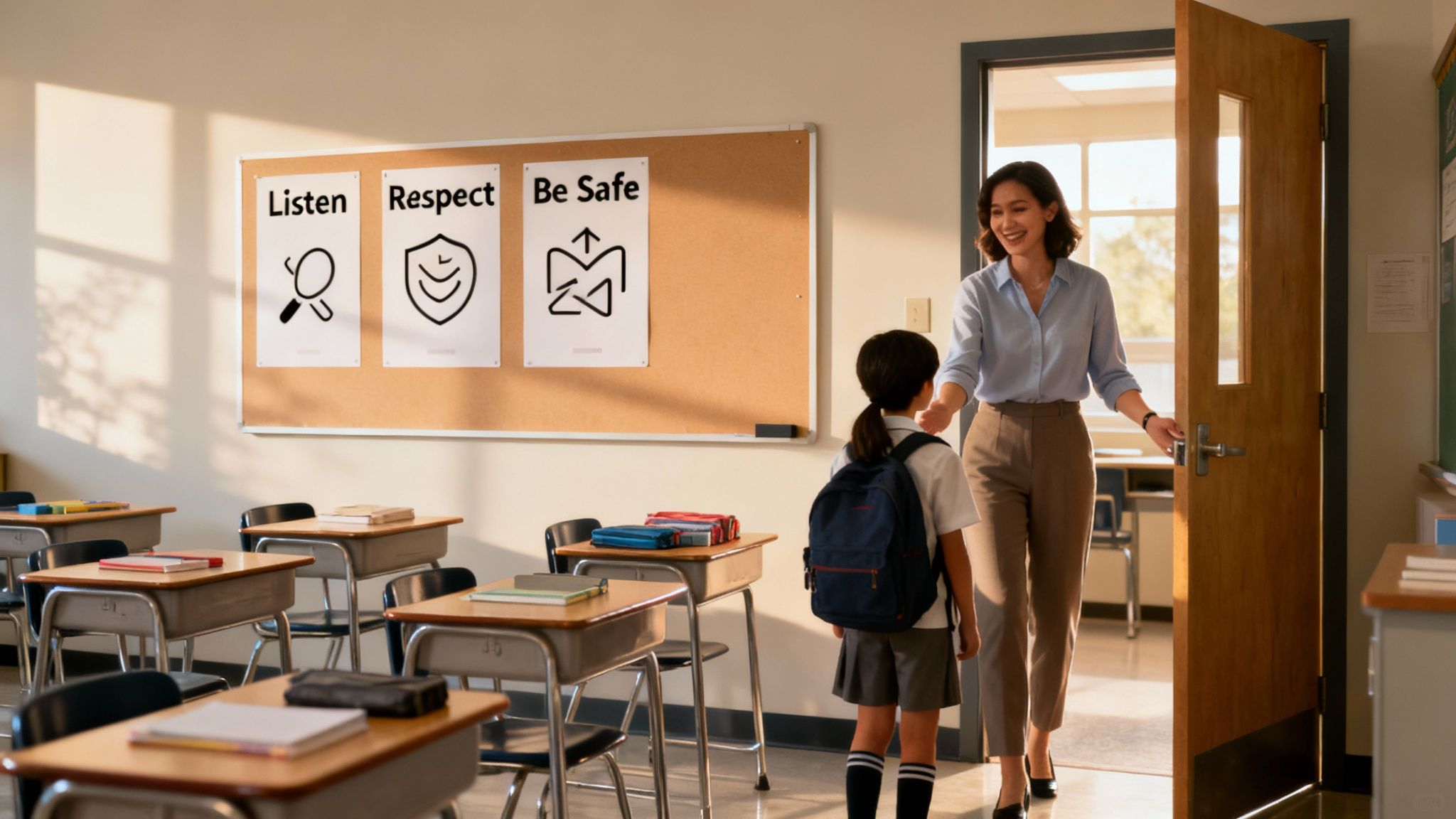
- Co-Create and Post Expectations: In the first week of school, work with students to create 3-5 positively stated classroom rules, like “Respect yourself, others, and our space.” Post these expectations visually. Teach them like any academic subject.
- Practical Example: For the rule “Be Prepared,” have students act out what it looks like (e.g., having a pencil and notebook ready) and what it doesn’t look like (e.g., searching through a messy desk after the bell rings).
- Establish Predictable Routines: Identify key parts of the day that need a clear procedure.
- Practical Example: Create a visual chart for the “Entering the Classroom” routine with pictures: 1. Put away backpack. 2. Turn in homework. 3. Start morning work. Practice this daily for the first month.
- Use Consistent Signals: Develop consistent verbal and non-verbal cues for transitions and getting attention. A simple chime, a hand signal, or a consistent phrase like “Eyes on me in 3, 2, 1” can effectively and calmly redirect the entire class.
Troubleshooting and Measurement
Quick Tip: If students are not following a routine, do not just remind them; re-teach and practice it. Break the routine down into smaller steps and have the class walk through it again. Consistency is more important than perfection, especially at the beginning of the year.
Track Your Impact: Measure the time it takes for students to complete key routines, such as lining up or transitioning between activities. Use a timer and track the data over several weeks. You should see a significant decrease in transition time, which translates directly into more time for instruction.
7. Social-Emotional Learning (SEL) Integration
Social-Emotional Learning (SEL) integration is a comprehensive approach where emotional intelligence is woven into the fabric of the classroom. Instead of treating SEL as a separate subject, this strategy embeds the five core competencies (self-awareness, self-management, social awareness, relationship skills, and responsible decision-making) into daily instruction, classroom culture, and every student interaction. This holistic method focuses on developing the whole child, creating the foundational conditions for both academic and behavioral success.
This strategy is highly effective because it proactively teaches students the skills they need to navigate their emotions, relationships, and challenges. By making SEL a constant, lived experience rather than an occasional lesson, it becomes one of the most powerful classroom management strategies for teachers. This approach builds a classroom culture where students feel understood, can manage their impulses, and are better equipped to learn and collaborate.
How to Implement SEL Integration
- Start with Daily Check-Ins: Begin each day with a simple “mood meter” or a question.
- Practical Example: Students can move a clothespin with their name to a chart showing different feelings (happy, sad, calm, frustrated). This gives you a quick visual of the class’s emotional state.
- Embed SEL into Academics: Use your existing curriculum as a vehicle for SEL.
- Practical Example: After reading a story, ask, “How do you think the main character showed resilience when they failed? What could we learn from that when we face a tough math problem?”
- Use Teachable Moments: When a conflict arises on the playground or during group work, treat it as a learning opportunity.
- Practical Example: A student gets frustrated and crumples up their paper. You approach them quietly and say, “I can see you’re feeling frustrated. It’s okay to feel that way. Let’s take a deep breath, and then we can look at the problem together.”
Troubleshooting and Measurement
Quick Tip: Avoid making SEL feel like just another task. The most authentic integration happens when you model the skills yourself. Talk about your own feelings (appropriately), admit when you make a mistake, and demonstrate respectful communication in every interaction. To get started with practical exercises, check out these engaging social-emotional learning activities.
Track Your Impact: Use a simple journal or checklist to note instances of students using SEL skills. Track how often students use “I feel…” statements, solve peer conflicts without teacher intervention, or persist through a challenging academic task. Look for a qualitative shift in classroom climate and a decrease in disruptive behavior over a grading period.
8. Relationship Building, Family and Community Partnership
This foundational strategy centers on the idea that students learn best when they feel seen, valued, and connected to a supportive network. It involves intentionally building genuine relationships with students, fostering a positive peer culture, and creating strong partnerships with families and the wider community. Instead of viewing management as a system of control, this approach sees it as a result of mutual respect and trust.
This strategy is powerful because it addresses the fundamental human need for belonging. When students feel a genuine connection to their teacher and peers, they are more motivated to engage, cooperate, and take academic risks. Extending this network to families makes it one of the most holistic classroom management strategies for teachers, creating a consistent web of support that reinforces positive behavior and academic success both at school and at home.
How to Implement Relationship Building and Partnerships
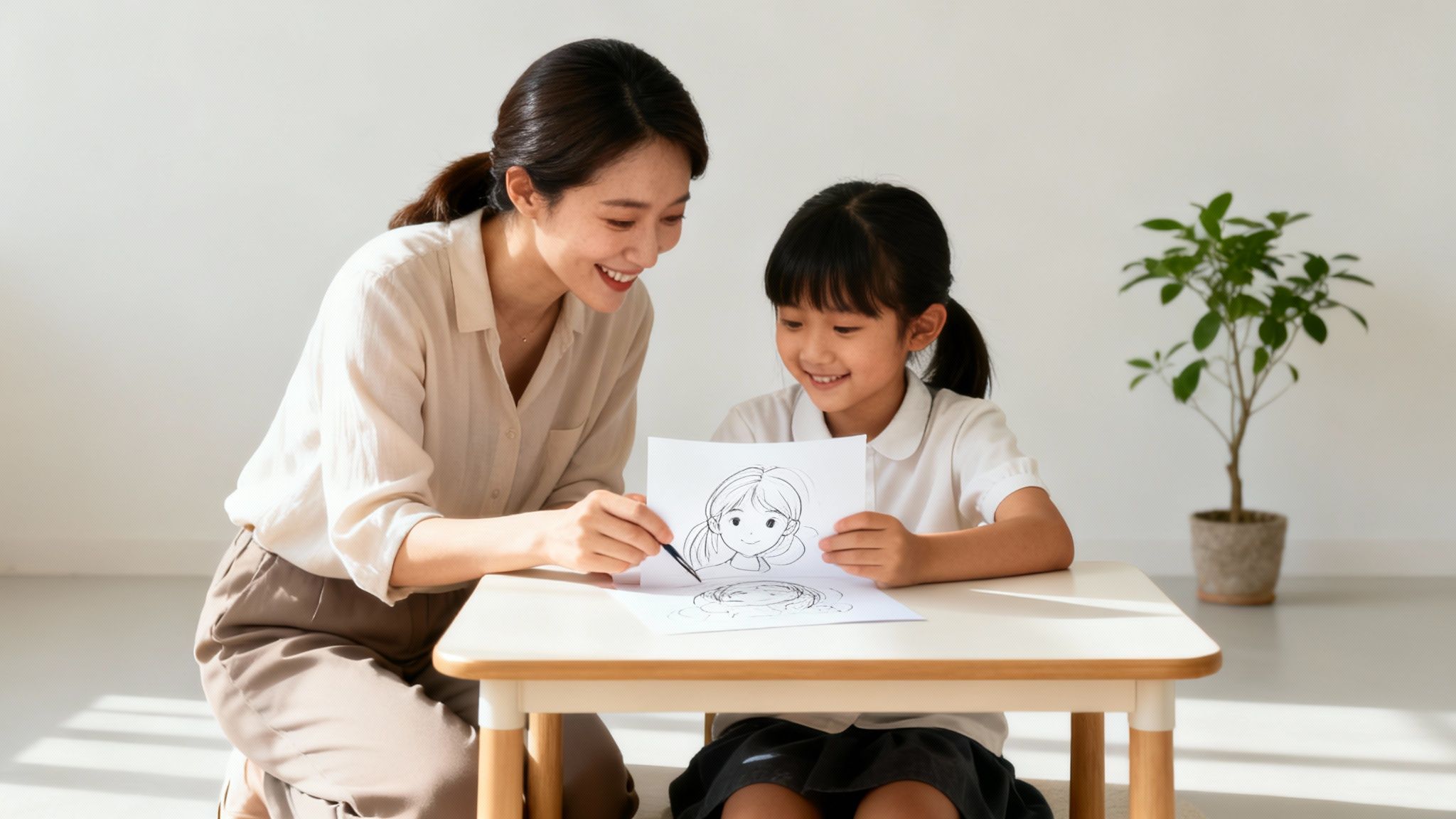
- Focus on Individual Connections: Make time for one-on-one interactions.
- Practical Example: Implement “2×10” strategy: Spend 2 minutes a day for 10 consecutive days talking with a student about anything other than schoolwork. Ask about their pets, hobbies, or favorite video games.
- Build a Classroom Community: Create shared experiences and rituals that foster a sense of “us.”
- Practical Example: Start a “Student of the Week” program where each student gets a special bulletin board to share photos and facts about themselves, and classmates write positive notes to them.
- Engage Families Proactively: Don’t wait for a problem to arise to contact home.
- Practical Example: Make it a goal to send two positive notes or emails home each day. “Dear Parent, I wanted to share that Maria was incredibly helpful to a new student today. You should be so proud!”
- Leverage Community Resources: Invite community members, like local artists, scientists, or elders, to share their expertise. Partner with local organizations to provide mentorship opportunities or support for students and families facing challenges.
Troubleshooting and Measurement
Quick Tip: With a student who seems withdrawn or resistant, start small. A simple, non-academic question like, “I noticed you like to draw; what’s your favorite thing to create?” can be an entry point. When communicating with families, always lead with a positive observation before discussing a concern.
Track Your Impact: Monitor qualitative and quantitative data. Keep anecdotal notes on student interactions and engagement levels. Track family attendance at conferences and school events. Survey students and families about their sense of belonging. Look for a decrease in office referrals and an increase in positive communication between home and school.
9. Positive Reinforcement and Recognition Systems
Positive reinforcement is a strategic approach that encourages desired behaviors by focusing on what students are doing right, rather than what they are doing wrong. This system shifts the classroom climate from reactive and punitive to proactive and encouraging. By systematically “catching” students demonstrating positive behaviors, teachers can boost student confidence, build intrinsic motivation, and clearly define community expectations.
This strategy is highly effective because it leverages the brain’s natural reward system, making students more likely to repeat actions that lead to positive outcomes. Meaningful recognition reinforces specific behaviors and shows students that their effort and positive choices are seen and valued. This makes it one of the most foundational classroom management strategies for teachers aiming to cultivate a positive and productive learning environment.
How to Implement a Positive Recognition System
- Be Specific and Immediate: Instead of a generic “Good job,” provide praise that is timely and detailed.
- Practical Example: As a student helps a classmate, say, “Marco, I noticed you paused your own work to explain that math step to Sarah. That was a perfect example of teamwork.”
- Focus on Effort and Growth: Frame recognition around progress and hard work, not just achievement.
- Practical Example: Say to a student, “Your first draft was good, but I can see you worked hard on adding more details in this version. Your effort really improved your writing!”
- Use a Variety of Methods: Combine different forms of recognition to keep the system engaging.
- Practical Example: Create a class-wide “marble jar.” When the whole class follows a direction quickly or shows kindness, add a handful of marbles. When the jar is full, they earn a reward they voted on, like a pajama day.
Troubleshooting and Measurement
Quick Tip: If a recognition system feels ineffective, ask for student input. They can tell you what they find motivating, whether it’s more autonomy, positive feedback, or tangible acknowledgments. Ensure you are recognizing a wide range of students regularly, not just the usual high-performers.
Track Your Impact: Use a simple behavior tracking chart to tally the frequency of specific target behaviors you want to increase, like “using kind words” or “starting work promptly.” Over a few weeks, you should see an upward trend in these positive actions and a corresponding decrease in off-task or disruptive behaviors.
10. Student Voice, Choice, and Agency
This empowering approach shifts the classroom dynamic from teacher-led compliance to a collaborative community. By giving students a voice in decisions, a choice in how they learn, and agency over their environment, you foster profound ownership and intrinsic motivation. Instead of passively receiving instructions, students become active partners in their education, developing critical thinking and self-advocacy skills.
This strategy is transformative because it respects students as capable, contributing members of the classroom. When students see that their opinions matter and their choices have a real impact, their engagement and responsibility skyrocket. This makes it one of the most effective classroom management strategies for teachers aiming to cultivate independent, motivated learners and a more democratic classroom culture.
How to Implement Voice, Choice, and Agency
- Start with Structured Choices: Begin by offering simple, meaningful choices.
- Practical Example: Instead of assigning 20 math problems, create a “tic-tac-toe” board of 9 different problems with varying difficulty. Tell students, “Complete any three problems in a row to win.”
- Facilitate Class Meetings: Hold regular class meetings to solve problems collaboratively.
- Practical Example: Say, “Our classroom library is getting messy. In our meeting today, let’s brainstorm a system to keep it organized. What are your ideas for a solution?” Have students vote on the best plan.
- Offer Agency Over the Environment: Allow students some control over their physical learning space.
- Practical Example: Let students choose where they work best for independent reading time. Options could include a beanbag chair, a space under a table, or a traditional desk.
Troubleshooting and Measurement
Quick Tip: If students are overwhelmed by choice, start with a simple “This or That” option before expanding. Frame choices clearly: “You can choose to work on your math problems independently or with a partner. You cannot choose to skip them.” To truly empower students and foster a sense of ownership, understanding proven strategies to motivate students is paramount.
Track Your Impact: Use student surveys or exit tickets to gather feedback on the choices offered. Ask questions like, “Did having a choice help you learn? Why or why not?” You can also track assignment completion rates and quality, looking for an increase after implementing more choice-based activities.
10 Classroom Management Strategies Compared
| Strategy | Implementation Complexity | Resource Requirements | Expected Outcomes | Ideal Use Cases | Key Advantages |
|---|---|---|---|---|---|
| Restorative Practices and Circles | Moderate–High (facilitation skills, sustained practice) | Time for regular circles; facilitator training; staff buy-in | Fewer suspensions; repaired relationships; improved conflict resolution | Community-building, repairing harm, restorative responses to incidents | Builds belonging; repairs harm; develops communication and accountability |
| Mindfulness and Self-Regulation Practices | Low–Moderate (consistent daily practice) | Minimal cost; short daily time blocks; teacher modeling & PD | Reduced anxiety/reactivity; improved focus and self-awareness | Transition times, stress reduction, universal SEL support K–8 | Portable, research-backed tools; low-cost; immediate calming effects |
| Positive Behavioral Interventions and Supports (PBIS) | High (school-wide, multi-tiered implementation) | Training, data systems, ongoing coaching, coordination | Reduced referrals; predictable environment; improved academics | School-wide behavior frameworks; data-driven behavior supports | Scalable and evidence-based; clear expectations and measurable data |
| Trauma-Informed Classroom Practices | High (policy shifts + staff capacity building) | Extensive PD, counseling partnerships, systemic supports | Fewer retraumatizing incidents; increased engagement; better coping | Schools with high ACEs; students with trauma histories | Addresses root causes; creates safety and compassionate responses |
| Collaborative Problem-Solving & Empathy Building | Moderate (skill teaching, facilitation time) | Time for student-led meetings; teacher coaching in facilitation | Increased empathy; student-owned solutions; better peer resolution | Peer conflicts, class meetings, social skills development | Fosters ownership; strengthens perspective-taking and real-world skills |
| Clear Expectations, Consistency, and Routines | Low–Moderate (planning and consistent enforcement) | Teacher planning time; visual supports; consistent staff practice | Reduced confusion and disruptions; more instructional time | Establishing classroom norms, transitions, support for neurodiverse students | Predictability; efficient classroom flow; supports diverse learners |
| Social-Emotional Learning (SEL) Integration | Moderate–High (curriculum integration across subjects) | PD, curricular time, school-wide alignment, assessment tools | Improved academics, behavior, resilience, sense of belonging | Whole-school culture change; embedding SEL into academics | Comprehensive, research-backed development of emotional competencies |
| Relationship Building, Family & Community Partnership | Moderate (ongoing relational work) | Time for one-on-one interactions; family outreach resources; events | Increased engagement, attendance, academic gains; closer home-school alignment | Building trust, family engagement initiatives, community partnerships | Deep trust and belonging; extended support network; culturally responsive |
| Positive Reinforcement & Recognition Systems | Low–Moderate (consistent application) | Time for praise systems; small budget for rewards; tracking mechanisms | Increased desired behaviors; higher confidence and motivation | Reinforcing specific behaviors; complements PBIS and SEL efforts | Immediate reinforcement; builds self-efficacy; reduces power struggles |
| Student Voice, Choice, and Agency | Moderate (structured opportunities, facilitation) | Time for choice structures, student leadership, teacher facilitation | Greater engagement, ownership, decision-making and leadership skills | Project-based learning, classroom governance, student-led conferences | Empowers students; develops responsibility and culturally responsive practice |
Your Next Step: Building a Connected Classroom
We have explored a comprehensive toolkit of powerful, research-informed classroom management strategies for teachers, moving far beyond traditional discipline. This journey has taken us through ten foundational approaches: from the community-building power of Restorative Circles and the calming influence of Mindfulness, to the structured support of PBIS and the essential empathy of Trauma-Informed Practices. We’ve seen how Collaborative Problem-Solving, clear routines, and deep SEL integration work in harmony to create a predictable, safe, and engaging learning environment.
The common thread weaving through each of these strategies is the undeniable power of human connection. True classroom management isn’t about enforcing rules; it’s about building relationships. It’s about fostering a culture where every student feels seen, heard, and valued. When you prioritize building trust, promoting student agency, and partnering with families, you are not just managing behavior, you are nurturing the whole child.
Key Takeaways for Immediate Action
The shift from a compliance-focused classroom to a connected community can feel overwhelming. Instead of trying to implement everything at once, focus on one or two key principles that resonate with your current needs.
- Start with Connection: Before focusing on any other strategy, double down on relationship-building. Greet students at the door by name. Learn one new thing about each student this week. Small, consistent efforts create a foundation of trust that makes all other strategies more effective.
- Embrace Consistency Over Intensity: Choose one new routine, such as a “Mindful Minute” at the start of class or a weekly “check-in circle,” and stick with it. Consistency builds psychological safety for students, letting them know what to expect and that you are a reliable leader.
- Model, Model, Model: The most effective classroom management strategies for teachers involve showing, not just telling. If you want students to use “I feel” statements, use them yourself. If you want them to practice self-regulation, openly narrate when you are taking a deep breath to manage your own stress. Your actions are the most powerful lesson.
From Strategy to System: Making It Sustainable
Implementing these approaches often requires resources, whether for professional development, classroom materials, or specialized programs. Proactively seeking funding can be a game-changer. For educators seeking direct financial support, investigating options such as how to secure Tennessee grants specifically for teachers can provide the necessary capital to bring ambitious, school-wide SEL and behavior initiatives to life. Exploring these avenues allows you to transform individual classroom efforts into a sustainable, systemic culture of support.
Ultimately, mastering these concepts is about more than creating a quieter, more orderly classroom. It’s about equipping the next generation with the emotional intelligence, empathy, and problem-solving skills they need to navigate an increasingly complex world. You are not just teaching academic content; you are shaping future leaders, collaborators, and compassionate citizens. This work is challenging, but its impact is immeasurable and profound. Keep learning, stay curious, and remember that every small step toward building a more connected classroom makes a world of difference.
For over 20 years, Soul Shoppe has partnered with schools to cultivate safe, empathetic, and connected communities where students can thrive. If you are ready to bring proven, transformative social-emotional learning programs to your campus, explore our offerings and see how we can support your journey. Visit Soul Shoppe to learn more.