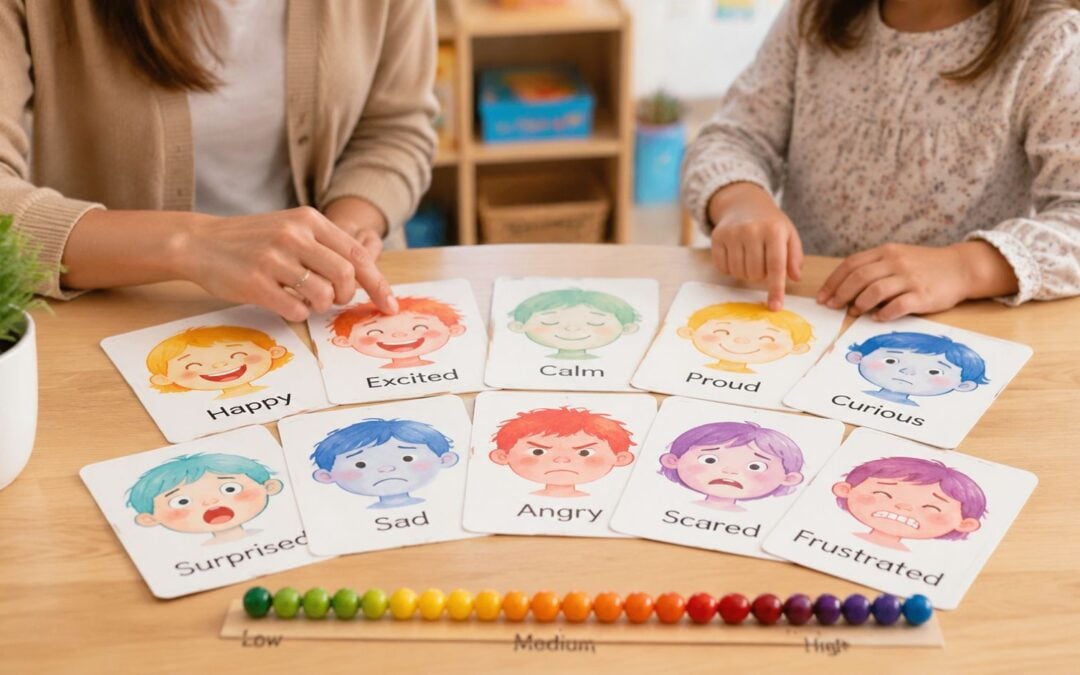
A child comes home quiet after school. They shrug at dinner, snap at a sibling over a small comment, then melt into tears when a backpack zipper sticks. Most adults see “a bad mood,” but children usually need something simpler and kinder, a name for what they feel, plus a clue about what to do next.
Words for emotions help children connect body signals, experiences, needs, and choices without treating feelings as good or bad. That matters because emotion language is learnable, and research shows it can be measured at scale, compared across ages, and linked with well-being and distress. It also matters because the words people use for feelings have changed over time, which means children are not just memorizing labels, they're learning a social language for inner life, as historical work on English emotion words shows (historical overview of emotion words, emotion vocabulary and well-being study).
For K–8 learners, the best path starts with broad feeling words, then adds more precise labels, body cues, and context. Younger children usually need direct teaching and repeated practice, because emotion-specific vocabulary grows quickly in early childhood and then becomes more nuanced later, and instruction that targets specific feelings in context works better than just handing kids a list (children's emotion vocabulary development, emotion-specific vocabulary and comprehension). Keep that in mind as you move through these core words. Each one can become part of a calm classroom routine, a family check-in, or a printable chart children can use.
1. Happy
Happy is the easiest place to begin because children already recognize it in faces, voices, and movement. A happy child may smile, laugh, bounce, clap, or talk more freely, but happiness also shows up as quiet contentment, like settling comfortably into a favorite book. Adults can help children notice that happiness is not only “big joy,” it's also a steady sense that something feels right.
What happiness looks like in everyday life
A child might bounce when they hear they earned extra recess. A class might cheer when a peer finally masters a hard concept. At home, a child might grin through dinner after hearing good news from a grandparent. In each case, the feeling is visible, but the reason matters too.
Use simple prompts that connect body and meaning. You might say, “Your smile tells me you're feeling happy,” or, “I can see your shoulders got lighter when that happened.” In a classroom chart, a happy face or thumbs up gives younger children a quick visual match for the word. At the family table, ask, “What made you feel happy today?” and let the child answer in their own words.
Practical rule: Notice happiness without overexplaining it. When adults name it calmly, children learn that positive emotion can be recognized, shared, and remembered.
For a teacher-friendly extension, positive thinking exercises can pair well with a short gratitude moment, a celebration circle, or a “good news” share. how to tell happiness from joy can also help adults think more carefully about related words, especially when older students start asking why two positive feelings do not always feel the same.
2. Sad
Sad names sorrow, disappointment, or grief, and it deserves just as much teaching time as happy. Children need to know that sadness is normal, not a problem to hide. When adults treat sadness as welcome information, kids learn that difficult feelings can be handled without shame.
A student might tear up after losing a game. A child may feel heavy after a pet dies or a friend moves away. Another student might go quiet after critical feedback on schoolwork. Sadness often shows up as a slower body, lower voice, less eye contact, or pulling away from noise and conversation.
How to respond without rushing
Start by making room for the feeling. Say, “It's okay to feel sad when something didn't go the way you hoped.” Then pause. Many adults try to fix sadness too quickly, but children often need a calm witness before they need advice.
A few helpful supports fit naturally at school or home.
- Name the cause: Ask, “What are you feeling sad about?” so the child can separate the feeling from the event.
- Offer quiet support: Sit nearby, draw together, or let the child cry if needed.
- Give choices for expression: Journaling, sketching, talking, or a trusted adult check-in can all help.
- Make space for recovery: A feelings corner, a cozy chair, or a quiet hallway reset can help children return when they're ready.
Sadness becomes easier to carry when adults don't treat it as a behavior to stop. It's a feeling to understand, and often a sign that something mattered significantly.
3. Angry
Angry is a powerful word, and children usually learn it early because the feeling is easy to spot. Anger can show up when a child feels threatened, disrespected, blocked, or unheard. It also often covers other feelings, like hurt, fear, or frustration, so the word opens the door to deeper understanding rather than ending the conversation.
Helping children catch anger early
A child might slam a pencil after making a mistake. Another might yell when a peer cuts in line. Some children throw materials, clench fists, or speak in a sharp voice when they've hit their limit. The goal is not to shame the feeling, it's to teach children to notice it before it takes over.
An anger thermometer works well for that. You can teach levels early, before the feeling reaches a breaking point. A child at level 2 or 3 might still be able to breathe, move, or ask for help. At higher levels, the body is flooded, and learning pauses.
Try phrases that separate feeling from behavior.
I see you're angry, and we don't hit.
That sentence keeps the limit clear while still naming the emotion. During calm moments, build an anger action plan together. It can include a signal, a breathing reset, a water break, or a short walk to cool down. For more classroom-ready guidance, anger management for kids can support consistent language between school and home.
What anger may be hiding
Sometimes the underlying question is not “Why are you angry?” but “What got hurt underneath?” A child may be angry because they felt left out, embarrassed, or frightened. When adults ask gently, “Are you angry because you felt left out?” they help children move from reaction to reflection. That shift is a major step in self-regulation.
4. Scared or Afraid
Scared and afraid are protective words. They tell us a child's body thinks something might be unsafe, even when the threat is social, new, or imagined rather than physical. Fear can look mild, like hesitation, or intense, like freezing, clinging, or refusing to move.
A child may get quiet before presenting in front of the class. Another might cling to a teacher on the first day of school. Some children refuse to go to the bathroom alone, and others worry about failing a test or disappointing adults. Those behaviors can look oppositional from the outside, but fear is often the engine underneath them.
Building courage in small steps
The most useful response is calm validation. Say, “I notice you're feeling scared about this.” Then help the child name the fear more specifically. Vague fear gets easier to handle once it has a shape.
Children also do better when adults model courage in small, honest ways. You can say, “I get nervous before new groups too, so I take a breath and check my plan.” That kind of sentence makes fear manageable instead of mysterious.
A few supports help children move forward without pressure.
- Use grounding: Try a 5 senses check-in or slow breathing.
- Make a safety plan: Ask, “What would help you feel safer?”
- Break the step apart: Let the child practice one piece at a time.
- Avoid force: Pushing a child hard into fear usually makes the fear stronger.
For more ideas, anxiety coping skills for kids pairs well with short, repeatable routines that children can remember in the moment.
Fear needs respect, not punishment. When adults treat it as information, children can build courage instead of avoidance.
5. Frustrated
Frustrated is one of the most useful emotion words for school because it points to blocked effort. Unlike anger, frustration usually means the problem is the task, the delay, or the obstacle. That distinction helps children move from blame to problem-solving.
A child might sigh heavily over a hard math problem. Another may get upset when a block tower keeps falling down. Some children feel frustrated because they can't tie their shoes yet, and others react when a game doesn't turn out the way they planned. The feeling often shows up in the hands, shoulders, and voice before children can explain it.
Teaching the frustration pause
The goal is not to erase frustration. It's to help children stay inside it long enough to keep trying. A simple line like, “This is tricky, and it makes sense you're frustrated,” gives the child both empathy and direction.
Teach a frustration pause. The child stops, breathes, and decides what to try next. That can be as small as checking the first step again or asking for a hint. It works best when adults model it out loud.
You might say, “I'm frustrated too, so I'm going to reread the directions.” That sentence shows children that adults don't magically avoid frustration, they manage it.
A quick classroom or home routine can include:
- Break it down: Divide a hard task into smaller steps.
- Ask a support question: “What could help?”
- Praise persistence: Notice effort, not only success.
- Name the situation: Help children see that a blocked task is not the same as a personal failure.
When children build frustration tolerance, they get better at math, writing, building, sharing, and repairing friendships. They also learn that hard feelings can sit beside hard work.
6. Nervous or Anxious
Nervous and anxious both point to worry about what might happen next. The difference often lies in intensity and duration, but for children, both words matter because they help separate useful caution from unhelpful fear spirals. A nervous child may still move forward. An anxious child may get stuck.
A stomachache before a test, trouble sleeping before a field trip, worrying about making friends in a new class, or repeatedly asking “What if something goes wrong?” are all common signs. Children often feel the body cue before they know the word. That makes language especially important.
Making worry more specific
Start with reassurance that matches the moment. “Your body is preparing you, but you're safe,” is honest and calming. Then invite the child to name one specific worry rather than carrying a cloud of worry all at once.
A simple structure helps: what event is coming, what feels uncertain, and what part can be planned. If a child worries about an assembly, walk through the schedule. If a student worries about a test, review the format and the support they'll get.
For classroom and home practice, use:
- 5-4-3-2-1 sensory awareness
- Slow breathing
- Progressive muscle relaxation
- Guided imagery
- Clear previews of what comes next
Nervousness is normal before new things. But if a child's worry keeps growing, avoid brushing it off. Watch for the point where support from a counselor, school team, or pediatric professional may be needed. The word itself is a starting point, not the whole plan.
7. Excited
Excited is a high-energy positive feeling, and it often gets mistaken for happiness. The difference is timing and motion. Happiness can feel settled, while excitement points forward. A child is excited about what's coming next, and that future focus can make bodies louder, faster, and harder to regulate.
A student might bounce and talk rapidly about an upcoming field trip. A child may keep shooting their hand up because they're eager to answer. A group of children can get louder during a fun activity. Some children even lose focus in regular class after hearing exciting news, not because they're defiant, but because their energy is overflowing.
Channeling energy without shutting it down
The best response is not to dampen excitement, it's to guide it. First, name it. “I can see you're excited.” Then help the child shift that energy into something manageable.
You can say, “Show me with your body how excited you are, then let's breathe.” That gives the feeling a safe outlet without pretending it isn't there. It also teaches children that strong positive feelings need regulation too.
A few classroom-friendly supports work well:
- Movement breaks before sustained seat work
- Hands-on activities to use the energy
- Count-to-5 resets before transitions
- Excitement scales so children can notice when energy is climbing
Teachers can also use excitement as motivation. “When we focus during math, we'll have time for the exciting activity after.” That keeps the classroom calm while respecting the feeling. Children learn that enthusiasm is welcome, as long as it doesn't take over the room.
8. Embarrassed or Ashamed
Embarrassed and ashamed are social emotions, which means they are tied to how children think others see them. Mild embarrassment is normal and even useful, but shame can cut deeper. When shame becomes frequent or intense, children may stop trying, stop speaking, or avoid situations where they might be seen.
A child may look down after making a mistake in front of the class. Another may refuse to participate after being laughed at. A child might cover their face when corrected, or avoid a classmate after an awkward moment. These behaviors often hide a strong wish to disappear.
Naming the feeling without deepening it
Adults can help most by lowering the social spotlight. Offer privacy when possible. Speak kindly, and keep the correction focused on the behavior, not the child's worth. “You made a mistake. That doesn't make you bad,” is a sentence children remember because it protects dignity.
A little gentle humor can help when the adult is sharing their own embarrassing moment, but it should never be used to minimize the child. The core message is that mistakes are part of being human. For language that supports this kind of emotional naming, naming feelings and helping kids find the words they need fits naturally with a classroom culture built on safety.
Shame shrinks children. Respect helps them rejoin the group.
What to say in the moment
Try a brief, private check-in.
- Name what you noticed: “I saw you look embarrassed.”
- Offer a choice: “Do you want to talk, or do you want a minute?”
- Separate action from identity: Focus on the moment, not the child's character.
- Re-enter gently: Help the child return to the task with dignity intact.
When classrooms treat mistakes as learning moments, embarrassment loses some of its power and children become more willing to try again.
9. Disappointed
Disappointed belongs in every vocabulary set because children face it constantly. It happens when expectations aren't met or a hoped-for result doesn't arrive. The feeling can sit near sadness, anger, or frustration, which is why children often need help sorting it out.
A child might learn their favorite activity was cancelled. A student may not be chosen for a team or special role. A birthday gift may not match what they hoped for. Plans change, delays happen, and disappointment shows up fast.
Helping children sit with unmet expectations
Start with acknowledgment. “I see you're disappointed. That makes sense.” Then resist the urge to rush past the feeling. Children do learn resilience from disappointment, but only if adults let the feeling exist long enough to be understood.
Ask, “What were you hoping would happen?” That question helps children compare expectation with reality. Once the child can name that gap, you can move toward control and next steps. “We can't change this, but we can decide what to do now,” gives agency without pretending the disappointment didn't hurt.
Disappointment is a useful teaching moment for family life, too. When a birthday plan changes or a weekend outing gets delayed, adults can model their own response. “I'm disappointed too, and here's what I'll do,” shows children that disappointment is survivable and manageable.
One of the best supports is small, repeated practice with flexible plans. Children who learn to tolerate minor disappointments are often better prepared for larger ones later. They don't need perfect outcomes. They need language, repair, and a steady adult nearby.
10. Proud
Proud helps children notice accomplishment, effort, and character. Healthy pride is not the same as bragging. It says, “I did something hard, and it mattered.” That feeling supports confidence, persistence, and a stronger sense of identity.
A child may beam after finishing a difficult task. A student might stand taller when recognized for helping a classmate. Another child may show a page full of mistakes because they can see growth. A group can feel proud after working together on a project, especially when the effort mattered as much as the result.
Building pride the healthy way
The strongest pride comes from effort, values, and growth. Say, “Look how hard you worked on this,” or, “I'm proud of how you treated your friend.” Those comments point children toward choices they can repeat.
Avoid praise that only compares children to others. It can make pride depend on being better than someone else. Specific feedback works better, because it shows children exactly what they did well. “You organized your ideas clearly,” teaches more than a generic “good job.”
A good pride routine in class or at home can include a short reflection chart.
- What did I work hard on?
- What did I improve?
- What kind choice did I make?
- What do I want to keep doing?
Children who can name their own pride are less dependent on constant outside approval. They begin to notice that growth is worth celebrating even when nobody else is clapping.
Comparison of 10 Emotion Words
| Emotion | Implementation complexity | Resource requirements | Expected outcomes | Ideal use cases | Key advantages |
|---|---|---|---|---|---|
| Happy | Low, simple recognition and celebration activities | Minimal, visual cues, prompts, short activities | Greater emotional vocabulary; positive classroom climate | Celebrations, daily check-ins, teach-feelings lessons | Easy to identify; reinforces positive behavior |
| Sad | Low–Medium, requires adult validation skills | Moderate, quiet space, adult support, validation training | Validation of feelings; better coping and empathy | Loss, disappointment, processing difficult events | Normalizes negative emotion; builds empathy and resilience |
| Angry | Medium–High, needs behavior plans and regulation tools | Moderate, conflict-resolution curricula, adult coaching, safety plans | Improved self-regulation and conflict resolution | Conflict incidents, boundary-setting, impulse control lessons | Signals unmet needs; can motivate advocacy when channeled |
| Scared / Afraid | Medium, needs safety planning and gradual exposure | Moderate, safety strategies, adult support, grounding techniques | Increased sense of safety; gradual reduction of avoidance | Transitions, fears (dark, separation), anxiety triggers | Protective emotion; opportunity to teach courage and safety skills |
| Frustrated | Low–Medium, teach problem-solving and tolerance strategies | Minimal–Moderate, scaffolding, task breakdowns, short breaks | Greater persistence, problem-solving, reduced escalation | Challenging tasks, skill-building moments, learning edges | Fuels growth; lower intensity entry point to self-regulation |
| Nervous / Anxious | Medium–High, requires evidence-based coping skills | Moderate–High, mindfulness tools, planned practice, possible referrals | Reduced avoidance; improved focus and coping for future events | Tests, presentations, chronic worry, transitions | Teaches anticipatory coping; supports long-term functioning |
| Excited | Low, teach channeling and brief regulation strategies | Minimal, movement breaks, planned outlets, signal systems | Managed energy; maintained engagement and safety | Anticipatory events, high-motivation activities, group celebrations | Drives participation and enthusiasm; boosts motivation |
| Embarrassed / Ashamed | Medium, needs culture-building and sensitive responses | Moderate, private recovery options, adult modeling, supportive norms | Increased social resilience; restored self-worth | Public mistakes, social mishaps, correction moments | Addresses hidden emotions; promotes self-compassion and belonging |
| Disappointed | Low–Medium, teach tolerance and reflective processing | Minimal–Moderate, adult acknowledgement, framing prompts | Improved acceptance, perspective-taking, resilience | Cancelled plans, unmet expectations, competitive loss | Builds disappointment tolerance; supports realistic expectations |
| Proud | Low, encourage effort-based recognition and reflection | Minimal, opportunities for acknowledgement, specific feedback | Stronger self-esteem, intrinsic motivation, persistence | Celebrating effort, growth-mindset activities, showcases | Reinforces effort and values; fosters lasting motivation |
Turn Emotion Words Into Everyday Practice
The strongest words for emotions routine is simple enough to repeat and detailed enough to guide action. Start with a basic feeling word, then offer a more precise synonym when the child is ready. Place the feeling on an intensity scale, notice a body cue, and choose one supportive next step. That sequence helps children move from vague reaction to usable language, which is exactly what they need in classrooms, at home, and during conflict.
A printable vocabulary chart can make that sequence visible. Use it during morning check-ins so children can point before they can fully explain. Bring it out after conflicts so students can separate what happened from what they felt. Keep it near a journal station, because written reflection often helps older children move from “mad” or “sad” to more accurate labels. Family conversations work too, especially at dinner, in the car, or after school when the day is still fresh.
The goal is not to turn children into perfect talkers about feelings. The goal is to give them enough language to recognize patterns, ask for help, and make safer choices. Naming an emotion does not excuse unsafe behavior. A child can be angry and still need to keep hands and feet safe. A child can be scared and still need to follow the plan. The word helps explain the experience, but the adult still has to hold the boundary.
That balance is where SEL becomes practical. When schools and families use the same words, children don't have to translate from one adult to another. They start to hear, “I feel frustrated when…” and “I need a break,” as normal parts of being human. Soul Shoppe's programs, courses, app, and resources fit that kind of shared language well, especially for communities that want consistent tools for self-regulation, communication, and conflict repair. You can also keep a running reflection journal for adults and students with Journal from Walling if you want a simple space to track the language children are using.
If your school, classroom, or family wants a shared emotional vocabulary that children can practice every day, visit Soul Shoppe and explore the SEL supports that help kids and grownups use words, not just reactions, to move through hard moments together.