

8 Empathy Building Activities for K–8 Learners
A student pushes past a classmate in line. Another child sits alone at lunch after a disagreement. At home, a sibling snaps, “You never listen,” while the adult nearby wonders whether to correct the behavior, investigate the feeling, or give everyone space. These moments are common across K–8 settings, and they can leave caring adults unsure what to say next.
Empathy is a skill children can practice. It involves noticing emotions, understanding another person's viewpoint, regulating attention and strong feelings enough to listen, and choosing a supportive response. It isn't the same as being naturally kind, agreeing with someone, or excusing hurtful behavior.
The following empathy building activities move from emotion vocabulary and mindfulness to perspective-taking, conflict coaching, service, and structured peer support. Teachers and parents can keep the routines short and repeat them often. Children should also have respectful opt-outs for sensitive activities, and adults can assess growth through observable behaviors such as listening, inclusion, repair, and help-seeking, without requiring personal disclosure.
1. Perspective-Taking Stories and Role-Playing
A story becomes more powerful when children stop asking only, “What happened?” and begin asking, “How might this have felt to each person?” Read a short scene with several characters, then invite students to retell it from different viewpoints. A playground disagreement, a missed invitation, or a new student entering an established group works well because the situations feel familiar without requiring children to reveal private experiences.
For younger learners, use picture books, puppets, illustrated emotion masks, or two simple character cards. K–2 students might choose a feeling and explain what a character could be thinking. In grades 3–5, students can compare competing interpretations. Middle school students can examine motives, power, assumptions, and the difference between intent and impact.

A simple facilitation sequence
- Read and pause: Stop before the resolution and ask students to identify what each character might know, want, and feel.
- Think, pair, share: Let children rehearse their ideas with a partner before role-playing in front of the group.
- Use sentence stems: Offer “When I was in that role, I felt… because…” and “One thing this character might need is…”
- Debrief carefully: Ask how it felt to inhabit the role, not whether the performance was convincing.
At home, a caregiver can role-play a sibling conflict using stuffed animals. In class, pairs can practice responding when a peer is excluded. Start with low-stakes scenarios before discussing bullying, family stress, identity, or loss. Celebrate effort and thoughtful interpretation, not dramatic performance. The perspective-taking activities for children can provide another way to extend this routine.
Assess students by listening for multiple viewpoints, uncertainty expressed respectfully, and supportive response choices. A child doesn't need to guess another person's feelings perfectly. Growth looks like asking rather than assuming.
2. Emotion Identification and Labeling Games
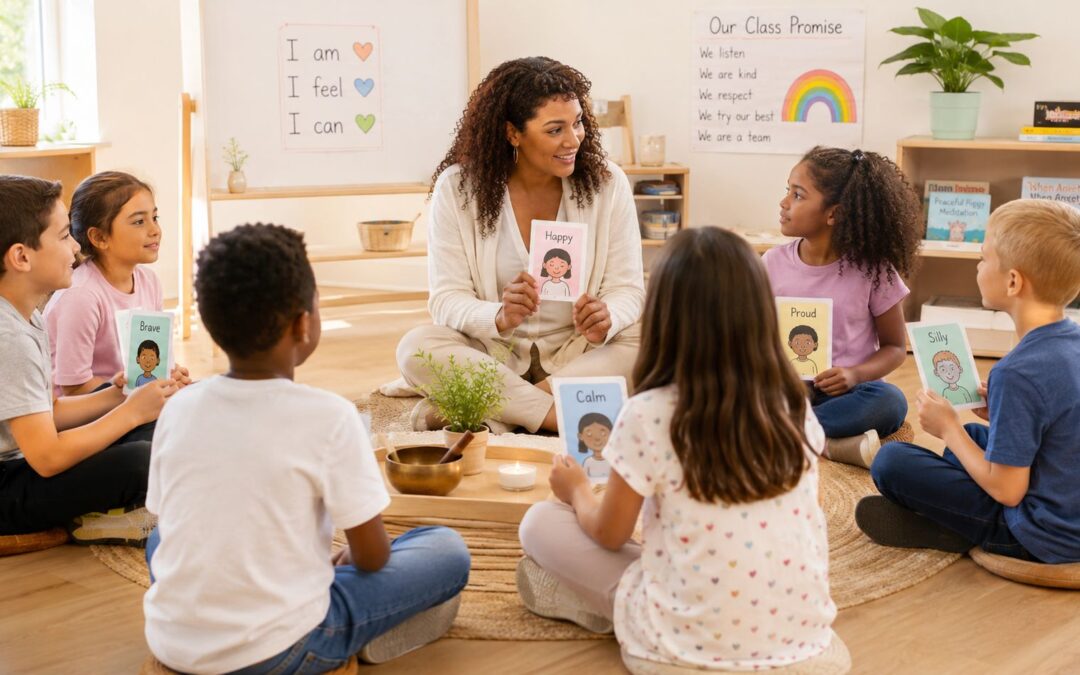
Children can't respond thoughtfully to an emotion they can't recognize or name. Emotion games make that language concrete by using faces, body sensations, short scenarios, and everyday check-ins. Begin with familiar words such as happy, sad, angry, and scared, then add frustrated, disappointed, excited, peaceful, nervous, and proud.
A teacher might hold up a feeling card and ask students to show the emotion with their eyebrows, posture, or voice. Students can then place the card on an intensity line, distinguishing mildly frustrated from furious. For K–2 learners, draw simple faces and connect each feeling to a body clue, such as a tight stomach or warm cheeks. Older students can sort emotions by possible needs, including rest, fairness, privacy, reassurance, or help.
Make the language usable
Use a consistent visual support at school and home. A child who sees the same emotion wheel on a classroom wall and near the kitchen table has an easier time transferring the skill between settings. Practice during calm moments, not only after a conflict, and ask, “Where do you feel that emotion?” rather than demanding a personal story.
At home, play “emotion detective” with characters in a favorite book or show. In class, read a neutral scenario such as, “A student studied hard but received unexpected feedback,” and invite several possible feelings. Emphasize that all emotions are acceptable, while some behaviors still need limits. Feeling angry is allowed. Hitting, threatening, or humiliating someone isn't.
For a practical extension, explore ways to help kids find the words for their feelings. Assessment can include a private feelings map, an exit ticket using one new emotion word, or teacher observation of students naming feelings before choosing an action. Don't require children to announce their own emotions publicly. Pointing, drawing, or using a card can be equally valid.
3. Kindness Observation and Gratitude Practices
Kindness becomes easier to notice when adults slow the group down and make specific actions visible. Rather than asking students to produce generic compliments, invite them to observe patience, inclusion, careful listening, encouragement, or repair. The emphasis should remain on the action and its effect, not on popularity.
Create a classroom “noticed kindness” board, a family gratitude jar, or a rotating journal. A student might write, “Sam saved me a seat when I was looking for a place,” or draw a picture of someone helping clean up. Younger children can dictate their observation to an adult. Students who prefer privacy can submit notes anonymously or share them one to one.
Keep recognition equitable
- Name the behavior: Say, “Your patience helped your partner finish,” rather than “You're so nice.”
- Notice quiet contributions: Include students whose kindness doesn't attract attention.
- Offer varied formats: Let children speak, write, draw, use a symbol, or create a short audio reflection.
- Model sincerely: Adults should describe real gratitude, including appreciation for effort and character.
At home, a caregiver can point out a child's patience during a sibling disagreement, then ask what the other person may have experienced. In class, reserve a few minutes for students to record one act of care they witnessed. Avoid turning the practice into a contest or requiring children to praise a peer who has made them uncomfortable.
The World Kindness Day ideas for teachers offer additional classroom inspiration, while gratitude activities for students can help educators vary the format. Assess whether students identify specific behaviors, connect actions with impact, and recognize care across different relationships.
4. Community Service and Helping Projects
Empathy becomes visible when children use what they notice to help someone else. A useful service project doesn't treat recipients as a distant abstraction. Students should understand who benefits, why the project matters, and whether their contribution is useful.
In a classroom, students might organize materials for younger readers, create welcoming signs for a shared school space, or maintain a class lending shelf. A family might choose a neighborhood cleanup, prepare practical items with a community partner, or help care for a shared garden. Older students can connect service with social studies, science, literacy, or local problem-solving.
Begin by asking students what they've noticed. Who has difficulty accessing a resource? What makes a school space feel unwelcoming? Which community need can children address safely and respectfully? Explain broader conditions where appropriate, so service doesn't reduce complex issues to individual charity.
Build reflection into the project
Use a short before-and-after conversation:
- Before: What do we think people need, and how can we find out without assuming?
- During: What are we noticing about the work, the people involved, and our own reactions?
- After: What changed, what still needs attention, and what did we learn?
Choose sustained relationships when possible instead of treating service as a single event. Make the work reciprocal, thank partners respectfully, and celebrate helpers without making recipients perform gratitude. At home, ask, “How do you think this helped?” rather than “Did they like what you did?” At school, students can keep a project log with observations, questions, and next steps.
The community service examples for children offer ideas for extending this work, and examples of prosocial behavior can help adults name the actions they want students to practice. Assess planning, cooperation, follow-through, respectful inquiry, and reflection, not the amount of work completed.
5. Emotion Coaching During Conflicts and Challenges
A conflict is often the moment children need empathy practice most, but it's also the moment their attention is least available. Emotion coaching starts with the adult regulating their own voice, posture, and pace. A calm adult can set a limit without adding shame.
Use a predictable sequence. First, describe what you see without exaggeration. Next, acknowledge the feeling. Then set the boundary, identify the need, and help the child choose a safer response. For example: “You're furious that the game ended. I won't let you throw the pieces. You need a way to show how disappointed you are. Would you like to explain it, take a quiet pause, or ask to restart later?”
Practical rule: Validate the emotion without approving harmful behavior.
Younger children may need two choices and a visual calm-down card. Older students can use reflective listening, “I” statements, or a written repair plan. In a classroom, an educator might coach two students separately before bringing them together. At home, a caregiver can revisit a sibling conflict after everyone has settled and ask each child what they needed, what the other person may have felt, and what repair could look like.
Use the same language across adults when possible. Students benefit when teachers, counselors, caregivers, and after-school staff all distinguish feelings from actions and return to reflection after emotions settle. The accompanying process can help adults connect service, empathy, and follow-through.
For an additional modeling resource, watch the emotion coaching video. Assess whether students can identify feelings and needs, accept a limit, use a coping strategy, listen to another viewpoint, and attempt repair. Serious safety concerns still require adult intervention. Empathy coaching never replaces protection.
6. Feelings-Based Literature Circles and Discussions
Books let students examine complex feelings from a safe distance. A character can feel jealous, loyal, ashamed, hopeful, or conflicted without any child needing to disclose a similar experience. The teacher's questions determine whether the discussion stays at plot summary or develops emotional reasoning.
Choose books with varied characters, family structures, abilities, cultures, and lived experiences. Pair fiction with nonfiction when a topic involves real communities or historical events. In a literature circle, assign roles such as feeling detective, evidence finder, questioner, and connection maker, then rotate them so one student doesn't control the interpretation.
Questions that open rather than close discussion
Ask, “What might this character be feeling?” and “What detail makes you think that?” Follow with, “What else could be true?” This wording allows divergent interpretations and teaches students that empathy involves informed curiosity, not mind-reading. Ask how a character's needs, relationships, or past experiences may shape a choice.
For K–2, students can draw a character's face and body before and after an event. Grades 3–5 can cite a sentence or illustration as evidence. Middle school students can compare how two characters experience the same event or debate whether a well-intended action caused harm.
At home, pause during a shared read-aloud and invite each family member to choose a character. In class, use a talking object or timed rounds so every student has a chance to contribute. Let students pass, and acknowledge when a book brings up difficult experiences. Have a counselor, trusted adult, or quiet space available when content may be activating.
Assess the quality of evidence, listening, respectful disagreement, and willingness to revise an interpretation. A strong response may sound like, “I first thought she was angry, but the illustration suggests she may be embarrassed.” That shift shows empathy developing through attention and reflection.
7. Mindfulness and Perspective-Shifting Exercises
Empathy requires attention. When children feel overloaded, they may react quickly, miss social cues, or focus only on their own immediate discomfort. Brief mindfulness gives them a way to pause and notice internal experience before responding to someone else.
Offer multiple entry points. A K–2 class might notice five things they can see, four things they can feel, and three things they can hear. Older students might try a body scan, paced breathing, mindful movement, visualization, or a silent walk outside. Keep the first practice very short, around 2–3 minutes, and extend it gradually only when students remain comfortable and engaged.

Connect calm attention with care
Tell students why they're practicing: “When we calm our minds, we can better understand what other people may need.” After breathing, ask them to imagine a classmate arriving late, losing a game, or sitting alone. What might they notice before making a judgment? What question could they ask?
At home, try a mindful pause before homework or after a difficult transition. A caregiver can model wandering attention by saying, “My mind moved to tomorrow's plans. I noticed it, and I'm bringing it back.” In school, students may sit, stand, draw, listen to a sound, or move gently. Don't require closed eyes, personal sharing, or a particular posture.
Use gentle opt-outs that preserve respectful presence, such as quiet drawing or watching the timer. Some children may find stillness uncomfortable, so movement and sensory practices matter. Assess readiness through observable behavior: returning attention, waiting before speaking, noticing a body cue, and choosing a more thoughtful response. Mindfulness isn't a demand to appear calm. It's a practice of noticing what's happening and deciding what to do next.
8. Peer Support and Buddy Systems
A child can learn about empathy in a discussion, but consistent relationships give that skill somewhere to live. Structured buddy systems pair students for reading, lunch, welcoming, tutoring, or shared projects. The roles should be clear, supported, and limited. A child helper isn't a counselor, therapist, or substitute adult.
Before pairing students, teach listening, validation, respectful questions, confidentiality limits, and the need to involve an adult. Practice with scripts such as, “That sounds hard,” “Do you want company or help?” and “I'm going to tell an adult because someone may not be safe.” Explain that reporting a serious concern is responsible support, not betrayal.
Design the relationship with care
Match buddies thoughtfully, considering personalities, communication styles, age, interests, and support needs. A younger reader might meet an older reading buddy during a predictable classroom block. A new student could have rotating lunch companions rather than one child carrying the entire responsibility. At home, siblings can use a “helping partner” routine for chores, games, or transitions, with adults monitoring fairness.
Check in with peer supporters regularly. Invite them to keep a private journal, speak with a counselor, or use a short reflection form describing what felt easy, difficult, or unclear. Rotate roles so many students experience both receiving and offering support. Celebrate contributions specifically, such as, “You asked before helping,” rather than praising a child for being responsible for another person's feelings.
The Olweus Bullying Prevention Program evaluation reported increased expressions of empathy with bullied peers, decreased willingness to join bullying, and perceptions that primary teachers made greater efforts to address bullying, as described in the PubMed evaluation. The adult response remains central. Students should know exactly which adults can help and how to reach them.
Assess listening, inclusion, reliable follow-through, appropriate boundaries, and help-seeking. A successful buddy system creates connection without placing serious emotional or safety work on children.
Comparison of 8 Empathy-Building Activities
| Approach | Implementation Complexity | Resource Requirements | Expected Outcomes | Ideal Use Cases | Key Advantages | Key Limitations |
|---|---|---|---|---|---|---|
| Perspective-Taking Stories and Role-Playing | High, needs skilled facilitation and staged scenarios | Facilitator training, stories/props, time, safe debrief space | Improved theory of mind; reduced stereotyping; stronger perspective-taking | SEL lessons, small groups, conflict exploration, role-play sessions | Engaging, experiential learning; memorable emotional practice | Time-intensive; may discomfort some students; risk of retraumatization without care |
| Emotion Identification and Labeling Games | Low–Medium, scalable and routine-based | Emotion cards/wheels, visual supports, consistent reinforcement | Expanded emotional vocabulary; better self-regulation; shared language | Daily check-ins, early grades, cross-setting vocab development | Foundational for empathy; adaptable across ages and styles | Can feel repetitive; needs ongoing practice; cultural expression differences |
| Kindness Observation and Gratitude Practices | Low, simple routines to sustain | Boards/jars, reflection time, recognition systems | More prosocial behavior; improved mood and classroom climate | Morning meetings, family dinners, school-wide culture-building | Easy to implement; boosts positivity and belonging | Can feel superficial if not authentic; pressure to perform gratitude |
| Community Service and Helping Projects | High, requires coordination and logistics | Partnerships, planning time, transportation, adult supervision | Empathy translated into action; agency; community awareness | Service-learning, outreach projects, sustained partnerships | Tangible impact; builds purpose and civic understanding | Logistical demands; potential tokenism; requires reflection and care |
| Emotion Coaching During Conflicts and Challenges | Medium–High, relies on adult skill and presence | Adult training, time in-the-moment, consistent adult responses | Reduced shame, improved regulation, stronger adult-student trust | Real-time conflicts, restorative circles, behavior support moments | Uses teachable moments; models healthy processing | Requires adult regulation training; time-consuming in moments |
| Feelings-Based Literature Circles and Discussions | Medium, needs book selection and facilitation | Carefully chosen texts, discussion protocols, time | Vicarious empathy, critical thinking, nuanced emotion vocabulary | Literacy-integrated SEL, book clubs, small guided discussions | Safe distance to explore hard topics; diverse perspectives | Time-intensive; potential to trigger trauma; requires facilitation |
| Mindfulness and Perspective-Shifting Exercises | Low–Medium, short, regular practice | Guided scripts, brief routines, facilitator modeling | Better regulation, calmer attention, neural support for empathy | Transitions, calm-down routines, independent coping tools | Short sessions; accessible; supports self-regulation | Requires consistency; some students may resist or be triggered |
| Peer Support and Buddy Systems | Medium, structured pairing and oversight | Peer training, matching process, ongoing monitoring, adult oversight | Increased belonging, peer-led empathy, leadership development | Lunch/read buddies, peer tutoring, peer mediation programs | Builds relationships; reduces adult load; empowers students | Risk of burnout/cliques; needs training and supervision |
Turn Empathy Practice Into a Shared Daily Habit
Choose the activity according to the need you can see today. If students lack words for their inner experience, begin with emotion identification and labeling. If the room feels rushed or reactive, use a brief mindfulness routine before discussion. If children are making quick assumptions about one another, choose stories and perspective-taking. If conflict is recurring, practice emotion coaching and repair language when nobody is upset.
Use service when students need a concrete way to turn concern into action. Use buddy systems when isolation or belonging is the immediate concern. Literature circles can support careful discussion of difference, motivation, and moral choices. No activity has to carry the whole SEL program. A short routine repeated consistently often creates more opportunity for practice than an impressive one-time event.
Keep the language aligned across settings. A teacher might say, “Name the feeling, notice the need, choose a safe response,” while a caregiver uses the same sequence at home. A school counselor can send home the sentence stems used in class. Families can tell teachers which visual supports or calming choices work well, and educators can share observations without labeling a child's character.
Track small, observable evidence rather than demanding emotional disclosure. Look for students waiting to listen, including someone who is alone, asking before offering help, repairing harm, using a feeling word, accepting a boundary, or seeking an adult when a situation exceeds their role. Invite brief reflections such as, “What did you notice?” “What choice did you make?” and “What might you try next time?”
Psychological safety matters as much as activity design. Give children choices about speaking, writing, drawing, partnering, or observing. Avoid forcing eye contact, public confession, physical contact, or role-play about a student's real experience. Adults should respond to disclosures with care and follow safeguarding procedures rather than turning the moment into a lesson.
A broader school-community approach can help when educators want shared language and sustained support. Soul Shoppe offers SEL programs, courses, an app, workshops, assemblies, and coaching for school communities working on connection, safety, empathy, communication, mindfulness, self-regulation, and conflict resolution. Families and educators can also find practical ideas through this parenting and mental health blog.
Start with one routine, select a consistent time, and observe what changes in student behavior. After the routine feels familiar, add a second practice that addresses the next need. Empathy grows when children repeatedly experience adults who listen, set safe limits, model repair, and make belonging visible.
Soul Shoppe offers workshops, assemblies, coaching, courses, and an app that support empathy, self-regulation, communication, mindfulness, and conflict resolution for school communities and families. Visit Soul Shoppe to explore practical SEL resources that can help turn these empathy building activities into shared daily routines.