

Strengths Based Approach for K–8 Schools: A Practical Guide
The first clue often shows up before the bell. A child who has been redirected three times is also the first one to greet a new classmate, help unzip a backpack, or notice who looks lost at the carpet. A tired adult can miss that in a busy morning, but a strengths based approach asks for a different habit, notice what a child already does well, then build the day around that asset instead of only the problem.
That shift matters because schools don't run on one note. Kids need correction, yes, but they also need adults who can see competence, connection, and effort in the same child who forgot a pencil or blurted out an answer. When teachers lead with strengths, they're not pretending behavior never needs attention, they're changing the starting point so the plan can include success, not just repair. For a connected SEL lens on why that matters, this Soul Shoppe overview of social emotional learning fits well with the same idea, kids learn best when they feel seen and safe.
Why a Strengths Based Approach Matters in Elementary Classrooms
The morning circle is already moving when the teacher notices it. One student has interrupted twice, another is squirming, and the new classmate still hasn't found a place to sit. Then the same child who got redirected three times slides over, pats the rug, and says, “You can sit here.”
That moment is the difference between a deficit lens and a strengths based approach. The deficit lens tracks what went wrong first, then builds a response around fixing it. The strengths-based lens sees the same child as someone who has social awareness, initiative, and a way of making other people feel safe, then asks how those qualities can be used on purpose during the school day.
What changes when adults look for assets first
A classroom built on strengths still has rules. It still has consequences. What changes is the adult's first question. Instead of, “What's wrong with this child?” the teacher asks, “What does this child already bring that we can build on?” That small shift changes tone, language, and planning.
It also changes how children hear themselves. A student who is treated as a problem quickly learns to perform the role. A student who is named for a real strength hears something more useful, “I can do something that matters here.” That doesn't erase struggle, but it gives the child a place to stand while learning.
Practical rule: If the only time a child hears their name is during correction, the room is teaching them that mistakes define them.
Schools like this approach because it fits naturally with SEL work. Teachers are already trying to build self-awareness, relationship skills, and responsible decision-making. A strengths based approach gives those goals a concrete habit, notice what works, then use it more often. For a broader SEL context, the Soul Shoppe SEL article offers a useful companion frame.
Defining the Strengths Based Approach Without the Jargon
A strengths based approach starts with a child's resources, relationships, and environment, then uses those assets to shape support. The Social Care Institute for Excellence describes it as outcomes led rather than services led, which means the goal comes first, and the support is chosen to match the goal and the person's real-life context.
A deficit model works the other way around. It starts with what is missing or difficult, then assigns help based on the problem category. That model can be useful for identifying risk, but it often makes adults ignore what a child already does well. A strengths based approach keeps the need in view without letting the need become the child's whole identity.
A quick way to explain it in a meeting
Try this: “Instead of asking only what the student can't do, we ask what they already do, who supports them, and what outcome they want.” That language works with teachers, parents, counselors, and administrators because it keeps the conversation practical.
| Question asked | Deficit lens | Strengths based approach |
|---|---|---|
| What is the main concern? | What the student is doing wrong | What the student can already do, plus what support they need |
| What do we focus on first? | Problems and risk | Resources, relationships, and goal setting |
| How is help chosen? | By the category of the issue | By the student's outcome and available strengths |
| What does success look like? | Less of the unwanted behavior | More movement toward a meaningful goal |
A child struggling with reading offers a simple example. Under a deficit lens, the note might say, “Needs intervention for weak decoding.” Under a strengths based approach, the conversation sounds more like, “He remembers stories well, uses pictures to figure out meaning, and works hard with one-on-one support. Let's use those skills while we build decoding.”
That difference matters because it keeps adults from confusing a skill gap with a lack of value. It also keeps the plan linked to the child's real life, not just a service label. SCIE's framing is helpful because it reminds educators that the point is not to feel positive, it is to produce better outcomes by using what is already there.
What the Research Shows About Strengths Based Work

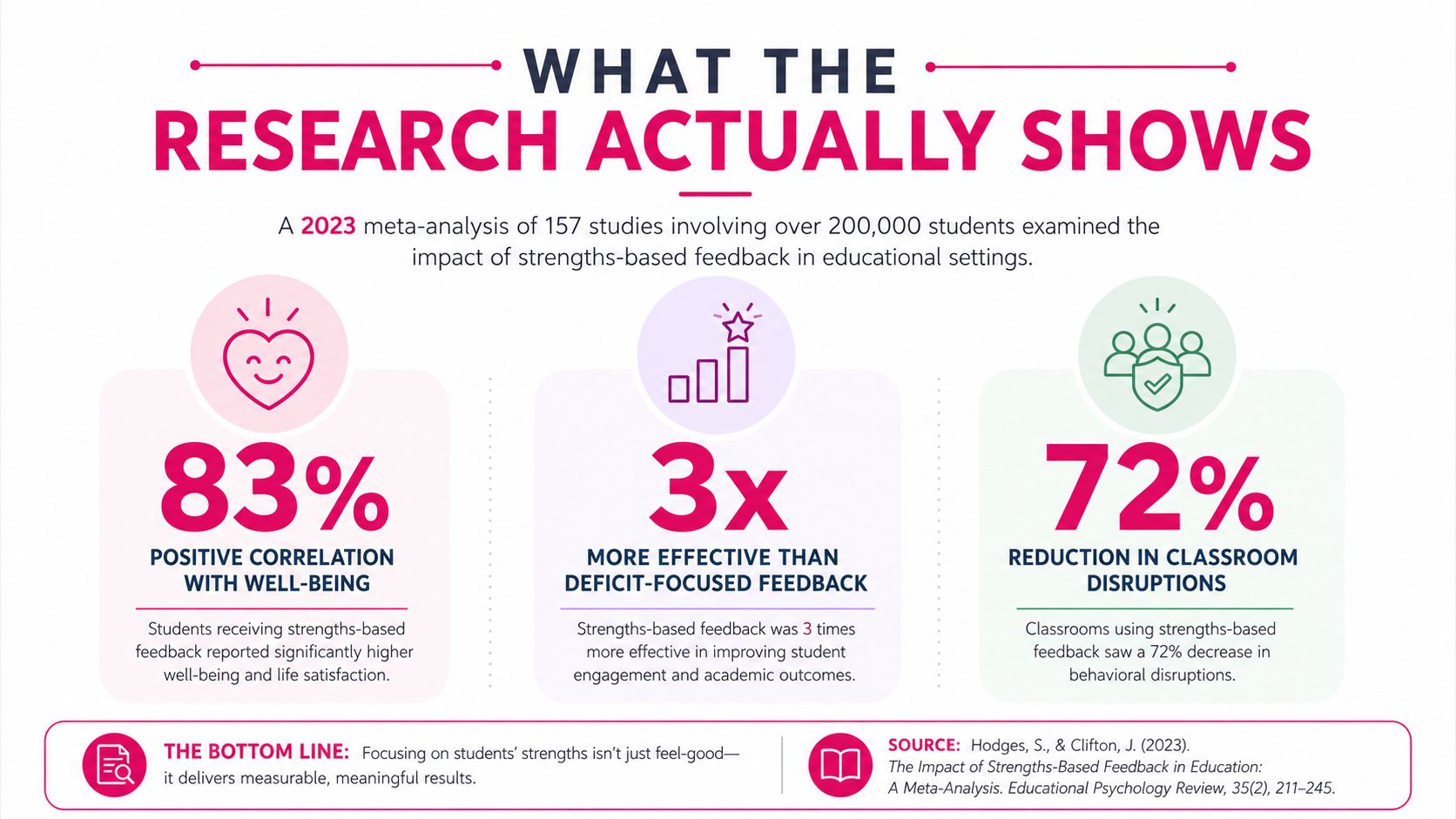
A strengths based approach has support, but it is not magic, and that honesty helps schools use it well. A 2023 narrative review and meta-analysis of strength-based psychotherapies examined 57 effect sizes nested in 9 trials and found a small but statistically significant advantage for strengths-based methods, with an overall weighted effect size of g = 0.166, 95% CI [0.027, 0.305], and p < .01 in favor of the strengths-based treatments PMC review of strength-based psychotherapies. The practical takeaway is simple. The approach has measurable support, but it is not a cure-all.
Another systematic review of strengths-based interventions in severe mental illness gives school teams a useful boundary. It did not show significant differences versus control models for functioning or quality of life, and controls did better on symptoms PMC systematic review of strengths-based interventions. That does not cancel the value of the approach. It does show that strengths based work should not be treated as a stand-alone symptom treatment.
What that means for schools
The clearest reading is this. Strengths based practice works best as a service-delivery framework for self-determination, goal attainment, and better engagement. It is especially useful when adults need a way to organize support around relationships, voice, and practical next steps. It is less persuasive as a replacement for clinical care when a child has significant mental health needs.
Schools also need to be careful not to turn strengths language into a feel-good script with no follow-through. A student does not need adults to praise effort in the abstract, the student needs adults to notice what already works and change the support around it. That includes how goals are written, how families are invited into planning, and how adults respond when a child's current setting is making success harder than it should be.
That is why leaders should treat it as a schoolwide way of working, not a slogan. It belongs in conference conversations, coaching notes, family meetings, and student goal setting. It does not belong as a shortcut around assessment or intervention. For a simple example of how confidence can be built through everyday language and consistent support, see this guide to building confidence in kids.
Core Principles Every Teacher and Coach Should Know
A strengths based classroom sounds warm, but it only works when adults practice a few concrete habits. The first is asset focus, which means naming what the child can already do instead of making every note about failure. The second is collaboration, which keeps the student and family in the conversation instead of handing them a finished plan.
The third principle is using the environment as a resource. A child's strengths aren't only inside the child, they also live in relationships, routines, and settings that make success more likely. The fourth is goal setting linked to strengths, which turns “be better” into something a child can do. A fifth, and often missed, is identity-specific strengths, which means recognizing that culture, language, disability, and marginalized experience shape what strength looks like.
A classroom plan gets stronger when it names the child's skill and the adult's next move in the same sentence.
Here's a script teachers can use right away. Instead of “You are bad at reading,” try, “You remember stories well and use pictures to figure out meaning, let's build on that skill.” At home, the parallel line can be, “You stayed calm while waiting for help, let's use that patience again during homework.”
Another useful move comes from relationship patterns. When a student struggles in groups but does well with one trusted peer, that peer connection can become a bridge to larger collaboration. The adult is not lowering expectations, the adult is using an existing strength in the environment.
The identity piece matters more than many staff realize. Research on identity-specific strengths argues that the skills, knowledge, and perspective gained through marginalized experience are strengths too. That matters for multilingual learners, students with disabilities, and racially marginalized youth, whose strengths may show up as translation, care for siblings, survival skills, or cultural knowledge, not just the traits printed on a school rubric.
For teachers who want the mindset behind this work, Soul Shoppe's article on self-efficacy in teaching pairs well with strengths language because adults do this work best when they believe their small moves matter.

Classroom and Family Activities You Can Use Tomorrow
A strengths based routine doesn't need new curriculum. It needs a repeatable way to help children name what works and then use it again. The simplest place to start is morning meeting for K-2, where children can share one thing they're good at or one thing that helped them yesterday.
For grades 3-5, a two stars and a strength journal works well. Kids can write two things that went well and one strength they used to make them happen. For grades 6-8, a peer-buddy bridge is often better, especially for group work, because older students are more likely to accept help from a peer than from an adult.
A few ready-to-use activities
- Strengths Circle, K-2: Materials, a talking piece. Time, 5 minutes. SEL focus, self-awareness and relationship skills. Ask, “What is something you do that helps other people?”
- Two Stars and a Strength Journal, 3-5: Materials, notebook or half-sheet reflection page. Time, 7 minutes. SEL focus, self-management and self-awareness. Ask, “Which strength helped you finish a hard task today?”
- Peer Strengths Nomination, 6-8: Materials, sticky notes or a simple form. Time, 10 minutes. SEL focus, social awareness and relationship skills. Ask, “Who helped the group move forward, and what strength did they use?”
- Family Strengths Interview, any grade: Materials, a short question card. Time, 10 to 15 minutes. SEL focus, communication and belonging. Ask, “What helps you get through hard days?”
A home version can mirror each activity without feeling school-like. At dinner, a parent can ask, “What went well today, and what helped?” A child can answer with a real example, and the adult can name the strength they hear in it.
Here's a simple two-week sequence that keeps the work light. Week 1, use a strengths circle or dinner-table check-in twice. Week 2, add one reflection journal entry and one peer-buddy conversation. That's enough to start changing the language in the room without taking over instructional time.
For a related family lens, Soul Shoppe's confidence article offers a nice companion idea, confidence grows when kids hear specific feedback about what they can already do.
