

Calm & Focused: 7 Mindfulness Brain Breaks for K-8
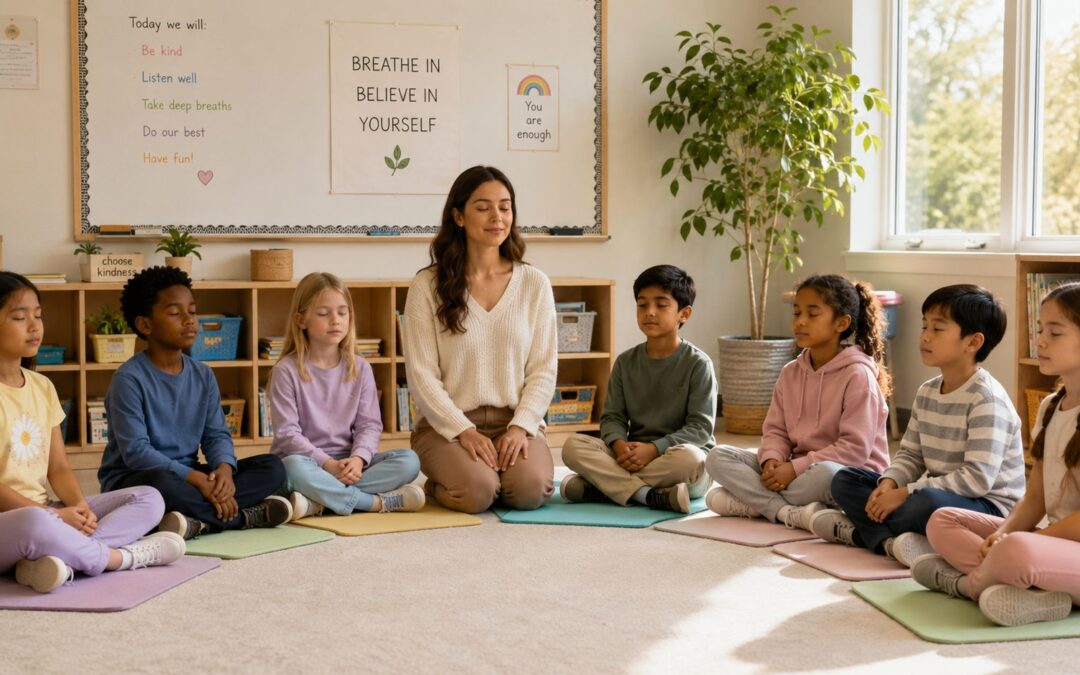
It's the middle of the afternoon. Pencils are tapping, chairs are scraping, and the room feels one comment away from unraveling. You don't need a complicated reset, you need a short, calm pause that helps students regulate, refocus, and return ready to learn. That's exactly where mindfulness brain breaks earn their place in K-8 classrooms and at home.
The strongest research on active breaks and mindfulness points in the same direction. Brief, scheduled pauses can improve attention and concentration, and mindfulness-based interventions have been associated with gains in global cognition and attention-related skills in learning settings, including executive attention, working memory, and sustained attention (systematic review and meta-analysis). In other words, these are not filler activities. They're short, structured tools for helping students reset before fatigue turns into behavior problems. For a quick timing model that fits busy classrooms, see this practical Pomodoro and ADHD-friendly tips resource.

1. Box Breathing for Emotional Regulation
Box breathing gives students a clear rhythm when feelings are running hot. The pattern is simple, inhale for four counts, hold for four, exhale for four, hold for four. That structure matters because predictable pacing helps a nervous system settle, and it gives children a concrete action to repeat when they feel overwhelmed.
A 3rd-grade teacher might use it every morning during the transition from arrival to morning work. Students can hold up four fingers as they count, which adds visual support and keeps the whole class synced. At home, parents often use the same routine before bed or after conflict so children hear the same cue in both settings. For younger students, the language can be even simpler, “smell the flowers, hold, blow bubbles.”
Practical rule: Teach box breathing when the room is calm, not during a meltdown. Once students have practiced it successfully, they're far more likely to use it when they're anxious before a quiz, upset after recess, or stuck in the middle of a hard conversation.
A visual aid helps a lot. Draw a square on the board, trace it with a finger, or use an animated breathing tool so students can follow the shape with their eyes and breath. A discreet hand signal also helps, especially for older students who don't want to interrupt instruction to ask for help.
A breathing break works best when students can request it without embarrassment.
Teachers who want a step-by-step family-friendly version can pair this with Soul Shoppe's belly breathing technique. Used consistently, box breathing becomes less of a “calm down” trick and more of a self-regulation habit students can carry into tests, friendships, and home routines.
2. Body Scan Meditation for Awareness and Tension Release
A body scan works well when students seem distracted but can't explain why. Instead of asking them to “relax,” you guide them to notice sensations from head to toe, including tension, warmth, pressure, or stillness. That awareness helps students recognize stress earlier, which is a key SEL skill, because children can't use coping tools they haven't learned to notice.

A 4th-grade teacher might guide a body scan after lunch, when the class has energy to burn but still needs to settle for reading or writing. A 2nd-grade class can use a shorter “sleepy scan” before dismissal, with simple prompts like, “Notice your feet. Notice your legs. Notice your belly.” At bedtime, parents often use the same pattern to help children wind down in a familiar voice.
Keep the language gentle and observational
Familiar voices matter. If you record the script in your own voice, students usually settle more quickly because the rhythm feels safe and recognizable. Start short, around five to seven minutes for younger children, and give permission for small wiggles or posture shifts. The goal is noticing, not perfect stillness.
For trauma-informed practice, avoid telling students exactly what to relax. Say, “Notice where your body meets the chair,” or “See if anything feels tight or loose,” rather than directing a specific body part to change. Some students do better with breath paired to each region, one breath at the shoulders, one at the chest, one at the hands. If a child feels uncomfortable closing their eyes, let them keep a soft gaze or look down at their desk.
Teachers looking for a child-centered companion resource can use Soul Shoppe's mindfulness teaching guide for children. A body scan is most useful when it feels like noticing, not forcing, and when students leave the practice with more self-awareness than they had before.
3. 5-4-3-2-1 Sensory Grounding for Anxiety and Overwhelm
When a student's anxiety climbs, attention often shrinks with it. The 5-4-3-2-1 grounding routine gives students a quick way to return to the present by naming five things they see, four they can touch, three they hear, two they smell, and one they taste. It works well before presentations, during sensory overload, or any time a student looks disconnected and overwhelmed.
A 3rd grader who is about to present can use the sequence right at her desk and often settle enough to speak. In counseling, a middle schooler might name classroom objects, touch a soft chair, listen for a fountain, and notice lotion or hand soap in the room. For younger children, laminated picture cards can keep the routine concrete during fire drills or other stressful transitions, and teachers who want more hands-on sensory support can pair it with preschool sensory table ideas.
Make the senses visible and flexible
For younger students, point to the object or let them touch it as they name it. That keeps the exercise active instead of abstract, which is often easier for children who get flooded by too much verbal direction. If smell or taste is not practical, swap in other grounding prompts that still bring attention back to the room, such as “one thing you like,” “one thing you're grateful for,” or “one thing that feels safe.”
Use grounding before the anxiety rises, not only after a child is already in distress.
A visual anchor card can make this routine easier to remember. Some teachers draw simple icons for each sense and post them near the carpet or send them home for family use. Parents can turn it into a game at a restaurant or family gathering, asking, “Can you find five things we can see together?” That kind of playful repetition helps children use grounding without feeling singled out.
For more classroom-ready wording and child-friendly variations, teachers can look at Soul Shoppe's grounding techniques for kids. Sensory grounding interrupts spirals and gives students a concrete place to put attention when their minds feel noisy.
4. Loving-Kindness Meditation for Connection and Empathy
Loving-kindness meditation changes the emotional tone of a room in a quiet but noticeable way. Students repeat phrases of goodwill toward themselves and others, such as, “May I be happy. May I be safe. May you be happy. May you be healthy.” The practice can soften self-criticism, reduce social friction, and give empathy a concrete routine instead of a vague expectation.
A 5th-grade teacher might use it once a week, starting with self-kindness and then expanding outward to classmates. That sequence gives students repeated practice wishing well for the people they share space with every day, which can support a more respectful classroom climate over time. A counselor can also use it with students involved in conflict to lower shame before a repair conversation, and teachers looking to build lifelong emotional skills can use the same structure to reinforce emotional language and perspective-taking.
A 2nd-grade class may need simpler words and a drawing component. Children can draw a heart, a sun, or a safe place while repeating, “May I be kind. May you be kind. May we be safe.” Parents sometimes use the same idea at bedtime, especially after sibling conflict, because the calm repetition can help move a child out of blame and toward repair.
Start where children can succeed
Begin with self-compassion and loved ones before moving toward neutral or difficult people. That sequence matters because some students are not ready to extend goodwill to someone who hurt them. Do not push a child to send kindness toward someone they fear. Move carefully, and pair the practice with restorative conversations when a real repair is needed.
To deepen engagement, try drawing, gentle movement, or a recorded script in your own voice. Teachers who want a broader empathy lens can also explore Soul Shoppe's empathy teaching resource. Loving-kindness works best when it feels concrete, repeated, and emotionally safe, not abstract or performative.
5. Mindful Movement and Stretching for Energizing and Calming
Some students can't access stillness first. They need movement before mindfulness makes sense. Mindful movement gives them that bridge by pairing stretching, walking, or yoga poses with deliberate attention to breath, muscles, and balance.
A 3rd-grade teacher might use a short stretching sequence after reading block to help students re-enter writing with better focus. A kindergarten class can make the practice playful with animal stretches, which lowers self-consciousness and keeps the routine age-appropriate. In a 6th-grade PE class, a mindful walk before activity can settle entry energy without turning the whole period into a silent meditation.
Pace determines the effect
Slow movement tends to calm. Faster, more energetic movement can wake students up when they're sluggish. That's why a teacher should choose the pace intentionally instead of treating movement as one-size-fits-all. A classroom that's buzzy after lunch usually needs slower breathing and slower stretches, while a sleepy group before math may benefit from standing reaches or wall pushes.
Model the movements slowly and exaggerate the shape. Students follow what they can see, not what they're told.
Offer standing, seated, and wall-supported versions so every child can participate without drawing attention to differences. A 5th grader who fidgets during transitions may do better with chair yoga than with a full-group pose sequence. Use descriptive language like, “Feel your feet on the floor,” or, “Notice your shoulders releasing,” so movement stays linked to awareness.
The most useful classroom versions keep competition out of the room. This isn't about who stretches best. It's about helping students notice how their bodies feel before they return to work. For self-conscious learners, calmer music or dimmer lighting can make participation feel safer, and outdoor practice often adds a helpful layer of sensory richness.
6. Mindful Listening and Silence for Presence and Connection
Silence is hard for many children at first, especially in noisy classrooms. That's exactly why mindful listening can be so effective. It teaches students to notice sound without reacting to it, and it helps them practice presence in a way that feels more accessible than sitting still with closed eyes.
A 4th-grade class might do a short sound meditation with dimmed lights, then share what they noticed, such as the air conditioner, a hallway footstep, or the bell. In counseling, two students in conflict can practice mindful listening by taking turns speaking and listening without planning a response. A 2nd-grade class can start with just two minutes of daily silence and build gradually as students become more comfortable.
Use sound as a shared anchor
Foreground and background sounds make a useful distinction for students who get distracted easily. Ask them to identify what sounds are closest, what sounds are far away, and what sounds they can tune out. If the environment is noisy, a nature soundtrack can give the class one shared anchor without requiring perfect quiet from the whole building.
A partner-listening routine also works well in upper elementary and middle school. One student speaks, the other listens with full attention, then they switch. Sentence starters like, “I heard you say…” or, “What stood out to me was…” keep the reflection respectful and focused.
Normalize silence before you ask children to sit in it.
The benefit isn't just calm. It's respect, attention, and the ability to listen without immediately preparing a reply. That matters in classrooms, on playgrounds, and in family conversations where children need practice hearing one another all the way through.
7. Mindful Eating and Sensory Awareness for Presence and Gratitude
Mindful eating turns a snack into a short lesson in attention. Instead of rushing through a raisin, strawberry, or chocolate chip, students slow down and notice texture, aroma, flavor, and the experience of eating itself. That small pause can help children recognize hunger and fullness cues, which makes the practice useful both for mindfulness and for everyday self-awareness.
A 3rd-grade class might use mindful chocolate chip eating as a brain break before writing. A kindergarten class can do it with strawberries, using exaggerated smelling and tiny bites to keep the steps concrete. In 6th grade, a raisin can become an introduction to mindfulness before an SEL unit, especially if students are ready for a more reflective activity.
Keep the food, pacing, and language inclusive
Choose safe, sensory-rich foods and check allergies with families in advance. Have alternatives ready so every child can participate without stress. In schools where food insecurity may be part of students' reality, frame the activity as a special practice, not a reward or a test of self-control.
Use descriptive language that stays away from judgment. Say, “Notice the shape,” “Notice the scent,” or, “Take one tiny bite and see what changes.” Younger children often respond well to playful directions like, “Eat like a slow snail,” because the image keeps the pace slow without sounding punitive.
For a student who tends to overeat quickly, mindful eating can also become a discreet counseling tool. It gives them language for noticing satisfaction before they're uncomfortably full. A teacher can end by asking what students noticed, which builds metacognition and gratitude without making the moment heavy.
7 Mindfulness Brain Breaks Comparison
| Technique | Implementation complexity | Resource requirements | Expected outcomes | Ideal use cases | Key advantages |
|---|---|---|---|---|---|
| Box Breathing for Emotional Regulation | Low, teachable in minutes, short practice (3–5 min) | None required; optional visual cue or app | Rapid calming, lowered heart rate, reduced acute stress | Transitions, test prep, quick desk resets, anxiety moments | Fast, discreet, easy to learn, supports independent regulation |
| Body Scan Meditation for Awareness and Tension Release | Moderate, guided script, longer practice (5–15 min) | Quiet space, recorded or live guidance, mat optional | Increased interoception, tension release, reduced rumination | Calming routines, counseling, post-lunch transitions, bedtime | Deep body awareness, helps detect early stress signs |
| 5-4-3-2-1 Sensory Grounding for Anxiety and Overwhelm | Low–Moderate, simple steps but needs initial coaching | Minimal; real objects or visual cue cards enhance practice | Immediate grounding, interrupts panic/anxiety spirals | Acute anxiety, sensory overload, pre-performance grounding | Multisensory, discreet, adaptable across settings |
| Loving‑Kindness Meditation for Connection and Empathy | Moderate, structured phrases, needs facilitation and sensitivity | Quiet space, scripted guidance or recording | Increased empathy, self‑compassion, reduced social conflict | SEL lessons, bullying prevention, restorative practices | Builds prosocial behavior and belonging, complements SEL |
| Mindful Movement and Stretching for Energizing and Calming | Low–Moderate, simple sequences, requires modeling | Space for movement, optional music, teacher demonstration | Energy regulation, improved attention, reduced tension | Brain breaks, transitions, kinesthetic learners, ADHD supports | Engages body-based learners, versatile (calming or energizing) |
| Mindful Listening and Silence for Presence and Connection | Low, short practices, requires facilitation for partners | Minimal; optional bell or nature sounds, relatively quiet space | Improved attention, listening skills, increased empathy | Partner exercises, attention training, conflict de-escalation | Strengthens relational skills, minimal setup |
| Mindful Eating and Sensory Awareness for Presence and Gratitude | Moderate, planning required, careful facilitation | Small safe snacks, allergy checks, cleanup and family communication | Heightened sensory awareness, gratitude, mindful eating habits | Intro to mindfulness, sensory lessons, gratitude practices | Tangible, engaging, concrete for learners resistant to sitting meditation |
Making Mindfulness a Classroom Habit, Not an Interruption
These mindfulness brain breaks work best when they become part of the day's rhythm, not an emergency measure. The research supports that timing matters, brief breaks can help students reset attention, and mindfulness-based practices can support cognition and attention-related skills in learning contexts (active breaks review, mindfulness meta-analysis). The practical lesson is simple. Keep the break short, keep the cue predictable, and keep the language warm.
Teachers and caregivers don't need to do all seven at once. One practice, used consistently, often does more for a classroom than a long list of ideas that never leave the planning stage. If a group needs regulation, start with box breathing or a body scan. If they need grounding, use 5-4-3-2-1. If they need connection, choose loving-kindness or mindful listening. The right fit depends on the moment, the age group, and what the children can tolerate calmly.
There's also a real trade-off to respect. Some students love stillness, and some don't. Some classrooms can hold silence easily, and others need movement first. That's not a failure of the practice, it's a sign that the teacher is reading the room correctly and choosing the right reset for the learners in front of them. The most effective routines are timed, predictable, and matched to student needs, especially when the goal is regulation rather than performance.
Soul Shoppe offers research-based, experiential SEL programs, workshops, coaching, and tools that help school communities build shared language for self-regulation, mindfulness, communication, and conflict resolution. For schools and families looking to make these routines more consistent, their programs can support the same kinds of connection and safety these brain breaks are designed to strengthen.
If you're ready to bring calmer transitions and more focused learning into your classroom or home, visit Soul Shoppe to explore programs, courses, and tools that support mindfulness, SEL, and conflict resolution. Their work can help you turn short reset moments into a shared language kids use.