

7 Best Therapeutic Games for Teens (2026 Guide)
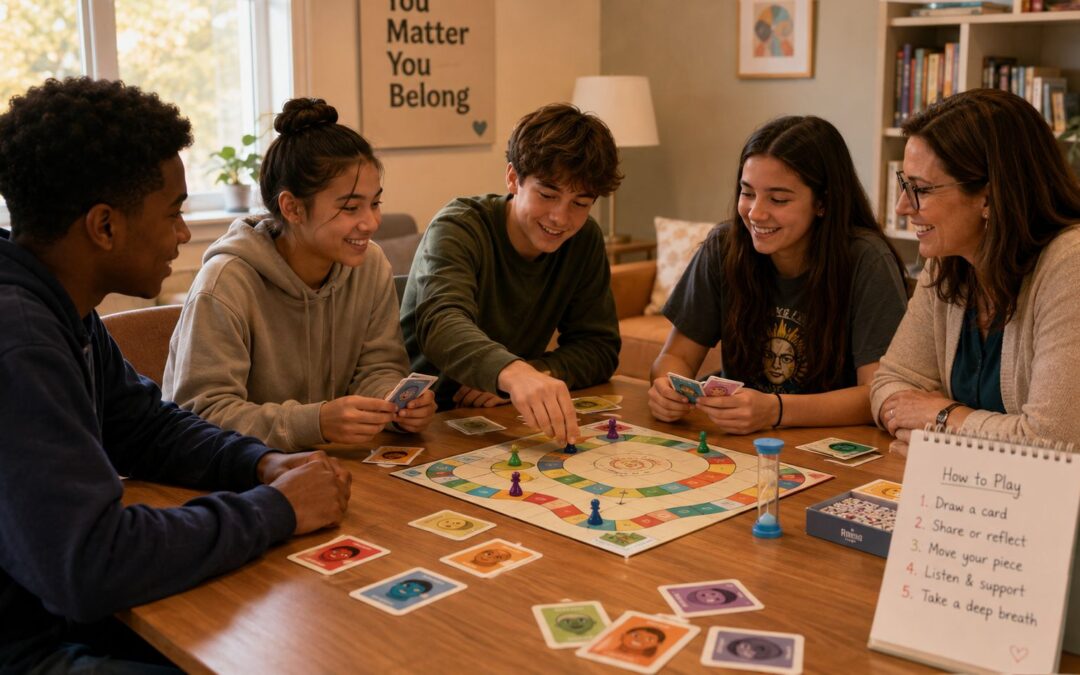
A teen is slouched in a chair, answering every question with “fine.” A parent is trying not to push too hard. A counselor has twenty minutes left in the period and can feel the room tightening. A teacher wants a better advisory activity than another forced discussion circle. This is usually the moment adults start looking for therapeutic games for teens that work.
Games help because they change the posture of the interaction. Instead of direct eye contact and pressure to perform emotionally, teens get a shared task, a structure, and a little breathing room. That matters at a stage when many young people are dealing with stress, sadness, anxiety, and identity concerns, often before they have the language to explain what's going on. A U.S. summary cited by Compass Health Center notes that 50% of lifetime mental illnesses begin by age 14, 42% of teens experience persistent sadness or hopelessness, and 22% have seriously considered suicide in the teen mental health statistics overview.
That's one reason game-based support has expanded. A systematic review of electronic game-based therapy describes game-based interventions built to improve social skills, problem-solving, emotional modulation, self-control, and therapist-client interaction, and notes that computer and video game play in the U.S. was estimated at 59% to 63% in the review's cited data, making games a familiar medium for many young people in the systematic review on electronic game-based therapy.
The tools below aren't just a product roundup. Each one includes the practical part adults usually need most: what it's good for, how to run it, how to adapt it when a teen is guarded or dysregulated, and what to ask afterward so the game turns into learning.
1. Leadership Truth or Dare Game

Leadership Truth or Dare Game by Soul Shoppe is the one I'd put in the hands of most adults first. It keeps the familiarity of Truth or Dare but removes the social risk that makes the party version a bad fit for therapeutic work. The prompts are oriented toward reflection, empathy, communication, and everyday leadership.
That makes it especially useful in advisories, youth groups, restorative spaces, team-building sessions, and family conversations where you want real participation without pushing teens into oversharing. It also fits naturally with Soul Shoppe's SEL approach and long-standing work in research-based experiential programming.
If you want a related group format for perspective-taking and collaborative problem-solving, it can pair well with these student diplomacy games.
Best use and trade-offs
This game shines when your goal is connection plus low-stakes skill practice. Reserved teens usually tolerate it better than games that ask for immediate deep disclosure, because the dares are action-based and the truths are structured instead of wide open.
The trade-off is that it isn't intensive therapy. It won't replace targeted counseling for acute anxiety, trauma processing, or crisis support. It works best as a guided SEL tool with adult ground rules.
Practical rule: Don't let teens write their own dares on the spot unless you already have strong group norms. Adult-curated safety beats spontaneity in mixed groups.
How to facilitate it well
Use this simple sequence:
- Set the container first: Tell the group they may always pass, they don't have to explain a pass, and nobody comments on another person's choice to pass.
- Start with demonstration rounds: Model one truth and one dare yourself so teens hear the tone you want.
- Keep rounds short: Early on, do quick turns so nobody gets stuck under a spotlight.
- Use pair or triad rounds: In cautious groups, let teens answer with one partner before sharing with the larger group.
- Pause after strong moments: If a prompt lands emotionally, stop the game and name what skill just showed up, such as courage, listening, or repair.
A classroom example: in a ninth-grade advisory, you might have a dare prompt that asks students to thank someone in the room for a specific contribution, then a truth prompt asking when it's hard to ask for help. That sequence moves from observable behavior to reflection. It's safer than beginning with “share your biggest struggle.”
Trauma-informed adaptations and debrief
For teens with social anxiety, let them choose “truth,” “dare,” or “coach.” A coach role can observe and name strengths they see in another player. For neurodivergent teens, preview sample prompts before the game begins. Predictability reduces stress.
For groups with peer tension, remove any prompts that involve public ranking, comparison, or forced vulnerability. The strongest therapeutic games for teens are matched to regulation state and social risk tolerance, not just to what seems fun. That practical distinction is often missing from broad “group game” lists, as discussed in this group therapy games perspective for teens.
Use debrief questions like these:
- Self-awareness: What kind of prompt was easiest for you, action, reflection, or appreciation?
- Social awareness: What helped someone else feel safe enough to participate?
- Leadership: What does leadership look like when you're not “in charge”?
- Transfer: Where could you use that same skill this week, class, home, or with friends?
This is the featured pick because it's flexible, emotionally safer than it sounds, and easy for adults to use well after one read-through.
2. Mightier

Mightier is the most concrete choice here for teaching self-regulation in real time. Teens wear a Bluetooth heart-rate sensor armband while they play arcade-style games. As arousal rises, the game responds, which gives adults a visible way to coach regulation instead of talking about it abstractly.
That's a strong fit for teens who say they “don't know” when they're getting worked up. The biofeedback helps them connect body cues to choices.
Where it works best
Mightier works well in school counseling offices, skills groups, and home practice when the main target is noticing escalation early and using coping strategies before behavior tips over. Research on gaming-based mental-health interventions also points to benefits that go beyond engagement, including reduced symptomatology, improved attention, and better social, executive, and cognitive functioning across several conditions in the JMIR review on gaming-based mental-health interventions.
The limitation is setup. You need the sensor, a compatible device, and a little adult patience in the beginning. It's not the tool I'd choose for a quick pull-out lunch group with no tech support.
Facilitation guide for adults
Here's a reliable way to run it:
- Start with body language, not app language: Ask, “What does your body do first when stress starts climbing?”
- Name two calming options before play: Breathing, unclenching hands, relaxing shoulders, grounding with feet.
- Run a short play block: Stop before frustration turns into failure.
- Reflect immediately: Ask what they noticed right before the meter changed.
- Assign one carryover skill: Pick a coping move to try outside the game, such as one from these emotion-focused coping examples.
A practical example at home: if a teen gets frustrated during homework, practice Mightier after school, then ask them to use the same “reset move” before beginning math. That bridge is where the learning starts to matter.
If a teen treats the game like a performance test, slow it down. The point is noticing and recovering, not staying perfectly calm.
Trauma-informed adaptations and debrief
For trauma-exposed teens, avoid language like “control your body.” Use “notice,” “signal,” and “shift.” For perfectionistic teens, praise recovery attempts rather than low arousal.
Good debrief questions:
- What happened in your body before you got annoyed?
- Which coping move changed your state?
- When would this same body signal show up at school or home?
- What would make it easier to remember the skill outside the game?
3. SuperBetter

SuperBetter works best when you want to build resilience through habit and identity, not just run a single engaging activity. Its quests, power-ups, allies, and boss battles give teens a game-like frame for daily actions and setbacks.
I like it for advisories, clubs, re-entry groups, and Tier 1 or Tier 2 supports because it feels less clinical than many mental-health tools. Teens can work individually, and schools or organizations can use Host accounts to organize squads and track participation.
What adults need to know before choosing it
SuperBetter has a low barrier for individual use, but group success depends on facilitation. If adults launch it and then disappear, momentum drops fast. This is a platform that benefits from weekly rituals.
The other trade-off is administrative. Organizational use requires outreach and onboarding, so it isn't the easiest same-day purchase for a school team.
Ready-to-use facilitation pattern
Try a weekly rhythm like this:
- Monday challenge: Set one quest tied to a real SEL skill, such as asking for help, taking a movement break, or noticing self-talk.
- Midweek ally check-in: Have students identify a peer or adult who supports the goal.
- Boss battle reflection: Name one obstacle, such as procrastination, conflict, or avoidance.
- Friday reset: Share one power-up that helped.
A teacher example: an advisory group picks “speak to yourself like you would to a friend” as the weekly quest. Students track one moment they caught harsh self-talk and replaced it. If you want a printable support alongside that, these self-esteem worksheets for teens can reinforce the same language.
Trauma-informed adaptations and debrief
Some teens love game terminology. Others find it childish or too exposed. Let them rename categories. “Boss battle” can become “barrier.” “Ally” can become “support person.” Choice increases buy-in.
For resistant teens, keep sharing private at first. They can complete quests without reporting the personal details to the group.
Facilitator move: Ask teens to rate whether a quest felt energizing, neutral, or draining. Don't assume a “healthy” activity was a good fit.
Debrief prompts:
- Which quest felt realistic enough to repeat?
- What got in the way?
- Who helps you follow through when motivation drops?
- What kind of challenge helps you grow without shutting down?
4. Personal Zen

Personal Zen is a quieter option. It uses a mobile-game format built around attention bias modification, with short sessions designed for repeated use. That makes it a useful fit for anxious teens who won't do a worksheet but will tolerate a brief phone-based practice.
The visual style is calm, and the task is simple enough to use as coping homework between sessions. I'd choose it for teens who get stuck in scanning for threat, replaying social mistakes, or spiraling after minor stressors.
Best fit and realistic limits
This isn't a broad social game. It's more like a focused anxiety tool in game clothing. That means it works better for individual use, counseling homework, or a quiet reset station than for interactive group bonding.
Consistency matters. A teen who uses it once and decides it should solve panic immediately will likely dismiss it.
How to use it with teens
Keep the framing specific. Don't say, “This will fix your anxiety.” Say, “This helps you practice where your attention goes when stress is high.”
Then build a short routine:
- Pick the trigger window: Before school, after lunch, before bed, or before a stressful class.
- Keep sessions brief: Short and repeatable beats ambitious and abandoned.
- Track what changes: Not just mood, but body tension, irritability, or how fast they recover after stress.
- Review patterns: Ask when it helped most and when it didn't.
A counselor example: assign Personal Zen before first period for a student whose anxiety spikes during crowded transitions. In the next check-in, ask whether the morning felt any different, not whether they felt “good.”
Trauma-informed adaptations and debrief
For trauma-affected teens, monitor whether a solo phone activity feels regulating or isolating. Some need a co-regulating adult nearby before they can benefit from independent coping tools.
For skeptical teens, offer it as an experiment. A two-week trial framed as “let's see if this changes anything” usually gets better engagement than strong promises.
Useful debrief questions:
- Did you notice any shift in your body after playing?
- Was there a time of day when this felt easier to use?
- Did it help you recover faster from stress, even a little?
- What would help you remember it before anxiety ramps up?
5. Totika

Totika from TherapyGames is one of the most classroom-friendly and counseling-friendly physical tools on this list. Think stacking game plus color-coded prompt decks. The tactile play lowers the pressure enough that conversation often starts naturally.
This format is especially useful with teens who resist “talking about feelings” but will answer while their hands are busy. It also gives adults control over topic intensity, since you can choose decks around coping, mindfulness, resilience, values, or self-esteem.
Why adults keep reaching for it
Totika is easy to adapt. You can use it one-to-one, in small groups, in a restorative circle, or as a quick station in a counseling office. There's no log-in, battery, or setup hurdle.
The downside is facilitation quality matters a lot. If adults ask every card exactly as written, pace too slowly, or follow every answer with a mini-lecture, the game gets stale fast.
A facilitation guide that works
Use the tower as the structure, but control the emotional load.
- Start with low-intensity cards: Preferences, strengths, routines, small successes.
- Move toward coping and support: What helps when stressed, who notices, what gets in the way.
- Offer response modes: Speak, write, draw, or pass.
- Close with regulation: End on one takeaway or one support plan, not the heaviest disclosure of the day.
A practical school example: in a lunch group for students returning after conflict, start with a values or strengths deck rather than a feelings-heavy deck. Let them build rhythm and predictability before you ask for reflection about trust.
Trauma-informed adaptations and debrief
This is one of the better therapeutic games for teens who need indirect expression. If direct sharing increases performance anxiety, let them answer in third person first. “Some teens might…” is often the bridge to “for me…”
Remote adaptation is possible too. Telehealth-oriented activity guides note that structure, movement, and controlled participation help online engagement, especially for teens who are anxious or resistant, in this telehealth games and activities overview. If you're remote, you can simulate Totika by using a virtual spinner and digital prompt cards.
Debrief questions:
- Which prompts felt easy, and which felt too personal?
- Did answering while doing something with your hands make it easier?
- What topic would you choose for next time?
- What's one coping idea from today you might use?
6. The Ungame

The Ungame is the least flashy tool here, and that's part of its strength. It's non-competitive, built around turn-taking and open-ended prompts, and often works with groups that don't need excitement so much as emotional safety.
I'd use it for new groups, family meetings, advisory circles, and counseling sessions where the main target is listening, perspective-taking, and normalizing feelings. Pocket and teen versions also make it practical for brief sessions.
When it works and when it doesn't
The Ungame works well for groups that get overstimulated by fast competition or silly dares. It also lowers performance anxiety because there's no winner and no “right answer.”
What it doesn't do well is direct skill training by itself. If you need a game to teach a specific behavior, such as impulse control or consequential thinking, this isn't the strongest standalone choice.
How to make it more useful than a generic conversation starter
The key is to layer one explicit skill onto the prompts. Listening is usually the better choice.
Try this format:
- One person answers
- The next person reflects back one part they heard
- Then they answer their own prompt
- The group notices what good listening sounded like
That turns a simple board game into practical SEL practice. If you want a companion exercise, this active listening activity fits naturally before or after a round.
A home example: during a tense week, a family uses three prompt cards after dinner, and each person has to reflect back before speaking. That tiny structure often reduces interruption and defensiveness more than adults expect.
Some teens will say, “This is cheesy,” and then answer thoughtfully two turns later. Don't argue with the resistance. Keep the rhythm steady.
Trauma-informed adaptations and debrief
Pre-screen cards for mixed groups. Remove prompts that assume high family safety, easy disclosure, or social confidence. In school settings, let teens answer hypothetically if needed.
Debrief with questions like:
- What helped you feel heard today?
- What made listening hard?
- Did any answer surprise you?
- Where do you interrupt, shut down, or rush people in real life?
7. Actions & Consequences Card Game, Teen Version

Actions & Consequences Card Games from Childswork are built for a different job than the connection-heavy tools above. This one targets decision-making. Teens respond to scenario prompts around real-life choices, then think through likely outcomes.
That makes it useful in behavioral support groups, school counseling, health classes, and one-to-one work with teens who act fast and reflect later. It's less about emotional opening and more about building the pause between impulse and action.
Why it's useful in practice
Many teens don't need another abstract lecture about “good choices.” They need repeated reps at slowing down, spotting options, and anticipating consequences before the moment gets hot.
This game gives adults a concrete script for that practice. It's portable, easy to run, and works in short sessions.
A simple way to run a strong round
Use a four-step debrief after each card:
- Situation: What's happening?
- Options: What could the teen do next?
- Short-term payoff: Why might the risky choice seem tempting?
- Likely outcome: What happens later, for self, peers, school, or family?
A group example: if the scenario involves a friend pressuring someone to skip class, don't stop at “bad idea.” Ask what need the risky choice serves. Belonging, relief, image, or avoidance. Then generate alternatives that meet the same need with less fallout.
This works especially well alongside direct teaching about accountability, repair, and follow-through. If you need language for that, this guide on how to teach a child to take responsibility for their actions can support the conversation.
Trauma-informed adaptations and debrief
Avoid turning scenarios into public confessionals. Keep the focus on problem-solving, not extracting personal disclosures. Teens can discuss what “someone your age” might do.
For students with shame sensitivity, ask, “What would help this person recover after a poor choice?” That keeps the frame growth-oriented instead of punitive.
Good debrief questions:
- What makes that choice tempting in the moment?
- What's the first warning sign that things are heading off track?
- What could a friend say that would help?
- If the person already messed up, what's the next best step?
Therapeutic Games for Teens, 7-Item Comparison
| Item | Implementation complexity | Resource requirements | Expected outcomes | Ideal use cases | Key advantages |
|---|---|---|---|---|---|
| Leadership Truth or Dare Game | Low–Moderate; simple to run with basic facilitation | Card deck; minimal prep; adult guidance recommended | Increased self‑awareness, peer connection, practice of low‑risk leadership behaviors | Classrooms, advisories, youth groups, team retreats, family nights | Research‑based SEL prompts; low‑risk, reflective format; versatile |
| Mightier | Moderate–High; device pairing and onboarding needed | Wearable heart‑rate armband, compatible device, subscription | Improved physiological self‑regulation and arousal awareness | School counseling centers, SEL groups, home carryover | Real‑time biofeedback; highly engaging gameplay; measurable practice |
| SuperBetter | Low–Moderate; easy individual start, org setup for groups | Free player app; optional Host console for organizations | Increased resilience, habit building, SEL skill practice | Clubs, advisories, MTSS Tier 1 programs, community squads | Very low barrier to start; scalable; non‑stigmatizing game mechanics |
| Personal Zen | Low; quick mobile sessions, minimal setup | Smartphone (iOS/Android); consistent repeated use | Reduced attention bias to threat; improved stress resilience with adherence | On‑the‑go coping, counseling homework, brief practice between sessions | Evidence‑based ABM protocol; calm, accessible game format |
| Totika (Open Spaces / TherapyGames) | Low–Moderate; tactile facilitation skills helpful | Physical stacking set and themed card decks; storage/maintenance | Rapport building, guided discussion, mindfulness, resilience practice | 1:1 counseling, small groups, restorative circles, SEL lessons | Hands‑on engagement; targeted decks for specific topics; non‑tech |
| The Ungame | Very Low; simple rules and quick setup | Board or pocket edition; minimal facilitation | Normalized feelings, improved listening, group norms | Icebreakers, advisories, family sessions, group therapy | Non‑competitive; easy to run; accessible for all ages |
| Actions & Consequences Card Game – Teen Version | Low; brief play with facilitator debrief | Card deck; facilitator for discussion and role‑play | Improved decision‑making, foresight, executive function practice | Counseling groups, health classes, behavioral supports | Teen‑specific scenarios; portable; quick integration into sessions |
Integrating Therapeutic Play into Your Teen's Routine
Choosing among therapeutic games for teens matters, but the bigger factor is how the adult uses the tool. A great game can fall flat in a pressured room. A simple one can open real conversation if the adult sets clear norms, paces the emotional intensity, and knows when to stop.
The strongest starting move is co-creating safety. Tell teens they can pass. Say whether answers stay private or may be shared with caregivers or staff. Avoid surprise vulnerability. In remote or hybrid settings, think through camera-off participation, private chat use, and whether a teen is regulated enough for group interaction before you start.
That operational piece matters more than many list articles admit. In practice, games often function as access tools for teens who are anxious, skeptical, or resistant to direct emotional talk. They aren't only engagement tools. They help adults meet teens where they are. That fits a larger shift toward digital and flexible support.
A few habits make these tools work better across settings:
- Match the game to the regulation state: If a teen is flooded, use structure, movement, or tactile play before reflective sharing.
- Protect privacy: Don't force public self-disclosure in mixed groups, especially at school.
- Debrief every time: Without reflection, a game is just an activity.
- Focus on transfer: Ask where the same skill shows up in class, at home, online, or with peers.
- End with grounding: Close on one support, one takeaway, or one next step.
Adults also need realistic expectations. Game-based approaches can support adherence and reduce tension, and electronic games in therapy have been found equivalent, though not superior, to treatment-as-usual across many settings in the earlier cited review. That's useful because it positions games as legitimate adjuncts, not gimmicks. But guided use matters, especially with adolescents, because the same review also notes concerns about time spent gaming and session length when use is not well bounded.
For parents, this may look like ten structured minutes after dinner instead of another “How was your day?” dead end. For teachers, it may be a weekly advisory routine with clear norms and low-pressure prompts. For counselors, it may be a more skillful bridge into coping, communication, and repair.
If you want more ways to build low-pressure connection around shared activity, this craft kits for teens guide offers another practical angle. For school and family support centered on belonging, empathy, emotional safety, and shared SEL language, Soul Shoppe's programs and workshops are worth exploring.
A note on scope: this article describes classroom and home strategies, not clinical treatment. It is not medical advice and is not a substitute for assessment or care from a qualified professional. If you have concerns about a child’s development or mental health, speak with their doctor, school psychologist, or another licensed clinician.
If you want support beyond a single game, Soul Shoppe offers research-based SEL programs, workshops, and family resources that help young people build self-regulation, communication, empathy, and conflict-resolution skills in ways that feel active, practical, and emotionally safe.