

School Safety Programs: A Guide for K-8 Schools
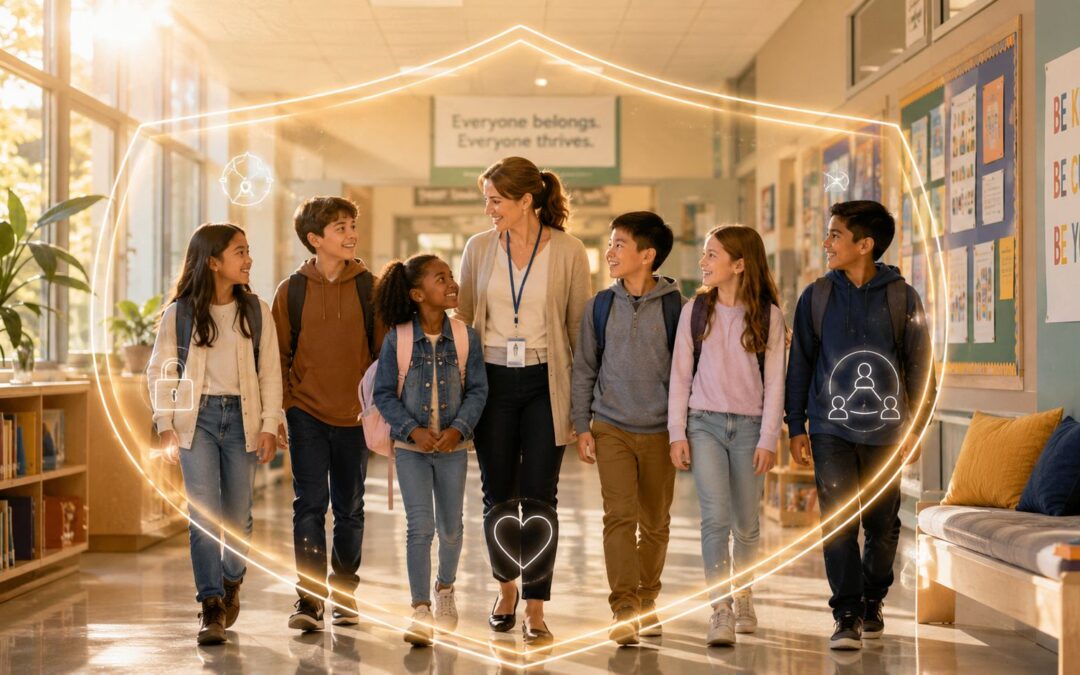
A principal stands at the front office window during morning drop-off. The doors are locked. The visitor badge system works. The camera feed is on. Yet what keeps pulling at her attention isn't the entrance. It's the student who's been eating alone for two weeks, the rising tension between two fourth graders, and the teacher who says her class feels “edgy” every afternoon.
That's where many schools are right now. They've handled parts of physical security, but they're still asking a harder question. What makes children feel safe enough to learn, connect, and ask for help?
For K-8 schools, that answer has to be bigger than hardware. Children are safest when adults notice patterns early, when classmates know how to include one another, when conflict has a repair process, and when students trust that speaking up will lead to help instead of shame. Safety starts to look less like a fortress and more like a healthy community with clear routines, strong relationships, and adults who respond consistently.
Rethinking What Makes a School Truly Safe
A lot of school leaders inherit a narrow version of safety. It focuses on entrances, procedures, and emergencies. Those matter. But principals and parents usually know, from lived experience, that a school can be physically secure and still feel socially unsafe.
A second grader may dread recess because of exclusion. A fifth grader may stop participating because classmates laugh when he gets an answer wrong. A middle-grade student may carry anger from home or the neighborhood into the classroom with no language for it. None of those situations begins with a lockdown. They begin with disconnection.
That's why many effective school safety programs now start with prevention. Long-term national data point in that direction. The nonfatal criminal victimization rate for students ages 12 to 18 at school fell from 181 per 1,000 students in 1992 to 22 per 1,000 in 2022, according to the U.S. Department of Education's Indicators of School Crime and Safety release. That long decline helps explain why the field has increasingly emphasized climate, behavioral supports, and conflict reduction before problems escalate.
A safe school isn't just a place where bad things are stopped. It's a place where students are taught how to belong, regulate, repair, and report concerns early.
For K-8 educators, this shift matters because younger students are still building the skills that shape how they handle frustration, embarrassment, peer pressure, and power. If adults treat every conflict as a rule violation only, children don't learn what to do differently next time. If adults teach emotional vocabulary, help students practice repair, and create routines for inclusion, they build safety from the inside out.
Parents often understand this immediately when it's framed in everyday terms. They want doors locked, yes. They also want their child to have a trusted adult, a clear plan for bullying, and a classroom where mistakes don't become social punishment.
That broader view is where modern school safety programs begin.
What Are Modern School Safety Programs
A modern school safety program works like an ecosystem. You don't get a healthy garden from one strong fence. You need soil, water, routines, early attention to problems, and people who know what they're looking at. Schools work the same way.

Safety is a system, not a single tool
Many schools already use visible security measures. In fact, nearly all schools use at least one security measure like visitor sign-ins. But the strongest evidence for reducing violence points to proactive approaches such as improving school climate, teaching social-emotional skills, and implementing anti-bullying programs, as outlined in the National Center for School Safety overview shared by NIJ.
That distinction clears up a common confusion. A camera can record an incident. A strong adult relationship may prevent it. A locked door controls entry. A classroom routine for calming down can stop a hallway conflict from turning into a fight. Both types of tools matter, but they do different jobs.
What this looks like in a K-8 school
A modern program usually includes layers that work together:
- Physical procedures: Locked exterior doors, visitor check-in, supervision plans, and practiced emergency routines.
- Prevention practices: SEL instruction, anti-bullying systems, predictable behavior expectations, and adult check-ins.
- Student support: Counseling access, mental health referrals, re-entry support after crisis, and family communication.
- Response structures: A way to report concerns, a team that reviews them, and clear follow-up.
A simple example helps. Suppose a student tells a lunch aide that another child has been making threatening comments during recess. In an older model, staff might wait to see whether something happens. In a modern model, the concern gets documented, reviewed, and addressed through both support and supervision. The student who reported it is taken seriously. The student of concern is not merely labeled “bad.” Adults ask what's driving the behavior, who needs support, and what immediate precautions are necessary.
Practical rule: If your safety plan only activates during a crisis, it's incomplete. Strong school safety programs are active on ordinary Tuesdays.
The strongest programs feel almost boring in the best way. Students know the routines. Adults share language. Families know whom to contact. Small concerns don't get ignored until they become big ones. That consistency is what creates trust.
The Three Pillars of Comprehensive School Safety
When schools try to improve safety, they often overinvest in what's easiest to see. Doors, radios, cameras, and checklists are concrete. Emotional safety is harder to measure in the moment, but it affects everything students do once they enter the building.
The U.S. Department of Education highlights school-based mental health services and climate improvement initiatives as core tools for preventing violence, which is why effective planning has to go beyond physical measures and include psychological and emotional safety as part of the whole system through Safe and Supportive Schools guidance.
Comparing the three pillars
| Pillar | Primary Goal | K-8 Classroom Example |
|---|---|---|
| Physical safety and security | Protect students and staff through procedures, supervision, and environmental safeguards | A teacher keeps the classroom door protocol consistent, reviews evacuation routes, and uses a clear student pickup routine |
| Psychological and emotional safety | Help students feel safe to speak, participate, regulate emotions, and seek help | A class uses a Peace Corner where students can calm down, name feelings, and rejoin learning with support |
| Community and digital safety | Extend safety beyond the classroom through family partnership, online behavior norms, and shared expectations | A school teaches students how to respond to unkind group chats and gives families common language for reporting concerns |
Pillar one: physical safety and security
This pillar includes the visible basics. Entry procedures, adult supervision, visitor management, emergency drills, and campus routines all belong here. In K-8 settings, consistency matters as much as equipment.
A practical example is arrival duty. If adults greet students by name while also scanning for distress, they're doing both safety and connection work at once. A child who looks upset, withdrawn, or unusually activated can be redirected to support before the school day unravels.
Pillar two: psychological and emotional safety
This is the pillar schools sometimes skip because it can sound soft. It isn't soft. It's operational. Students who feel humiliated, isolated, or chronically dysregulated don't learn well and don't always make safe choices.
Psychological safety shows up in small routines. A teacher starts the day with a check-in board where students place their name under “ready,” “need quiet,” or “need support.” A counselor teaches students how to use breathing, movement, and feeling words before conflict peaks. A playground supervisor helps children use a repair script instead of forcing a quick apology.
Schools looking for practical support in this area often explore social-emotional learning programs for schools that give staff and students a shared language for self-regulation and conflict resolution.
Pillar three: community and digital safety
Children don't leave their social world at the school gate. A lunchtime conflict may continue in a group text. Neighborhood stress may enter the classroom as irritability or fear. Family uncertainty may show up as withdrawal.
Community and digital safety means schools teach students what to do when online behavior turns mean, secretive, or threatening. It also means parents know how concerns get reported and who follows up. A fifth-grade teacher might say, “If something unsafe happens online at night and it affects school, bring it to us. Don't carry it alone.”
Safety often begins before first period and continues after dismissal. Schools need language and partnerships that travel with children across settings.
The pillars support one another. A child is more likely to follow procedures when they trust adults. A family is more likely to report a concern when they've been treated as partners. That's why multi-faceted school safety programs never rely on a single lane.
Core Components of an Effective Program
The strongest school safety programs are concrete. They don't stay at the level of mission statements. They translate into routines, tools, roles, and practice.

Prevention has to be visible in daily school life
Start with what students experience every day. If a school says it values safety, students should be able to point to where they learn it.
That might include:
- A schoolwide SEL routine: Morning meetings, emotion check-ins, calming strategies, and shared language for feelings and needs.
- Anti-bullying instruction: Direct teaching on exclusion, bystander action, rumor-spreading, and repair.
- Restorative responses: Guided conversations after harm so students learn accountability, empathy, and next steps.
- Adult relationship systems: Advisory, lunch bunches, check-in/check-out, or a trusted adult list for students who need extra connection.
A fourth-grade restorative circle is a good example. Two students have a conflict during art. Instead of sending both away with equal blame, the teacher gathers them later with a simple structure: What happened? Who was affected? What do you need now? What can repair look like? Students learn that conflict has a process. That lowers fear and increases fairness.
Schools that want practical prevention tools may also look at bullying prevention programs for schools that combine student instruction with staff training and school climate work. Soul Shoppe is one example of an SEL organization that teaches conflict resolution and shared language for peer support.
Reporting systems and response teams matter
Students often see warning signs before adults do. The key question is whether they trust the adults enough to say something, and whether the school has a system to act on that information.
In U.S. Secret Service research on averted school attacks, prevention happened in nearly all cases because someone reported concerning behavior before the attack was carried out, a finding from the Secret Service National Threat Assessment Center’s review of averted attacks. That's why an effective program includes both a reporting path and a trained behavioral threat assessment team.
A strong setup includes:
- Low-friction reporting: Students and families know how to report concerns without jumping through hoops.
- Clear triage: Reports don't sit in an inbox. A team reviews them quickly.
- Support plus safety planning: The response isn't only punitive. It also asks what support, supervision, and communication are needed.
- Follow-through: The reporting student sees that adults took the concern seriously.
For younger students, “reporting system” may be as simple as a trusted adult board, a classroom worry box, or a counselor form that an adult helps complete. For older elementary and middle grades, it can include web-based or mobile options.
A school's physical spaces should support this work too. Recess zones, pickup areas, and play structures need clear supervision and upkeep. For a practical facilities lens, many schools review guidelines for school playground safety to make sure environment and behavior expectations match.
Later in the year, some teams find it helpful to revisit core response ideas through a short training video before staff planning days.