Most adults meet goal setting when they're already overwhelmed. A preschooler meets it while standing in one sock, refusing the other shoe, and melting down because the zipper feels “wrong.”

That's why goal setting for preschoolers has to look different. It can't feel like pressure. It has to feel like help.

In early childhood settings, I've found that the best goals are woven into ordinary moments. Getting dressed. Putting blocks away. Waiting for a turn. Carrying a napkin to the table. These small efforts teach children something bigger than task completion. They teach, “I can try. I can keep going. I can do one step at a time.”

Why Tiny Goals Lead to Big Confidence

A four-year-old doesn't wake up wanting a lecture about perseverance. They want to do what the big kids do, feel capable, and get through the day without everything turning into a struggle.

That's why tiny goals work so well. When a child hears, “Your job is to put both shoes by the door,” that feels doable. “Get ready by yourself” often doesn't. One is clear. The other is too big to hold in mind.

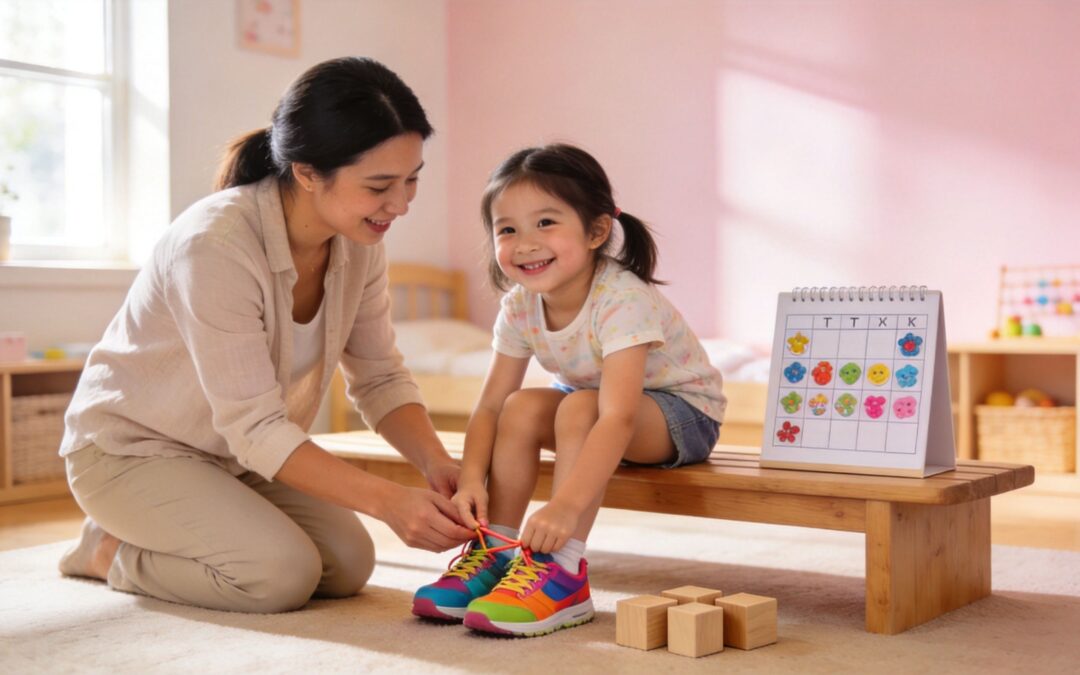
A happy young child sits on a wooden shelf, practicing tying their black high-top sneakers.

Everyday struggles are often hidden learning moments

Think about a common morning scene. A child can't get their coat on. An adult is late. Voices get tighter. The child shuts down.

Now shift the frame. Instead of “Come on, get dressed,” try a small mission: “Today your goal is to put one arm in your coat by yourself.” That changes the emotional tone right away. The child has a target they can reach.

Small success builds momentum. Children start to expect that effort leads somewhere. That mindset matters. If you want a deeper family-friendly read on nurturing children's growth mindset, it pairs well with this approach because both focus on helping kids see progress as something they can create.

Practical rule: If a goal leads to instant frustration, it's probably too large. Shrink it until the child can act on it right away.

Confidence grows through repetition, not speeches

Preschoolers build confidence from doing, not from being told they're capable. When they repeat a manageable goal across several days, they begin to trust themselves.

That's especially important in social-emotional learning. A child who learns, “I can carry my cup to the sink,” is also learning to tolerate frustration, recover from mistakes, and stay with a task. Those are self-management muscles.

You can see this same idea in confidence from the inside out. Real confidence doesn't come from constant praise. It grows when children experience themselves as effective.

A few preschool-friendly goals that build this kind of confidence:

  • Self-care goal: Put your socks in the hamper.
  • Classroom goal: Push in your chair after snack.
  • Friendship goal: Use words when you want a turn.
  • Cleanup goal: Put three blocks in the bin.

None of these sound dramatic. That's the point. Tiny goals let children practice success often enough that “I can't” slowly becomes “I'll try.”

The Building Blocks of a Preschooler's Goal

Adults usually think of goals as future plans. Preschoolers need goals they can see, touch, and do today.

A developmentally appropriate goal for this age is small, concrete, visual, and close in time. “Be more responsible” won't mean much to a four-year-old. “Put your cup on the tray after snack” will.

A young Asian child sitting at a table carefully stacking wooden blocks to practice developmental skills.

What a good preschool goal looks like

A strong preschool goal usually has these features:

  • It's observable: You can tell whether it happened. “Wash hands before snack” works. “Have better listening” is too vague.
  • It's short-term: The child can experience it soon, often within the day or over several days.
  • It's action-based: It focuses on what the child will do, not on a personality trait.
  • It fits the routine: It lives inside real moments like arrival, cleanup, centers, snack, or bedtime.

A useful test is this. Can the child picture the goal in their mind? If not, simplify it.

Process goals beat broad outcome goals

For young children, process matters more than outcome. “Try both shoes before asking for help” is often a better goal than “Put on shoes perfectly.”

This approach protects motivation. Preschoolers are still developing planning, working memory, and frustration tolerance. When adults choose goals that are too broad, children can feel like they've failed before they've even started.

A helpful overview of how early learning goals fit into child development can be found where Grow With Me explains early years learning. It gives useful context for why daily routines matter so much in the early years.

A preschool goal should sound more like a next step than a life lesson.

Predictability helps children stay engaged

Routine matters even more than many adults realize. A 2023 study on preschoolers' goal adaptation found that children were more likely to adjust their approach when changes in a task were predictable, while unpredictable changes were more disruptive, especially for children under 4.5 years.

That finding matches what teachers see every day. If the goal-setting routine changes constantly, some children spend all their energy figuring out the format instead of doing the task.

Here's what predictability can look like in practice:

Everyday setting Less helpful approach More helpful approach
Arrival New chart, new language, new expectation each day Same visual, same phrase, same first step
Cleanup “Clean everything up” “Put five cars in the basket”
Dressing Rushed adult takeover Same sequence each time, with one child-owned step
Circle time Goal introduced only when behavior is hard Goal named before the routine begins

If you're supporting children's self-regulation alongside goal setting, self-management skills in young learners offers a useful companion lens.

How to Introduce and Model Goals Together

Many adults make goal setting sound heavier than it needs to be. Preschoolers respond best when it feels conversational, shared, and tied to something they already want to do.

Start with one real moment. Maybe your child wants to pour water without spilling. Maybe your students rush through cleanup. That's enough. You don't need a special unit or a formal meeting.

A simple visual can help make the idea concrete.

An infographic titled Setting Goals Together illustrating four simple steps for parents to guide preschoolers in goal setting.

Say less, guide more

Use short sentences and invite the child into the plan.

Try language like this at home or in the classroom:

  1. Name the goal

    • “Our goal is to put the books back on the shelf.”
    • “Your goal is to carry your plate to the counter.”
  2. Ask for the first step

    • “What do you do first?”
    • “Which book will you pick up?”
  3. Notice effort

    • “You kept trying even when the zipper got stuck.”
    • “You remembered the basket without me telling you again.”
  4. Keep the next step small

    • “Tomorrow, your goal is to do the first button.”
    • “Next time, let's try two toys before cleanup help.”

This kind of language reduces power struggles. It also gives children practice thinking in sequence, which is a major part of early self-regulation.

Model your own goals out loud

Preschoolers learn a lot from hearing adults think aloud. You can model goals in ordinary language without turning it into a lesson.

For example:

  • During snack prep: “My goal is to put all the cups on the table before I sit down.”
  • During cleanup: “I'm going to finish putting the markers in the box.”
  • During transitions: “My goal is to find my keys and my water bottle before we leave.”

When adults do this, children start to understand that goals aren't just demands adults place on kids. Goals are tools people use to help themselves.

Later in the section, this short video can reinforce the idea for families and educators who like to see concepts modeled in action.

Make the goal visible

For preschoolers, invisible ideas fade fast. A drawing, a photo, or a simple picture card keeps the goal in view.

Research from Boston Children's Health Physicians notes that visually representing goals can support follow-through. For preschoolers, drawing the goal can increase task completion for independence skills by up to 50% compared with verbal instructions alone.

That doesn't mean every family needs a perfect chart. It means the child benefits from seeing what they're aiming for.

Try these easy versions:

  • Draw it: Sketch a toothbrush, backpack, or toy bin.
  • Use a photo: Take a picture of the child completing the step.
  • Make a first-then card: “First shoes on, then outside.”
  • Use one symbol: A cup icon near the sink means “put cup here.”

“Our goal is something we can see and do.”

Sample scripts for common preschool moments

Adults often ask for exact words. Here are a few.

Situation Try saying
Morning dressing “Your goal is one sleeve by yourself. I'll help with the other one if you need it.”
Classroom cleanup “We're all working on one cleanup goal. Put three items where they belong.”
Turn-taking “Your goal is to ask for a turn with words.”
Bedtime routine “Let's draw your bedtime goal. Pajamas first, then book.”

The simpler the script, the more likely children are to remember it and act on it.

A Toolbox of Goal-Setting Activities and Examples

Sometimes adults understand the concept but still wonder, “What goal should I use tomorrow?”

The easiest answer is to start where the child already bumps into difficulty. If mornings are hard, build a morning goal. If transitions are rough, create a transition goal. If a child wants to help, turn that desire into a helper goal.

For families who like paper tools, journals, or planners for older kids and adults, it can be interesting to look at strategic partners for personal growth. For preschoolers, though, the “planner” is usually much simpler: a photo, a picture card, a basket label, or a tiny checklist with images.

Sample Preschool Goal-Setting Ideas

If you're planning classroom routines, preschool lesson plan ideas can help you connect goals to the flow of the day.

Domain Example Goal What to Say Activity Idea
Self-Care & Independence Put both shoes by the door “Your goal is shoes by the mat.” Make a shoe spot with tape or a picture label
Self-Care & Independence Wash hands before snack “What comes first before we eat?” Put picture cues by the sink
Self-Care & Independence Zip coat after help starting “You pull it up after I click it.” Practice on a dressing board or jacket station
Helping & Community Carry one napkin to the table “Today you're our napkin helper.” Set up a helper basket near meals
Helping & Community Put one book back after reading “When you finish, the book goes home to the shelf.” Match books to shelf labels with pictures
Helping & Community Greet one classmate or family member “Can you say good morning to one friend?” Use arrival name cards
Quiet Time & Focus Sit and look at one book for a few minutes “Your goal is book time with your body calm.” Create a cozy reading spot
Quiet Time & Focus Finish one simple puzzle step “Let's find the edge piece first.” Offer a small puzzle with a tray
Quiet Time & Focus Stay with one center before switching “Pick one job, then we'll check back.” Use a center choice card
Movement & Motor Skills Hop to the line “Can your feet do two hops to the line?” Make a hop path with floor spots
Movement & Motor Skills Carry a tray with two hands “Your goal is two hands all the way.” Practice with beanbags or cups
Movement & Motor Skills Stack blocks carefully “Build up, then stop and look.” Challenge the child to make a short tower
Social-Emotional Skills Ask for help with words “What can you say if it's too hard?” Practice with puppets
Social-Emotional Skills Wait for one turn “Your goal is to wait, then go.” Use a turn-taking game
Social-Emotional Skills Use a calm-down spot “When your body feels big, you can go to your cozy spot.” Add a visual choice card for calming tools

Choose the goal by watching, not guessing

The best examples come from observation. Notice where a child nearly succeeds. That's usually the sweet spot.

For example:

  • A child who throws all the toys during cleanup may not need “better behavior.” They may need a smaller cleanup target.
  • A child who avoids drawing may need a goal around sitting for one short art step, not finishing a whole project.
  • A child who always asks for help immediately may need a goal like “try one step, then ask.”

Classroom lens: Strong goals often begin with, “I noticed you can almost do this.”

That tone protects dignity. It invites partnership instead of correction.

Tracking Progress with Purpose and Joy

Tracking can help children stay engaged, but only if it feels encouraging. When adults turn tracking into pressure, preschoolers either perform for the reward or avoid the task altogether.

The better approach is to make progress visible while keeping the emotional message clear. We're noticing effort. We're not grading worth.

Let the child do the tracking

Research using self-recording methods found that over 50% of preschoolers can state their own achievable goals and track progress with visual aids. That process includes identifying a goal, self-recording steps, and sharing the goal with peers. It's linked with significant increases in performance and motivation.

That matters because self-recording changes the child's role. They're no longer just receiving adult feedback. They're participating in their own growth.

Simple self-recording tools work best:

  • Pom-pom jar: Add one pom-pom after the child completes the agreed step.
  • Picture checklist: The child marks off images, not words.
  • Sticker path: One sticker for each day they practice.
  • Goal ladder: Each rung shows one tiny part of the task.

The tool should match the child's developmental level. If the tracker is confusing, it becomes one more demand.

Keep celebration grounded in effort

There's nothing wrong with being happy when a child meets a goal. The key is what you highlight.

Try responses like:

  • “You kept working when it felt tricky.”
  • “You remembered the first step on your own.”
  • “You came back after getting frustrated.”
  • “You used your picture card to help yourself.”

Those comments teach children what to value in themselves.

A supportive classroom routine can strengthen this. During meeting time, children might share one goal they're practicing or one step they tried that day. In many classrooms, simple daily check-ins and reflection tools create the emotional safety needed for that kind of sharing.

When tracking stops helping

Sometimes a chart loses its power. Sometimes a child starts demanding the sticker more than caring about the skill. That's your cue to adjust.

You might:

  • Simplify the tracker: Move from a weekly chart to one card.
  • Change the visual: Use photos instead of icons.
  • Shorten the time frame: Track one routine, not the whole day.
  • Pause the tool: Keep the goal, remove the chart for a while.

Tracking should support ownership. If it starts feeling like surveillance, it's time to reset.

Adapting Goal Setting for Every Child

Many goal-setting resources often fall short. They offer one chart, one script, and one version of success. Preschoolers don't come in one version.

Some children are highly verbal and eager to announce a goal. Others communicate through movement, gestures, AAC, or very few words. Some love visual charts. Others respond better to real photos, objects, or a short adult-child routine repeated the same way every day.

A 2024 expert consensus study noted that inclusive goal setting must be tailored to individual needs using child-specific tools. The same source also highlights a real gap in practical guidance, especially for children with diverse abilities. That gap matters in every preschool classroom.

Personalization isn't extra. It's the work.

If a child has communication differences, don't assume they can't participate in goal setting. Change the entry point.

For example:

  • For children with limited verbal language: Offer two photo choices. “Coat” or “hands washed.”
  • For children with motor challenges: Make the goal about one meaningful part of the routine they can own.
  • For children who are easily overwhelmed: Use one goal in one setting, with the same adult and same visual each time.
  • For highly active children: Build movement into the goal. “Carry two cushions to the circle” may work better than “sit still nicely.”
  • For cautious or shy children: Start privately. A public goal-share can come later, or not at all.

Use tools that match the child, not adult convenience

Sticker charts are popular because adults can set them up quickly. But quick for adults isn't always accessible for children.

Better options might include:

  • Real photos instead of cartoon icons
  • Object cues like an actual spoon, shoe, or book
  • Single-step boards rather than multi-step charts
  • Simple tech supports if a child responds well to them
  • Choice-based language so the child has some ownership

The most effective goal is the one the child can understand, enter, and experience as success.

In inclusive practice, child-led doesn't mean child-alone. It means we watch carefully, adapt thoughtfully, and refuse to confuse compliance with growth.


If you want support building inclusive, practical SEL routines around goal setting, communication, and self-regulation, Soul Shoppe offers programs and resources designed to help school communities and families create more connection, confidence, and belonging for every child.