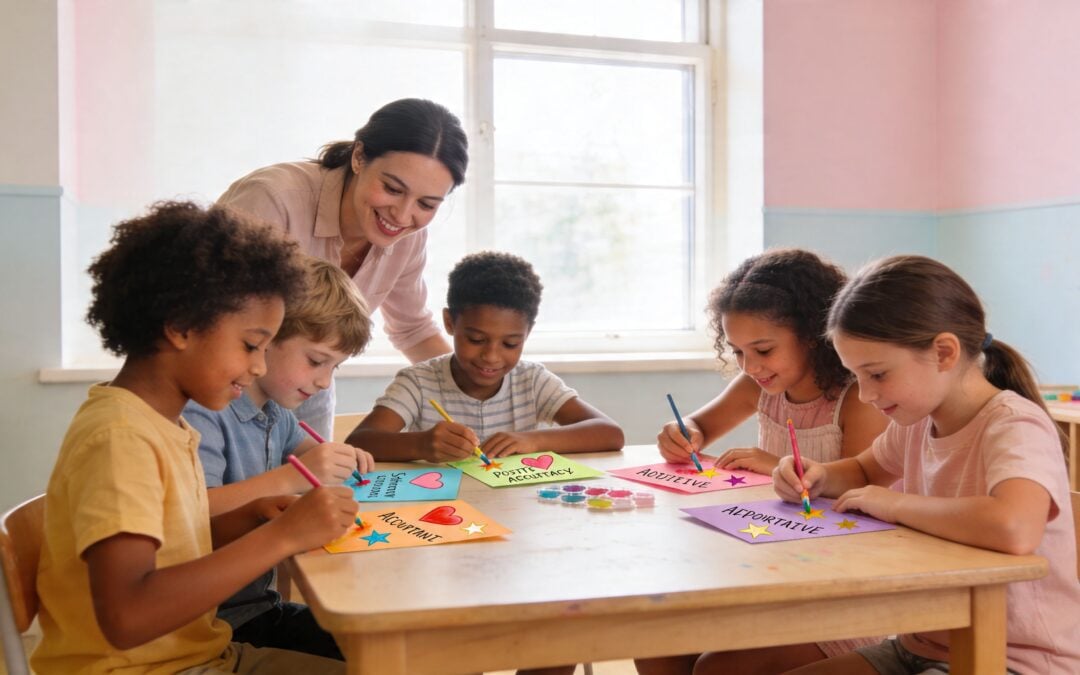
You’re probably here because you’ve seen the same pattern many adults see. A child shuts down after one mistake. Another brushes off every compliment. One student dominates group work to hide insecurity, while another stays quiet because they’ve already decided they’re “not good at it.” In those moments, kids don’t just need encouragement. They need repeated experiences that help them feel capable, valued, and connected.
That’s why self esteem building activities for kids work best when they’re concrete and predictable. Empty praise fades fast. Specific feedback, meaningful roles, and structured reflection stick. They give children evidence they can use the next time they face a challenge, conflict, or disappointment.
This matters for more than feelings. A large Millennium Cohort Study analysis of 6,209 children found that frequent engagement in arts activities such as music, drawing, painting, making things, and reading for enjoyment was positively associated with higher self-esteem at age 11. For teachers and parents, that’s a useful reminder that confidence grows through everyday practice, not a single big talk.
If you’re also thinking about movement-based confidence builders, some families pair SEL routines with activities like martial arts for kids because consistent practice, self-control, and skill mastery can reinforce the same message: “I can learn hard things.”
The ideas below are built as grab-and-go mini lesson plans. Each one includes a simple objective, materials, steps, and ways to adapt for different ages or learning needs. You can use them in a classroom morning meeting, counseling group, after-school program, or at the kitchen table tonight.
1. Strength-Based Recognition & Positive Behavior Systems
Some children rarely hear what they do well in language that feels believable. “Good job” is kind, but it’s too vague to build sturdy self-esteem. A stronger approach is to name the exact action, habit, or character strength a child showed.
A simple recognition circle can do this in ten minutes. Students sit in a circle, and each child names one classmate’s observable strength using a sentence stem like, “I noticed you helped clean up without being asked. That shows responsibility.” Over time, children start to internalize a more accurate picture of themselves.
Mini lesson plan
Objective: Help children connect positive identity with specific actions.
Materials:
- Sentence stems on chart paper or index cards
- Sticky notes or small slips of paper
- A wall space, bulletin board, or digital board for recognition notes
- Optional token system for classroomwide positive behaviors
Steps:
- Model first: Give two or three examples aloud. Keep them concrete, such as “I noticed Maya waited for her turn during the game. That shows patience.”
- Practice together: Invite students to help improve vague praise. Turn “He’s nice” into “He invited me to join the group at recess.”
- Run the circle: Let each child recognize one peer. Younger children can draw a picture instead of speaking.
- Save the evidence: Post notes on an appreciation wall or place them in personal folders children can revisit.
- Close with reflection: Ask, “Which strength was easiest for you to notice today?” and “Which strength do you want to practice tomorrow?”
Real example in school and at home
In a third-grade classroom, a teacher might use this after morning meeting every Friday. In a family setting, one adult can run a mini version at dinner by asking each child to name one helpful thing a sibling did that day.
Recognition systems work best when they’re steady, not flashy. A “caught being kind” card, ClassDojo point for collaboration, or a simple classroom appreciation wall can all support the same habit if adults use specific language consistently. If you want more structure around praise and feedback, Soul Shoppe’s post on positive reinforcement in the classroom offers practical language choices that fit this approach.
Practical rule: Praise the behavior, connect it to a strength, and keep it believable.
Differentiation
- For younger children: Use pictures for strengths like kindness, courage, and teamwork.
- For multilingual learners: Offer sentence frames and allow home-language responses.
- For neurodiverse learners: Provide options for private recognition instead of public speaking.
- For equity: Track who receives recognition so the same confident children don’t get all the attention.
This is one of the most effective self esteem building activities for kids because it helps children feel seen by a community, not just corrected by it.
2. Growth Mindset Goal-Setting & Progress Tracking
Self-esteem gets stronger when kids can point to progress. That’s especially true for children who think ability is fixed. They need visible proof that effort, strategy, and support move them forward.
A goal wall, reflection journal, or digital portfolio makes growth visible. Instead of asking, “Did I win?” children start asking, “What did I improve?” That shift lowers shame and builds resilience.
Mini lesson plan
Objective: Help children build confidence by tracking effort, strategy, and growth over time.
Materials:
- Goal sheet or journal page
- Markers or pencils
- Sticky dots, mini charts, or portfolio folders
- Optional Seesaw or Google Classroom portfolio
Steps:
- Choose one small goal: Keep it narrow. A student might choose “I will read aloud with a clear voice” or “I will solve word problems by underlining key information.”
- Name the plan: Ask the child to list one strategy they’ll try, one obstacle they might hit, and one person who can help.
- Track often: Use quick check-ins two or three times a week. Students can color a chart, record a voice note, or write one sentence.
- Reflect on setbacks: If the plan isn’t working, ask, “What can you try next?” instead of “Why didn’t you do it?”
- Share evidence: At the end of the cycle, students present one piece of proof that they grew.
Classroom example
A fifth-grade teacher might ask students to set a speaking goal before presentations. One child writes, “I want to look up at the audience three times.” After each practice, the student marks a simple tracker. By presentation day, the child doesn’t need inflated praise. They have evidence.
At home, parents can use the same structure for routines like tying shoes, learning multiplication facts, or entering soccer practice with a calm body. A refrigerator chart works fine. What matters is that children notice change over time.
Language that builds confidence
- Try this: “You haven’t mastered it yet.”
- Try this: “What strategy helped most?”
- Try this: “What did you do differently this time?”
- Avoid this: “You’re so smart.”
- Avoid this: “You’re just not a math person.”
Soul Shoppe’s piece on growth mindset in the classroom gives useful language for helping students stay with hard tasks without tying their worth to perfect performance.
Some children need confidence before they’ll try. Others need a successful try before confidence appears. Progress tracking helps both.
Differentiation
- For K-2: Use picture goals and sticker progress charts.
- For older students: Add a short reflection prompt such as “What did I learn about myself?”
- For children who get overwhelmed: Limit goals to one habit for one week.
- For perfectionists: Celebrate strategy changes, not just results.
This activity teaches a powerful truth. Confidence doesn’t always arrive first. Sometimes it follows repeated effort.
3. Collaborative Community Service Projects
Kids often feel better about themselves when they experience themselves as helpful. Service gives children a direct answer to the question, “Do I matter here?” When they can see that their actions improve something for someone else, self-esteem becomes grounded in contribution.
This is one reason service projects work so well in schools and youth programs. They combine teamwork, responsibility, and visible impact. Even small projects can change how a child sees their role in a community.
Mini lesson plan
Objective: Build self-worth through shared responsibility and meaningful contribution.
Materials:
- Chart paper for brainstorming
- Basic project supplies based on the service idea
- Reflection sheets or journals
- Camera or display board for documenting the project
Steps:
- Start with need-finding: Ask, “What does our school or neighborhood need more of?” Let students brainstorm real problems.
- Choose one manageable project: Options include a school garden, campus cleanup, peer reading buddies, thank-you cards for support staff, or a donation drive.
- Assign roles: Give every child a specific job. Photographer, organizer, greeter, sorter, waterer, announcer, and recorder all count.
- Do the work: Keep sessions short and regular so the project feels doable.
- Reflect after each session: Ask, “How did we help?” and “What did you contribute today?”
Real examples
A kindergarten class can maintain one raised garden bed and take turns watering, weeding, and observing growth. A middle school advisory can partner with a younger grade for buddy reading once a week. A family can organize a neighborhood litter walk and let children create the route and supply list.
Research on the Boys & Girls Clubs of America’s “True to Me” program reported lasting benefits for participants. Three years after participation, 60% of girls showed significantly improved body confidence, 78% felt more confident and capable at school, 71% reported better peer relationships, and 53% had improved family relationships. That reinforces an important point for adults. Structured experiences that help kids see themselves positively can support both confidence and relationships over time.
Differentiation
- For younger children: Keep projects concrete and visible, like planting flowers or making welcome cards.
- For older children: Add student leadership in planning and communication.
- For children with language or processing differences: Offer visual job cards and hands-on roles.
- For hesitant children: Pair them with a buddy and assign one clear task first.
Contribution is often more stabilizing than praise. A child who thinks, “I helped,” is building a stronger identity than a child who only hears, “You’re great.”
Service belongs on any strong list of self esteem building activities for kids because it moves confidence out of the abstract and into action.
4. Mindfulness & Self-Regulation Practice
A child spills paint, freezes, and then whispers, “I’m bad at everything.” That moment is not just about paint. It is about what the child believes the mistake means.
Mindfulness and self-regulation practice help children separate a hard moment from their identity. When a child learns how to slow breathing, notice body signals, or reset after frustration, they get evidence that they can handle discomfort. Self-esteem grows from that evidence. It grows when a child can say, “I got upset, and I knew what to do next.”
Regulation works like a reset button for the nervous system. The goal is not a perfectly calm child. The goal is a child who starts to recognize, “My heart is racing. My shoulders are tight. I can use a strategy.” That shift matters because children often mistake dysregulation for failure. A simple routine teaches them to read it as a skill-building moment instead.
Mini lesson plan
Objective: Help children build confidence by practicing one calm-body strategy they can use during everyday stress.
Materials:
- Stuffed animal or beanbag for breathing-buddy practice
- Soft mat or carpet spot
- Visual breathing card or calm-down poster
- Optional timer or guided audio
Steps:
- Name the skill clearly: Say, “Today we are practicing how to help our bodies settle.” Keep the focus on skill, not behavior control.
- Teach one strategy only: Start with belly breathing, hand tracing, or a 5-4-3-2-1 grounding routine. One tool at a time helps children remember what to do.
- Model it where children can see it: Breathe slowly, relax your shoulders, and narrate what you notice. For example, “My breath is getting slower now.”
- Practice during neutral moments: Introduce the routine at morning meeting, after lunch, or before independent work. Children learn best before they are overwhelmed.
- Use it in predictable stress points: Repeat the same strategy before tests, transitions, presentations, or re-entry after recess. Repetition turns the strategy into a habit.
- Reflect in one minute or less: Ask, “What did you notice in your body?” or “When might this help you later today?”
Two easy examples
For early elementary, give each child a stuffed animal to place on their belly while they lie on the floor. Ask them to watch it rise and fall for five slow breaths. That visual cue makes an invisible skill easier to understand.
For older students, teach a 30-second grounding routine before presentations. Feet on floor. One slow inhale. One long exhale. Then ask them to notice five things they can see. Quick routines often work better with older children because they feel private and practical.
If you want a larger bank of classroom-ready tools, Soul Shoppe’s guide to self-regulation strategies for students fits well with this kind of daily practice.
What to say when a child struggles
The language adults use matters. A child in distress often borrows the adult’s words before they can form their own.
- Say: “Your body is having a hard time. Let’s help it.”
- Say: “You’re learning a skill.”
- Say: “Wandering thoughts are normal. Come back to your breath.”
- Avoid: “Calm down.”
- Avoid: “You know better.”
A short guided example can help adults picture the pace and tone children usually respond to best:
Differentiation
- For movement-seeking children: Use wall pushes, chair yoga, marching in place, or stretching instead of stillness alone.
- For sensory-sensitive children: Offer quiet choices and let them keep eyes open or sit farther from the group.
- For multilingual learners: Pair spoken prompts with gestures, picture cues, and repeated routine language.
- For children affected by stress or unpredictability: Keep the sequence simple and consistent. Gentle invitations work better than pressure.
Children do not build self-esteem by staying regulated all day. They build it by learning that they can return to steady, one practice at a time.
5. Student Leadership & Peer Mentoring Programs
One of the fastest ways to change a child’s self-image is to give them a real job that matters to other people. Leadership roles tell students, “We trust you.” Peer mentoring adds another powerful message: “You have something to offer.”
These roles don’t need to be big or formal. A buddy reader, recess game leader, new-student ambassador, or classroom tech helper can all strengthen confidence when the role is clear and supported.
Mini lesson plan
Objective: Build self-esteem through responsibility, service, and trusted leadership.
Materials:
- Role cards or job descriptions
- Simple scripts for mentors or helpers
- Reflection sheet
- Badge, clipboard, or other role marker if helpful
Steps:
- Choose roles intentionally: Match students to roles based on strengths and readiness, not popularity.
- Teach the role: Show exactly what the job looks like. Practice with scripts and role-play.
- Start small: Keep leadership windows short at first so students experience success.
- Provide support: Check in after each session and troubleshoot without shame.
- Reflect on impact: Ask, “How did your role help someone today?”
Examples that work
A fourth grader can greet a new student each morning for the first week and walk them through lunch and recess routines. A middle school student can serve on a peer mediation team with adult coaching. A first grader can be the line leader who checks that everyone has a partner before leaving the room.
Leadership also helps adults notice strengths that traditional academics don’t always reveal. The quiet child may be an excellent welcome buddy. The energetic child may shine when leading movement breaks. The student who struggles with written work may be wonderful at helping younger children organize materials.
Give children roles that let them be useful, not just visible.
Differentiation
- For younger students: Use concrete classroom jobs with visual reminders.
- For older students: Add peer mentoring, conflict support, or event planning.
- For shy students: Offer leadership that happens in pairs or behind the scenes.
- For students who’ve struggled behaviorally: Start with one highly supported responsibility that lets them rebuild trust.
This category of self esteem building activities for kids is especially powerful for children who’ve been defined by what they do wrong. A meaningful role gives them a different story to live into.
6. Strengths-Finder Activities & Personal Brand Exploration
Some children can list their mistakes in seconds but freeze when asked what they’re good at. Strengths work helps them build a vocabulary for who they are at their best. That kind of language supports more authentic self-esteem than generic compliments ever could.
You don’t need a formal assessment to do this well. Tools like CliftonStrengths or VIA Character Strengths can be useful with older students, but an informal inventory works too. Ask children what feels easy, what others come to them for, and when they feel proud of how they handled something.
Mini lesson plan
Objective: Help children identify personal strengths and use them in real settings.
Materials:
- Strengths list with child-friendly language
- Reflection sheet or “strengths shield” template
- Markers, magazines, or collage materials
- Optional student conference folder
Steps:
- Introduce strengths language: Offer words like brave, curious, organized, caring, creative, fair, persistent, and thoughtful.
- Invite self-reflection: Ask children to choose three strengths that fit them and write or draw examples.
- Add outside feedback: Peers, teachers, or family members contribute one strength they see.
- Apply the strengths: Ask, “Where can you use this in school, at home, or with friends?”
- Create a strengths product: Students make a shield, poster, slide, or short speech about their strengths.
Real examples
A second grader might identify “helpful,” “creative,” and “careful,” then show those through helping a classmate zip a coat, inventing a game at recess, and checking plant pots in the class garden. A seventh grader might choose “fair,” “determined,” and “good listener,” then connect those to student council, sports practice, or sibling conflicts at home.
This works best when adults revisit strengths during ordinary moments. If a child says, “I’m bad at school,” you can answer with something more grounded: “You stayed with that problem even when it got frustrating. Persistence is one of your strengths.”
Differentiation
- For K-2: Use picture cards and role-play examples of each strength.
- For grades 3-8: Add written reflection and application to group roles.
- For children with expressive language challenges: Let them sort cards, point, or use photos.
- For families: Create a “family strengths board” where each person adds examples over time.
The reason this belongs on a practical list is simple. Children need language for their identity, not just language for their mistakes.
7. Restorative Practices & Accountability-Through-Connection Models
A child’s self-esteem can drop quickly when discipline focuses only on what they did wrong. That doesn’t mean children shouldn’t be held accountable. It means accountability should preserve dignity while helping them repair harm.
Restorative practices do that by asking students to face impact, hear others, and make things right. Instead of a shame-based message of “You are the problem,” the child hears, “Your choices had an impact, and you can help repair it.”
Mini lesson plan
Objective: Build self-respect and empathy by teaching children how to repair harm without losing belonging.
Materials:
- Restorative question cards
- Talking piece for circles
- Reflection sheet
- Repair plan template
Steps:
- Teach in calm moments: Introduce restorative questions before conflicts happen.
- Use a simple script: Ask, “What happened?” “Who was affected?” “What do you need now?” and “How can we repair this?”
- Hold a brief circle or conference: Keep the tone calm, specific, and forward-looking.
- Make a repair plan: Include one action, one timeline, and one follow-up check.
- Reconnect the student: End with a clear message that they still belong in the community.
Example scenario
Two students argue during group work. One grabs materials and calls the other “useless.” A punitive response might remove the student from class and stop there. A restorative response still addresses the harm, but it also guides the student to hear the impact, apologize in a meaningful way, and help rebuild trust in the group.
Soul Shoppe’s article on restorative practices in education offers a useful foundation for adults who want sentence stems and routines they can use consistently.
The broader context matters too. Interest in structured social-emotional learning has grown quickly. According to Fortune Business Insights, the global social and emotional learning market reached USD 2.71 billion in 2026 and is projected to reach USD 15.67 billion by 2034, with a CAGR of 24.50%. Schools are looking for approaches that can be used consistently across classrooms, not just in isolated lessons. Restorative routines fit that need because they can become part of daily school culture.
Repair builds stronger self-esteem than punishment alone because it teaches, “I can make this right.”
Differentiation
- For younger children: Use puppets, visuals, and one-sentence repair plans.
- For older students: Add written reflection before the conference.
- For students who shut down: Offer drawing, private writing, or a shorter one-on-one conversation first.
- For classrooms: Use proactive circles regularly so the process feels familiar before conflict happens.
Restorative practice belongs on any serious list of self esteem building activities for kids because children need to know they can make mistakes, take responsibility, and still remain worthy of connection.
7-Point Comparison: Self-Esteem Activities for Kids
| Program | Implementation complexity | Resource requirements | Expected outcomes | Ideal use cases | Key advantages |
|---|---|---|---|---|---|
| Strength-Based Recognition & Positive Behavior Systems | Low–moderate: set routines and facilitation skills required | Minimal cost; simple tracking tools and staff training | Greater belonging, confidence, and documented positive feedback | Whole-school culture building; daily classroom routines | Scalable, peer-and-adult recognition, visible reinforcement |
| Growth Mindset Goal-Setting & Progress Tracking | Moderate: ongoing coaching, reflection cycles | Time for goal-setting, visual trackers or digital portfolios | Increased self-efficacy, resilience, intrinsic motivation | Academic growth, student-led learning, conferences | Builds metacognition, ownership, long-term mindset shifts |
| Collaborative Community Service Projects | Moderate–high: planning, coordination, logistics | Staff time, community partnerships, possible transportation/materials | Sense of purpose, leadership, civic responsibility, visible impact | Service-learning, cross-grade projects, real-world impact | Tangible contributions, teamwork, alternative success pathways |
| Mindfulness & Self-Regulation Practice | Low: short, repeatable routines integrated into day | Minimal materials; facilitator training for fidelity | Improved emotional regulation, focus, and coping skills | Managing transitions, anxiety reduction, classroom readiness | Low-cost, immediate in-the-moment tools, adaptable modalities |
| Student Leadership & Peer Mentoring Programs | Moderate: structured training and ongoing supervision | Adult supervision, training time, clear role descriptions | Increased confidence, communication skills, peer support | Peer support systems, leadership development, transition support | Meaningful responsibility, skill development, peer-led support |
| Strengths-Finder Activities & Personal Brand Exploration | Moderate: assessment administration plus facilitated application | Assessment tools (some paid), facilitator time for debriefs | Greater self-awareness, durable self-esteem, better role fit | Career exploration, student-led conferences, role matching | Asset-based identity building, strengths language, future planning |
| Restorative Practices & Accountability-Through-Connection Models | High: cultural shift, skilled facilitation, time-intensive | Significant training, facilitator expertise, time for circles | Restored relationships, reduced exclusions, stronger school climate | Conflict repair, discipline reform, community healing | Preserves dignity, builds empathy, lowers repeat incidents |
Creating a Culture of Worth and Belonging
A child walks into class after a rough morning, misses two problems, snaps at a classmate, and decides, “I’m bad at this.” Another child has the same kind of morning but hears, “You’re having a hard moment. Let’s use your plan, repair the problem, and keep going.” The difference is not luck. It is the culture around the child.
That culture teaches self-esteem every day. Children build a steady sense of worth when adults notice specific strengths, make growth visible, give them meaningful ways to contribute, teach calming routines, offer real responsibility, and treat mistakes as something to repair rather than an identity label. Self-esteem works like a house frame. Single activities can help, but daily routines are what hold everything up.
Consistency matters more than intensity. One compliment poster or one confidence lesson may feel nice in the moment, but it rarely changes a child’s self-story by itself. What helps is a pattern the child can count on. A Monday goal check-in, a two-minute breathing reset before a test, a Friday recognition circle, or a familiar repair conversation after conflict gives children repeated proof that they are capable, valued, and still included when things go wrong.
For educators, the most useful question is simple: where can belonging live inside the schedule you already have? That shift matters. Busy teachers do not need seven more things to plan from scratch. They need grab-and-go structures they can place into morning meeting, independent work, transitions, recess, advisory, or closing circle.
Each activity in this list works best as a mini-lesson plan. Start with a clear objective. Choose a few basic materials. Teach the steps. Then adjust for the children in front of you. For example, recognition can happen with sentence stems for younger students and peer nominations for older ones. Goal tracking can use stickers, checklists, or reflection journals. Restorative questions can be spoken aloud, drawn, or practiced with role-play cards.
Parents can use the same approach at home on a smaller scale. You do not need to recreate a classroom. Pick one routine that matches your child’s current need and repeat it long enough for it to feel familiar. A weekly family appreciation round, a homework calm-down plan, a simple progress chart on the fridge, or a short sibling repair script after conflict can do a great deal because children learn from what happens again and again.
Keep expectations realistic.
Healthy self-esteem does not mean a child feels confident all the time. It means the child begins to believe, “I can handle hard feelings. I can improve. I can ask for help. I can make things right.” That belief is quieter than constant confidence, but it lasts longer.
For this reason, experiential activities matter so much. Children usually do not build self-worth from speeches. They build it from lived evidence. They breathe through frustration and notice their body settle. They help a younger peer and see that they have something to offer. They hear a classmate name a strength and realize others notice their effort. They track progress across days or weeks and learn that change is possible.
If you are deciding where to begin, match the activity to the problem you see most often. If children compare themselves harshly, start with strength-based recognition. If they give up quickly, use growth mindset goals and visible progress tracking. If the room feels disconnected, try service projects or peer leadership. If conflict keeps damaging relationships, start with restorative routines that teach accountability and return.
The goal is bigger than a single lesson. You are building a place where children feel seen clearly, challenged kindly, and welcomed back after mistakes. Once that happens, the activities above stop feeling like extras. They become part of how children learn who they are.