

What is interpersonal communication and its impact on relationships
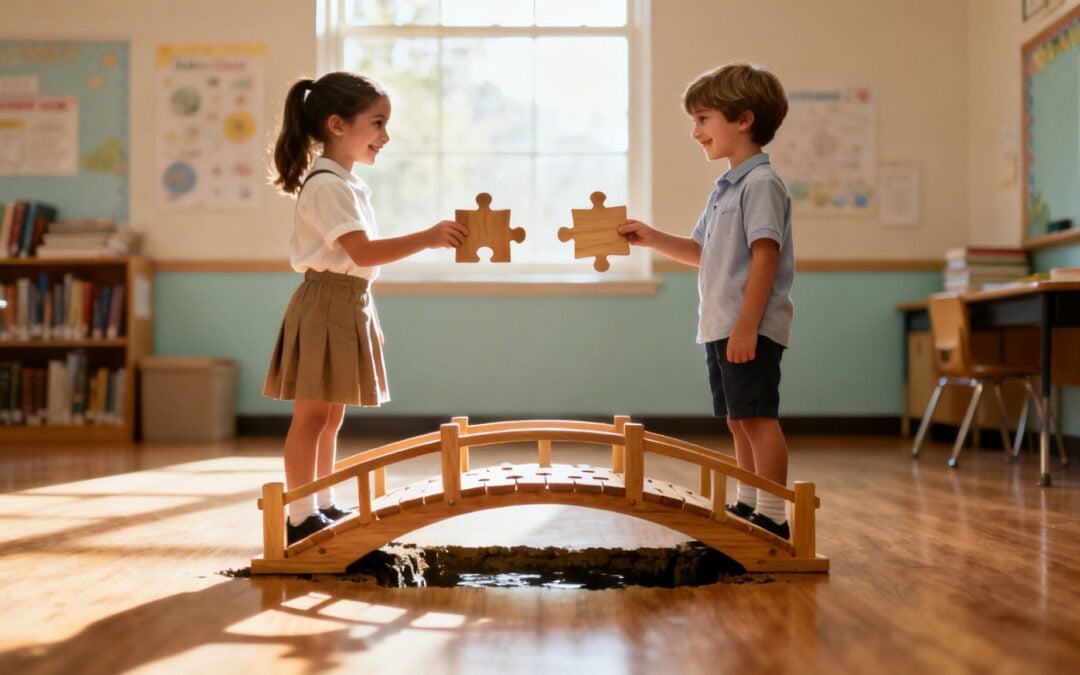
We often think of communication as just talking—the words we say. But it’s so much more than that. It’s the look on a child's face when they finally solve a tough math problem, the high-five between teammates after a game, and the quiet understanding in a shared glance.
This is interpersonal communication: the complete, two-way exchange of ideas, feelings, and information between people. It's the foundation of how we build relationships, work together, and figure out disagreements.
What Is Interpersonal Communication?
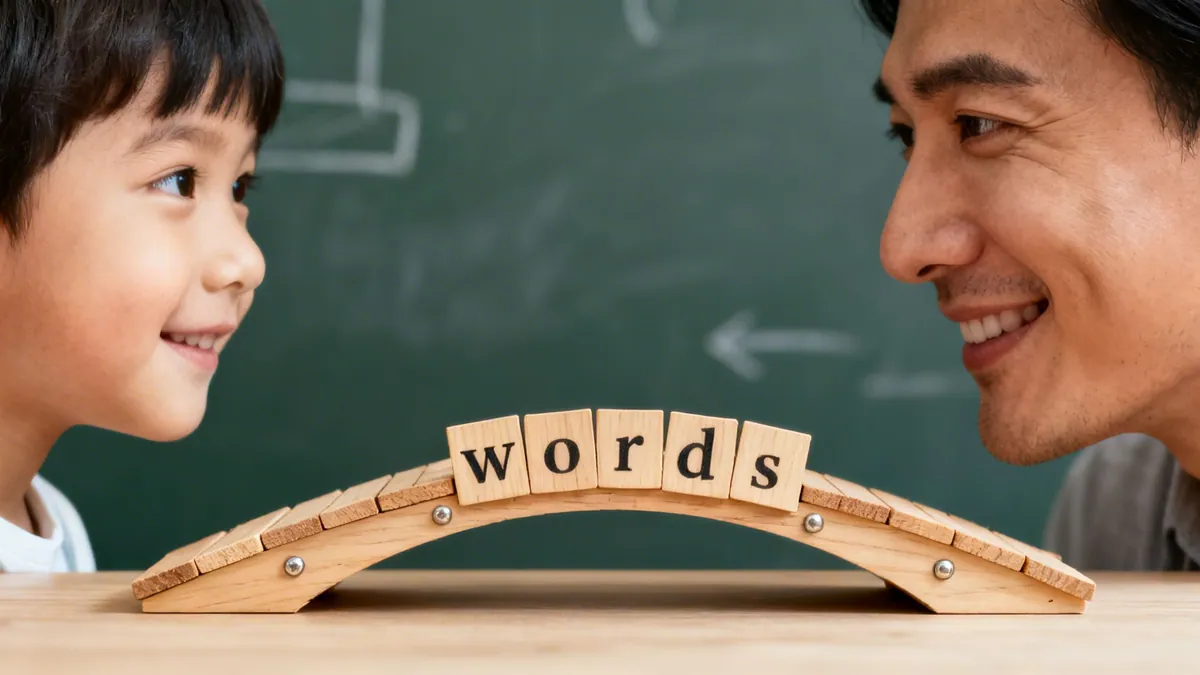
Think of every conversation as building a bridge. Each word is a plank, every gesture a nail, and every moment of listening reinforces the whole structure. When all the parts work together, you create a strong connection that allows understanding to travel back and forth.
But a single missing plank—like a joke that doesn't land—or a wobbly nail—like a misunderstood frown—can make that bridge feel unsafe. For instance, a teacher might say, "Great job," but if their arms are crossed and they aren't looking at the student, the message feels confusing.
For parents and teachers, this perspective is powerful. It shifts the focus from just correcting a child’s words to helping them see how their entire message—their tone, their body language, their listening—is received by others. It turns every interaction into a teachable moment.
The Four Pillars of a Communication Bridge
To make this idea even more concrete for kids (and adults!), we can break down any interaction into four key pillars. When students understand these parts, they can start to see why a conversation might feel strong or wobbly.
| Pillar | What It Means | Example in a Classroom |
|---|---|---|
| Verbal | The words you choose to say. | Saying, "Can I please have a turn when you're done?" instead of "Give me that!" |
| Non-Verbal | Your body language, facial expressions, and gestures. | Making eye contact and smiling while listening to a friend share their weekend story. |
| Listening | Truly hearing and trying to understand what someone else is communicating. | A student nods along and waits for their classmate to finish explaining a math problem before asking a question. |
| Empathy | Trying to feel what the other person is feeling. | A child sees a classmate fall on the playground and says, "That looked like it hurt. Are you okay?" |
Each pillar is crucial. A conversation with great words but poor listening still feels one-sided, just like a bridge that's missing a key support.
Why This Skill Matters Now More Than Ever
Interpersonal communication is the bedrock of a healthy school environment. It's how children learn to navigate friendships, resolve conflicts, and build a sense of belonging. But the way we all connect is changing.
While face-to-face conversations are still the top method for personal communication for about 40% of people, that number drops to just 25% for 18-24-year-olds. This shift shows just how important it is to be intentional about teaching these skills, both for in-person and digital worlds.
By teaching students how to communicate effectively, we are giving them the tools to build psychological safety, support their peers, and form healthy relationships that last a lifetime. This skill is a core component of their overall development.
Putting It All Together in the Classroom
So what does this look like on a typical school day? You're already seeing it in action.
- Sharing During Circle Time: A first grader who says, "I'm sad because my toy broke" while looking at the floor is using both verbal and non-verbal cues to share an emotion. A classmate who responds with, "I'm sorry that happened," and gives a gentle pat on the shoulder is completing that communication loop with empathy.
- A Playground Disagreement: Two fourth graders are arguing over a kickball rule. A teacher can guide them to use "I-statements"—like, "I feel frustrated when the rules aren't clear"—instead of blaming with, "You're cheating!" This shifts the focus from attack to explanation.
- Collaborating on a Project: A group of seventh graders has to assign tasks, share ideas, and give constructive feedback to build a presentation. Their success depends almost entirely on their ability to listen and express their thoughts clearly and respectfully. One student might say, "That's a good start, but what if we added more pictures to make it interesting?" instead of, "Your part is boring."
These everyday interactions are the training ground for a child’s broader growth. Strong communication skills are deeply tied to a child’s entire social and emotional journey. You can see just how connected these concepts are in our guide on what is social and emotional development.
The Three Essential Elements of Communication
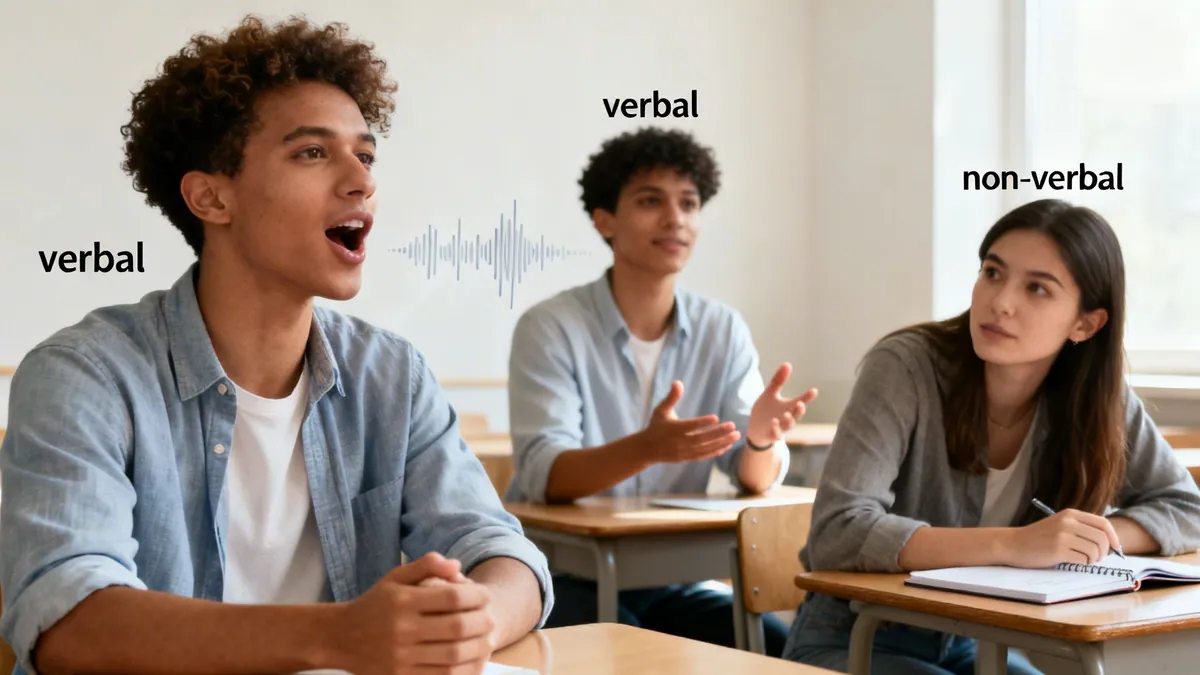
Think of great communication like a three-legged stool. For it to be steady and strong, all three legs—verbal cues, non-verbal signals, and active listening—need to be in place. When we teach kids how to use all three, they don’t just get better at talking; they get better at connecting. Let’s break down what each of these elements looks like in the classroom and at home.
Verbal Communication: The Music Behind the Words
When we talk about verbal communication, it’s easy to get hung up on just the words themselves. But the real magic is in how we say them. The “music” behind our words—our tone of voice, volume, and speed—often says more than the words do.
A child who mumbles a quick "I'm sorry" isn't communicating the same thing as a child who says it clearly and sincerely. The first feels like a chore, while the second shows they actually understand their impact. Helping kids tune into this verbal music is a huge first step toward more meaningful conversations.
Practical Example: A student, Leo, is getting frustrated during a group project because he feels his ideas aren't being heard.
- Ineffective Communication: He throws his hands up and yells, "You guys never listen to me!" His loud volume and sharp tone immediately make his group defensive. The conversation shuts down.
- Effective Communication: His teacher pulls him aside and prompts him to try again, this time focusing on his tone. Leo takes a breath and says, "Hey, I have an idea I'm excited about. Could we talk it through for a minute?" His calm, inviting language opens the door for collaboration instead of closing it with conflict.
Non-Verbal Communication: The Silent Language
So much of what we communicate happens without a single word. Non-verbal communication is the silent language of facial expressions, gestures, posture, and eye contact. These signals are powerful because they often reveal our true feelings, sometimes even more honestly than our words.
In fact, some research suggests that body language can carry as much as 55% of a message’s total meaning.
A student slumping in their chair could be bored, sure. But they might also be exhausted, overwhelmed, or even feeling unwell. A classmate who avoids eye contact might not be disinterested—they might just be shy. Teaching kids to notice these cues in others, and to be aware of their own, is a cornerstone of social awareness.
Practical Example: A teacher notices a student, Ava, with her head down on her desk during a lesson.
- Assumption: The teacher might assume Ava is being disrespectful or bored and say, "Ava, sit up and pay attention."
- Reading the Cue: Instead, the teacher walks over quietly and asks, "I notice you have your head down. Is everything okay?" Ava explains she has a headache. The teacher's approach, based on reading a non-verbal cue, leads to support instead of conflict.
Active Listening: More Than Just Hearing
The final piece of the puzzle is active listening. This is worlds away from just passively hearing noise while waiting for your turn to talk. Active listening is a full-body sport—it’s the conscious effort to understand, process, and respond to what someone is really saying. It sends a clear message: "I'm with you, and you matter."
For students, this means learning to pause their own thoughts and truly absorb what a peer is sharing. The key skills involved are:
- Reflecting: Paraphrasing what they heard to make sure they got it right. For example, "So, it sounds like you're feeling frustrated because the rules seem unfair?"
- Asking Clarifying Questions: Digging a little deeper instead of jumping to conclusions. For instance, "When you say he 'always' takes the ball, can you tell me more about that?"
- Showing Engagement: Using non-verbal cues to show they're tuned in—nodding, making eye contact, and putting away distractions.
Practical Example: A child, Maya, comes home looking defeated and says, "Nobody played with me today."
- Passive Hearing: A busy parent, focused on making dinner, might reply, "Oh, that's a shame. You'll play with them tomorrow." The conversation ends there, leaving Maya feeling unheard.
- Active Listening: The parent pauses what they're doing, turns to face Maya, gets down on her level, and says, "That sounds like it felt really lonely at recess today. What happened?" This response validates Maya's feelings and opens the door for a real, supportive conversation.
When we teach children to listen this way, we give them an incredible tool for building empathy and resolving conflicts on their own. To get your students practicing this skill, check out our guide with a fun and simple active listening activity.
How Communication Fuels Social-Emotional Learning
We often talk about social-emotional skills and communication skills as separate things. But in reality, they’re deeply intertwined. Think of it this way: interpersonal communication isn't just another skill to learn; it's the very current that makes social emotional learning (SEL) come to life in the classroom and on the playground.
The five core SEL competencies—self-awareness, self-management, social awareness, relationship skills, and responsible decision-making—are the building blocks. But communication is the mortar that holds them all together.
A student might feel a surge of frustration (self-awareness), but if they can't express that feeling constructively, it stays bottled up. That's when we see disruptive outbursts or silent withdrawal. Effective communication is the bridge between knowing an emotion and managing it successfully.
Connecting Communication to SEL Competencies
To see how this works in a real-world scenario, let's imagine a classic playground disagreement. Maria and Sam are in the middle of a kickball game when they hit a snag over the rules. How this little conflict plays out depends entirely on their ability to communicate.
- Self-Awareness: Maria feels her face get hot. She recognizes that she's angry because she believes Sam isn't playing by the rules they agreed on.
- Self-Management: Her first impulse is to yell, "That's not fair!" Instead, she takes a deep breath to calm that initial flash of anger, giving herself a moment to think.
- Social Awareness: Sam looks over and sees Maria's clenched fists and tight expression. He reads her non-verbal cues and realizes she's genuinely upset, which makes him more willing to listen instead of just getting defensive.
- Relationship Skills: Using an "I-statement," Maria starts the conversation. "I feel frustrated when the rules seem to change mid-game." Sam, in turn, asks a clarifying question: "What rule do you think I broke?" This simple exchange keeps the friendship intact.
- Responsible Decision-Making: They talk it out and agree on a clear rule for the rest of the game that everyone can stick to. They solved a problem together instead of letting it ruin recess.
Without the ability to name a feeling, listen to a friend, and negotiate a solution, none of these SEL skills could have been put into practice. The two are fundamentally linked.
Fostering a Supportive School Environment
When schools make teaching these communication skills a priority, the ripple effect goes far beyond one playground moment. It begins to shape the entire school culture into a place where students and staff feel seen, heard, and valued.
That sense of value is a powerful thing. While the data comes from the corporate world, a Gallup study found that when people feel more valued, productivity can increase by 12% and turnover can be cut by 27%. The principle holds true in schools: a climate built on strong interpersonal skills and respect leads to less isolation and a more engaged, supportive community for everyone.
Interpersonal communication is the thread that weaves the five SEL competencies together. By teaching students how to articulate their feelings, listen with empathy, and solve problems together, we are not just teaching them to be better communicators—we are nurturing emotionally intelligent and resilient human beings.
This table breaks down exactly how specific communication skills support the development of core SEL competencies in everyday classroom life.
Connecting Communication Skills to SEL Competencies
| SEL Competency | Associated Interpersonal Skill | Classroom Example |
|---|---|---|
| Self-Awareness | Identifying and naming emotions. | A student says, "I'm feeling nervous about the presentation," instead of just being quiet or getting a stomach ache. |
| Self-Management | Using a calm tone of voice. | A student takes a breath before responding to a frustrating comment from a peer, instead of yelling back. |
| Social Awareness | Active listening and observing non-verbal cues. | A child notices a classmate is sitting alone with their head down and asks, "Are you okay? You look sad." |
| Relationship Skills | Giving and receiving constructive feedback. | During a group project, one student says, "I like that idea, and what if we also added this?" instead of "That's a bad idea." |
| Responsible Decision-Making | Negotiating and finding a compromise. | Two students who both want the same book agree to take turns, with one reading the first chapter and then swapping. |
As you can see, these aren't abstract academic concepts. They are small, teachable moments that happen every single day.
Actionable Ways to Teach Communication in the Classroom
Theory is one thing, but putting it into practice is where students really start to get what interpersonal communication is all about. For us as educators, this means weaving intentional strategies into the daily fabric of our classrooms. These simple, actionable methods make abstract concepts like empathy and active listening feel real, giving kids the tools they need to connect, collaborate, and navigate conflicts.
The goal isn't to add another subject to an already packed schedule. It's about integrating these skills into the activities you're already doing. When we do this, learning feels natural and reinforces the idea that good communication is something we practice all the time—not just during a special lesson.
Start with Safe and Structured Sharing
Morning Meetings or daily check-ins are the perfect place to build a foundation of trust and practice core communication skills. By creating a predictable and safe space for sharing, you lower the stakes for quieter students and set a positive, connected tone for the entire day.
Here are a few ways to focus these moments on communication:
- Practice Compliments: Dedicate one meeting a week to giving and receiving genuine compliments. First, model how to be specific. Instead of a generic, "You're nice," try something like, "I really appreciated how you included me in the game at recess today." This teaches students to notice and name specific positive behaviors.
- Ask Open-Ended Questions: Encourage students to ask questions that invite more than a "yes" or "no" answer. Prompt them with starters like, "Tell me more about…" or "What was your favorite part of…" This simple shift teaches them to show curiosity and helps deepen their conversations. For example, instead of asking, "Did you have a good weekend?" ask, "What was something fun you did this weekend?"
Teach Students to Own Their Feelings with I-Statements
One of the most powerful tools you can give a child is the "I-Statement." This simple sentence structure is a game-changer. It helps students own their feelings without placing blame, which can instantly turn a potential conflict into a productive conversation. The focus shifts from accusing someone else to simply expressing a personal feeling or need.
An I-Statement has a simple formula: "I feel [emotion] when [situation] because [reason]." This structure empowers students to articulate what's happening inside them, clearly and calmly.
Practical Example: A disagreement over supplies.
- Without an I-Statement (Blaming): A student might yell, "You always take my markers without asking!" This is an accusation, and it's guaranteed to make the other child defensive.
- With an I-Statement (Explaining): The student says, "I feel frustrated when my markers are gone from my desk because I can't finish my drawing." This version clearly states the emotion and the impact without attacking the other person, opening the door for a solution.
When you consistently model and encourage I-Statements, you're giving students a script for navigating those tricky moments. It's a small change in language with a massive impact. To help your students get comfortable with this, you can explore various activities for building communication skills.
Use Activities to Practice Active Listening
Active listening isn't a passive skill; it requires explicit instruction and plenty of practice. A fantastic way to do this is through structured activities that you can easily adapt for different grade levels. Below is a sample lesson outline you can tweak for your own classroom.
Sample Lesson: The "Talking Stick" and Structured Debates
The core idea is simple: only the person holding a specific object (the "talking stick") is allowed to speak. This physically enforces the concept of taking turns and truly listening without interrupting.
For K-2 Students (Talking Stick):
- Gather students in a circle and introduce a special object as the talking stick.
- Pose a simple question, like, "What is your favorite thing to do on the weekend?"
- The student holding the stick shares their answer. They then pass it to another student, who must first say, "I heard you say that you like…" before sharing their own answer. This small step reinforces the listening component.
For 3-5 Students (Building on the Concept):
- Use the talking stick for more complex topics, such as, "What makes a good friend?"
- After one student speaks, the next must ask a clarifying question about what they shared before offering their own opinion. For example, "You said being honest is important. Can you give an example of that?"
For 6-8 Students (Structured Debates):
- Evolve the talking stick into a more formal debate on a relevant topic (like school uniforms or social media rules).
- Assign students to "pro" and "con" sides. Each speaker gets a set amount of time to make their point.
- Before offering a rebuttal, the opposing side must accurately summarize the previous speaker's argument. This ensures they were listening to understand, not just to respond.
This infographic really shows how these communication skills directly fuel the key areas of social-emotional learning.
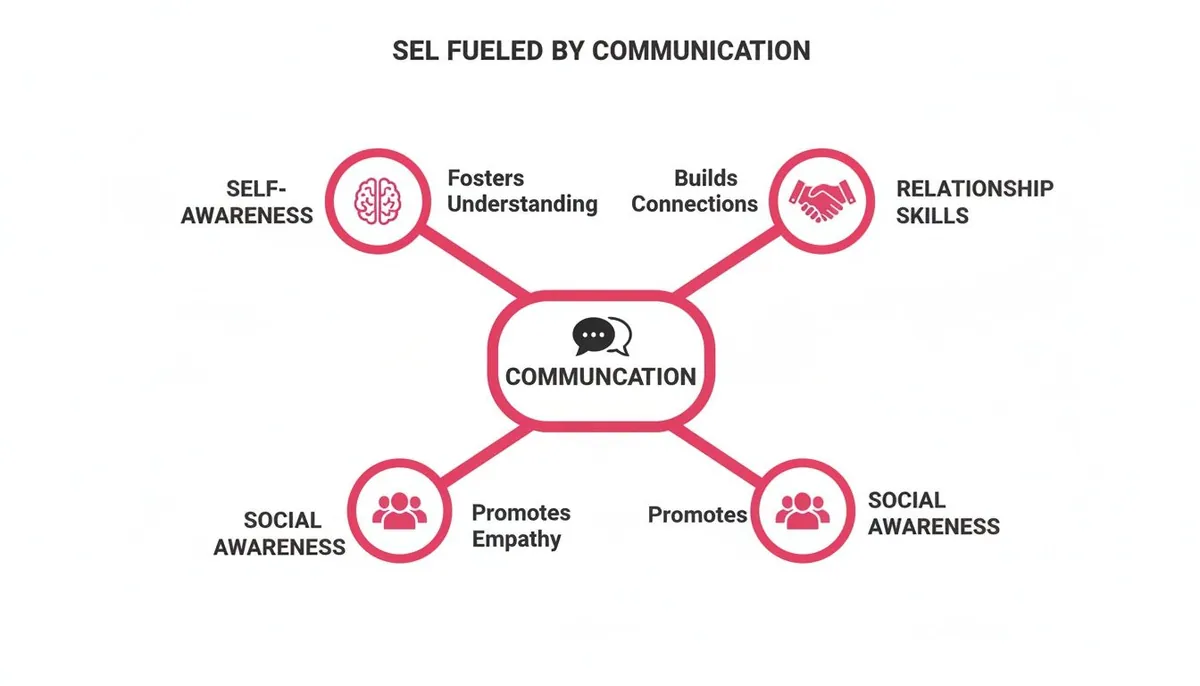
As you can see, strong communication acts as the central hub connecting self-awareness, social awareness, and relationship skills. Without it, real social-emotional growth just isn't possible. These classroom strategies are so vital because they prepare students for a future where clear and empathetic interaction is everything. A 2023 report found that knowledge workers spend up to 38.9 hours every week on communication, yet 44% feel dissatisfied with their tools, leading to huge productivity losses. By teaching these skills early, we help students avoid those same struggles in their future academic and professional lives.