

A Parent’s Guide to I Statements for Kids

“I-statements” are a simple but incredibly effective communication tool that helps kids voice their feelings without pointing fingers. Think about the difference between a child saying, “You made me mad,” versus, “I feel mad when you take my toy.” That tiny shift is a cornerstone of social-emotional learning, empowering kids to own their feelings and start a conversation instead of a fight.
The Power of ‘I Feel’ Over ‘You Did’
When a child feels hurt or wronged, the first instinct is often to blame. You’ll hear phrases like “You’re so mean!” or “You always ruin everything!” While these words definitely get the frustration across, they also immediately put the other person on the defensive. Conflict escalates, and resolution feels impossible.
This is where teaching I-statements becomes a total game-changer.
The whole idea is to switch from accusation to expression. By starting with “I feel,” a child is sharing their internal experience—something that’s undeniably true for them—rather than passing judgment on someone else. This simple change helps build several key skills:
- Builds Self-Awareness: It forces a pause, helping kids identify what they’re actually feeling before they react.
- Promotes Empathy: When a friend hears how their actions made someone else feel, it offers a window into another person’s perspective.
- De-escalates Conflict: It’s a lot harder to argue with “I feel sad” than it is with “You’re a bad friend.”
- Encourages Responsibility: Kids learn to take ownership of their emotions instead of making others responsible for how they feel.
From ‘You-Blame’ to ‘I-Feel’ Statements
Let’s look at how this shift works in real-world kid conflicts. It’s often easier to see the difference side-by-side. The goal is to move from an attack that shuts down communication to an invitation that opens it up.
| Common Conflict | Problematic ‘You Statement’ | Empowering ‘I Statement’ |
|---|---|---|
| Being Left Out | “You never let me play with you!” | “I feel sad when I’m left out of the game.” |
| Sharing Toys | “You’re so selfish for not sharing!” | “I feel frustrated when I can’t have a turn.” |
| Unkind Words | “You’re being mean to me.” | “I feel hurt when you say things like that.” |
| Broken Promises | “You always break your promises!” | “I feel disappointed when you don’t do what you said you would.” |
Seeing these examples makes it clear how “I-statements” can completely change the tone of a disagreement, turning a potential fight into a moment for understanding.
A Foundational Skill for Life
This isn’t just some clever script to memorize; it’s a core component of healthy relationships and emotional intelligence. Picture a classroom where a student can confidently say, “I feel sad when I’m not included in the game,” instead of shoving another child or withdrawing in silence. That’s the power of I-statements in action.
Research backs this up. Social-emotional learning (SEL) programs, which lean heavily on tools like this, have been shown to significantly improve student outcomes. In fact, schools with strong SEL curricula can see a reduction in disruptive behaviors by up to 20-30%, creating a more positive and collaborative learning environment.
By teaching children to speak from their own experience, we give them a tool to navigate disagreements constructively. It transforms a potential fight into an opportunity for connection and understanding.
From the Playground to the Boardroom
Mastering this skill early really does set kids up for future success. Knowing how to express yourself clearly and respectfully is fundamental to effective communication and builds broader diplomacy skills for students. This approach teaches kids that their feelings are valid and gives them a constructive way to share them, which in turn builds confidence and resilience. It’s a skill that will serve them on the playground, in the classroom, and one day, in their adult relationships and careers.
Ultimately, weaving I-statements into daily language helps create an environment where kids feel heard and respected. This small linguistic shift makes a massive impact, paving the way for more peaceful and effective communication.
If you’re looking for more ways to help children resolve disagreements, check out our guide on conflict resolution for kids.
The Four-Part Formula for Effective I-Statements
Think of a good I-statement like a recipe. When you add all the right ingredients in the right order, you get a much better result. We can break down powerful I-statements for kids into a simple, four-part formula that takes the guesswork out of clear communication.
This structure helps kids organize their thoughts and express themselves without falling back on blame, which almost always shuts down a conversation. It’s about shifting communication from accusation to connection.
This visual shows exactly that—the shift from a “You-Blame” approach that creates conflict to an “I-Feel” approach that opens the door for understanding.
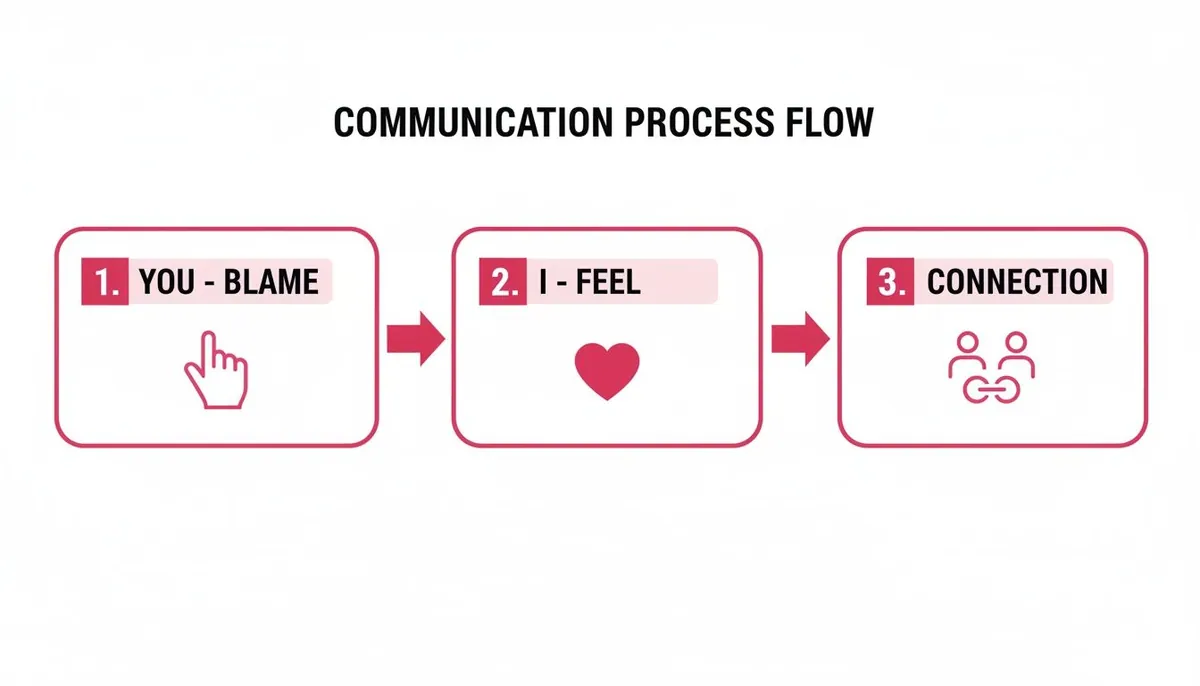
By focusing on personal feelings (“I”) instead of accusations (“You”), children invite empathy and problem-solving rather than making the other person defensive.
Part 1: Start with Your Feeling
The first step is simply to name the emotion. It sounds easy, but it requires a child to hit the pause button and figure out what’s really going on inside. Our goal is to help kids build a rich emotional vocabulary that goes way beyond just “mad,” “sad,” or “happy.”
For instance, instead of just “mad,” a child might feel frustrated, annoyed, or irritated. Instead of “sad,” they might be feeling lonely, disappointed, or hurt.
- Practical Example: “I feel frustrated…”
- Practical Example: “I feel lonely…”
- Practical Example: “I feel annoyed…”
Using more specific words gives the other person a much clearer picture of the situation’s emotional weight. You can find more ideas for helping kids name their feelings in our other communication skill activities.
Part 2: Describe the Specific Behavior
This is probably the most crucial—and toughest—part of the formula. The key is to state the observable action that triggered the feeling, not a judgment or assumption about why the other person did it.
Think of it like being a video camera recording exactly what happened. A camera sees someone talking while another person is speaking; it doesn’t see someone “being rude.”
-
Avoid Judgment: “when you are mean.”
-
Stick to Facts (Practical Example): “when you call me a name.”
-
Avoid Generalizations: “when you never share.”
-
Stick to Facts (Practical Example): “when you don’t offer me a turn with the controller.”
-
Avoid Assumptions: “when you ignore me on purpose.”
-
Stick to Facts (Practical Example): “when you walk away while I’m talking.”
Sticking to a specific, observable behavior keeps the listener from feeling attacked and focuses the conversation on a single, solvable action.
Part 3: Explain the Impact on You
The “because” part of the statement is where the magic happens—it’s where empathy is built. This piece explains why the behavior led to the feeling, connecting the action to its consequence. It helps the other person understand the reasoning behind the emotion.
This step essentially answers the silent “So what?” that can hang in the air after someone states a feeling. It makes an abstract emotion feel concrete and real.
Key Takeaway: The ‘because’ clause is the bridge to understanding. It helps the other person see the situation from your child’s perspective, making it more likely they will want to help find a solution.
Let’s build on our earlier examples with practical scenarios:
- Practical Example: “I feel frustrated when you don’t offer me a turn with the controller because I’ve been waiting a long time and thought we agreed to share.“
- Practical Example: “I feel lonely when I’m not invited to sit at the lunch table because it makes me feel like I don’t have any friends.“
- Practical Example: “I feel hurt when you call me a name because words like that stick in my head and make me feel bad about myself.“
This adds depth and a little vulnerability, inviting the other person to connect with the speaker’s experience instead of just reacting to a demand.
Part 4: Make a Positive Request
The final piece is stating what you need. This isn’t a demand. It’s a clear, positive, and actionable request for what would help fix things. The secret is to ask for what you want, not just for what you want to stop.
Framing the need positively is a game-changer. A negative request (“Stop doing that!”) can still sound like a criticism, while a positive one (“Could we try this instead?”) invites teamwork.
-
Negative Request (Avoid): “I need you to stop hogging the game.”
-
Positive Request (Use/Practical Example): “I need us to set a timer so we both get a fair turn.”
-
Negative Request (Avoid): “Stop being so mean.”
-
Positive Request (Use/Practical Example): “I need you to use my real name instead of calling me names.”
Here are the full, four-part statements, all put together in practical examples:
- Practical Example: “I feel frustrated when you don’t offer me a turn with the controller because I’ve been waiting a long time and thought we agreed to share. I need us to set a timer for turns.”
- Practical Example: “I feel lonely when I’m not invited to sit at the lunch table because it makes me feel like I don’t have any friends. I need you to save me a seat sometimes.”
- Practical Example: “I feel hurt when you talk over me during my presentation because it makes me feel like my ideas aren’t important. I need to be able to finish my thoughts without being interrupted.”
This complete formula gives kids a clear, respectful, and effective roadmap for communication that empowers them to solve problems together.
Teaching I Statements with Age-Specific Scenarios
Kids’ emotional worlds and communication skills change dramatically as they grow up. The way you’d teach a four-year-old is completely different from how you’d approach a fourteen-year-old, right? That’s why teaching I statements for kids can’t be a one-size-fits-all lesson. It requires a flexible strategy that meets them right where they are, developmentally speaking.
Forget handing them a generic script to memorize. The real goal is to offer them tools that feel natural and genuinely useful for the social challenges they’re actually facing, whether that’s in the sandbox or on social media.
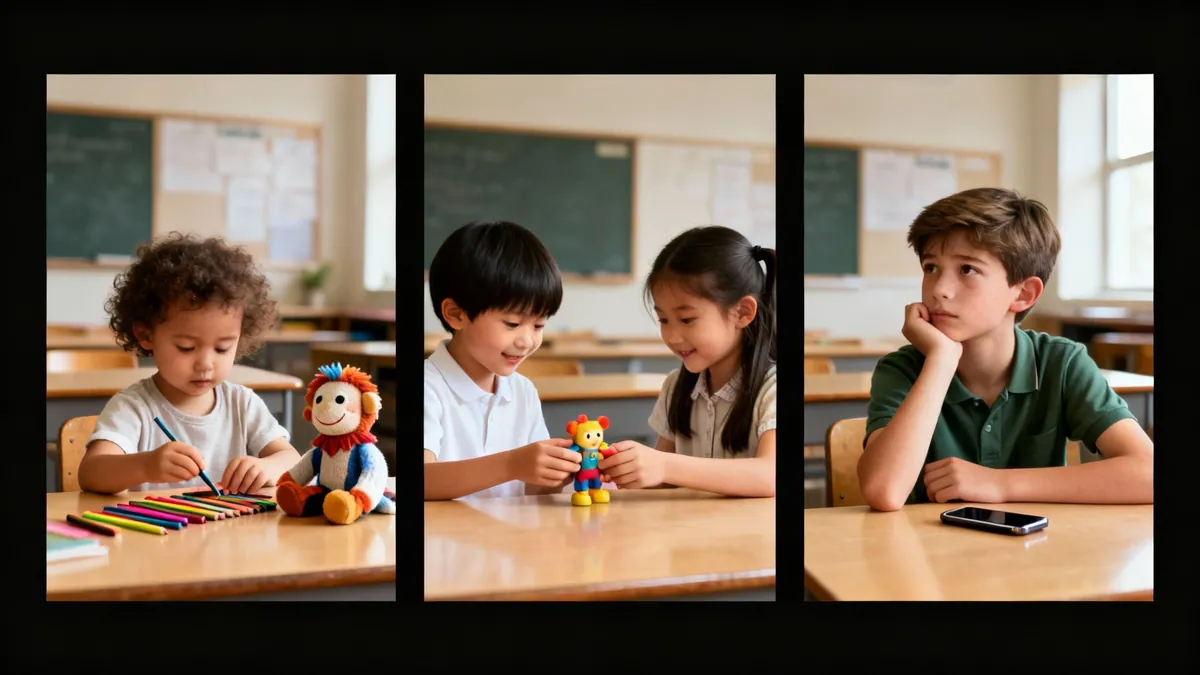
This age-differentiated method empowers children with language that feels relevant, making the skill less like a formula and more like a real way to express themselves.
Preschoolers: Simple and Concrete Language
At this age, emotions are HUGE, but the words to describe them are still pretty new. The goal here is to keep it simple and direct. We can introduce a shortened, two-part I-statement that clearly connects a feeling to a specific thing that happened.
For this age group, the most effective formula is straightforward: “I feel [feeling] when [action].”
To make this idea stick, bring in visual aids like feelings charts with smiley, sad, and angry faces. Puppets are another fantastic tool for acting out different situations in a playful, low-stakes way. Repetition and connecting the words to physical experiences are everything.
Practical Examples for Preschoolers:
- Sharing a Toy: Instead of a child yelling, “He’s hogging the blocks!”, you can gently model: “I feel sad when you take the blue block because I was using it.”
- Unwanted Physical Contact: Rather than a shove or a frustrated cry, guide them toward saying: “I feel upset when you push me because it hurts my body.”
- Being Ignored: Help them find the words for that left-out feeling: “I feel lonely when you run away from me during playtime.”
- Clean-up Time: Instead of “You’re messy!”, try: “I feel frustrated when the toys are left on the floor.”
With preschoolers, the adult’s role is to provide the script and patiently coach them through it. Your consistent modeling is the most powerful tool you have. If you’re looking to expand your child’s emotional vocabulary, our guide on naming feelings and helping kids find the words they need is a fantastic resource to start with.
Elementary Students: Adding ‘Because’ and ‘I Need’
By the time kids hit elementary school, they can handle more complexity. They’re starting to understand cause and effect, and they can grasp how their actions impact others. This is the perfect time to introduce the full four-part I-statement formula.
Their social worlds are also way more intricate now. Friendships, playground politics, and classroom dynamics bring a whole new set of challenges. This is where the “because” and “I need” parts of the statement become so important—they help kids not only express feelings but also start thinking about solutions.
This is where the skill shifts from simply naming an emotion to actively solving a problem. By stating a need, kids learn to advocate for themselves respectfully and invite cooperation.
Practical Scenarios for Elementary Kids:
- Feeling Left Out at Recess: “I feel left out when you and Sara run off to play without asking me because it makes me think you don’t want to be my friend anymore. I need us to make a plan to play together at the start of recess.”
- Frustration with a Sibling: “I feel frustrated when you come into my room and take my things without asking because then I can’t find them when I need them. I need you to ask me first.”
- Hurtful Words: “I feel hurt when you make a joke about my new glasses because it makes me feel embarrassed. I need you to stop making comments about how I look.”
- Group Work in Class: “I feel worried when we wait until the last minute to do our project because I’m afraid we won’t finish. I need us to make a schedule to get the work done on time.”
The value of teaching I statements at this age is backed by decades of research in Social Emotional Learning (SEL). When a 7-year-old can say, “I need space because I’m feeling overwhelmed,” they are practicing a core SEL skill that helps them own their emotions without blame. Since its formation in 1994, CASEL has embedded these concepts into core SEL components. In fact, they are present in over 70% (10 of 14) of evidence-based elementary programs. Research shows SEL leads to academic gains of up to 11 percentile points, a 23% reduction in emotional distress, and a 9% drop in conduct problems. With 76% of U.S. schools using formal SEL in 2021-2022, this approach is clearly making an impact. You can explore the full report on SEL in U.S. schools and its impact to learn more.
Middle Schoolers: Navigating Complex Social Dynamics
Tweens and young teens are dealing with a whole new level of social pressure. Their conflicts are more nuanced, often tangled up in group dynamics, social media drama, and a huge fear of embarrassment. For this age group, I statements become a vital tool for navigating friendships and setting boundaries with integrity.
The biggest challenge is getting them to actually use the skill without it sounding robotic or “lame.” Encourage them to find their own words while sticking to the core principles: own your feelings and don’t place blame. Role-playing is incredibly powerful here, as it gives them a safe space to practice before trying it out with their peers.
Practical Scenarios for Middle Schoolers:
- Social Media Drama: “I feel really stressed out when I see comments about me in the group chat because it feels like everyone is talking behind my back. I need you to talk to me directly if you have a problem.”
- Group Project Frustrations: “I feel overwhelmed when I end up doing most of the work for our project because it doesn’t seem fair. I need us to sit down and divide up the remaining tasks equally.”
- Responding to Peer Pressure: “I feel uncomfortable when you keep asking me to skip class because I’m worried about getting in trouble. I need you to respect my decision to say no.”
- Feeling Unheard by a Friend: “I feel ignored when I’m telling you about my day and you’re on your phone the whole time because it makes me feel like you don’t care about what I’m saying. I need you to listen to me when we’re talking.”
By tailoring your approach to each stage of development, you give kids practical and relevant communication tools they can use for the rest of their lives.
Making I-Statements a Daily Habit
Learning the I-statement formula is one thing, but the real magic happens when this way of communicating becomes second nature. The goal isn’t to create a rigid script kids have to follow; it’s to weave this language into everyday moments until it becomes a genuine habit. For that to happen, consistency and adult modeling are everything.
Showing kids how it’s done is far more powerful than just telling them. When adults use I-statements to talk about their own feelings and needs, children see the tool in action. They learn that expressing emotions respectfully isn’t just for conflict resolution—it’s a normal and effective way to connect with others.

Weaving I-Statements into Home Life
At home, opportunities to model and practice I-statements pop up all the time. Sibling squabbles, chore negotiations, and setting simple boundaries are perfect moments to steer the conversation toward healthier communication. Instead of playing referee, you get to be a communication coach.
Here are a few practical ways to embed this habit in the real world:
- During Sibling Disputes: When one child yells, “He won’t share!”, you can gently guide them by asking, “How does that make you feel inside? Can you try an I-statement to tell him?” A practical prompt could be: “Try saying, ‘I feel frustrated when I can’t get a turn.'”
- Setting Boundaries Around Chores: Model it yourself. Instead of, “You never clean up your mess,” try something like, “I feel stressed when toys are left on the floor because it makes the room feel chaotic and hard to clean. I need us to work together to put them away before dinner.”
- Dinner Table Check-ins: Make sharing feelings a low-pressure part of your routine. You could ask, “What was something today that made you feel proud?” or “Did anything happen that made you feel frustrated?”
- Responding to Backtalk: Instead of “Don’t use that tone with me,” try modeling a response like: “I feel disrespected when you use that tone of voice because it makes it hard for me to listen to what you’re saying. I need you to speak to me calmly.”
By consistently prompting and modeling, you’re building emotional muscle memory. If you’re looking for more ideas on establishing positive patterns, check out our guide on creating routines that help kids feel emotionally grounded.
Creating a Culture of Respect in the Classroom
Teachers have a unique opportunity to make I-statements a core part of the classroom culture. When this language is used daily, it can dramatically reduce minor conflicts and build a much stronger sense of community. Visual reminders and dedicated practice time are key here.
Creating an “I-Statement Anchor Chart” with the four-part formula and posting it in a visible spot gives students a quick reference point. This simple visual cue can help them recall the steps when they feel overwhelmed by a big emotion.
Practical Conversation Starter Prompt: “It looks like you two are having a tough time. Can we pause and try using our I-statements to figure out what’s happening?”
This simple prompt shifts the focus from blame to understanding. It empowers students to start solving their own problems. Incorporating I-statements into morning meetings also provides a regular, low-stakes time to practice. You might present a hypothetical scenario—like someone cutting in line or borrowing a crayon without asking—and have students work in pairs to craft an I-statement for it.
The widespread adoption of these tools is part of a larger, positive shift in education. As difficult events in the late 1990s revealed emotional gaps in schools, I-statements for kids became a frontline tool in Social-Emotional Learning (SEL) curricula, teaching students to voice needs safely. After the pandemic, federal relief funds led to a huge spike in usage, with principals reporting a 29-point jump in elementary SEL implementation by 2021. Today, 86% of school leaders connect discipline with emotional growth, directly using tools like I-statements for conflict resolution. Discover more insights about the growth of SEL in U.S. schools.
Navigating Common Roadblocks and Challenges
Teaching I-statements for kids is a huge step forward, but let’s be real—communication is messy. Even with the best tools, you and your child will hit moments where things just don’t go according to plan. Being ready for these bumps in the road is what builds confidence and turns this skill into a resilient tool, not just a formula to ditch when things get tough.