Soul Shoppe's work is made possible by donors and partners who care deeply about the young people in their communities! We can't do this work without you. Support our work in classrooms and on playgrounds across the nation by donating here.
A disagreement over a shared toy. Hurt feelings after a comment at recess. A group project that falls apart because no one feels heard. If you work with kids, you’ve seen how fast small moments can turn into tears, silence, blame, or pushing.
Conflict is part of school life. That won’t change. What can change is how students move through it. With practice, a tense moment can become a lesson in listening, problem-solving, empathy, and repair. That’s why conflict resolution activities for students matter so much. They don’t just calm a classroom in the moment. They help children build habits they’ll use in friendships, family life, and future work.
The good news is that you don’t need to wait for a big behavior issue to start. You can teach these skills in morning meeting, partner work, read-aloud discussions, recess support, advisory, and family conversations at home. Many educators also build on essential conflict resolution techniques to create shared language across classrooms.
At Soul Shoppe, we’ve spent more than 20 years helping schools build connected, safe communities through experiential social-emotional learning. One thing we’ve seen again and again is simple: kids rise when adults give them tools, scripts, and steady practice. The ten strategies below aren’t just one-off activities. They’re practical mini-systems you can use from kindergarten through middle school to help students handle conflict with more confidence and care.
1. Peer Mediation Programs
Two students storm in from recess, each talking over the other, each sure they were wronged. The teacher has twenty other children waiting, a lesson to start, and about thirty seconds to decide what happens next. Peer mediation gives schools a middle path between ignoring the conflict and turning every disagreement into an adult-run event.
At its best, peer mediation works like a student version of a good traffic signal. It slows the moment down, creates turns, and helps everyone move more safely. Trained student mediators do not hand out punishments or decide who is telling the truth. They guide a process so classmates can listen, name what happened, and agree on a repair step they can both carry out.
This approach is especially useful for recurring peer conflicts such as exclusion at recess, arguments over shared materials, teasing, friendship strain, and misunderstandings that grow because no one pauses to check the facts. In Soul Shoppe’s 20-plus years of working with schools, we’ve seen that students often accept peer support more readily when the process is clear, supervised, and practiced. It sends a powerful message. Problem-solving belongs to the whole community.
How it looks in practice
A fourth grader and a fifth grader are stuck in a kickball argument. Both want an adult to declare a winner. A trained mediator brings them to a quiet spot and starts with one simple norm:
“One person talks at a time. First, tell what happened from your point of view. Then your classmate gets a turn.”
From there, the mediator might ask, “What part felt unfair?” “What did you want to happen instead?” and “What is one step that would help fix this today?” Those questions shift the conversation from proving a case to solving a problem. For many students, that is the moment the temperature drops.
Peer mediation works best as part of a larger school system. Students need to know which conflicts fit mediation, how to request it, when an adult steps in, and what happens after an agreement is made. Schools often pair mediation with class agreements and follow-up reflection. If you want the repair side of this work to feel stronger, Soul Shoppe shares related practices in its guide to restorative circles in schools and in its guide to conflict resolution for schools.
K-8 differentiation
K-2: Keep it short and adult-supported. Use picture cards for feelings, sentence frames such as “I felt ___ when ___,” and one concrete repair choice.
3-5: Train student mediators to paraphrase, check for understanding, and help peers agree on one next step they can do the same day.
6-8: Add confidentiality guidelines, note-taking, and practice with more layered conflicts such as rumors, shifting friend groups, and online issues that spill into school.
A simple SEL script for training mediators
Start with language students can remember:
“Tell me what happened from your side.”
“What were you feeling at the time?”
“What did you need or want?”
“Now let’s hear the other person.”
“What is one fair step you both agree to next?”
For younger students, shorten it even more. For older students, add, “Can you repeat what you heard before you respond?” That one move often prevents the conversation from sliding back into debate.
Reflection prompts for staff and student mediators
Which conflicts should go to mediation, and which need immediate adult support?
Do students see mediation as fair, private, and helpful?
Are agreements specific enough to follow through on?
What support do mediators need after a tough case?
Peer mediation is one strategy in this larger toolkit. It builds student voice, shared responsibility, and everyday repair skills that support a more peaceful school culture.
2. Restorative Practices, Circles, Community Conferences, and Classroom Practices
It is 10:15 on a Tuesday. Two students are glaring at each other after a recess argument, the rest of the class is watching, and instruction has stalled. In that moment, a consequence alone rarely repairs the room. Students also need a process that helps them name impact, hear one another, and make a clear plan to put things right.
That is the role of restorative practices. They give schools a repeatable way to handle conflict before it grows, during the hard moment, and after harm has happened. A weekly circle, a short partner check-in, and a formal community conference are all part of the same system. The goal is not only to respond to problems. The goal is to teach students how a healthy community repairs strain.
Restorative work shifts the questions adults ask. Instead of focusing only on rule-breaking, teachers guide students to consider who was affected, what each person experienced, and what repair now looks like. That change matters because accountability becomes concrete. Students are not just receiving a consequence. They are practicing responsibility.
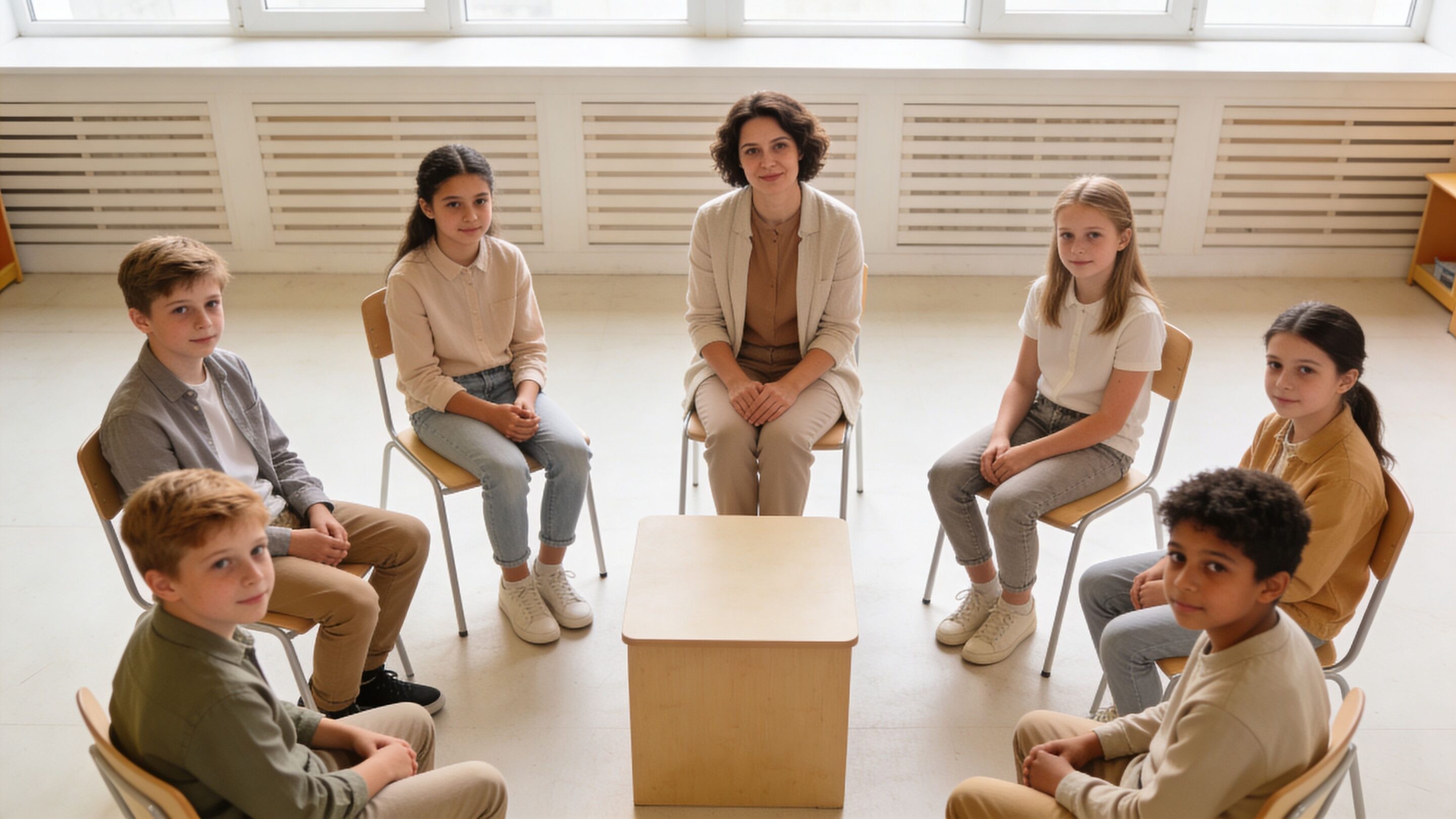
A classroom circle works like a homeroom meeting with more structure and more intention. The format is simple, but the routine does a lot of heavy lifting over time. It builds listening stamina, emotional vocabulary, and trust before students need those skills in a tense conversation. Soul Shoppe shares practical examples of restorative circles in schools that teachers can adapt across grade levels.
A simple classroom circle
Try this in a grade 2 classroom after repeated line-cutting conflicts:
Opening prompt: “What helps you feel respected in a line?”
Middle prompt: “What happens in your body when someone cuts in front of you?”
Repair prompt: “What can our class agree to do next time?”
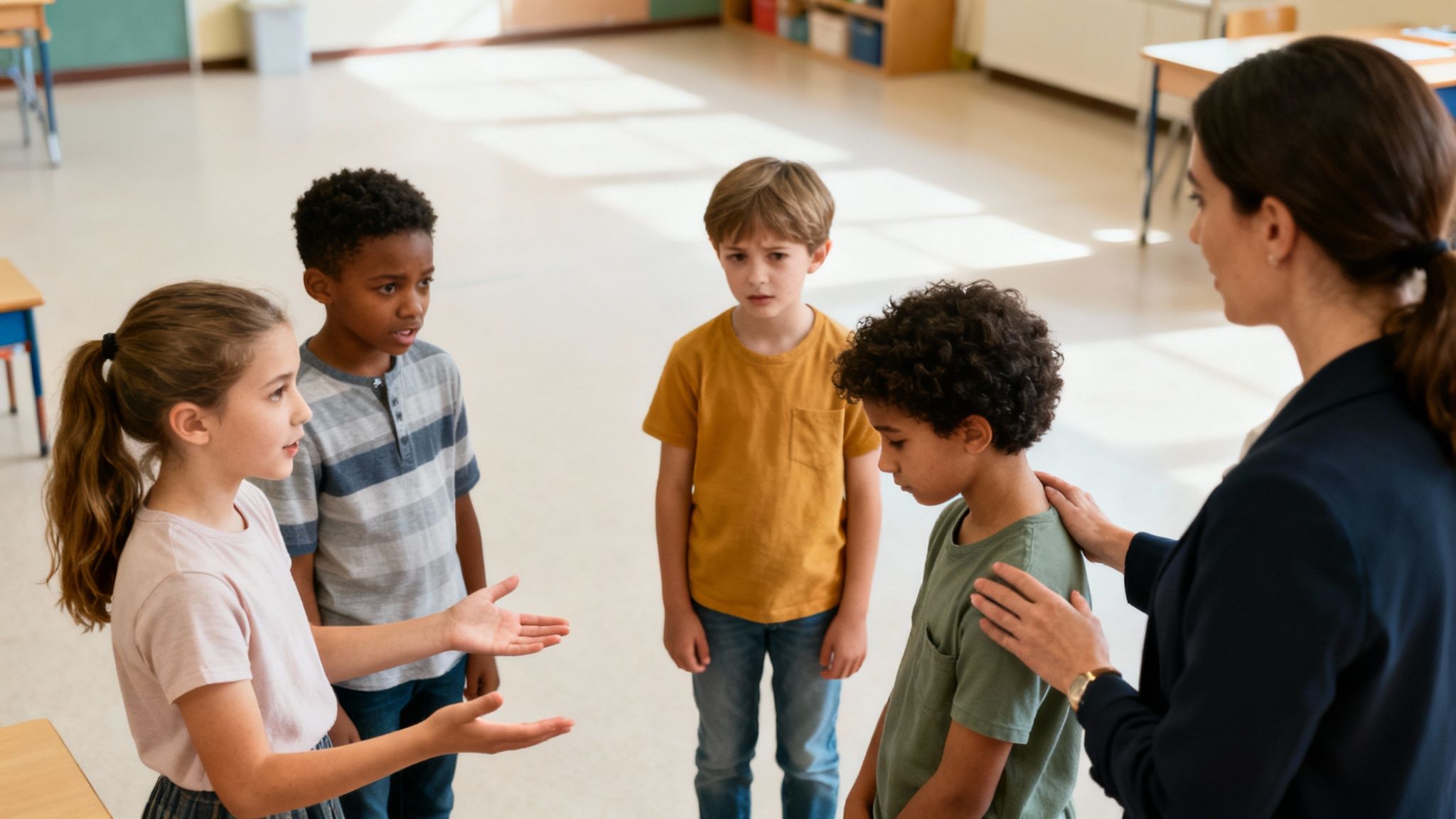
For older students, the structure can widen into a community conference. That might include the student who caused harm, the student affected, a staff member, and a caregiver. The adult’s job is to keep the conversation steady and specific so it stays on impact, responsibility, and repair rather than blame or debate.
Start with low-stakes circles first. Students need practice with turn-taking and honest sharing before they can use circles well during conflict.
A helpful way to picture the progression is this: circles build the classroom soil, and conferences address the specific damage. If the soil is dry, the repair conversation has very little to grow in. That is why schools with strong restorative practice do not treat circles as a one-time activity. They use them as a routine that supports safety, belonging, and honest problem-solving.
Research and practice summaries from the International Institute for Restorative Practices describe stronger relationships and healthier school climate as common outcomes of well-implemented restorative approaches. In Soul Shoppe’s work with schools over more than 20 years, the pattern is familiar. Students are more willing to repair harm when adults have already taught the structure, modeled calm language, and protected everyone’s dignity during the process.
3. Role-Playing and Perspective-Taking Scenarios
Students need rehearsal before real-life conflict shows up. Role-play gives them that rehearsal. It lets them try language, make mistakes, and build confidence while the stakes are low.
A useful role-play isn’t dramatic for drama’s sake. It’s familiar. Two students want the same marker set. One student feels left out of a game. A lab partner takes over the whole assignment. Those are the conflicts kids recognize.
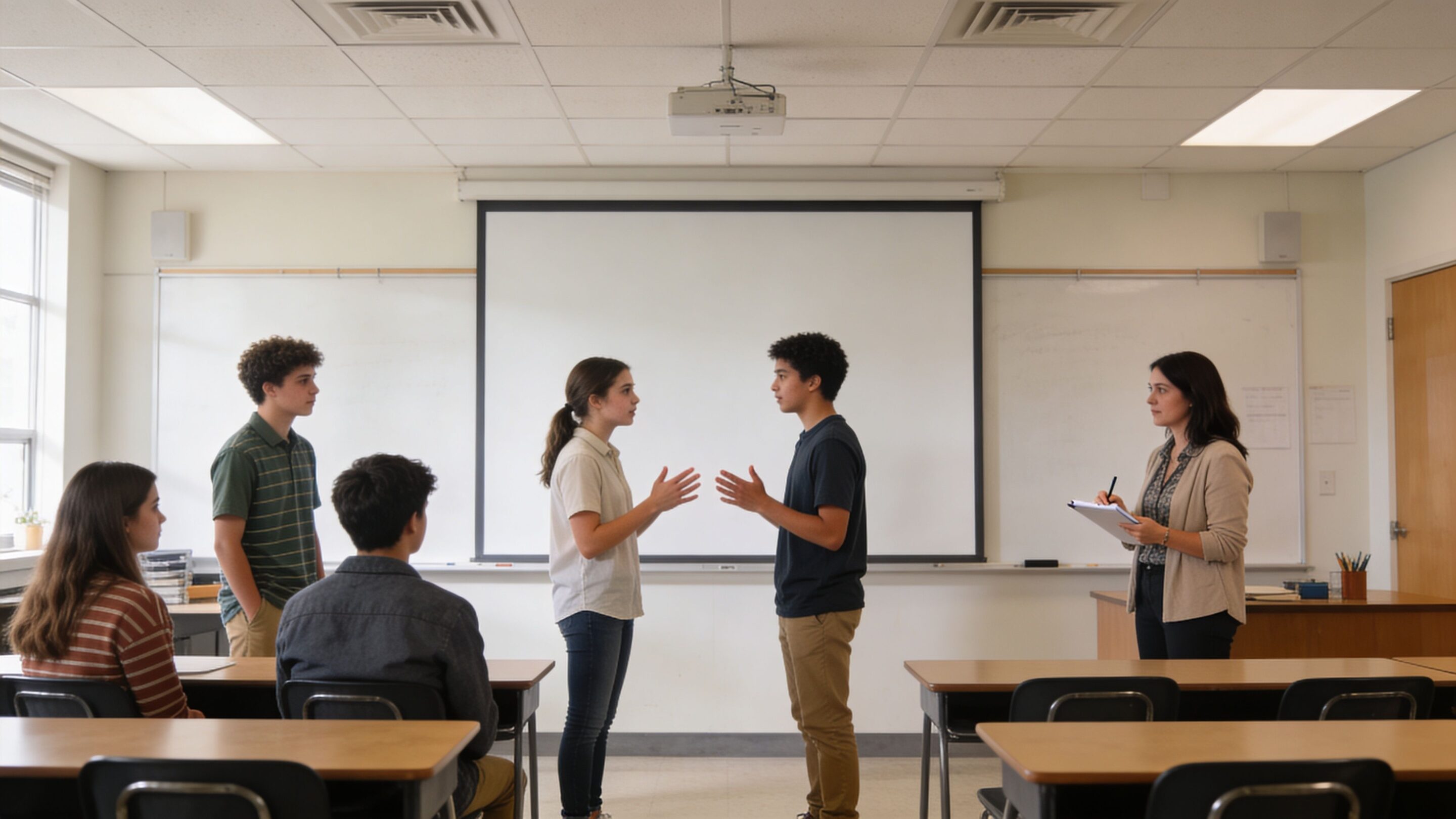
A role-play format that works
Use three roles:
Student A
Student B
Coach or observer
Give the observer a job. They listen for one thing, such as interrupting, blaming language, or whether each student offered a solution. That makes the debrief much sharper.
Try these sentence starters:
“When that happened, I felt…”
“What I needed was…”
“Next time, could we…?”
“Let me say back what I heard.”
In primary grades, use puppets, stuffed animals, or character cards. In upper elementary and middle school, ask students to switch roles halfway through so they must argue the other person’s side. That’s where empathy often clicks.
Here’s a classroom video you can use as a discussion starter before students practice.
Reflection prompts
After each role-play, ask:
What words helped lower the heat?
Where did the conflict get worse?
What would you try differently in a real situation?
This kind of practice is especially promising in digital and gamified environments too. Analysis of 16,597 players in the FLIGBY serious game found improvements in conflict recognition, decision-making, and self-awareness through simulated scenarios.
4. Social Emotional Learning Curriculum Integration
A familiar classroom moment. Two students argue over materials during science. The teacher helps them settle it, but by lunch the same pattern shows up again with different students, different words, same stuck cycle.
That is why conflict resolution grows faster when it lives inside the school day instead of sitting in a once-a-month lesson. Students need repeated practice, in real contexts, with the same language showing up across classrooms, recess, advisory, and family communication. Over time, those skills start to work like a shared map. Children know where to go when feelings rise.
Integrated SEL gives students more than a reminder to “be nice” or “use your words.” It teaches the building blocks underneath conflict. Naming feelings. Noticing body signals. Listening for the other person’s perspective. Asking for what you need without blame. Repairing harm after a hard moment.
What integration can look like across the day
In kindergarten, that might mean using picture cards for words like “frustrated,” “left out,” and “proud” during morning meeting, then returning to those same words during play-based conflicts.
In grades 3 to 5, a teacher might pause a group project and ask, “What skill would help this group right now. Taking turns, listening, compromise, or repair?” Students begin to connect the lesson to the moment, which is where transfer happens.
In middle school, advisory can become a steady practice space for friendship conflict, digital communication, boundary setting, and problem-solving scripts. The key is repetition with adult modeling, not a single polished lesson.
Programs such as Second Step, PATHS, and Responsive Classroom are often used this way. What matters most is that the adults share language, protect time for practice, and reinforce the same skills outside the SEL block. Soul Shoppe has seen this pattern across more than 20 years of building connected and safe school communities. Students use conflict tools more consistently when the whole campus treats SEL as part of how school works, not an extra program on the side.
Practical rule: If adults are not using the same phrases students are learning, students usually stop using them under stress.
A simple planning test can help. Ask, “Where will students learn this skill, where will they practice it, and where will they use it during a real problem?” If a school can answer all three, integration is taking root.
For schools comparing approaches, Soul Shoppe shares helpful implementation questions in its guide to social-emotional learning programs for schools. Research summarized by CASEL on schoolwide SEL points to stronger student relationships, better emotion management, and improved academic engagement when these skills are taught intentionally and reinforced across the school environment.
5. Conflict Resolution Think-Pair-Share and Discussion Protocols
Not every student is ready to process conflict out loud in front of a class. Think-pair-share gives them time to collect their thoughts first. That pause alone can prevent shutdown or escalation.
This strategy is simple. Students think privately, talk with one partner, then share with a larger group if they’re ready. Because the first step is quiet reflection, more students can participate thoughtfully.
Try this with a real conflict theme
Prompt: “Two students both think the other one was rude during partner work. What could each student say to start repairing the problem?”
Give students one minute to write or draw. Then ask them to turn to a partner and compare ideas. Finally, invite a few responses to the group and chart the language that sounds respectful and clear.
Useful protocols include:
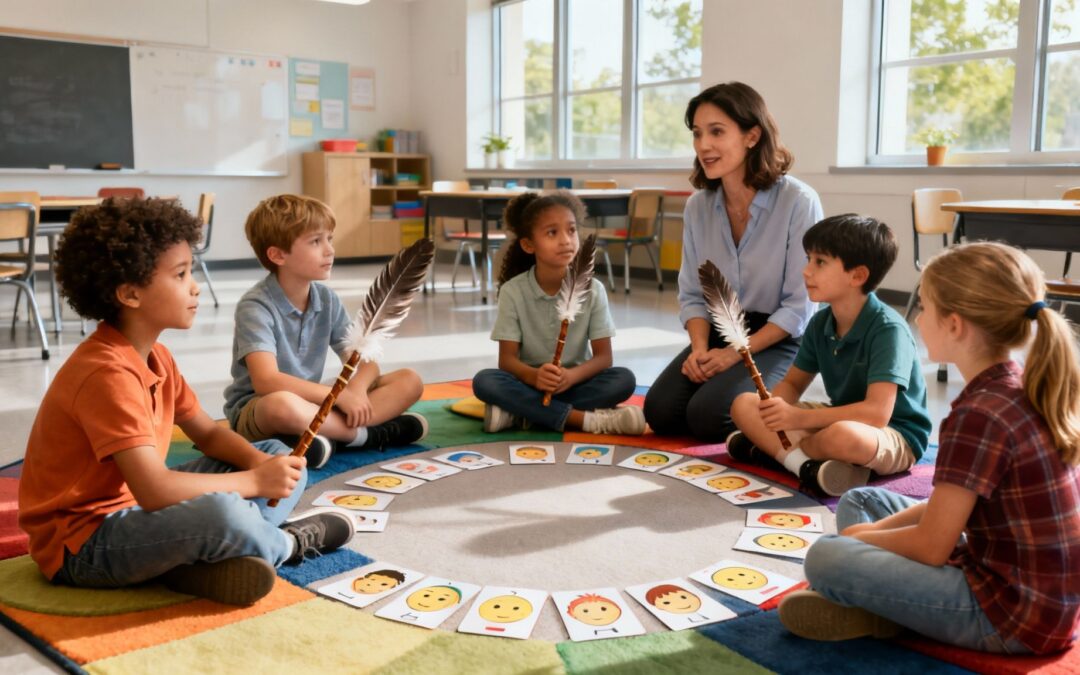
Talking piece circles for equal turns
Fishbowl discussions where one group models while another observes
Dialogue rounds with one question and no interruptions
This works well after recess incidents, before group projects, or after reading a story with a conflict scene. It also helps multilingual learners and quieter students because they get rehearsal time.
Helpful prompts by age
K-2: “What can you say if someone grabs your crayon?”
3-5: “How can you disagree without being mean?”
6-8: “What’s the difference between honesty and public embarrassment?”
The teacher’s role is to model curiosity instead of rushing to a verdict. If a child says, “I’d tell them they’re selfish,” you can ask, “What message do you want them to hear, and what wording would make that more likely?”
6. Cooperative Learning and Team-Building Activities
A group project starts. One student grabs the markers, another goes quiet, a third complains that they always do all the work, and the fourth checks out before the task really begins. By the time the disagreement shows up out loud, the conflict has usually been building for several minutes. Sometimes for several weeks.
That is why cooperative learning matters in a conflict resolution toolkit. It gives students practice with shared responsibility, turn-taking, and repair during low-stakes tasks, so they have something to stand on when real tension shows up. In Soul Shoppe’s 20+ years of work with schools, we have seen this pattern again and again. Students handle conflict better when adults teach collaboration as a skill, not as a hope.
A team task works like a practice field. If the structure is loose, stronger personalities can take over and quieter students can disappear. If the structure is clear, students get repeated chances to use conflict resolution moves in real time.
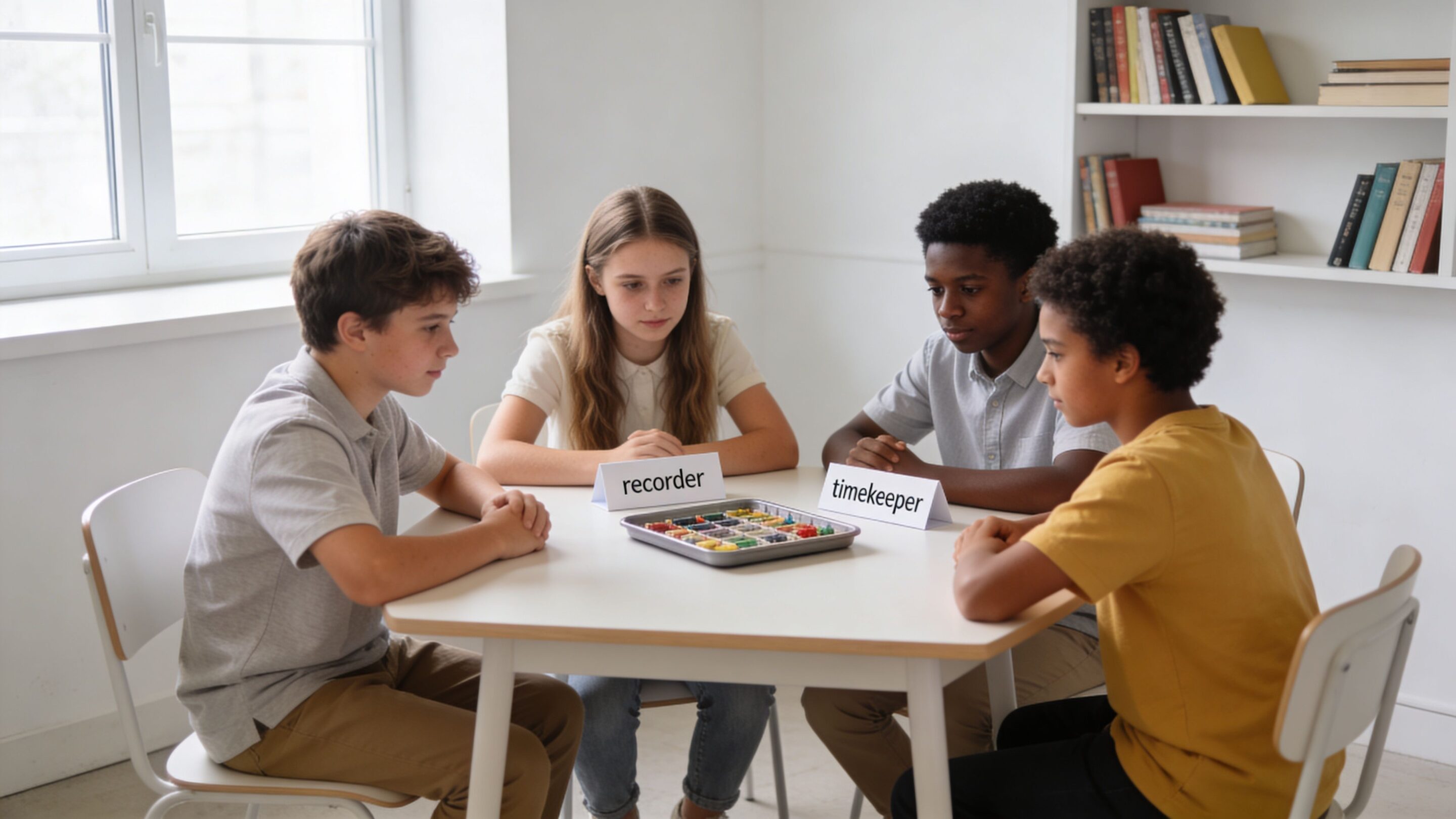
Start with roles that rotate:
facilitator
recorder
materials manager
timekeeper
inclusion checker
That last role often makes the biggest difference. The inclusion checker watches for who has spoken, who has been interrupted, and whether the group is making room for every voice.
Try a shared-challenge task
In a fourth grade classroom, give each team a building challenge with limited supplies. One student handles tape. One reads directions. One tracks time. One notices whether every idea gets heard before the group chooses a plan.
Then debrief the process, not just the product. That is where students learn how cooperation works.
Ask:
Who helped the group stay focused when opinions were different?
What did your team do when two ideas competed?
When did someone feel left out or unheard?
What sentence helped your group get back on track?
K-8 differentiation
K-2: Use short partner tasks with clear visuals and one shared material, such as one box of crayons for two students. Teach simple lines like, “My turn next, please,” and, “Let’s do it together.”
3-5: Add rotating jobs and a quick reflection sheet. Students at this age can start noticing patterns like interrupting, blaming, or deciding too fast.
6-8: Use longer group challenges with checkpoints. Older students benefit from naming group dynamics directly, such as social exclusion, sarcasm, unequal effort, or leadership struggles.
SEL script educators can use
Try a brief coaching script during group work:
“I’m noticing two strong ideas. Pause first. Let’s hear each one all the way through, then choose a plan together.”
If one student dominates, try: “Your ideas matter. Your job now is to make space for someone else’s idea too.”
If a student withdraws, try: “I want to make sure your voice is in the group. Do you want to share with a partner first, then bring your idea to the team?”
These prompts help students experience conflict as something they can handle, not something adults always have to fix for them.
Research on cooperative learning has found that well-structured group work can support stronger peer relationships and more positive academic and social outcomes, especially when students depend on one another to succeed. A helpful summary appears through the Education Endowment Foundation’s guidance on collaborative learning approaches. For playful practice beyond the classroom, some families and educators also use cooperative board games.
A simple reflection closes the loop: “How did we treat each other while we worked?” That question turns one activity into a repeatable strategy, which is exactly what helps a classroom grow from isolated conflict lessons into a steady culture of peace.
7. Mindfulness and Self-Regulation Practices
Some students know exactly what they should say in a conflict, but they can’t access that skill when they’re flooded. Their heart is racing, their jaw is tight, and their brain is locked on defense. Self-regulation practices help bridge that gap.
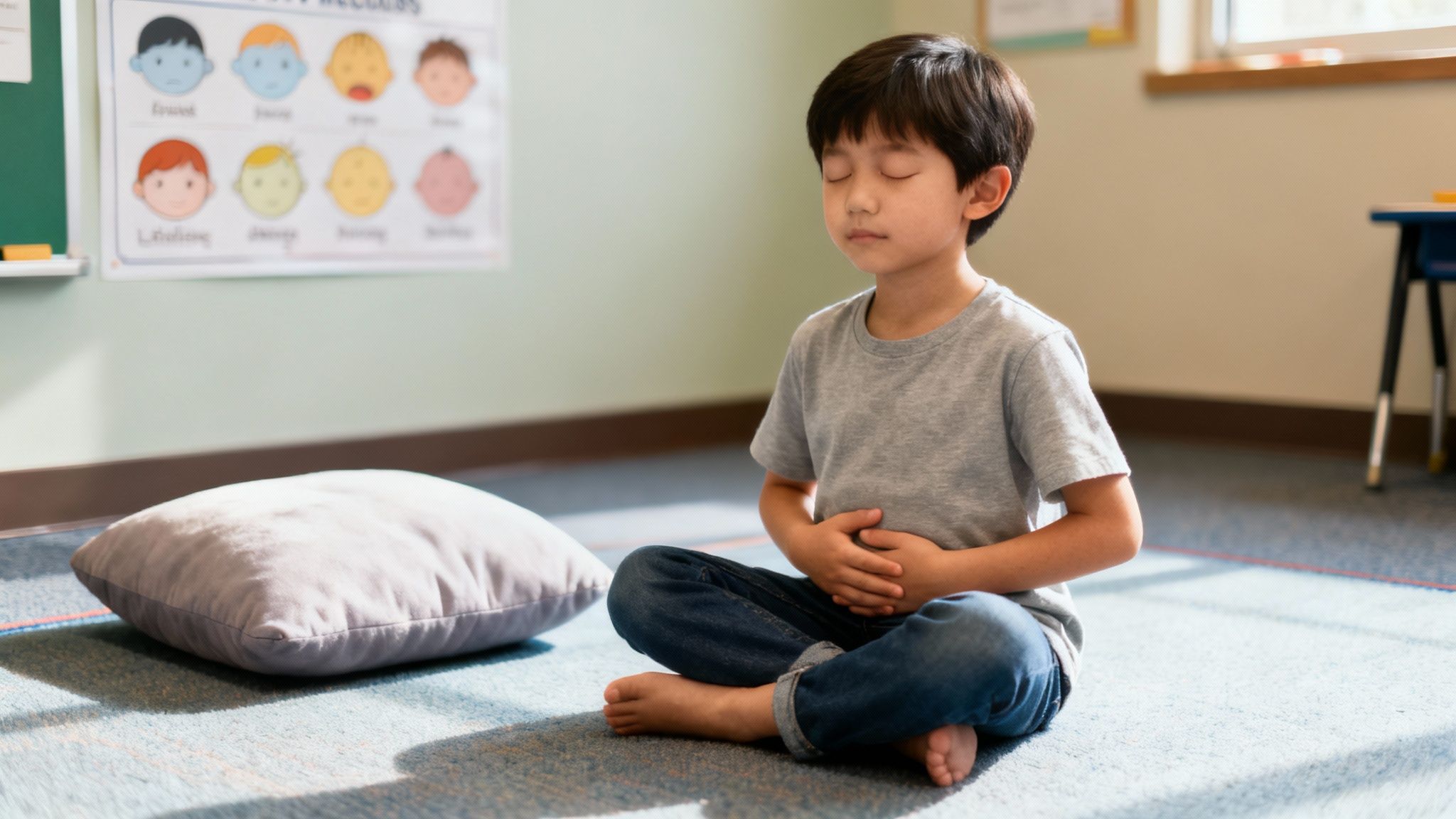
Mindfulness in schools doesn’t have to mean long silent meditation. It can be brief, concrete, and child-friendly. A breathing pattern. A body check. A hand on the heart. A “notice five things” reset before a hard conversation.
Use it before, during, and after conflict
Try this sequence:
Before conflict practice: “Take one slow breath and relax your shoulders.”
During conflict: “Pause. Name what you’re feeling before you answer.”
After conflict: “What is your body telling you now?”
For younger students, use visuals like “smell the flower, blow out the candle.” For older students, teach a private reset they can use without drawing attention to themselves, such as pressing their feet into the floor and counting breaths.
A child who can pause has a much better chance of listening.
Ask students, “What’s your early warning sign that you need a reset?” Common answers include hot cheeks, clenched fists, fast talking, or wanting to walk away. That awareness is a conflict resolution skill.
8. Nonviolent Communication and Feelings and Needs Vocabulary
Many students are fluent in blame. “You’re rude.” “You never let me play.” “He did it on purpose.” They need help turning those reactions into language another person can hear.
Nonviolent Communication offers a useful frame. Students learn to separate what happened from the story they’re telling about it. Then they identify a feeling, connect it to a need, and make a clear request.
A student-friendly formula
Try:
When…
I felt…
Because I needed…
Next time, I’d like…
Example: “When you laughed while I was reading, I felt embarrassed because I needed respect. Next time, I’d like you to wait until I finish.”
That’s very different from, “You always make fun of me.”
For younger children, shorten it: “When you took my block, I felt mad. I want a turn.”
Post a feelings chart, but don’t stop there. Students also need needs words: fairness, space, help, inclusion, calm, choice, respect, clarity. Once kids can name what they need, they’re more likely to problem-solve instead of attack.
A helpful routine is to model this language as adults:
“I’m feeling scattered. I need everyone’s eyes for one minute.”
“I felt concerned when voices got louder. We need a reset so everyone feels safe.”
When adults use the script naturally, students trust it more.
9. Empathy-Building Activities and Perspective-Taking Exercises
Students don’t resolve conflict well if they can’t imagine another person’s inner world. Empathy-building activities help them move past “I’m right” and toward “I can see how that felt for you.”
This can start with literature, art, and storytelling. You don’t always need to begin with a live conflict. Sometimes the safest entry point is a character in a book, a historical figure, or a classroom scenario that feels one step removed.
Strong empathy practices
Try these:
Character hot seat: One student speaks as a book character and answers classmates’ questions about motives and feelings.
Identity circles: Students reflect on parts of who they are, such as family role, language, hobbies, or traditions, and discuss what helps them feel respected.
Two-side journaling: Students write one paragraph from each person’s point of view in a conflict.
A third grader might read a story about exclusion and discuss how each character felt. A seventh grader might examine a rumor scenario and write from the perspective of the person who spread it, the person harmed, and the bystander.
The most important safeguard is choice. Students should never be pushed to disclose something personal in the name of empathy work.
“Use stories first, then invite personal connection if students want it.”
Reflection prompts
Ask:
What might this person have needed?
What did they possibly misunderstand?
What would help them feel dignity in the repair?
These questions train students to look below surface behavior, which often softens conflict before it hardens.
10. Problem-Solving and Decision-Making Frameworks
Two students are stuck. One says, “That was my idea.” The other says, “You never listen to me.” At that moment, they usually do not need a lecture. They need a process they can hold onto.
That is what a problem-solving framework gives them. It works like a trail map in the woods. Students may still feel upset, but they can see the next step instead of getting lost in the feeling.
Across Soul Shoppe’s 20+ years of helping schools build safer, more connected communities, one pattern shows up again and again. Students are more likely to use peaceful conflict skills when the adults teach one shared process, practice it often, and use it consistently across settings.
A school-friendly framework students can remember
The letters matter less than the routine. Your school might use STOP, PAUSE, or a teacher-created chart. What matters is that students hear the same sequence in the classroom, on the playground, and during problem-solving conversations.
A practical five-step model is:
Name the problem
Identify what each person needs
Brainstorm several possible solutions
Choose one solution and try it
Check back and adjust if needed
This approach adds something distinct to your conflict resolution toolkit. Peer mediation supports student-led repair. Restorative practices rebuild community after harm. Perspective-taking helps students understand each other. A decision-making framework teaches what to do next, especially in the small, everyday moments when students are upset, rushed, or unsure.
How to teach it so students actually use it
Start small. Teach the process during a calm part of the day, not in the middle of a conflict.
For younger students, use pictures, gestures, and repeated sentence frames. A first grade teacher might say, “First, tell me what happened. Next, tell me what you need. Now let’s think of two ways to fix it.” For older students, add written reflection or a quick problem-solving form they complete before a conversation.
Here are sample prompts you can use:
Name the problem: “What is the problem, in one sentence?”
Identify needs: “What do you need right now? What might the other person need?”
Brainstorm solutions: “What are three choices, even if one is not your favorite?”
Choose and try: “Which choice is fair, safe, and realistic?”
Check back: “Did that solution work for both people? If not, what needs to change?”
Students often rush past brainstorming and grab the first idea that feels good to them. That is a common sticking point. Slow them down there. The goal is not just agreement. The goal is a solution that is safe, workable, and respectful.
K-8 differentiation
K-2: Use visuals, puppets, and short oral prompts. Keep choices concrete. “Take turns,” “get a new marker,” or “ask for space.”
3-5: Add simple partner reflection sheets. Ask students to separate facts from feelings. That helps reduce “He always” and “She never” language.
6-8: Introduce trade-offs and consequences. Middle school students can compare options by asking, “What solves the problem now?” and “What prevents the same problem tomorrow?”
A lab dispute, group project disagreement, or recess argument can all use the same structure. That consistency helps the framework stick.
Make the framework part of daily classroom life
Students use what they can see and what adults repeat.
Post it: Keep the steps visible at student eye level.
Practice it: Use low-stakes examples before real conflict happens.
Model it aloud: Let students hear adults solve classroom problems with the same language.
Use portable tools: Desk cards, notebooks, and small cue cards help students remember the steps independently.
Reflect after use: Ask, “Which step helped most?” or “Which step was hardest?”
A good framework does not remove conflict. It gives students a repeatable way to handle it with more clarity, more responsibility, and more chance of repair.
Reflection prompts
Use questions like these after students try the process:
Which step felt easiest for you?
Where did you get stuck?
Did your solution meet both people’s needs, or only one person’s wants?
What would you do differently next time?
That is how a single activity grows into a schoolwide habit. Students stop relying only on impulse, and start building judgment.
Concrete step-by-step tool students can apply independently
From Activities to a Culture of Resolution
The class has just come in from recess. Two students are still upset about a kickball argument. One is talking over you. The other has shut down completely. A few classmates are watching to see what happens next. In that moment, conflict resolution is not a single activity you pull off the shelf. It is the set of routines, language, and shared expectations that tell students, "We know what to do with hard moments here."
That is the shift from activities to culture.
A strong conflict resolution approach works like a woven fabric. Each thread matters on its own, but its true strength comes from how the threads hold together. Peer mediation gives students leadership roles. Restorative practices create ways to repair harm and rebuild trust. Role-play lets students rehearse before the actual moment arrives. SEL lessons keep skills in daily use instead of limiting them to one advisory block. Discussion protocols, team tasks, regulation tools, feelings-and-needs language, empathy practice, and problem-solving steps all support the same goal. Students learn that conflict is a normal part of community life, and that there are clear, respectful ways to handle it.
That broader view is the unique value of this guide. These ten entries are not random ideas to try once and forget. They are ten connected strategies that reach from individual skill-building to schoolwide systems. Each one can become a mini playbook for your staff, with K-8 adjustments, simple SEL scripts, and reflection prompts that help students practice, reflect, and try again.
Start small, but start on purpose.
If students tend to react quickly, begin with self-regulation and a few shared sentence stems. If classroom tension grows during partner or group work, focus on cooperative structures and brief repair routines. If your school is ready to build stronger systems, peer mediation or restorative circles can give students and adults a common process across settings. In our experience at Soul Shoppe, schools make the most lasting progress when adults choose a manageable starting point and repeat it often enough that students can use the skill under stress, not only during a calm lesson.
This work supports more than behavior. Research summarized by the Collaborative for Academic, Social, and Emotional Learning (CASEL) connects SEL implementation with stronger relationships, more positive school experiences, and better conditions for learning. You can review that body of work through CASEL’s research overview. For educators, the practical takeaway is simple. When students have tools for handling conflict, classrooms spend less time stuck in repeated social injuries and more time returning to learning.
School culture changes when adults use the same habits in small, ordinary moments. A teacher prompts a student to restate a concern respectfully. A recess aide guides a quick repair conversation instead of handing out blame. A principal opens a meeting with a check-in circle so staff experience the same kind of belonging they want students to feel. These moments may look small, but together they set the norm. Conflict has a process. Repair is expected. Relationships matter here.
Students need visible supports for that process. Post sentence stems. Keep reflection questions short enough to use in real time. Model what an apology sounds like when it includes both accountability and a plan. Notice the student who takes a breath before responding, the pair that solves a disagreement with words, or the group that pauses to include a classmate who feels left out. Those are signs that a culture is taking root.
At Soul Shoppe, we have seen for more than 20 years that schools feel different when students and adults share practical tools for self-regulation, communication, empathy, and repair. Hallways grow calmer. Recess becomes more inclusive. Teachers recover instructional time because fewer conflicts spiral into long cycles. Soul Shoppe is one option schools use when they want experiential support through workshops, assemblies, coaching, and related SEL resources.
The deeper goal is not perfect behavior. It is helping children build confidence, belonging, and the ability to repair relationships after something goes wrong. Conflict is a little like friction in a classroom community. Left alone, it can create heat and damage. Guided well, it can become the pressure that helps students build social strength. That is the heart of conflict resolution strategies. It is also the heart of a school community where people feel safe enough to learn and brave enough to make things right.
If you want support bringing these practices to life across classrooms, recess spaces, and family partnerships, explore Soul Shoppe. Their programs and resources focus on helping school communities build connection, safety, empathy, and practical conflict resolution skills that students can apply.
Conflict is a natural and inevitable part of growing up. From playground disagreements over a turn on the swings to classroom collaboration challenges, kids constantly navigate social hurdles. How we equip them to handle these moments defines their ability to build healthy relationships, develop resilience, and contribute to a positive learning environment. Instead of viewing conflict as something to be avoided, we can reframe it as a powerful teaching opportunity. The ability to manage disagreements constructively is one of the most important life skills a child can develop, laying the groundwork for future academic and social success.
This guide provides a comprehensive roundup of ten research-informed conflict resolution activities for kids in grades K-8. Each activity is designed to be practical and actionable, offering educators, counselors, and parents the specific tools needed to teach essential social-emotional learning (SEL) skills. You’ll find step-by-step instructions for implementing strategies that foster:
Empathy and perspective-taking
Self-regulation and emotional management
Effective communication and active listening
These strategies move beyond temporary fixes, aiming to build a foundational skill set that will serve children throughout their lives. By integrating these practices, we can help students transform disputes into moments of connection and growth. This list will provide you with a structured, easy-to-follow toolkit for building a classroom or home culture rooted in understanding, respect, and collaborative problem-solving.
1. Restorative Circles
Restorative Circles are a powerful, structured approach to dialogue where students sit in a circle to discuss conflicts, share perspectives, and collaboratively find solutions. This method shifts the focus from punishment to repairing harm, making it one of the most effective conflict resolution activities for kids to build a strong, empathetic community. The core practice involves using a “talking piece” (like a small stone or ball) which is passed around the circle; only the person holding the piece may speak.
This simple rule ensures everyone is heard and encourages active listening rather than reactive responses. By creating a space for honest sharing, Restorative Circles help students understand the real impact of their actions, fostering accountability and genuine remorse. This practice is foundational for building a classroom culture where every voice matters and relationships are prioritized.
How It Works
Objective: To repair harm, build community, and develop empathy by giving every participant a voice in resolving a conflict.
Materials Needed: A designated “talking piece” that is easy to hold and pass.
Best For: Addressing classroom-wide issues (like gossip or exclusion), repairing harm after a specific conflict between students, and proactively building a positive community.
Step-by-Step Directions:
Arrange Seating: Have all participants sit in a circle where everyone can see one another. The facilitator sits in the circle as an equal member.
Introduce the Process: The facilitator explains the purpose of the circle, establishes group agreements (e.g., “respect the talking piece,” “listen with compassion”), and introduces the talking piece.
Opening Ritual: Start with a simple opening, like a brief moment of quiet reflection or a check-in question (e.g., “Share one word describing how you feel today”).
Guided Dialogue: The facilitator poses questions to guide the conversation, starting with those who were harmed. The talking piece is passed sequentially around the circle.
Develop Solutions: After all perspectives are shared, the facilitator asks, “What needs to happen to make things right?” The group works together to create a mutually agreeable plan.
Closing Ritual: End the circle with a closing round, such as sharing one thing each person will commit to doing.
Practical Example: After several students were excluded from a game at recess, a teacher holds a circle. The first question is, “What happened?” Each student shares their view. The next question is, “How did that make you feel?” A student who was excluded might say, “I felt lonely and invisible.” A student who did the excluding might say, “I felt pressured to only play with my close friends.” The final question, “What can we do to make sure everyone feels included next time?” leads to a group-created plan for inviting others to join games.
Restorative practices have a proven track record. For instance, Oakland Unified School District integrated restorative circles and saw significant improvements in peer relationships and school climate. The foundational principles are part of a broader framework known as restorative justice. For a deeper understanding of this approach, you can learn more about what restorative practices in education look like and how they transform school communities.
2. Peer Mediation and Collaborative Problem-Solving
Peer Mediation empowers students to resolve their own conflicts by training them as neutral facilitators. This approach shifts responsibility from adults to students, teaching them to guide their peers through a structured, collaborative problem-solving process. Instead of focusing on blame, mediators help students identify their underlying needs and co-create “win-win” solutions, making it a powerful tool among conflict resolution activities for kids.
This process not only de-escalates immediate disputes but also equips the entire student body with essential life skills. By learning to distinguish between a “position” (what they want) and an “interest” (why they want it), children develop empathy, communication, and negotiation abilities. This fosters a school culture where students feel capable of handling disagreements constructively, reducing reliance on adult intervention.
How It Works
Objective: To empower students to resolve their own disputes by training student mediators to facilitate a structured, interest-based negotiation process.
Materials Needed: A quiet, private space for mediations; mediation script or guide sheet for mediators; agreement forms to document solutions.
Best For: Resolving recurring interpersonal conflicts between students, such as arguments over games, rumors, or property. It is also excellent for building student leadership and school-wide problem-solving capacity.
Step-by-Step Directions:
Recruit and Train Mediators: Select and train a diverse group of students in a structured mediation process. Training should cover active listening, impartiality, confidentiality, and guiding peers to find their own solutions.
Establish Ground Rules: At the start of a mediation, the student mediator asks both parties to agree to rules like “take turns talking,” “no name-calling,” and “work to solve the problem.”
Each Person Tells Their Story: Each student explains their perspective without interruption. The mediator listens, summarizes, and reflects back what they heard to ensure each party feels understood.
Identify Interests: The mediator helps students move beyond their demands by asking questions like, “What is most important to you about this?” or “What do you need to happen to feel okay?”
Brainstorm Solutions: The mediator encourages students to brainstorm as many possible solutions as they can. All ideas are initially accepted without judgment.
Agree on a Solution: The students evaluate the brainstormed options and choose a mutually acceptable solution. The mediator writes it down on an agreement form, which both students sign.
Practical Example: Two students, Alex and Ben, both want to use the same basketball during recess. A peer mediator facilitates. Alex’s story: “Ben grabbed the ball from me!” Ben’s story: “I had it first!” The mediator asks, “Alex, why is it important for you to use the ball?” Alex explains he wants to practice for his team. The mediator asks Ben the same question, who says he just wants to have fun with friends. After brainstorming, they agree Alex can use the ball for the first 10 minutes to practice drills, and then Ben and his friends can use it for a game for the rest of recess.
Peer mediation has a strong evidence base. For example, schools implementing peer mediation programs, like those in San Francisco, have reported significant reductions in office referrals and playground conflicts. The principles are rooted in the work of negotiation experts like William Ury and the Harvard Negotiation Project. For families seeking engaging ways to practice collaborative skills at home, activities like a Family Real World Adventure Game can help build the teamwork and problem-solving mindset necessary for these skills to flourish.
3. Emotion Coaching and Check-In Conversations
Emotion Coaching is a responsive communication strategy where adults guide children to recognize, label, and manage their feelings. Instead of dismissing or punishing emotions, this approach treats them as opportunities for connection and teaching. Paired with brief, intentional check-in conversations, it becomes one of the most proactive conflict resolution activities for kids, as it builds the emotional literacy needed to prevent conflicts from escalating.
By validating a child’s feelings first, adults create a sense of psychological safety that makes problem-solving possible. A child who feels understood is more open to discussing their behavior and finding a better way forward. This method, popularized by Dr. John Gottman, shifts the adult role from a disciplinarian to an emotional guide, empowering kids with essential self-regulation skills they can use in any situation.
How It Works
Objective: To help children identify and understand their emotions, build emotional vocabulary, and develop healthy coping strategies to manage feelings constructively.
Materials Needed: None. Visual aids like an emotions chart or “feelings wheel” can be helpful for younger children.
Best For: De-escalating conflicts in the moment, preventing future conflicts by building emotional awareness, and strengthening adult-child relationships through trust and empathy.
Step-by-Step Directions:
Notice and Acknowledge: Tune in to the child’s emotions, paying attention to body language and tone. Acknowledge their feelings without judgment, e.g., “I can see you are very upset.”
Listen and Validate: Give the child your full attention and listen to their perspective. Validate their feelings by saying something like, “It’s understandable that you feel angry because your turn was skipped.”
Help Label the Emotion: Provide the child with the vocabulary to name their feeling. For instance, “It sounds like you’re feeling frustrated and left out.”
Set Limits and Boundaries (If Needed): After validating, clarify that while the feeling is okay, the behavior is not. For example, “You are allowed to be mad, but you are not allowed to push.”
Problem-Solve Together: Guide the child to brainstorm solutions. Ask questions like, “What could you do next time you feel this way?” or “How can we solve this problem together?”
Practical Example: A child, Maria, slams her book on the table after a group project discussion. A teacher approaches calmly and says, “That was a loud noise. It looks like you’re feeling really frustrated right now.” Maria nods, still upset. The teacher validates: “It’s hard when you have a different idea than your group. I get why you feel that way.” After a moment, she sets a boundary: “It’s okay to be frustrated, but it’s not okay to slam books. What’s another way you could show your group how you’re feeling or ask for a turn to share your idea?”
Research from Dr. John Gottman’s work shows that children who are emotion-coached have better friendships and are more resilient. For example, schools incorporating this model into their SEL curricula have seen significant improvements in classroom climate and overall student wellbeing. To further explore routine-based check-ins, you can discover more about using daily mood meters and reflection tools to boost student confidence.
Social-Emotional Learning (SEL) Curricular Programs are comprehensive, evidence-based frameworks that systematically teach core social and emotional skills. Instead of being a one-off activity, these curricula integrate conflict resolution, empathy, and responsible decision-making directly into classroom instruction through structured lessons and activities. By adopting a program, schools create a shared language and consistent approach to behavior and relationship management.
These programs equip students with the tools to understand their emotions, build healthy relationships, and navigate disagreements constructively. For example, a lesson might teach students to identify their “trigger points” before a conflict escalates. This makes SEL curricula one of the most proactive and impactful conflict resolution activities for kids, as it builds foundational skills that prevent many conflicts from ever starting.
How It Works
Objective: To embed social-emotional competencies like self-awareness, self-management, and relationship skills into the school day, providing students with a consistent framework for resolving conflicts.
Materials Needed: Varies by program, but typically includes a teacher’s guide, student workbooks or digital resources, posters, and activity materials.
Best For: Schools or districts seeking a structured, school-wide approach to improving student behavior, building a positive school climate, and reducing conflicts systemically.
Step-by-Step Directions:
Select a Curriculum: Research and choose a program aligned with your school’s values and student needs (e.g., Second Step, RULER, Zones of Regulation).
Provide Teacher Training: Ensure all staff receive comprehensive professional development on the curriculum’s philosophy, language, and lesson delivery.
Schedule SEL Time: Dedicate consistent time in the weekly schedule for SEL lessons, just as you would for core academic subjects.
Teach the Core Concepts: Deliver the lessons sequentially. For example, a unit might start with identifying emotions, then move to managing those emotions, and finally apply those skills to social problems.
Integrate and Reinforce: Use the curriculum’s language and concepts throughout the day. If a conflict occurs on the playground, a teacher can reference a specific strategy taught in a lesson, like “using an I-message.”
Involve Families: Share information and take-home activities with families so they can reinforce the concepts at home, creating consistency for the child.
Practical Example: A school using the “Zones of Regulation” curriculum teaches students to identify if they are in the Green Zone (calm), Blue Zone (sad/tired), Yellow Zone (frustrated/anxious), or Red Zone (angry/out of control). During a disagreement over game rules, one student recognizes he’s entering the “Yellow Zone.” Because of the SEL lesson, he knows to use a strategy. He tells his friend, “I’m in the Yellow Zone. I need to take a break,” and walks to the classroom’s designated calm-down corner before the conflict escalates into a Red Zone problem.
The impact of these programs is well-documented. Schools using the Second Step curriculum, for instance, often see a measurable improvement in students’ social competency and a reduction in aggression. Similarly, the RULER approach from the Yale Center for Emotional Intelligence has been shown to improve classroom emotional climates. By providing a common framework, these programs empower entire communities to handle conflict with skill and compassion.
5. Role-Playing and Scenario-Based Practice
Role-Playing and Scenario-Based Practice allows students to safely act out conflict scenarios in a structured environment. By taking on different roles such as the aggressor, the person harmed, a bystander, or a mediator, children can practice various responses and witness potential outcomes without real-world consequences. This active, kinesthetic approach helps solidify learning and makes it one of the most practical conflict resolution activities for kids.
This method is powerful because it moves conflict resolution from an abstract concept to a tangible skill. Students not only learn what to say but how to say it, practicing tone, body language, and active listening. It builds empathy by literally putting students in someone else’s shoes, helping them understand different perspectives in a visceral way. This practice is a cornerstone of many successful Social-Emotional Learning (SEL) programs.
How It Works
Objective: To practice communication and problem-solving skills, build empathy through perspective-taking, and test different conflict resolution strategies in a controlled setting.
Materials Needed: Pre-written scenario cards (optional), open space for acting.
Best For: Practicing specific skills like using “I-statements,” learning to de-escalate disagreements, and exploring the impact of bystander intervention.
Step-by-Step Directions:
Introduce the Scenario: The facilitator presents a common conflict scenario relevant to the students’ age. For example: “Two friends both want to use the same swing at recess.”
Assign Roles: Assign (or ask for volunteers for) roles: the two friends, and perhaps a bystander who sees the argument.
Act It Out: The students act out the scenario. The first run-through can show the conflict escalating naturally.
Pause and Discuss: The facilitator pauses the scene and asks processing questions: “How is each person feeling right now?” or “What could the bystander do to help?”
Re-enact with a Strategy: The group brainstorms a better approach (e.g., taking turns, finding another activity). The students then re-enact the scene using the new strategy.
Debrief and Reflect: After the role-play, the entire group discusses what they learned, focusing on the feelings and outcomes of each approach.
Practical Example: The scenario is: “Your friend told a secret you shared with them.” One student plays the person whose secret was told, and another plays the friend who told it. First, they act out a yelling match. The teacher pauses them and asks, “What else could you do?” The class suggests using an “I-statement.” They re-enact the scene. The student now says, “I felt really hurt and betrayed when I heard you told my secret because I trusted you. I need to know I can trust my friends.” This leads to a more productive conversation about the impact of the action.
Role-playing is a core component of proven SEL curricula, such as the Second Step program. Studies show that drama-based interventions and consistent scenario practice significantly improve students’ empathy and social perspective-taking, leading to more positive peer interactions.
6. Mindfulness and Breathing Techniques
Mindfulness and breathing techniques are fundamental tools that teach children to manage their internal state before, during, and after a conflict. These practices focus on developing self-awareness and self-regulation, allowing students to pause and notice their emotions instead of acting impulsively. By learning simple exercises like belly breathing or box breathing, children gain the ability to calm their nervous systems, which is a critical first step in engaging in productive dialogue and one of the most proactive conflict resolution activities for kids.
This approach empowers students by giving them control over their own emotional responses. When a child feels anger or frustration rising, having a go-to breathing technique provides an immediate, constructive action to take. Research shows that schools implementing mindfulness programs see a significant reduction in behavioral incidents, as children are better equipped to handle stress and approach peer disputes with a clearer, more thoughtful mindset.
How It Works
Objective: To teach children how to self-regulate their emotions, reduce stress responses, and approach conflicts from a place of calm and clarity.
Materials Needed: A quiet space, optional visuals like a pinwheel or a breathing ball.
Best For: Proactively building emotional regulation skills, de-escalating conflicts in the moment, and helping students manage anxiety and stress.
Step-by-Step Directions:
Introduce the Concept: Explain in simple terms that our breath can help our brains and bodies calm down when we feel big emotions like anger or sadness. Use an analogy, like letting the air out of a balloon slowly.
Model a Technique: Demonstrate a simple breathing exercise. For “Belly Breathing,” place a hand on your stomach and take a deep breath in through your nose, feeling your belly expand. Then, breathe out slowly through your mouth, feeling your belly go down.
Practice Together: Guide students through several rounds of the breathing exercise. Use visual cues, like pretending to smell a flower (breathing in) and blow out a candle (breathing out).
Connect to Emotions: Help students identify when to use this tool. Ask, “When might be a good time to use our calm breathing?” (e.g., “When I feel mad at a friend,” or “Before I take a test”).
Create a Calm-Down Corner: Designate a quiet area in the classroom with pillows and visual aids for breathing techniques that students can use independently when they feel overwhelmed.
Integrate into Daily Routines: Practice for 1-3 minutes daily, such as after recess or before a challenging subject, to build the skill as a habit.
Practical Example: Liam gets a math problem wrong and crumples his paper in frustration, ready to yell. His teacher, noticing his clenched fists, quietly says, “Liam, let’s do our box breathing.” She guides him to breathe in for a count of four, hold for four, breathe out for four, and hold for four, tracing a square in the air with her finger. After two rounds, Liam’s shoulders relax. He is now calm enough to look at his mistake without a major outburst, and the teacher can help him with the problem.
Mindfulness is not just about sitting still; it’s about building awareness. Programs like Mindful Schools have shown incredible success in K-8 settings by giving students practical tools for emotional management. To explore more ways to integrate these practices, you can find a variety of age-appropriate mindfulness activities for kids that support social-emotional learning and conflict resolution.
7. Nonviolent Communication (NVC) and Compassionate Listening
Nonviolent Communication (NVC), often called Compassionate Communication, is a framework that helps children express themselves honestly without blame or criticism. It focuses on four core components: observations, feelings, needs, and requests. This approach guides students to listen for the underlying needs in others’ words, making it a transformative tool among conflict resolution activities for kids that builds deep empathy and connection.
Instead of reacting with judgment, children learn to say, “When I see/hear [observation], I feel [feeling] because I need [need]. Would you be willing to [request]?” This structure moves conversations away from right-and-wrong thinking and toward mutual understanding. By teaching kids to identify their own feelings and needs, NVC empowers them to solve problems collaboratively, reducing defensiveness and fostering a culture of care.
How It Works
Objective: To teach children to communicate their feelings and needs without blame and to listen with empathy to the feelings and needs of others.
Materials Needed: Visual aids like posters or flashcards showing the four NVC steps, a list of “feelings” and “needs” words.
Best For: De-escalating interpersonal conflicts, teaching self-advocacy skills, building emotional vocabulary, and fostering a collaborative classroom environment.
Step-by-Step Directions:
Introduce the Four Steps: Explain the NVC model: Observations (what you saw/heard), Feelings (the emotion it triggered), Needs (the universal need behind the feeling), and Requests (a specific, positive action).
Build Vocabulary: Create and display lists of “Feelings Words” (e.g., sad, frustrated, joyful) and “Needs Words” (e.g., respect, safety, to be included).
Practice with Scenarios: Use role-playing or puppets to practice the NVC formula. For example, a student might practice saying, “When you took the ball without asking, I felt frustrated because I need to be respected. Would you be willing to ask me next time?”
Practice “Guessing” Needs: When a child is upset, model compassionate listening by guessing their feelings and needs. “Are you feeling angry because you need more playtime?”
Model the Language: Consistently use NVC language in your own interactions with students and other adults to make it a natural part of the environment.
Celebrate Efforts: Acknowledge and praise students when you see them attempting to use NVC to express themselves or understand a peer.
Practical Example: Instead of yelling, “You always leave me out!” a child learns to use NVC. She approaches her friend and says, “When I saw you and the others playing a new game at recess and I wasn’t invited [observation], I felt sad [feeling] because I need to feel included by my friends [need]. Would you be willing to ask me to play next time you start a new game [request]?” This gives the friend concrete information to work with, rather than just an accusation.
The NVC framework, developed by Marshall B. Rosenberg, has been successfully integrated into schools and restorative justice programs worldwide. Schools using NVC report significant improvements in peer relationships and a more collaborative classroom culture. For more resources and training materials, you can explore the Center for Nonviolent Communication.
8. Empathy-Building Activities and Perspective-Taking Exercises
Empathy-Building Activities are designed to help children understand and share the feelings of others by actively engaging in perspective-taking. Through exercises like analyzing stories, role-playing scenarios, or creating “empathy maps,” students learn to look beyond their own viewpoint. This approach is fundamental to conflict resolution, as it shifts a child’s focus from “who is right” to “how does the other person feel,” making it an essential set of conflict resolution activities for kids.
By practicing empathy, children build the cognitive and emotional skills needed to recognize emotions, appreciate diverse experiences, and connect with their peers. This proactive approach doesn’t just resolve conflicts; it prevents them from escalating by fostering a culture of compassion and mutual respect. Research consistently shows that anti-bullying programs incorporating empathy activities can reduce bullying incidents by 25-35%, demonstrating its powerful impact on school climate.
How It Works
Objective: To develop the ability to understand and share the feelings of another person, fostering compassion and improving social interactions.
Materials Needed: Storybooks with diverse characters, pictures or videos depicting emotions, chart paper, and markers for empathy maps.
Best For: Proactively building a positive classroom culture, resolving interpersonal disagreements rooted in misunderstanding, and helping students understand the impact of their words and actions.
Step-by-Step Directions:
Select a Scenario: Choose a relatable story, a short video clip, or a real (but anonymized) classroom situation. For example, a story about a new student feeling left out.
Introduce Perspective-Taking: Ask students to imagine they are a specific character in the scenario. Prompt them with questions like, “What is this person thinking?” or “How might their body feel right now?”
Create an Empathy Map: Draw a large head on chart paper divided into four quadrants: Says, Thinks, Feels, and Does. As a group, fill in each quadrant from the character’s perspective.
Connect to Personal Experience: Ask students if they have ever felt a similar way. This helps bridge the gap between a fictional character and their own lives.
Brainstorm Empathetic Responses: Guide the group to think about what the character might need from others. Ask, “What could someone say or do to help this person feel better?”
Practice through Role-Play: Have students act out the scenario, first as it happened, and then again using the empathetic responses they just brainstormed.
Practical Example: A teacher reads the book Wonder to the class. After a chapter where the main character, Auggie, is bullied, the teacher creates an empathy map. Students brainstorm what Auggie might be thinking (“Why are they so mean?”), feeling (“Lonely, ashamed, scared”), saying (nothing, or something quiet), and doing (looking at the ground, hiding his face). This exercise helps students who might have laughed at someone different understand the deep emotional impact of their actions.
Empathy is a skill that can be taught and strengthened with intentional practice. Programs like Michele Borba’s The Kindness Curriculum have shown that structured empathy education leads to significant improvements in peer relationships and classroom behavior. To explore more strategies, you can learn how to teach empathy effectively and integrate it into daily interactions.
9. Bully Bystander Intervention Training
Bully Bystander Intervention Training empowers students who witness bullying to become “upstanders” instead of passive onlookers. Research shows that peer intervention can stop over half of bullying incidents within seconds, making this one of the most impactful conflict resolution activities for kids. This approach shifts the culture from one of silent complicity to one of active peer support and collective responsibility for safety.
Instead of just focusing on the bully and the target, this training recognizes that bystanders hold immense power to change the outcome of a conflict. It teaches students safe and effective strategies to de-escelate situations, support a classmate, or get adult help. By equipping the silent majority with concrete tools, schools can build a proactive, prosocial community where bullying is less likely to occur.
How It Works
Objective: To teach students how to safely and effectively intervene in bullying situations, reducing peer-on-peer aggression and fostering a culture of mutual support.
Materials Needed: Scenarios or role-playing scripts, chart paper or a whiteboard for brainstorming strategies.
Best For: Whole-class or school-wide initiatives to proactively address bullying, building peer leadership skills, and creating a safer school climate.
Step-by-Step Directions:
Define Roles: Start by explaining the three roles in a bullying situation: the person doing the bullying, the person being targeted, and the bystander. Emphasize that bystanders have a choice: to do nothing or to become an “upstander.”
Introduce the ‘4 D’s’ of Intervention: Teach students four clear, safe strategies:
Direct: Directly tell the bully to stop (e.g., “Hey, leave them alone. That’s not cool.”).
Distract: Create a diversion to interrupt the situation (e.g., “Come on, the bell’s about to ring,” or “Did you see that game last night?”).
Delegate: Get help from an adult like a teacher, counselor, or principal.
Delay: Check in with the person who was targeted after the incident to offer support.
Role-Play Scenarios: Have students practice using these strategies in guided role-playing scenarios. Provide realistic situations and encourage them to try different approaches.
Discuss Safety: Reinforce that their safety is the top priority. If a situation feels dangerous, the best choice is always to Delegate (get an adult).
Distinguish ‘Tattling’ from ‘Telling’: Clarify the difference: tattling is meant to get someone in trouble, while telling (or reporting) is meant to get someone out of trouble.
Celebrate Upstanders: Create a system to acknowledge and celebrate students who act as upstanders, reinforcing this positive behavior school-wide.
Practical Example: A student, Chloe, sees two popular kids making fun of a classmate’s new haircut. Instead of confronting them directly, which feels scary (Direct), she uses a different strategy. She chooses Distract. She walks over to the targeted student and says loudly, “Hey, Mrs. Davis is looking for you! We need to go practice for the play.” She pulls the student away from the situation. Later, she uses Delay by checking in and saying, “I’m sorry they were mean. I really like your haircut.” She also decides to Delegate by letting her teacher know what happened in private.
10. Positive Behavioral Interventions and Supports (PBIS) with SEL Integration
Positive Behavioral Interventions and Supports (PBIS) is a proactive, school-wide framework designed to teach and promote positive behavior, creating a more supportive learning environment. Instead of just reacting to misbehavior, PBIS focuses on explicitly teaching students the social and emotional skills they need to succeed. When integrated with Social-Emotional Learning (SEL), it becomes one of the most comprehensive systems for improving how students navigate their social world, making it a powerful foundation for conflict resolution activities for kids.
By establishing clear, consistent expectations across the entire school-from the classroom to the playground-PBIS reduces the ambiguity that often leads to conflict. This systematic approach ensures that students understand what is expected of them and are positively reinforced for meeting those expectations. This creates a predictable and safe climate where students are better equipped to handle disagreements constructively, as they have a shared language and set of skills to draw upon.
How It Works
Objective: To create a positive school climate by systematically teaching, modeling, and reinforcing behavioral expectations, thereby preventing conflict before it starts.
Materials Needed: School-wide commitment, visual aids (posters with expectations), a system for positive reinforcement (e.g., tokens, verbal praise), and data tracking tools.
Best For: Establishing a consistent, school-wide culture of respect and responsibility, reducing overall disciplinary incidents, and integrating SEL competencies into daily school life.
Step-by-Step Directions:
Establish Expectations: A leadership team, including students and families, defines 3-5 broad, positively stated behavioral expectations (e.g., “Be Respectful,” “Be Responsible,” “Be Safe”).
Teach Explicitly: Create lesson plans to teach what these expectations look like in different settings (e.g., “Respect in the hallway means using quiet voices”). Use role-playing and direct instruction.
Create a Reinforcement System: Develop a system to acknowledge students when they meet the expectations. This could be verbal praise, a school-wide token economy, or other forms of recognition.
Implement Tiered Interventions: Use school data (like office referrals) to identify students who need more targeted support (Tier 2) or intensive, individualized support (Tier 3).
Integrate SEL and Conflict Resolution: Embed specific conflict resolution skills into the PBIS framework. For example, teach “I-statements” as part of what it means to “Be Respectful.”
Review Data and Adapt: Regularly analyze behavioral data to identify trends and adjust strategies. Celebrate successes to maintain momentum and buy-in from staff and students.
Practical Example: A school’s PBIS theme is “Be a STAR: Safe, Thoughtful, and Respectful.” In the cafeteria, “Respectful” is defined on a poster as “Wait your turn, use kind words, and include others.” A teacher sees a student letting another student cut in line and says, “Thank you for being respectful by including your friend.” Later, when two students argue over a seat, a lunch monitor can point to the poster and ask, “How can we solve this problem in a way that is thoughtful and respectful, like a STAR?”
PBIS is a data-driven framework with extensive evidence of success. The Center on PBIS provides a wealth of resources, research, and implementation guides for schools. For example, districts that combine PBIS with restorative practices have shown some of the strongest improvements in school climate and reductions in disciplinary disparities.
Comparison of 10 Kids Conflict-Resolution Activities
Item
Implementation complexity
Resource requirements
Expected outcomes
Ideal use cases
Key advantages
Restorative Circles
Medium–High (skilled facilitation, time)
Trained facilitators, scheduled circle time, consistent practice
Improved relationships; fewer disciplinary referrals; stronger community
Coherent, data-driven framework; tiered supports and consistency
From Conflict to Connection: Your Next Steps
Teaching conflict resolution is not about creating a world devoid of disagreements; it’s about empowering children with a durable toolkit to navigate them with confidence, empathy, and integrity. Throughout this guide, we’ve explored ten powerful conflict resolution activities for kids, moving from the structured dialogue of Restorative Circles to the internal focus of Mindfulness and Breathing Techniques. Each strategy, whether it’s the peer-led approach of Mediation or the compassionate framework of Nonviolent Communication, offers a unique pathway toward building more peaceful and connected communities.
The common thread weaving through these diverse activities is a fundamental shift in perspective. Instead of viewing conflict as a disruptive problem to be punished or avoided, we can reframe it as a critical opportunity for growth, learning, and deeper understanding. A disagreement over a shared toy is no longer just a moment of friction; it becomes a practical lesson in empathy, negotiation, and self-regulation.
Key Takeaways: Weaving Skills into Daily Life
The true power of these strategies is unlocked through consistent and intentional integration. A one-time role-playing session is helpful, but embedding these skills into the very fabric of the classroom or home environment creates lasting change.
Conflict is a Teachable Moment: Every argument, from a playground dispute to a sibling squabble, is a chance to practice the skills you’re teaching. Use these moments to guide children through identifying their feelings, using “I” statements, and actively listening to another’s perspective.
Consistency is Crucial: A school that combines a PBIS framework with daily Emotion Coaching and weekly Restorative Circles builds a multi-layered support system. At home, pairing mindfulness exercises with regular check-in conversations reinforces the message that emotional health is a family priority.
Modeling is Everything: Adults are the primary role models. When a teacher or parent demonstrates calm, active listening, and a willingness to see another’s point of view during their own conflicts, they provide the most powerful lesson of all. Children learn more from what we do than from what we say.
Your Actionable Next Steps
Transforming theory into practice can feel daunting, but progress begins with small, deliberate steps. Choose one or two activities from this list that resonate most with your specific needs and start there.
Start Small with a “Skill of the Week”: Dedicate one week to practicing a specific skill. For instance, focus on “Active Listening.” Model it in conversations, praise students when they demonstrate it, and use a simple debrief question at the end of the day: “When did you feel truly heard today?”
Create a “Peace Corner” or “Calm-Down Spot”: Designate a physical space in the classroom or home where a child can go to self-regulate. Stock it with tools discussed in this article, like breathing exercise cards, feeling wheels, or a journal for reflection. This normalizes the act of taking space to manage big emotions.
Integrate Language into Daily Routines: Make the vocabulary of conflict resolution part of your everyday language. Instead of saying, “Stop fighting,” try, “It looks like you two have a problem. How can you solve it together?” or “Let’s use our ‘I feel’ statements to explain what’s happening.”
By intentionally implementing these conflict resolution activities for kids, you are not just managing behavior; you are cultivating essential life skills. You are building a foundation for healthier relationships, stronger communities, and more resilient, empathetic, and emotionally intelligent individuals who can turn moments of conflict into opportunities for profound connection.
Ready to bring these powerful strategies to your entire school community with expert guidance? Soul Shoppe specializes in creating safe, empathetic, and connected school environments through interactive programs and professional development that make social-emotional learning and conflict resolution come alive. Explore Soul Shoppe to see how our proven, hands-on approach can help you build a more peaceful and supportive culture for every student.