

How to Implement Social Emotional Learning in the Classroom
Somewhere between the math block and dismissal, it happens. Two students snap at each other over a pencil. One child puts their head down and won't try the assignment. Another keeps making jokes because that's easier than saying, "I'm overwhelmed."
Most teachers don't need a lecture on why behavior matters. You live it all day. What you need is a way to respond that helps kids settle, reconnect, and keep learning.
That's where social emotional learning fits. It isn't extra fluff, and it isn't a reward for classes that are already calm. It's a practical way to teach students how to notice feelings, manage stress, solve problems, and stay connected to the people around them. If you've been wondering how to implement social emotional learning in the classroom without adding one more impossible task to your plate, start small and think in layers: routines, lessons, relationships, and schoolwide support.
Creating a Classroom Where Every Student Thrives
A third grader rips up her paper after making a mistake. Two classmates start whispering about it, and now the whole table is off track. In another room, a middle school student shrugs and says, "I don't care," even though you can tell he does. These moments look different on the surface, but they often point to the same missing skills: naming emotions, handling frustration, reading social cues, and repairing conflict.
Social emotional learning gives teachers a way to teach those skills directly. Instead of only reacting after problems explode, you build habits that help students pause sooner and recover faster. That changes the feel of the room. Kids get more language for what they're feeling, and teachers get more options than "stop" and "sit down."
A 2018 meta-analysis reviewing 50 years of studies found that SEL programs produced significant gains in reading, mathematics, and science for PreK to 12 students, and the benefits were observed across grade levels and across student groups, as summarized in Northern University's overview of SEL research. That matters because it tells us SEL isn't a side project. It belongs in real classrooms with real academic demands.
What this looks like in an ordinary week
In practice, SEL can be as simple as greeting students by name, running a quick feelings check-in, teaching one sentence stem for conflict, and giving students a calm place to reset. Those moves don't solve everything. They do create enough safety and predictability for learning to happen more often.
For the classroom environment itself, this piece on what makes a peaceful and welcoming classroom pairs well with daily SEL practice.
SEL works best when students experience it as part of the day, not as a special event that disappears when things get busy.
Building the Foundation with Core SEL Routines
The strongest classrooms don't rely on one great lesson. They rely on repeated routines. Students need the same emotional tools practiced again and again when they're calm, so those tools are available when they're upset.
A strong foundation for SEL starts with the five core competencies from CASEL: self-awareness, self-management, social awareness, relationship skills, and responsible decision-making. Research syntheses covering hundreds of studies, summarized by the Learning Policy Institute's report on evidence for social and emotional learning, found that this approach supports stronger social-emotional competencies, better behavior, and gains in academic performance.

Make the five competencies visible and simple
You don't need to introduce the CASEL language like a formal unit. Translate it into classroom language students can use.
- Self-awareness means "I can notice what I'm feeling."
- Self-management means "I can calm my body and make a plan."
- Social awareness means "I can think about how someone else might feel."
- Relationship skills means "I can listen, speak respectfully, and work things out."
- Responsible decision-making means "I can choose a response that helps, not harms."
Post those ideas on the wall in student-friendly words. Refer to them when something real happens. If a student is frustrated during writing, say, "Let's use self-management." If two students interrupt each other, say, "This is relationship skills practice."
Start the day with one predictable check-in
Morning meeting doesn't have to be elaborate. In many classrooms, a five-minute routine is enough. The key is consistency.
A simple structure works well:
- Greeting: "Good morning, Maya. I'm glad you're here."
- Check-in: "Show with fingers, colors, or a one-word answer how you're arriving today."
- Mini skill: one brief breathing, listening, or speaking routine.
- Preview: "Today, we'll practice asking for help respectfully during partner work."
Here are a few check-in prompts you can use tomorrow:
- For K to 2: "Point to the face that matches how you feel."
- For 3 to 5: "What's one word for your energy right now?"
- For 6 to 8: "What's something that might help you focus today?"
If you need help building routines that calm students before instruction starts, this guide on routines for kids and emotional grounding offers practical ideas that transfer well to classrooms.
Practical rule: Keep the routine short enough that you'll actually use it on busy days.
Teach one calming strategy until everyone knows it
Many teachers make the mistake of offering six coping tools at once. Start with one. Practice it when no one is upset. Then coach students to use it during mild frustration.
You can use this script:
"Let's take a turtle breath. Pretend you're a turtle pulling into your shell. Tuck your head down, breathe in slowly through your nose, and as you breathe out, slowly peek your head back out."
That works especially well in K to 3, but older students often respond if you present it plainly and skip babyish tone. For middle grades, you might call it "slow in, slower out" and have students track the breath with a hand on the desk.
Other low-prep regulation routines include:
- Desk reset: Students put both feet down, relax shoulders, and take three quiet breaths.
- Hand trace breathing: Trace one finger up and down the other hand while breathing in and out.
- Count and choose: "Name what you're feeling. Rate it low, medium, or high. Choose one calm strategy."
Create a calm-down space that teaches, not punishes
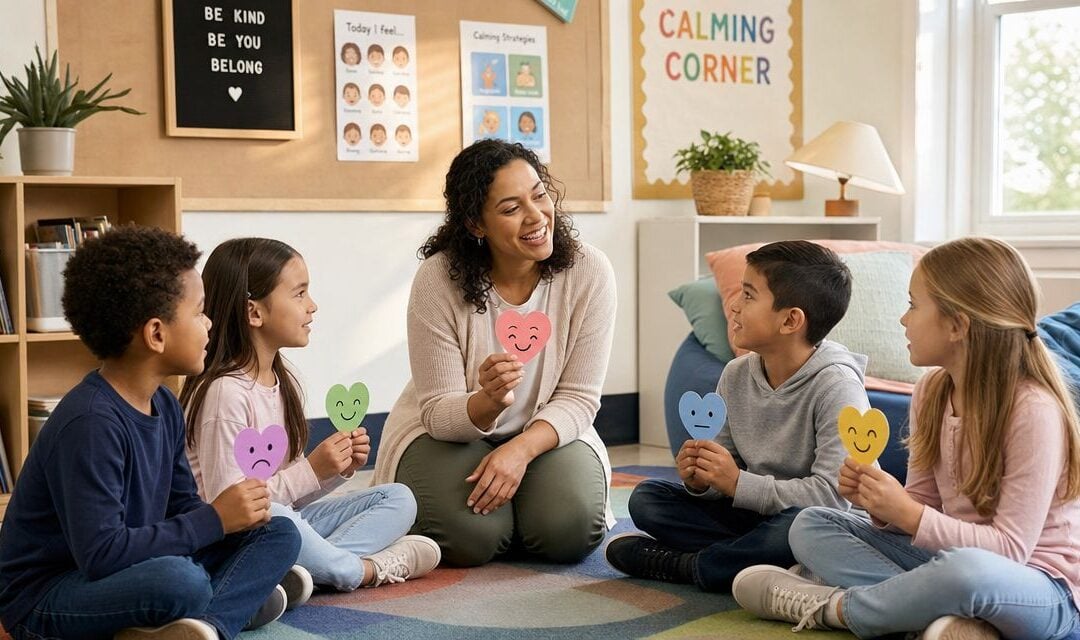
A Peace Corner isn't time-out with softer decor. It should be a brief reset space students use to regulate and return.
Keep it simple. Add a small visual feelings chart, one breathing prompt, a reflection card, and a clear expectation such as: "Calm body. Quiet reset. Return when ready." A clipboard with sentence starters can help:
- "I am feeling…"
- "What happened was…"
- "What I need next is…"
- "When I go back, I will…"
For younger students, use pictures. For older students, use a short written reflection or a dry-erase board.
Build shared language for conflict
Students need actual words. "Use your words" is too vague. Give them sentence stems they can practice during low-stakes moments.
Try these:
- I-statement: "I feel frustrated when you grab the marker because I wasn't finished."
- Boundary: "Please don't touch my work without asking."
- Repair: "I want to fix this. Can we start over?"
- Request: "Next time, can you ask first?"
Role-play these during class meetings. Keep the scenarios ordinary: line cutting, teasing, interrupting, not sharing materials. Students are much more likely to use language they've rehearsed.
Weaving SEL into Your Academic Lessons
One of the biggest misconceptions about SEL is that it requires a separate block you don't have. In most classrooms, the more sustainable move is to build social and emotional skills into the lessons you're already teaching.
That means you use reading discussions to practice perspective-taking, math problem solving to practice frustration tolerance, and social studies to practice empathy and ethical thinking. SEL becomes part of how students learn, not one more thing stacked on top.
What SEL looks like during instruction
In literacy, ask students to support emotional inferences with evidence. "What clues in the text tell you how she was feeling?" moves the conversation beyond guessing. It teaches careful reading and emotional awareness at the same time.
In math, normalize productive struggle. Before students tackle a challenging problem, you might say, "If you feel stuck, that's the moment to use self-management. Pause, breathe, reread, and try one part." During partner work, coach them to ask, "Can you explain how you started?" instead of "What's the answer?"
In social studies, SEL often shows up through perspective. When students study a community, a migration, a protest, or a historical decision, invite them to ask: "What pressures might this group have faced?" or "How might two people have experienced this event differently?"
For more classroom-ready examples, this collection of social emotional learning strategies can help teachers expand beyond standalone activities.
Sample SEL Integration Activities by Grade Band
| Grade Band | Literacy (Relationship Skills) | Math (Self-Management) | Social Studies (Social Awareness) |
|---|---|---|---|
| K-2 | Read a picture book and ask, "How did the character know their friend was upset?" Then have students practice one kind response. | Before independent work, teach a "try, breathe, ask" routine. Students try one strategy, take one slow breath, then ask for help. | When learning about helpers in the community, ask, "What does this person do to care for others?" |
| 3-5 | During character analysis, ask students to compare two characters' communication choices and discuss what made one more respectful. | After a hard problem, students reflect: "What did I do when I got stuck?" Share useful coping moves with a partner. | When studying communities or regions, ask students to consider how people with different roles may see the same issue differently. |
| 6-8 | Use discussion stems such as "I hear your point, and I see it differently because…" during text-based conversation. | Teach students to notice stress signals during multi-step tasks and choose a reset move before giving up. | During historical inquiry, have students examine whose voices are centered, whose are missing, and how perspective shapes understanding. |
Questions that pull double duty
A good integration question strengthens both the subject and the SEL skill. Here are a few that work across grade levels:
- In reading: "What does this character need but isn't saying out loud?"
- In writing: "How can you disagree respectfully in your response?"
- In math: "What do you tell yourself when the first strategy doesn't work?"
- In science: "How does your group decide whose idea to test first?"
- In social studies: "What might seem fair to one group and unfair to another?"
Ask SEL questions during content lessons when students are already engaged. That's when the skill feels useful instead of abstract.
Fostering a Culture of Empathy and Connection
Some classrooms feel settled the moment students walk in. Not silent. Not rigid. Just steady. Students know how to join a group, how to disagree without escalating, and how to recover after a rough moment.
That kind of room is built through repeated human choices. The teacher notices tone. Students learn how to repair harm. Everyone shares some responsibility for belonging.

Use restorative conversations after conflict
When a conflict happens, many students expect one thing: blame. A restorative approach still holds students accountable, but it also teaches them how to understand impact and repair relationships.
A simple four-question script works well:
- What happened?
- What were you feeling at the time?
- Who was affected, and how?
- What needs to happen to make things right?
This can happen in a quiet corner, at a back table, or after class. Keep your voice steady. Don't rush to solve it for them. Let students do the thinking.
Here is what that might sound like with upper elementary students:
- Student A: "He kept interrupting me."
- Student B: "I thought you were ignoring me."
- Teacher: "Who was affected?"
- Student A: "Both of us. We stopped working."
- Teacher: "What's one repair step?"
- Student B: "I'll let you finish, then ask."
Give students jobs that build community
Not every class job has to involve papers or pencils. Some of the best jobs strengthen the social life of the room.
Consider roles like these:
- Inclusion Ambassador: notices when someone is left out during partner or group work.
- Peacemaker: reminds classmates to use agreed-upon sentence stems during small conflicts.
- Welcome Greeter: helps new or absent students rejoin routines.
- Calm Corner Manager: checks that reflection tools are put back and ready.
These roles matter because they tell students that empathy and responsibility aren't private virtues. They are part of how the classroom runs.
Let students see you practice SEL too
Years ago, I snapped at a class after a loud transition. I wasn't cruel, but my tone was sharper than I wanted. A minute later, I stopped, took a breath, and said, "That came out harsher than I meant. I was feeling frustrated, and I didn't handle it the way I want us to handle frustration here. I'm sorry. Let me try that again."
The room softened immediately. Not because I was perfect, but because I showed them what repair looks like.
A short video can help teachers picture this kind of relational work in action.
2. Peer Appreciation & Strength-Spotting – Social Awareness & Relationship Skills
This structured activity teaches students to move beyond generic compliments and identify specific, positive character strengths they observe in their peers. Using sentence stems, students learn to articulate what they appreciate, which builds a culture of mutual support, psychological safety, and celebration. This is one of the most powerful social emotional learning activities for shifting classroom dynamics from competition to collaboration and directly addressing relational aggression.
The goal is to help students see and name the good in others, which in turn helps them recognize it in themselves. By focusing on concrete actions and character traits, such as “perseverance” or “kindness,” the practice reinforces positive behaviors and enhances social awareness. This exercise is foundational for building relationship skills and fostering a true sense of belonging.
How It Works: Implementation & Tips
Begin by introducing the concept of “strength-spotting” and provide a list of character strengths with simple definitions. Use sentence stems to guide students and ensure the feedback is specific and meaningful.
- Practical Example: During a morning meeting, a 5th-grade teacher passes a “talking piece” around a circle. When a student receives it, they turn to the person on their right and say, “I see the strength of creativity in you because I noticed how you solved that math problem in a new way yesterday.”
- Use Sentence Stems: Provide visual aids or cards with prompts like, “I noticed you were a leader when you…” or “You showed courage by…” This scaffolding is especially helpful for younger students or those who struggle with social communication.
- Make it a Ritual: Consistency is key. Implement a “Strength Circle” every Friday or start each day by having two students recognize each other. This normalizes positive recognition and makes it a core part of the classroom culture.
- Model It: Actively participate by spotting strengths in your students. Say things like, “David, I saw you showing great self-regulation when you took a deep breath instead of getting upset.” Your modeling demonstrates the value of the practice.
Schools that integrate strength-spotting into their daily routines often report a significant decrease in bullying incidents and an increase in students’ willingness to help one another. The practice directly counters the negativity that can fuel conflict by creating a shared language of appreciation and respect.
3. Feelings Thermometer & Emotion Naming – Self-Awareness & Self-Regulation
The Feelings Thermometer is a visual tool that helps students identify and label the intensity of their emotions on a scale. By linking feelings to different levels, often represented by colors like green (calm), yellow (agitated), and red (overwhelmed), students develop a shared vocabulary to express their internal states. This is one of the most effective social emotional learning activities for building emotional granularity, the ability to put feelings into precise words.
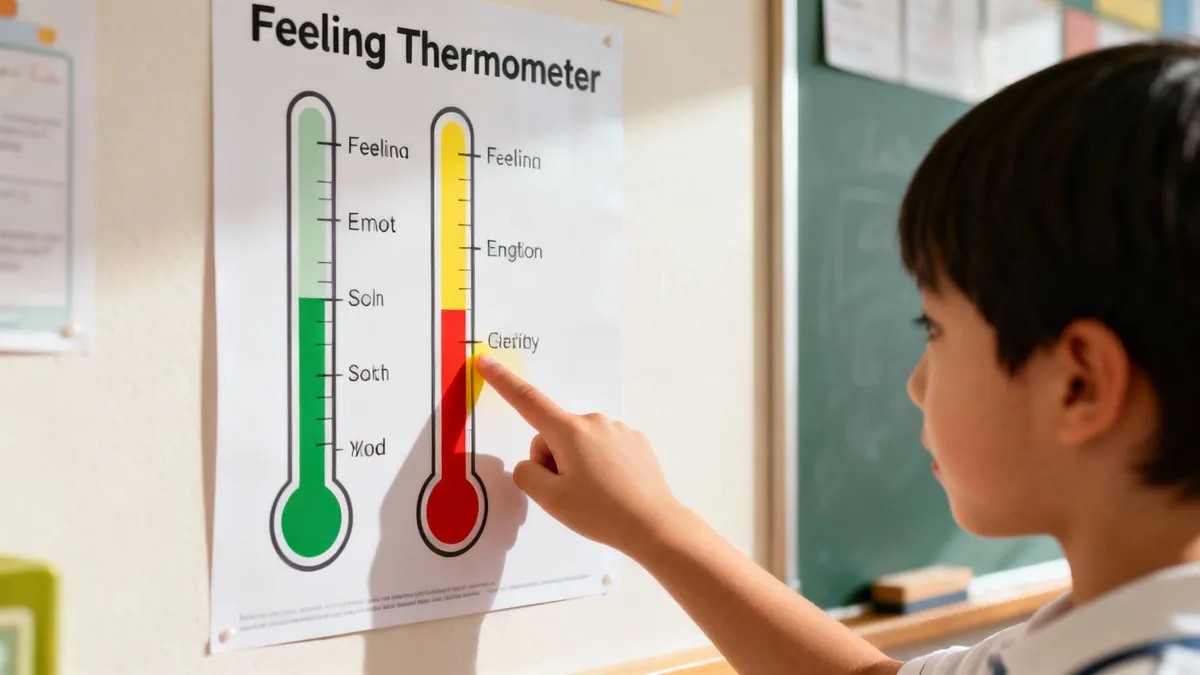
This practice normalizes the full spectrum of emotions and empowers students to recognize escalating feelings before they become unmanageable. Instead of just saying “I’m mad,” a student can articulate, “I’m in the yellow zone, feeling frustrated.” This crucial distinction creates an opportunity for early intervention and co-regulation, directly strengthening self-awareness and self-regulation skills.
How It Works: Implementation & Tips
Integrate the Feelings Thermometer into daily routines to make emotional check-ins a natural part of the classroom culture. The goal is to make identifying and communicating feelings a regular, shame-free practice.
- Practical Example: During a morning meeting, a 2nd-grade teacher asks, “Let’s do a quick temperature check. Using our fingers, show me where you are on the thermometer today: 1 for green, 2 for yellow, or 3 for red.” The teacher notes which students might need a quiet check-in later.
- Make it Visible and Personal: Post a large, clear Feelings Thermometer in the classroom. Encourage students to create their own smaller, personalized versions that include their unique physical cues for each zone (e.g., “My hands get sweaty in the yellow zone”).
- Connect to Scenarios: Use the thermometer when discussing characters in a book or scenarios on the playground. “How do you think the character was feeling on the thermometer when his friend took his toy?”
- Teach Coping Strategies for Each Zone: Link each level of the thermometer to specific strategies. For example, the green zone is for learning, the yellow zone is a time to use calming strategies (like deep breathing), and the red zone is when we need to ask for help from an adult to get safe.
Schools using this approach report a significant increase in students’ ability to self-report their emotional state. This allows educators to resolve potential conflicts more quickly, as students can articulate their high-intensity feelings and request support before a crisis occurs.
4. Conflict Resolution Role-Play with I-Statements – Responsible Decision-Making & Relationship Skills
This structured activity teaches students to navigate disagreements constructively using a powerful communication tool: the “I-Statement.” Instead of blaming (“You always take my crayons!”), students learn to express their feelings and needs clearly and respectfully. This guided role-play directly builds core competencies in responsible decision-making and relationship skills, turning conflict into an opportunity for understanding rather than escalation.
The goal is to empower students with a concrete framework: “I feel [emotion] when [specific behavior] because [impact], and I need [request].” By rotating through roles of speaker, listener, and observer, they build empathy, practice perspective-taking, and gain the confidence to handle real-life peer issues peacefully. This is one of the most practical social emotional learning activities for creating a safer, more connected classroom community.
How It Works: Implementation & Tips
Introduce the I-Statement formula and model it with a co-teacher or a student volunteer. Use simple scenarios before moving to more complex ones. The structure and repetition are key to helping students internalize this new way of communicating.
- Practical Example: In a 4th-grade class, two students role-play a conflict over a group project. The speaker says, “I feel frustrated when you don’t add your ideas because it makes me feel like I’m doing all the work alone. I need us to brainstorm together for 10 minutes.”
- Provide Scaffolds: Use written sentence starters on a whiteboard or notecards for students to reference.
"I feel __ when you __ because __. I need __." - Rotate Roles: Ensure every student experiences being the speaker (advocating for themselves), the listener (practicing active listening), and the observer (providing feedback).
- Debrief Effectively: After each role-play, ask targeted questions: “What was it like to use an I-Statement?” “To the listener, how did that feel different than being told ‘You’re lazy’?”
- Practice Proactively: Don’t wait for a real conflict. Make this a regular, low-stakes practice during morning meetings or advisory periods. Peer mediation programs in middle schools are often built on this foundational skill.
Schools that implement this practice, like those using Soul Shoppe’s core workshops, report that students begin using I-Statements spontaneously on the playground and in the classroom weeks after training. You can explore a deeper dive into the magic of ‘I Feel’ statements for kids to further support this transformative practice.
5. Empathy Interviews & Perspective-Taking – Social Awareness & Relationship Skills
This activity involves structured interviews where students ask peers open-ended questions designed to build understanding across differences. The core practice is active listening, which validates diverse experiences and dismantles stereotypes by fostering genuine personal connections. Empathy interviews are powerful social emotional learning activities because they teach students to move beyond their own worldview and appreciate the rich inner lives of others.
The objective isn’t just to gather facts but to understand a peer’s feelings, motivations, and experiences. By creating a safe space for vulnerability, this practice directly develops social awareness (perspective-taking) and relationship skills (communication, building positive relationships), ultimately fostering a more inclusive and compassionate classroom culture that can reduce bullying.
How It Works: Implementation & Tips
Begin by explicitly teaching active listening skills, such as making eye contact, nodding, and asking follow-up questions. Provide students with an interview protocol sheet containing open-ended questions like “What is something that makes you feel proud?” or “Can you describe a challenge you’ve overcome?”
- Practical Example: A 6th-grade teacher pairs students from different social groups for empathy interviews. One student asks, “Tell me about a time you felt really understood by a friend.” After listening, the interviewer reflects back, “It sounds like you felt valued when your friend remembered something important to you.”
- Model First: Always model the activity with a student volunteer. Demonstrate how to ask questions with genuine curiosity and listen without interrupting.
- Strategic Pairing: Intentionally pair students who don’t typically interact to bridge social divides and break down cliques.
- Share Out: After the interviews, have students share one surprising or interesting thing they learned about their partner (with their partner’s permission). This normalizes different experiences for the whole class.
- Repeat & Deepen: Conduct these interviews throughout the year with different partners and evolving questions to build a strong foundation of mutual respect.
Schools that regularly implement empathy interviews often report significant shifts in friendship patterns and a marked increase in peer acceptance for students with diverse backgrounds or needs. These interactions serve as the starting point for ongoing connections and collaborative projects. You can find more strategies for teaching empathy to kids and teenagers to expand on this foundational activity.
6. Growth Mindset Challenges & Failure Celebrations – Responsible Decision-Making & Self-Awareness
This set of activities shifts the classroom culture from a fear of mistakes to an embrace of the learning process. Students are taught to view challenges and failures not as endpoints but as valuable data. By actively engaging in difficult tasks and celebrating the “productive struggle,” they build resilience, intellectual risk-taking, and a deeper understanding of how effort and strategy lead to growth. This approach is a cornerstone of social emotional learning activities that foster persistence.
The goal is to normalize struggle and reframe the concept of failure. When students learn to say “I can’t do this yet,” they develop self-awareness about their current skill level and are empowered to make responsible decisions about what strategies to try next. This directly builds skills in responsible decision-making and self-awareness by linking effort to outcomes.
How It Works: Implementation & Tips
Begin by explicitly teaching the difference between a fixed mindset (“I’m bad at math”) and a growth mindset (“This problem is tricky, so I’ll try a new strategy”). Introduce tiered challenges that allow every student to experience an appropriate level of difficulty.
- Practical Example: A 5th-grade teacher creates a “Failure Wall” or “Celebrate Our Goofs” board. When a student makes a mistake in a math problem but then figures out their error, they write it on a sticky note. “I kept forgetting to carry the one, but then I started circling it to remember.” This celebrates the learning process itself.
- Use Precise Language: Model and encourage specific growth mindset language. Instead of generic praise like “You’re so smart,” say, “I saw you use three different strategies to solve that problem. Your persistence paid off!”
- Respond with Curiosity: When a student is stuck, ask, “What have you tried so far? What’s another approach you could take?” This positions the teacher as a facilitator of learning, not just an answer provider.
- Share Your Struggles: Be open about your own learning challenges. “I had to read this chapter twice to really understand it. Let me show you the notes I took the second time.”
Schools that implement these practices report a noticeable increase in student engagement and a willingness to tackle difficult problems. Fostering this mindset is critical for academic and personal success. You can find more strategies by exploring resources on developing a growth mindset for kids.
7. Circle of Trust & Community Agreements – Social Awareness & Relationship Skills
This practice establishes a structured, predictable forum for students to connect, solve problems, and build a shared sense of community. By co-creating behavioral expectations, often called community agreements or norms, students take ownership of their classroom culture. This process directly targets social awareness by requiring students to consider diverse perspectives and fosters relationship skills through active listening and respectful communication.
The circle format physically represents equity, as every member has an equal position and voice. When used consistently for everything from morning meetings to conflict resolution, it becomes a powerful tool for building trust and psychological safety. Students learn to navigate disagreements constructively and celebrate successes collectively, strengthening their interpersonal bonds.
How It Works: Implementation & Tips
Begin the school year by facilitating a circle where students brainstorm what they need to feel safe, respected, and ready to learn. Group their ideas into 4-6 core values and write them as positive, actionable statements (e.g., “Listen to understand” instead of “Don’t interrupt”). Post these agreements visibly in the classroom.
- Practical Example: A 6th-grade class’s community agreement is “Assume good intent.” When a student feels slighted by a peer’s comment, the teacher references the agreement and asks, “Let’s assume good intent here. Can you ask them what they meant by that?” This reframes conflict into a moment of clarification rather than accusation.
- Use a Talking Piece: Introduce a designated object (a small ball, a decorated stone) that grants the holder the exclusive right to speak. This simple tool dramatically improves listening, as others focus on the speaker instead of planning what to say next.
- Be Consistent: Use the circle for daily check-ins, academic discussions, problem-solving, and celebrations. Consistency makes it a reliable and trusted part of the classroom routine, not just a tool for when things go wrong.
- Model Vulnerability: As the educator, participate authentically in the circle. Share your own relevant experiences and model the type of listening and respect you expect from students.
Schools that fully integrate restorative practices, which are heavily based on the circle model, often report significant decreases in disciplinary issues. By empowering students to create and uphold their own community standards, these social emotional learning activities foster a profound sense of belonging and accountability.
8. Responsible Decision-Making Scenarios & Peer Problem-Solving – Responsible Decision-Making
This social emotional learning activity moves students from theory to practice by presenting them with realistic social and ethical dilemmas. In small groups, students analyze scenarios related to bullying, inclusion, academic integrity, peer pressure, or digital citizenship. This process builds essential responsible decision-making skills by requiring them to apply personal values, consider consequences, and collaborate on ethical solutions.
The core objective is to equip students with a structured framework for navigating complex choices. By repeatedly practicing in a safe, guided environment, they develop the cognitive habits needed to make thoughtful decisions when faced with real-world conflicts. It turns abstract concepts like integrity and empathy into tangible skills.
How It Works: Implementation & Tips
Introduce a simple decision-making model, such as: 1) Identify the problem, 2) Brainstorm solutions, 3) Consider the consequences for everyone involved, and 4) Choose the most responsible option. Present a scenario and have small groups work through the steps together before sharing with the class.
- Practical Example: A 5th-grade teacher presents the scenario: “You see a classmate take an extra snack from the share bin when they think no one is looking. What do you do?” Students discuss the problem (fairness, honesty), possible solutions (tell the teacher, talk to the classmate, do nothing), and the consequences of each choice for themselves, the classmate, and the class community.
- Keep it Relevant: Choose or create scenarios that reflect the actual challenges your students face. This makes the exercise meaningful and immediately applicable.
- Use ‘What Would You Do?’: Frame the discussion around exploration rather than finding a single “right” answer. This encourages critical thinking and respects diverse perspectives.
- Rotate Groups: Ensure students have opportunities to problem-solve with different peers. This exposes them to new ways of thinking and builds broader social cohesion.
- Connect to Class Values: Explicitly link the decisions made in scenarios back to your established classroom agreements or school-wide values. This reinforces the ethical foundation of your learning community.
Many educators find that after engaging in these social emotional learning activities, students begin referencing the scenarios and problem-solving steps during actual peer conflicts. The structured practice provides them with a shared language and a clear process for navigating difficult social situations constructively.
9. Gratitude Practices & Appreciation Journals – Self-Awareness & Social Awareness
This practice intentionally shifts students’ focus toward the positive aspects of their lives, helping to counteract the brain’s natural negativity bias. By regularly identifying and reflecting on things they are grateful for, students develop a deeper appreciation for their experiences, relationships, and even their own strengths. These powerful social emotional learning activities build both self-awareness by acknowledging personal feelings of gratitude and social awareness by recognizing the positive impact of others.
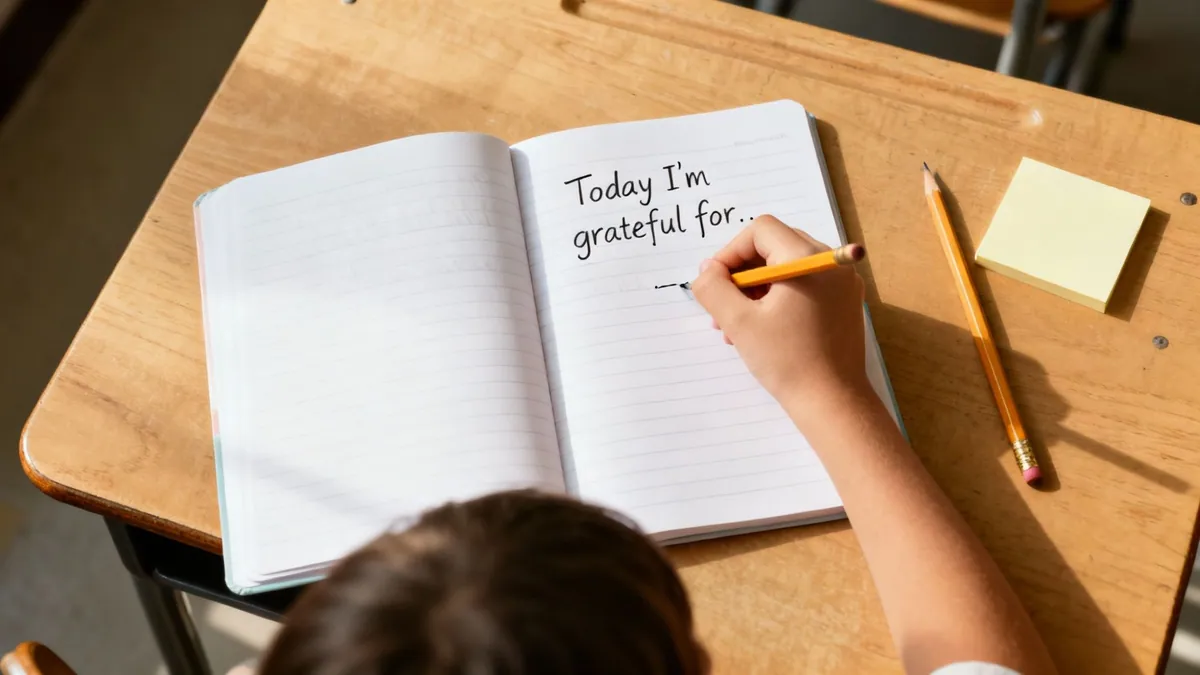
The goal is to cultivate a habit of noticing good in the world, which can improve overall mood, resilience, and empathy. When students share what they are grateful for, it strengthens classroom community and fosters a more positive and supportive learning environment. This simple practice builds skills that contribute to long-term well-being and relational health.
How It Works: Implementation & Tips
Introduce gratitude as a simple “notice the good” exercise. This can take many forms, from private journaling to public sharing in a “gratitude circle” or on a “gratitude wall.” The key is making it a consistent, low-pressure routine.
- Practical Example: A 5th-grade class starts each Friday morning with “Appreciation Notes.” Students are given a sticky note to write a specific thank you to a classmate for something kind they did that week. The notes are then delivered, creating a powerful wave of positive peer-to-peer recognition.
- Model It: Be specific in your own expressions of gratitude. Instead of saying “Thanks for being good,” try “I’m so grateful for how you all helped each other clean up so quickly today; it shows real teamwork.”
- Vary the Format: Keep the practice fresh by switching between different methods. Use a class gratitude jar where students add slips of paper throughout the week, create a collaborative gratitude collage with drawings and words, or hold a circle where students can verbally share.
- Include Challenges: Encourage students to find gratitude even in difficult situations. Frame it as appreciating the opportunity to learn, grow stronger, or discover something new about themselves.
- Make it Optional: Always provide an option to pass. Gratitude should feel authentic, not forced. A student having a tough day should be allowed to simply listen and absorb the positive energy of others.
10. Restorative Circles & Repair Practices – Responsible Decision-Making & Relationship Skills
Restorative circles are a structured approach to conflict resolution that shifts the focus from punishment to repair. When harm occurs, this practice brings together the person who caused the harm, those affected, and a facilitator to discuss the impact and collaboratively decide how to make things right. This process is a powerful tool among social emotional learning activities, as it directly teaches accountability, empathy, and responsible decision-making.
The goal is to mend relationships and restore the community, not to assign blame or isolate individuals. By understanding the real-world consequences of their actions, students develop crucial relationship skills and learn to take ownership of their choices. This method preserves a student’s connection to the school community, a key factor in reducing repeat offenses.
How It Works: Implementation & Tips
Restorative practices require a shift in mindset and should be introduced with intention and training. The circle format creates a non-hierarchical space where every voice is valued.
- Practical Example: After a conflict where one 5th grader took another’s art supplies, a counselor facilitates a restorative circle. The student who was harmed explains, “When my special markers were gone, I felt disrespected and couldn’t finish my project.” The other student, hearing the direct impact, offers a sincere apology and agrees to help organize the art station for a week as a way to make amends.
- Use a Trained Facilitator: Initially, have a trained staff member lead the circle. Over time, build capacity by training other teachers and even student peer mediators.
- Follow a Clear Protocol: A common structure includes an opening, storytelling from all perspectives (“what happened?”), discussing the impact (“who was affected?”), and creating a repair agreement (“what needs to be done to make things right?”).
- Focus on Behavior, Not Character: Frame the conversation around the action and its impact. Avoid labels like “bad” or “mean.” The focus is on repairing harm, not judging the person.
- Create Concrete Agreements: Ensure the plan for repair is specific, achievable, and agreed upon by all parties. Follow up to see that the agreement was honored and that the relationship is healing.
Schools implementing restorative justice models often report a 30-50% reduction in suspensions. Students feel heard and are more likely to learn from their mistakes when they participate in fixing them, rather than being excluded through traditional discipline.
10 SEL Activities — Skills & Implementation
| Item | Implementation complexity | Resource requirements | Expected outcomes | Ideal use cases | Key advantages |
|---|---|---|---|---|---|
| Mindful Breathing & Body Scan Practice | Low — short sessions, needs teacher modeling and trauma-sensitive options | Minimal — no materials; optional audio/visual cues | Improved self-regulation, interoceptive awareness, reduced anxiety | Transitions, pre-tests, calm-down moments, crisis de-escalation | Immediate calming, portable skills, low cost |
| Peer Appreciation & Strength-Spotting | Low–Moderate — requires scaffolding for authentic feedback | Sentence stems/cards, bulletin space, brief prep time | Increased belonging, reduced bullying, higher self-esteem | Community-building, anti-bullying lessons, weekly rituals | Builds empathy, peer recognition, scalable |
| Feelings Thermometer & Emotion Naming | Low — introduce visuals and practice to build fluency | Visual charts/posters, personalized tools | Earlier intervention, shared emotional language, reduced shame | Morning check-ins, transitions, individual support | Common language for feelings, easy home use, supports regulation |
| Conflict Resolution Role-Play with I-Statements | Moderate — needs facilitation, scripts, role rotation | I-statement templates, role scripts, facilitator time | Reduced conflicts, improved communication, greater empathy | Conflict skills lessons, peer mediation, rehearsing difficult conversations | Provides concrete language, practices real dialogues |
| Empathy Interviews & Perspective-Taking | Moderate — requires preparation and safe environment | Interview protocols, time for pairs, possible recording materials | Stronger relationships, reduced stereotyping, active listening skills | Diversity/ inclusion lessons, bridging social groups, projects | Deepens understanding, validates diverse experiences |
| Growth Mindset Challenges & Failure Celebrations | Low–Moderate — consistent messaging and modeling needed | Tiered challenges, reflection prompts, teacher modeling | Increased resilience, greater risk-taking, improved persistence | Academic struggle areas, challenge tasks, whole-class culture work | Normalizes failure, builds effort orientation and persistence |
| Circle of Trust & Community Agreements | Moderate–High — time to establish norms and maintain practice | Circle time, posted agreements, talking piece, ongoing facilitation | Stronger community, student ownership, improved self-regulation | Morning meetings, classroom culture-building, restorative work | Shared ownership of rules, reduces external discipline, builds voice |
| Responsible Decision-Making Scenarios & Peer Problem-Solving | Moderate — requires skilled facilitation and debriefing | Scenario cards, facilitator guide, small-group time | Better judgment, ethical reasoning, stakeholder perspective-taking | Social dilemmas, digital citizenship, character education | Applies decision frameworks to real issues, promotes critical thinking |
| Gratitude Practices & Appreciation Journals | Low — simple routines that can be brief and regular | Journals/notes/jars, prompts; minimal prep | Improved wellbeing, more positive classroom climate, stronger connections | Morning rituals, SEL check-ins, end-of-week reflections | Research-backed wellbeing benefits, easy and flexible to implement |
| Restorative Circles & Repair Practices | High — requires trained facilitation, prep, and follow-up | Trained staff/facilitators, time, clear protocols, administrative buy-in | Relationship repair, reduced suspensions, accountability and restitution | Serious conflicts, harm repair, disciplinary alternatives | Preserves relationships, teaches accountability, reduces repeat harm |
Weaving SEL into the Fabric of Your School: Your Next Steps
The comprehensive collection of social emotional learning activities detailed in this article-from Mindful Breathing to Restorative Circles-provides a powerful toolkit for educators. Yet, the true potential of SEL is unlocked not by occasionally implementing an isolated activity, but by weaving these practices into the very fabric of your school’s culture. This is not about adding another item to a packed curriculum; it is about fundamentally shifting how students and staff interact, understand themselves, and navigate their world together.
The journey begins by moving from doing SEL to being SEL. It’s the difference between a one-off “Conflict Resolution Role-Play” and a classroom where using “I-Statements” becomes the natural, expected way to communicate disagreement. It’s transforming a “Gratitude Practice” from a five-minute exercise into a school-wide culture of appreciation, where students and teachers actively look for and acknowledge the good in each other. This sustained, integrated approach creates the psychological safety necessary for deep learning and personal growth to occur.
Making SEL Stick: From Theory to Daily Practice
The most effective implementation is both strategic and organic. It requires a thoughtful plan but also the flexibility to respond to the real-time needs of your community. For a classroom teacher, this means starting small and building momentum.
Consider these actionable next steps:
- Start with One or Two Core Activities: Don’t try to implement all ten activities at once. Choose one that addresses a pressing need in your classroom. For instance, if transitions are challenging, begin with the Feelings Thermometer to help students identify and manage their energy levels before moving to the next subject. If you notice social cliques forming, introduce Peer Appreciation & Strength-Spotting to foster broader connections.
- Model Authenticity: Your own engagement is the most powerful endorsement. When you, as the adult, share a moment you felt frustrated and used a breathing technique to calm down, you make it safe for students to do the same. This vulnerability transforms abstract concepts into relatable, human experiences.
- Create Predictable Routines: Integrate these activities into the natural rhythm of the school day. A Mindful Breathing exercise can become the standard way you begin class after recess. A Gratitude Circle can be the consistent closing ritual every Friday afternoon. Consistency turns practice into habit. For additional practical ideas on integrating SEL into daily routines, you can refer to this guide on 10 Social Emotional Learning Activities to Build Real-World Skills.
A School-Wide Commitment to Nurturing Whole Beings
For school leaders and administrators, the goal is to cultivate an environment where every adult feels equipped and empowered to champion SEL. This involves more than just providing a list of social emotional learning activities; it requires systemic support.
Key Insight: A successful SEL initiative is not a top-down mandate but a collaborative, community-wide commitment. It thrives when teachers are given the professional development, resources, and autonomy to adapt practices to their unique classroom environments.
By investing in these skills, you are doing far more than managing behavior or improving academic metrics. You are nurturing a generation of resilient, empathetic, and responsible individuals. You are equipping them with the internal architecture to handle adversity, build meaningful relationships, and contribute positively to their communities. This is the ultimate return on investment-developing engaged, self-aware, and compassionate citizens prepared not just for the next test, but for a lifetime of well-being and success.
Ready to transform your school’s culture with proven, hands-on support? Soul Shoppe provides comprehensive programs that empower students, staff, and parents with the tools to build empathy, resolve conflicts, and create a climate of respect. Visit Soul Shoppe to learn how their on-site and virtual assemblies, parent workshops, and professional development can bring these essential social emotional learning activities to life in your community.