

A Practical Guide to Goal Setting for Kids
Teaching your child how to set goals is more than just a life skill; it’s a way to give them a sense of purpose and control over their own journey. It’s the simple but powerful process of turning “I wish” into “I can,” one small step at a time.
Why Goal Setting for Kids Is a Game Changer
Think about a student who just goes through the motions, completing assignments without any real spark. Now, imagine that same student’s face lighting up after they set a tiny, personal goal and achieve it. This is the magic of goal setting for kids—it shifts their mindset from passive to proactive.
When children learn to set their own targets, they start seeing the direct link between their effort and the results. This isn’t just about chasing better grades; it’s a core Social-Emotional Learning (SEL) practice that builds real confidence and self-awareness from the inside out.
Building Resilience and Focus
A goal gives a child a clear destination. All of a sudden, classroom tasks aren’t just things they have to do; they’re stepping stones toward something they genuinely want to accomplish.
- For a kindergartener, the goal might be as simple as learning to tie their shoes by the end of the month. Every fumbled knot and successful loop has a purpose. A parent could say, “Let’s practice making the ‘bunny ears’ with the laces five times every morning after you put on your shoes.”
- For a fifth-grader, it could be tackling a chapter book that’s just a little bit challenging. They learn to break it down, persevere through tricky words, and celebrate finishing the last page. A teacher might help them set a goal like, “I will read one chapter each night and write down one new word I learned.”
This process naturally teaches resilience. Missing a goal isn’t a failure; it becomes a powerful lesson in what to try differently next time. It also strengthens their self-management skills—a cornerstone of both academic success and personal growth. You can explore our guide on https://soulshoppe.org/blog/2026/02/21/what-are-self-management-skills/ for a deeper dive into this crucial area.
Connecting Effort to Achievement
Goal setting takes the vague idea of “working hard” and makes it tangible. It offers a framework where children can see their own actions creating real, measurable outcomes.
Teaching goal setting is about showing children they are the authors of their own progress. When they see a goal through from start to finish, they build a belief in their own ability to make things happen.
The benefits of goal setting for students are clear, but how they manifest can look different depending on the child’s age.
Goal Setting Benefits Across K-8
Here’s a quick look at how goal setting supports students at each developmental stage.
| Grade Band | Primary Benefit | Example |
|---|---|---|
| K–2 | Building Self-Efficacy | “I can do it!” A student feels proud after successfully writing their name with a capital letter, a goal they worked on all week. |
| 3–5 | Developing Persistence | “I won’t give up.” A student uses a checklist to finish a multi-step science project, even when parts are tricky. |
| 6–8 | Fostering Agency | “I’m in charge of my learning.” A student sets a goal to improve their pre-algebra grade by attending after-school help sessions. |
As you can see, the goals evolve, but the underlying skills—confidence, perseverance, and ownership—grow right alongside them.
This skill has a surprisingly significant global impact, too. Studies related to UN Sustainable Development Goal 4 found that children who practice structured goal setting early on have a 20-30% higher rate of on-time primary school completion. This is especially critical in regions where students are at a higher risk of dropping out.
By creating a shared language around goals at home and in the classroom, we build a supportive ecosystem for our kids. We help them turn abstract ambitions into concrete achievements, fostering a sense of agency that will serve them for the rest of their lives. For more on fostering genuine student motivation, check out this fantastic guide: Goal Setting for Kids: How to Build Agency, Not Just Checklists.
Making Goals Click with a Kid-Friendly Framework
Adults love acronyms like SMART goals, but let’s be honest—for a kid, that can feel like doing homework. When it comes to goal setting for kids, the words we use are everything. We need to ditch the corporate jargon and translate it into something that makes sense on the playground.
The idea is to turn a rigid process into an exciting adventure. Instead of getting hung up on formal definitions, we can reframe the core principles into something fun, memorable, and easy for a child to own.
The real aim isn’t just to set a target; it’s to spark a child’s own motivation. When the framework itself is empowering and simple, we give them the keys to drive their own progress.
This kid-friendly approach breaks down the same powerful ideas behind effective goal setting into five simple, action-oriented phrases.
Super Clear What I’ll Do
Vague goals like “I want to be better at math” are a recipe for frustration. Why? Because there’s no clear target. A “Super Clear” goal helps a child pinpoint exactly what they will do, turning a fuzzy wish into a concrete action.
This step is all about getting specific. You can guide them with questions like, “What does ‘being better’ look like? What’s one small thing you could do this week to practice?”
- Vague Idea: “Be better at math.”
- Super Clear Goal: “I will finish my math homework before dinner on Mondays and Wednesdays without asking for help on the first try.”
This clarity gives them a starting line and a defined task, which is far less overwhelming than a huge, undefined ambition.
Easy to See My Progress
A goal needs a way to be measured so kids can see they’re getting somewhere and celebrate those small wins. It’s the difference between “getting good at reading” and “reading five pages of my book every night before bed.” This is how they build momentum.
What if a child wants to be kinder? How can they see their progress? We can help them make it measurable.
- Vague Idea: “Be nicer to my friends.”
- Super Clear & Measurable Goal: “I will give one real compliment to a classmate during recess each day this week.”
Suddenly, the goal is trackable. At the end of the week, they can count their compliments and feel a genuine sense of accomplishment. Setting measurable social goals like this is incredibly powerful. In fact, schools using research-based SEL programs have seen bullying drop by 28%, in large part because students set and track specific goals around empathy. To learn more about how structured goals support better education, check out the resources from the Joint SDG Fund.
A Challenge I Can Actually Do
Goals should stretch a child, but not so much that they feel defeated before they even start. An achievable goal builds confidence. If a kid has never scored in soccer, a goal of “scoring 10 goals in the next game” is just a setup for disappointment.
A much better approach is to focus on the process.
- Unrealistic Goal: “Score 10 goals in the next game.”
- Achievable Goal: “I will take five practice shots on the goal every day after school this week.”
This shifts the focus to effort—something that is completely within the child’s control—rather than a final outcome that depends on many different factors.
Something That Matters to Me
This is the secret sauce: the “why” behind the goal. For a child to stick with something hard, it has to connect to what they actually care about. A goal to “practice piano for 30 minutes” will always feel like a chore if it’s just what a parent wants.
Help them find their own reason. Maybe they want to learn the theme song from their favorite video game.
- Assigned Goal: “You will practice piano for 30 minutes daily.”
- Relevant Goal: “I will practice the first page of the ‘Super Mario’ theme song until I can play it without mistakes, so I can show my friends.”
When the goal truly matters to them, the motivation comes from within.
My Finish Line
Every great quest needs a finish line. A deadline creates a healthy sense of focus and gives everyone a clear moment to celebrate success. Without a “when,” goals can drag on forever and lose steam.
The timeline should make sense for the child’s age—keep it short for younger kids and allow for longer-term goals for older students.
- Goal without a Finish Line: “I want to build a cool Lego creation.”
- Goal with a Finish Line: “I will finish building my Lego space station by the end of Saturday afternoon.”
This simple addition transforms a casual activity into a real project with a clear end point, teaching kids about focus and planning along the way.
Hands-On Goal Setting Activities for Every Age
Now that we have a kid-friendly framework, it’s time to put it into action. Let’s be real—goal setting for kids only clicks when it moves off the worksheet and into the real world. The right activity makes the whole process feel less like a chore and more like a game they’re excited to win.
The trick is to match the activity to their developmental stage. A kindergartener needs something visual and immediate, while a middle schooler is totally ready to take on a complex, long-term project. Here are some of my favorite hands-on activities that bring goals to life for every age group.
Activities for Early Learners (Grades K-2)
For our youngest students, goals need to be tangible, simple, and—most importantly—fun. At this age, they’re just starting to grasp that their actions can lead to a specific outcome. The focus should always be on short-term goals with super visible progress markers to keep them motivated.
A simple visual can make all the difference. It helps them see the two most important parts: a “Super Clear” start and a “My Finish Line” they can look forward to.
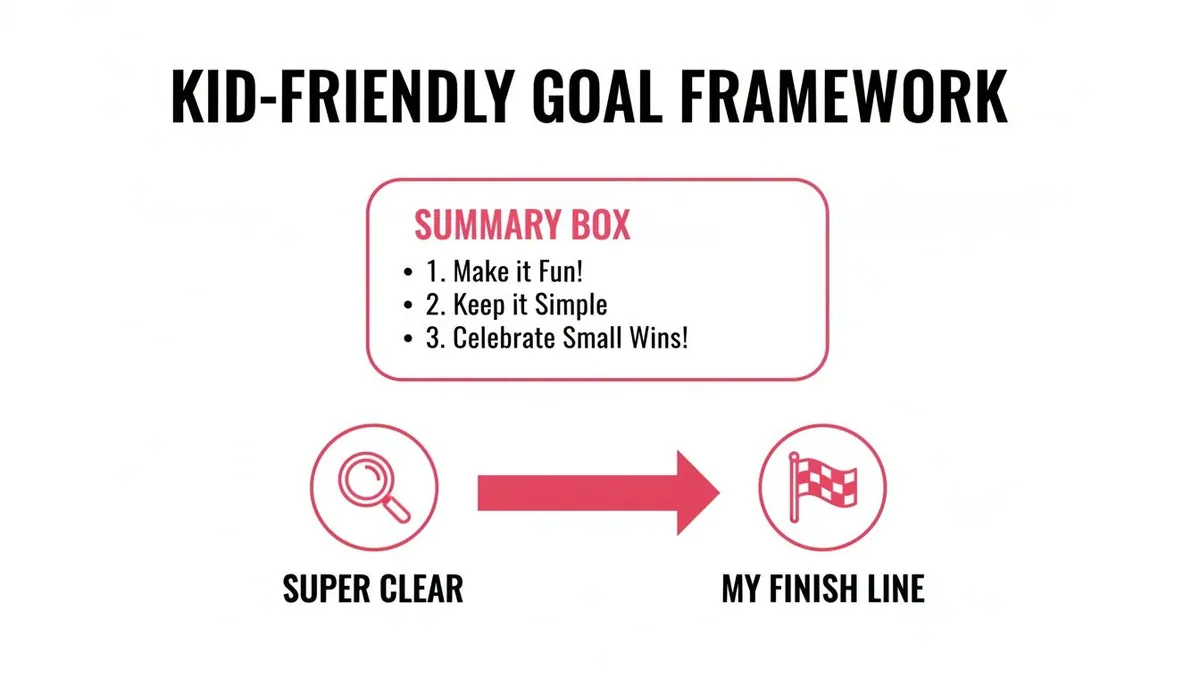
This simple image reminds us that a successful goal for a little one starts with a very specific task and ends with a clear point of completion.
Kindness Quest
This activity turns a social-emotional goal into a playful adventure. It makes abstract concepts like “being kind” totally concrete and helps kids practice those pro-social behaviors in a structured, rewarding way.
How it works:
- Create a Quest Board: Grab a piece of construction paper or a small whiteboard. At the top, write down the goal, something like, “My Kindness Quest this week is to share my toys.”
- Define the Actions: Brainstorm what “sharing” actually looks like. You might get answers like “let a friend have a turn with the red truck” or “ask someone if they want to build blocks with me.”
- Track with Stickers: Every time the child completes a kind action, they get to put a sticker on their Quest Board. Seeing that board fill up is immediate, positive reinforcement!
Discussion Questions:
- “How did it feel when you shared your toy with your friend?”
- “What did their face look like when you asked them to play?”
Goal Goalposts
This is a fun, sports-themed activity that’s perfect for tracking academic or behavioral goals, like learning sight words or remembering to raise a hand. It uses a familiar and exciting visual to represent progress.
Practical Example:
A first-grader’s goal is to learn five new sight words by Friday. You can create two “goalposts” on a wall using painter’s tape. Each day the child practices, they move a paper soccer ball a little closer to the goal. When they can read all five words correctly, they get to “score” by taping the ball right between the posts. That simple action creates a powerful sense of accomplishment.
Activities for Elementary Students (Grades 3-5)
By this age, kids can handle more complex, multi-step goals. They’re starting to understand the connection between consistent effort over time and a bigger achievement down the road. Activities for this group should encourage planning, persistence, and a bit of self-reflection.
At this stage, goal-setting becomes a tool for personal discovery. It’s not just about what they can do, but about who they are becoming—a persistent problem-solver, a helpful community member, or a dedicated artist.
Personal Best Portfolio
This activity is fantastic for skill-based goals where improvement is gradual, like in P.E., art, or writing. It beautifully shifts the focus from competing with others to competing with oneself, which is a core tenet of a growth mindset.
How it works:
- Select a Skill: The student picks a skill they want to improve, like dribbling a basketball, drawing a portrait, or writing a story.
- Create the Portfolio: Use a simple folder or binder to collect evidence of their progress.
- Capture Baselines and Milestones: The first entry is their “starting point”—maybe a video of them dribbling for 30 seconds or their first story draft. As they practice, they add new entries, dating each one.
Practical Example:
A fourth-grader wants to improve her jump rope skills. Her goal: “to do 25 consecutive jumps by the end of the month.” Her portfolio starts with a note saying she can currently do seven jumps. Each week, she records her new “personal best.” Seeing the number climb from 7 to 12, then 18, and finally to 26 provides undeniable proof that her practice is paying off. For more ideas, you can find some wonderful social-emotional learning activities for elementary students in this guide.
Helping Hands Challenge
This project-based activity connects personal goals to community impact. It helps students see that their actions can benefit others—a powerful motivator, as research has shown time and again.
How it works:
The class or family picks a community-focused goal, like “Collect 50 cans for the local food drive” or “Make 20 thank-you cards for school support staff.” They then break the large goal into smaller, individual tasks. A large paper cutout of a tree on a bulletin board can serve as a tracker; for every milestone reached (like every 5 cans collected), students add a “leaf” with their name on it to the tree.
Activities for Middle Schoolers (Grades 6-8)
Middle schoolers are primed for long-term, passion-driven goals. They’re capable of abstract thinking and complex planning, so our activities should empower them to take full ownership of their ambitions, from the initial idea to the final execution.
Passion Project Blueprint
This activity guides students in turning a personal interest into a significant, long-term project. It’s an amazing way to teach essential life skills like research, planning, time management, and presentation.
How it works:
- Identify a Passion: The student chooses something they’re genuinely curious about—learning to code a simple game, starting a podcast, or organizing a charity bake sale.
- Create the Blueprint: The student maps out their entire project. This “blueprint” should include the final goal, necessary resources, a step-by-step timeline with mini-deadlines, and a plan for sharing their final product.
- Regular Check-ins: The adult’s role shifts to that of a project manager or coach. Hold weekly check-ins to discuss progress, troubleshoot obstacles, and offer encouragement.
Peer Accountability Groups
For academic or study-related goals, working with peers can provide a huge boost of both support and motivation. This activity also teaches collaboration, communication, and mutual responsibility.
Practical Example:
A group of three eighth-graders wants to improve their algebra grades before final exams. They form an accountability group and set a shared goal: “We will all complete our homework on time and score a B or higher on the next quiz.” They agree to meet once a week during lunch to review tough concepts and check in on each other’s progress. This structure turns an individual struggle into a shared team mission.
To make it even easier, here’s a quick-reference table with some sample goals tailored for different developmental stages.
Grade-Appropriate Goal Ideas
| Grade Band | Academic Goal Example | Social-Emotional Goal Example |
|---|---|---|
| K–2 | I will learn my 5 new sight words by Friday. | I will share my toys with a friend at recess this week. |
| 3–5 | I will read for 20 minutes every night for a month. | I will give a classmate a genuine compliment each day. |
| 6–8 | I will raise my science grade from a C to a B by the next report card. | I will join one new club to meet people with similar interests. |
Think of these as starting points. The most powerful goals will always be the ones that come directly from the students themselves, reflecting their own unique interests and aspirations.
Connecting Goals to a Growth Mindset
Once kids can name their big feelings, the real magic happens when we teach them what to do next. This is where resilience truly starts to build.
It’s about shifting from just weathering emotional storms to actually navigating the choppy waters that cause them. We can coach kids to see problems not as scary dead ends, but as puzzles waiting to be solved.
And this skill is desperately needed. A recent survey from the Boys & Girls Clubs of America found that a staggering 7 out of 10 young people said they couldn’t stop worrying when something important went wrong. Giving them a simple way to tackle problems gives them back a sense of control.
A Simple Method for Solving Problems
Our first instinct is often to rescue kids from their struggles. But to build resilience, we have to start coaching them to find their own solutions.
The next time a child comes to you with a problem—a forgotten homework assignment, a squabble with a friend—try to resist the urge to jump in and fix it.
Instead, you can guide them through a simple, collaborative process. Think of yourself as their co-pilot.
- What’s the Real Problem? First, help them get specific. Ask gentle questions like, “What’s the one thing that’s really bothering you about this?” This helps cut through the noise and identify the core issue.
- Brainstorm—No Bad Ideas Allowed! Next, encourage them to toss out any and all possible solutions, even the silly ones. This isn’t about finding the perfect answer right away; it’s about showing them that there are always options.
- Think It Through. Now, look at the list together. Ask, “What do you think would happen if you tried this one? What about that one?” This is huge for developing foresight and thinking about consequences without any judgment.
- You Pick, You Try. Let the child choose which solution to test drive. This step is all about ownership. They’re in the driver’s seat.
- So, How’d It Go? Later, circle back. A simple, “How did that work out? Would you do it that way again?” is all it takes. This reflection is where the deep learning really sticks.
Here’s how it looks in real life: Ten-year-old Leo is bummed because his friend Sam keeps picking other kids for their class project. Instead of calling Sam’s mom, Leo’s dad coaches him. Leo decides his solution is to talk to Sam directly at recess. He finds out Sam just thought he was already working with someone else. Problem solved. More importantly, Leo just got a huge confidence boost in handling social mix-ups himself.
Building a Growth Mindset
This whole problem-solving approach feeds directly into what we call a growth mindset—the belief that our abilities aren’t fixed, but can be developed with effort and practice.
When we praise the process a child uses instead of just the final result, we’re laying the foundation for resilience. A kid with a growth mindset sees a tough math problem as a chance to get stronger, not as a verdict on how “smart” they are.
The language we use is everything. It’s a small shift that sends a massive message about what truly matters.
Here are a few easy swaps you can make today:
- Instead of: “You’re so smart!”
- Try: “I was so impressed with how you stuck with that problem.”
- Instead of: “You’re a natural at this.”
- Try: “I can tell you’ve been working really hard to practice that skill.”
- Instead of: “Don’t worry, you’ll get it next time.”
- Try: “That didn’t work out the way you planned. What’s another strategy we could try?”
These phrases teach kids that effort and strategy—not innate talent—are the real keys to success. For a deeper dive, check out our guide on how a growth mindset in the classroom builds resilience and perseverance in students.
When we arm children with both problem-solving skills and a growth mindset, we’re giving them the tools to face whatever comes their way with confidence and grit.
Integrating Resilience Into Daily Life

Resilience isn’t taught in a single lesson or a special assembly. It’s built in the small, everyday moments. The real magic happens when we make these skills a habit, creating a supportive ecosystem where kids practice emotional awareness and problem-solving as part of their daily rhythm.
Our goal is to weave these practices into the fabric of school and home life. We want to create environments where trying, failing, and trying again is totally normal and supported. When we do this, kids internalize these skills until they become second nature.
Making Resilience a Routine in the Classroom
Schools are the perfect training ground for resilience. They’re filled with daily opportunities for social and academic challenges. The good news is that integrating these skills doesn’t mean adding another subject to an already packed schedule. It just means being more intentional about the routines you already have.
Morning meetings, for instance, are an ideal time for emotional check-ins. Instead of just taking attendance, kick things off with a simple question like, “On a scale of 1 to 5, how are you arriving today?” or “What’s one thing you’re looking forward to?” This small shift validates students’ feelings and sets a tone of emotional awareness for the entire day.
Even literature class offers rich opportunities. When you’re reading a story, you can gently shift the focus to explore a character’s journey through adversity.
Practical Example: While reading a book where the main character faces a big setback, pause and ask the class: “What did the character do to keep going when things got tough? Who did they ask for help? Have you ever felt that way?” This connects the story to their own lives, making the concept of resilience tangible and relatable.
Embedding Resilience Practices at Home
The home is where a child’s sense of safety is nurtured most. Families can create simple but powerful rituals that make resilience part of their culture, providing stability and a safe space for kids to be vulnerable and grow.
One highly effective idea is creating a “calm-down corner” or a “peace corner.” This isn’t a timeout spot, but a cozy, inviting space where any family member can go to regulate their emotions when they feel overwhelmed.
- What to Include: Fill it with comforting items like soft pillows, a weighted blanket, drawing materials, a stress ball, or a favorite book.
- How to Use It: When a child feels overwhelmed, you can gently suggest, “It seems like you’re having a really big feeling right now. Would you like to spend a few minutes in the calm-down corner?”
This teaches self-regulation by giving them a physical place to practice coping skills.
Another powerful family practice is a daily gratitude ritual. It can be as simple as sharing one thing you’re thankful for at the dinner table. This helps shift everyone’s focus toward the positive, even on tough days—a core part of a resilient mindset.
Of course, modeling how you handle your own setbacks is probably the most impactful strategy of all.
Real-World Scenario: You burn dinner. Instead of getting upset, you can model resilience by saying, “Oops, I really messed that up! Well, that’s frustrating, but it’s okay. Let’s brainstorm. What’s our Plan B for dinner?” This shows your child that mistakes aren’t catastrophes; they’re just solvable problems.
These skills are especially critical today. An estimated 333 million children—1 in every 6—live in extreme poverty, while over 473 million are in areas affected by conflict. These numbers show why building resilience into daily life isn’t just a nice-to-have; it’s essential for helping kids navigate and overcome profound challenges.
By creating this consistent, supportive ecosystem at home and school, we give children the practice they need to build the skills to thrive.
Common Questions About Building Resilience in Kids
Even with the best intentions, helping a child learn to navigate life’s ups and downs can bring up a lot of questions. When you’re in the middle of it, you need practical answers. Here are some of the most common things parents and educators ask about building resilience.
How Can I Tell if My Child Is Struggling with Resilience?
The biggest clue is a noticeable shift in their usual behavior. A resilient child bounces back from small disappointments fairly quickly. A child who’s struggling, however, might show more lasting changes.
You might notice they’re more irritable, get frustrated over tiny things, or start avoiding activities they used to enjoy. At school, this could look like a student giving up on a tough problem almost immediately or having an outsized emotional reaction to simple feedback. These aren’t necessarily red flags, but they are clear invitations to lean in with a little extra support.
Here’s a real-world example: Seven-year-old Maya usually can’t wait for soccer practice. But for the past few weeks, she’s had a “stomachache” right before it’s time to leave. Instead of making her go, her dad sits with her and says, “I’ve noticed soccer doesn’t seem as fun for you lately. What’s on your mind?” He learns she’s worried about not being as fast as the other kids. That conversation opens the door to talk about trying your best and just having fun.
What’s the Single Most Important Thing I Can Do?
Focus on building a strong, supportive relationship. This is the absolute foundation of resilience. A child who feels seen, heard, and safe to fail has an incredible buffer against stress.
This connection gives them a secure base to explore the world from, take healthy risks, and learn from their fumbles without fearing they’ll lose your love. A practical example is putting your phone away when your child is talking to you about their day, giving them your full, undivided attention to show they are your priority.
How Do I Encourage a Growth Mindset Without Invalidating Their Feelings?
This is a delicate balance, but the key is to validate the emotion first. Before you jump to solutions, acknowledge what they’re feeling. A quick “You’ve got this!” can accidentally make a child feel unheard when they’re truly stuck.
Start with empathy. Say something like, “I can see you’re really frustrated with this. It looks tough.” Let that sit for a second. Then, you can gently shift the focus to strategy: “Let’s take a deep breath. What’s one tiny thing we could try next?” This approach honors their struggle while empowering them to see a path forward.
How Can Teachers Weave This In with So Little Time?
The trick is integration, not addition. Look for small moments to build resilience within the routines you already have. Consistent, bite-sized actions are far more powerful than a once-a-month lesson on “grit.”
Here are a few simple ways to do it:
- During Morning Meetings: Use your bell-ringer time for a quick emotional check-in. “What color is your mood today?”
- On the Playground: When a conflict breaks out, use it as a real-time lesson in problem-solving instead of just a disciplinary moment.
- With Tough Assignments: Frame a challenging math problem as a chance to “grow your brain.” Make a point to praise the different strategies students try, not just who gets the right answer first.
At Soul Shoppe, we give schools and families the practical tools and shared language needed to create environments where children can truly flourish. Our programs are designed to fit right into your daily life, helping you build a culture of connection, empathy, and resilience.
Find out how our workshops and resources can support your school community by visiting soulshoppe.org.