Soul Shoppe's work is made possible by donors and partners who care deeply about the young people in their communities! We can't do this work without you. Support our work in classrooms and on playgrounds across the nation by donating here.
Beyond academics, a child’s ability to understand emotions, build healthy relationships, and make responsible choices is crucial for success in school and life. This is the core of social emotional learning (SEL). For elementary students, these skills are not just ‘nice-to-haves’; they are the building blocks of a safe, connected, and productive learning environment where every child can thrive.
Integrating SEL doesn’t require a complete curriculum overhaul. Many effective strategies can be woven into daily routines, complementing existing educational frameworks. For instance, philosophies like the Montessori method of teaching naturally emphasize student autonomy and self-management, which are key pillars of social emotional development. By intentionally incorporating SEL, educators and caregivers can cultivate classrooms where students feel seen, heard, and equipped to navigate social complexities.
This article provides a comprehensive roundup of 10 practical and research-backed social emotional learning activities for elementary students. Each activity is designed for immediate use by busy teachers, counselors, and parents, offering a clear structure to guide implementation. You will find:
Step-by-step instructions and clear goals for each activity.
SEL competency alignment (e.g., self-awareness, relationship skills).
Practical adaptations for different grade levels, remote settings, and large classes.
From fostering self-awareness with simple mindfulness exercises to building community through cooperative games, these strategies will equip you to nurture emotionally intelligent and resilient learners. The goal is to provide actionable tools that turn abstract SEL concepts into tangible classroom experiences, strengthening the foundation for academic achievement and lifelong well-being.
1. Mindfulness and Breathing Exercises
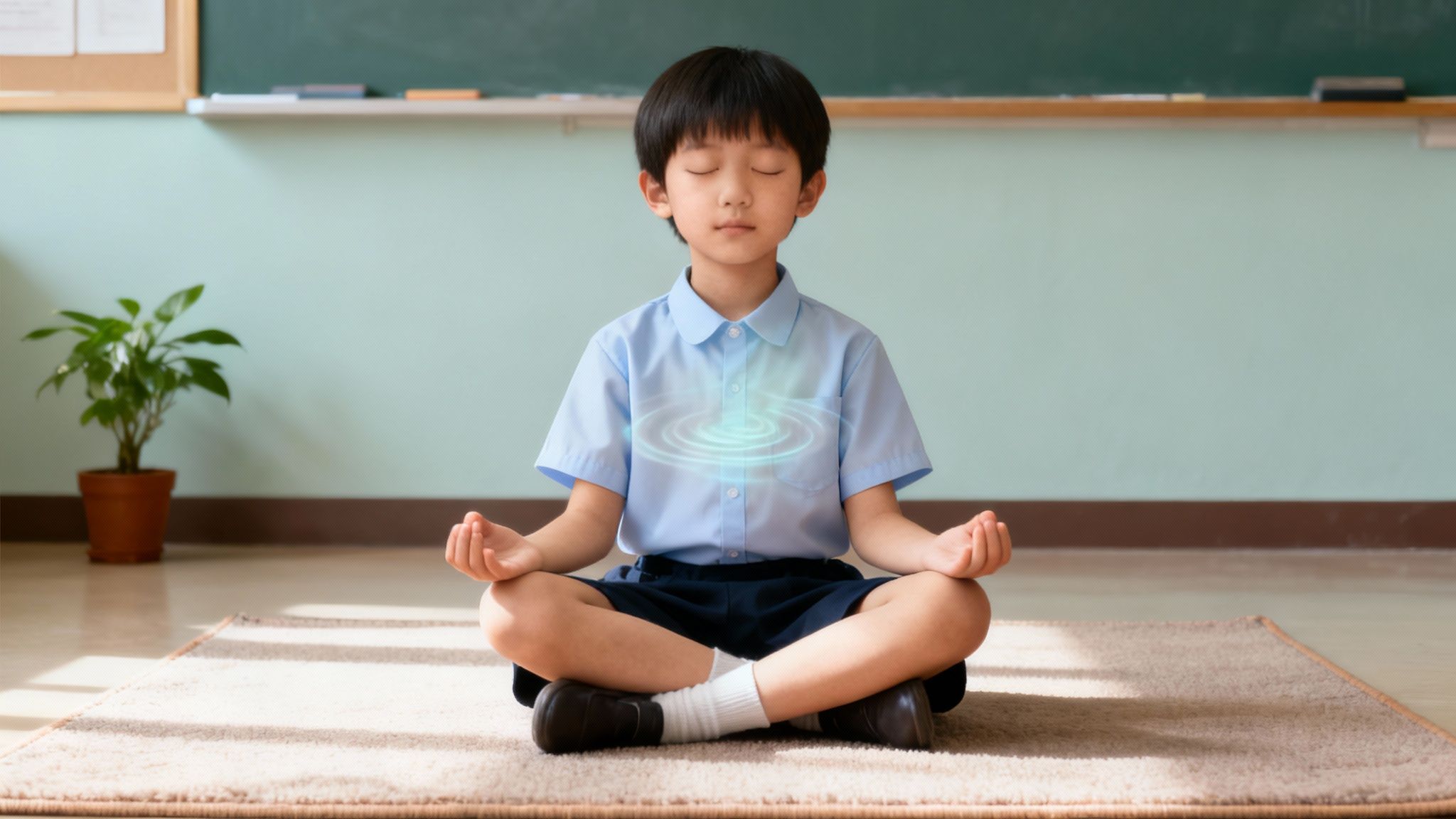
Mindfulness practices are foundational social emotional learning activities for elementary students, teaching them to pause, focus on the present moment, and observe their thoughts and feelings without judgment. By guiding children through simple breathing techniques, body scans, or sensory awareness exercises, you help them build a crucial gap between a triggering event and their reaction. This mental space is where self-regulation begins, allowing students to manage big emotions like anxiety, frustration, and over-excitement.
These exercises directly support the core SEL competencies of self-awareness (noticing internal states) and self-management (using a tool to regulate those states). The goal is not to eliminate difficult feelings but to equip children with the skills to navigate them constructively.
How to Implement Mindfulness and Breathing
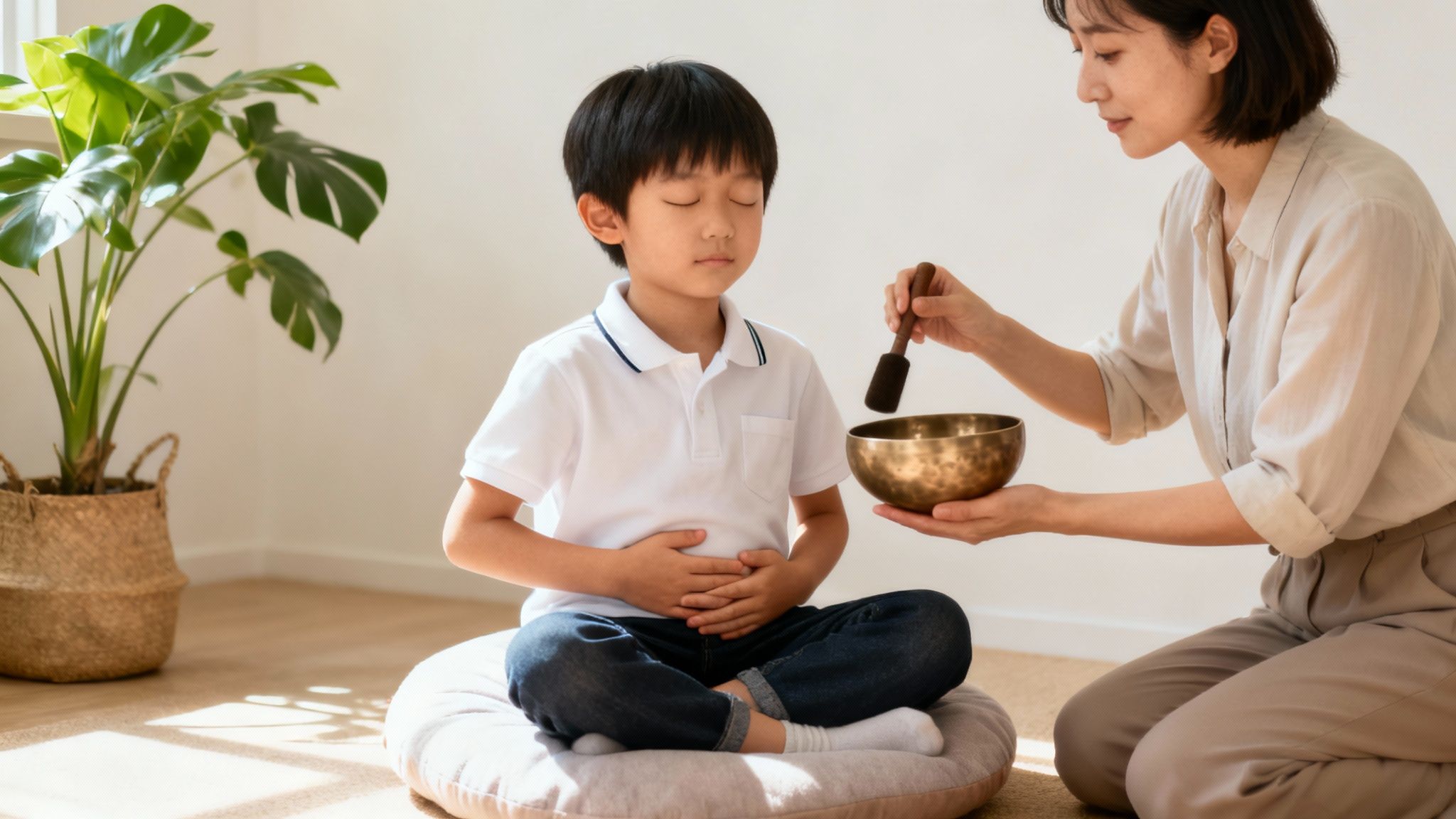
Start by integrating short, simple practices into daily routines. For example, a “Mindful Morning” can begin with two minutes of “belly breathing,” where students place a hand on their stomach to feel it rise and fall. This tangible sensation helps younger learners stay focused. Before a challenging task like a math test, guide them through a “square breathing” exercise: inhale for four counts, hold for four, exhale for four, and pause for four, tracing a square in the air or on their desk.
Practical Example:
A second-grade teacher notices her class is overly energetic and unfocused after recess. She signals for a “Mindful Minute” by ringing a small chime. She guides them: “Place your feet flat on the floor and rest your hands on your desk. Let’s do ‘Volcano Breaths.’ Reach your arms up high as you breathe in deeply, then push the air out with a ‘whoosh’ sound as your arms come down.” She repeats this three times, and the class settles, ready for the next lesson.
Tips for Success
Model First: Always demonstrate the breathing exercise yourself so students see and hear what is expected.
Start Small: Begin with practices as short as 30 seconds to one minute, gradually increasing the duration as students build their focus “muscles.”
Offer Choices: Allow students to sit at their desks, stand, or lie on a rug. Giving them agency over their body position increases comfort and participation.
Use Consistent Cues: A specific chime, a hand signal, or a phrase like “Let’s find our calm” can signal the start of a mindfulness practice, making transitions smoother.
By consistently weaving these moments into the school day, you provide students with a powerful, portable tool for managing their emotional well-being. For more ideas on creating a peaceful classroom, you can find a variety of mindfulness strategies for a relaxed learning environment on soulshoppe.org.
2. Feelings Check-In and Emotion Identification
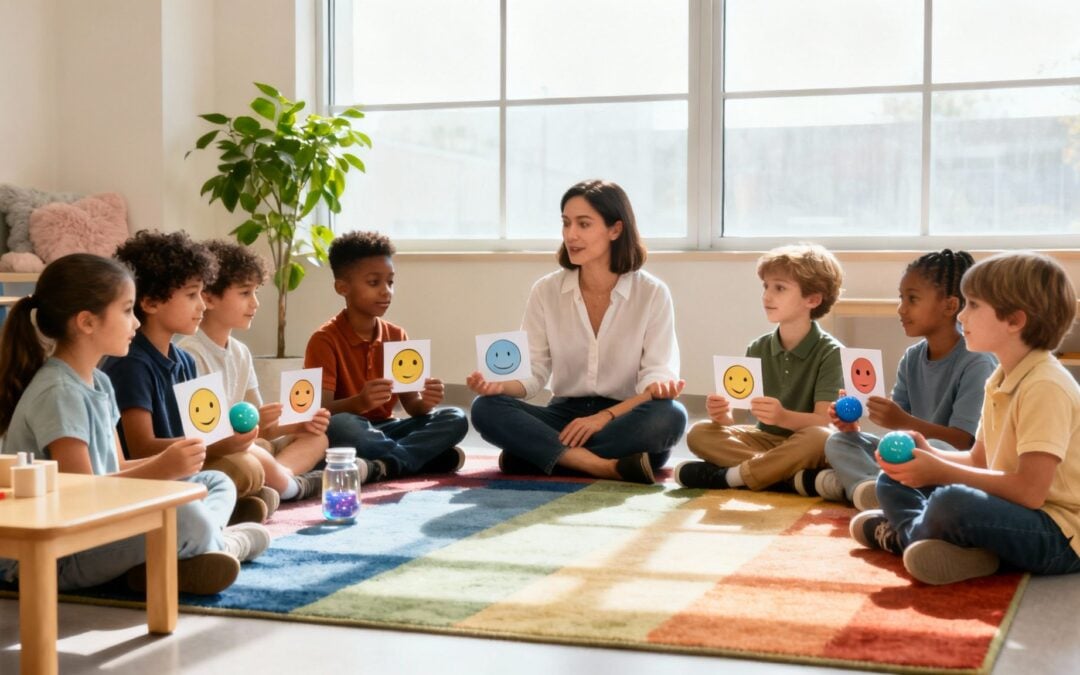
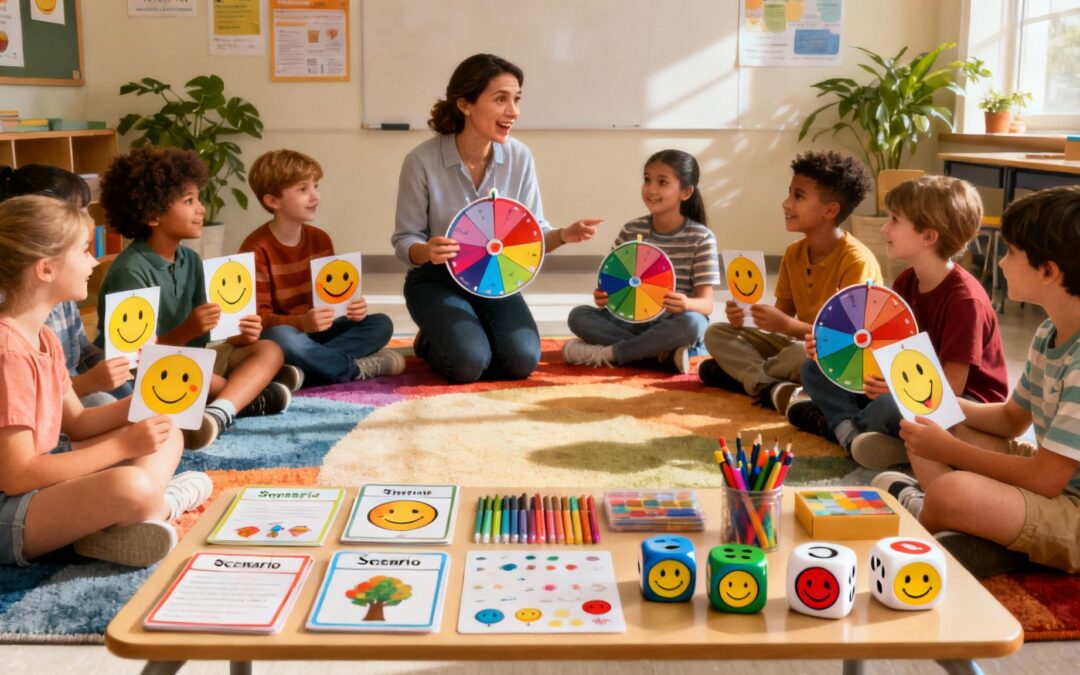
Feelings check-ins are structured daily activities where students learn to recognize, name, and express their emotions using specific vocabulary and visual aids. These simple routines build emotional literacy from the ground up, giving children the words to articulate their internal states. This practice is one of the most essential social emotional learning activities for elementary students because it normalizes conversations about feelings and creates a classroom culture of empathy and support.
This activity directly supports the core SEL competencies of self-awareness (identifying one’s own emotions) and social awareness (recognizing and understanding the emotions of others). By making emotional identification a regular part of the day, you teach students that all feelings are valid and manageable.
How to Implement Feelings Check-Ins
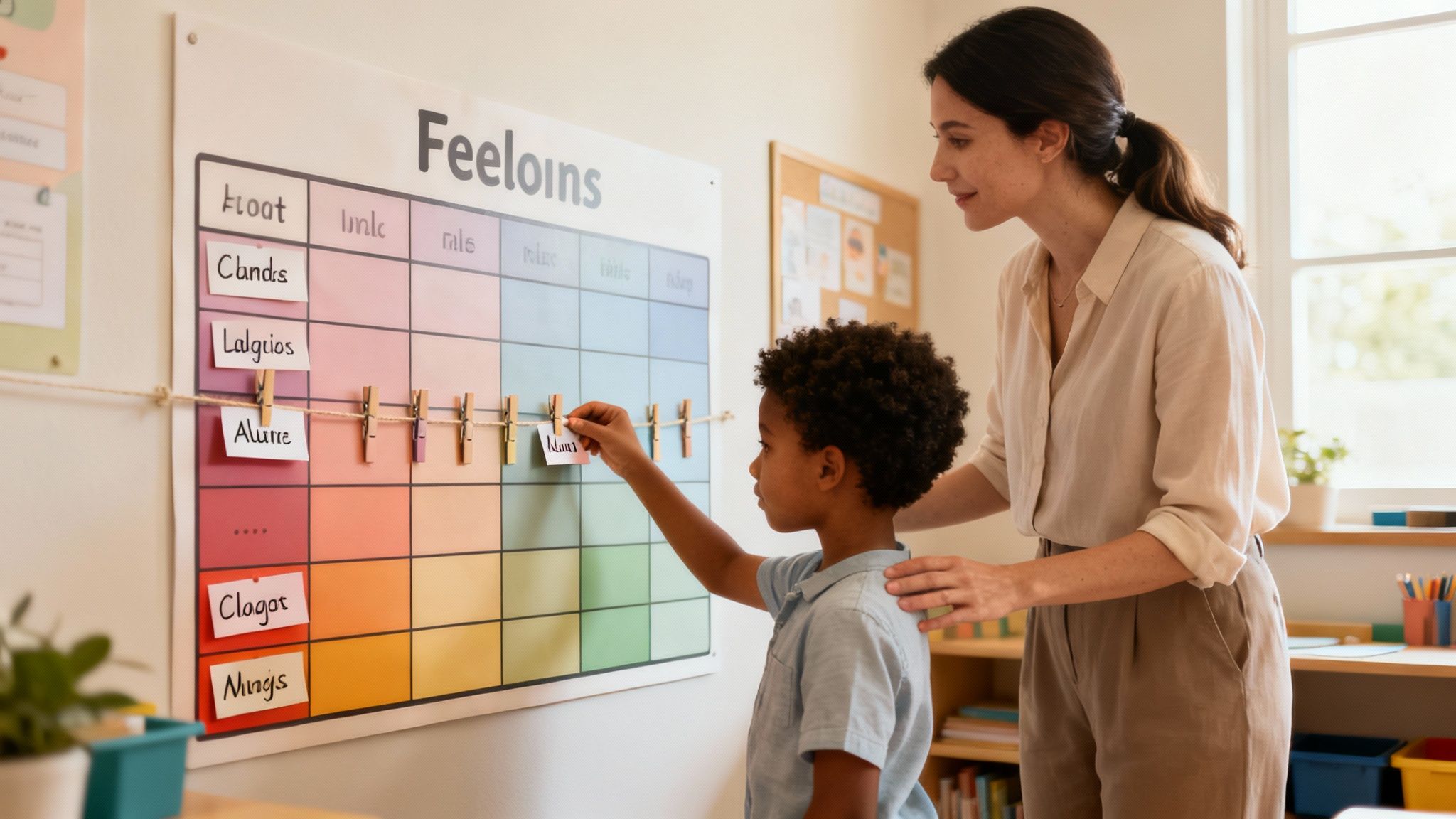
Integrate check-ins into predictable routines, like morning meetings or the transition after lunch. Use visual tools like a “Feelings Thermometer” or an “Emotion Wheel” where students can point to or place their name next to the feeling that best describes their current state. This non-verbal option is excellent for younger students or those who are hesitant to share aloud. As students become more comfortable, you can invite them to briefly share why they feel a certain way.
Practical Example:
A third-grade teacher starts each morning by having students move their personal clothespin to a section of a large color-coded chart. Red represents intense feelings like anger or excitement, yellow for mild feelings like worry or silliness, and blue for low-energy feelings like sadness or tiredness. She then asks, “I see a few friends in the yellow zone today. Would anyone like to share what’s on their mind?” This simple act validates their emotions and gives her valuable insight into her students’ readiness to learn.
Tips for Success
Validate All Emotions: Respond with empathy and without judgment. Phrases like, “It’s okay to feel disappointed,” or “I understand why you might feel nervous,” create emotional safety.
Expand Emotional Vocabulary: Move beyond “happy, sad, mad.” Introduce more nuanced words like “frustrated,” “proud,” “anxious,” and “content” to help students identify their feelings with greater precision.
Offer Private Options: For students who are not comfortable sharing with the group, provide a journal or a private check-in slip they can hand to you.
Connect Feelings to Needs: Ask follow-up questions like, “What do you need right now to help with that feeling?” This empowers students to practice self-advocacy and problem-solving.
Consistently using these check-ins helps students develop a deeper understanding of themselves and their peers. You can explore a variety of methods for these important routines and find more about using mood meters and other reflection tools on soulshoppe.org.
3. Cooperative Games and Team-Building Activities
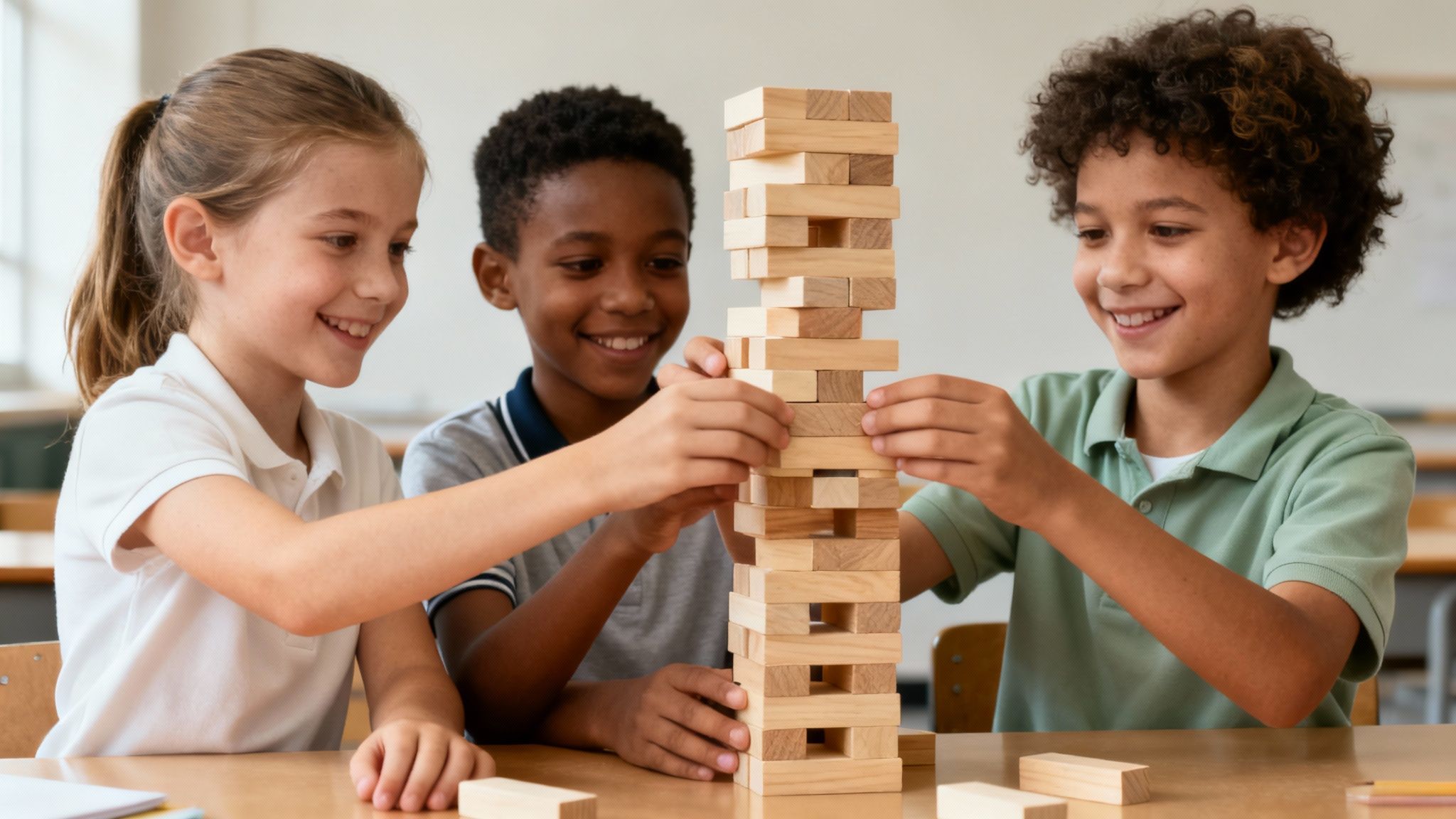
Cooperative games shift the focus from individual competition to collective success, making them powerful social emotional learning activities for elementary students. Instead of a “win-lose” dynamic, these activities create a “we all win or we all learn together” environment. By engaging in challenges that require communication, shared strategy, and mutual support, children learn to value collaboration and appreciate the unique strengths of their peers.
These activities are essential for developing relationship skills (communication, cooperation, conflict resolution) and social awareness (perspective-taking, empathy). They build a strong sense of classroom community and belonging, teaching students that relying on others and being reliable are equally important. The goal is to solve a problem together, strengthening interpersonal bonds in the process.
How to Implement Cooperative Games
Integrate team-building exercises during morning meetings, brain breaks, or dedicated community-building time. Start with low-stakes activities that have simple rules. For example, the “Human Knot” challenges a small group to untangle themselves from a jumble of interconnected arms without letting go. Another classic is “Build a Tower,” where teams use limited materials like spaghetti and marshmallows to construct the tallest possible freestanding structure.
Practical Example:
A fourth-grade teacher wants to improve how her students work in small groups. She introduces a challenge: “Cross the River.” She lays out a few small mats (“rafts”) on the floor and explains that the entire group must get from one side of the room to the other without touching the “water” (the floor). The team must pass the rafts to one another to move forward, requiring planning and clear communication. The activity generates laughter, a few failed attempts, and ultimately, a shared sense of accomplishment.
Tips for Success
Focus on Process, Not Outcome: Emphasize how the group worked together, not whether they “won” the challenge. Use prompts like, “What was one helpful thing a teammate said?”
Facilitate a Debrief: After the activity, guide a brief discussion. Ask students what went well, what was challenging, and what they might do differently next time.
Offer Opt-in Participation: Create a psychologically safe environment where students feel comfortable participating. For activities involving touch, like the Human Knot, allow students to choose their level of involvement.
Mix Up the Groups: Intentionally create different groupings for various activities. This helps break down social cliques and builds relationships across the entire classroom.
By incorporating cooperative games, you actively teach students the skills needed to navigate group dynamics, resolve conflicts, and build positive relationships, setting a foundation for successful collaboration inside and outside the classroom.
4. Conflict Resolution and Peer Mediation
Conflict resolution and peer mediation programs are powerful social emotional learning activities for elementary students that teach them to navigate disagreements constructively. Instead of relying on adult intervention for every problem, these structured processes empower children with the skills to listen, understand different perspectives, and find mutually agreeable solutions. This approach transforms conflict from a negative event into a valuable learning opportunity.
These activities directly build the core SEL competencies of social awareness (perspective-taking), relationship skills (communication and conflict resolution), and responsible decision-making (evaluating consequences and solving problems ethically). The ultimate goal is to create a safer, more respectful school climate where students feel capable of solving their own problems.
How to Implement Conflict Resolution
Begin by establishing a dedicated “Peace Corner” or “Conflict Resolution Zone” in the classroom. This area can be equipped with visual aids outlining the steps for resolving a problem, such as using “I-Feel” statements, listening without interrupting, and brainstorming solutions. Introduce these steps through role-playing common classroom scenarios, like arguments over toys or disagreements during a group project. For a more structured approach, older students can be trained as peer mediators to help younger students resolve conflicts during recess.
Practical Example:
Two third-grade students are arguing over a single red marker they both want for an art project. Instead of solving it for them, their teacher directs them to the classroom’s Peace Corner. Following the posted steps, the first student says, “I feel frustrated because I need the red marker for my drawing.” The second student listens and responds, “I hear you’re frustrated. I feel upset because I need it for my drawing, too.” They agree to take turns, using the marker for five minutes each, resolving the conflict independently and respectfully.
Tips for Success
Start Simple: Teach foundational skills like “I-Feel” statements to students in grades K-2 before introducing more complex mediation steps.
Use Real Scenarios: Role-play conflicts that genuinely occur in your classroom or on the playground to make the practice relevant and meaningful.
Practice Consistently: Regular practice helps students internalize the steps so they can recall them automatically during a real, emotionally charged conflict.
Establish Clear Boundaries: Define which problems students can solve themselves and which require adult help, ensuring safety and appropriate support.
By teaching these essential life skills, you equip students to build healthier relationships and contribute to a more positive community. For a deeper look into the language of resolving disputes, you can explore the use of “I-Feel” statements for kids and how they transform disagreements.
5. Gratitude and Appreciation Practices
Gratitude practices are powerful social emotional learning activities for elementary students that shift their focus toward appreciating the positive aspects of their lives. By regularly identifying and expressing thankfulness, children develop a more optimistic outlook, build resilience against setbacks, and strengthen their connections with others. This intentional focus on appreciation helps counter negativity and fosters a sense of contentment and well-being.
These activities directly support the SEL competencies of social awareness (recognizing the contributions of others) and relationship skills (communicating appreciation to build positive connections). The goal is to cultivate a habit of noticing the good, which can profoundly impact a child’s mental health and social interactions.
How to Implement Gratitude and Appreciation
Integrate gratitude into existing routines to make it a natural part of the day. A “Gratitude Circle” during a morning meeting allows students to share one small thing they are thankful for, setting a positive tone for learning. Another effective tool is a “Gratitude Journal,” where students can write or draw something they appreciate each day, creating a personal log of positivity to look back on.
Practical Example:
A third-grade teacher starts an “Appreciation Mail” system. Each Friday, students have a few minutes to write a short, specific note of appreciation to a classmate, teacher, or staff member and “mail” it in a decorated classroom mailbox. The teacher reads a few aloud (with permission), and then delivers the notes. This activity not only highlights kindness but also gives every student a chance to feel seen and valued by their peers.
Tips for Success
Model Authenticity: Share your own specific gratitudes with the class. For example, say, “I’m grateful for how quietly everyone came in this morning; it helped us get started right away.”
Encourage Specificity: Guide students beyond generic answers like “my family.” Prompt them with questions like, “What is something specific your brother did that you are grateful for?”
Offer Multiple Formats: Allow students to express gratitude by writing, drawing, speaking, or even creating a short video. This accommodates different learning styles and comfort levels.
Connect to Community: Create a whole-class “Thankfulness Tree” or an “Appreciation Board” where notes can be posted publicly, fostering a school-wide culture of recognition.
By consistently making space for gratitude, you help students develop a lasting habit of recognizing and appreciating the people and moments that make life meaningful. For more ways to foster a positive classroom climate, explore resources like those available on the Greater Good Science Center’s education page.
6. Social Stories and Perspective-Taking Activities
Social stories and perspective-taking activities are powerful social emotional learning activities for elementary students that use structured narratives to build empathy and social understanding. By stepping into someone else’s shoes through stories, role-playing, or discussions, children learn to recognize different viewpoints, motivations, and emotional experiences. This process helps them understand how their words and actions impact others, laying the groundwork for more compassionate and inclusive interactions.
These activities are essential for developing the core SEL competencies of social awareness (understanding the perspectives of others and empathizing with them) and relationship skills (communicating effectively and building positive connections). The goal is to move students beyond their own immediate experience and cultivate a genuine curiosity and respect for the diverse world around them.
How to Implement Social Stories and Perspective-Taking
Integrate perspective-taking into your existing literacy or morning meeting routines. Start by reading a book with a clear emotional conflict, like The Hundred Dresses by Eleanor Estes, and pause to ask questions that encourage students to consider different characters’ feelings. For example, “How do you think Wanda felt when Peggy teased her? What might Maddie have been thinking when she stood by and said nothing?”
From there, you can move into role-playing scenarios. Use situations that are common in a school setting, like a disagreement over a game at recess or someone feeling left out at the lunch table. Assign roles and have students act out the scenario, then discuss how each character felt and what could have been done differently.
Practical Example:
During a class meeting, a fourth-grade teacher addresses a recurring issue of students saving seats in the cafeteria. She divides the class into small groups and gives them a scenario: “A new student wants to sit at a table, but the other kids say, ‘You can’t sit here, we’re saving these spots for our friends.’ How does the new student feel? How do the other kids feel?” The groups discuss and then share their ideas, leading to a class-wide conversation about creating a more welcoming lunchroom.
Tips for Success
Use Diverse Literature: Select books and stories that feature characters from a wide range of backgrounds, cultures, and abilities to broaden students’ understanding.
Ask Probing Questions: Go beyond simple comprehension. Ask “why” questions like, “Why do you think the character made that choice?” or “What might have happened before this story started to make them feel that way?”
Connect to Real Life: Help students see the connection between the characters’ experiences and their own lives. Ask if they have ever felt a similar way or witnessed a similar situation.
Model Empathy: When discussing characters, model empathetic language yourself. Say things like, “It sounds like that must have been really hard for him,” to guide students’ responses.
By regularly engaging in these activities, you help students build the critical muscle of empathy, transforming your classroom into a more understanding and supportive community.
7. Self-Regulation and Coping Strategy Toolkits
Creating self-regulation and coping strategy toolkits is one of the most powerful social emotional learning activities for elementary students. It moves beyond simply identifying feelings to actively building a personalized plan for managing them. By teaching students to recognize their emotional triggers and the physiological signs of dysregulation, you empower them to proactively choose a strategy that helps them return to a calm, focused state.
This approach directly targets the core SEL competencies of self-awareness (recognizing internal signals) and self-management (deploying a specific coping tool). The goal is to equip every child with a menu of effective, accessible strategies they can use independently when emotions feel overwhelming, fostering resilience and a sense of agency over their well-being.
How to Implement Coping Strategy Toolkits
Begin by explicitly teaching a variety of strategies, explaining which emotions they might help with. Create a visual “Coping Menu” or use a framework like the Zones of Regulation to connect feelings to specific actions. A physical toolkit can be a small box with sensory items, while a classroom “peace corner” offers a designated space for students to use these tools without stigma.
Practical Example:
A third-grade teacher helps a student who gets frustrated during math create a personal toolkit. Inside a pencil box, they place a small piece of bubble wrap to pop, a smooth stone to rub, and a card with three deep-breathing steps. When the student feels frustration rising, they know they can quietly take out their toolkit at their desk and use one of the items to reset before asking for help.
Tips for Success
Practice Proactively: Introduce and practice coping strategies when students are calm, not just in the middle of a difficult moment. This builds muscle memory.
Offer Diverse Options: Include strategies that involve movement (wall pushes), sensory input (fidgets, weighted lap pads), and quiet reflection (drawing, listening to music).
Personalize the Toolkit: Help students identify what truly works for them. What is calming for one child might be overstimulating for another.
Involve Families: Share a list of the strategies being taught at school and encourage families to identify and practice them at home for consistent support. You can explore parent resources from Soul Shoppe for ideas on home implementation.
By normalizing the need for self-regulation tools, you create a supportive environment where students see managing emotions as a skillful and healthy part of life.
8. Morning Meeting and Class Circles
Morning Meeting is a structured daily gathering where students and teachers come together in a circle to start the day. This powerful ritual establishes a predictable and safe routine that intentionally builds classroom community, strengthens relationships, and provides a dedicated time for practicing key social skills. By creating this space for greeting, sharing, and engaging in a group activity, you set a positive tone for learning and reinforce a sense of belonging for every child.
These daily circles are a cornerstone of social emotional learning activities for elementary students because they directly target multiple SEL competencies. They foster social awareness (listening to peers’ perspectives), relationship skills (practicing respectful communication), and responsible decision-making (collaboratively solving class problems). It becomes a living laboratory for the social skills taught in other lessons.
How to Implement Morning Meeting and Class Circles
A typical Morning Meeting, popularized by the Responsive Classroom approach, includes four components: greeting, sharing, group activity, and a morning message. The greeting involves students acknowledging each other by name. Sharing allows students to talk about important events in their lives, while others practice active listening. The group activity is a short, fun game or song that promotes group cohesion, and the message previews the day’s learning goals.
Practical Example:
A third-grade teacher begins her Morning Meeting to address a recurring issue of students feeling left out at recess. During the sharing portion, she poses a prompt: “Think about a time you invited someone new to play. How did it feel?” After a few students share, she uses the morning message to announce they will be creating a class “Inclusion Agreement” together, turning a problem into a collaborative, community-building lesson.
Tips for Success
Establish Clear Norms: Co-create rules for the circle, such as “One person speaks at a time,” “Listen with your whole body,” and “It’s okay to pass.”
Start Small: Keep initial meetings short, around 10-15 minutes, especially for younger students in kindergarten and first grade.
Rotate Leadership: Empower students by allowing them to take turns leading different parts of the meeting, such as the greeting or group activity.
Protect the Time: Treat Morning Meeting as essential instructional time, not something to be skipped when you are busy. Consistency is what builds trust and safety.
By making this a non-negotiable part of your daily schedule, you show students that their voices matter and their relationships are a priority. For a deeper look into fostering this environment, explore these tips on how to build classroom community with Soul Shoppe.
9. Empathy and Kindness Challenges
Empathy and Kindness Challenges are structured campaigns designed to make thoughtful behavior a conscious and celebrated part of school culture. By prompting students to perform deliberate acts of kindness, these activities move empathy from an abstract concept to a tangible action. These challenges build positive momentum, demonstrating how small, individual choices can collectively create a more supportive and inclusive environment for everyone.
These social emotional learning activities for elementary students directly target social awareness (understanding and empathizing with others’ feelings) and relationship skills (building positive connections through prosocial behavior). The goal is to help children recognize the power they have to impact their peers and community positively.
How to Implement Empathy and Kindness Challenges
Launch a school-wide or classroom-specific challenge with a clear theme and duration. For example, a “Kindness is Our Superpower” week could feature daily prompts. Monday’s challenge might be to give a genuine compliment, while Tuesday’s could be to invite someone new to play during recess. The key is making the actions specific and achievable for young students.
Practical Example:
A third-grade classroom creates a “Compliment Chain.” When a student observes or receives a particularly kind act, they write it on a strip of colored paper. The teacher helps them add it as a new link to a paper chain hanging across the classroom. By the end of the month, the chain visually represents the class’s collective kindness, and the teacher reads some of the links aloud to celebrate their progress.
Tips for Success
Be Specific: Vague instructions like “be kind” are less effective than “hold the door open for someone” or “ask a classmate about their weekend.”
Celebrate the Process: Acknowledge effort and intention, not just grand gestures. Create a “Kindness Corner” where students can post notes about kind acts they’ve witnessed.
Connect to Empathy: After an act of kindness, facilitate a brief discussion. Ask questions like, “How do you think it made that person feel when you shared your crayons?”
Involve Families: Send home a note about the challenge and encourage families to participate by noticing and celebrating kindness at home.
These challenges transform the school environment by making kindness and empathy active, shared values. To see how these concepts are integrated into large-scale bullying prevention, you can learn about Soul Shoppe’s successful partnerships, like the one with the Junior Giants to help kids Strike Out Bullying.
10. Family and Community Engagement in SEL
Social emotional learning activities for elementary students are most effective when they extend beyond the school walls. Family and community engagement bridges the gap between classroom instruction and a child’s home life, creating a consistent and supportive ecosystem. By intentionally involving parents, caregivers, and community partners, schools can amplify SEL skills, ensuring children hear and practice the same positive language and strategies in every part of their lives.
This approach strengthens all five core SEL competencies by creating a shared understanding and commitment to social awareness, relationship skills, and responsible decision-making across different environments. When families and schools partner, children see that these skills are valued everywhere, not just in the classroom.
How to Implement Family and Community Engagement
Begin by providing accessible resources and opportunities for connection. Offer parent workshops at various times (in-person and virtual) to accommodate different schedules. Distribute take-home SEL activity packets or newsletters that align with classroom lessons, giving families simple, actionable ways to practice skills like empathy or conflict resolution at home. Partnering with community organizations for events can also broaden your reach and impact.
Practical Example:
A school hosts a “Peaceful Families Night” facilitated by a community partner. Families participate in interactive stations, learning a simple “I-statement” formula for expressing feelings. They are sent home with a magnet summarizing the technique. The following week, a parent shares that her son used an “I-statement” to resolve a disagreement over a toy, a direct result of the shared learning experience.
Tips for Success
Provide Multilingual Resources: Ensure materials are translated to reflect the languages spoken by your school community, making content accessible to all families.
Connect to Parent Priorities: Frame SEL as a tool to help with common challenges like managing homework stress or building cooperation. To extend the spirit of cooperation from the classroom to the home, learning how to creating a family chore chart that fosters teamwork can effectively foster teamwork and shared responsibility among family members.
Start Simple: Introduce one easy-to-use strategy at a time, such as a “calm-down corner” at home or a single feeling word to focus on for the week.
Create a Welcoming Environment: Foster a school culture where families feel valued, respected, and seen as true partners in their child’s education. Gather feedback regularly to ensure programming meets their needs.
10 Elementary SEL Activities Comparison
Program
Implementation complexity
Resource requirements
Expected outcomes
Ideal use cases
Key advantages
Mindfulness and Breathing Exercises
Low — short scripted practices; needs consistency
Minimal — time, quiet space; no special equipment
Faster calming, improved attention and emotion regulation
Creates positive norms, engages students, visible cultural shift
Family and Community Engagement in SEL
High — coordination, outreach, cultural adaptation
Moderate–High — workshops, multilingual materials, staff time
Greater consistency across contexts; stronger family-school partnerships
Family workshops, take-home activities, community partnerships
Extends SEL to home, builds trust, leverages community resources
Putting it All Together: Building a Culture of Connection and Empathy
We have explored a wide range of powerful and practical social emotional learning activities for elementary students, from the quiet introspection of mindful breathing to the dynamic collaboration of cooperative games. Each activity, whether it’s a quick Feelings Check-In or a structured Peer Mediation session, serves as a single thread. When woven together consistently, these threads create a strong, resilient, and supportive classroom tapestry. The goal is not to treat SEL as another box to check, but to embed it into the very heart of the school day.
The true power of these activities is unlocked through intentional and consistent application. A one-time empathy challenge is a great start, but a weekly practice builds a lasting habit of kindness. A coping strategies toolkit is most effective when students are regularly encouraged to use it, not just during moments of crisis, but as a proactive self-management tool. The journey from learning about emotions to living with emotional intelligence is a marathon, not a sprint, built upon these small, repeated practices.
From Activities to a Thriving Classroom Culture
Integrating these diverse activities creates a powerful synergy that transforms the learning environment. Imagine a classroom where a Morning Meeting sets a positive and inclusive tone, a Gratitude Jar visibly tracks the community’s appreciation, and a student-led conflict resolution corner empowers children to solve their own disagreements respectfully. This is the tangible result of a commitment to SEL.
This cultural shift doesn’t happen by accident. It is the direct outcome of educators and caregivers who model these skills and create predictable routines where students feel safe to be vulnerable, make mistakes, and grow. When students have a shared vocabulary for their feelings and a toolbox of strategies for managing them, you’ll see a decrease in disruptive behaviors and an increase in on-task learning, engagement, and peer support.
Your Actionable Next Steps for SEL Implementation
Moving from inspiration to action is the most critical step. Instead of feeling overwhelmed by the number of options, commit to a small, sustainable start.
Choose Your Starting Point: Select one or two activities from this list that resonate most with your students’ needs and your own teaching style. Perhaps it’s starting each day with a “Rose, Bud, Thorn” check-in or introducing a weekly cooperative game.
Schedule It In: Consistency is key. Formally schedule your chosen SEL activities into your weekly lesson plans. This ensures they don’t get pushed aside when things get busy. Even five dedicated minutes a day can have a profound impact over time.
Involve Your Community: Share these ideas with colleagues, administrators, and families. When students see and hear consistent SEL language and practices at school and at home, the learning is reinforced exponentially. Consider sending home a “Kindness Challenge” or a list of conversation starters about feelings.
By embracing these social emotional learning activities for elementary students, you are doing more than just managing a classroom; you are nurturing a generation of compassionate leaders, resilient problem-solvers, and empathetic global citizens. The investment you make in their emotional well-being today will pay dividends for the rest of their lives, equipping them with the essential skills to navigate an increasingly complex world with confidence, kindness, and a strong sense of self.
Ready to take your school’s commitment to SEL to the next level? Soul Shoppe provides comprehensive, research-based programs that create safer, more compassionate school communities by empowering students, staff, and families. Discover how their dynamic assemblies and in-depth curriculum can help you build a sustainable culture of empathy and connection at Soul Shoppe.
In today’s dynamic elementary classrooms, academic skills are only half the story. The ability to understand emotions, build relationships, and make responsible decisions forms the bedrock of a successful learner and a compassionate human being. This is the core of social-emotional learning (SEL), a framework that equips students with the essential tools to navigate their inner worlds and the world around them. For educators seeking a child-centered philosophy that deeply aligns with holistic child development and SEL, exploring foundational approaches like the Reggio Emilia approach to education can provide a powerful, inquiry-based framework for these practices.
For teachers, counselors, and parents, the primary challenge isn’t just knowing that SEL is important-it’s finding practical, engaging ways to integrate it into daily routines. This guide moves beyond abstract theory to offer a comprehensive roundup of field-tested social emotional learning activities elementary students can immediately benefit from. We provide step-by-step instructions, grade-specific adaptations from Kindergarten through 5th grade, and real-world examples to help you cultivate a thriving, emotionally intelligent community.
Inside this resource, you will discover a curated list of activities designed to build key competencies, including:
Self-Awareness: Identifying and understanding emotions.
Self-Management: Developing coping strategies and resilience.
Social Awareness: Cultivating empathy and perspective-taking.
Relationship Skills: Fostering collaboration and effective communication.
Responsible Decision-Making: Encouraging thoughtful and ethical choices.
Whether you’re looking to start an emotion check-in circle, introduce mindfulness exercises, or implement peer conflict resolution, this article serves as your practical playbook. These activities will help you foster connection, safety, and resilience in the children you support, building a foundation for lifelong well-being and academic success.
1. Emotion Check-In Circle
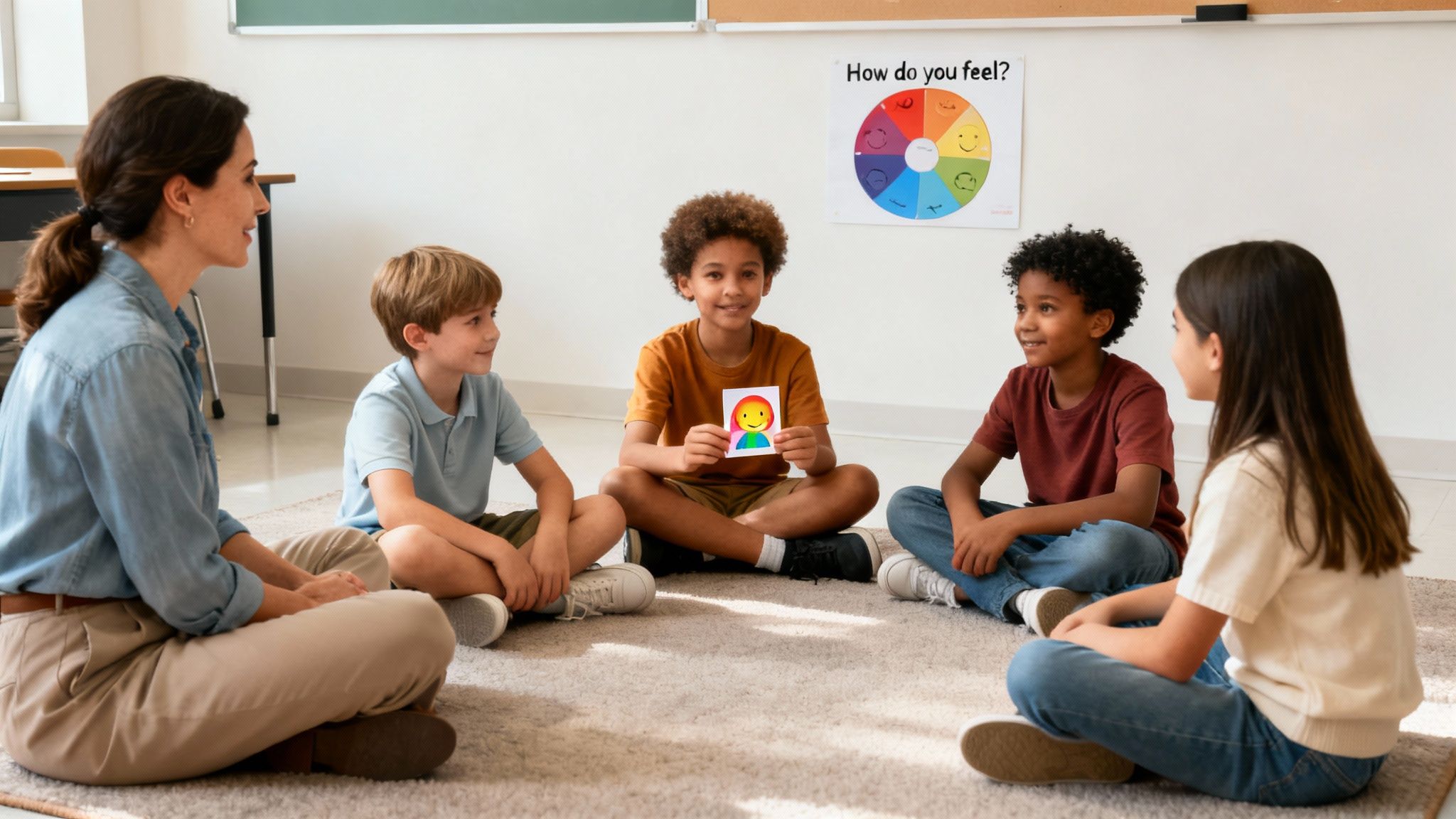
The Emotion Check-In Circle is a foundational routine where students gather to identify and share their current feelings in a safe, structured setting. This simple yet powerful practice serves as a daily emotional barometer for the classroom, helping students build self-awareness and empathy from the very start of their day. By creating a predictable space to name emotions, teachers normalize the full spectrum of feelings, from excitement to disappointment, fostering a culture of psychological safety.
This activity is more than just a morning greeting; it is a core component of many effective social emotional learning activities for elementary students. It provides valuable insight into who might need extra support and helps children connect their internal state to their readiness to learn.
How to Implement an Emotion Check-In Circle
Materials Needed: Emotion wheel, feeling cards, or a simple chart paper with different feeling words/faces. For a more structured approach, consider the Mood Meter framework popularized by Marc Brackett at the Yale Center for Emotional Intelligence.
Time: 5-10 minutes daily.
CASEL Competency: Self-Awareness, Social Awareness.
Step-by-Step Instructions:
Gather Students: Arrange students in a circle on the rug or at their desks.
Model First: The teacher starts by sharing their own feeling. For example, “Good morning, everyone. Today, I am feeling calm because I had a relaxing weekend and drank my favorite tea this morning.”
Provide a Framework: Students share their feeling using a sentence stem, like “Today I feel ____ because ____.”
Practical Example (Kindergarten): A student points to a happy face card and says, “Today I feel happy because it’s my turn to be the line leader.”
Practical Example (3rd Grade): A student shares, “Today I feel a little nervous because we have a math test, but I also feel hopeful because I studied.”
Listen and Acknowledge: The group listens without judgment. The goal is to acknowledge, not to fix. A simple “Thank you for sharing” is often enough.
Offer Alternatives: Always include a “pass” option. Students who are not ready to share can say “pass” without penalty.
Key Insight: Consistency is crucial. When the Emotion Check-In Circle becomes a non-negotiable part of the daily routine, students learn to trust the process and become more willing to share honestly over time. It transforms the classroom into a community where every emotional state is valid and heard.
2. Mindfulness and Breathing Exercises
Mindfulness and Breathing Exercises are brief, guided practices that teach students to focus their attention on the present moment. Through simple breathing techniques, body scans, or visualizations, these evidence-based exercises help reduce stress, improve focus, and build crucial self-regulation skills. They provide students with concrete, accessible tools to use independently when feeling overwhelmed, anxious, or dysregulated, making them a cornerstone of effective social emotional learning activities for elementary students.
These practices are not about emptying the mind but about anchoring it. For young learners, this can be as simple as a two-minute “belly breathing” break between subjects or using an app like Calm or Headspace Kids for a guided meditation. This builds a foundation for managing big emotions and enhances their ability to engage in learning.
How to Implement Mindfulness and Breathing Exercises
Materials Needed: A quiet space, optional items like a chime or bell, cushions, or guided meditation audio from an app or website.
Create a Signal: Use a consistent sound, like a chime, a soft bell, or a specific song, to signal that it is time for a mindfulness break.
Guide the Breathing: Start with a simple, tangible technique.
Practical Example (“Take 5 Breathing”): “Hold up one hand like a star. Use the pointer finger of your other hand to trace it. Breathe in as you trace up your thumb, and breathe out as you trace down. Inhale up your pointer finger, exhale down. Continue for all five fingers.”
Practical Example (“Belly Breathing”): “Place one hand on your tummy. Imagine a small balloon inside. As you breathe in through your nose, feel the balloon fill up with air. As you breathe out through your mouth, feel the balloon slowly deflate.”
Offer Options: Provide choices to accommodate different needs. Students can sit at their desks, lie on the rug, or stand. Offer “eyes open” options for students who may find closing their eyes uncomfortable, suggesting they find a single spot to focus on.
Keep it Brief: Begin with very short sessions (60-90 seconds) and gradually increase the duration as students build their focus “muscles.”
Practice Proactively: Introduce and practice these skills when students are calm. This ensures they can access the tools when they are actually feeling stressed or upset.
Key Insight: The goal is not to achieve perfect stillness but to practice returning focus to the breath. Frame it as a “brain break” or “reset button.” When students learn that they have the power to calm their own bodies and minds with their breath, they gain a profound sense of agency over their emotional well-being.
3. Peer Collaboration and Cooperative Learning Projects
Peer Collaboration and Cooperative Learning Projects are structured small-group activities where students work together toward a shared goal, requiring communication, compromise, and interdependence. This approach transforms academic tasks into powerful opportunities for social and emotional growth. By intentionally designing projects that necessitate teamwork, teachers help students develop vital competencies like perspective-taking, conflict resolution, and leadership in an authentic context.
These projects are more than just group work; they are among the most effective social emotional learning activities for elementary students because they integrate SEL directly into academic content. This method builds a classroom culture where students learn to value diverse ideas, support their peers, and navigate the social complexities of achieving a common objective.
How to Implement Peer Collaboration and Cooperative Learning
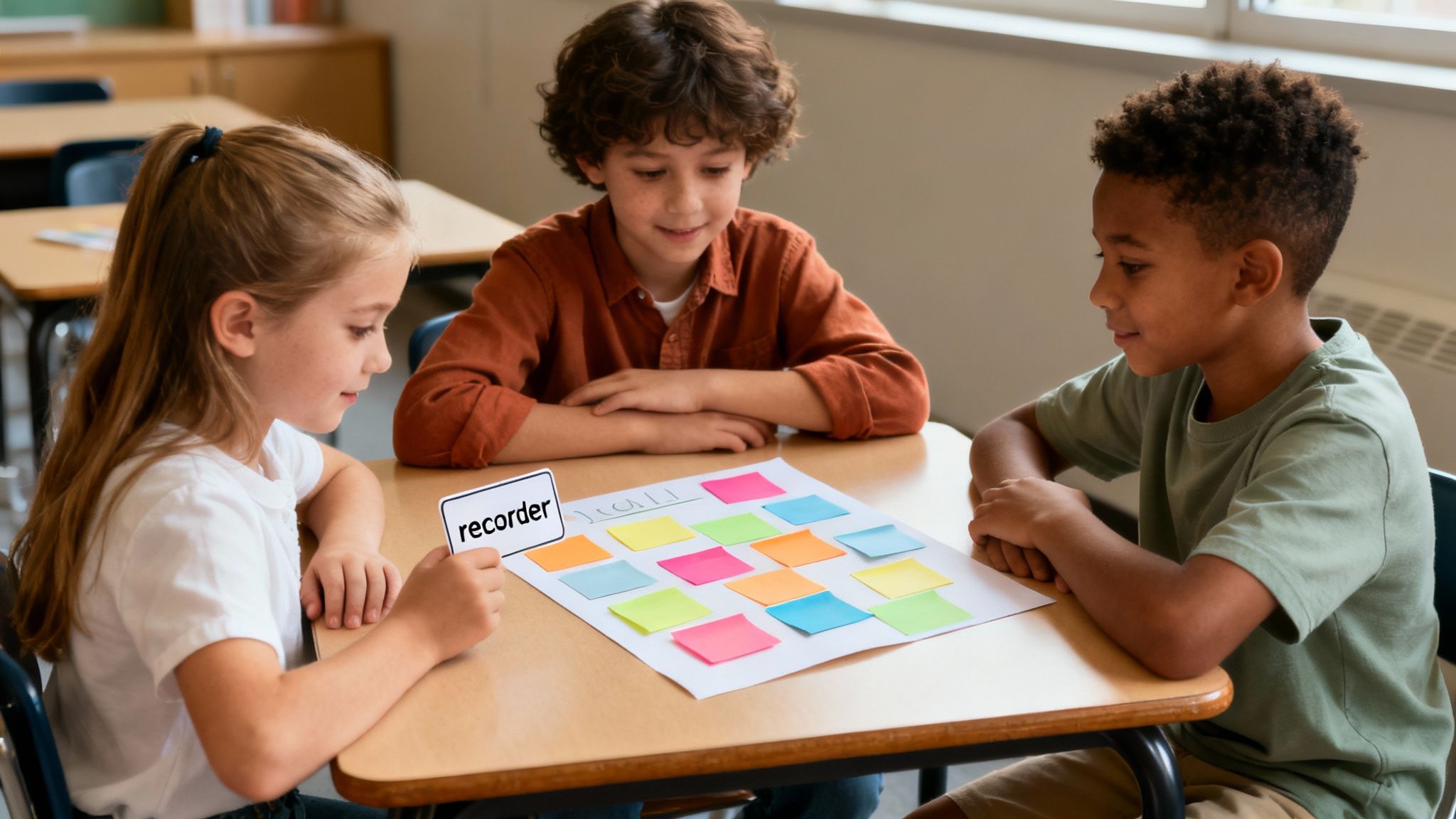
Materials Needed: Varies by project. Chart paper for group norms, role cards (e.g., Time Keeper, Encourager, Reporter), and project-specific supplies like research materials or STEM building items.
Time: Can range from a single 20-minute session (e.g., Think-Pair-Share) to a multi-week project.
Form Groups Intentionally: Create small, diverse groups that balance academic abilities, social skills, and personalities. Avoid letting students always pick their own groups.
Define Clear Roles and Goals: Assign specific roles to each member and provide a clear, measurable group goal. Rotate roles regularly so every student gains experience.
Practical Example (Science Project): In a group of four building a volcano, one student is the Materials Manager (gathers supplies), one is the Builder (constructs the model), one is the Recorder (writes down the steps), and one is the Presenter (explains the project to the class).
Teach Collaboration Skills Explicitly: Before starting, model and practice skills like active listening and respectful disagreement. Use sentence stems like, “I hear you saying…, what if we tried…?”
Structure the Task: Use a proven cooperative learning structure.
Practical Example (Think-Pair-Share): The teacher poses a question (“What was the main character’s biggest challenge?”). Students think quietly for one minute, pair up with a partner to discuss their ideas, and then share their combined thoughts with the whole class.
Monitor and Coach: Circulate the room to provide support, ask guiding questions, and help groups navigate challenges.
Include Group Reflection: After the project, guide students to reflect on their process. Ask: “What went well in our teamwork?” and “What could we do differently next time?”
Key Insight: The most crucial element is teaching collaboration as a skill in itself. Celebrate the process, not just the final product. Acknowledge groups for excellent communication, problem-solving, and mutual respect, reinforcing that how they work together is just as important as what they create.
4. Social Stories and Perspective-Taking Activities
Social Stories and perspective-taking activities use narratives and role-playing to help students understand that others have different thoughts, feelings, and experiences. These exercises are fundamental for developing empathy and reducing bias by allowing children to step into someone else’s shoes in a guided, safe way. By exploring character motivations and diverse viewpoints, students build a stronger “Theory of Mind,” which is the ability to understand others’ mental states.
This method is one of the most effective social emotional learning activities for elementary students because it translates abstract concepts like empathy into concrete, relatable scenarios. Whether through a picture book or a specific social narrative, these tools give children the language and framework to navigate complex social situations.
How to Implement Social Stories and Perspective-Taking
Materials Needed: Diverse picture books (like The Feelings Book by Todd Parr or In My Heart by Jo Witek), pre-written social stories for specific situations, chart paper, markers, or role-playing props.
Time: 15-20 minutes, 1-2 times per week.
CASEL Competency: Social Awareness, Relationship Skills.
Step-by-Step Instructions:
Select a Relevant Story: Choose a picture book or social story that reflects a current classroom challenge (e.g., sharing, handling disappointment, joining a new group).
Practical Example: After noticing students arguing over playground equipment, read The Recess Queen by Alexis O’Neill.
Read and Pause: Read the story aloud, pausing at key moments to ask perspective-taking questions.
Practical Example: While reading, pause and ask, “How do you think Mean Jean felt when no one wanted to play with her? Look at her face. What clues do you see? What about Katie Sue? How did she feel when she decided to ask Jean to play?”
Facilitate Discussion: Encourage students to share their interpretations. Validate different ideas by explaining that people can feel differently about the same situation. Use sentence starters like, “I think they felt ____ because ____.”
Extend with an Activity: Follow the story with a related activity.
Practical Example: Students can draw two faces: one showing how a character felt at the beginning of the story and another showing how they felt at the end. They then explain the change to a partner.
Connect to Real Life: Link the story’s lesson back to the classroom. For instance, “Remember how Katie Sue invited Mean Jean to play? Let’s be like Katie Sue today and look for someone who might need a friend at recess.”
Key Insight: The power of this activity lies in using diverse and authentic narratives. When students see characters from varied backgrounds, abilities, and family structures, they learn that empathy extends to everyone, not just those who are like them. It builds a foundation for an inclusive and understanding community.
5. Conflict Resolution and Peer Mediation Programs
Conflict Resolution and Peer Mediation Programs are structured systems that teach students the skills to identify, communicate about, and solve interpersonal problems collaboratively. These programs shift the classroom dynamic from adult-led discipline to student-led problem-solving, empowering children to become active agents in creating a positive school climate. By training students as mediators, schools build leadership skills and reduce teacher intervention in minor disputes.
This approach is one of the most impactful social emotional learning activities elementary students can engage in because it provides real-world application of complex skills. It reframes conflict not as a failure but as a valuable opportunity for growth, empathy, and understanding. Programs like Responsive Classroom and Soul Shoppe have popularized these practices in schools nationwide.
How to Implement Conflict Resolution and Peer Mediation
Materials Needed: “I-statement” sentence frames, conflict resolution posters with clear steps, a designated “peace corner” or table for mediations, and training materials for student mediators.
Time: 15-20 minutes for mediations as needed; ongoing training and reinforcement.
Teach Core Concepts: Introduce a simple, school-wide conflict resolution process. A common model is: 1. Cool Down, 2. Talk and Listen (using I-statements), 3. Brainstorm Solutions, 4. Agree on a Plan.
Model I-Statements: Explicitly teach and practice the “I feel ___ when you ___ because ___” framework.
Practical Example: Instead of “You’re a mean cheater!”, teach a student to say, “I feel frustrated when you change the rules of the game because I thought we already agreed.”
Train Peer Mediators: Select and train a diverse group of students (not just the “best behaved”) to act as neutral third-party facilitators. Train them to guide peers through the resolution steps without giving solutions.
Establish Protocols: Define which conflicts are appropriate for peer mediation (e.g., disagreements over games, feeling left out) and which require adult help (e.g., bullying or safety concerns).
Provide a Space: Set up a specific, quiet area where mediations can happen without an audience. This makes the process feel official and safe. A small table in the corner with a “peace rose” or talking stick can work well.
Key Insight: The goal of a student mediator is not to solve the problem for their peers but to ask powerful questions that help them solve it themselves. Train mediators with questions like, “What could you do differently next time?” and “What do you need to feel better?” This builds true problem-solving capacity and agency.
6. Gratitude and Kindness Practices
Gratitude and Kindness Practices are intentional activities designed to cultivate appreciation, generosity, and positive regard for others. These powerful routines shift a classroom’s focus toward optimism and interconnectedness, helping students recognize the good in their lives and in their peers. By embedding practices like gratitude journals and kindness challenges, teachers actively build a more prosocial and supportive learning environment.
This goes beyond simply saying “thank you.” These social emotional learning activities for elementary students teach them to look for and acknowledge kindness, which in turn boosts their own happiness, strengthens relationships, and improves their overall mental well-being. This practice helps rewire the brain to notice positive experiences.
How to Implement Gratitude and Kindness Practices
Materials Needed: Journals or notebooks, chart paper, sticky notes, a “kindness jar” or box, art supplies.
Time: 5-15 minutes daily or weekly.
CASEL Competency: Relationship Skills, Social Awareness.
Step-by-Step Instructions:
Introduce the Concept: Begin with a simple discussion about what gratitude and kindness mean. Use a story or personal example to illustrate the concepts.
Establish a Routine: Choose a consistent practice.
Practical Example (Gratitude Circle): During morning meeting, pass a “gratitude stone” around the circle. The person holding the stone shares one specific thing they are thankful for, like “I’m grateful for my dad because he made me pancakes this morning.”
Launch a Kindness Challenge: Dedicate a week to kindness. Provide daily prompts.
Practical Example: A “Kindness Bingo” card could have squares like “Give a genuine compliment,” “Invite someone new to play,” “Hold the door for someone,” and “Help a classmate clean up.”
Create a Visual Tracker: Use a “Caught Being Kind” bulletin board where students can post sticky notes acknowledging kind acts they witness. This makes kindness visible and celebrated.
Connect Gratitude to Action: After a special event or field trip, have students write thank-you notes or create a short thank-you video for the people who made it possible.
Key Insight: Specificity is the cornerstone of effective gratitude practice. Guide students beyond generic statements like “I’m grateful for my family.” Encourage them to elaborate: “I’m grateful my big sister read me a story last night because it made me feel safe and loved.” This deeper reflection anchors the feeling and makes the practice more meaningful.
7. Self-Advocacy and Assertiveness Skills Training
Self-Advocacy and Assertiveness Skills Training explicitly teaches students how to recognize and respectfully communicate their needs, boundaries, and preferences. This practice empowers children by giving them the tools to develop their own voice, agency, and confidence. By learning the crucial difference between passive, aggressive, and assertive communication, students build a foundation for academic success and lifelong healthy relationships.
This training is one of the most vital social emotional learning activities for elementary students, as it moves beyond simply identifying feelings to acting on them constructively. It is especially impactful for students who are marginalized, have learning differences, or tend to be more withdrawn, ensuring they have the skills to be seen and heard.
How to Implement Self-Advocacy and Assertiveness Skills Training
Materials Needed: Scenario cards, “I-statement” sentence frames, anchor charts defining passive, assertive, and aggressive communication styles.
Define and Differentiate: Use an anchor chart to explicitly teach the differences between passive (quiet, avoiding conflict), aggressive (blaming, demanding), and assertive (calm, clear, respectful) communication. Use simple examples for each.
Introduce “I-Statements”: Provide students with a clear and simple script for assertive communication, such as: “I feel ____ when you ____. I need ____.”
Role-Play Scenarios: Practice with low-stakes scenarios.
Practical Example (Academic Need): A student role-plays telling a teacher, “I feel confused by the directions for the project. I need you to explain step two again, please.”
Practical Example (Social Boundary): One student practices saying to another, “I feel uncomfortable when you stand so close to me. I need a little more space, please.”
Practice Saying “No”: Teach students respectful ways to set boundaries, such as “No, thank you,” or “I’d rather not do that.” Role-play situations where a friend asks them to do something they don’t want to do.
Debrief and Reinforce: After role-playing, discuss how it felt to be assertive. Acknowledge that it can feel uncomfortable at first but gets easier with practice.
Key Insight: Modeling is everything. When teachers and parents consistently use assertive “I-statements” and respect students’ boundaries, they demonstrate that self-advocacy is a valued and effective skill. Celebrate students’ attempts, even if imperfect, to create a culture where every child knows their voice matters and will be heard.
8. Growth Mindset and Resilience-Building Lessons
Growth Mindset and Resilience-Building Lessons teach students that intelligence and abilities are not fixed traits but can be developed through effort, strategic practice, and feedback. Based on the research of Carol Dweck, these lessons help children reframe challenges as opportunities, view mistakes as crucial parts of learning, and persist through setbacks. This approach shifts the focus from innate talent to the power of process, building a foundation for both academic achievement and emotional well-being.
These lessons are a cornerstone of effective social emotional learning activities for elementary students because they directly target self-management and responsible decision-making. By cultivating resilience, students are better equipped to handle academic frustrations and social conflicts with confidence and determination. To further cultivate this mindset, students can benefit from learning effective strategies to improve problem-solving skills, empowering them to tackle challenges constructively.
How to Implement Growth Mindset and Resilience-Building Lessons
Materials Needed: “The Magical Yet” by Angela DiTerlizzi or other growth mindset books, chart paper, markers, stories of famous failures (e.g., Michael Jordan, Oprah), goal-setting worksheets.
Introduce the Concept: Use a simple analogy like comparing the brain to a muscle. Explain that when we work hard and try new things, our brain grows stronger by creating new connections.
Read and Discuss: Read a story that models a growth mindset. Ask discussion questions like, “What challenge did the character face?” and “What did they do when they made a mistake?”
Teach “The Power of Yet”: Introduce the phrase “I can’t do it… yet.”
Practical Example: Create a class chart with two columns: “Fixed Mindset Thoughts” and “Growth Mindset Thoughts.” Fill it with examples like changing “This is too hard” to “This may take some time and effort.” Or “I can’t read this word” to “I can’t read this word… yet.”
Create a “Famous Failures” Gallery: Display pictures and stories of successful people who overcame significant setbacks. Discuss how failure was a necessary step in their journey to success.
Use Effort-Based Praise: In daily interactions, praise the process, not just the outcome.
Practical Example: Instead of saying “You’re so smart!” when a child solves a puzzle, say, “I love how you turned the pieces different ways to see what would fit. Your strategy worked!”
Key Insight: A growth mindset is cultivated through consistent language and classroom culture, not just isolated lessons. Creating a “mistake-friendly” environment where errors are celebrated as “brain builders” is essential. When teachers model their own learning struggles and resilience, students learn that productive struggle is a normal and valuable part of growth.
9. Diversity, Inclusion, and Anti-Bias Classroom Activities
Diversity, Inclusion, and Anti-Bias Activities are intentional lessons that celebrate human differences while actively addressing bias and discrimination. These practices move beyond surface-level multicultural celebrations to build genuine cultural competence, challenge stereotypes, and foster a deep sense of belonging for all students. By integrating these social emotional learning activities, elementary teachers equip children to understand their own identities and appreciate the diverse world around them.
This approach, championed by educators like Louise Derman-Sparks, is not just about being kind; it’s about creating justice. It gives students the language and tools to recognize and confront unfairness, making them active participants in building a more equitable classroom and community.
How to Implement Diversity, Inclusion, and Anti-Bias Activities
Materials Needed: Diverse books featuring “windows and mirrors” (characters both different from and similar to your students), identity charts, chart paper, markers, and curated read-alouds that tackle topics of fairness and bias.
Time: Varies; can be a 15-minute read-aloud or an ongoing, year-long unit.
CASEL Competency: Self-Awareness, Social Awareness, Relationship Skills.
Step-by-Step Instructions:
Introduce “Windows and Mirrors”: Using the framework from Rudine Sims Bishop, explain that books can be mirrors (reflecting our own lives) or windows (offering a view into someone else’s).
Practical Example: After reading Amazing Grace by Mary Hoffman, ask, “Who in our class saw a mirror in this story? Who saw a window into a new experience?”
Create Identity Charts: Give each student a large piece of paper with their name in the center. Have them draw or write words that describe the multiple facets of their identity (e.g., sister, artist, soccer player, Spanish speaker).
Share and Connect: Students share one part of their identity chart with a partner or small group, finding connections and celebrating differences.
Discuss Fairness: Use a picture book to introduce a scenario involving bias or unfairness.
Practical Example: Read The Sneetches by Dr. Seuss and ask, “Was it fair that only the Star-Belly Sneetches could go to the parties? Why or why not? What could the Plain-Belly Sneetches have done?”
Practice Being an Upstander: Role-play scenarios where students can practice being an “upstander” by safely and respectfully speaking up when they see something unfair.
Key Insight: Authentic representation is paramount. Anti-bias work must be woven into the curriculum year-round, not isolated to specific heritage months. This consistency ensures students see diversity as a fundamental and valued aspect of the human experience, not a special topic.
10. Emotion Regulation and Coping Strategy Toolbox
The Emotion Regulation and Coping Strategy Toolbox is a personalized collection of techniques students can use to manage overwhelming feelings and calm their nervous systems. This approach shifts the focus from adult-led intervention to student-led self-regulation, empowering children with a sense of agency and control over their emotional responses. By creating a tangible or mental “toolbox,” students learn to identify what they need in a moment of stress, building independence and emotional resilience.
This concept is a cornerstone of effective social emotional learning activities for elementary students because it acknowledges that there is no one-size-fits-all solution for managing emotions. It teaches children to become experts on their own needs, equipping them with practical skills to navigate challenges like frustration, anxiety, and excitement both inside and outside the classroom.
How to Implement a Coping Strategy Toolbox
Materials Needed: Poster board, index cards, art supplies, a physical box or container, sensory items (stress balls, scented dough, soft fabric), and visual aids for different strategies.
Time: 15-20 minutes for initial teaching of a new strategy; ongoing practice daily.
Introduce the Concept: Explain that a toolbox holds tools to fix things, and an emotional toolbox holds tools to help us manage our feelings. Use a physical box as a visual anchor.
Teach Strategies Explicitly: During calm moments, teach one or two strategies at a time.
Practical Example: For a “Grounding” technique, teach the 5-4-3-2-1 method: “When you feel worried, pause and silently name 5 things you can see, 4 things you can touch, 3 things you can hear, 2 things you can smell, and 1 thing you can taste. This helps bring your brain back to the present moment.”
Categorize for Clarity: Group strategies into categories like Movement (jumping jacks, stretching), Sensory (squeezing a stress ball, listening to music), Cognitive (counting to 10, positive self-talk), and Creative (drawing, journaling).
Create Visual Tools: Have students create their own strategy cards with drawings or words. These can be put on a ring, in a personal box, or displayed on a “Calm Down Corner” poster.
Model and Narrate: As the teacher, visibly use the strategies yourself. Say, “I’m feeling a little frustrated with this technology, so I’m going to take three deep breaths before I try again.”
Practice and Reflect: After a student uses a strategy, follow up later. Ask, “I saw you went to the calm corner to squeeze the dough. How did that feel for your body? Did it help?”
Key Insight: The power of the toolbox comes from choice and practice. Teach strategies when students are calm and regulated, not in the heat of the moment. This ensures the brain is ready to learn and retain the skill, making it accessible when big emotions arise. Validate that it takes practice, just like learning to read or ride a bike.
Multi-modal, individualized strategies; addresses root dysregulation rather than symptoms
Putting It All Together: Weaving SEL into the Fabric of Your School and Home
Throughout this guide, we’ve explored a comprehensive toolkit of social emotional learning activities elementary students can use to build a strong foundation for life. From the quiet self-reflection of Mindfulness and Breathing Exercises to the dynamic collaboration of Peer Projects, each activity serves as a vital building block. We’ve seen how Emotion Check-Ins cultivate self-awareness, how Social Stories foster empathy, and how Conflict Resolution programs empower students to navigate complex social landscapes with confidence.
The true power of these activities is realized not when they are treated as isolated lessons, but when they become an integrated part of your daily rhythm. The goal is to move beyond a checklist of SEL tasks and cultivate an environment where emotional intelligence is as valued and practiced as academic achievement. This is about weaving a thread of empathy, resilience, and connection into the very fabric of your classroom, school, and home.
Key Takeaways for Lasting Impact
As you move forward, keep these core principles at the forefront of your SEL implementation. These are the foundational ideas that transform individual activities into a sustainable, culture-shaping practice.
Consistency Over Intensity: A brief, 5-minute daily Emotion Check-In or Gratitude Practice will yield far greater results over time than an elaborate, one-off monthly assembly. Small, consistent actions build lasting habits and create a predictable, safe emotional environment for children.
Modeling is Non-Negotiable: Children learn by observing the adults around them. When you, as a teacher or parent, take a deep breath when frustrated, use “I feel” statements to express your emotions, or admit a mistake and discuss what you learned, you are providing the most powerful SEL lesson of all. Your actions give students permission and a clear roadmap to do the same.
Integration, Not Addition: Look for organic opportunities to embed SEL into your existing routines. A math problem can become a lesson in resilience through a Growth Mindset lens. A history lesson is a perfect opportunity for perspective-taking. A class disagreement is a real-time chance to practice conflict resolution skills.
Actionable Next Steps: From Plan to Practice
Knowing what to do is the first step; putting it into practice is what creates change. Here are tangible next steps you can take today to bring these social emotional learning activities elementary concepts to life.
Start Small and Build Momentum: Don’t try to implement all ten activity types at once. Choose one or two that resonate most with your students’ or children’s current needs. Perhaps you start with an “Emotion Regulation Toolbox” if big feelings are a challenge, or “Kindness Practices” to improve classroom climate. Master that activity, celebrate your successes, and then gradually introduce another.
Create a Common Language: Ensure everyone in the child’s ecosystem is using the same terms. If you’re using the “Zones of Regulation” in the classroom, share a simple guide with families so they can use the same language at home. When a student talks about being in the “yellow zone,” every adult understands what that means and how to offer support.
Gather Feedback and Adapt: The most effective SEL strategies are responsive to student needs. Regularly ask students what’s working. A simple exit ticket asking, “What was one coping strategy that helped you today?” can provide invaluable insight. Be prepared to adapt your approach based on their feedback, ensuring the activities remain relevant and impactful.
By committing to these practices, you are doing more than just managing classroom behavior or navigating sibling squabbles. You are nurturing a generation of compassionate, resilient, and self-aware leaders. You are equipping children with the essential skills they need to understand themselves, connect meaningfully with others, and contribute positively to their communities. This journey is a profound investment in their future well-being and success, creating a ripple effect of kindness and emotional intelligence that will extend far beyond your classroom or home.
Ready to take your school’s social emotional learning to the next level with proven, structured programs? Soul Shoppe provides dynamic, engaging assemblies, classroom curriculum, and parent workshops designed to build empathy and stop bullying before it starts. Explore how Soul Shoppe can help you create a safer, more connected school community today.