Soul Shoppe's work is made possible by donors and partners who care deeply about the young people in their communities! We can't do this work without you. Support our work in classrooms and on playgrounds across the nation by donating here.
Anxiety coping skills are the tools we give children to help them navigate feelings of worry, fear, and stress. Think of them as emotional first aid—things like grounding techniques, deep breathing exercises, and simple ways to reframe scary thoughts. They equip kids to handle emotional bumps in the road in a healthy, constructive way.
Understanding Childhood Anxiety in Today’s World
Before we jump into specific strategies, it’s important to get a clear picture of what anxiety actually looks like in children today. We’re not just talking about the occasional butterflies before a school play. For many kids, it’s a much more persistent response to a world packed with academic pressure, tricky social dynamics online, and the echoes of global uncertainty.
For a child, anxiety often feels different than fear. Fear is usually a reaction to a clear and present danger, like a dog barking loudly. Anxiety, on the other hand, is that nagging sense of dread about something that might happen down the road. For example, a child might feel fear when seeing a spider (an immediate threat), but they feel anxiety when lying in bed worrying that a spider might be in their room.
Distinguishing Normal Worries from Heightened Anxiety
It’s completely normal for a child to worry about a test or feel shy on the first day of school. These are just part of growing up. But when those worries become so big and persistent that they get in the way of daily life—school, friendships, sleep—it might signal a need for more support. You can learn more about the specific signs of stress in children and how to spot them.
Here’s how anxiety can show up differently than typical worries:
Intensity: A child might worry about a spelling test. But a child struggling with anxiety might lose sleep for a week straight leading up to it, feel sick to their stomach, or refuse to go to school on test day.
Duration: Everyday worries tend to pass quickly. Anxious feelings can hang around for days or even weeks, casting a shadow over everything. For example, a typical worry about a sleepover ends once the child has fun, but anxiety might cause them to worry about the next sleepover weeks in advance.
Physical Symptoms: Anxiety often brings real physical complaints. Think frequent stomachaches, headaches, or constant tiredness that isn’t linked to any medical illness. A child might consistently ask to go to the nurse’s office on Mondays before a math test they find difficult.
It’s a tough reality, but the global prevalence of anxiety disorders in children has become a major concern. About 14% of children worldwide experience some form of mental health challenge, with anxiety being one of the most common, especially for older kids and teens.
Why Coping Skills Are a Core Life Skill
Teaching children how to manage anxiety is as fundamental as teaching them to read or tie their shoes. It’s not about trying to get rid of worry completely—that’s not realistic or even healthy. The goal is to give them the tools to work with their feelings so their feelings don’t run the show.
When we reframe anxiety as a signal from their bodies, not a character flaw, we empower them to listen and respond in a helpful way. For more support and information on children’s well-being, exploring general resources for mental health awareness can be incredibly valuable.
Creating emotionally safe spaces, both at home and in the classroom, is the absolute first step. This means building an environment where kids feel seen, heard, and validated when they share what’s scaring them.
For example, if a child is afraid of the dark, instead of saying, “There’s nothing to be scared of,” try something like, “I hear that you’re feeling scared when the lights are out. It feels pretty lonely in the dark sometimes. What could we do to make it feel a little safer?” This simple shift from dismissal to empathy opens the door for a child to build true resilience.
Tangible Coping Skills for Young Children (Grades K-2)
When you tell a kindergartener to “just relax,” you might as well be speaking another language. For young children in grades K-2, abstract ideas about feelings are confusing. Their brains are wired for concrete, physical experiences, so our strategies for teaching anxiety coping skills need to be tangible—something they can see, touch, and do.
The goal is to connect their big feelings to simple, physical actions. This process builds a kind of emotional muscle memory, turning an overwhelming internal state into a manageable, hands-on task. By making coping skills sensory-based and even playful, we give them tools they can actually understand and use on their own.
Create a Calm-Down Corner
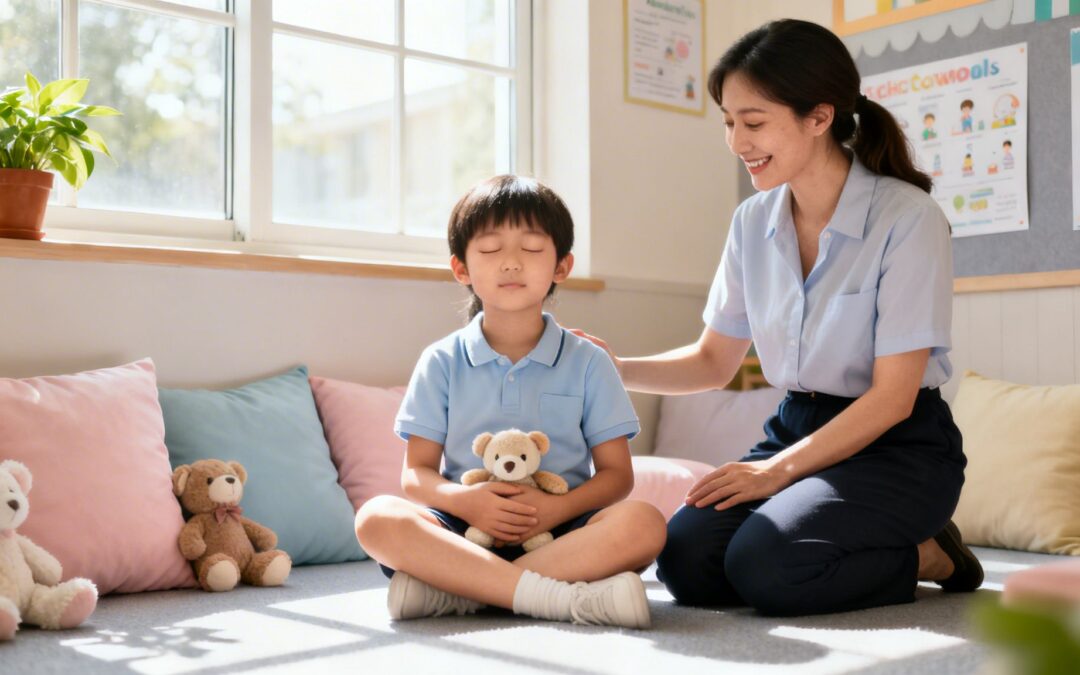
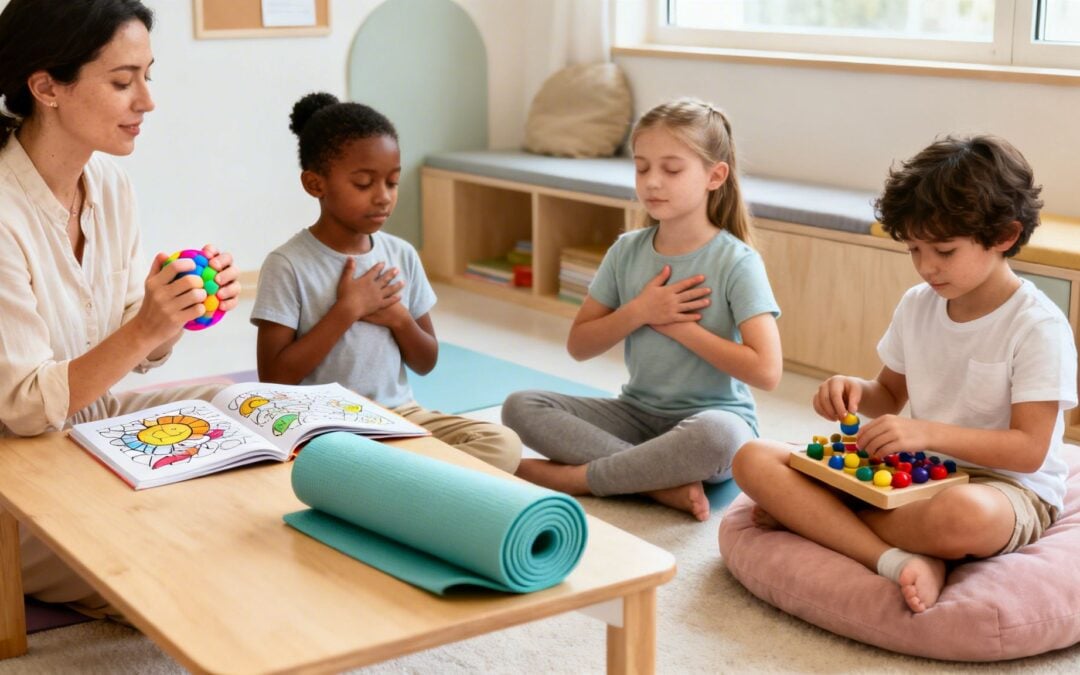
One of the most powerful tools in my experience is a designated “Calm-Down Corner” or “Peace Corner.” This isn’t a timeout spot for bad behavior; it’s a safe, cozy space a child can choose to visit when they feel overwhelmed. The space itself should feel like a warm hug, creating a positive association with self-regulation.
To make it effective, fill it with sensory items that help soothe an agitated nervous system. These tools give all that anxious energy a place to go.
Soft Textures: A fuzzy blanket, a soft rug, or a few large pillows are perfect.
Squishy Toys: Stress balls, textured fidgets, and squishy toys help release physical tension in their hands.
Weighted Items: A weighted lap pad or a heavy stuffed animal can provide a grounding, calming pressure that feels incredibly secure.
Practical Example: A teacher might notice a student getting wiggly and frustrated during math. She could quietly say, “It looks like your body needs a break. Would you like to spend five minutes in the Calm-Down Corner with the weighted lizard?”
Deep breathing is a game-changer for anxiety, but telling a young child to “take a deep breath” often leads to quick, shallow gasps that do more harm than good. We have to make the process visual and interactive. It needs to feel less like a chore and more like a gentle game.
This simple process flow shows how we can guide a child from recognizing an anxious signal to using a skill with our help.
This visual reminds us that our job is to help kids first notice the Signal (their body’s clue that they’re anxious), offer loving Support, and then guide them toward a tangible Skill. This framework builds their confidence and independence over time.
A fantastic way to practice this is with “Stuffed Animal Breathing.” Have the child lie down and place a favorite stuffed animal on their belly. Then, guide them with a soft, gentle voice.
Example Script: “Let’s give your teddy bear a slow ride. Take a big breath in through your nose and make your belly rise up high, like a balloon. 1… 2… 3… Now, breathe out slowly through your mouth and let the teddy bear float back down. 1… 2… 3… 4…”
Watching the toy rise and fall gives them a concrete visual for the rhythm of deep, calming breaths. It transforms a complex concept into a simple, observable action they can control.
Introduce Worry Monsters and Worry Boxes
Young children often can’t find the words for their anxieties. Giving their worries a physical form makes them feel less scary and much more manageable. This is where tools like a “Worry Monster” or a “Worry Box” can be magical.
A Worry Monster is just a special puppet or a decorated tissue box with a big mouth. Introduce it as a friendly creature that loves to eat worries for lunch.
Here’s how it works: If a child is anxious about a parent leaving at drop-off, you can say, “It sounds like you have a big worry about saying goodbye. The Worry Monster is really hungry today. Let’s draw a picture of that worry and feed it to him so he can gobble it all up!”
The child can draw or write what’s bothering them on a small piece of paper, then physically “feed” it to the monster. This simple, symbolic act helps them externalize the fear, giving them a real sense of control and relief.
To help you get started, here are a few simple, age-appropriate skills you can introduce in the classroom or at home.
Core Coping Skills for Grades K-2
Coping Skill
Classroom or Home Activity
What It Teaches
Belly Breathing
Stuffed Animal Breathing: Lie down, place a toy on the belly, and watch it rise and fall with each deep breath. Flower & Candle: Pretend to smell a flower (breathe in) and blow out a candle (breathe out).
Body awareness and how to slow down the nervous system.
Grounding
5 Senses Game: Name 5 things you can see, 4 you can touch, 3 you can hear, 2 you can smell, and 1 you can taste. Chair Push-Ups: While seated, push hands down on the chair to feel the strong muscles in your arms.
Pulls focus away from anxious thoughts and back to the present moment.
Externalizing Worries
Worry Monster/Box: Draw or write down a worry and “feed” it to a special box or puppet.
Makes abstract fears tangible and provides a sense of control over them.
Sensory Soothing
Calm-Down Corner: Use a designated space with soft blankets, squishy toys, or weighted lap pads.
How to self-soothe using sensory input to calm the body.
These activities are more than just distractions; they are the building blocks of lifelong emotional regulation. By weaving these simple practices into daily routines, we normalize the process of managing emotions and empower kids with skills they’ll use for years to come.
Helping Older Elementary Kids Understand Their Worries (Grades 3-5)
By the time kids hit the upper elementary grades, their minds are making some incredible leaps. They’re starting to think more abstractly, which is fantastic for learning but can also open the door to more complex worries. While the sensory tools we use with younger kids are still great to have on hand, students in grades 3-5 are ready for some real cognitive strategies.
This is the perfect age to pull back the curtain and teach them about the fascinating mechanics of their own brains. Giving them this knowledge is empowering—it helps them understand what’s happening inside when big feelings take over.
This shift couldn’t come at a better time. Diagnosed anxiety among children has been climbing, with 2022–2023 data showing that 11% of U.S. children ages 3-17 have received a diagnosis. But that might just be the tip of the iceberg. Global research suggests as many as 20.5% of young people experience significant anxiety symptoms, hinting that the official numbers don’t capture the full picture.
The Upstairs vs. Downstairs Brain
One of the most powerful analogies for this age group is the “upstairs brain” and the “downstairs brain.” It’s a simple, sticky way to explain a complex process.
You can frame it like this: the upstairs brain (the prefrontal cortex) is our “Wise Owl” or “Thinking Brain.” It’s the part that helps us make smart choices, solve problems, and calm ourselves down.
Then there’s the downstairs brain (amygdala and limbic system), which is our “Guard Dog” or “Feeling Brain.” Its job is to sniff out danger. When it senses a threat—whether it’s a real emergency or just a scary thought—it starts barking. And when it barks really loud, it can cause us to “flip our lid.”
When a child “flips their lid,” the connection between the calm upstairs brain and the reactive downstairs brain temporarily snaps. The Guard Dog takes over completely, making it almost impossible to think clearly or listen to reason. Explaining this helps kids see their intense reactions not as a personal failure, but as a normal (and temporary) brain state.
Try This: A hand model makes this concept click instantly. Make a fist with your thumb tucked inside. Your wrist is the brainstem, your tucked-in thumb is the “downstairs brain,” and your fingers wrapping over the top are the “upstairs brain.” When you’re calm, it’s a connected fist. But when you flip your lid, your fingers fly up, leaving the thumb (downstairs brain) exposed and in charge. You can practice this with a child after a difficult moment, saying, “It looks like your Guard Dog was in charge then. What can we do to help your Wise Owl come back online?”
The 5-4-3-2-1 Grounding Trick
When a child’s mind is caught in a spiral of “what ifs,” grounding techniques are the lifeline that pulls them back to the present moment. The 5-4-3-2-1 method is a go-to because it methodically engages all five senses, forcing the brain to focus on the here and now instead of future fears.
Walk them through it gently. No rush. Practical Example: A student is frozen with test anxiety. A teacher can kneel beside them and whisper:
See: “Okay, quietly look around and name 5 blue things you can see in the classroom.” (The poster, Maya’s shirt, the recycling bin…)
Feel: “Great. Now, can you tell me 4 things you can feel? Wiggle your toes in your shoes. Feel the desk under your hands.” (My feet in my shoes, the smooth desk, my soft sweater…)
Hear: “Good job. Now listen closely. What are 3 things you can hear right now?” (The clock ticking, someone turning a page, the fan humming…)
Smell: “Almost there. Take a sniff. What are 2 things you can smell?” (The pencil shavings, the dry-erase marker…)
Taste: “Last one. What is 1 thing you can taste?” (The mint from my toothpaste this morning.)
This technique works because it interrupts the anxiety cycle by redirecting the brain’s attention. Of course, having the words for their feelings is a huge help, too. Building a rich feelings vocabulary is key, and you can find some great ideas in our guide to teaching emotional vocabulary for kids.
Becoming a Thought Detective
Another game-changer for this age group is “thought challenging.” This skill teaches kids to be detectives of their own minds, investigating their worries instead of just accepting them as fact. When we learn to question our anxious thoughts, we can build resilience in children and help them navigate life’s inevitable bumps.
Start by helping a student catch their “worry thought.” Then, you can gently prompt them to put it on trial with one simple but powerful question: “Is my worry 100% true?”
Here’s How It Looks in Action:
A student is completely panicked about giving her book report.
Worry Thought: “Everyone is going to laugh at me. I just know I’m going to mess up and fail.”
Challenge Question: “Okay, let’s investigate. Is it 100% true that everyone will laugh? Have you ever seen the entire class laugh at someone’s report before? What’s a more likely thing to happen? What’s one thing you know you did well when you practiced?”
Balanced Thought: “I feel really nervous, and that’s okay. Some kids might not be listening, but probably no one will laugh. I practiced my first page a lot, so I know I can start strong. I’m just going to do my best.”
This simple process is incredibly empowering. It shows kids they can talk back to their anxiety, shifting them from feeling like a victim of their worries to being a resourceful problem-solver. It’s a foundational skill for a healthy inner dialogue that will serve them for years to come.
Advanced Self-Advocacy Skills for Middle Schoolers (Grades 6-8)
The middle school years bring a whole new flavor of anxiety. Suddenly, the social world gets way more complicated, the academic stakes feel higher, and students are in the thick of figuring out who they are. For this age group, basic breathing exercises aren’t always enough. We need to introduce them to metacognition—the powerful ability to think about their own thinking.
As students navigate this tricky period, their capacity for self-awareness is actually growing. This is the perfect time to introduce more advanced strategies that empower them to become their own best advocates. We can guide them not just to manage their anxiety, but to understand it, question it, and communicate their needs effectively.
And the need for these skills is urgent. The ripple effects of the pandemic have revealed some troubling patterns in kids’ mental health. Researchers at Boston University found that childhood anxiety spiked in 2020 and hasn’t returned to pre-COVID levels. As one researcher noted, the core drivers of anxiety, like intolerance for uncertainty, just “haven’t come back down.” It’s a clear signal that we need to equip kids with robust coping tools.
Teaching the Fact vs. Feeling Check
A middle schooler’s brain can easily blur the line between an emotional reaction and what’s actually happening. A game-changing metacognitive tool is the “Fact vs. Feeling” check. It helps students step back from an intense emotion and analyze the situation like a detective, separating what they feel from what they know.
Let’s walk through a classic middle school scenario:
A student sees a group of friends whispering in the hallway and feels a surge of panic. You can guide them with these prompts:
The Feeling: “Okay, what’s the feeling right now? Name it.” (They might say: “They’re talking about me. I must have done something wrong. They hate me.”)
The Facts: “Got it. Now let’s be detectives. What are the facts we know for sure? What did you see with your eyes?” (They might say: “I saw my friends talking. I have no idea what they were saying. One of them smiled when she looked over. I don’t have any actual evidence that it’s about me.”)
The Reframe: “So the feeling is ‘they hate me,’ but the fact is ‘I saw them talking.’ Can we hold both? The feeling is real, but it might not be true.”
By guiding them through this process, we’re teaching them to challenge their brain’s automatic negative thoughts. It’s not about invalidating their feelings; it’s about putting them in perspective. This technique builds a habit of critical thinking that can short-circuit an anxiety spiral before it really takes off.
The Mind-Body Connection in Middle School
Middle schoolers are finally old enough to grasp that their daily habits directly impact their mental state. This opens the door for some really powerful conversations about the link between physical health and emotional well-being.
Instead of just nagging them to “get more sleep,” we can frame it as a concrete strategy for managing anxiety.
Sleep: Explain that when they’re tired, the “Guard Dog” part of their brain is way more reactive. Getting 8-10 hours of sleep helps the “Thinking Brain” stay in charge. Example: “I notice you seem more on edge on days after you stay up late gaming. Let’s try an experiment: for one week, we’ll shut down screens at 9 PM and see if you feel less anxious in the mornings.”
Nutrition: Talk about how sugary foods can cause energy spikes and crashes that feel a lot like the physical symptoms of anxiety. Eating balanced meals helps keep both their blood sugar and their mood more stable. Example: “Let’s pack a snack with some protein, like cheese and crackers, for that mid-afternoon slump. It will give you more steady energy than a cookie and might help you feel less jittery before soccer practice.”
Screen Time: Discuss how constant notifications and the social media comparison game can keep their nervous systems on high alert. Encourage designated “unplugged” times to give their brains a chance to rest and reset. Example: “Let’s all put our phones in this basket during dinner so we can actually connect. It gives our brains a break from all that buzzing.”
Teaching students that they have agency over their anxiety by making healthy choices is a massive step toward self-empowerment. It shifts their perspective from feeling helpless to feeling capable and in control of their own well-being.
Empowering Students with Sentence Starters
The final, crucial piece is self-advocacy—giving students the actual words to use when they need help. So many tweens feel anxious but have no idea how to ask for support without feeling awkward or embarrassed. Providing them with simple, respectful sentence starters can be a total game-changer.
This skill is all about teaching them how to be assertive, not aggressive. You can dive deeper into this important distinction in our guide on teaching assertiveness vs. aggressiveness.
Encourage them to practice these scripts so they roll off the tongue more naturally when needed:
For Academic Confusion: “Can we review the instructions again? I’m feeling unsure about where to start.” (Practice this by role-playing with a confusing homework assignment at home.)
When Feeling Overwhelmed: “I’m feeling a little overwhelmed by this assignment. Could I have a few minutes to take some deep breaths before I dive in?” (Suggest they write this on a sticky note and keep it in their binder.)
For Social Situations: “When you said that, it made me feel anxious. Could you help me understand what you meant?” (Role-play a scenario with a friend who makes a joke that doesn’t land well.)
When Needing a Break: “My brain feels really full right now. I’m going to use a coping skill for a minute and then I’ll be ready to focus.” (Identify a non-verbal signal they can give a teacher, like placing a specific colored card on their desk.)
Equipping middle schoolers with these advanced skills helps them build a strong foundation of self-awareness and self-advocacy that will support them long after they’ve left your classroom.
Creating a Supportive Environment at School and Home
Teaching kids individual anxiety coping skills is a huge step, but those skills truly take root when they’re practiced in a consistent and reassuring environment. A child is far more likely to remember deep breathing or grounding techniques when the adults in their life are modeling and encouraging them. Creating this kind of supportive ecosystem—at both school and home—is what transforms coping from an isolated activity into a shared cultural value.
The goal is to build a world where talking about feelings is normal and using a coping skill feels as natural as brushing their teeth. This consistency chips away at uncertainty, which is a major anxiety trigger, and gives children a predictable foundation to stand on when their inner world feels shaky. When school and home are in sync, kids get a clear, powerful message: your feelings are valid, and you have the tools to manage them.
This alignment is crucial. It creates a seamless experience for a child, reinforcing that all the grown-ups in their life are a united team working for their well-being.
Integrating Coping Skills Into the School Day
For educators, the most effective approach is to weave coping skills right into the fabric of the classroom routine, rather than treating them as a separate lesson. This normalizes self-regulation and gives students frequent, low-stakes opportunities to practice. The key is to keep these moments brief, predictable, and positive.
Here are a few practical ways to embed these skills seamlessly:
Start with a Mindful Minute: Kick off the day or transition after recess with just 60 seconds of quiet. Example: “Okay class, before we start math, let’s have a Mindful Minute. Everyone put your hands on your desk, feel your feet on the floor, and let’s listen for any sounds outside our classroom. Go.”
Use Emotion Check-Ins: During morning meetings, add a quick emotional check-in. Students can point to a “feelings wheel” or just hold up a number from 1 to 5 to show where they’re at emotionally. This builds emotional vocabulary and gives you a quick read on who might need extra support.
Create Predictable Routines: Unpredictability can be a huge source of anxiety. Post a clear daily schedule and do your best to stick to it. If things have to change, give as much advance notice as possible to help students prepare mentally. Example: “Team, I just found out the assembly is moved to 10:00 AM today, which means we’ll do our reading block after lunch. I’ve updated it here on the board for us.”
Building a predictable classroom environment is one of the most effective, yet simple, strategies to reduce ambient anxiety. When students aren’t spending mental energy wondering what’s next, they have more capacity for learning and emotional regulation.
Modeling Healthy Coping at Home
At home, parents and caregivers are the primary role models for emotional regulation. The “do as I say, not as I do” approach just doesn’t work when it comes to anxiety. Kids learn how to handle stress by watching how you handle your own. This doesn’t mean being perfectly calm all the time—in fact, it’s more powerful when they see you navigate stress in a healthy, real way.
A huge part of this is verbalizing your own internal process. Instead of just quietly taking deep breaths when you’re stressed, you narrate the experience for them.
What This Looks Like in Real Life:
Stuck in traffic: “Ugh, this traffic is making me feel really frustrated. I can feel my shoulders getting tight. I’m going to take three slow, deep ‘lion breaths’ to help my body relax. Want to do them with me? Big breath in… ROAR!”
During a tricky task: “I’m having a tough time putting this shelf together, and I’m starting to feel angry. I think I’ll take a five-minute break to get a glass of water and come back to it with a clearer head.”
Before a big event: “I’m feeling a little nervous about my big meeting tomorrow. I’m going to look over my notes one more time and then listen to some calming music to help me unwind.”
This kind of modeling does two critical things. First, it validates their own feelings by showing them that adults get frustrated, angry, and nervous, too. Second, it gives them a real-life script for how to connect a feeling to a constructive action.
By creating a shared family language around emotions and building predictable daily routines, you construct a safe harbor for your child. It becomes a place where they feel secure enough to name their worries and practice their new skills without fear of judgment.
Common Questions About Kids’ Anxiety Coping Skills
As you start putting these anxiety coping skills into practice, you’re bound to run into some real-world questions. It’s one thing to read about a technique, but it’s another thing entirely to use it when a child is feeling completely overwhelmed.
This section gets into the nitty-gritty, tackling the most common concerns we hear from parents and educators. Think of it as your field guide for navigating those tricky moments with a bit more confidence. Knowing what to expect makes all the difference.
When Is It Normal Worry vs. a Potential Disorder?
This is probably the biggest question on everyone’s mind. The short answer? All kids worry. It’s a healthy, normal part of growing up. The line gets crossed when that worry starts getting in the way of their day-to-day life.
The key things to look for are the intensity, duration, and impact of their anxiety.
Normal Worry: A child is nervous before their first piano recital. They feel butterflies, but they still go on stage and perform. The feeling fades afterward.
Potential Disorder: Weeks before a piano recital, a child has trouble sleeping, complains of stomachaches, and has meltdowns during practice. They might ultimately refuse to perform. The worry is disproportionate to the event and significantly impacts their functioning.
If a child’s anxiety is consistently keeping them from doing age-appropriate things—like going to school, making friends, or sleeping through the night—that’s a clear signal it’s time to seek some professional guidance.
A great rule of thumb is to consider the “Three Fs.” Is the anxiety impacting their Functioning (at school, home, or with activities), their Friendships, or their Family life? If you see a major negative shift in any of these areas, that’s your cue to talk with a school counselor, pediatrician, or another mental health professional.
What If My Child Resists Trying a Coping Skill?
This happens all the time. When a child is in the middle of a big, anxious moment, their logical “upstairs brain” is offline. Trying something new feels impossible. The most important thing to remember here is to lead with patience, connection, and choice.
First off, never try to force a skill when anxiety is high. It will only backfire. Instead, just model it yourself. You could say something like, “Wow, this is a really big feeling. I can see you’re having a hard time. I’m going to take a few slow breaths to help my own body calm down.” Your calm presence is the most powerful tool you have. Through co-regulation, you’re helping their nervous system sync up with yours.
Later, when things are calm, you can bring it up again. But frame it as a game and give them options.
Here’s what that might look like:
Instead of demanding, “You need to do your belly breathing,” try this later in the day: “Hey, remember those big feelings from earlier? Let’s practice for next time so we feel stronger. Do you want to give our teddy bear a ride on our belly, or should we draw our worries and feed them to the Worry Monster? You pick.”
Giving them that sense of control makes them so much more willing to try. The goal is low-pressure practice outside of the stressful moment.
How Can I Adapt These Skills for Neurodivergent Children?
This is such an important consideration. For neurodivergent kids, including those with autism or ADHD, the core principles of calming the nervous system are the same, but the approach often needs to be more concrete, sensory-based, and built around their unique needs.
Simply talking about “calming down” is often too abstract to be helpful. Many neurodivergent children are visual and sensory thinkers.
Make it Visual: A visual timer can show them exactly how long a calming activity will last. A “choice board” with pictures of different coping skills lets them point to what they need when words are hard to find. Example: Create a laminated card with pictures of a weighted blanket, headphones, and a squishy toy. When they’re overwhelmed, you can show them the card and ask them to point to what their body needs.
Lean into Sensory Needs: For a child who seeks out sensory input, a big, deep-pressure hug or a weighted blanket might be a game-changer—far more effective than deep breathing. For a child who gets easily overstimulated, noise-canceling headphones in a quiet corner might be the essential first step.
Use Their Interests: Connect coping strategies to whatever they’re passionate about. If a child loves trains, you could call deep breathing “chugging like a train”—a slow “choo” on the inhale and a long, drawn-out “chooooo” on the exhale. If they love superheroes, you can call grounding “activating your spidey-senses” to notice things in the room.
The best strategy is to observe what already soothes them and build from there. Their self-soothing behaviors (often called “stims”) are their natural way of regulating. Instead of trying to stop them, see how you can incorporate them into a more structured coping strategy.
At Soul Shoppe, we believe every child deserves the tools to navigate their inner world with confidence. Our programs are designed to help schools and families build supportive environments where children can learn, practice, and master the social-emotional skills they need to thrive. Explore our K-8 programs to bring these vital tools to your community at https://www.soulshoppe.org.
Anxiety in children can feel like an overwhelming storm of emotions, making it difficult for them to learn, connect with others, and feel secure in their environment. For parents, caregivers, and educators, finding effective ways to help can be a significant challenge. The goal is not to eliminate worry entirely, but to equip children with a practical toolkit to navigate these feelings successfully. This article moves beyond generic advice to provide a curated collection of eight evidence-based, actionable activities for kids with anxiety.
Each strategy is designed for easy implementation in both classroom and home settings, supported by specific examples and trauma-informed tips. We will explore a range of approaches that address the whole child, from grounding mindfulness and breathing exercises to expressive creative arts and purposeful movement. You will find concrete methods that help children externalize their feelings through journaling, connect with nature, and build social skills through structured games.
This resource provides a comprehensive guide for building resilience and emotional regulation skills. It focuses on empowering children by teaching them how to recognize their emotional triggers and respond with confidence. We are not just aiming to calm the immediate storm; we are teaching children how to become their own anchors in any weather, fostering a sense of agency over their emotional well-being. Let’s begin building a versatile toolkit filled with practical and effective strategies.
1. Mindfulness and Breathing Exercises
Mindfulness and breathing exercises are foundational activities for kids with anxiety, teaching them to anchor themselves in the present moment and consciously calm their nervous system. These structured practices interrupt the body’s automatic stress response, or “fight-or-flight” mode, by activating the parasympathetic nervous system, which promotes rest and relaxation. By focusing on the physical sensation of their breath, children gain a powerful, portable tool they can use anywhere to manage overwhelming feelings.
This approach empowers children with a sense of control over their internal state, turning an abstract feeling like anxiety into a manageable physical process. The work of pioneers like Jon Kabat-Zinn and Thich Nhat Hanh has shown that consistent practice can reshape neural pathways, making self-regulation a more accessible skill over time.
Why It Works for Anxiety
Anxiety often pulls a child’s focus toward future worries (“What if I fail the test?”) or past events (“Why did I say that?”). Breathing exercises immediately redirect their attention to the present. The slow, deep breaths signal safety to the brain, lowering heart rate and blood pressure, and providing immediate physiological relief.
Practical Examples and Implementation
Belly Breathing (or “Balloon Breathing”): Ask the child to place a hand or a small stuffed animal on their belly. Instruct them: “Breathe in slowly through your nose for four counts and watch the stuffed animal rise as you fill your belly like a big balloon. Then, breathe out slowly through your mouth for four counts and watch it go back down.”
Box Breathing: Use a visual aid or have them trace a square on their desk or leg with their finger. Guide them: “Breathe in for four seconds as you trace the top side, hold your breath for four seconds as you trace down, breathe out for four seconds as you trace the bottom, and hold for four seconds as you trace back up.”
Snake Breath: This makes exhaling fun. Have the child take a deep breath in and then hiss it out slowly and steadily like a snake, trying to make the “ssssss” sound last as long as possible.
Classroom “Calm Corner”: Schools like those using Soul Shoppe’s peer mediation programs often designate a quiet space with visual breathing guides (like a poster of box breathing), glitter jars, and soft seating. A child feeling overwhelmed can use the corner for a 3-minute reset.
Actionable Tips for Adults
Practice Proactively: Introduce these techniques during calm moments, such as circle time in the morning or before bedtime at home. Say, “Let’s practice our Balloon Breaths to help our bodies feel calm and ready for the day.”
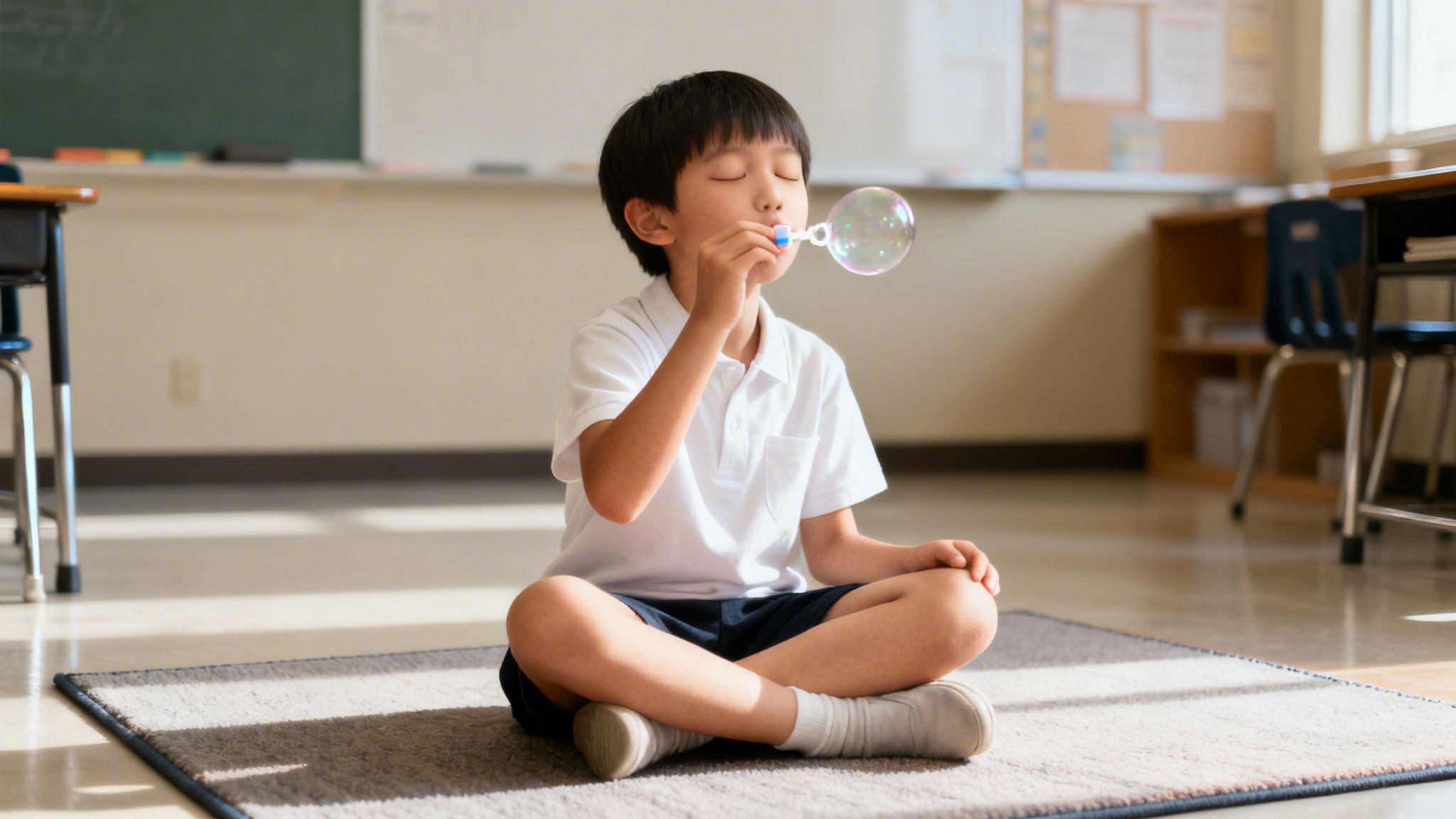
Use Visuals: For younger children, use a pinwheel or bubbles to provide a concrete visual for their exhale. This makes the concept of a long, slow breath less abstract. Challenge them to see how slowly they can make the pinwheel spin.
Model It Yourself: When you feel stressed, say aloud, “I’m feeling a little overwhelmed, so I’m going to take three deep belly breaths.” This normalizes the practice and shows its real-world application.
Keep It Short: Start with just 30-60 seconds of focused breathing for younger kids and gradually increase the duration as they become more comfortable.
To explore a wider range of exercises, you can find more mindfulness activities for kids that build on these foundational breathing techniques.
2. Creative Arts and Expression (Drawing, Painting, Sculpting)
Creative arts provide a powerful non-verbal outlet for children to process complex emotions like anxiety. Activities such as drawing, painting, or sculpting bypass the analytical parts of the brain that can get stuck in worry loops, allowing children to access and express their feelings directly. The tactile and sensory nature of art-making itself is inherently grounding, making it one of the most effective activities for kids with anxiety.
This approach is championed by art therapists and trauma-informed educational practices, which recognize that giving form to a feeling makes it less overwhelming and more manageable. The focus is not on artistic skill but on the act of creation, which provides a sense of agency and a safe container for difficult emotions.
Why It Works for Anxiety
Anxiety can be hard for children to put into words. Art offers a different language, one of symbols, colors, and shapes. This externalization process allows a child to see their anxiety as separate from themselves, reducing its power. The repetitive, rhythmic motions involved in drawing or sculpting can also be meditative, helping to calm a racing mind and an activated nervous system.
Practical Examples and Implementation
Worry Monsters: Provide paper, markers, and modeling clay. Instruct the child: “Draw or build what your worry looks like. Does it have big teeth? Spiky hair? Give it a name.” Afterward, they can draw a cage around it, give it a silly hat, or physically lock a clay version in a box to symbolize taking control.
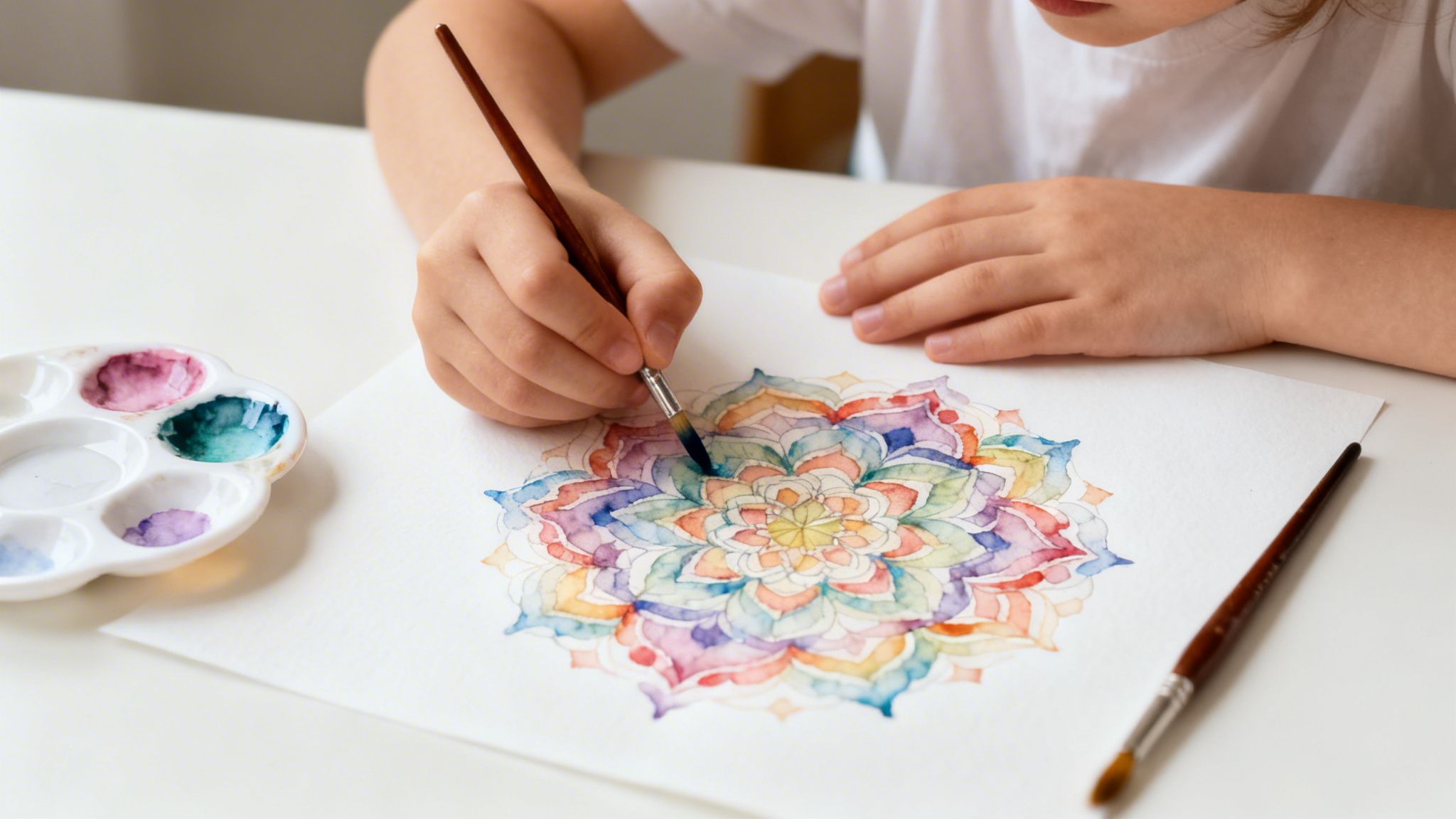
Mandala Coloring: Provide printed mandala templates for children to color. The structured, symmetrical patterns are known to promote focus and calm, making them a perfect tool for a classroom “calm-down corner.” Suggest they start from the center and work their way out.
“Feelings” Painting: Set out paints and paper with the simple prompt to “paint what your worry feels like” or “paint what calm looks like.” For example, a child might paint anxiety as a chaotic scribble of black and red, while calm might be a smooth wash of blue and green.
Clay Squishing and Sculpting: The sensory act of kneading, rolling, and squishing clay is very grounding. Prompt them: “Squeeze the clay as hard as you can when you think of a worry, then smooth it out to make it feel calm.”
Actionable Tips for Adults
Focus on Process, Not Product: Emphasize that there is no “right” way to create. Use phrases like, “Tell me about the colors you chose,” instead of asking, “What is it?”
Offer a Variety of Materials: Provide options like clay, paint, markers, and collage materials. Different textures and mediums will appeal to different children and sensory needs.
Use Specific Prompts: Guide their expression with gentle prompts like, “Draw a picture of a place where you feel totally safe,” or “If your anger had a color, what would it be today?”
Validate Their Expression: Display their artwork (with their permission) to show that their feelings and creative expressions are valued and seen.
Expanding on creative outlets, it’s worth exploring the developmental benefits of beginner guitar lessons for kids, which can contribute to a child’s emotional well-being through structured musical expression.
3. Movement and Somatic Activities (Yoga, Dance, Stretching)
Physical activities that integrate mind-body awareness help anxious children release stored tension and reconnect with their bodies in a safe, non-judgmental way. Movement practices like yoga, dance, and stretching activate the parasympathetic nervous system, reducing the physiological symptoms of anxiety while building body awareness and confidence. These are powerful activities for kids with anxiety because they offer a non-verbal outlet for expressing complex emotions.
This approach is grounded in somatic psychology, which recognizes that emotional stress is stored physically in the body. As Bessel van der Kolk’s work highlights, intentional movement can help process and release this tension. By guiding a child to move their body, you give them a direct tool to change how they feel from the inside out.
Why It Works for Anxiety
Anxiety often creates a feeling of disconnection from one’s own body, leading to physical symptoms like a racing heart, tense muscles, or shallow breathing. Somatic activities counter this by drawing a child’s attention back to their physical sensations in a positive context. This process helps them feel more grounded and in control, proving that they can influence their physical state through movement.
Practical Examples and Implementation
Cosmic Kids Yoga: Programs like Cosmic Kids Yoga, popular in elementary classrooms, weave storytelling into yoga poses. For instance, children don’t just do “Cat-Cow Pose”; they pretend to be cats arching their backs in a spooky cave and then cows mooing at the moon. This makes the practice engaging and less intimidating.
“Brain Break” Dance Videos: Many teachers use short, energetic dance videos (like GoNoodle) as a transition tool between academic subjects. This provides a quick, structured release of pent-up anxious energy. A three-minute “freeze dance” can reset the entire classroom’s energy.
Progressive Muscle Relaxation (PMR): A school counselor can guide a child to systematically tense and then release different muscle groups. For instance, “Pretend you’re squeezing lemons in your hands as tight as you can for five seconds… now let them go and feel the softness. Now, scrunch up your toes like you’re trying to pick up a pencil with your feet… and relax.”
Stomping and Shaking: For a child with a lot of jittery energy, say, “Let’s pretend we’re big elephants and stomp our feet ten times. Now, let’s shake out our arms like wet noodles for a count of ten.”
Actionable Tips for Adults
Offer Choices: Let the child lead. Ask, “Would you rather stretch like a tall giraffe or shake out your wiggles like a puppy?” This empowers them and respects what their body needs.
Start with Gentle Movements: For a highly anxious child, begin with slow, simple stretches or swaying to calm music rather than high-energy activities.
Combine with Breathing: Encourage a child to exhale audibly during a big stretch (“Let out a big sigh as you reach for your toes”) or to breathe in time with the music. This deepens the calming effect of the movement.
Focus on Feeling, Not Performance: Use prompts like, “Notice how your feet feel planted on the floor like tree roots,” or “What does that stretch feel like in your arms?” This shifts the focus from “doing it right” to internal awareness.
To discover more ways to connect movement and emotion, explore these embodiment practices for kids suitable for school and home.
4. Journaling and Expressive Writing
Journaling and expressive writing provide children with a private, reflective space to explore anxious thoughts and feelings without judgment or pressure. This activity helps externalize worries by moving them from the mind onto paper, making them feel more tangible and manageable. It fosters metacognitive awareness, allowing kids to observe their thought patterns and identify specific anxiety triggers over time.
This approach empowers children to process their emotions independently, turning abstract fears into concrete words they can examine and understand. The pioneering research of psychologist James Pennebaker demonstrated that expressive writing about emotions can lead to significant improvements in both mental and physical health, including reduced anxiety.
Why It Works for Anxiety
Anxious thoughts often swirl internally in a repetitive, overwhelming loop. The act of writing forces a child to structure these thoughts, which can slow down the mental spiral and reduce its intensity. By giving worries a name and a description, journaling makes them less powerful and provides a healthy outlet for feelings that might otherwise remain bottled up.
Practical Examples and Implementation
Prompted Anxiety Journals: Use a dedicated notebook with simple prompts like, “Today my worry feels like a __ out of 10,” “One thing I am worried about is…,” or “A time I felt brave was when…” This guided structure is less intimidating than a blank page.
Worry Notebooks: Many school counselors provide “worry notebooks” or a “worry box” where students can write down a concern on a slip of paper and “post” it in the box. This symbolic act helps them set the worry aside and focus on their day.
Gratitude Journaling: Instead of focusing on worry, prompt the child to write or draw three things they are thankful for each day. This shifts their focus toward positive experiences. For example: “1. The sun was warm at recess. 2. My friend shared their snack. 3. I liked the book we read.”
Creative and Art Journals: Combine writing with drawing or collage. Books like “Wreck This Journal” encourage messy, imperfect expression. A child can draw their anxiety monster, scribble out a frustrating feeling with a black crayon, or write down a brave thought in their favorite color.
Actionable Tips for Adults
Start with Prompts: A blank page can be overwhelming. Offer simple sentence starters like, “I feel nervous when…” or “I feel calm when…” to get them started.
Keep It Private: Reassure the child that their journal is their private space. They should only share entries if they choose to. This builds trust and encourages honesty.
Model the Behavior: Let your child see you writing in your own journal. You can share, “I’m writing down something that’s on my mind so I can understand it better.”
Focus on Effort, Not Perfection: Emphasize that spelling, grammar, and handwriting don’t matter. The goal is expression, not a perfect essay. Praise their willingness to explore their feelings.
For children who struggle to find the right words, you can learn more about how to express your feelings in words to provide better support and guidance.
5. Nature-Based Activities and Outdoor Time
Engaging with the natural world offers a powerful, restorative antidote to the internal-facing nature of anxiety. Nature-based activities shift a child’s focus outward, providing gentle sensory input that grounds them in the present moment and reduces stress. This approach leverages the environment as a co-regulator, lowering cortisol levels, improving mood, and restoring the capacity for attention without the pressure of structured performance.
This method taps into the concept of “biophilia,” our innate tendency to connect with nature. Influential figures like Richard Louv, author of Last Child in the Woods, and the global Forest School movement have highlighted how outdoor time is essential for healthy child development, directly counteracting the overstimulation and worry that feed anxiety. Time spent outdoors provides a non-judgmental space for exploration and being.
Why It Works for Anxiety
Anxiety often traps children in a loop of worrisome thoughts. Nature interrupts this cycle by engaging all the senses: the feeling of grass underfoot, the sound of birds, the smell of rain, the sight of a leaf’s intricate patterns. This multisensory engagement is a form of natural mindfulness that requires no special training, effectively lowering heart rate and promoting a sense of calm and connection.
Practical Examples and Implementation
5-4-3-2-1 Grounding: This is a classic outdoor mindfulness exercise. Ask the child to name: 5 things they can see (a bird, a green leaf, a crack in the sidewalk), 4 things they can feel (the wind on their skin, a rough tree bark), 3 things they can hear (a car, a dog barking), 2 things they can smell (freshly cut grass), and 1 thing they can taste.
School or Home Garden: The simple, repetitive tasks of watering plants, pulling weeds, and observing a seedling grow are rhythmic and grounding. Caring for another living thing can also build confidence and a sense of purpose.
“Sit Spot” Practice: Designate a specific spot in a park, backyard, or schoolyard where the child can sit quietly for 5-10 minutes. Encourage them to simply observe what happens around them, noticing the insects, the clouds, and the movement of leaves without any goal or expectation.
Nature Scavenger Hunt: Create a list of things to find, not just by sight but by other senses. For example: “Find something smooth,” “Find something that makes a crunching sound,” or “Find something that smells like pine.”
Actionable Tips for Adults
Start Small: If a child is hesitant, begin with short, 10-minute exposures, like eating a snack on the porch or looking at the clouds from a window.
Allow Unstructured Play: Resist the urge to direct every activity. Let the child lead the exploration, whether it’s digging in the dirt, collecting interesting rocks, or simply lying in the grass.
Create a “Nature Box”: Keep a small box for collecting natural treasures like pinecones, feathers, or unique stones. This gives a purpose to walks and creates a tangible connection to the experience.
Model Curiosity: Express your own wonder about the natural world. Say things like, “Wow, look at the intricate pattern on that leaf!” or “I wonder what kind of bird is making that sound.” Your enthusiasm is contagious.
6. Social-Emotional Learning Games and Role-Playing
Social-emotional learning (SEL) games and role-playing activities offer an engaging, non-threatening way for children to build crucial anxiety management skills. By embedding learning within a playful context, these activities reduce the pressure of practicing difficult social and emotional concepts. This approach transforms abstract skills like empathy, problem-solving, and emotional regulation into tangible, interactive experiences.
Role-playing, in particular, allows children to safely rehearse their responses to anxiety-provoking scenarios, building confidence and a sense of preparedness. Through experiential programs like those developed by Soul Shoppe, which use interactive workshops and games, children learn by doing. This active participation helps internalize coping strategies far more effectively than passive instruction.
Why It Works for Anxiety
Anxiety often stems from a fear of the unknown or a feeling of being unprepared for social situations. SEL games and role-playing directly address this by creating a safe “practice ground.” Children can try out different responses, make mistakes without real-world consequences, and learn scripts for navigating challenges like peer conflict or asking for help, making these some of the most effective activities for kids with anxiety.
Practical Examples and Implementation
Emotion Charades: Write different emotions (e.g., worried, excited, frustrated, proud) on slips of paper. A child draws one and acts it out using only their face and body while others guess. This builds emotional vocabulary and the ability to recognize nonverbal cues.
Problem-Solving Scenarios with Puppets: Use puppets to act out a common dilemma, such as “One puppet wants to join a game but is too scared to ask.” The children can give the puppet advice and then act out a positive outcome, lowering the personal stakes of the role-play.
SEL Board Games: Use commercially available games like “The Emotion Game” or “Calm Down Time” to structure conversations about feelings. The game format provides clear rules and turn-taking, which can be comforting for an anxious child. A teacher might use these in a small group setting.
“What If?” Brainstorm: Pose a common worry: “What if no one plays with you at recess?” Have the group brainstorm as many possible solutions as they can, from asking a specific person to play, to joining a game already in progress, to telling a teacher they feel lonely. This builds a mental library of options.
Actionable Tips for Adults
Focus on Process, Not Perfection: Celebrate a child’s courage to participate rather than the “correctness” of their answer or performance. The goal is practice and effort, not winning.
Debrief After Play: After a game or role-play, ask open-ended questions like, “How did that feel to ask for help?” or “When could you use that strategy at school?” This helps connect the playful activity to real-life application.
Allow Observation First: For a hesitant or shy child, allow them to watch their peers play first. You can give them a job, like “timekeeper” or “idea writer,” to keep them involved before they feel ready to actively participate.
Start with Low-Stakes Scenarios: Begin role-playing with simple, positive situations (e.g., how to give a friend a compliment) before moving on to more challenging scenarios like managing disagreements.
To build on these ideas, you can find a variety of other kids’ social skills activities that incorporate similar playful learning principles.
7. Pet Therapy and Animal-Assisted Interventions
Interacting with a calm, trained animal offers immediate, non-verbal comfort that can be profoundly grounding for a child experiencing anxiety. Animal-assisted interventions leverage the human-animal bond to reduce physiological stress responses, providing a safe and non-judgmental presence that anxious children often crave. The simple act of petting an animal can lower cortisol levels and blood pressure, creating a tangible calming effect.
This approach creates a bridge for connection and communication, as children often find it easier to express their feelings to an animal or about an animal. Organizations like Pet Partners have established standards and training programs that underscore the therapeutic benefits of these interactions, making them a trusted and evidence-based practice in many schools and clinical settings.
Why It Works for Anxiety
Anxiety can make a child feel isolated and misunderstood. An animal’s presence is simple, accepting, and unconditional. It doesn’t ask questions or place demands, which can disarm a child’s defensiveness and create an environment of pure comfort. This allows the child to shift their focus from internal worries to the external, sensory experience of touching, watching, or caring for the animal.
Practical Examples and Implementation
Reading Programs: Many schools and libraries have “Reading to Dogs” programs where children practice reading aloud to a therapy dog. This lowers performance anxiety because the dog is a non-judgmental listener, helping the child build fluency and confidence.
Counselor’s Office Companion: A trained therapy dog that resides in the school counselor’s office can help children feel more comfortable opening up. A counselor might start a session by saying, “Why don’t you tell Buddy about your morning while you give him a nice pet?”
Equine-Assisted Therapy: In these programs, a child might be tasked with grooming a horse. The repetitive, rhythmic motion of brushing is calming, and successfully leading a large animal builds immense confidence and teaches non-verbal communication skills.
Classroom Pet Responsibility: Caring for a small class pet like a guinea pig or hamster teaches routine and empathy. A specific, predictable task like feeding the pet each morning can be a grounding start to the day for an anxious child.
Actionable Tips for Adults
Prioritize Safety and Certification: Only work with certified therapy animals and handlers from reputable organizations. Ensure you screen for student allergies or phobias beforehand.
Teach Respectful Interaction: Model and explicitly teach children how to approach and touch an animal gently. Say, “We need to use soft hands and let him sniff us first to say hello. This helps him feel safe with us.”
Let the Child Lead: Allow the child to approach the animal at their own pace. Never force an interaction. The goal is to build a sense of safety and control, not to create another source of pressure.
Integrate Mindful Petting: Frame the interaction as a sensory activity. Guide them: “Notice how soft his fur feels under your fingers. Let’s try to match our breathing to his while we pet him slowly and quietly.” This combines the benefits of animal interaction with mindfulness.
8. Cognitive-Behavioral and Coping Strategy Tools
Cognitive-behavioral and coping strategy tools are structured activities that help children understand and change the relationship between their thoughts, feelings, and actions. These techniques, drawn from evidence-based Cognitive Behavioral Therapy (CBT), give kids a practical framework to identify anxious thoughts, question their validity, and replace them with more balanced and helpful ones. This empowers them with agency over their internal world, transforming abstract worries into manageable challenges.
This approach operationalizes anxiety management, making it a learnable skill rather than a mysterious force. The work of CBT pioneers like Aaron Beck and Albert Ellis established the core principle that our interpretations of events, not the events themselves, cause our emotional responses. By teaching children to become “thought detectives,” we equip them to reframe their experiences and build resilience.
Why It Works for Anxiety
Anxiety thrives on unexamined, catastrophic thoughts that often spiral out of control. CBT-based tools interrupt this cycle by introducing a critical pause. They teach children to externalize their worries by writing or drawing them, which creates psychological distance and makes the thoughts less powerful. By systematically evaluating and challenging these thoughts, kids learn that feelings aren’t always facts and that they can choose more effective ways to respond.
Practical Examples and Implementation
Thought Detective Work (Thought Record): Create a simple worksheet with three columns: “Worry Thought” (e.g., “The teacher is going to be mad I forgot my homework”), “Clues Against It” (e.g., “She was understanding last time,” “I can tell her I’ll bring it tomorrow”), and “Helpful Thought” (e.g., “I made a mistake, and I can fix it. It’s not a disaster”).
Coping Cards: On small index cards, help the child write or draw 3-5 simple, actionable strategies they can use when feeling anxious. Examples include “Take 5 balloon breaths,” “Think of my safe place (my bed with my cat),” or “Squeeze my stress ball 10 times.” They can keep these in a pocket or on their desk for quick reminders.
Worry Time: Designate a specific 10-15 minute period each day as “Worry Time.” If a worry pops up outside this time, the child writes it down in a “Worry Journal” to be addressed during the designated period. This teaches them they can control when they engage with worries.
Ladder of Bravery: For a specific fear (e.g., speaking in class), help the child break it down into small, manageable steps. Step 1 might be just thinking about raising their hand. Step 2 could be raising their hand without speaking. Step 3 could be answering a one-word question. They tackle one step at a time, building confidence as they climb the “ladder.”
Actionable Tips for Adults
Introduce One Tool at a Time: Start with a single strategy, like identifying “worry thoughts,” and practice it consistently before adding another layer like “helpful thoughts.”
Use Their Language: Frame concepts using relatable metaphors. Anxious thoughts can be “worry bugs” that need to be shooed away, “gremlins” telling lies, or “false alarms” from their brain.
Practice When Calm: Introduce and role-play these strategies during calm, neutral moments. Trying to teach a new skill during a moment of high anxiety is rarely effective.
Create Visuals: Make charts, posters, or personalized cards that remind the child of their coping strategies. Visual cues are powerful anchors during moments of distress.
Target Specific Concerns: Tailor the tools to address a child’s unique fears. For instance, addressing specific concerns like how to help kids with separation anxiety requires focused strategies and tools that directly challenge thoughts about being away from a caregiver.
8-Point Comparison: Activities for Kids with Anxiety
Item
Implementation complexity
Resource requirements
Expected outcomes
Ideal use cases
Key advantages
Mindfulness and Breathing Exercises
Low — simple to teach; needs routine
Minimal — no materials or special setup
Immediate calming; improved self-regulation over time
Classroom transitions, pre-test routines, at-home practice
Fast, evidence-based, zero cost, portable
Creative Arts and Expression (Drawing, Painting, Sculpting)
Low–Medium — setup and facilitation needed
Art supplies, space; optional art therapist for depth
Emotional processing, confidence, calming through creation
Counselor offices, art stations, family art nights
Non‑verbal processing, tangible outcomes, inclusive for low‑verbal kids
Movement and Somatic Activities (Yoga, Dance, Stretching)
Low–Medium — space and basic instruction recommended
Open space, optional instructor or video, music
Reduced physiological arousal; better sleep and body awareness
Putting It All Together: Building a Resilient Future
Supporting a child navigating the often-turbulent waters of anxiety is a journey, not a destination. It’s a process built on patience, consistent practice, and most importantly, a deep sense of connection. The comprehensive toolkit of activities for kids with anxiety explored in this article, from grounding mindfulness exercises to expressive art and somatic movement, are far more than simple distractions. They are the fundamental building blocks of emotional literacy and lifelong resilience.
Each strategy offers a unique pathway for a child to understand and manage their internal world. The immediate calm of a structured breathing exercise can anchor a child in a moment of panic. The expressive release of painting or sculpting can give voice to feelings that are too big for words. The empowering logic of a cognitive coping card can help a child challenge distorted thoughts and regain a sense of control. The goal is not to eliminate anxiety, an impossible and unhelpful task, but to equip children with the skills to recognize it, sit with it, and navigate through it without letting it take the lead.
Key Takeaways for Lasting Impact
The true power of these interventions lies in their consistent and thoughtful application. Moving forward, the most critical step is to shift from knowing these strategies to integrating them into the fabric of daily life.
Consistency Over Intensity: A five-minute “5-4-3-2-1” grounding exercise every day before a challenging subject is more effective than a one-hour session once a month. Create predictable routines where these tools are a normal part of the day, not just a reaction to a crisis.
Empowerment Through Choice: No single activity works for every child or every situation. Offer a “menu” of coping strategies. A child who feels overwhelmed might reject a quiet breathing exercise but enthusiastically engage in a vigorous “stomp and shake” movement activity to release physical tension.
Model and Co-Regulate: Children learn emotional regulation by watching the adults around them. When you feel stressed, model taking a deep breath and naming your feeling. Say, “I’m feeling a little frustrated right now, so I’m going to take three slow belly breaths to help my body calm down.” This act of co-regulation is one of the most powerful teaching tools you have.
Focus on the “Why”: Frame these activities not as a fix for something “wrong” but as powerful tools for building “brain muscles.” Explain that just like we exercise our bodies to get stronger, these activities help us build a stronger, more flexible mind that can handle big feelings.
Actionable Next Steps: From Plan to Practice
To make these strategies stick, begin with small, manageable steps. Choose one or two activities from the list that you believe will resonate most with your child or students. For example, you might create a “calm-down corner” in a classroom or a “peace place” at home, stocking it with drawing supplies, soft clay, and pre-written journaling prompts.
Next, identify a specific time to introduce and practice the new skill when the child is already calm and regulated. For instance, you could practice “Box Breathing” together after school as a way to decompress from the day. By weaving these activities for kids with anxiety into predictable routines, you normalize them and reduce the barrier to using them during moments of genuine distress. The ultimate goal is to empower children to become active, confident participants in their own emotional well-being, one small, brave, and supported step at a time.
Ready to bring a structured, school-wide approach to social-emotional learning? Soul Shoppe provides dynamic, experiential programs that teach children essential skills for emotional regulation, empathy, and conflict resolution, creating a culture of support that reinforces these vital activities. Learn how to transform your school community at Soul Shoppe.