

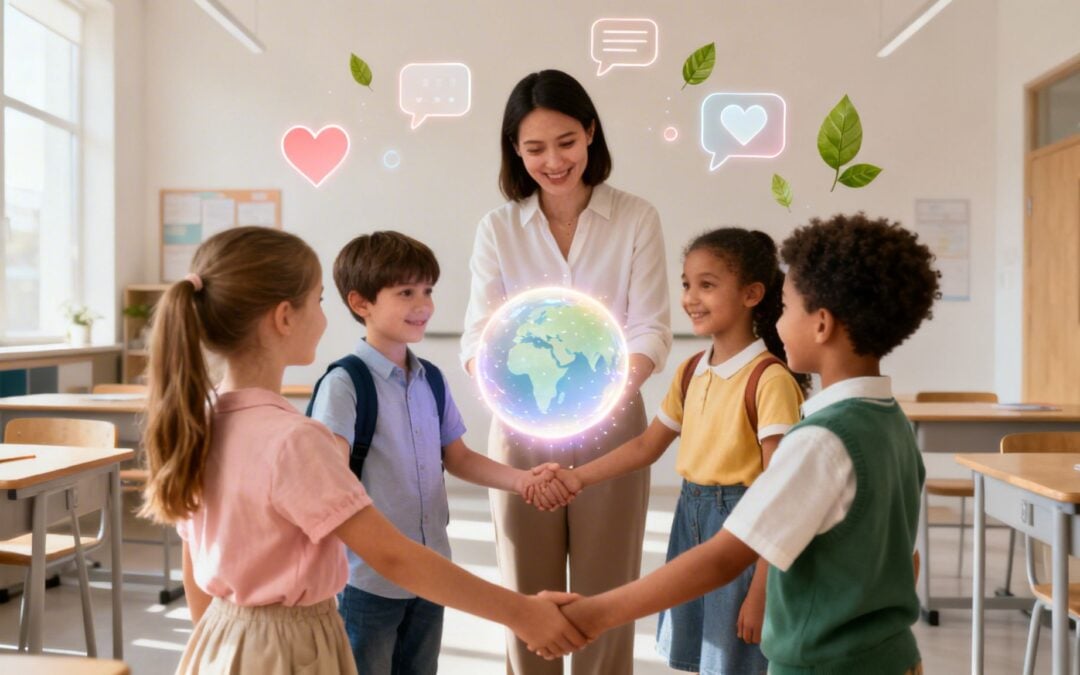
Benefits of social emotional learning: Boost Student Success and Well-Being
When we talk about the benefits of social emotional learning (SEL), the conversation often goes straight to better grades, stronger friendships, and improved mental health. And yes, those are absolutely huge outcomes. But the real magic of SEL is that it gives students the inner toolkit they need to navigate not just school, but life itself.
What Is Social Emotional Learning And Why It Matters Now
Think of Social Emotional Learning (SEL) less as another subject to be taught, and more as a fundamental way of being. It’s the process of teaching our kids how to understand their inner world, connect with others in a healthy way, and make thoughtful decisions. It’s where the heart and the mind learn to work together.
Imagine a pilot flying through a storm. They have a whole instrument panel showing their altitude, speed, and direction, which allows them to stay calm and fly safely. SEL provides students with a similar internal dashboard. It gives them the emotional gauges to handle tough assignments, social turbulence, and personal setbacks with a lot more confidence and resilience.
The Five Core SEL Skills
At its core, SEL is built on five interconnected skills. These aren't just abstract ideas—they're practical abilities that can be taught, practiced, and strengthened over time. These skills are the building blocks of a person's overall social and emotional wellbeing.
To make this clear, let's break down each of these five areas with a quick look at what they mean and how they show up in a real classroom.
The Five Core Competencies of SEL at a Glance
| Core Competency | What It Means | Practical Example |
|---|---|---|
| Self-Awareness | The ability to recognize your own emotions, thoughts, and how they impact your actions. | A student notices their stomach is in knots before a presentation and thinks, "I'm feeling nervous, and it's making it hard to think clearly." |
| Self-Management | The ability to control your emotions, thoughts, and behaviors in healthy ways. | A student feeling angry after losing a game decides to squeeze a stress ball for a minute instead of yelling at their teammate. |
| Social Awareness | The ability to understand and empathize with others, even those with different backgrounds. | A student notices a classmate looks sad and asks, "Are you okay?" showing they are paying attention to others' feelings. |
| Relationship Skills | The ability to build and keep positive, supportive relationships with others. | During a group project, students listen to each other's ideas without interrupting and work together to find a compromise. |
| Responsible Decision-Making | The ability to make thoughtful, constructive choices about your behavior and interactions. | A student finds a wallet on the playground and chooses to turn it in to the teacher instead of keeping it. |
These competencies work together, building on one another to help students become more well-rounded individuals.
These so-called 'soft skills' are actually critical skills for educating the whole child. They create the framework for students to not only do well in school but to grow into kind, capable, and resilient people.
In a world where student anxiety is on the rise, teaching these skills is more urgent than ever. They empower kids to handle life's complexities, build resilience, and become positive forces in their communities.
To dive deeper into these skills, be sure to read our complete guide on the five core SEL competencies explained.
The Academic Boost From Social Emotional Learning
It’s a common worry for educators and parents: with so much to cover, will focusing on social emotional learning take precious time away from core subjects like math and reading?
But what we've seen time and again is that the opposite is true. SEL isn't a detour from academics; it's the very road that leads to greater achievement. Instead of being a distraction, SEL builds the foundation students need to become more focused, resilient, and engaged learners.
When kids have the tools to manage their emotions, they are simply better equipped for the classroom. They can navigate the stress of a big test, stick with a tough assignment, and work well with others on group projects.
How SEL Directly Impacts Learning
Think about what a child needs to truly absorb new information. They need to feel safe, focus their attention, manage frustration when things get hard, and believe they can succeed. These aren't just personality traits—they are skills we can teach.
Here's what this looks like in a real classroom:
- Improved Self-Regulation: A student overwhelmed by a long essay can use a breathing technique to calm down and break the task into smaller steps. This skill prevents them from shutting down and giving up entirely.
- Enhanced Focus and Attention: A classroom that starts with a brief mindfulness exercise helps students shift from the buzz of the hallway to a state of calm readiness. This means more time is spent on learning and less on managing distractions.
- Greater Perseverance: When a student learns that struggle is a normal part of the process, they're more likely to try again after a setback. SEL helps build this growth mindset, turning "I can't do it" into "Let me try this a different way."
The tools within an SEL framework are designed to build this academic foundation.

As you can see, skills like empathy and stress management aren't just for social situations. They are absolutely critical for creating a classroom where every student can thrive.
The Data Backs It Up
This connection between SEL and academics isn't just a feeling—it's backed by a huge body of research. A landmark report analyzing 424 studies with over 500,000 K-12 students across more than 50 countries confirmed it.
The findings showed that students in SEL programs outperformed their peers by an average of 4 percentage points in academic performance. When the programs ran for a full school year, that number more than doubled to 8 percentage points. Specifically, literacy scores rose by 6.3 points and math scores by 3.8 points—major gains for any classroom.
These aren't just small bumps in grades. The research also revealed that students in SEL programs had better attendance, higher self-efficacy, more optimism, and lower levels of anxiety, stress, and depression.
When students feel better, they learn better. It’s that simple. You can explore more about the powerful link between SEL and school outcomes by reviewing our curated Soul Shoppe research.
Practical Examples for Teachers and Parents
So, what does connecting SEL to academics look like day-to-day? Here are a few simple ways to get started.
In the Classroom (For Teachers):
- Goal-Setting for a Big Project: Before starting a research paper, have students write one personal goal (e.g., "I will ask for help when I'm stuck") and one academic goal (e.g., "I will finish my rough draft by Friday"). This weaves self-management and responsibility into the assignment.
- Using "I-Statements" in Group Work: During a collaborative science experiment, guide students to use "I-statements" if a disagreement pops up. Instead of "You're doing it wrong," a student learns to say, "I feel confused when we mix things without reading the instructions first."
At Home (For Parents):
- Problem-Solving Homework Frustration: When your child is getting frustrated with their math homework, ask, "What's one small step we can take right now?" This builds perseverance and makes overwhelming tasks feel more manageable.
- Reflecting on Reading: After reading a story together, ask questions that build empathy. "How do you think the main character felt when that happened? Have you ever felt that way?" This connects the dots between literacy and social awareness.
Creating Safer And More Connected School Communities
Beyond individual success stories, one of the most powerful ripple effects of social emotional learning is its ability to completely reshape a school’s atmosphere. SEL isn’t just about correcting one student’s behavior; it’s about cultivating a campus-wide culture of safety, respect, and belonging.
When an entire school community—from students to teachers and staff—begins speaking a shared language of empathy and problem-solving, the entire ecosystem shifts for the better. This happens because SEL gets to the root causes of so much of the conflict and isolation we see in schools.

Building A Culture Of Belonging
A positive school climate isn't simply about the absence of problems; it’s about the presence of connection. When students feel seen, heard, and valued for who they are, they’re far more likely to engage in learning and support their peers. SEL gives us the framework to build these connections intentionally.
For principals and school leaders, this is a game-changer. A school where kids feel physically and emotionally safe is a school where learning can truly flourish. For teachers, it means a more cooperative and manageable classroom, where precious time is spent on instruction instead of navigating social friction.
Imagine a playground where a disagreement over a game doesn't escalate into a shouting match or a physical fight. Instead, students use their SEL skills to talk it out, find a compromise, and get back to playing. This is what a strong SEL culture looks like in action—it turns conflict into a learning opportunity.
From Conflict To Connection In Practice
Let’s get practical. Think about a common school challenge: recess drama. Here’s how SEL can flip the script through something like a peer mediation program.
- The Problem: Recess is constantly interrupted by arguments over kickball rules. This leads to hurt feelings, yelling, and students feeling left out. Teachers are exhausted from playing referee and putting out fires.
- The SEL Solution: Older students are trained as peer mediators. They learn active listening, how to identify the feelings behind a conflict, and how to use "I-statements" to communicate without blame. They get a step-by-step process for guiding their peers toward a fair solution.
- The Outcome: An argument starts. Instead of a teacher running over, the student mediators step in. They don’t take sides. They guide the kids involved to express themselves clearly ("I feel frustrated when you change the rules") and state their needs ("I just want to play a fair game"). The result? A calmer playground, empowered students who can solve their own problems, and a huge drop in recess-related discipline issues.
This is a perfect example of how SEL gives students the actual tools to build a better community for themselves. Learning how to improve school culture is a journey, and SEL provides the map.
The Lasting Impact on School Safety and Climate
This feeling of safety isn't just a nice-to-have; the research is crystal clear. A massive 2023 meta-analysis reviewing 424 rigorous studies found that SEL programs deliver incredible, widespread improvements.
Students showed significant gains in social skills, positive attitudes, and relationships. Even more telling, bullying decreased, stress levels went down, and students in SEL programs reported that their schools simply felt much safer and more respectful.
These positive effects were still present even six months after the programs ended, proving that SEL creates a durable, lasting shift in a school's climate.
Building Lifelong Resilience And Mental Wellbeing
Beyond grades and friendships, one of the most powerful gifts of social emotional learning is its deep, lasting impact on a child's mental wellbeing. Think of SEL as a proactive, preventative approach to mental health. It gives children an internal toolkit of coping skills to navigate life’s inevitable ups and downs.
These skills are absolutely essential for handling everything from everyday disappointments to the much bigger stressors that come with being a teenager and, eventually, an adult.
When children learn to name their feelings, figure out what triggers them, and practice healthy ways to respond, they are literally building the foundation for lifelong resilience. This isn’t about stopping kids from ever feeling sad or anxious. It’s about giving them the confidence and the skills to move through those feelings without getting stuck.

From Reacting To Responding
Emotional regulation is a cornerstone of mental wellbeing. It’s the ability to manage big emotions without being completely swept away by them. SEL teaches this critical skill through direct practice, creating supportive spaces where students can safely learn to self-soothe and problem-solve.
At the heart of this is the development of resiliency, which truly is the Resiliency The Hidden Hero Of Overcoming Obstacles. This is the capacity to bounce back from adversity, failure, and stress—a skill that will serve children their entire lives.
Let's see what this looks like in the real world for both educators and parents.
Practical Example for Teachers: The Peace Corner
- The Scenario: Alex, a second-grader, gets super frustrated when his block tower keeps falling. His fists are clenched, and he’s about to knock the whole thing down in anger.
- The SEL Practice: Instead of a timeout, his teacher gently guides him to the classroom's "Peace Corner"—a cozy spot with pillows, a feelings chart, and calming tools like squishy balls. The teacher says, "It looks like you're feeling really frustrated. Why don't you take a few minutes in the Peace Corner to help your body feel calm again?"
- The Outcome: Alex goes to the corner, uses a breathing ball for a few deep breaths, and points to the "angry" face on the feelings chart. After a few minutes, he’s ready to try building again. He’s learned to recognize his frustration and use a strategy to manage it instead of letting it control him.
By providing a designated space and tools for self-regulation, the teacher empowers students to take charge of their own emotional states. This proactive strategy builds self-awareness and self-management skills that are vital for mental health.
Practical Examples For Parents And Caregivers
These skills are just as crucial at home. Parents can use SEL principles to help children process their day and build their emotional vocabulary.
Practical Example for Parents: Active Listening After a Hard Day
- The Scenario: Maya, a fifth-grader, comes home, throws her backpack down, and sighs, "Today was the worst."
- The SEL Practice: Instead of jumping in to fix it ("What happened? Who was mean?"), Maya's dad practices active listening. He gets down on her level, makes eye contact, and says, "It sounds like you had a really tough day. I'm here to listen if you want to tell me about it."
- The Outcome: Feeling safe, Maya opens up about being picked last for a team in gym and feeling embarrassed. Her dad just listens, validating her feelings with, "That sounds really hurtful. It's okay to feel sad about that." By simply listening with empathy, he helps Maya process her feelings and reinforces that she has a safe person to talk to when things are hard.
When teachers and parents consistently use these strategies, they help children build a sturdy internal framework for mental wellbeing. This is one of the most durable benefits of social emotional learning, creating emotionally intelligent people who are simply better equipped for life.
How To Implement SEL In Your School And Home
Knowing why social emotional learning matters is one thing. Putting it into practice is where the real magic happens. So, how do we get there? Creating an environment where kids can truly thrive isn't just a school's job or a parent's job—it’s a partnership. Let's walk through how to build that bridge between school and home.
A School-Wide Roadmap For Success
Real, lasting SEL isn't a checkbox on a lesson plan or a 30-minute block on a Friday. It's a shift in the very air of the school. The goal is to weave these skills into the daily rhythm of learning, so they become as natural as reading and writing for students and staff alike.
Here’s how school leaders can get started:
- Build Your Team's "Why": Get everyone on board by starting with a shared understanding. Professional development should show how SEL not only helps students but also creates more engaged, manageable classrooms and a healthier, more supportive work environment for teachers.
- Find a Proven, Structured Program: You don't have to build this from scratch. Partnering with an organization that provides a research-backed curriculum gives you reliable materials, a clear path forward, and ongoing support. A great program provides a common language and consistent tools for the whole school.
- Integrate, Don't Isolate: Weave SEL language and strategies into everything you do. This means talking about feelings during math, using problem-solving skills on the playground, and practicing empathy in the cafeteria.
True implementation means every adult in the building—from the principal to the bus driver—understands and uses the same core language for conflict resolution and emotional support. This consistency is what builds a genuinely safe and connected community.
High-Impact Strategies For Parents At Home
The skills kids practice in the classroom become superpowers when they're also part of their life at home. You are your child’s first and most important teacher, and you don’t need to be an SEL expert to make a profound impact. A few simple, consistent practices can build a rock-solid emotional foundation.
Here are a few powerful strategies to try:
- Create a "Calm-Down Corner": Find a cozy spot in your home and fill it with pillows, a soft blanket, and a few calming tools—like a squishy ball, a favorite book, or some coloring supplies. When big feelings bubble up, guide your child to this space to cool down. This teaches them to manage their emotions, rather than feeling punished for having them.
- Use "I-Statements" During Disagreements: Sibling arguments and parent-child conflicts are actually perfect training grounds for healthy communication. Instead of "You always grab my stuff!" help them practice saying, "I feel frustrated when you take my toy without asking." It completely changes the dynamic from blame to self-expression.
- Model Healthy Emotional Honesty: Be open about your own feelings in an age-appropriate way. Saying something like, "I'm feeling a little nervous about my presentation today, so I'm going to take a few deep breaths," shows your child that all feelings are okay and there are healthy ways to handle them.
This table shows just how beautifully these strategies can connect what’s happening at school with what’s happening at home, creating a seamless support system for your child.
Practical SEL Strategies For School And Home
| Strategy Area | In the Classroom (Teacher/Admin) | At Home (Parent/Caregiver) |
|---|---|---|
| Morning Routine | Start with a "check-in" circle where students share how they are feeling using a 1-5 scale or a feelings word. | Ask your child at breakfast, "What are you looking forward to today?" or "Is anything on your mind?" |
| Conflict Resolution | Use consistent prompts like, "It looks like you two have a problem. How can you solve it together?" | When siblings argue, ask, "What do you need? What does your brother/sister need? Let's find a compromise." |
| Emotional Regulation | Implement a "Peace Corner" or "Calm-Down Spot" in the classroom for students who need a moment to regulate. | Create a home "Calm-Down Corner" and practice using it together when feelings get big. |
| Communication | Teach and model "I-statements" during group projects and class discussions to promote clear, respectful communication. | Model "I-statements" during family disagreements to show how to express feelings without blaming others. |
By working together, schools and families create a consistent, supportive world where children learn they have the tools to navigate any challenge that comes their way.
When you are ready to take the next step for your school, you can explore our detailed guide to choosing the right SEL programs for schools for the upcoming 2026-27 school year.
Answering Your Questions About Social Emotional Learning
As more schools see the incredible results of social emotional learning, it’s completely normal for parents, teachers, and school leaders to have questions. It’s a big topic! We’ve gathered some of the most common questions to help clear up any confusion and build confidence as you bring SEL into your community.
Is There Proof That SEL Actually Improves Academic Scores?
Yes, absolutely. The connection between social emotional skills and academic success is one of the most powerful and well-proven benefits of SEL. Time and again, research shows that when students learn to focus, persevere through challenges, and work with others, their learning takes off.
Just think about it: a student who feels overwhelmed by anxiety simply can't absorb a math lesson. But a student who has learned a simple breathing technique to manage that feeling can stay calm, focused, and ready to learn. SEL gives kids the foundation that makes all other learning possible.
A landmark 2025 analysis, which looked at over 400 separate studies, cemented this fact. It found that students in SEL programs academically outperformed their peers by an average of 4 percentile points. When those programs ran for a full school year, the gain doubled to a remarkable 8 percentile points.
Digging deeper, this included a 6.3-point jump in literacy scores and a 3.8-point rise in math scores. SEL isn’t a distraction from academics—it’s what fuels them.
What This Looks Like for a Teacher
- Reading with Empathy: During a talk about a character in a book, a teacher might ask, "How do you think she's feeling right now? What could she do to handle this tough situation?" This simple question connects responsible decision-making directly to reading comprehension.
How Can We Fit SEL Into an Already Packed School Day?
This is one of the most realistic and common concerns we hear from teachers. The secret is to stop seeing SEL as one more thing to add to the schedule. Instead, think of it as the lens through which all teaching and learning happens. The goal is integration, not addition.
Truly effective SEL is woven right into the fabric of the school day. It’s in the words teachers use, the way arguments on the playground are handled, and the simple routines that kick off each class. When done this way, SEL actually gives back instructional time by creating calmer, more focused, and better-managed classrooms.
Here are a few ways to blend SEL into your day:
- Morning Meetings: Start the day with a quick two-minute check-in where students can share how they’re feeling. This builds self-awareness and a sense of community.
- Mindfulness Moments: Before a test or a tricky new lesson, lead a one-minute breathing exercise to help students quiet their minds and sharpen their focus.
- Shared Conflict Language: When the whole school uses the same steps for solving problems, kids learn to handle their own disagreements more quickly and peacefully, whether they're in the cafeteria or the classroom.
What This Looks Like for a Parent
- Bringing SEL Home: If your child's school is teaching "I-statements," you can use them at home, too. Instead of saying, "You made a mess," try modeling with, "I feel frustrated when I see toys on the floor because I'm worried someone might trip." This reinforces the skill in a whole new setting.
Isn't Teaching Emotions and Values the Parents' Job?
Social emotional learning is a partnership. Parents are, without a doubt, a child's first and most important teachers. You lay the groundwork for values and emotional health. Schools then take that foundation and help children apply it in a much more complex social world.
Think about it: a school is a mini-community where kids spend hours every single day navigating dozens of different social situations. SEL provides a consistent set of tools and a shared language to handle those moments successfully. It doesn't replace what parents teach; it reinforces and complements it.
When home and school team up, the results are incredible. For example, a school might teach empathy by reading stories about different cultures. When a parent continues that conversation at home by asking, "How do you think you would feel if you were that character?" the child's ability to understand others grows exponentially.
The best SEL programs always include resources for parents because they recognize that a strong, consistent support system is what helps children truly thrive.
How Do We Know If Our SEL Program Is Actually Working?
Measuring the results of SEL is critical to making sure it’s having the right impact. The good news is that you can see progress through both hard numbers (quantitative) and the changes you observe day-to-day (qualitative).
The Numbers-Based Proof
Schools can track clear metrics that often shift dramatically once a solid SEL program is in place. Look for changes in:
- Attendance Rates: Kids who feel safe, seen, and connected actually want to come to school.
- Disciplinary Referrals: A noticeable drop in office visits for fighting, bullying, or classroom disruptions is a huge sign of success.
- Academic Scores: As we saw earlier, improvements in grades and test scores are a key outcome.
- Climate Surveys: Asking students and staff how safe and included they feel before and after implementing a program gives you direct, honest feedback.
The Human-Level Proof
Sometimes, the most powerful evidence is in the little moments you see and hear around campus.
- Student Interactions: Are students using conflict resolution words on their own? Are they including others in games at recess? Are they helping a friend who seems sad?
- Teacher Feedback: Teachers are often the first to notice a shift. They’ll report a calmer classroom vibe, more focused students, and way less time spent managing behavior.
- Student and Parent Stories: Hearing a student say they used a breathing exercise to calm down before a test, or a parent sharing that their kids are fighting less at home—these are the stories that show SEL is truly taking root.
Ready to bring the benefits of social emotional learning to your school? Soul Shoppe provides research-based, experiential programs that give your entire school community the tools and language to cultivate connection, safety, and empathy. Learn more about how we can help your students and staff thrive.