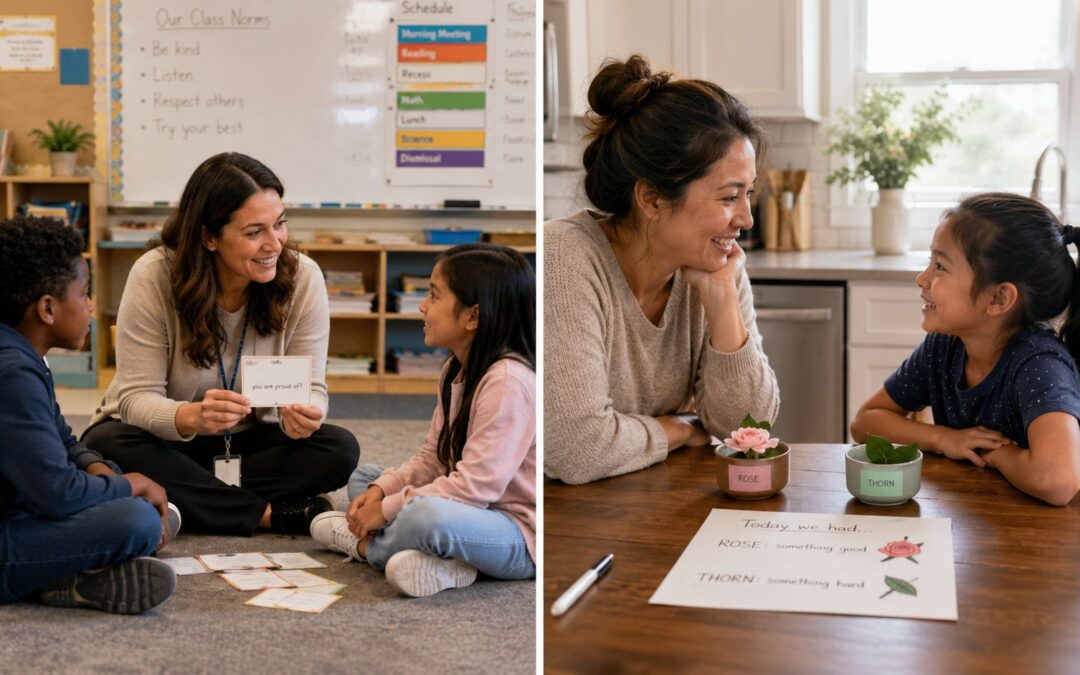
A child walks into class already upset. Another student bumps their chair. The first child shouts, “Stop it!” The second child says, “I didn't even do anything.” By the time anyone figures out what happened, the room is tense, instruction has stopped, and two children feel misunderstood.

Versions of this happen all day, at school and at home. A kindergartner cries because they can't explain why they're overwhelmed. A fourth grader shuts down during group work. A seventh grader sends a sharp text, then insists, “That's not what I meant.” Adults usually see the behavior first. The communication need is underneath it.

That's why communication improvement matters so much in K-8 settings. It isn't just about teaching kids to use polite words. It's about helping them notice feelings, express needs, listen for meaning, repair conflict, and stay connected even when things feel hard. When schools and families use the same tools and language, children get something they rarely get by accident. They get consistency.

Why Communication Improvement Is Foundational for Kids

When adults talk about communication, they often mean speaking clearly. Kids need more than that. They need a way to say, “I'm confused,” “That felt unfair,” “I need space,” and “Can we try again?” They also need help hearing those messages from others without immediately moving into blame, defensiveness, or shutdown.

In SEL work, communication sits underneath almost everything else. A child can't ask for help if they don't have words for their frustration. They can't solve a friendship problem if they only know how to accuse. They can't fully participate in learning if every misunderstanding feels like a threat.

An infographic showing the challenges and benefits of developing strong communication skills for young children.

What strong communication looks like by age

Communication improvement should match development. A five-year-old and an eighth grader both need support, but the skills won't look the same.

Grade band What communication often looks like What we want to build
K-2 Big feelings, short language, quick reactions Naming feelings, asking for help, turn-taking, listening with body and eyes
3-5 More words, but still impulsive under stress Using “I” statements, asking clarifying questions, respectful disagreement
6-8 More social awareness, more peer pressure, more nuance Reading tone, repairing harm, giving feedback, navigating group dynamics

A kindergartner might say, “He's mean.” With support, that becomes, “I got mad when he grabbed the marker.” An eighth grader may need help turning “Nobody listens in this group” into “I want a turn to explain my idea before we decide.”

That shift matters. It turns reaction into reflection.

Practical rule: If a child's language gets smaller when emotions get bigger, that's not manipulation. It's a sign they need structure, modeling, and time.

Communication is relational, not just verbal

Some of the hardest communication problems in schools aren't about vocabulary. They're about safety, trust, and power. A child may know the words but still not use them if they expect embarrassment, punishment, or dismissal.

That's one reason communication improvement has to include equity. Brookings' discussion of communication across language, literacy, and trust gaps points to practical supports like plain language, teach-back, interpreters, and trusted intermediaries. In school terms, that means we don't just ask, “Did we say it?” We ask, “Could this family understand it, trust it, and use it?”

For example, instead of sending home, “Please ensure completion of unfinished academic tasks,” a teacher can say, “If your child didn't finish classwork, please help them complete it tonight. If that's hard at home, send me a note and I'll help.”

Teach-back works well with children too. After giving instructions, say, “Tell me what you're going to do first.” That small move catches confusion early and reduces shame.

Why this belongs at the center of SEL

When communication improves, behavior often improves with it. Not because children become compliant, but because they become more capable. They can express themselves without exploding. They can listen without assuming attack. They can recover after mistakes.

That's part of why the benefits of social-emotional learning show up in both relationships and academics. Kids learn better when they feel understood, and they connect better when they have words that work.

Communication is a life skill, but in K-8 settings it's also a daily regulation tool. It helps children move from “something is wrong” to “here's what I need.”

Bringing Communication Skills to Life in the Classroom

Classroom communication lessons work best when they're brief, repeatable, and tied to real moments. Kids don't need one big lesson on respectful speaking in September. They need small routines they can practice in morning meeting, partner work, conflict repair, and transitions.

A shared classroom language helps. When everyone knows what “listen to understand” or “use an I-statement” means, you spend less time lecturing and more time coaching.

A teacher interacts with a small group of students around a table using puppets for emotional learning.

Active listening that kids can actually do

“Listen” is too vague for most children. They need visible actions.

Try teaching whole-body listening as a menu, not a compliance rule. Some students won't make eye contact consistently, and that's okay. Focus on behaviors that show attention and respect.

  • K-2 activity
    Use a listening detective game: Pair students. One student shares a favorite snack or animal. The listener has one job: repeat one detail they heard. Script it like this: “Your job is not to talk yet. Your job is to catch one important thing.”

  • 3-5 activity
    Teach paraphrasing: Put sentence frames on the board: “I heard you say…” and “Do you mean…?” During partner talk, students must use one frame before adding their own idea.

  • 6-8 activity
    Use disagreement rounds: Give pairs a low-stakes prompt such as whether recess should be longer or whether homework should be optional. One student speaks for a minute. The other must summarize the point fairly before responding.

What doesn't work is correcting listening only after a conflict. Build it during calm moments first.

I-statements that don't sound robotic

Kids often learn the formula but not the purpose. The point isn't to force stiff language. The point is to lower blame and increase clarity.

A simple classroom frame is: I feel… when… because… I need…

Examples:

  • “I feel frustrated when people talk while I'm reading because I lose my place. I need quiet for a minute.”
  • “I felt left out when the group started without me because I wanted to help. I need us to restart together.”

For more ready-to-use practice ideas, teachers can pull from communication skills activities for students.

When a child says, “You're mean,” pause and coach the translation. “Try telling them what happened and how it affected you.”

Here are grade-band variations:

Grade band Teacher prompt Student example
K-2 “Say: I didn't like it when…” “I didn't like it when you took my crayon.”
3-5 “Add the feeling word” “I felt annoyed when you interrupted me.”
6-8 “Add a request” “I felt dismissed when you laughed. Next time, let me finish first.”

Feedback and repair

Many classrooms teach sharing, but not enough teach repair. Kids need practice saying both “That didn't work for me” and “I want to make this right.”

Use these mini-scripts:

  • For giving feedback: “One thing that helped was…” or “Next time, it would help me if…”
  • For receiving feedback: “Okay, I hear that.” “Thanks for telling me.” “I want to fix it.”

With older students, I like to teach the difference between intent and impact. A student may not have meant harm, but impact still matters. That idea changes peer conversations fast.

A helpful outside resource for middle-grade conversation coaching is better conversations with Translate AI. It's useful when you want extra prompts for keeping discussions curious instead of combative.

This is a good point to model what respectful talk sounds like in motion:

Nonverbal cues and group norms

Kids miss social cues for many reasons. They may be distracted, impulsive, anxious, neurodivergent, or inexperienced. Don't assume they're being rude. Teach what cues mean, then let them practice.

Try these routines:

  • Freeze and notice: Stop a role-play and ask, “What is this face or posture telling you?”
  • Silent line-up: Students line up by birthday month or shoe type without talking. Then reflect on gestures, eye contact, and problem-solving.
  • Tone swap: Say the same sentence in different tones. Ask students how the meaning changes.

If your school uses structured SEL support, one option is a program like Soul Shoppe, which offers workshops that teach shared language for communication and conflict resolution. The important part isn't the brand. It's that staff and students practice the same tools often enough for them to become usable under stress.

Partnering with Families for Communication Growth at Home

Families usually see the spillover from school stress. Homework refusal. Sibling fights. Bedtime blowups. Silence after a hard day. Parents don't need more theory in those moments. They need a sentence to say next.

Home communication improvement works when it feels doable. Short routines beat long lectures. Predictable language beats improvising while everyone's upset.

A mother and daughter smiling and talking while drawing pictures together at a wooden kitchen table.

Replace pressure with structure

When adults ask, “How was school?” many children say, “Fine.” That's not defiance. It's often a broad question asked when the child is tired, hungry, or still regulating.

Use narrower prompts:

  • For younger kids: “What made you smile today?” “What felt hard?”
  • For older kids: “Was there a part of the day that felt annoying?” “Did anything surprise you?”
  • For any age: “Do you want listening, help, or space?”

That last question is gold. It stops adults from jumping into fixing mode too fast.

A simple home routine can be Rose, Thorn, and Help:

  • Rose: Something good from the day
  • Thorn: Something difficult
  • Help: One thing I need tomorrow

Scripts for common family friction points

Parents often tell me they know what not to say, but they freeze on what to say instead. Keep your scripts plain.

Homework conflict

  • Instead of: “You need to stop arguing and do it now.”
  • Try: “You don't want to start. I get it. Tell me what feels hard. Is it confusing, boring, or too much?”

Sibling conflict

  • Instead of: “Both of you knock it off.”
  • Try: “Pause. One person talks, one person listens. Start with what happened, not what kind of person your sibling is.”

Bedtime resistance

  • Instead of: “Why do you always make this difficult?”
  • Try: “Your body isn't ready to slow down yet. Let's choose. Two quiet songs or one short story?”

Screen time pushback

  • Instead of: “Because I said so.”
  • Try: “You want more time. I hear that. The limit is still the limit. Do you want to stop now and save time tomorrow, or stop now and help me choose tomorrow's plan?”

For families practicing feeling language, I-statements for kids can help translate blame into clearer, calmer language.

Home shift: Don't ask children to communicate respectfully while adults are speaking in accusations, threats, or sarcasm. Kids learn the pattern they hear most.

When home support needs to look different

Not every family has the same schedule, language background, access to services, or confidence with school systems. Generic advice often misses that reality. Research on communication support for children in underserved settings and hybrid models notes that alternative service delivery approaches are needed when in-person support is limited.

In practice, that means flexibility:

  • For busy households: Use one-minute check-ins in the car, during dinner cleanup, or before lights out.
  • For multilingual families: Encourage communication in the language that feels most natural and emotionally rich at home.
  • For caregivers at a distance: Use voice notes, visual schedules, shared journals, or brief video check-ins.
  • For children who struggle to talk face-to-face: Let them draw, point to feelings, write a note, or text a draft before speaking.

Build one bridge between school and home

The strongest school-home partnerships use the same phrases. If a teacher coaches, “Tell me what happened, how you felt, and what you need,” parents can use that exact language. If home uses “pause and repair,” school can echo it.

A shared script might look like this:

  1. Pause the reaction
  2. Name what happened
  3. Name the feeling
  4. Say what's needed next
  5. Repair if necessary

That kind of consistency reduces confusion for children. They stop having to decode different adult systems and start practicing one usable skill across places.

The Adult's Role in Modeling and Self-Regulation

Kids notice our tone before they absorb our words. They watch how we handle interruption, disagreement, stress, and mistakes. That's why adult modeling is the strongest communication curriculum in the room.

A workplace poll of 1,000 employees found that 91% felt their leaders lacked critical communication skills in the Interact/Harris Poll summary shared by Becoming Your Best. That comes from a corporate setting, but the lesson carries over cleanly. Leadership breaks down when communication does. In schools and homes, adults are the leaders kids study most closely.

What modeling looks like in real life

Modeling doesn't mean sounding calm all the time. It means showing children what repair, clarity, and regulation look like when things aren't perfect.

Try these swaps:

  • Instead of “Calm down.”
    Try “I see you're upset. I'm staying with you. Let's slow your body first.”

  • Instead of “Use your words.”
    Try “You don't have the words yet. I can help. Are you mad, embarrassed, or worried?”

  • Instead of “You're being disrespectful.”
    Try “That tone tells me you're really frustrated. Let's talk in a way we can both hear.”

  • Instead of “We already went over this.”
    Try “I need to say that more clearly.”

That last one matters. Adults who restate without shaming teach children that misunderstanding is solvable.

Co-regulation comes before correction

When a child is flooded, logic won't land. Co-regulation means the adult lends steadiness before expecting skill. That might sound like a slower voice, fewer words, a lower body position, or a hand gesture the child already knows.

“Connection first, correction second.”

This isn't permissiveness. It's sequencing. A dysregulated child can't access the lesson you want to teach.

Questions adults should ask themselves

Communication improvement for kids usually starts with communication improvement for adults.

Consider these reflection prompts:

  • When I'm stressed, do I speed up, get louder, or repeat myself?
  • Do I ask children questions when I'm giving orders?
  • Do I leave space for an answer, or do I rush to fill silence?
  • Do I expect respectful language while using sarcasm or sharpness myself?
  • How often do I repair after I've misread a child?

Adults don't need to perform perfection. They need to model accountability. A simple “I spoke too sharply. Let me try that again” teaches more than a polished lecture on kindness.

Tracking Progress and Launching a Whole-School Initiative

A few strong classrooms can change student experience. A whole-school communication approach changes culture. The difference is consistency. Students hear the same language in class, on the playground, in the office, and at home-facing touchpoints.

The biggest mistake schools make is jumping straight to training materials or slogans. An evidence-based workflow for communication improvement starts with a baseline assessment, then measurable goals, role-specific training, practice opportunities, and monitoring and refining, as described in Moxie Institute's workplace communication guidance. Skipping the baseline is the common pitfall, because then nobody can tell whether improvement came from the training or from wishful thinking.

A six-step infographic illustrating a strategic whole-school initiative for improving student and staff communication.

Start with what's actually happening

Before launching anything, gather a real picture of current communication patterns.

Useful baseline tools include:

  • Observation checklists: Notice how often adults prompt repair, how students enter group work, and what conflict language sounds like.
  • Student reflection forms: Ask simple questions like “When I'm upset, I know what to say” or “Adults at school help me feel heard.”
  • Family listening sessions: Find out where communication breaks down most often between school and home.
  • Staff self-audits: Let adults reflect on tone, clarity, wait time, and consistency.

If your school wants to think carefully about evidence and practical metrics, outcome measurement for SEL work is a useful reference point.

A five-part rollout that schools can sustain

Not every role needs the same training. A playground aide, classroom teacher, counselor, and front office staff member all communicate differently. The system works better when each group gets examples tied to their real day.

  1. Baseline assessment
    Gather observations, surveys, and family input. Look for patterns, not just standout incidents.

  2. Measurable goals
    Keep goals concrete. For example, a school might aim for more consistent use of shared conflict-repair prompts across classrooms.

  3. Role-specific training
    Teachers may need sentence stems for academic disagreement. Office staff may need family-facing plain language. Recess staff may need quick de-escalation scripts.

  4. Practice and reinforcement
    Put skills into meetings, advisories, classroom agreements, and family communication templates. If people only hear the strategy in training, it won't stick.

  5. Monitor and refine
    Revisit the same tools you used at baseline. Ask what's changing, what's uneven, and what adults still need.

What to watch at the channel level

Sometimes communication fails because the message is wrong. Sometimes it fails because the channel is wrong. Selerix benchmark guidance on communication metrics notes that internal email open rates are commonly benchmarked at 65-75%, internal email click-through rates at 10-15%, and only 37% of employees reportedly watch internal videos to completion.

Schools can use that lesson without copying workplace culture. If a principal sends a long family email and few people act on it, the issue may be timing, overload, readability, or format. A translated text reminder, a short visual, or a teacher-recorded voice message may work better.

Leadership move: Measure whether families and staff can use the message, not just whether the message was sent.

Build buy-in through usefulness

Staff rarely resist communication improvement because they dislike communication. They resist one more initiative that feels disconnected from the school day.

Buy-in grows when staff can immediately use what they learn:

  • A sentence stem for hallway conflict
  • A teach-back routine for directions
  • A common repair script after peer harm
  • A plain-language family template for sensitive updates

School leaders should also model the same habits internally. If leadership wants calm, clear, respectful communication from staff, meetings and emails should reflect that expectation.

Building a Lasting Culture of Connection

Communication improvement isn't a one-time lesson, a poster, or a PD day. It's a daily practice that children and adults build together. Kids need direct teaching, but they also need repetition, coaching, and the safety to try again after they get it wrong.

The school-home bridge matters because children don't live in separate worlds. They carry stress, habits, and language from one setting into the other. When teachers and families share a few common tools, children spend less energy decoding adults and more energy learning how to express themselves, listen, and repair.

The most durable progress usually comes from simple things done consistently. A calm script. A check-in routine. A shared conflict process. A leader who models repair. A teacher who pauses to coach instead of shame. A parent who asks one better question in the evening.

Start small, but start on purpose. Choose one phrase, one routine, or one moment in the day where communication can get clearer, kinder, and more useful. That's how connection becomes culture.


Soul Shoppe helps school communities build shared language and practical SEL skills for communication, conflict resolution, self-regulation, and connection. If your school or family is looking for hands-on support, workshops, or tools that strengthen communication across classrooms and homes, explore Soul Shoppe.