

8 Anger Management Activities for Preschoolers (2026 Guide)
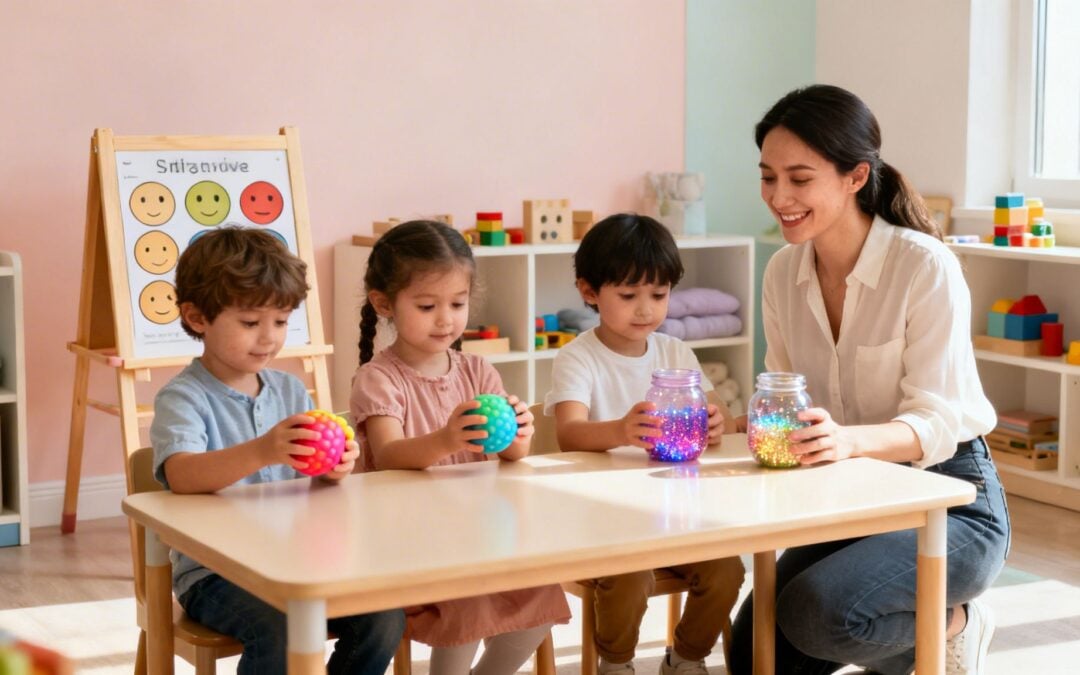
The fiery intensity of a preschooler's anger can be overwhelming for them and the adults who care for them. While meltdowns, stomping feet, and shouts of 'No!' are a normal part of development, they also present a crucial opportunity. This isn't just about stopping 'bad behavior'; it's about building the foundational skills of emotional intelligence that will support a child for a lifetime. Helping young children understand and manage their anger is one of the most important social-emotional learning (SEL) tasks they will face.
This guide moves beyond generic advice to provide eight specific, evidence-based, and playful anger management activities for preschoolers. Designed for both classroom and home settings, these strategies will equip educators and parents with practical tools to turn challenging moments into powerful lessons in self-regulation, empathy, and resilience.
You will learn how to implement actionable strategies such as:
- Creating a "Feelings Thermometer" for emotional check-ins.
- Teaching "Calm Down Breathing" through simple, memorable exercises.
- Building effective "Calm Corners" or sensory stations.
- Using picture books to discuss and normalize big feelings.
Each activity includes step-by-step instructions, materials lists, and specific language to use, making it easy to put these ideas into practice immediately. These are not just activities, but building blocks for creating an environment where every child feels understood and can learn to navigate their emotions constructively.
1. Feelings Thermometer Activity & Check-In Circles
Combining a visual feelings thermometer with regular check-in circles gives preschoolers a concrete tool and a structured routine to understand and manage their emotions. This two-part approach is one of the most effective anger management activities for preschoolers because it teaches emotional awareness and builds a supportive community simultaneously. The thermometer makes an abstract concept, the intensity of anger, visible and understandable for young children.
Check-in circles provide a safe, predictable space to practice using this new emotional vocabulary. By normalizing discussions about feelings, children learn that emotions are a normal part of life and that there are healthy ways to express them.
How It Works
A feelings thermometer is a visual scale, often color-coded, that helps a child identify the intensity of their emotions. It might range from blue (calm) at the bottom, to yellow (frustrated), orange (upset), and finally red (furious) at the top. The goal is to help children recognize when their feelings are starting to "heat up" before they reach the red zone.
Check-in circles are short, structured group gatherings where each child gets an opportunity to share how they are feeling using the thermometer as a guide. This routine builds empathy, listening skills, and a sense of belonging.
Key Insight: The power of this activity lies in the connection between the visual tool and the social routine. The thermometer gives children the language, and the circle gives them a safe place to use it.
Implementation Guide
- Objective: To help preschoolers identify the intensity of their anger and practice sharing their feelings in a supportive group setting.
- Materials: Large chart paper or poster board, markers, crayons, or paint in various colors (blues, greens, yellows, oranges, reds), optional clothespins or magnets with children's names.
- Step-by-Step:
- Create the Thermometer Together: Involve the children in making the feelings thermometer. Draw a large thermometer shape and assign colors to different feeling levels. Ask them, "What color feels calm? What color feels a little mad? What about very, very angry?" This co-creation builds ownership.
- Introduce the Concept: During a calm time, show them the thermometer. Say, "This is our Feelings Thermometer. When we are feeling great, we might be down here in the cool blue. Sometimes, things make us feel frustrated, and we start to warm up to yellow."
- Establish Circle Norms: Before the first check-in, set simple rules: "We listen with our ears and hearts," "It's okay to pass," and "What we share in the circle stays in the circle."
- Model and Practice: Begin the circle by modeling. "I'm feeling yellow today because I couldn't find my favorite pen. I am going to take a deep breath to help myself cool down." Then, go around the circle, inviting each child to share their "color" for the day. Keep it brief, just 5-10 minutes.
Tips for Success
- Practice When Calm: Introduce and practice using the thermometer when children are relaxed. Don't wait for a moment of intense anger to teach the tool.
- Use "Pass" Options: Always allow children the option to pass. Forcing a child to share can increase anxiety. A simple "pass" is a valid and respected choice.
- Home Adaptation: Families can use a smaller, portable thermometer on the fridge. During dinner or bedtime, ask, "What was your color today? What made you feel that way?" For example, a parent could say, "I felt yellow today when I was stuck in traffic, but now I feel blue because I am home with you."
This activity provides a foundational skill set for emotional self-regulation. To dive deeper into using visual aids, explore different types of charts and their benefits with our guide to using a feelings chart for kids.
2. Breathing and Mindfulness Exercises (Calm Down Breathing)
Teaching structured, age-appropriate breathing and mindfulness exercises gives preschoolers a powerful, portable tool for self-regulation. Techniques like "Bubble Breaths" or "Hot Chocolate Breathing" are exceptional anger management activities for preschoolers because they directly activate the body's relaxation response. These simple, playful exercises use visualization to help children calm their nervous systems when big feelings like anger start to take over.
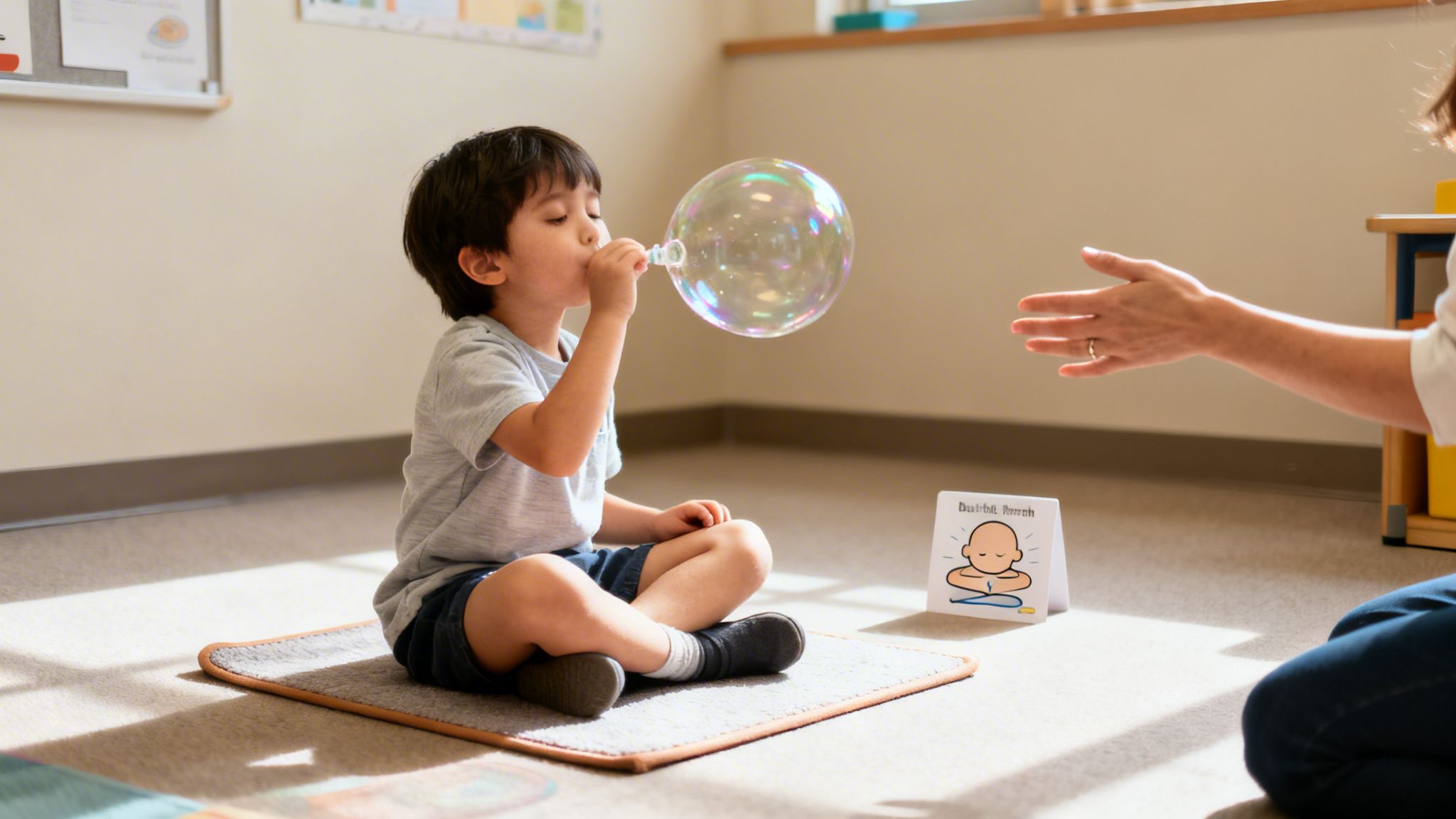
Unlike other strategies that require materials or specific locations, breathing is always available. By practicing these techniques during calm moments, children build the neural pathways needed to access this skill during times of stress, frustration, or anger. It empowers them with a sense of control over their bodies and emotions.
How It Works
Mindful breathing interrupts the body's fight-or-flight response, which is triggered by anger. Slow, deep breaths send a signal to the brain that the danger has passed, lowering the heart rate and allowing the prefrontal cortex-the thinking part of the brain-to come back online. Using child-friendly imagery makes this biological process accessible and engaging.
For example, "Flower and Candle" breathing involves pretending to smell a flower (deep inhale through the nose) and then blowing out a candle (slow exhale through the mouth). This gives children a concrete action to focus on, making the abstract concept of deep breathing easy to grasp.
Key Insight: The goal is not to stop anger but to give children a way to pause and create space between a feeling and a reaction. This pause is where self-control begins.
Implementation Guide
- Objective: To teach preschoolers simple, memorable breathing techniques to calm their bodies when they feel angry or overwhelmed.
- Materials: Optional visual aids like a real or toy flower, bubbles, or a picture of hot chocolate.
- Step-by-Step:
- Choose an Engaging Technique: Select a method with imagery that will appeal to your children. "Hot Chocolate Breathing" is a great start: "Let's pretend we have a big cup of hot chocolate. It's too hot to drink! First, smell the yummy chocolate (breathe in slowly through the nose). Now, cool it off (breathe out slowly through the mouth)."
- Model and Exaggerate: During a calm group time, model the exercise yourself. Make your inhales and exhales audible and your movements big. Say, "Watch me! I'm breathing in… 1, 2, 3… and now I'm blowing out… 1, 2, 3, 4, 5."
- Practice Together: Guide the children through three to five repetitions. Make it a fun, gentle game.
- Integrate into Routines: Practice for a few minutes daily, such as during morning circle, before transitions, or after active play. This routine makes the skill second nature.
Tips for Success
- Practice When Calm: The most critical tip is to introduce and practice these exercises when children are happy and relaxed. It's a skill that must be learned before it can be used in a moment of anger.
- Use Visual Cues: Use your hands to "hold" the imaginary hot chocolate or flower. For "Bubble Breaths," you can use a real bubble wand to show how a slow, steady exhale creates the best bubbles.
- Name the Feeling: When a child is upset, calmly say, "You look so frustrated. Your body is tight. Let's try our Hot Chocolate Breaths together to help your body feel calm again." This connects the technique directly to the feeling. For instance, if a child is crying because their block tower fell, you can get down to their level and say, "That is so sad and frustrating. I see your fists are clenched. Let's blow out some imaginary birthday candles to help those feelings move."
By making breathing exercises a playful and consistent part of their day, you are giving preschoolers a foundational life skill for emotional regulation. To explore a core technique in more detail, you can get practical tips from our guide on the belly breathing technique.
3. Anger Management Sensory Stations / Calm Corners
Creating a designated calm corner or sensory station gives preschoolers a safe, independent space to go when they feel overwhelmed by anger. This physical area, stocked with carefully chosen sensory tools, is one of the most effective anger management activities for preschoolers because it honors their individual sensory needs and empowers them to self-regulate. It moves the focus from punishment for big feelings to providing support for them.
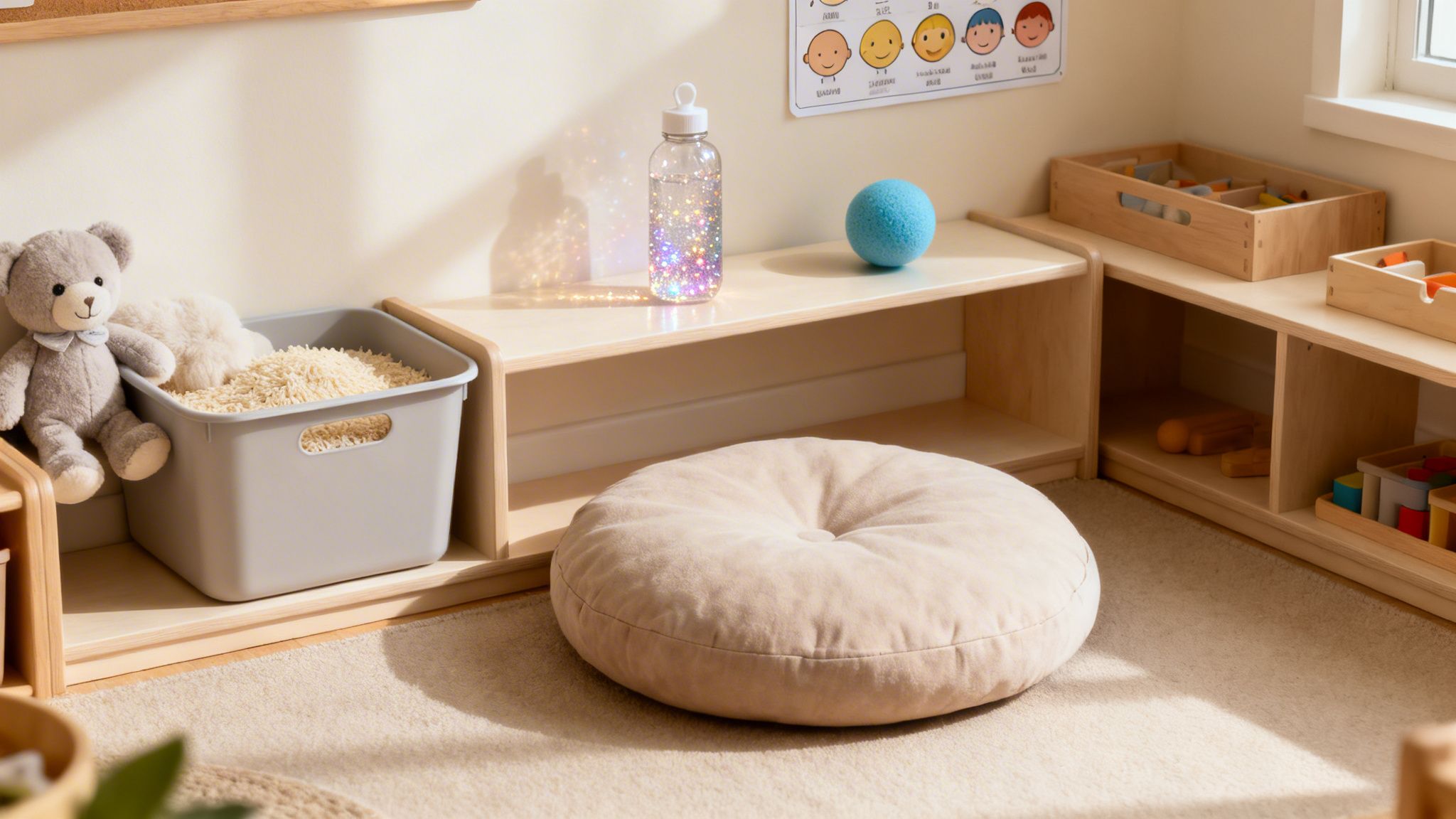
These spaces, often called 'peace corners' in Montessori schools, offer a multisensory approach that addresses diverse regulatory styles. One child may need to squeeze a stress ball (proprioceptive input), while another may need to watch a glitter jar settle (visual input). Providing these options gives children agency and teaches them a critical life skill: how to recognize what their body needs and take action to feel better.
How It Works
A calm corner is not a "time-out" spot; it is a "time-in" space for self-regulation. It is a quiet, comfortable area in the classroom or home filled with tools that help a child's nervous system return to a state of calm. The items provide tactile, visual, auditory, and proprioceptive input that can de-escalate feelings of frustration, overstimulation, and anger.
The goal is for children to learn to recognize their rising anger and voluntarily use the space to manage their emotions before they become explosive. For example, a child who feels themselves getting "hot" might choose to go to the corner and knead play-doh, redirecting their physical energy in a safe way.
Key Insight: This activity teaches children that their big feelings are acceptable and that they have the power to manage them. The corner is a tool, not a punishment, which builds internal motivation for self-regulation.
Implementation Guide
- Objective: To provide a safe, accessible space with sensory tools that help preschoolers self-soothe and manage feelings of anger independently.
- Materials: A soft rug or cushion, a small tent or canopy for privacy, and a variety of sensory items like: squishy balls, play-doh, sensory bins (with rice or beans), glitter jars, headphones with calming music, soft blankets, and textured books.
- Step-by-Step:
- Co-Create the Space: Involve the children in designing the corner. Let them help pick the spot and decorate it. Ask, "What things help you feel calm? What colors feel peaceful?" This builds ownership and makes the space more inviting.
- Introduce During Calm Times: Present the calm corner as a special, wonderful place. During a circle time, say, "This is our new Calm Corner! It's a place we can go when our bodies feel too busy or our hearts feel upset." Let them explore the items freely when they are relaxed.
- Model and Role-Play: Demonstrate how to use the space. You might say, "I'm feeling a little frustrated because my blocks fell over. I think I'll go to the calm corner and look at the glitter jar to help my body feel better." Role-play a scenario: "Let's pretend Leo is feeling angry because it's time to clean up. What could Leo do in the calm corner to help his body feel ready?"
- Guide, Don't Force: When you see a child struggling, gently suggest the corner. "You seem upset. Would you like to go to the calm corner and squeeze the squishy ball for a few minutes?"
Tips for Success
- Rotate the Items: Keep the station engaging by rotating the sensory tools every few weeks. Novelty prevents boredom and encourages exploration.
- Label with Pictures: For pre-readers, use picture labels on bins and shelves. This helps them find what they need independently and builds pre-literacy skills.
- Observe and Adapt: Pay attention to which items children use most. If everyone loves the play-doh but ignores the textured books, swap the books for something else.
- Home Adaptation: A calm corner at home can be as simple as a basket of sensory toys in a quiet part of a room. Parents can say, "Let's take a break with your calm basket," when they notice frustration building during playtime. For example, before a tantrum over screen time ending, a parent could say, "I know you're sad the show is over. Let's go to your calm corner and build with the magnetic tiles for five minutes."
Sensory stations are powerful because they directly address how a child’s brain and body experience stress. To explore this connection further, see how you can apply these principles with a simple 5 senses activity that helps ground children in the present moment.
4. Angry Feelings Picture Books and Bibliotherapy
Using picture books to explore big emotions, a practice known as bibliotherapy, is a gentle yet powerful anger management activity for preschoolers. Stories provide a safe distance for children to observe characters who are feeling angry, which normalizes the emotion and models a variety of coping strategies. This approach builds emotional vocabulary, empathy, and problem-solving skills in a low-pressure, engaging way.
When a child sees a beloved character like Sophie from When Sophie Gets Angry feel overwhelmed, it validates their own feelings. Discussing the story afterward helps them connect the character's experience to their own life, giving them language for their emotions and ideas for what to do when they feel that "roaring, red-hot" anger.
How It Works
Bibliotherapy for young children involves reading a story that features a specific emotional challenge and then facilitating a discussion that helps them process it. The narrative acts as a mirror, reflecting the child's own potential feelings, and as a window, showing them how others might handle similar situations. This process turns a simple storytime into a meaningful social-emotional learning opportunity.
By asking thoughtful questions, you guide children to think critically about emotions and behavior. This is not about finding the "right" answer but about exploring possibilities. For instance, you can discuss what a character did, what else they could have tried, and how their actions affected others.
Key Insight: Stories create a "third space" where children can talk about a character's anger without feeling the shame or pressure of talking directly about their own. This makes it a perfect entry point for discussing difficult emotions.
Implementation Guide
- Objective: To use children's literature to normalize anger, teach emotional vocabulary, and model healthy coping strategies.
- Materials: A curated selection of age-appropriate books about anger, such as When Sophie Gets Angry by Molly Bang, The Color Monster by Anna Llenas, or In My Heart: A Book of Feelings by Jo Witek.
- Step-by-Step:
- Select a Relevant Book: Choose a book that depicts anger in a relatable way. Ensure the illustrations and story are clear and not overly frightening.
- Read with Intention: Read the story once through for enjoyment. On a second or third reading, pause at key moments. Use your tone of voice to match the character's feelings to make the emotion more tangible. For example, when reading about a character getting angry, you might speed up your words and speak a little louder, then slow down and soften your voice as they calm down.
- Ask Open-Ended Questions: After reading, start a conversation. Ask questions like, "How do you think the little bear was feeling on this page? What made him so angry?" and "What did he do to calm down? Have you ever tried that?"
- Connect to Their World: Bridge the story to their own lives. Say, "I remember you felt frustrated yesterday when the blocks fell over. The rabbit in our story also got frustrated. What could we do next time that happens?"
- Act It Out: Use dramatic play to re-enact scenes. Let children take on the role of the angry character and practice the coping strategy from the book, like taking a deep breath or finding a quiet corner.
Tips for Success
- Repeat and Revisit: Preschoolers thrive on repetition. Reading the same book multiple times allows for deeper understanding and new conversations as they become more familiar with the story.
- Choose Diverse Books: Select books that show a range of characters from different backgrounds and feature various coping strategies, from physical actions like stomping feet to quiet activities like drawing.
- Create a "Cozy Corner Library": Designate a small, comfortable area in the classroom or home with a basket of "feelings books" that children can access independently when they need a moment.
- Home Adaptation: Send books home on a rotating basis with a simple activity sheet. A prompt like, "Talk about a time you felt like the grumpy squirrel. Draw what helped you feel better," can involve families in the learning process.
5. Movement and Physical Activity for Anger Release
When a preschooler feels angry, their body often fills with a surge of physical energy. Structured movement is one of the most effective anger management activities for preschoolers because it provides a safe, constructive way to release this energy. Instead of suppressing the physical sensations of anger, activities like dancing, jumping, or stomping help children channel them into productive motion.
This approach teaches children that the physical feelings of anger are normal and manageable. By giving them a designated way to "get the wiggles out," we help them process stress hormones and connect with their bodies without resorting to hitting, kicking, or other aggressive behaviors.
How It Works
Structured physical activity gives anger a job to do. When a child feels overwhelmed, their fight-or-flight response is activated. Vigorous movement helps complete this stress cycle, allowing their nervous system to return to a calmer state. Activities like a designated "angry dance," stomping walks, or squeezing a foam ball provide immediate physical and sensory feedback.
Following these high-energy moments with a calming cool-down, such as stretching or deep breathing, teaches a crucial self-regulation skill: how to shift from a state of high arousal to one of rest and recovery. This helps build the mind-body connection.
Key Insight: Movement doesn't just burn off energy; it helps a child's brain and body process the physiological experience of anger, turning a potentially destructive impulse into a constructive action.
Implementation Guide
- Objective: To provide a safe and acceptable physical outlet for the energy that accompanies anger, and to teach children how to transition from high energy back to a calm state.
- Materials: Energetic music, open space, soft objects (pillows, foam balls, stuffed animals), optional obstacle course items (cushions, hula hoops).
- Step-by-Step:
- Introduce the Concept: During a calm moment, explain the idea. Say, "Sometimes our bodies feel full of angry energy, like a shaken-up soda bottle. It’s okay to feel that way! We can do a 'Stomping Walk' or an 'Angry Dance' to let that energy out safely."
- Designate a Safe Space: Identify an area where vigorous movement is okay, like a corner with soft mats, an outdoor space, or a clear area in a room. This boundary is crucial for safety.
- Model the Movements: Demonstrate specific, acceptable actions. Show them how to stomp their feet like a dinosaur, punch a pillow, or jump up and down. Frame it positively: "Let’s help our bodies get the mad feelings out!"
- Practice and Cool Down: Turn on some upbeat music for a short "energy release" session. After a minute or two of vigorous activity, transition to slower, calmer music and lead them through cool-down stretches or breathing exercises. For example, after an "angry dance," say, "Great dancing! Now let's pretend we are melting ice cream. Slowly, slowly, let's melt all the way to the floor."
Tips for Success
- Frame as Healthy, Not Punitive: Never present movement as a punishment (e.g., "Go run until you calm down"). Instead, use inviting language like, "Your body has a lot of energy right now. Let's go to the movement spot and let it out together."
- Integrate into Routines: Use short movement breaks during transitions, which can be challenging times for preschoolers. A quick session of jumping jacks can preempt frustration.
- Home Adaptation: Parents can create an "energy release kit" with a soft foam ball to squeeze and a special playlist for "dance it out" moments. For example, engaging in various motor skills activities for preschoolers can provide a healthy outlet for pent-up energy and help improve coordination, which can indirectly aid in self-regulation.
6. Creative Art Expression and Anger Artwork
Creative art expression provides a powerful nonverbal outlet for preschoolers to process anger. Open-ended art activities like painting, drawing, or sculpting allow children to externalize big feelings in a safe, tangible way. This makes it one of the most effective anger management activities for preschoolers, as it validates their emotions without needing complex vocabulary and produces a concrete artifact they can reflect on later.

This method helps children channel their physical energy and emotional intensity into a creative act. Instead of suppressing anger or acting it out destructively, they learn to transform it. The focus is on the process of creation, not the final product, giving them a healthy and constructive way to explore what they are feeling.
How It Works
This activity works by connecting physical action to emotional release. The vigorous brush strokes of painting, the forceful squeezing of clay, or the quick, sharp lines of a crayon drawing can mirror the physical sensations of anger. This tactile and visual process helps externalize the emotion, making it feel less overwhelming and more manageable.
Creating "anger artwork" allows a child to give their feeling a shape, color, and form. Afterward, the artwork can serve as a talking point. A teacher or parent can ask gentle, open-ended questions about the piece, helping the child build a narrative around their experience and connect their feelings to the events that caused them.
Key Insight: The value of anger artwork is not in its aesthetic quality but in its function as a bridge between a nonverbal emotional experience and verbal processing. It gives a child something concrete to point to and say, "This is what my anger looks like."
Implementation Guide
- Objective: To provide a nonverbal, physical, and creative outlet for preschoolers to express and process feelings of anger.
- Materials: Washable tempera paints, large sheets of paper, thick brushes, modeling clay or play-doh, chunky crayons or markers, collage materials (scrap paper, fabric scraps, glue sticks).
- Step-by-Step:
- Set Up an Invitation: Create an inviting art station, perhaps in a calm-down corner or a designated art area. Lay out the materials on an easel or a covered table.
- Offer Minimal Direction: When a child is feeling angry or frustrated, guide them to the art station. Say something simple like, "It looks like you have some big feelings. Would you like to paint your anger?" or "Here is some clay you can squeeze and pound."
- Allow for Free Expression: Let the child lead the way. Avoid giving instructions like "Use this color" or "Draw a picture of what happened." The goal is pure, unfiltered expression. Vigorous, messy, and bold actions are welcome and part of the process.
- Engage After Creation: Once the child seems calmer and has finished their artwork, open a gentle dialogue. Ask, "Can you tell me about your art?" or "What's happening in this picture?" For example, if they used a lot of red, you might say, "I see a lot of powerful red here. That looks like a very strong feeling."
Tips for Success
- Embrace Boldness: Use large paper and provide thick paints and brushes to encourage big, physical movements. Don't worry about the mess; focus on the expression.
- Offer Texture Variety: Different textures appeal to different children. Some may find squeezing clay more satisfying, while others prefer the smooth glide of paint. When encouraging preschoolers to express their anger through art, consider incorporating structured yet flexible creative art projects for preschoolers.
- Home Adaptation: Designate an "angry art" box at home with special crayons or a specific notepad. When a child is upset, they can go to their box. Families can also keep a portfolio of this artwork to look back on, noticing patterns or progress over time.
7. Positive Discipline and Restorative Practices Conversations
Shifting the focus from punishment to learning, restorative conversations are a cornerstone of positive discipline. This approach guides preschoolers through their big feelings after an outburst, helping them understand the situation, their emotions, and the impact of their actions on others. It is one of the most meaningful anger management activities for preschoolers because it teaches accountability, empathy, and problem-solving skills instead of simply punishing a behavior.
These conversations are not about blame but about repair. By creating a safe space for reflection, adults help children connect their feelings to their actions and discover more constructive ways to handle anger in the future. This method builds a child's internal moral compass and strengthens the parent-child or teacher-child relationship.
How It Works
Positive discipline and restorative practices use guided, curious questioning to help a child process an anger-driven incident after they have calmed down. Instead of asking "Why did you do that?", which can feel accusatory, the focus is on understanding and healing. The conversation moves from what happened to how everyone felt, what was needed, and how to make things right.
This method transforms conflict into a teachable moment. For example, after a conflict over a toy, a restorative conversation helps both children express their feelings and work together on a solution, such as taking turns or finding another toy.
Key Insight: The goal is connection before correction. By validating the child's anger ("It's okay to feel mad") while setting a boundary on the action ("but it's not okay to hit"), you teach that all feelings are acceptable, but not all behaviors are.
Implementation Guide
- Objective: To help preschoolers reflect on their anger, understand its impact on others, and learn how to repair relationships and solve problems constructively.
- Materials: A quiet, private space; a calm and regulated adult.
- Step-by-Step:
- Wait for Calm: Never initiate a restorative conversation in the heat of the moment. Wait until the child is completely calm and regulated. This might be 10 minutes or an hour later.
- Find a Private Space: Choose a neutral, comfortable setting where you won't be interrupted. Sit at the child's level to create a feeling of safety and respect.
- Start with Curiosity: Begin with an open, non-judgmental tone. Say something like, "I saw what happened earlier and wanted to check in. Can you tell me about it?"
- Use Guided Questions: Gently guide the child through reflection with key restorative questions:
- "What happened?" (Let them tell their story.)
- "What were you feeling right before that happened?" (Helps connect feeling to action.)
- "How do you think [the other person] felt when that happened?" (Builds empathy.)
- "What can we do to make things better?" (Promotes accountability and repair.)
- Brainstorm and Co-create Solutions: Help the child think of a way to make amends. This could be a hug, a drawing, helping to fix a broken toy, or simply saying, "I'm sorry I pushed you. Can we play?"
Tips for Success
- Validate the Emotion: Always start by acknowledging the feeling. "I can see you were very angry when your block tower fell down." This shows the child they are understood.
- Focus on Repair, Not Punishment: The outcome should be about fixing the harm done, not about a punitive consequence. The natural consequence is having to repair the relationship. For example, if a child scribbled on their sibling's drawing out of anger, the repair isn't a time-out; it's helping their sibling make a new drawing.
- Model the Process: When you, as the adult, make a mistake, model a restorative apology. "I'm sorry I raised my voice. I was feeling frustrated. Next time, I will take a deep breath."
This approach helps children build essential life skills. To see how these principles are applied in group settings, you can learn more about how to implement restorative circles in schools.
8. Family Engagement and Home-School Consistency Strategies
Creating a united front between home and school is a powerful strategy for reinforcing emotional learning. When parents and caregivers use the same anger management language and tools as educators, it provides a consistent, predictable environment for preschoolers. This approach validates a child's learning by showing that these skills are important everywhere, not just in the classroom.
This alignment transforms isolated lessons into a shared culture of emotional awareness. It empowers families to become active partners in their child's social-emotional development, extending the benefits of anger management activities for preschoolers far beyond school hours and building a stronger community around the child.
How It Works
Home-school consistency involves equipping parents with the same knowledge, vocabulary, and strategies used in the classroom. This is achieved through a variety of resources, such as parent workshops, take-home toolkits with printable breathing cards, and regular communication that shares specific techniques.
When a child learns to use a "calm-down corner" at school, a similar space at home reinforces the strategy. If a teacher uses the phrase "I see you're in the red zone, let's take a dragon breath," and a parent uses the same phrase later that day, the child's brain makes a stronger connection, making the skill easier to access during a moment of anger.
Key Insight: Consistency is the bridge that turns a classroom activity into a life skill. When a child hears the same emotional language at home and school, the concepts become deeply ingrained and more accessible during moments of high emotion.
Implementation Guide
- Objective: To create a consistent emotional support system for preschoolers by aligning the strategies used at home and school, reinforcing emotional regulation skills.
- Materials: Printable resources (e.g., feeling thermometers, breathing exercise cards), parent newsletters, digital communication apps, workshop presentation materials.
- Step-by-Step:
- Host Family Workshops: Offer workshops that teach parents the core anger management strategies you use. Cover topics like co-regulation, validating feelings, and setting up a "peace corner" at home. Offer them at various times (mornings, evenings) to accommodate different schedules.
- Create 'Take-Home Toolkits': Assemble simple kits for families. Include a laminated feelings chart, a few illustrated breathing technique cards, and a one-page guide explaining how to use them.
- Establish a Communication Rhythm: Send a weekly or monthly newsletter. Each edition can highlight one specific strategy, such as "This week, we are practicing 'smelling the flower, blowing out the candle' breaths when we feel frustrated."
- Use a Home-School Log: For children needing extra support, a simple communication log can be very effective. A teacher might note, "Sam used the glitter jar to calm down today," giving the parent a specific success to build on at home. The parent could write back, "We practiced our hot chocolate breathing at bedtime, and it worked well!"
Tips for Success
- Keep it Simple: Parents are busy. Provide tools that are easy to understand and can be used immediately without much preparation. One-page guides are more likely to be used than lengthy handbooks.
- Celebrate Parent Efforts: Acknowledge and praise parents for their partnership. Create a parent support group or a section in the newsletter where families can share what's working for them.
- Provide Accessible Materials: Offer all resources in multiple languages and consider different literacy levels. Use visuals and videos to convey concepts whenever possible. For an example of how to build a comprehensive program, see how Soul Shoppe's family engagement model supports schools.
Preschool Anger Management: 8-Strategy Comparison
| Intervention | Implementation complexity | Resource requirements | Expected outcomes | Ideal use cases | Key advantages |
|---|---|---|---|---|---|
| Feelings Thermometer Activity & Check-In Circles | Moderate — needs routine and skilled facilitation | Low–Moderate — visual tools, regular time block | Better emotional identification, early intervention, stronger classroom community | Daily morning meetings, preschool classrooms, family check-ins | Concrete visual scale; builds shared language and belonging |
| Breathing and Mindfulness Exercises (Calm Down Breathing) | Low–Moderate — requires modeling and practice | Minimal — time, optional audio/video | Immediate calming, improved self-regulation, increased body awareness | Transitions, individual practice, group calming moments | Evidence-based, immediately accessible without props |
| Anger Management Sensory Stations / Calm Corners | Moderate — setup, supervision, and maintenance | Moderate — sensory items, dedicated space, upkeep | Independent regulation, accommodates sensory needs, quick de-escalation | Classrooms with diverse sensory profiles, calm-down needs | Choice and autonomy; multisensory regulation options |
| Angry Feelings Picture Books and Bibliotherapy | Low — select texts and facilitate discussion | Low — books and discussion time | Expanded emotional vocabulary, empathy, normalized feelings | Read-alouds, circle time, library or counseling sessions | Story-based learning creates safe distance to explore emotions |
| Movement and Physical Activity for Anger Release | Moderate — requires structure, safety and transitions | Moderate–High — space, equipment, supervision | Reduced physiological arousal, energy release, improved mood | Outdoor play, brain breaks, high-energy de-escalation moments | Directly addresses bodily sensations; highly engaging |
| Creative Art Expression and Anger Artwork | Low–Moderate — materials prep and brief processing | Moderate — art supplies, dedicated area, cleanup | Nonverbal expression, tactile processing, artifacts for reflection | Art sessions, calm corners, therapeutic follow-ups | Accessible to nonverbal learners; fosters agency and expression |
| Positive Discipline and Restorative Practices Conversations | High — needs trained facilitators and timing post-incident | Low–Moderate — time, trained staff | Accountability, relationship repair, improved problem-solving | Post-incident debriefs, conflict resolution, relationship rebuilding | Promotes repair over punishment; builds empathy and responsibility |
| Family Engagement and Home-School Consistency Strategies | High — coordination, outreach, sustained follow-through | High — staff time, workshops, materials, translation | Greater consistency of strategies, extended learning, stronger partnerships | Whole-school SEL initiatives, vulnerable families, scaling programs | Amplifies impact across environments; empowers caregivers to reinforce skills |
Building a Community of Calm and Connection
Guiding preschoolers through the powerful emotion of anger is one of the most fundamental tasks we undertake as educators, administrators, and caregivers. The collection of anger management activities for preschoolers detailed in this article-from building a Feelings Thermometer to engaging in restorative conversations-is not about suppressing a "bad" emotion. Instead, it’s about building a robust emotional vocabulary and a toolkit of healthy coping mechanisms that will serve children throughout their entire lives.
The journey to emotional regulation is a marathon, not a sprint. Consistency and patience are your most important allies. A single breathing exercise or one session in a Calm Corner will not instantly resolve every outburst. True progress comes from embedding these practices into the daily rhythm of the classroom and home, creating a predictable and safe environment where all feelings are acknowledged and validated.
From Individual Skills to a Shared Culture
The real power of these strategies is unlocked when they move beyond isolated activities and become part of a shared culture. When a teacher uses the same "Calm Down Breathing" technique that a parent reinforces at home, the child receives a unified message of support. This consistency is critical for preschoolers, who thrive on predictability.
Consider the ripple effect:
- A child who learns to identify their anger level on a Feelings Thermometer can ask for help before an explosive moment, preventing disruption and building self-awareness.
- A classroom that regularly uses bibliotherapy with stories about anger normalizes the feeling, reducing shame and encouraging open discussion among peers.
- A school that adopts restorative practices shifts the focus from punishment to understanding, teaching children that their actions have an impact and giving them a chance to make things right.
This collective approach transforms a set of individual anger management activities for preschoolers into a community-wide commitment to emotional well-being. It sends a clear message to children: "Your big feelings are welcome here, and we will help you learn how to handle them."
The Long-Term Impact of Early Intervention
The skills children develop through these activities extend far beyond managing tantrums. They are laying the foundation for critical life competencies. A preschooler who can take a deep breath instead of hitting is learning impulse control. A child who uses "I feel…" statements is practicing assertive communication. A student who participates in a restorative circle is developing empathy and problem-solving skills.
Key Takeaway: The goal is not to raise children who never get angry. The goal is to raise children who know what to do with their anger. We are equipping them to face future challenges-disagreements with friends, academic frustrations, and personal disappointments-with resilience and emotional intelligence.
By intentionally teaching these skills, we are proactively building a more compassionate and connected school community. Children who feel understood and have the tools to manage their emotions are better learners, kinder friends, and more engaged citizens of the classroom. This work is the bedrock of creating a positive school climate, reducing behavioral issues, and fostering an environment where every child can thrive academically and socially. The investment you make today in teaching these foundational skills will pay dividends for years to come, shaping more empathetic and self-aware adults.
Ready to bring a structured, school-wide approach to social-emotional learning into your community? Soul Shoppe provides the programs, training, and resources that turn these powerful anger management activities for preschoolers into a cohesive and sustainable culture of peace. Explore our evidence-based programs and see how we can help you build a safer, more connected school at Soul Shoppe.