

Your Guide to Using a Feelings Chart for Kids
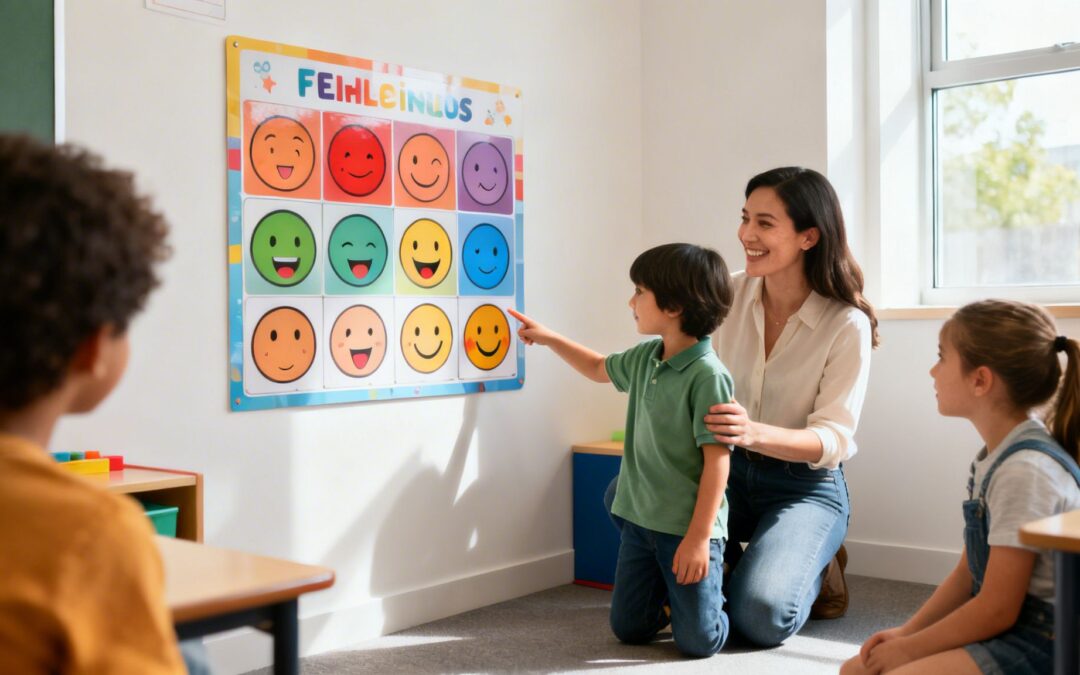
A feelings chart for kids is one of the simplest, most effective tools in the social-emotional learning (SEL) toolkit. You've probably seen them—posters with faces showing a range of emotions, from happy and excited to sad and frustrated. But they're so much more than just a piece of classroom decor.
A good feelings chart gives children a concrete way to identify, name, and begin to understand their own complex emotions. It provides a shared language for those big, messy internal experiences that can be so hard to put into words.
More Than a Poster: Why Feelings Charts Work
Think of a feelings chart as a bridge. It connects what a child is feeling on the inside to something tangible they can see, point to, and talk about. This simple act of giving an emotion a name and a face is a game-changer for building emotional intelligence.

When a child can match their internal storm to a word like "disappointed" or "worried," they take the first crucial step toward self-awareness. That feeling is no longer a scary, overwhelming force. It’s something real that can be understood and, eventually, managed.
Giving Kids the Words for Their Feelings
Imagine a first-grader with clenched fists and a scowl. They can't explain why they're upset. Maybe a friend didn't want to play, or they're struggling with a math problem. Without the right words, that frustration just builds.
This is where the feelings chart comes in.
By gently guiding them to the chart, you can ask, "Can you show me which face looks like how you feel right now?" This one question opens the door. It helps the child shift from a reactive state of distress to a more expressive one. They're no longer just feeling the anger; they are starting to understand it.
The goal isn't just to get a label for the feeling—it's to validate it. When we acknowledge an emotion, we're telling a child, "What you're feeling is real, it's okay, and we can figure this out together." This builds the trust and psychological safety every child needs.
This growing vocabulary empowers kids to advocate for themselves. A child who once might have pushed or cried can begin to say, "I feel sad because I miss my mom," or "I'm worried about the assembly." You can learn more about naming feelings to help kids find the words they need in our dedicated guide.
Building a Foundation for Empathy and Self-Regulation
The benefits don't stop at self-awareness. When children get comfortable recognizing their own emotions, they get better at spotting them in others, too. This is the very foundation of empathy. They start to realize that their friends also have a rich, complex inner world.
For example, a teacher might say, "Leo pointed to 'frustrated' on our chart. Has anyone else ever felt frustrated when their block tower fell down?" This simple question helps other children connect Leo's experience to their own, building a shared emotional understanding.
This skill is absolutely vital for building a kind and connected community, whether at home or in the classroom. It's a bit startling, but recent studies suggest only about 36% of people globally score high in emotional intelligence. This highlights just how important it is to start early with simple tools like a feelings chart.
By building this foundational skill, we’re not just managing today's behavior—we're equipping kids for a lifetime of healthier relationships and greater well-being. You can explore the latest global findings on child well-being to see just how critical these early skills are.
Creating a Feelings Chart That Kids Will Actually Use
For a feelings chart to be more than just wallpaper, it needs to feel alive and relevant to a child. A generic, downloaded poster might work in a pinch, but the charts that truly make a difference are the ones kids feel a real connection to.
So, how do we create a feelings chart that children will be genuinely excited to use?

The secret is surprisingly simple: involvement. When children are part of the creation process, they develop a sense of ownership. It becomes their tool, not just another poster the adults put up.
Tailor Emotions to the Right Age
The first move is to choose emotions that match your kids' developmental stage. A chart that’s too simple will bore older kids, while one that’s too complex will just overwhelm the younger ones.
- For Early Years (Ages 3-6): Start with the absolute basics. Stick to 4-6 core emotions that are easy to spot and happen often. Think happy, sad, mad, and surprised. The goal here isn't a huge vocabulary; it's about introducing the foundational language of feelings.
- For Lower Elementary (Ages 7-9): Now you can start expanding their emotional world. Bring in more nuanced feelings like proud, frustrated, worried, and excited. Kids at this age are starting to grasp that they can feel more than one thing at a time, and your chart can begin to reflect that complexity.
- For Upper Elementary (Ages 10-12): Older kids are ready for even more sophisticated words. You can introduce concepts like anxious, overwhelmed, lonely, jealous, and hopeful. For this group, a simple chart might evolve into a "mood meter" or a feelings wheel that shows a wider range of emotional states.
For more ideas on how to build this vocabulary, our guide on teaching emotional vocabulary for kids has some great games and tools.
Go Beyond Basic Emojis
Visuals are the heart of any feelings chart, but they don't have to be limited to yellow smiley faces. In fact, the more personal and relatable the images are, the better.
A key insight from working with children is that they connect deeply with authenticity. Using photos of real human faces—or even their own—makes the concept of emotions feel much more real and less abstract than a cartoon character.
Here are a few powerful alternatives to consider:
- Use Photographs of the Kids: With permission, of course, hold a "feelings photoshoot." Ask each child to show you their best "surprised face" or "frustrated face." Print these to create a chart that’s a true reflection of your specific group.
- Draw Your Own Faces: Turn it into an art project. Give each child a paper plate and an emotion to illustrate. This kind of collaborative work builds community and gets buy-in from every single child.
- Cutouts from Magazines: For a fun collage activity, have kids look through old magazines to find pictures of people showing different emotions. This sparks incredible conversations about how we read feelings in others' body language and facial expressions.
Get Creative with the Design
The format of the chart itself can be a game-changer. A static poster is good, but a dynamic, interactive tool is even better. This invites children to physically engage with the chart, turning the emotional check-in into an active experience rather than a passive one.
Here are a few practical examples to get your ideas flowing:
Feelings Thermometer
A "feelings thermometer" is a fantastic way to help kids visualize emotional intensity.
- Example for a 2nd Grade Classroom: Draw a large thermometer on poster board. Label the bottom "Cool & Calm" (in blue), the middle "Getting Warm" (yellow/orange), and the top "Hot & Angry" (red). Students can move a clothespin with their name up or down to show where they are, which helps them notice when their big feelings are starting to escalate.
Feelings Wheel with Clothespins
This design is perfect for helping children pinpoint a specific feeling with more accuracy.
- Example for a Home Setting: Make a wheel from a paper plate and divide it into wedges for different feelings like 'Peaceful,' 'Silly,' 'Worried,' and 'Disappointed.' Your child can clip a clothespin to the feeling that best describes their state, creating a natural and easy opening for a conversation.
Weaving the Feelings Chart into Your Daily Routine
A feelings chart hanging on the wall is a great start, but it's just a poster until you breathe life into it. Its real magic unfolds when it becomes a living, breathing part of your daily rhythm—as automatic as grabbing a snack or starting a lesson.
This isn’t about adding another task to your already full plate. It's about finding natural moments to connect and make checking in on emotions a normal, everyday habit. When you do that, the chart stops being just a piece of paper and becomes a powerful tool for building emotional awareness.
Creating Predictable Check-in Times
The secret to making the chart a habit is to build it into moments you already have. For kids, routines create safety, and a safe-feeling child is far more likely to open up and share what’s really going on inside.
For teachers, the morning check-in is a perfect opportunity.
- Here’s how it looks: As students come into the room and unpack, they can move a clothespin with their name to the feeling that fits their morning. One child might place their pin on "tired" after a restless night, while another puts it on "excited" for a friend's birthday party. This gives you a quiet, immediate snapshot of your classroom’s emotional temperature without ever putting a single child on the spot.
For parents, an after-school check-in can become a treasured ritual.
- Here’s how it looks: As you’re both unpacking backpacks and settling in with a snack, you can simply ask, “Let’s see where our feelings landed after today.” A child might point to "proud" for acing a math quiz or "lonely" because recess was tough. This small gesture cracks the door open for bigger conversations about their day.
These simple, consistent touchpoints normalize talking about feelings. If you're looking for more ideas on building these kinds of structures, our guide on how effective routines for kids can help them feel emotionally grounded is a great resource.
Guiding Kids to the Chart in Real Time
Beyond your planned check-ins, some of the most powerful moments to use a feelings chart will be the unplanned ones—right when big emotions are bubbling over. The trick is to approach these moments with curiosity, not as a chance to discipline.
Instead of a reactive, "Stop crying!" try gently guiding them toward the chart. You can say something like, "Wow, that looks like a really big feeling. Can you show me on the chart what's happening inside you right now?"
This simple pivot does two amazing things at once:
- It co-regulates. Your calm focus on the chart helps soothe their activated nervous system.
- It empowers. You're giving them a tool to communicate when their words are lost in the emotional storm.
The most important rule of thumb? The chart must always be a safe, judgment-free zone. It’s a tool for understanding, not for correction. If a child points to "angry" or "jealous," the right response is always one of validation: "Thank you for showing me you feel frustrated. I get it."
This approach transforms a meltdown into a teachable moment, helping kids learn to identify and handle their feelings before they become overwhelming.
Connecting the Chart to Positive Outcomes
Using a feelings chart consistently does far more than just help a child name an emotion. It's a foundational skill in emotional intelligence (EI) that has a direct, measurable impact on their behavior and even their academics.
Research has shown that teaching EI with tools like feelings charts can dramatically reduce aggression and boost a child's chances of success in school. One study of over 400 primary students discovered a direct link between higher emotional intelligence and lower aggressive behaviors. In fact, the children with the highest EI scores showed 35% lower aggression rates.
For example, a school that implements a daily feelings check-in might see a drop in playground conflicts. A student who can identify feeling "annoyed" can then use a calm-down strategy, like taking five deep breaths, instead of shoving the person who cut in line. This proactive self-regulation, learned through the chart, directly reduces aggressive incidents.
This happens because naming an emotion is the first step toward taming it. A child who can point to "angry" is less likely to express that anger by hitting or yelling. This skill also pays off in the classroom, as children with higher EI have been found to have 25% better attention spans and form 40% more positive peer relationships. You can read the full research about these emotional intelligence findings and their impact on student behavior.
From Naming Feelings to Building Real Resilience
It’s a huge win when a child can confidently point to the "angry" or "sad" face on a feelings chart. That’s a massive step in self-awareness. But that’s only half the battle.
The real magic happens when we teach them what to do with that big, powerful emotion. This is how a simple feelings chart transforms from an identification tool into a powerful engine for problem-solving and resilience. The goal is to connect their feeling to an underlying need, empowering them to see emotions as helpful messengers, not something to be pushed away.
Connecting Feelings to Needs and Actions
When a child shares a big feeling, they’re opening a door for connection. By responding with gentle curiosity instead of judgment, you help them forge the neural pathways for self-regulation. You guide them from simply saying, "I feel," to discovering, "I need."
Here’s what this can look like in the moment:
- When a child indicates 'Angry': "I see you're feeling angry. Thank you for showing me that. It looks like your fists are tight, too. Do you need a minute alone in the calm-down corner, or would you like to try that tough puzzle again with my help?"
- When a child points to 'Sad': "You're feeling sad today. I'm so sorry you feel that way. Would a hug help right now, or would you rather draw a picture about what’s making you sad?"
- When a child shows they're 'Worried': "It's okay to feel worried. I see you’re pointing to that feeling. Is it about the test later? Do you want to take five deep 'dragon breaths' with me, or would looking at our schedule help you know what's coming next?"
This simple framework validates what they feel and shows them they have the power to take positive action. It’s a core component of building resilience in students through SEL and activities.
This simple routine can help you weave these check-ins into the fabric of your day.

These consistent touchpoints create a predictable structure where kids can safely practice moving from identifying an emotion to managing it constructively.
To make this even more concrete, we've found it helps to explicitly link common feelings to healthy coping strategies. The right strategy often depends on a child's developmental stage.
Pairing Feelings with Healthy Coping Strategies
| Feeling | What It Might Look Like | Healthy Coping Strategy (K-3) | Healthy Coping Strategy (4-8) |
|---|---|---|---|
| Angry | Clenched fists, scowling, raising voice, stomping feet | Squeezing a stress ball, ripping up paper, stomping on bubble wrap | Punching a pillow, doing 10 jumping jacks, writing an "angry letter" (and tearing it up) |
| Sad | Crying, withdrawing, low energy, drooping shoulders | Asking for a hug, snuggling with a soft blanket or stuffed animal, looking at a happy picture | Listening to music, talking to a trusted friend or adult, journaling about their feelings |
| Worried | Fidgeting, asking repetitive questions, stomachaches | Taking deep "smell the flower, blow out the candle" breaths, holding a smooth "worry stone" | Making a list of what they can and can't control, practicing a 5-senses grounding exercise |
| Overwhelmed | Covering ears or eyes, shutting down, saying "I can't do it" | Going to a quiet "calm-down corner," looking at a sensory bottle | Taking a short break, breaking a big task into smaller steps, listening to a short guided meditation |
This isn't about prescribing a single "fix," but rather expanding a child's toolkit. Over time, they'll start to recognize what works best for them, building genuine self-regulation skills.
Using the Chart to Grow Empathy
A feelings chart doesn't just build self-awareness; it’s a fantastic tool for cultivating a caring community. When one child's feelings are made visible in a safe way, it becomes an opportunity for everyone to learn how to show up for each other.
You can gently nudge this process by extending the conversation to the group.
Teacher Prompt: "Friends, I see that Sarah has her name on 'sad' this morning. Let's think. What is one kind thing our class could do to show Sarah we care?"
This simple question turns a personal emotion into a chance for collective kindness. The other kids might suggest drawing her a picture, inviting her to play a special game, or just offering a friendly wave. They learn to not only notice how others feel but to respond with compassion—a skill that will serve them for their entire lives.
Fostering Self-Esteem and Long-Term Well-Being
This emotional work does more than just manage tough moments; it lays the foundation for lasting self-esteem and resilience. When children feel seen and equipped to handle their feelings, their confidence grows. For more on this, check out these great tips for Raising Confident Kids.
This isn't just a nice-to-have. The World Happiness Report 2024 found that while 10-year-olds in Spain report high life satisfaction (8.25/10), these scores often plummet during adolescence. Kids with higher emotional intelligence are simply better equipped to navigate these turbulent years.
A 2023 OECD study backs this up, finding that self-awareness—the very skill a feelings chart builds—predicts 66% of the variance in a child’s empathy and social skills. Those with top scores are also 25% more collaborative. This work matters.
Solving Common Problems with Your Feelings Chart
So you've introduced a feelings chart for kids, but it's not quite going as planned. Don't worry. Even with the best intentions, you might run into some resistance or see kids using it in ways you didn't expect.
These moments aren't failures—they're valuable feedback. When a child interacts with the chart in an unusual way, they're telling you something. Let's walk through some of the most common hurdles I've seen in classrooms and homes, and how to navigate them with confidence.
When a Child Always Stays on 'Happy'
It’s a classic scenario: a child who keeps their marker on "happy" day after day, even when their slumped shoulders or the situation itself tells a different story. It’s easy to get frustrated and think they aren't taking it seriously.
But often, this is a form of self-protection. For some kids, admitting to feeling sad, angry, or scared feels incredibly risky. They might worry about disappointing you, getting in trouble, or being seen as a "problem." Sticking with "happy" is the safest bet they can make.
The key here is to build trust without any pressure.
- Acknowledge their choice. Start by validating what they've shared. "I see you're on 'happy' again today! It’s wonderful when we feel happy."
- Create emotional safety. In a quiet, private moment, you could gently say, "I just want you to know, it’s safe to feel all your feelings here. It's okay to be sad or frustrated, too. We'll figure it out together."
- Model your own vulnerability. Share your own emotional shifts. "My name is on 'calm' right now, but this morning I was feeling 'frustrated' because I couldn't find my keys anywhere."
The goal isn't to get them to pick another feeling. It's to reinforce that every emotion is okay and welcome in your space. When they truly believe that, the authentic sharing will follow.
Sometimes, a physical tool can make this process feel safer. Objects like Cuddle Kind handmade dolls can become a bridge, giving kids a way to act out and understand their feelings through play when words feel too hard.
When Older Kids Say It's 'Babyish'
As kids move into the upper elementary and middle school grades, a chart full of simple smiley faces can feel condescending. A 10-year-old wrestling with social anxiety isn't going to connect with a tool that looks like it was made for their little sister.
If you hear, "This is for babies," listen up. They're giving you crucial feedback. It's your cue to adapt the tool to meet them where they are. The idea of an emotional check-in is still vital, but the presentation needs to mature along with them.
Practical Adaptations for Older Kids:
- Upgrade the Vocabulary: Swap the simple faces for a more sophisticated "Mood Meter." This can be a quadrant chart with an X-axis for "Energy" (low to high) and a Y-axis for "Pleasantness" (low to high). This opens up a world of nuanced words like serene, agitated, lethargic, or elated.
- Introduce a Feelings Wheel: A detailed feelings wheel with dozens of specific emotions—from "insecure" and "betrayed" to "inspired" and "optimistic"—respects their growing intellect and emotional depth.
- Go Digital: A simple Google Form or a dedicated check-in app can feel more private and age-appropriate for tech-savvy kids.
- Use a Journal: Shift the focus to writing. Provide a journal with prompts like, "What was a high point and a low point of your day?" or "What's taking up the most space in your mind right now?"
The secret is to be flexible. By evolving your tools, you show older kids you respect their maturity. You're teaching them that emotional awareness isn't a lesson you outgrow—it's a skill you refine for life.
Frequently Asked Questions About Feelings Charts
As you start bringing a feelings chart for kids into your classroom or home, a few common questions always seem to pop up. It's one thing to have the tool, but it's another to use it in a way that truly clicks for your kids. Let's walk through some of those frequent questions with practical answers I've picked up over the years.
At What Age Can I Start Using a Feelings Chart?
You can start much earlier than most people realize—even with toddlers as young as two or three. The trick is to keep it super simple. A chart with just three or four basic emotions like happy, sad, and mad, shown with really clear, simple facial expressions, works perfectly.
The goal isn't deep emotional analysis; it's just about building that first layer of emotional vocabulary. You can make connections in the moment. If your toddler is giggling, you might say, “You’re laughing so much! That looks just like the ‘happy’ face on our chart.” As kids get into kindergarten and elementary school, you can slowly introduce a wider range of feelings like surprised, frustrated, and proud.
How Can a Feelings Chart Help with Hitting or Yelling?
This is a big one. A feelings chart works best as a teaching tool before and after a big behavior, not as a punishment during it. Big actions like hitting or yelling are often what happens when a child's feelings get too big for their words. The emotion spills out physically because they don't know what else to do with it.
Once everyone is calm after an incident, the chart becomes your bridge. You can use it to help them connect their action to the feeling that was underneath it all.
You could say, "When you threw the block, what was that big feeling inside you? Were you feeling angry?" Just giving the feeling a name is the first step toward helping them recognize their own triggers. Over time, you can start to intervene earlier: "I see your face looks like the 'frustrated' face. Let's take three big breaths before that feeling gets any bigger."
This doesn't excuse the behavior. It gets to the root cause and teaches the incredibly important skill of self-regulation.
What if My Child Only Ever Points to 'Happy'?
Don't panic—this is really common and it’s giving you important information. When a child always defaults to "happy," even when they clearly aren't, it’s often a sign that they don't feel completely safe expressing those "negative" emotions yet. They might be worried about getting in trouble or disappointing you.
Your job here is to build that emotional safety. First, validate what they showed you: "I see you're on 'happy' today." Then, later, in a quiet, low-pressure moment, you can open the door for more. "You know, it's always okay to feel other things here, too. It's safe to feel sad or angry with me."
How Do I Adapt a Feelings Chart for an Older Child?
It's almost a guarantee that a middle schooler will look at a chart with smiley faces and say it's "for little kids." And they're not wrong! To keep the concept useful, you have to level it up to meet them where they are. The idea of checking in on emotions is still vital, but the tool itself needs to mature.
Here are a few ways to make it work for older kids:
- Use a Mood Meter: Instead of cartoon faces, try a quadrant-style "Mood Meter." It uses more sophisticated vocabulary like serene, agitated, or lethargic that respects their intelligence.
- Introduce a Feelings Wheel: A detailed feelings wheel shows dozens of specific emotions, acknowledging the complex feelings they're starting to navigate.
- Go Digital: A simple check-in app or even a shared private document can feel more appropriate and tech-friendly for this age group.
When you frame it as a tool for managing stress or improving focus—skills they know are important—it feels less like a kid's activity and more like a strategy for success.
At Soul Shoppe, we believe that giving children the tools to understand their emotions is foundational to building kinder, safer school communities. Our programs are designed to equip students, teachers, and parents with practical strategies for empathy and connection.
Explore our SEL programs and resources to bring these essential skills to your school or home: https://www.soulshoppe.org