

A Practical Guide to Teaching Mindfulness to Children
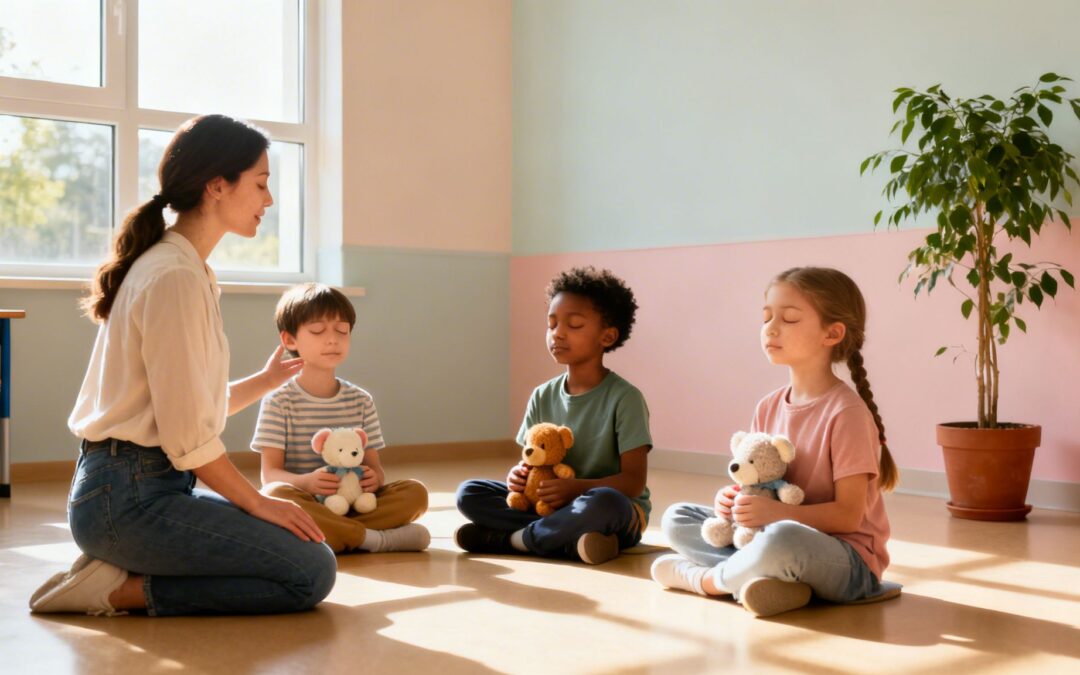
When we talk about teaching mindfulness to children, we’re talking about giving them simple, practical tools to pay attention to the present moment without judgment. This can be as easy as a few focused breaths or a game that hones their sensory awareness. The goal is to help them regulate their emotions, improve focus, and build resilience in a way that just makes sense to them.
Why Teaching Mindfulness to Children Matters Now More Than Ever

Let’s be honest: managing a child’s big emotions, whether in a bustling classroom or a busy home, can be a daily challenge. Kids today are swimming in a sea of constant stimulation, academic pressure, and tricky social situations. This environment is fueling a noticeable rise in https://soulshoppe.org/blog/2022/01/29/stress-in-children/, making it harder for them to focus, connect with others, and simply manage their feelings.
Mindfulness isn’t about forcing kids to sit still and be quiet. It’s about handing them a toolkit for life. It gives them the foundational skills to understand their own inner world, creating that all-important pause between a feeling and a reaction. For example, instead of a child immediately shoving a classmate who takes their toy, mindfulness helps them notice the anger, pause, and maybe use their words instead.
The Research-Backed Benefits in Action
When we introduce mindfulness to children, we’re not just hoping for the best. We’re teaching skills with proven, positive outcomes that go far beyond a few moments of calm. These benefits show up in real, tangible ways in their behavior and learning.
So what does this look like in practice? Here are a few core benefits you can expect to see blossom with a consistent mindfulness routine.
A Quick Look at Mindfulness Benefits for K-8 Students
This table breaks down the research-supported benefits you can expect to see when you bring mindfulness into your students’ lives.
| Benefit Area | What It Looks Like in a Child | Impact on Learning |
|---|---|---|
| Improved Focus | A child can gently bring their attention back to the lesson, even with distractions around them. | Students absorb new material more easily and stay engaged for longer periods. |
| Emotional Regulation | Instead of an outburst, a student learns to recognize anger and says, “I need a minute.” | Fewer classroom disruptions and a more positive, supportive atmosphere for everyone. |
| Increased Empathy | A child understands their own feelings better, so they can recognize and respond to their peers’. | Conflicts on the playground decrease, and students build stronger, kinder relationships. |
| Reduced Stress | A student uses a breathing technique before a test instead of feeling overwhelmed by anxiety. | Kids feel more confident and capable, which frees up mental energy for academic challenges. |
| Greater Resilience | A child can bounce back from a mistake or social hiccup with a more balanced perspective. | Students are more willing to take academic risks and persevere through difficult assignments. |
Ultimately, by equipping students with these tools, we create psychologically safer environments where they feel seen, heard, and understood. This sense of security is the bedrock of any thriving learning community.
This approach aligns beautifully with the philosophy behind the Montessori method of teaching, which emphasizes child-led learning and fostering curiosity within a prepared environment. Both mindfulness and Montessori empower children by giving them tools for self-direction and deep concentration.
A Growing Movement Supported by Evidence
Mindfulness in schools is far from a fleeting trend. A massive body of research backs up its effectiveness, with systematic reviews showing consistent positive effects on mental health, cognitive skills, and social-emotional growth.
The data also reveals a powerful truth: when educators practice mindfulness themselves, the benefits for students are significantly amplified.
And the support is overwhelming. With global parental support for school-based programs at 93%, there is a clear mandate to weave these essential skills into our educational fabric. By teaching mindfulness, we aren’t just adding another subject to the day. We are investing in their long-term well-being and giving them skills to navigate a complex world with greater awareness, compassion, and resilience.
Age-Appropriate Mindfulness Activities You Can Use Today
The best way to get started with mindfulness is by doing, not just explaining. We want these practices to feel like a natural part of the day, not another chore. Instead of demanding perfect stillness, we can meet kids where they are with playful, sensory activities that match their developmental stage.
The real key is to keep it simple, engaging, and short, especially in the beginning. I’ve found that a one-minute mindful activity done consistently is far more powerful than a long, infrequent session that everyone dreads.
Here are some practical, age-appropriate activities you can try today, complete with scripts and tips I’ve picked up from years in the classroom.
Engaging Early Learners: Grades K-2
For our youngest students, mindfulness needs to be a sensory experience. It should be playful and concrete. Abstract ideas won’t land nearly as well as activities that involve their bodies, their favorite toys, and the world right in front of them. We’re building the most basic awareness skills here.
Buddy Breathing
This simple breathing exercise is a classroom favorite. It uses a stuffed animal to make an invisible process—the breath—visible and real. It’s a wonderfully calming activity for transitions or settling down after a rowdy recess.
- How to do it: Invite the kids to lie down comfortably on their backs. Have them place a small stuffed animal or “breathing buddy” on their belly.
- Script: “Let’s give our buddies a gentle ride. When you breathe in, watch your buddy rise up toward the ceiling. As you breathe out, see your buddy slowly float back down. Just notice your buddy going for a quiet ride, up and down, with each breath.”
- Pro-Tip: I like to play some soft, instrumental music in the background. If a child is extra wiggly, reframe it. Encourage them to notice how their buddy is having a “bumpy ride” today. This turns it into an observation, not a failure.
Sound Safari
This one is fantastic for sharpening listening skills and practicing focused attention. It uses the sounds already in your environment and turns the simple act of listening into a fun adventure.
- How to do it: Ask students to sit comfortably and close their eyes if they want to. I use a small chime to signal the start and end of our “safari.”
- Script: “We’re going on a Sound Safari! Our ears are our superpowers. For the next minute, let’s listen for as many different sounds as we can. What can you hear inside our room? What can you hear outside? What sounds are quiet? What sounds are loud?”
- Pro-Tip: When the minute is up, have students share the sounds they “collected.” This validates their experience and creates a great sense of shared discovery.
Building Awareness: Grades 3-5
As kids get into the upper elementary years, they’re ready to start grasping more abstract ideas and doing a bit of self-reflection. Activities for this age can focus more on identifying internal states—like thoughts and emotions—and connecting them to what’s happening in their bodies.
Weather Report Check-In
This metaphor gives students a simple, non-judgmental way to name and share how they’re feeling. Just like the weather, emotions come and go. They aren’t permanent, and they aren’t “good” or “bad.”
- How to do it: Introduce the idea that our feelings are like the weather inside us. I have a visual chart on the wall with different weather types (sunny, cloudy, rainy, stormy, windy).
- Script: “Let’s check in with our internal weather today. You don’t have to change it, just notice what it is. Are you feeling sunny and bright? A little cloudy or foggy? Maybe it feels rainy with some sad tears, or even stormy with some big, loud feelings. Take a quiet moment and see what your weather is right now.”
- Pro-Tip: Let students share by pointing to the chart or writing it on a sticky note. This lets them communicate their feelings without needing to find complicated words. It’s a quick and powerful emotional check-in.
Mindful Walking
This practice is great for grounding kids in their bodies and the present moment. It turns a simple walk across the room into an exercise in focus and serves as an excellent “brain break” between subjects.
- How to do it: Ask students to stand and find their own space. Then, instruct them to walk around the room in slow motion.
- Script: “Let’s try some ‘turtle walking.’ As you walk very, very slowly, can you feel your foot lifting off the floor? Can you feel your heel touching down, then the rest of your foot? Just notice the feeling of your feet connecting with the ground. What does the floor feel like under your feet?”
- Pro-Tip: Start with just 30-60 seconds. As they get used to it, you can have them notice other things, like the air on their skin. These embodiment exercises are powerful tools for self-regulation; for more ideas, you might be interested in our guide on embodiment practices for kids in school and at home.
The goal here isn’t to get rid of the wiggles or stop all thinking. It’s to build the muscle of awareness—that ability to notice what’s happening, inside and out, without immediately getting swept away by it.
Empowering Middle Schoolers: Grades 6-8
By middle school, students are dealing with complex social situations and intense academic pressure. They’re also capable of more sophisticated metacognition—thinking about their own thinking. Mindfulness for this age group can offer real, practical tools for navigating difficult thoughts and building self-awareness.
Thought Surfing
This technique uses a surfing metaphor to help students relate to their thoughts in a new way. Instead of getting pulled under by a difficult thought, they learn to “ride the wave” of it—observing it as it rises, crests, and falls away.
- How to do it: Explain that thoughts are like waves in the ocean; they come and go. We can’t stop the waves, but we can learn to surf.
- Script: “When a strong or tricky thought comes up, like ‘I’m going to fail this test,’ imagine it as a wave. Acknowledge it’s there. Instead of fighting it, try to ride it. Notice how the thought feels in your body. Notice its peak, and then watch as it starts to lose energy and fade, just like a wave on the shore.”
- Pro-Tip: This is about changing the relationship to thoughts, not suppressing them. Encourage students to name the thought (“Ah, the ‘I’m not good enough’ wave is here again”) to create some distance and reduce its power.
Mindful Journaling Prompts
Journaling offers a structured, private space for middle schoolers to practice self-reflection. Giving them specific, mindful prompts can help them move beyond just listing events to actually exploring their inner experience.
- How to do it: Provide a journal and set aside 5-10 minutes of quiet time. I usually offer a few prompts on the board for them to choose from.
- Examples of Prompts:
- “Describe a moment today when you felt completely present. What were you doing? What did you notice with your senses?”
- “Think of a challenging moment from your week. What emotion did you feel most strongly? Where did you feel it in your body?”
- “Write about one small thing you’re grateful for today and why. It could be a song, a food, a person, or a sunny spot in the room.”
- Pro-Tip: I always emphasize that there are no right or wrong answers, and that spelling and grammar don’t matter. The journal is for their eyes only. This creates a safe space for honest reflection without the pressure of being graded.
Weaving Mindfulness into Your Daily Routine
The real magic happens when mindfulness isn’t just another lesson but becomes a natural, seamless part of the day. When you weave small, consistent moments of awareness into existing routines, you help create a classroom culture where focus and calm are the default settings. It’s about turning those chaotic transitions into opportunities for a collective deep breath.
This approach makes mindfulness feel easy and sustainable. Instead of trying to carve out a new 30-minute block, you infuse it into the seconds and minutes you already have. These small, repeated actions are what build lasting habits and a genuine culture of awareness.
From Morning Chaos to Mindful Arrival
The first few minutes of the school day can set the tone for the next several hours. A frantic, rushed entry often leads to a scattered, unfocused class. But what if you could swap that chaotic energy for a simple, two-minute “Mindful Arrival”? This is a game-changer for grounding students and preparing their minds for learning.
Here’s what that shift can look like in practice:
- The Old Way: The bell screams, kids flood the room, bags drop with a thud, and chatter fills the air while you try to get everyone’s attention for announcements.
- The Mindful Way: As students enter, soft, instrumental music is playing. They know the routine: put their things away and find their seats. Once most are settled, you ring a small chime to signal the start of a one-minute mindful moment.
Mindful Arrival Script: “Good morning, everyone. Let’s start our day together. As you settle into your seat, can you feel your feet flat on the floor? Take a slow breath in… and let it all the way out. For the next minute, let’s just listen to the quiet sounds in our room.”
This simple change doesn’t add time to your day; it reclaims it. It acts as a powerful reset, allowing the entire class to start on the same calm page. Building these simple, predictable moments is key to helping children feel emotionally grounded. You can find more ideas in our guide to creating emotionally grounding routines for kids.
Integrating Mindfulness into Your Curriculum
You don’t need a separate curriculum to teach mindfulness. In fact, the most powerful way to do it is by embedding these practices directly into the subjects you already teach. This reframes mindfulness as a practical tool for learning, not just another “thing” to do.
I hear from a lot of teachers who worry kids will find these practices “boring.” But my experience—backed by research—is that when they’re woven in thoughtfully, kids are incredibly receptive. A 2023 feasibility study on school-based interventions had a remarkable 96% retention rate in a program run during class hours. It just goes to show that when the activities are interactive and supported by the teacher, kids are all in. You can read the full research on this effective school integration.
Here are a few ways this can look in different subjects:
- Science: During a nature observation, add a mindful step. Before students start classifying a leaf or a rock, ask them to spend one minute simply observing it with all their senses. “What do you see? What does it feel like? What do you smell?”
- Language Arts: When reading a story, pause after a key emotional moment. You could ask: “Where do you think the character is feeling that sadness in their body? Where do you feel big emotions in your own body?”
- History: After learning about a difficult historical event, use a quiet, reflective prompt. “Take a quiet moment to think about one feeling that came up for you during this lesson. You don’t have to share it, just notice it.”
- Math: When a student is stuck on a tough problem, suggest a “Math Brain Break.” Say, “Okay, let’s pause. Everyone close your eyes and take three slow ‘balloon breaths’—breathe in deep to fill your belly like a balloon, and breathe out slow to let the air out. Now, let’s look at the problem again with fresh eyes.”
As kids get older, these practices can evolve, moving from simple sensory exercises to more reflective techniques.

As you can see, the journey builds on itself. It starts with concrete, body-based activities for our youngest learners and grows into more introspective practices for older students.
Using Micro-Practices for Transitions and Resets
Some of the best opportunities for mindfulness are hidden in the “in-between” moments. Think about the transition from math to reading, the lull before lunch, or the restlessness after a long assembly. These are perfect times for a “Mindful Minute.”
These quick one-minute resets act like a mental palate cleanser, helping students shift gears and release any lingering stress or excitement. A great example is a ‘Starfish Breath’: have kids spread their hand like a starfish. They trace up one finger while breathing in, and trace down the other side while breathing out, continuing for all five fingers.
The Gratitude Share
A wonderful way to close the day is with a brief “Gratitude Share.” This simple practice helps students leave on a positive, reflective note.
- Set the Tone: Gather students in a circle or have them turn to a partner.
- The Prompt: Ask them to think of one small thing from their day they are grateful for. It could be learning something new, a kind word from a friend, or the sunshine during recess.
- Share (Optional): Invite a few students to share their gratitude aloud if they feel comfortable. This simple act of sharing amplifies the positive feeling in the room.
It’s these small, consistent practices, woven into the fabric of the school day, that truly build a lasting foundation of awareness, focus, and emotional well-being for every child.
Partnering With Families to Build a Mindful Community

When we teach mindfulness in the classroom, the practices truly come alive when they become a shared language between school and home. Bridging this gap creates a supportive ecosystem that reinforces these essential life skills, helping transform classroom exercises into deeply rooted family habits.
Let’s face it, though—most families are incredibly busy and might not be familiar with mindfulness at all. The key is to make your communication simple, inviting, and practical. Start by clearly explaining what you’re doing in the classroom and, just as importantly, why it matters for their child.
Sharing Your “Why” Through Newsletters
Your regular class or school newsletter is the perfect place to start. You don’t need to write a long essay. Just keep the blurbs short, positive, and focused on the benefits for their child. Avoid jargon and always offer one simple thing they can try at home.
Here’s a little blurb you can adapt for your own newsletter:
This Week’s Mindful Moment: Listening Ears
Hello Families! This week in class, we’ve been practicing “Mindful Listening”—a fun game where we pause and notice all the quiet sounds around us. This simple activity helps students improve their focus and calm their bodies. You can try it at home for just one minute! Ask your child: “What sounds can you hear right now?” It’s a great way to settle down before bed.
These small, consistent updates demystify the practice and empower parents to become partners in your work.
Host a Family Mindfulness Night
For a more immersive experience, think about hosting a family mindfulness night. This can be virtual or in-person, and it’s not about sitting in silence for an hour! It’s about playful connection, shared learning, and giving families tangible tools they can use right away.
Structure the evening around fun, interactive activities:
- Buddy Breathing: Ask each family to bring a favorite stuffed animal. Lead them through the same breathing exercise you use in class so parents can experience it firsthand.
- Mindful Tasting: Use a simple snack like a raisin or a small piece of chocolate. Guide families to explore it with all their senses before eating. It’s always a hit.
- Create ‘Calm Down Jars’: This is a wonderful hands-on activity. Provide jars, water, glitter, and glue, and let families create a visual tool they can take home for when big emotions arise.
This kind of shared experience builds real community and shows parents that mindfulness is an activity for connection, not just for quiet time. Positive parenting is all about connection, and you can explore more strategies by reading our guide on positive parenting tips to nurture your child’s growth.
Launch a Home-and-School Mindfulness Challenge
A weekly or monthly challenge can be a fantastic, low-pressure way to encourage consistent practice. Create a simple, downloadable sheet with fun activities that families can do together.
The impact of these school-led initiatives can be huge. In the ‘World’s Largest Mindful Moment’ event, an impressive 67% of parents reported practicing mindfulness at home with their kids afterward. A staggering 96% saw clear benefits, including children getting better at handling emotions (63%), becoming calmer (42%), and showing more empathy (28%). This highlights the powerful ripple effect of your work. You can discover more about these powerful family engagement findings.
Here are some sample weekly challenges you could include:
- Week 1 – Mindful Munching: Practice ‘Mindful Eating’ with one snack this week. Eat without screens and talk about the tastes, smells, and textures.
- Week 2 – Rose, Thorn, Bud: At dinner one night, share your “rose” (a positive moment), “thorn” (a challenge), and “bud” (something you’re looking forward to).
- Week 3 – Mindful Steps: Take a three-minute walk together, inside or out. Walk in silence and just notice the feeling of your feet on the ground.
- Week 4 – Gratitude Jar: Write down one thing you’re thankful for each day and add it to a jar. Read them all at the end of the week.
By making families your partners, you multiply the impact of your efforts. You’re not just teaching a skill; you’re helping to build a truly mindful community where every child is supported.
Wrestling with the Hurdles and Spotting Real Wins
Even with the best game plan, bringing mindfulness into a classroom isn’t always a walk in the park. Let’s get real about the bumps you’ll hit along the way. The good news? These challenges are totally normal, predictable, and you can absolutely navigate them with a little creativity and a lot of heart.
When you first introduce mindfulness, you’re almost guaranteed to hear, “This is boring!” or “This is so silly.” It’s a rite of passage, especially with older students. The trick is to not let it get under your skin. Instead, get curious. More often than not, that pushback comes from feeling self-conscious or just not getting why you’re doing it.
Getting Past “This is Boring”
The best way to flip skepticism on its head is to reframe the whole thing. Tie mindfulness directly to stuff they already care about—like leveling up in a video game, nailing a free throw, or not panicking during a test. You can even call it “attention training” to help them get focused and stay cool under pressure.
Another game-changer is tweaking your language. If a kid is squirming in their seat, don’t rush to label them “unfocused.” Try using their wiggles as part of the practice.
Here’s what that sounds like:
Instead of saying, “You need to sit still,” try something like, “I notice your body has a lot of energy right now. That’s totally okay. For just a moment, let’s see if we can notice that ‘body energy’ without needing to fix it. Is it a buzzy feeling? Or maybe a jumpy one?”
This little shift validates what they’re feeling and turns their restlessness into an object of curiosity, not a behavior problem. It’s a subtle but powerful move from judgment to awareness.
Finding Time in a Jam-Packed Day
“I just don’t have the time.” We hear this from teachers and parents all the time, and it’s a valid concern. But here’s the secret: you don’t need to find a new 30-minute block in your day. It’s all about using the little pockets of time you already have. This is where “micro-practices” become your secret weapon.
These are super-short, 30- to 60-second mindfulness hits you can sprinkle throughout the day. They’re amazing for hitting the reset button without derailing your entire schedule.
- Right Before a Test: Lead a 30-second “cool the pizza” breath. “Okay, let’s pretend we have a super hot slice of pizza. Breathe in and smell that yummy pizza… now blow out nice and slow to cool it down.”
- Lining Up for Recess: Try a quick “sound safari.” “While we’re waiting, let’s close our eyes for a minute and see how many different sounds we can hear. Go!”
- Switching Between Subjects: Use a one-minute mindful walk. “Let’s walk to our reading spots in super slow motion. See if you can feel your feet on the floor with every single step.”
When you weave in these tiny moments, mindfulness stops feeling like another thing to do and just becomes part of the classroom rhythm. It proves you don’t need a ton of time to make a huge difference.
Measuring What Really Matters
While it’s great to see data on improved test scores or focus, the most profound signs of success aren’t usually found on a spreadsheet. Real progress shows up in how kids talk to themselves, how they treat each other, and how they handle their big feelings.
So, what are you looking for? Success isn’t about kids sitting in perfect silence with empty minds. It’s about their growing awareness.
Qualitative Signs of Success
| What You Might See | What It Really Means |
|---|---|
| Self-Regulation | A student says, “I’m getting frustrated, I need a minute,” instead of melting down. They’re noticing an emotion and choosing how to respond. That’s a huge win. |
| Empathy & Kindness | You spot fewer squabbles on the playground or see a child comforting a friend who’s upset. This shows they’re tuning into how others feel, not just their own world. |
| Home Connection | A parent emails you to say their child used a breathing exercise to calm down before bed or started talking about their “internal weather” at home. This is the gold standard—it means the skills are sticking. |
These are the moments that tell you the practice is truly taking root. It shows that kids aren’t just doing mindfulness exercises; they’re starting to live more mindfully. Every time a child shows a little more patience, a bit more self-awareness, or an ounce more kindness, you’re witnessing real, tangible success.
Got Questions About Teaching Mindfulness?
When you’re just starting to bring mindfulness to kids, it’s natural for a few common questions to pop up. Whether you’re a teacher or a parent, you’re not alone in wondering about the practical side of things. Let’s walk through some of the most frequent ones I hear from educators just like you.
How Do I Introduce Mindfulness Without Touching on Religion?
This is a big one, and the answer is simpler than you might think: keep it secular and grounded in brain science. I always advise teachers to frame mindfulness as “attention practice” or “brain training.” The focus is on concrete, observable benefits like better focus and a calmer way to handle stress.
Use simple, universal language. Instead of words that might feel spiritual, try phrases like:
- “Let’s notice our breath.”
- “We’re going to pay attention on purpose for a minute.”
- “Let’s check in with our feelings right now.”
The goal is to teach a life skill for mental well-being, just like P.E. class teaches students how to care for their bodies. A “Mindful Minute” isn’t a spiritual ritual; it’s a tool for getting ready to learn.
The most successful school programs I’ve seen all have one thing in common: they treat mindfulness as a mental fitness exercise. You’re helping kids train the muscle of attention—a skill every single child can benefit from, no matter their family’s personal beliefs.
I’m a Teacher. What’s the Single Most Important First Step for Me?
Before you teach anyone else, start your own practice. Seriously. It doesn’t have to be a huge commitment—even five minutes a day can make a world of difference. Study after study shows that students get significantly more out of mindfulness when their teacher has a personal practice.
You don’t need to become a meditation guru overnight. The point is to understand what you’re teaching from the inside out. This is what allows you to teach with authenticity.
It lets you troubleshoot from experience and, most importantly, model a calm, present demeanor for your students. When a child says, “I can’t stop thinking!” you’ll be able to nod and say with genuine empathy, “I know what you mean, my mind gets super busy too! Let’s just watch those thoughts go by like clouds in the sky.” Your own practice is the bedrock of a truly mindful classroom.
How Can I Start If I Have Zero Budget for SEL Programs?
Great news: many of the most powerful mindfulness activities are completely free. You can start today. The most important investment isn’t money; it’s your consistent time and energy.
Here are a few zero-cost ideas to get you started:
- Breathing Buddies: Grab some stuffed animals for a simple “Buddy Breathing” exercise where kids watch the animal rise and fall on their belly. Or try “Cool the Pizza” breathing to teach slow, intentional exhales.
- Mindful Listening: Ring a chime, a bell, or just use the sounds already in your classroom for a “Sound Safari.” The goal is just to notice.
- One-Minute Resets: Squeeze in a quick, one-minute “Mindful Reset” during transitions between subjects. It’s a perfect way to help students shift gears and bring their focus back.
Start small. Keep a simple log of the positive changes you see—maybe fewer disruptions or kids being a little kinder to each other. This kind of real-world evidence can build a powerful case for getting a budget for more formal social-emotional learning programs down the road.
At Soul Shoppe, we believe that every child deserves the tools to build a kind and connected world, starting from within. Our programs provide students and educators with the shared language and practical skills to cultivate empathy, resilience, and psychological safety in schools. Ready to bring these powerful social-emotional learning tools to your community? Explore our programs and see how we can help your school thrive.