

A Parent’s Guide to Books on Emotions for Children
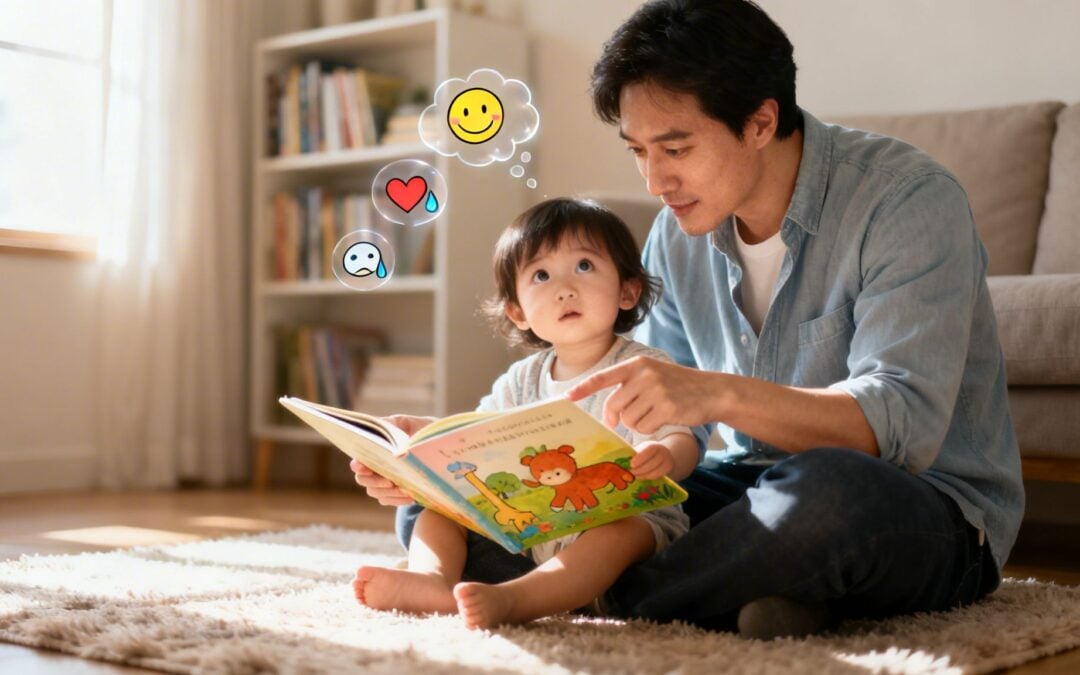
Using books on emotions for children is one of the most powerful and natural ways to build emotional intelligence. Stories give kids the words and a safe space to understand big, complicated feelings—like sadness, joy, and frustration—in a way that makes perfect sense to them.
How Stories Build Emotionally Resilient Children

Think of a storybook as a “flight simulator for feelings.” It lets a child step into a tricky situation, like watching a character feel left out on the playground, but from a totally safe distance. They get to process the character’s disappointment and watch them solve the problem, all without feeling overwhelmed themselves.
This kind of safe exploration is where empathy and social skills really begin to take root. When kids see a character navigate a big feeling, it provides a mental blueprint they can use later when a similar situation pops up in their own lives. For instance, after reading a story about a little bear who shares his favorite toy, a parent can reference it on the playground by saying, “Remember how Barnaby Bear felt so happy when he shared his red ball? Maybe you could try sharing your truck with Leo.”
Creating a Shared Emotional Language
When you read together about a grumpy badger or a nervous squirrel, you’re not just reading a story—you’re building a shared vocabulary. This makes it so much easier for a child to express themselves down the road.
Instead of a meltdown, they might be able to say, “I feel grumpy like that badger today.” That shared language turns abstract feelings into something concrete they can point to, building a bridge between their inner world and your ability to help them.
Practical Example: A teacher reads “Grumpy Monkey” by Suzanne Lang to her class. The next day, a student is quiet and withdrawn. The teacher can gently ask, “Are you feeling a bit like Grumpy Monkey today?” This gives the child a simple, low-pressure way to confirm their feelings without having to find complex words.
This growing focus on emotional literacy isn’t just happening in homes and classrooms; it’s being noticed across the publishing world. In fact, the global children’s book market is expected to hit USD 882.08 million by 2035, a trend that’s heavily influenced by the new emphasis on social-emotional development in early education. You can read more about this market growth on Global Market Statistics.
From Storytime to Real-Life Skills
Reading a book about feelings does more than just fill a few minutes before bedtime. It actively builds the foundation for lifelong emotional resilience. It’s a chance to connect and grow, turning a simple story into a truly powerful tool.
A story gives a child a safe place to put their feelings. When a character is sad or angry, the child can feel it too, but from the comfort of a lap or a cozy reading corner. This is how empathy begins.
By exploring these stories together, you’re helping your child practice skills that will last a lifetime. For more ideas, check out our guide on building emotional resilience in kids. This simple act of reading together strengthens their ability to understand themselves and connect meaningfully with the world around them.
Choosing the Right Emotional Book for Any Age
Finding the perfect book to talk about feelings can feel like searching for a needle in a haystack. The real secret is matching the book’s content and complexity to your child’s developmental stage. What captivates a toddler simply won’t resonate with a third-grader, so knowing what to look for makes all the difference.
For the youngest children, the best books on emotions for children lean on simple language and crystal-clear, expressive illustrations. A toddler or preschooler connects best when a character’s feeling is impossible to miss—think of a rabbit’s big, sad tears or a bear’s angry, scrunched-up face. The emotional journey should be straightforward: a character feels a big emotion, and then they (or a caring friend) find a simple way to feel better.
As children grow, they’re ready for more complex stories. Elementary-aged kids can follow narratives with multiple characters, nuanced social moments, and internal conflicts. They can understand a character who feels embarrassed and a little bit proud at the same time, or one who is grappling with jealousy toward a friend.
Matching Books to Social-Emotional Skills
To make this even easier, you can filter your choices by the specific social-emotional skills you want to nurture. Different books are better suited for teaching different competencies. For a deeper look at these skills, you can explore our overview of what social-emotional development is and see how it unfolds at various stages.
Choosing a book isn’t just about the story; it’s about finding the right mirror for your child’s inner world. The right book makes them feel seen, understood, and equipped to handle their own emotional experiences.
And don’t forget the power of the cover! The visual presentation has a huge impact on a book’s initial appeal. The colors and imagery can draw a child in before you even read the first page. It’s fascinating to see how color psychology influences book cover perception and why certain designs connect so strongly with young readers.
To give you a practical tool, here is a simple framework for selecting books based on age and the specific SEL competency you want to focus on.
Book Selection Guide by Age and SEL Competency
This table breaks down what to look for when choosing books on emotions for children at different developmental stages, turning an overwhelming search into a focused one.
| Age Group | SEL Competency Focus | Key Book Characteristics | Practical Example |
|---|---|---|---|
| Toddlers (1-3) | Self-Awareness (Identifying basic feelings) | Features brightly colored, simple illustrations with clearly labeled emotions (e.g., “happy,” “sad”). Uses minimal text and a repetitive structure. | A book where each page shows an animal with a distinct facial expression. You can point and say, “Look, the lion is sad. Can you make a sad face?” Then, mirror their expression back to them. |
| Preschool (3-5) | Self-Management (Learning coping strategies) | The main character experiences a common frustration (like not getting a turn) and learns a simple calming technique, such as taking a deep breath or finding a quiet space. | A story about a little monster who gets angry when her block tower falls. She learns to stomp her feet three times and roar into her hands to let the “angry energy” out. You can practice this action together. |
| Early Elem. (6-8) | Empathy & Social Awareness (Understanding others’ perspectives) | The story shows a situation from more than one character’s point of view or features a main character who misinterprets a friend’s actions and later learns why they behaved that way. | A book about two friends who want to play different games. The story shows why each friend feels strongly about their choice. You can pause and ask, “How do you think Maya feels right now? What about Sam?” |
| Upper Elem. (9-11) | Relationship Skills & Responsible Decision-Making | Characters navigate complex social dynamics like peer pressure, exclusion, or ethical dilemmas. The plot shows the consequences of different choices. | A chapter book where the protagonist has to decide whether to join in on teasing a new student or to stand up for them. You can discuss the choices: “What do you think would happen if they told the teaser to stop? What might happen if they didn’t?” |
Think of this as your cheat sheet. By keeping your child’s age and your learning goal in mind, you can confidently pick stories that not only entertain but also empower.
Turning Storytime Into an Empathy Workout
Just reading the words on a page is one thing. But when we use books on emotions for children, the real magic happens when we turn storytime from a passive activity into an active, emotional exploration. With a few simple shifts, you can transform any book into a workout for the heart, building self-awareness and empathy with every page you turn.
This isn’t about quizzing kids or turning reading into a test. It’s about being curious together and creating space for them to connect a character’s journey to their own lives. When we read this way, it becomes a shared experience that strengthens our bond and their emotional toolkit.
The infographic below offers a simple way to think about choosing the right book. It helps you narrow down the options by starting with what’s age-appropriate, then thinking about the specific feelings you want to explore.

As the visual guide shows, starting with the child’s age group, focusing on a target emotion, and then looking for relatable character traits gives you a clear path to finding the perfect book for your needs.
Model Your Thinking with “Think-Alouds”
One of the most powerful things you can do is simply say what you’re thinking out loud as you read. This is called a Think-Aloud. It’s where you voice your own thoughts and reactions to the story, showing your child how a reader makes sense of what’s happening.
Think of yourself as an emotional tour guide for the story. You’re pointing out the important sights and helping them understand the landscape.
Practical Examples of a Think-Aloud:
- (Frustration): “Wow, the bear looks so frustrated that he can’t get that honey. See how his face is all scrunched up? I get that way when my computer is being slow. It makes me want to sigh really loudly, like this… Hmph!”
- (Sadness): “Oh, that little cloud looks pretty lonely. I wonder if she wishes she had a friend to float with. Her teardrop shape makes me feel a little sad for her.”
- (Excitement): “Look at that huge smile! He must be so excited for his birthday party. He’s wiggling all over, just like you do when we are about to go to the park!”
Ask “I Wonder…” Questions
Instead of asking direct questions that have a right or wrong answer (like “How does he feel?”), try framing them with curiosity. Wondering Questions are open-ended and invite imagination without any pressure to be “correct.”
“I wonder…” questions shift the dynamic from a quiz to a shared exploration. They tell a child, “Your ideas are interesting to me,” which builds confidence and encourages them to think more deeply.
These questions open the door for conversation. And if your child doesn’t answer? That’s okay. Just asking the question plants a seed for them to think about later.
Practical Examples of “I Wonder…” Questions:
- “I wonder what the fox is thinking right now, hiding behind that tree.”
- “I wonder why she didn’t want to share her toy. Maybe she was worried it would break.”
- “I wonder what they could do to solve this problem together. What’s one idea?”
Help Them Make Text-to-Self Connections
The real goal here is to help children see themselves in the story. We can gently guide this by making Text-to-Self Connections, linking what’s happening on the page to something in their own lives. This makes the emotional lesson feel personal, real, and much more likely to stick.
Practical Examples of a Text-to-Self Connection:
- “This reminds me of when you were nervous on your first day of school. The character’s tummy feels all fluttery, just like you said yours did. It’s the same feeling, isn’t it?”
- “Remember how proud you felt after you finished that huge puzzle? I bet the knight feels that exact same way right now after building that bridge.”
- “The rabbit is feeling very shy. That’s a bit like how you feel sometimes when we go to a new birthday party, before you get to know the other kids.”
Exploring lists of the best read aloud books for first graders can be a great starting point for finding stories that spark these conversations. These simple techniques are foundational for social-emotional growth, and you can learn even more ways to build these skills by checking out our guide on how to build empathy in the classroom.
Bringing Emotional Lessons Off the Page
While reading is a powerful start, the real magic happens when the lessons from books on emotions for children leap off the page and into everyday life. The goal is to build a bridge between a character’s experience and a child’s own world.
Hands-on activities are the perfect way to make abstract feelings concrete, tangible, and manageable. They don’t need to be complicated, either. In fact, the simplest extensions are often the most effective because they anchor the story’s message in a physical or creative experience, helping a child embody the emotional skills they’ve just read about.
Creative Expression Activities
Art gives kids a way to process and express what they’re feeling inside, especially when they don’t have the words. After reading a story together, you can use creative prompts to help them explore the book’s themes and communicate their understanding in a whole new way.
Practical Examples:
- Feelings Wheel: Grab a paper plate or draw a large circle and divide it into slices. In each slice, have your child draw a face showing a different emotion from the story—happy, sad, frustrated, surprised. This becomes a practical tool they can later point to when they’re struggling to find the right words.
- Character Sculptures: Using play-doh or clay, ask your child to sculpt the main character. You can prompt them by asking, “What did the character look like when they were feeling angry? Can you show me with the clay?” This connects the physical act of creation with emotional expression.
- Draw the Feeling: After reading a book like “The Color Monster,” give your child crayons and paper. Say, “The monster felt all mixed up inside. What do your feelings look like today? Can you draw them?” There are no rules—it could be scribbles, lines, or specific pictures.
Role-Playing and Problem-Solving
Acting out scenarios from a book is like a dress rehearsal for real life. Role-playing allows children to practice empathy, communication, and conflict resolution in a safe, low-stakes environment. It’s a chance to try out different responses and see what works.
When a child role-plays a character’s dilemma, they are literally stepping into their shoes. This practice moves empathy from an abstract idea to a felt experience, building a crucial foundation for strong relationship skills.
This is especially powerful when a story’s character makes a poor choice. You can pause the reading and act out a different, more positive way to handle the problem. This gives your child a practical script they can use later. For more guidance on this, our article offers great tips on how to express your feelings in words.
Practical Example:
If a book features friends arguing over a toy, you and your child can act it out. You can play one friend, and your child can be the other. First, act it out just like the book. Then, ask, “What’s another way the story could go? Let’s try it!” You could practice taking turns or finding a new game to play together.
Mindfulness and Movement
Connecting emotions to the body is a game-changer for developing self-regulation. Movement activities can release the pent-up energy that comes with feelings like anger or excitement, while mindfulness exercises can calm anxiety and frustration. These activities make emotional management a full-body experience.
Actionable Exercises:
- Dragon Breaths: After reading about a frustrated or angry character, try practicing “dragon breaths.” Breathe in deeply through your nose, then open your mouth and exhale forcefully like a dragon breathing fire. It’s a fun and surprisingly effective way to release tension.
- Feelings Dance: Put on some music and call out different emotions from the story. Ask your child to dance how that feeling would move—maybe a slow, heavy dance for sadness, or a fast, bouncy one for joy. This helps them understand how emotions feel in their bodies.
- Worry Stones: After reading about a worried character, find a smooth, small stone. Explain that this can be a “worry stone.” When they feel worried, they can hold it and rub it with their thumb, focusing on how it feels in their hand. This gives them a physical anchor to ground themselves.
As parents and educators look for more engaging tools, the market is responding. The interactive children’s book market is projected to grow to USD 1.04 billion by 2033, driven by an increasing focus on early literacy and emotional development.
By bringing these simple, hands-on activities into your routine, you turn storytime into an active, memorable lesson that equips children with the tools they need to thrive.
Building an Inclusive Emotional Bookshelf

For a story to truly connect, a child needs to see their own world reflected in its pages. A powerful collection of books on emotions for children is both a mirror and a window. It’s a mirror that shows a child they are seen, and a window that offers a respectful glimpse into the lives of others. Both are absolutely essential for building genuine empathy.
When kids see characters who look like them, live in families like theirs, or have abilities similar to their own, it’s a powerful validation. It sends a quiet but clear message: “Your feelings are normal, and your story matters.” Without that connection, the emotional lessons in a book can feel distant or abstract.
This is exactly why taking a thoughtful look at your bookshelf—whether at home or in the classroom—is so important. The goal isn’t just diversity for diversity’s sake; it’s to create a library where all kinds of characters experience universal emotions. This teaches kids that feelings are a shared human experience that cuts across all our differences.
How to Audit Your Bookshelf for Inclusion
Take a moment and look at your book collection with fresh eyes. This isn’t about judgment. It’s about being intentional. As you scan the spines and covers, ask yourself a few practical questions:
- Cultural Representation: Do the characters come from a range of cultural and ethnic backgrounds? Look for stories that authentically show different traditions, languages, and settings. For example, look for books where a child celebrates Diwali or Ramadan, not just Christmas.
- Family Structures: Do your books show different kinds of families? Try to include stories with single parents, grandparents as caregivers, same-sex parents, and blended or adoptive families. A book like “Stella Brings the Family” is a great example.
- Varying Abilities: Are there characters with physical disabilities, neurodiversity, or different learning styles? It’s vital for children to see disability portrayed as a natural and normal part of human diversity. For example, seek out stories featuring a main character who uses a wheelchair or is on the autism spectrum.
- Socioeconomic Diversity: Do the homes, neighborhoods, and experiences of the characters reflect different economic situations? This helps show that feelings are universal, no matter what a family’s circumstances are. Look for stories set in apartments as well as houses, or where a family takes the bus instead of driving a car.
A truly inclusive bookshelf goes way beyond tokenism. Instead of having just one book about a specific culture, try to find multiple stories where diverse characters are simply living their lives—feeling joy, solving problems, and figuring out friendships.
An inclusive bookshelf sends a powerful message: everyone belongs in the story. It teaches children not just to tolerate differences but to genuinely celebrate and understand them, building a foundation for a more compassionate worldview.
And this isn’t just a niche idea; it’s a growing movement. The market for personalized children’s books in the U.S. is expected to hit USD 1,128.52 million by 2032. This trend shows a huge demand from families who want books where their child can be the hero of the story. As you can see in the U.S. Personalized Children’s Books Market Report, this directly supports social-emotional learning by making these lessons deeply personal and relatable.
By carefully and intentionally curating a diverse library, you help every child feel seen and valued, all while teaching every child to appreciate the rich, wonderful tapestry of the world around them.
Your Questions About Emotional Storybooks Answered
It’s one thing to hear that books on emotions for children are a great tool, but it’s another to put it into practice. As you start exploring this world, questions are bound to come up.
Let’s walk through some of the most common ones we hear from parents and educators, with clear, supportive answers to help you along the way.
What if My Child Resists Books About Feelings?
This is a really common hurdle. The moment a book feels like a “lesson,” some kids will check out immediately. The secret is to avoid making it feel like medicine.
Instead, shift your focus to finding stories with fantastic, exciting plots where emotions are just a natural part of the adventure, not the entire point.
Practical Example: If your child loves trucks, find a story about a little dump truck who feels sad because he’s too small to carry big rocks, and then discovers his unique strength. The focus is on the trucks, but the feeling of inadequacy and self-acceptance is woven in naturally.
Look for books that tap into what they already love—dinosaurs, outer space, building amazing forts—that just happen to feature characters who get frustrated, feel overjoyed, or have to solve a problem with a friend. Graphic novels can also be a game-changer here; their visual storytelling is incredibly engaging and shows emotions through expressions and body language, which is often more powerful than words. The goal is to meet them where they are and sneak the emotional vocabulary into a story they can’t put down.
When a child resists a ‘feelings book,’ it’s often because they sense a lecture coming. The solution is to embed the lesson in a great story. A tale about a brave knight who feels scared before facing a dragon is still an adventure story first.
How Do I Handle Difficult Topics Like Grief or Anger?
Books are incredible for this because they create a safe, contained space to explore really tough emotions from a distance. A great first step is always to read the book yourself first. That way, you’re prepared for the tricky parts and can guide the conversation with confidence.
When you get to a heavy moment in the story, just pause. Validate the emotion without any judgment at all.
Practical Example:
You are reading “The Invisible String” by Patrice Karst, a book about connection even when loved ones are far away. When you reach the part about a loved one in heaven, you can pause and say, “Wow, the characters feel so sad because they miss their uncle. It hurts our hearts when we miss someone we love. It’s okay to feel that way.” Then, you can talk about the “invisible string” that connects you to people you miss.
Keep your language simple and honest. Answer their questions directly, but don’t feel like you have to give them more information than they’re asking for. The most important thing is to reassure them that all feelings are okay—even the big, uncomfortable ones. Frame the book as a way to learn what we can do when we feel that way.
How Can Books Actually Help with Tantrums?
They absolutely can. Think of books as a proactive tool for managing those tough behaviors. When you read a story about a character who gets mad and learns to take three deep “lion breaths,” you’re planting a seed. You’re giving your child a mental script and a concrete strategy to use before a tantrum even begins.
These stories create a shared language you can draw on later, even in the heat of the moment.
Practical Example:
You’ve read “When Sophie Gets Angry—Really, Really Angry…” by Molly Bang. Later that week, your child gets frustrated and is about to throw a toy. You can intervene gently by saying, “You are getting really, really angry, just like Sophie. Remember what she did? She ran and ran until she felt better. Let’s go outside and run to the big tree and back to let our angry energy out.”
Books don’t magically erase big feelings or replace the need for direct guidance, but they build a crucial foundation of emotional understanding. They give kids tangible tools for self-regulation and problem-solving, which, over time, can make a huge difference in reducing those difficult moments by equipping them with a better way forward.
At Soul Shoppe, we believe in equipping every child with the tools they need for a lifetime of emotional well-being. Our programs bring these concepts to life, helping school communities create environments where every child feels safe, seen, and supported. To learn how we can help your school, visit us at https://www.soulshoppe.org.