

Conflict Resolution Skills for Kids: Practical Guide for Parents
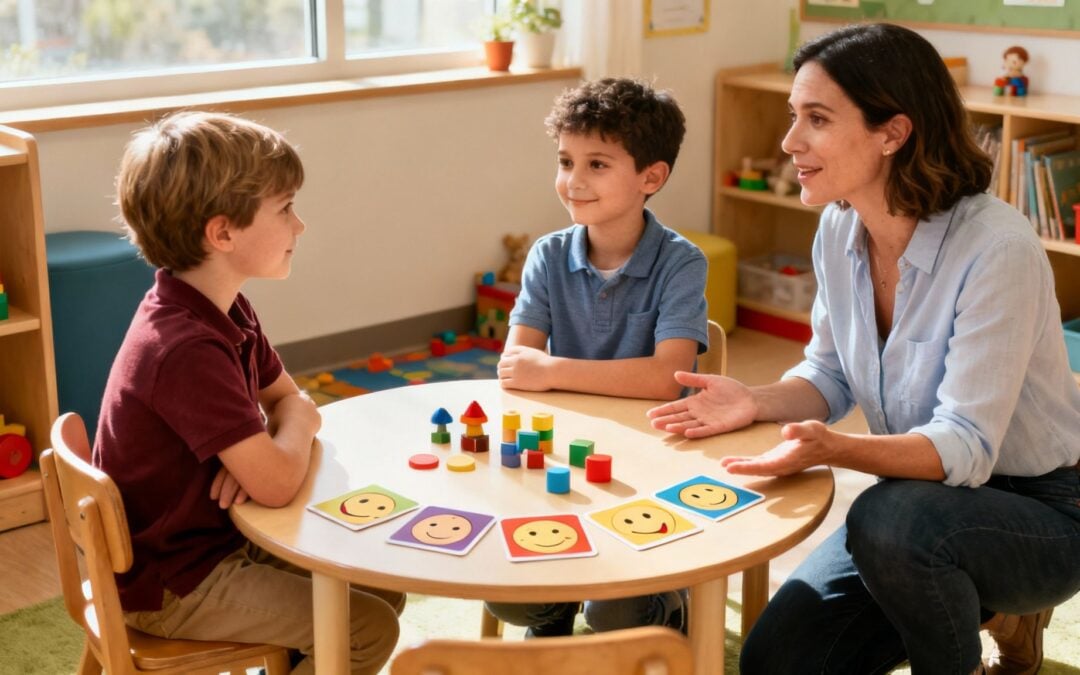
Conflict is a part of life, but it doesn’t have to be a source of stress. For kids, learning how to handle disagreements peacefully is one of the most powerful tools we can give them. It’s about more than just “playing nice”—it’s about learning to understand their emotions, communicate what they’re feeling, and work together to find a fair solution.
When we teach these skills, we turn conflict from something scary into an opportunity for connection and growth.
Why Kids Need Conflict Resolution Skills Now More Than Ever
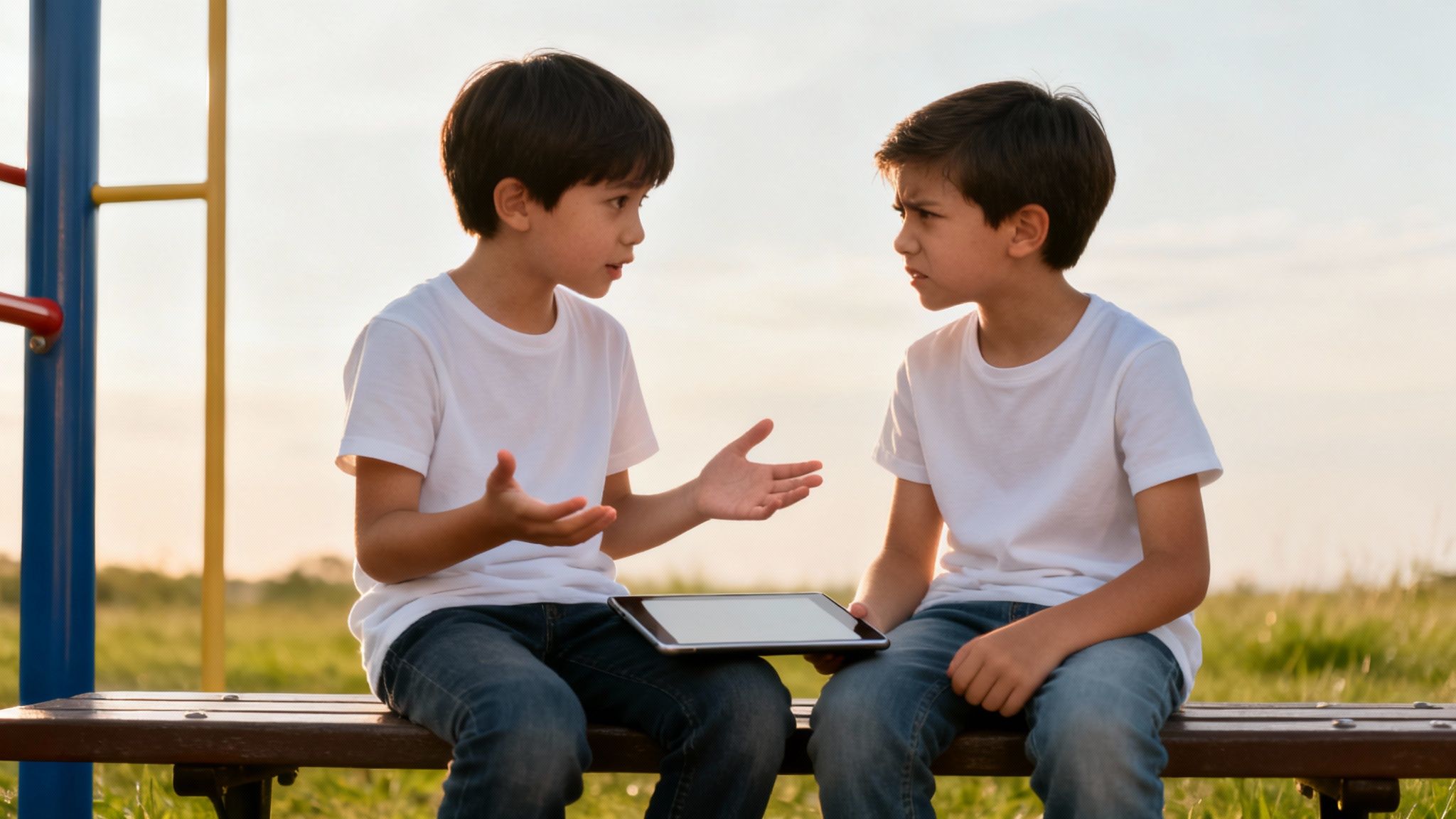
Let’s be honest: conflict resolution isn’t just a “nice-to-have” skill anymore. It’s an essential toolkit for building resilience, empathy, and emotional well-being. A simple argument over a playground swing or a shared toy can quickly snowball, leading to hurt feelings, social isolation, and classroom disruptions.
Practical Example (No Skills):
Think about a classic classroom squabble over a single tablet. Without the right tools, one child might snatch it away, while the other dissolves into tears. Nobody wins, and the underlying problem—how to share—remains unsolved.
Practical Example (With Skills):
Now, picture that same scene with a child who has some conflict resolution skills. They might take a breath and say, “I’m feeling frustrated because I haven’t had a turn yet. Can we use a timer for 10 minutes each?” Just like that, the dynamic shifts from a power struggle to a collaborative effort.
Conflict Is an Opportunity, Not a Threat
Every disagreement is a live-action classroom for learning vital life skills. When we reframe conflict as a chance to practice, we give kids a gift that will serve them at school, at home, and in their future relationships.
This is especially important because unresolved conflict can be a huge source of anxiety. If this is a concern, it’s helpful to learn the common signs of stress in children and how to step in with support.
The Core Pillars of Kid-Friendly Conflict Resolution
So, where do we start? This guide breaks it down into three foundational skills. I’ve found that focusing on these pillars gives kids a reliable roadmap for navigating almost any disagreement.
The following table summarizes these core skills and what they look like in action across different age groups. It’s a great quick-reference tool for both educators and parents.
| The Core Pillars of Kid-Friendly Conflict Resolution |
| :— | :— | :— |
| Skill | What It Looks Like in Action (K-3) | What It Looks Like in Action (4-8) |
| Understanding Emotions | Naming basic feelings like “mad” or “sad.” Pointing to a feelings chart to show how they feel. | Using more nuanced words like “frustrated” or “disappointed.” Recognizing how emotions feel in their body. |
| Communicating Feelings | Using simple “I feel…” statements, like “I feel sad when you take my crayon.” | Using “I-Statements” to express needs without blaming: “I feel left out when I’m not invited to play.” |
| Solving Problems Together | Suggesting simple solutions like taking turns or asking a teacher for help. | Brainstorming multiple solutions and discussing which one is fairest for everyone involved. |
By building these skills, we give kids the confidence to handle bumps in their friendships constructively instead of letting them derail their day.
The Link Between Emotions and Positive Actions
It all begins with emotional literacy. When kids can name what they’re feeling, they gain the power to manage their reactions instead of being controlled by them. The research is clear on this: there’s a direct line between understanding emotions and choosing positive conflict strategies.
One study found that young children with a better grasp of emotions were 20-30% more likely to negotiate or share instead of grabbing or yelling. This really drives home how critical emotional awareness is to peaceful problem-solving.
By equipping children with these foundational skills, we empower them to turn disagreements into moments of understanding and strengthen their social and emotional wellbeing.
Building the Foundation with Emotional Literacy
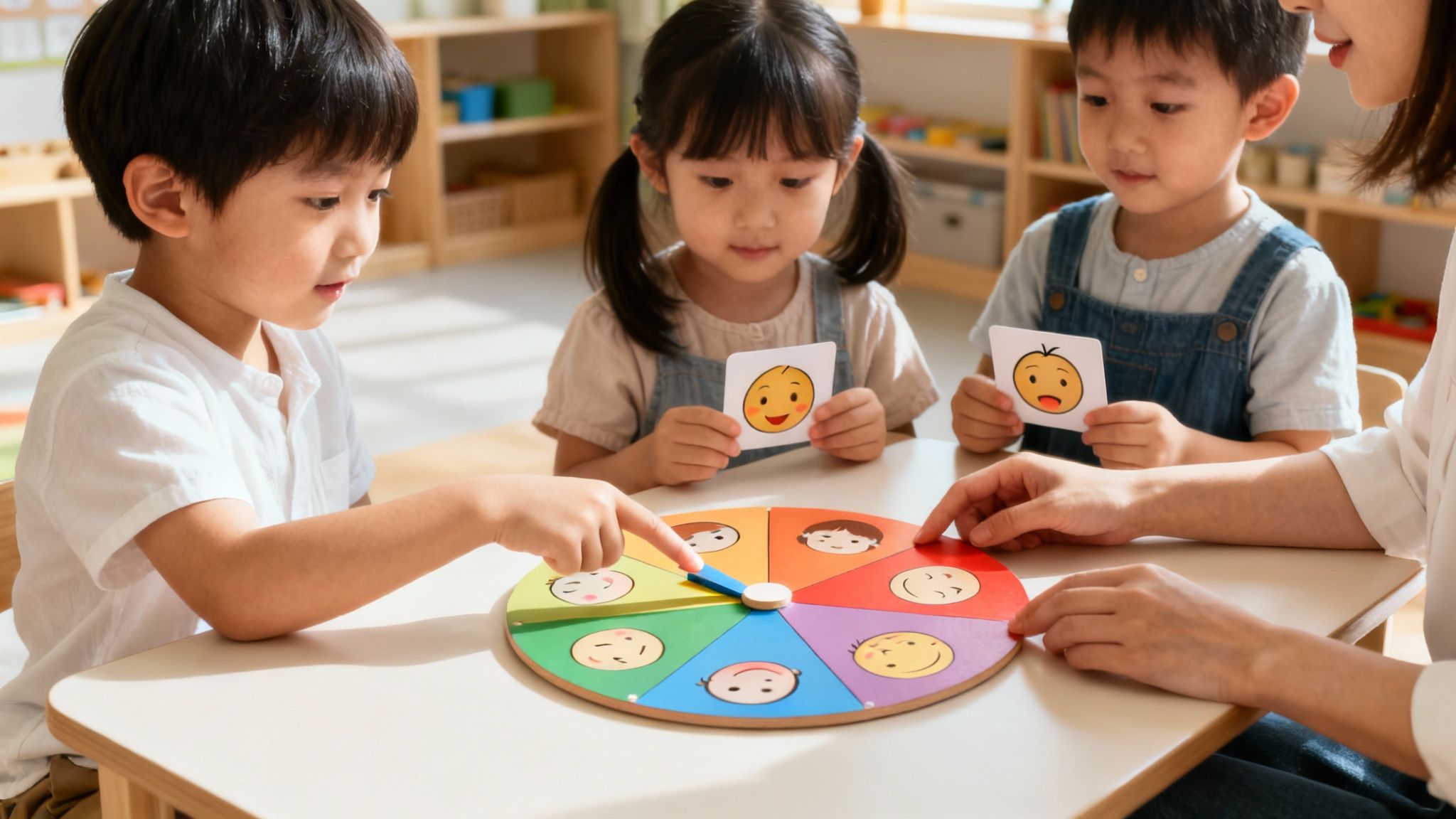
Before a child can say, “I’m upset because you knocked over my tower,” they first have to know what “upset” even feels like in their body. This core skill—the ability to spot, understand, and name our feelings—is called emotional literacy. It’s truly the bedrock of conflict resolution.
Without it, a small frustration can quickly snowball into a full-blown tantrum because the child simply doesn’t have the tools to explain their inner world. Our goal is to help them shift from showing their feelings (crying, yelling, stomping) to telling us about them. It all starts with giving them a rich emotional vocabulary. A strong foundation here is essential for their overall social and emotional wellbeing.
Name It to Tame It
There’s a powerful strategy I always come back to: “Name It to Tame It.” The simple act of putting a label on a big, confusing feeling makes it feel less overwhelming and much more manageable. For our youngest learners, this begins with the basics: happy, sad, angry, and scared.
When you see a child in the grip of an emotion, your job is to be a mirror and a narrator.
Practical Example (Kindergarten):
Imagine a kindergartener throws their crayons after a drawing goes wrong. Instead of jumping to a correction, try narrating what you see. “Wow, you slammed your hands down. It looks like you’re feeling frustrated that the lines aren’t straight. Is that right?”
This does two powerful things at once: it hands them the word “frustrated” for their emotional toolkit and it validates their feeling, sending the message that it’s okay to feel that way.
Hands-On Activities for Emotional Literacy
Emotional learning really sticks when it’s interactive. Abstract ideas like “disappointment” become real and understandable when kids can see, touch, and play with them.
Here are a few activities you can try in the classroom or at home:
- Create a ‘Feelings Wheel’: On a paper plate or a large circle of paper, draw different feeling faces—happy, sad, angry, surprised, worried. When a child is struggling to find the words, they can just point to the face that matches how they feel. It’s a fantastic pre-verbal tool.
- Emotion Charades: Write different emotions on slips of paper and toss them in a hat. Players take turns acting out the feeling without using any words. This is a fun way to help kids practice reading emotional cues in others, which is a huge part of empathy.
- Storybook Detectives: When you’re reading together, hit the pause button and ask, “How do you think that character is feeling right now? What clues in the picture or the words tell you that?” This teaches them to look for tells in facial expressions and body language. For more ideas, check out our guide on naming feelings and helping kids find the words they need.
Moving Beyond the Basics with Older Kids
With older kids in grades 4-8, emotional literacy gets more nuanced. Their social worlds are more complex, and so are their feelings. Now’s the time to start exploring the subtle, but important, differences between emotions that might seem similar on the surface.
Teaching children to distinguish between disappointment and jealousy, or between nervousness and excitement, gives them precision in their self-expression. It’s the difference between saying “I feel bad” and “I feel excluded because I wasn’t invited.”
To help them build this more advanced vocabulary, use gentle, observational language and ask curious questions. This builds self-awareness without putting them on the spot.
Coaching Script for an Older Child:
“I noticed you got really quiet and your shoulders slumped after you saw those pictures your friends posted. It looks like that hit you hard. Are you feeling disappointed you couldn’t be there, or is it maybe a little bit of jealousy, too?”
This approach gives them options and validates that their feelings might be complicated. It opens a door for a real conversation, rather than shutting it down with a generic “What’s wrong?” By building this foundational vocabulary, we give children the tools they need to understand themselves, state their needs clearly, and ultimately, resolve conflicts with confidence.
Teaching Kids to Use I-Statements and Active Listening
Once kids can put a name to their feelings, the real work begins: teaching them how to share those feelings without pointing fingers. This is where two of the most powerful tools in our conflict resolution toolbox come into play: I-Statements and active listening.
These skills shift the entire dynamic from accusation to communication, opening up a space where kids can actually understand each other.
Our goal is to help them move away from “You-Statements” like, “You’re so annoying!” or “You always mess up my stuff!” These phrases are conversation enders. They immediately put the other person on the defensive and slam the door on any real solution. Instead, we want to give them a way to talk about what’s happening on their side of the fence.
The Power of I-Statements
An I-Statement is a simple but mighty tool that helps a child own their feelings and state their needs clearly and respectfully. It follows a straightforward formula that pulls the blame right out of the conversation.
The magic formula is: I feel [feeling] when you [specific behavior] because [the impact it has on me].
Breaking it down this way helps kids see they aren’t attacking the other person; they’re just explaining their own reality. This structure is one of the most effective ways to teach children to communicate their feelings, and you can learn more about the magic of I-feel statements for kids in our detailed article.
Let’s look at how this plays out in situations we all see every single day.
Scenario 1: The Sibling Closet Raider
- Instead of: “You always steal my clothes! You’re so selfish!”
- Try This I-Statement: “I feel frustrated when you take my favorite hoodie without asking because I was planning to wear it and now I can’t find it.”
Scenario 2: Feeling Sidelined in a Game
- Instead of: “You never pass the ball to me! You’re a ball hog!”
- Try This I-Statement: “I feel left out when I’m open but don’t get a pass because it makes me feel like I’m not part of the team.”
Giving children sentence starters can make this feel way less intimidating. Try writing prompts on a whiteboard or creating a “peace table” at home with cues like: “I feel…” “It bothers me when…” or “I need…”
Shifting from Hearing to Listening
The other half of this communication puzzle is teaching kids how to truly listen. Let’s be honest, most of us listen just to figure out what we’re going to say next. We’re just waiting for our turn to talk.
Active listening, on the other hand, is about listening to understand.
This skill doesn’t come naturally; it needs to be coached. It’s about more than just staying quiet—it’s about showing the speaker you’re engaged and really trying to see things from their perspective. The impact here is huge. In fact, schools that teach conflict resolution tools often see bullying incidents drop by 35-50%, and students show a 24% improvement in their relationships. You can dive into the research by exploring the full report on educational programs and peace.
Here are a few simple techniques to get started:
- Nodding and Making Eye Contact: These small physical cues send a powerful message: “I’m with you. Keep going.”
- Putting Away Distractions: This means putting down the toy, pausing the video game, or turning to face the person who is speaking.
- Asking Clarifying Questions: Simple questions like, “What did you mean by that?” or “Can you tell me more?” show genuine curiosity and a desire to understand.
Try This: Playback Listening
One of the most effective strategies I’ve seen for ensuring understanding is an exercise I call Playback Listening. It’s a simple rule: before you can share your side of the story, you have to repeat back what you heard the other person say.
The point isn’t to agree with them. It’s to prove you were actually listening. The goal is to paraphrase their main point to their satisfaction.
Let’s see it in action during a screen-time squabble:
Imagine two kids, Alex and Ben, are arguing over a shared tablet.
Alex uses an I-Statement: “I feel angry when you keep playing after the timer went off because you promised it would be my turn.”
Ben uses Playback Listening: “So, you’re saying you’re angry because I didn’t stop when the timer went off, and you were supposed to have your turn?”
Alex confirms: “Yes, that’s right.”
Only after Alex confirms that Ben gets it can Ben share his perspective. This one simple step prevents countless misunderstandings. It forces both kids to slow down, take a breath, and truly hear each other, building a bridge of empathy before they even start looking for a solution.
A Practical Framework for Solving Problems Together
Knowing how to name their feelings is half the battle for kids. The other half? Having a clear, predictable plan to actually solve the problem.
Without a roadmap, kids get stuck in the emotional storm of a disagreement, completely unable to see a way out. This is where a simple, practical framework becomes a game-changer. It gives them a tangible process to follow, moving them from conflict to a real solution.
You can make this even more concrete by creating a dedicated physical space for it. Think of it as a “Peace Corner” in your home with some comfy pillows, or a “Resolution Table” in the classroom. Having a designated spot signals that this isn’t a time for arguing—it’s a special time for listening and problem-solving.
Set the Stage for Success
Before you even think about solutions, the environment has to feel safe and supportive. The whole point is to shift kids from a defensive, “me vs. you” mindset to a collaborative, “us vs. the problem” one. As the adult, your role is to be a neutral coach, guiding them with questions instead of just handing them the answers.
This approach is right in line with the principles of restorative practices, which focus on repairing harm and strengthening relationships over assigning blame. If you’re curious, you can learn more about what restorative practices in education look like and see how they create more connected school communities.
Once you have your space, you can introduce a simple, memorable process. This visual flow is a great starting point:
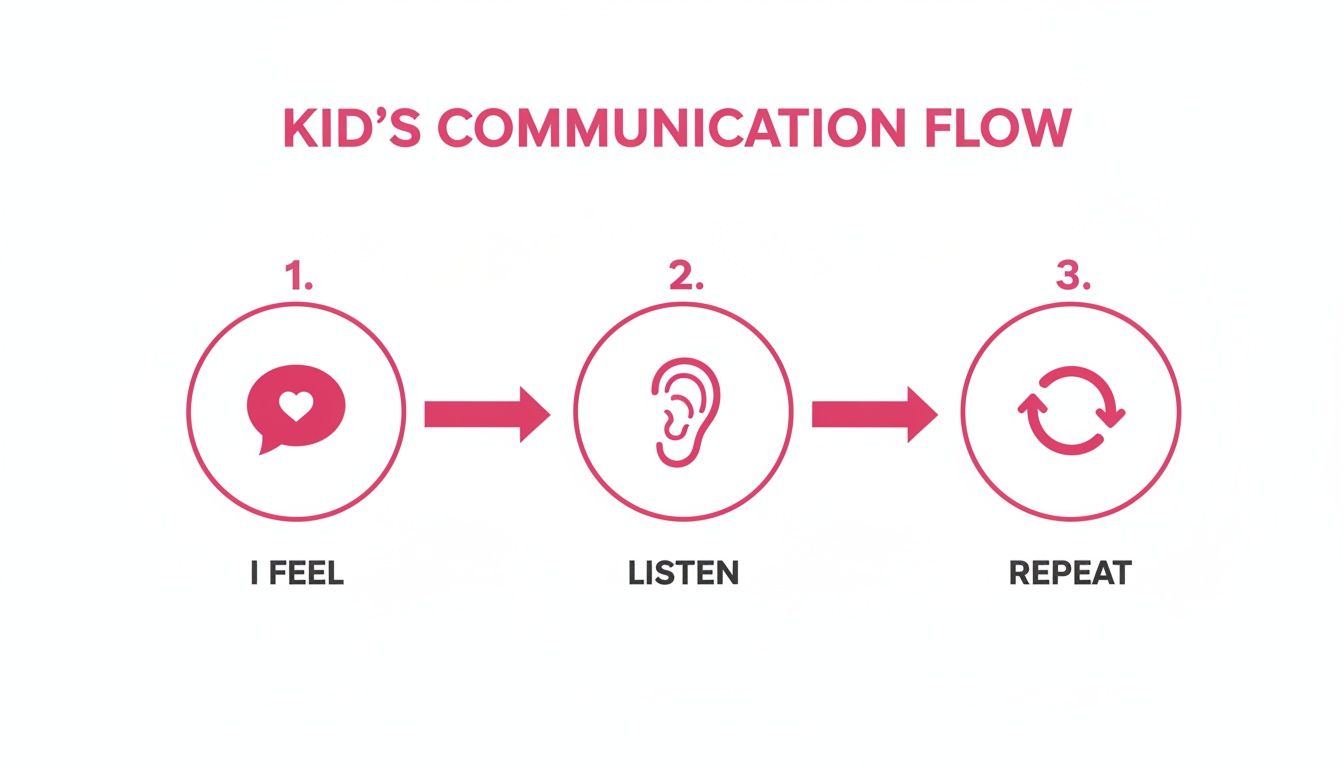
It’s a simple reminder that before we jump to fixing things, we have to express our own feelings and truly hear what the other person is saying.
A 4-Step Process for Finding Solutions
When kids are ready to solve the problem, you can guide them through these four actionable steps. This structure provides the scaffolding they need to build their own agreements and feel empowered.
- Step 1: Take a Breath & State the Problem (No Blame!). The first move is always to calm those big emotions. Once they’re a little more centered, each child gets to state the problem from their point of view using an “I-Statement.” The goal is just to define the issue clearly, like, “The problem is we both want to use the blue marker right now.”
- Step 2: Brainstorm Solutions Together. This is the “no bad ideas” phase. Get creative! Write down every single suggestion, even the silly ones. For younger kids, you can make this visual by drawing the ideas on a whiteboard.
- Step 3: Agree on a Win-Win Solution. Now, look over that brainstormed list together. Guide them in a discussion about which solution feels fair to everyone involved. The key here is mutual agreement. You might ask, “Is this a solution you can both feel good about?”
- Step 4: Give the Solution a Try. Once a solution is picked, it’s time to put it into action. Remind them that this is an experiment. If it doesn’t work out, that’s okay! They can always come back to the Resolution Table and try another idea from their list.
For older kids, you could even formalize the agreement a bit. Have them write down their chosen solution on a piece of paper and sign it like a “Friend Agreement.” This little step adds a real sense of ownership and commitment to their plan.
Age-Appropriate Conflict Resolution Scenarios and Solutions
The 4-step process is flexible enough for different age groups, but how you coach them through it will change. Younger kids need more direct guidance and simpler language, while older students can handle more complex brainstorming and abstract reasoning.
| Common Conflict | K-3 Approach (Example) | 4-8 Approach (Example) |
|---|---|---|
| Two kids want the same swing. | 1. State Problem: “We both want the swing.” 2. Brainstorm: “Take turns,” “Swing together,” “Play on something else.” 3. Agree: “Let’s use a timer for 5-minute turns.” 4. Try It: Set the timer and start swinging. | 1. State Problem: “We can’t agree on who gets the swing first.” 2. Brainstorm: “Rock-paper-scissors,” “One person gets it today, the other tomorrow,” “Find a different activity we both like.” 3. Agree: “Rock-paper-scissors for the first turn, then 10-minute timers.” 4. Try It: Play the game and honor the outcome. |
| A friend said something hurtful. | 1. State Problem: “I feel sad because my feelings were hurt.” 2. Brainstorm: “Say sorry,” “Draw a picture to show feelings,” “Ask for a hug.” 3. Agree: “I will say sorry for hurting your feelings.” 4. Try It: One child apologizes, and the other accepts. | 1. State Problem: “I feel disrespected by that comment.” 2. Brainstorm: “Talk about why it was hurtful,” “Explain my side,” “Agree on respectful ways to talk,” “Take a break from each other.” 3. Agree: “We agree to explain our feelings without interrupting and to apologize for the impact.” 4. Try It: Have a structured conversation using I-statements. |
| Disagreement over game rules. | 1. State Problem: “We don’t agree on the rules.” 2. Brainstorm: “Ask a grown-up,” “Make up a new rule,” “Play a different game.” 3. Agree: “Let’s make up one new rule for this game.” 4. Try It: Play one round with the new rule. | 1. State Problem: “The official rules are confusing, and it’s causing an argument.” 2. Brainstorm: “Read the rulebook together,” “Look up a video tutorial,” “Vote on an interpretation,” “Modify the rule for our game.” 3. Agree: “Let’s watch a quick ‘how to play’ video to clarify.” 4. Try It: Watch the video and restart the game. |
Seeing these real-world examples helps make the process feel less abstract and more achievable for both kids and the adults guiding them.
Coaching Kids Through a Disagreement
Let’s see how this works in a real scenario. Imagine two friends, Maya and Leo, are arguing over the rules of a board game.
Adult Coach: “It sounds like you’re both feeling really frustrated. Why don’t we head to the Resolution Table? Maya, can you start by telling us the problem without blaming Leo?”
Maya: “The problem is that I think we’re supposed to draw two cards, but Leo says it’s only one.”
Adult Coach: “Thanks for sharing that so clearly. Leo, what do you think the problem is?”
Leo: “The problem is the rules are confusing, and we’re arguing instead of actually playing.”
Adult Coach: “Great, we know the problem. Now, what are some possible solutions? Let’s brainstorm.”
Maya: “We could just guess and keep playing.”
Leo: “We could look up the official rules online.”
Maya: “We could make up our own rule just for this one time.”
Leo: “Or we could just play a totally different game.”
Adult Coach: “Those are four fantastic ideas. Which one feels fair to both of you?”
Maya: “I think looking up the rules online is the fairest.”
Leo: “I agree. That way we’ll know for sure.”
Adult Coach: “Excellent. You found a win-win solution. Let’s give it a try!”
Notice how the adult acted as a facilitator, not a judge. They simply asked questions and guided the conversation, which empowers kids to take ownership and solve their own problems. For a fun, low-stakes way to practice this, try incorporating some engaging family board games into your routine. They provide endless, natural opportunities to use this framework.
Coaching Kids Through More Complex Conflicts
While I-Statements and the basic problem-solving steps are fantastic for everyday squabbles, some conflicts just aren’t that simple. They’re messier. We’re talking about situations with deeper issues like power imbalances, rumors, social exclusion, or even a child who just shuts down and refuses to engage.
In these moments, your role has to shift. You’re no longer just a hands-off facilitator; you become a more active, supportive coach.
These tougher situations demand more nuance and a whole lot of patience. It’s not about swooping in to fix everything for them. Instead, you’re providing the scaffolding kids need to navigate these tricky social dynamics on their own. The goal is to stay neutral while empowering them to find their own way forward, even if the path is a little bumpy.
Knowing when to step in and when to let kids struggle a bit is an art. If safety is ever a concern, you intervene immediately. But if the stakes are lower, letting them grapple with the problem can build incredible resilience and problem-solving confidence.
Navigating Power Imbalances
Conflicts between an older, more assertive child and a younger, quieter one are incredibly common. Right from the start, the power dynamic is skewed, and the younger child can easily feel steamrolled. Your job is to level the playing field.
A great first step is to give the quieter child the floor first, making sure they have uninterrupted time to speak their mind. You might even need to help them find the right words.
- Coaching in Action: During a dispute over a shared space in the classroom, you might say to the younger child, “It looks like you have some big feelings about this. Can you tell us what’s on your mind? We’re all going to listen quietly.” This simple act validates their voice and sets clear expectations for the other child.
After they’ve spoken, use playback listening to ensure the older child truly heard them. This forces them to pause their own agenda and genuinely consider another perspective.
Addressing Social Exclusion and Rumors
When a conflict is about rumors or being left out, the hurt is often invisible but cuts deep. These situations are less about a tangible problem and more about mending relationships and tending to emotional pain. The focus has to be on empathy and impact.
Instead of getting bogged down trying to prove a rumor true or false, guide the conversation toward how the words or actions made someone feel.
“When coaching kids through social conflict, shift the focus from intent to impact. A child may not have intended to be hurtful, but acknowledging the impact of their actions is the first step toward genuine repair.”
Use gentle, curious questions to open up a real dialogue. You have to avoid blaming language, which will almost always cause a child to shut down.
- Instead of: “Why would you spread that rumor?”
- Try This: “I heard what was said, and I saw how it landed with Sarah. Can you help me understand what was going on for you in that moment?”
This approach invites reflection instead of defensiveness, creating the space needed for empathy to grow. The consequences of social isolation can be huge. Globally, 222 million crisis-impacted children need educational support, and programs that build these exact emotional skills have been shown to boost positive social approaches by 25-35%. You can learn more about how social-emotional skills support children in crisis on unesco.org.
When a Child Refuses to Participate
So, what do you do when one child crosses their arms, digs in their heels, and declares, “I’m not talking”? This refusal is usually a defense mechanism. It comes from a place of feeling overwhelmed, angry, or totally misunderstood. Forcing them to participate will only backfire.
The key is to give them space, but not an exit pass.
- Acknowledge and Validate: Start by saying something like, “I can see you’re not ready to talk right now, and that’s okay. It looks like you’re feeling really angry.”
- Offer a Cool-Down Period: Suggest a brief break in a designated calm-down corner. “Why don’t you take five minutes to cool off, and then we can try again? We’ll be here when you’re ready.”
- State the Inevitability of Resolution: Make it clear that the problem isn’t just going to disappear. “We still need to solve this problem together, so we’ll wait until you’re ready to join us.”
This approach honors their feelings while holding the boundary that resolution is still necessary. It teaches kids that while their emotions are valid, they are still responsible for their part in finding a solution. It’s a delicate balance, but one that builds both emotional intelligence and accountability.
Your Questions on Teaching Conflict Resolution Answered
As you start weaving these strategies into your classroom or home, questions are bound to pop up. Every kid is different, and every conflict has its own flavor, but the core ingredients—empathy, communication, and problem-solving—are always the same. Here are some of the most common questions I hear from parents and educators.
Think of this as your quick-reference guide. Each answer offers practical advice that connects back to the key strategies in this guide, helping you handle real-life situations with more confidence.
What Is the Best Age to Start Teaching Conflict Resolution Skills to Kids?
You can start laying the foundation for conflict resolution as early as age two or three. It all begins with the building blocks of emotional literacy.
For toddlers, it’s as simple as naming their big feelings. You might say, “You feel so angry that your tower fell down!” This simple act connects a word to a powerful, overwhelming emotion. For preschoolers (ages 4-6), you can introduce basic ideas like sharing and taking turns, along with simple “I feel sad when…” statements to help them express their needs without pointing fingers.
The key is to start with a strong emotional vocabulary and build from there. The strategies in this guide are designed to be flexible for any child in the K–8 range, with the complexity of the problems and solutions growing right alongside them.
How Can I Help a Shy Child Who Avoids Conflict?
For a child who shies away from disagreements, our main goal is to build their confidence through safe, low-stakes practice. Conflict can feel huge and scary, so avoiding it feels like the only safe option. Your job is to show them they have the tools to handle it.
Start by role-playing common scenarios at home or in a quiet corner of the classroom. Practice simple but powerful phrases like, “I’m not finished with that yet,” or, “Please stop, I don’t like that game.”
Using I-Statements is particularly effective for shy children because it allows them to express their feelings and needs without feeling confrontational. It reframes the conversation around their experience, not another child’s wrongdoing.
Reassure them that having a different opinion is perfectly okay and that standing up for their needs is a sign of strength. Make sure to celebrate every small step they take to find and use their voice.
What If the Other Child Refuses to Cooperate?
This is a huge—and very real—learning moment. It’s absolutely essential to teach kids that they can only control their own actions and choices, not anyone else’s.
The first and most important step is to ensure their physical and emotional safety. Teach them to walk away from a situation that feels stuck, hostile, or unproductive and to find a trusted adult. Frame this choice as smart and self-respecting, not as “giving in” or losing.
Practical Example:
If your child tries to use an I-Statement (“I feel frustrated when you keep changing the rules”) and their friend just laughs and says, “I don’t care,” the next step is crucial. Coach your child to say, “This isn’t working for me right now. I’m going to take a break and find an adult.” This empowers your child to make safe choices, even when others aren’t ready or willing to solve the problem. Once an adult is present, they can step in to mediate or address the other child’s behavior separately.
How Do I Align These Skills with My School’s SEL Program?
Consistency between home and school is a powerful amplifier for learning. The great news is that these conflict resolution skills are the foundation of most Social-Emotional Learning (SEL) and anti-bullying programs.
Reach out to your child’s teacher or school counselor. Ask about the specific language and tools they use in the classroom. Do they have a “Peace Path,” a “Cool-Down Corner,” or a “Resolution Table”? By creating a similar space or using the same vocabulary at home, you powerfully reinforce the learning.
When kids hear concepts like “I-Statements” and collaborative problem-solving steps in both environments, the skills really start to stick. It sends a clear message that these tools are important everywhere, creating a unified approach to their emotional growth.
At Soul Shoppe, we believe that every child deserves to feel safe, connected, and understood. Our programs equip K-8 school communities with the shared language and practical tools needed to turn conflict into connection. We provide students and educators with the skills to build empathy, communicate effectively, and solve problems together.
Discover how our experiential workshops and comprehensive SEL support can help your students thrive. Learn more about bringing Soul Shoppe to your school.