

A Principal’s Guide to SEL Programs for Schools That Work
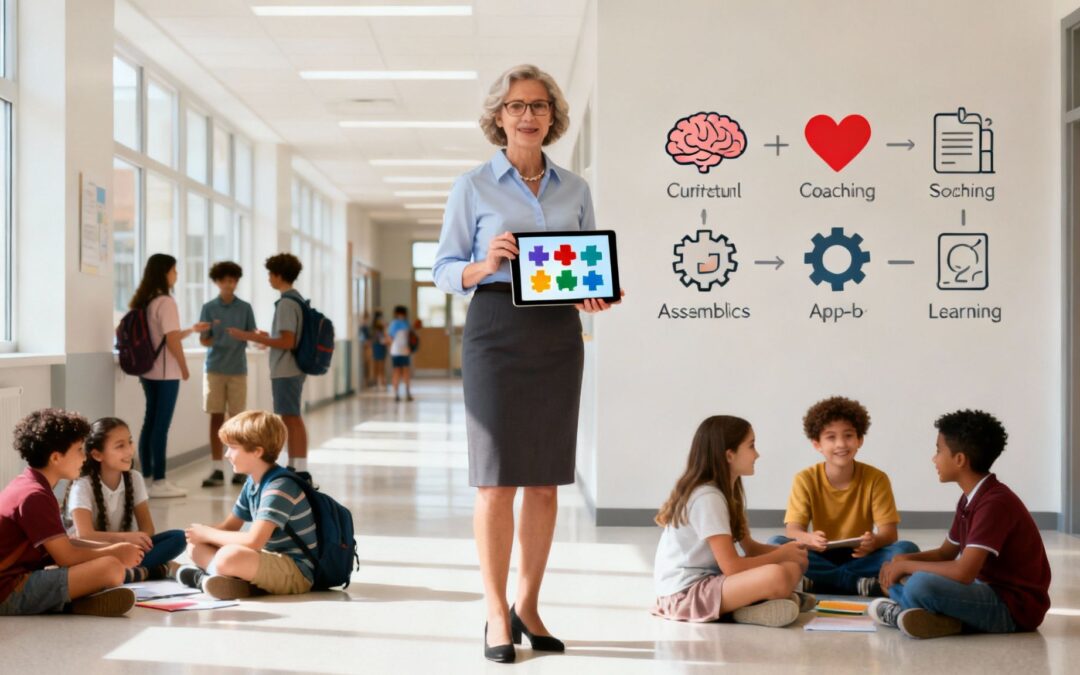
Effective SEL programs for schools aren’t just a “nice-to-have” anymore; they’re a foundational piece of a modern education. Think of them as an emotional operating system—the essential software that equips students with the core skills to manage academic pressures, navigate tricky social situations, and build a positive school culture from the ground up.
Why Effective SEL Programs Are No Longer Optional
Imagine a student’s education is a high-powered computer. You can load it up with the best programs—advanced math, engaging history lessons, creative arts—but none of it will run smoothly without a stable operating system.
That’s exactly what Social-Emotional Learning (SEL) is for our students. It’s the essential background processing that allows them to actually access academic content, manage stress, and work together. Without these skills, students often struggle to apply what they’re learning. SEL gives them the tools to not just succeed academically, but to thrive as well-rounded people.
The Core Competencies in Action
SEL is built on five core competencies that come to life every single day on campus. These aren’t just abstract concepts; they are the practical, real-world skills students use to navigate challenges big and small.
- Self-Awareness: A student recognizes they feel anxious before a big presentation and understands that this feeling is making it hard to focus. Practical Example for Teachers: You might notice a student is tapping their pencil rapidly or avoiding eye contact. A simple, private check-in like, “I see you’re getting ready for your presentation. It’s normal to feel some butterflies. What’s one thing you’re most proud of in your work?” helps them name the feeling.
- Self-Management: Instead of getting overwhelmed by that feeling, the student uses a deep-breathing technique they learned to calm their nerves and organize their thoughts. Practical Example for Parents: If your child is frustrated with their homework, you can say, “I can see this is really tough. Let’s try the ‘box breathing’ we learned: breathe in for four seconds, hold for four, out for four, hold for four. Let’s do it together three times before we look at the problem again.”
- Social Awareness: During a group project, one student notices a classmate is unusually quiet and seems frustrated. They practice empathy by asking, “Is everything okay? How can we help?” Practical Example for Teachers: During group work, you can prompt students with, “Take a moment to check in with your team. Is everyone’s voice being heard? Does anyone look like they might have an idea but haven’t shared it yet?”
- Relationship Skills: When a disagreement pops up about the project’s direction, the students use active listening and respectful communication to find a compromise, stopping the conflict before it escalates. Practical Example for Parents: If siblings are arguing over a toy, you can guide them by saying, “It sounds like you both want to play with the same thing. Let’s use our ‘I feel’ statements. Can you tell your sister, ‘I feel frustrated when you grab the toy from me’?”
- Responsible Decision-Making: The group talks through their options, considers the consequences for everyone involved, and chooses a path that ensures the project is completed fairly and on time. Practical Example for Teachers: Before recess, you could pose a quick scenario: “If you see a new student standing alone on the playground, what are three different choices you could make? What might happen with each choice?” This helps them practice thinking through consequences.
These everyday scenarios show exactly why effective sel programs for schools are so critical. They help students move from simply reacting emotionally to responding thoughtfully. A huge part of this is giving children healthy coping mechanisms for complex emotions. Offering tools and resources for reducing anxiety in children is a perfect example of putting this into practice.
An effective SEL program doesn’t just teach students what to learn; it teaches them how to learn. It builds the resilience, focus, and collaborative spirit necessary for a productive and positive campus culture.
Ultimately, bringing SEL into your school is a strategic move to address some of education’s most persistent challenges. From boosting student mental health to reducing behavioral issues, these programs create an environment where both academic and personal growth can truly flourish. For a deeper dive into why this is so fundamental, you can explore more about why SEL matters for today’s students.
Exploring the Four Main Models of SEL Programs
Choosing the right SEL program for your school can feel like a huge task, but it helps to know they generally fall into four main models. Each one offers a different way to build social-emotional skills, and the best fit really depends on your school’s unique culture, resources, and goals.
Think of it like tending a school garden. You could plant seeds in individual pots, cultivate a large community plot, or enrich the existing soil everywhere. Similarly, SEL programs can be targeted or school-wide, structured or integrated. Getting a handle on these delivery methods is the first step toward finding a solution that will truly take root and flourish on your campus.
Structured Curriculum Programs
The most traditional model is a structured curriculum. This approach provides explicit, weekly lessons on specific SEL competencies, much like a dedicated math or reading block. It’s designed to ensure that SEL skills are taught consistently and systematically to every single student.
Picture a third-grade teacher leading a 20-minute lesson on empathy every Tuesday. The lesson might kick off with a story about a character who feels left out, followed by a class discussion and a role-playing activity where students practice inviting a classmate to join their game.
- Pros: This model guarantees that all students receive direct instruction on core SEL skills. The lessons are often pre-planned, which is a huge time-saver for busy teachers.
- Cons: It can sometimes feel like “one more thing” to cram into an already packed schedule. If the concepts aren’t connected to daily school life, the lessons risk feeling isolated from students’ real-world experiences.
This decision tree shows how SEL skills can become the go-to tool for students navigating everyday challenges like stress.
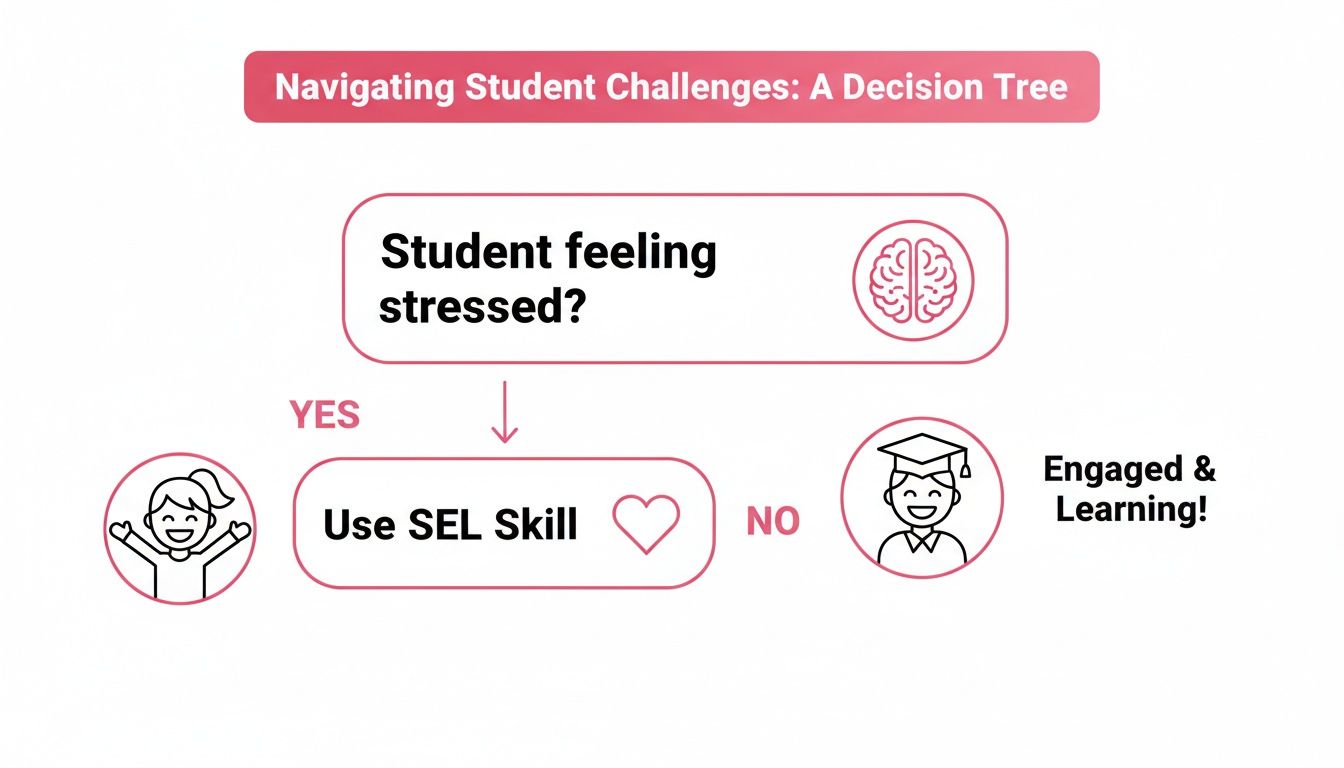
The key insight here is that SEL gives students a proactive pathway. It empowers them to actively manage their feelings rather than just reacting to them.
Integrated Teacher Coaching
Another powerful approach is integrated teacher coaching. Instead of treating SEL as a separate subject, this model focuses on professional development that helps teachers weave SEL concepts directly into their existing academic instruction. It’s less about adding new lessons and more about enriching the ones already happening.
For instance, during a history lesson about a difficult event, a teacher coached in SEL might prompt students to discuss the different perspectives of the people involved (social awareness). Or, before a challenging science experiment, they might lead a brief goal-setting exercise to build perseverance (self-management). This method makes SEL a natural, seamless part of the learning process.
High-Impact Assemblies and Workshops
The third model centers on high-impact assemblies and workshops. These are school-wide events designed to build a shared language and collective excitement around a core SEL concept, like conflict resolution or creating a sense of belonging. They work as a powerful catalyst for a positive school culture.
A perfect example is a school hosting an assembly that introduces a memorable, easy-to-use tool for managing frustration. Students and staff learn the tool together, and it becomes a common reference point. When a conflict later pops up on the playground, a yard-duty supervisor can simply say, “Remember the ‘Peace Path’?” creating an immediate, shared understanding of how to resolve the issue constructively.
This model excels at creating a ripple effect. A single, powerful experience can introduce concepts and tools that teachers, students, and staff can refer to and build upon for the rest of the school year.
Supplementary App-Based Tools
Finally, supplementary app-based tools offer a digital way to reinforce SEL skills. These programs give students opportunities for personalized practice through games, journaling prompts, and interactive scenarios on tablets or computers.
Imagine a student using a school-approved app for 10 minutes during a quiet work period. The app might present them with a scenario about feeling disappointed and guide them through a virtual exercise on identifying their emotions and choosing a healthy coping strategy. These tools are excellent for reinforcing lessons and giving students a private space to practice self-awareness and self-management at their own pace.
Comparing SEL Program Models
To help you sort through these options, here’s a quick-reference table comparing the four main models. Use it to get a clearer picture of which approach might align best with your school’s current needs, resources, and long-term vision.
| Program Model | Best For | Implementation Effort | Example in Action |
|---|---|---|---|
| Structured Curriculum | Schools needing a systematic, consistent approach that guarantees direct instruction for every student. | Medium to High: Requires dedicated time in the master schedule and teacher training on the curriculum. | A 30-minute SEL lesson on responsible decision-making is taught every Friday morning in all 4th-grade classrooms using a pre-made curriculum with videos and worksheets. |
| Integrated Coaching | Schools aiming to embed SEL into the fabric of daily academics, making it feel more natural and less like an “add-on.” | High: Requires significant investment in ongoing professional development and coaching for all teachers. | A science teacher uses a group lab experiment to explicitly teach collaboration, communication, and how to handle frustration when the experiment doesn’t work as planned. |
| Assemblies & Workshops | Schools looking to kickstart their SEL initiative, create a shared vocabulary, and build school-wide buy-in quickly. | Low to Medium: Involves scheduling the event and some light prep, but often relies on an outside provider for delivery. | An all-school assembly introduces a conflict-resolution tool called the “I-Message.” For the rest of the year, teachers and students use the phrase “Use your I-Message” on the playground and in the classroom. |
| App-Based Tools | Schools wanting to provide personalized, self-paced practice to reinforce concepts taught in other ways. | Low: Primarily involves procuring the software and integrating it into technology or quiet-time blocks. | During “choice time,” students spend 15 minutes twice a week on an app that provides scenarios for practicing empathy and identifying emotions in others. |
Each model has its strengths, and it’s not an all-or-nothing choice. Many schools find the most success by blending elements from multiple approaches to create a custom SEL strategy that truly serves their community.
The Impact of Evidence-Based SEL Programs
Choosing to invest in SEL programs for schools is a big decision, but the results from evidence-based approaches really do speak for themselves. This isn’t just about making students feel good; it’s about creating tangible, measurable improvements in your school’s climate and even its academic outcomes. When students learn how to manage their emotions and build healthy relationships, the entire campus culture starts to shift for the better.
That shift creates a powerful ripple effect. A more positive school environment naturally leads to fewer behavioral issues, which means teachers can spend more of their precious time actually teaching. In turn, students feel safer and more connected, making them more open to learning and more willing to participate in class.

From a Safer Hallway to Higher Test Scores
The line between social-emotional skills and academic success is direct and well-documented. Students who develop skills like perseverance, focus, and responsible decision-making are simply better equipped to tackle tough academic material. They’re less likely to give up when they get frustrated and more likely to ask for help when they need it.
Let’s look at a real-world example. Imagine a middle school that decides to implement an SEL program focused on relationship skills and conflict resolution.
- Before SEL: Hallway conflicts and minor scuffles between classes were a daily headache, causing frequent disciplinary referrals and lost instructional time. Students even reported feeling anxious during passing periods.
- After SEL: The school introduces a shared language for disagreeing respectfully and solving problems. Teachers model these skills, and students get to practice them through role-playing in class. Six months later, the school sees a 30% reduction in hallway-related discipline incidents because students are using “I-statements” instead of shoving.
This isn’t just a behavioral win; it’s an academic one, too. The time teachers once spent managing conflicts is now dedicated to learning, and the drop in student anxiety creates a more focused educational environment for everyone. This is the kind of clear, positive outcome that helps administrators show the real value of their investment. You can see more data on how this works by reviewing the research behind Soul Shoppe’s programs.
The Data Behind Thriving School Communities
These positive effects aren’t just isolated stories. A massive review of 424 studies across 53 countries found significant boosts in school climate after SEL was introduced. The key findings? Stronger feelings of connection among students, better peer and teacher relationships, a noticeable drop in bullying, and an increased sense of safety.
On top of that, a national survey showed 83% of principals now use SEL curricula, with 72% reporting that it’s effective for supporting youth mental health. For a deeper dive, you can explore the full 2023 year-in-review on SEL trends.
An evidence-based SEL program is not an expense; it is a strategic investment. It builds the foundational skills that reduce behavioral issues, foster a positive climate, and directly support the academic mission of the school.
This kind of data gives school leaders the compelling evidence needed to advocate for funding and get buy-in from staff, parents, and the district. When you frame SEL as a core strategy for student success, you can make a powerful case that it’s an essential piece of a modern, effective education. The evidence is clear: when students thrive emotionally, they thrive academically.
How to Choose the Right SEL Program for Your Campus
Picking the right partner from the many sel programs for schools is a huge decision, one that will echo through your campus culture for years to come. To get it right, you have to look past the glossy brochures and slick marketing claims. This isn’t about buying a product; it’s about choosing a long-term partner for your school’s mission.
A truly great program won’t feel like a separate, add-on initiative. It should weave itself into your school’s unique ecosystem, feeling more like a set of tools that amplify the good work you’re already doing. To find that perfect fit, you need a clear set of criteria to sift through the options.
Start with Evidence and Alignment
First things first: any program you consider needs to have a solid foundation in evidence. An evidence-based program is one that’s been tested and proven to deliver measurable, positive outcomes. For the sake of your students and your budget, this is completely non-negotiable.
Just as important is cultural alignment. The program’s content has to connect with your student body. It should reflect their lived experiences and offer tools that feel relevant and useful to every single child, no matter their background.
Here are a few questions to get your initial review started:
- Is the program backed by research? Ask vendors for the studies or data that prove its effectiveness in schools like yours.
- Is the content culturally responsive? How does the program make sure its materials are inclusive and respectful of diverse family structures, cultures, and identities? For example, do scenarios include different types of families and names from various cultural backgrounds?
- Can it adapt to our school’s specific needs? A one-size-fits-all approach almost never works. Look for flexibility.
Evaluate Teacher Support and Professional Development
You could have the best curriculum in the world, but it will fall flat if your teachers aren’t equipped and excited to use it. A top-tier SEL provider knows their job doesn’t end when the boxes of materials arrive. They stick around, offering robust, ongoing support to make sure your educators feel confident and competent.
A program’s commitment to professional development is a direct reflection of its commitment to your school’s long-term success. A single, one-off training day is not enough; look for a partner who offers sustained coaching and support.
When you’re talking with potential vendors, dig deep into their training models. Vague promises of “support” just won’t cut it. You need specifics that prove they’ll be a true partner to your staff.
Sample Questions for Vendors:
- What does your initial training for our teachers actually look like? Is it a lecture, or is it interactive and hands-on?
- Do you offer ongoing coaching or professional learning communities for our staff? For instance, will a coach visit our classrooms to provide feedback?
- What specific tools do you provide for teachers to weave these skills into daily instruction, not just during a 30-minute SEL block? Do you provide sample scripts or question stems?
- Can you share a case study from a school with a similar demographic to ours?
Look for Strong Family and Community Engagement
Social-emotional learning doesn’t stop when the school bell rings. The most successful sel programs for schools build a bridge from the classroom to the living room. They give parents and caregivers resources and strategies to reinforce the very same skills their kids are learning on campus.
This creates a consistent emotional language that supports a child in every part of their life. When parents are actively engaged, they become powerful allies. So, you’ll want to look for programs that have a real, intentional family engagement component.
This might look like:
- Parent workshops or virtual training sessions that teach them the same coping strategies their children are learning.
- Take-home activities or conversation starters for families, like a “dinner table question” related to empathy.
- A dedicated app or portal with resources just for parents, such as short videos explaining how to handle common behavioral challenges at home.
By following this kind of structured evaluation, you can move forward confidently, knowing you’re choosing a program that won’t just check a box, but will become a true partner in building a thriving, emotionally intelligent school community.
A Step-by-Step Guide to Implementing an SEL Program
Rolling out a new social-emotional learning program isn’t a one-and-done event. It’s a journey. If you rush it, you risk creating confusion and meeting resistance from your staff. But when you treat it like the thoughtful process it is, you can weave SEL into the very fabric of your school’s culture for years to come.
Breaking the implementation down into clear, manageable steps is the key. It helps you build momentum, overcome common hurdles like staff skepticism, and bring your entire community along for the ride. Think of this as your roadmap from the initial spark of an idea to sustained success.

Phase 1: Build an SEL Team and Assess Needs
Before you can decide where you’re going, you need a team to help navigate. The first step is to assemble a small, dedicated SEL committee. Pull together a diverse group of administrators, teachers from different grade levels, your school counselor, and maybe even a parent representative. These folks will become the champions and core planners for the whole initiative.
Their first mission? To get a crystal-clear picture of your school’s current social-emotional landscape. What are your real strengths, and where are the most pressing challenges?
- Dig into the Data: Start by looking at what you already have. Review school climate surveys, attendance sheets, and discipline records to spot any patterns. For example, do discipline referrals spike during recess or in the cafeteria? This could point to a need for conflict-resolution skills.
- Listen to Your People: Send out short, anonymous surveys or hold informal focus groups with staff and students. Ask simple but powerful questions like, “What’s the biggest challenge students run into when working in groups?” or “When do you feel most supported at school?” A common answer like “Students get frustrated and give up” indicates a need for self-management and perseverance strategies.
This initial groundwork gives you the “why” behind the entire process. It’s what helps you choose a program that actually solves your school’s problems, not just one that checks a box.
Phase 2: Secure Buy-In from Staff and Stakeholders
Let’s be honest: no new initiative gets off the ground without widespread support. Getting true buy-in means connecting SEL directly to the daily realities of your teachers, staff, and families. You have to frame it not as “one more thing” on their plate, but as a powerful tool that makes their jobs easier and students’ lives better.
The most effective way to build support is to show, not just tell. Demonstrate how SEL skills can lead to a more manageable and engaged classroom, directly addressing common pain points like student disengagement and teacher burnout.
A great way to do this is by running a small pilot program with a handful of enthusiastic volunteer teachers. After six weeks, share their success stories and, more importantly, their data. Imagine presenting a simple chart showing a 25% decrease in classroom disruptions for the pilot group. That’s far more persuasive than just talking about potential benefits.
Phase 3: Plan the Launch
With your team in place and support starting to build, it’s time to map out the official launch. A great kickoff event does more than just announce the program—it generates real excitement and establishes a shared language from day one. This is your chance to set a positive, unified tone for the whole school year.
Consider launching with a high-energy, all-school assembly. You could introduce a new school motto tied to an SEL skill, like “Hawks Help Each Other Soar,” to reinforce relationship skills and social awareness. The key is to follow it up immediately with classroom activities that connect to the assembly’s theme, making sure the message travels from the auditorium right back to each student’s desk. For example, after the assembly, each class could create a poster illustrating what “Hawks Help Each Other Soar” looks like in the classroom, on the playground, and in the cafeteria.
Phase 4: Provide Effective and Ongoing Training
A single day of training won’t create lasting change. It just won’t. To be effective, professional development has to be practical, ongoing, and genuinely supportive. Your staff needs to feel confident and fully equipped to bring these new skills into their daily routines.
This means getting beyond theory and focusing on strategies teachers can use in their classrooms the very next day. To ensure the program is used as intended, many schools seek professional coaching support for their staff. High-quality support from a professional development program can provide the sustained coaching teachers need to feel like they’ve truly mastered these skills.
Phase 5: Monitor, Refine, and Celebrate
Implementation is an active process, not a “set it and forget it” task. You need a simple system for monitoring progress and gathering feedback so you can make smart adjustments along the way.
- Regular Check-ins: Use quick surveys or short discussions during staff meetings to ask teachers what’s working and what isn’t. An example question could be: “Which SEL strategy have you used most this week, and how did it go?”
- Listen to Students: Hold quarterly focus groups with a few students to hear their side of the story. Ask them things like, “Have you used the ‘calm-down corner’ this month? How did it help?” or “Can you tell me about a time you used an ‘I-message’ with a friend?”
- Celebrate the Wins: Publicly acknowledge progress, no matter how small. Share stories of students successfully resolving conflicts or teachers noticing better cooperation in the school newsletter. For instance, “A huge shout-out to Mrs. Davis’s class for their amazing teamwork on their science projects this week!” This reinforces the value of what you’re doing and keeps everyone motivated.
How to Measure the Success of Your SEL Investment
After putting time, energy, and budget into an SEL program, the big question always comes up: “How do we know this is actually working?”
Measuring the impact of sel programs for schools is more than just a box to check. It’s how you justify the investment, secure future funding, and—most importantly—celebrate real, tangible progress with your staff, students, and families.
The key is moving beyond simple anecdotes. You need a thoughtful mix of numbers-driven data and human stories. Just like you track reading levels and math scores, you can track the social-emotional health of your school, giving you a clear picture of your return on investment and helping you refine your approach over time.
Using Quantitative Data to Track Progress
Quantitative data gives you the hard numbers to show change. These are the objective metrics that school boards, district leaders, and other stakeholders often want to see first.
The best place to start is with the data you’re probably already collecting. Use it to establish a baseline before your program kicks off.
A few powerful metrics to track include:
- Disciplinary Referrals: A noticeable drop in office referrals for things like hallway conflicts or classroom disruptions is a strong sign that students are using new self-management and conflict-resolution skills. Practical Example: You can track not just the number of referrals, but the type. A decrease in referrals for “physical aggression” could show the impact of a conflict resolution unit.
- Attendance Rates: When students feel safer and more connected, they want to come to school. An uptick in attendance often reflects a more positive and welcoming school climate.
- School Climate Surveys: Use pre- and post-program surveys with specific questions. Think along the lines of, “Do you have at least one trusted adult at this school?” or “Do you feel safe in the hallways?” A positive shift in these responses is compelling evidence of success.
This focus on measurable outcomes is fueling huge growth in the market. The global social-emotional learning market, which hit USD 4.0 billion, is projected to soar to USD 21.1 billion by 2033. Web-based tools now hold a 57% market share, largely because they make it easier for schools to collect the data they need to prove their programs are working.
Capturing Qualitative Insights and Stories
While numbers are powerful, the real heart of SEL’s impact often lies in the stories. Qualitative data captures the human side of your program’s success, illustrating how and why the culture is changing in ways that numbers alone can’t.
Qualitative measurement is about listening for the echoes of your SEL program in the daily life of your school. It’s hearing a student use a specific tool to solve a problem or a teacher describing a more cooperative classroom.
Gathering these insights doesn’t have to be complicated.
You could conduct brief student focus groups, asking them to share examples of when they used a new strategy to handle a tough situation. Collecting teacher testimonials about shifts in classroom cooperation or student confidence also provides powerful, relatable evidence. For example, a teacher might share, “Before, group projects were a struggle. Now, I hear students saying things like, ‘Let’s make sure everyone gets a turn to speak.’ It’s a small change, but it has made a huge difference.”
When you combine a teacher’s story about fewer arguments with data showing a 20% drop in referrals, you create an undeniable narrative of success. Many schools also get rich qualitative feedback by using tools like daily check-ins for students to boost confidence with mood meters and reflection tools.
Common Questions About Bringing SEL to Your School
Even with the best plan in hand, questions are bound to come up. As a school leader, you’re likely hearing them from every direction—teachers, staff, and parents. Here are some of the most common ones we hear, with answers that can help you build confidence and clear the path forward.
How Much Class Time Does This Really Take?
This is probably the number one question from teachers, and it’s a fair one. The time commitment really depends on the model you choose. A formal curriculum might call for a 20-30 minute lesson each week, but honestly, the most powerful SEL isn’t an isolated event. It’s woven into the fabric of the day.
Think of it this way: a teacher can lead a 5-minute breathing exercise to help students manage pre-test jitters. That’s self-management in action. Or they might use a quick “turn-and-talk” activity during a reading lesson to build relationship skills. An incredible assembly can introduce a shared language around respect and empathy in a single afternoon, which teachers can then reference for months. The goal is integration, not addition.
How Do We Get Teachers On Board with Another New Thing?
Teacher buy-in is everything. Without it, even the best program will fall flat. The key is to stop presenting initiatives and start building them together. Involve your teachers from day one. Give them a real voice in the selection process so they feel a sense of ownership.
Then, invest in high-quality professional development that goes beyond a single workshop—ongoing coaching is what makes the skills stick. Most importantly, frame SEL not as another task on their plate, but as a tool to make their classrooms calmer and more manageable. When teachers see for themselves that these skills lead to fewer disruptions and more focused students, they’ll become your biggest advocates.
A teacher at a staff meeting might share a win: “You know how Michael and Sarah used to argue constantly over kickball? After we practiced our conflict resolution tools, they worked out a disagreement at recess all by themselves. It saved me 15 minutes of mediation, and they were back to playing in no time.”
Can We Use Grant Money for an SEL Program?
Yes, absolutely! Many evidence-based SEL programs for schools are a perfect fit for federal and state grants, especially those focused on student well-being, school climate, and academic recovery, like Title I or ESSER funds.
The trick is to connect the dots in your application. Don’t just say you want an SEL program; clearly link the program’s specific outcomes to the grant’s goals. Use data and evidence to show how it will improve attendance, reduce discipline referrals, or boost student engagement. For instance, in your grant proposal, you could write, “This SEL program will directly address our goal of reducing chronic absenteeism by fostering a greater sense of belonging and safety, which research shows is linked to improved attendance.” When you do that, you’re not just asking for funding—you’re presenting a powerful, data-backed solution.
Ready to build a more connected, empathetic, and successful school community? Soul Shoppe provides research-based, hands-on programs that give students and staff the practical tools they need to thrive. Find out how our assemblies, workshops, and coaching can support your campus.