

Self Regulation Strategies for Elementary Students: 8 Tips
Stress, transition, academic frustration, and peer conflict can all push an elementary student out of thoughtful problem-solving fast. The good news is that self-regulation is teachable, especially when adults model it, practice it during calm moments, and reinforce it in the middle of real school routines. A 2022 review of school-based self-regulation programs found consistent improvement in 66% of the 50 studies, with gains showing up across curriculum-based, family-based, mindfulness, yoga, exercise, and social-skills formats, and pooled task-based outcomes from 19 studies showed a moderate positive effect size of 0.42 with a 95% confidence interval of 0.32 to 0.53 (NIHR evidence alert). That matters because elementary students don't need one perfect trick, they need usable tools for feelings, bodies, thinking, and relationships.
In classrooms and at home, the best supports are the ones children can use during math trouble, hallway conflict, screen-time homework, or a hard goodbye. Soul Shoppe's connection, safety, and empathy-centered SEL approach fits that need because it gives students shared language for regulation, communication, and repair without treating big feelings as bad behavior.
1. The Zones of Regulation
A color chart can make emotional self-awareness easier for young children to grasp. The Zones of Regulation gives students a simple way to name what is happening in their bodies and brains by sorting feelings into four color-coded states, Blue, Green, Yellow, and Red. A child who can say, “I'm in Yellow,” is already doing more regulation work than a child who only acts out.
A classroom example makes the idea clearer. A 2nd grader may notice that the Yellow Zone shows up as fast speech, shaky hands, or restless legs, then choose a tool such as deep breathing or a short movement break. A teacher can also say to a 4th grader, “I see you might be in the Blue Zone. Let's look at your strategy list and pick one that fits.” Students learn this language faster when the same chart appears in classrooms, hallways, and cafeterias, because then the words mean the same thing everywhere.
Make the zone language concrete
Children need practice with the chart while they are calm. Role-play gives them that chance before a real problem starts. Create a strategy menu for each zone, then rehearse it during morning meeting or after recess. For example, Green Zone strategies might include deep breathing, movement, or talking with a friend. A quick class check can show whether students can match a feeling to a zone and a zone to a tool, which tells the teacher whether the lesson has moved from naming to use.
Practical rule: If a student can name the zone but can't choose a tool, the lesson isn't finished yet.
For K–2, keep the language short and visual, with simple pictures and one clear action for each zone. For 3–5, ask students to explain why they chose a zone and which strategy fits best, since older students can start linking body clues to choices more independently.
- Home-school transfer: Send the zone chart home and invite families to use the same words during homework, bedtime, or sibling conflict.
- Simple progress check: Notice whether students can name their zone without adult prompting and choose one matching strategy.
2. Mindfulness and Breathing Techniques
Mindfulness helps children practice paying attention on purpose, right now, without judging themselves for getting distracted. That idea becomes clearer when a child pauses, takes a breath, and returns to a hard task instead of spiraling into frustration. Calm is learned through repetition, the same way reading fluency grows through practice.
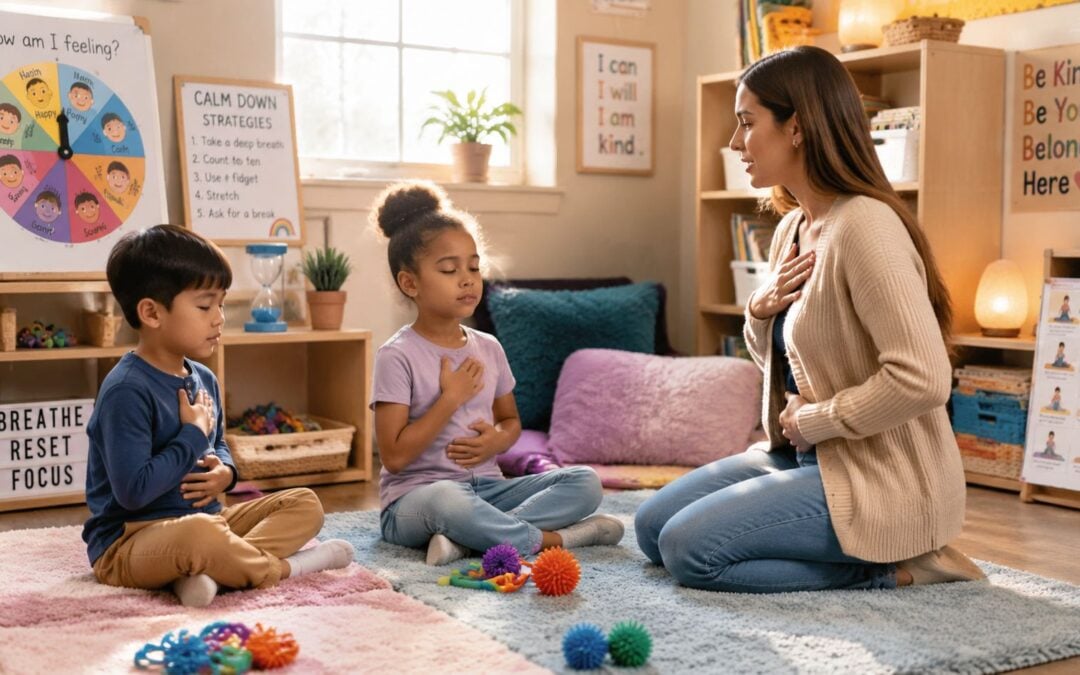
A classroom routine can start. A teacher might say, “Breathe in for 4 counts, hold for 4, out for 6. Notice how your body feels.” A 3rd grader can use box breathing at a desk during a test, and a parent can teach starfish breathing at bedtime by tracing each finger while breathing in and out. A body scan gives students another tool. They can notice feet, legs, stomach, and heartbeat, which helps them catch tension before it turns into a bigger reaction.
When breathing is paired with sound, the routine can feel even more settling. Teachers or families can choose mood music for videos with calming nature tracks or other quiet background music to support relaxation during breathing practice.
For a plain-language breathing guide that families can reuse, Soul Shoppe's belly breathing technique is a useful companion.
Some children do better with a picture cue. Others follow counts more easily. Both paths work, so the goal is not to find one perfect method, but to give students a few simple ways to reset their bodies. Keep the practice short at first, then repeat it often enough that the steps feel familiar before stress shows up.
A quiet corner can support this work if it includes visual cues, like expanding circles or a flower to smell and blow. Use the same breathing language before transitions so students hear the same script in the morning, after recess, and before challenging work. A teacher might say to the whole class, “Hands on belly, slow breath in, slow breath out.” A parent can use the same cue at home before reading or bedtime.
A calm breathing skill works best when adults teach it before the crisis, not during the crisis.
For younger children, the script should stay short and concrete. “Smell the flower, blow out the candle” gives K–2 students one image and one action they can repeat without much language load. For 3–5 students, invite them to choose the breathing style that fits the moment, such as before a quiz, during partner work, or after a disagreement.
A simple progress check is to watch what happens after frustration. If a child can settle faster, rejoin the task sooner, or resist a transition with less protest, the breathing routine is starting to work. Families and teachers can also notice whether students begin using the same language on their own, which shows the strategy is moving from adult-led practice to independent use.
3. Movement Breaks and Sensory Strategies
Some students calm down by moving, pressing, carrying, squeezing, or fidgeting. That is often a regulation need. When adults treat movement and sensory input as useful supports, children can stay in the room and still give their bodies what they need.
A teacher might lead a 5-minute dance break between lessons, with jumping jacks, spins, and toe touches. Another classroom might keep a movement menu on the wall with wall push-ups, bear crawls, jumping jacks, and stretches. A 4th grader who uses a textured fidget during morning meeting is using tactile input to stay focused. At home, a child doing homework with a weighted lap pad or compression blanket may settle better and work longer.
One student's story shows how specific this can be. A second grader who taps every pencil and swings in the chair may not need more warnings first. He may need heavy work before writing, like carrying books to the library, pushing a bin of supplies, or doing wall push-ups. Once his body gets that input, the pencil tapping often drops because the nervous system has something else to organize around. A simple classroom script helps: “First we move, then we work.”
The same idea fits transitions, too. A quick movement burst before math or writing can reset attention. If you want a fun classroom example bank, Soul Shoppe's fun brain breaks page connects movement with positivity and reset routines.
Match the sensory tool to the student
Not every child needs the same input. Some need motion, some need pressure, some need a fidget, and some need all three at different times. Ask students what helps them focus, then teach them when to use it and when to put it away. That keeps the tool tied to regulation, not random use.
You can also build proprioceptive work into the day, like pushing a cart, stacking chairs, or carrying supplies. Those tasks give organizing input to the nervous system and can prevent bigger behavior spikes later. If a child gets restless during independent work, offer a brief job that uses the body on purpose, then return to the task. The pattern is simple: give the body work, then ask the brain for work.
- K–2 adaptation: Offer two or three choices, such as stretch, dance, or wall push-ups.
- 3–5 adaptation: Let students self-select from a movement menu and explain why that choice helps.
- Simple progress check: Track whether the child returns to work faster after a break and needs fewer adult reminders.
4. Social-Emotional Check-ins and Reflective Conversations
A student often tells you how they're doing before they have the words for it. That's why short check-ins matter. They create a pause, show care, and give adults useful information before a small issue turns into a big one.
A morning check-in can be as simple as, “How are you feeling today? On a scale of 1 to 10, where are you at? Tell me more about that.” A parent might ask at dinner, “What was the hardest part of your day? What helped you through it? What might you do differently tomorrow?” Those questions build reflection, not just compliance. A counselor can also ask after an incident, “Help me understand what happened. What were you feeling? What do you need from me?”
Soul Shoppe's daily check-ins for students connects with this approach by using mood meters and reflection tools to help students notice and name their state.
A child who feels noticed is more likely to tell the truth about what they need.
Keep the conversation open and specific
Use open-ended questions instead of yes-or-no prompts. Make eye contact, pause long enough for a real answer, and reflect back what you hear. If a student seems quiet, try a private check-in and name what you noticed without accusing.
For younger students, feelings charts and emoji scales make it easier to answer. For older elementary students, a private one-on-one conversation can uncover stress that never shows up in whole-group settings.
- K–2 adaptation: Offer gesture-based responses, like thumbs up, sideways, or down.
- 3–5 adaptation: Ask students to explain the feeling, the trigger, and one support that might help.
- Simple progress check: Look for more honest sharing, quicker help-seeking, and fewer surprises.
5. Cognitive Reframing and Positive Self-Talk
Children believe their thoughts, especially when they are tired, embarrassed, or stuck. That's why self-talk matters. When a student says, “I can't do this,” the adult goal isn't fake cheerfulness, it's helping the child find a more accurate thought that makes effort possible.
A 3rd grader staring at a math problem can hear, “You haven't solved this yet. You can try a different strategy. What's one thing you could try?” A 5th grader before a presentation might repeat, “I've practiced this. I know my material. I can do hard things.” At home, a canceled playdate can become, “I'm sad the plan changed, and I can still have a good day doing something else I enjoy.” Those small shifts help children stay flexible instead of spiraling.
Soul Shoppe's life is perspective resource fits this kind of thinking because perspective-taking gives children another way to interpret a hard moment without denying the hard moment itself.
Teach students to question the thought
A simple thought-detective routine works well. Ask whether the thought is a fact or an opinion, then ask what evidence supports it and what evidence does not. That keeps reframing grounded and avoids toxic positivity.
Use anchor charts with phrases like Not yet, I made a mistake, and I need help. Students hear those phrases often enough that they start using them on their own during hard work.
- K–2 adaptation: Use picture-based reframes and short, repeatable phrases.
- 3–5 adaptation: Have students write or say a replacement thought before a tough assignment.
- Simple progress check: Notice whether the child recovers from a mistake without shutting down.
6. Problem-Solving and Conflict Resolution Skills
Conflicts don't disappear when kids get older. They just get more complex. That's why students need a reliable way to move from reacting to solving.
A 4th-grade pair can use a simple sequence after arguing over a basketball. First, each child tells their side without blame. Next, each listens. Then they name the problem together, brainstorm solutions, and pick one to try. A student can also use an I statement, like, “I felt left out when you didn't ask me to play. I'd like to be included next time.” That language is stronger than blame because it tells the other person what happened and what would help.
Classrooms can support this with a peace table or peace corner and a visual guide for the steps. Families can do the same thing at home when siblings argue over screens, chores, or turn-taking.
Useful rule: Don't rush to consequences before students have practiced repair.
Teach the steps before the conflict
Model the process during low-stakes moments, not only after a fight. Ask students to repeat what the other person said before they suggest a solution. That builds listening and reduces the urge to defend first.
A school can also use peer mediation when older elementary students are ready for more responsibility. When student leaders help classmates work through conflict, the process becomes part of the school culture instead of an adult rescue plan.
- K–2 adaptation: Use picture cards and simple choices, like “take turns, trade, or ask for help.”
- 3–5 adaptation: Have students practice active listening and solution brainstorming in role-play.
- Simple progress check: Look for shorter conflicts, more repair language, and less adult mediation.
7. Emotion Coaching and Validation
Emotion coaching tells students that feelings are real, names them clearly, and sets limits on behavior without shaming the child. That balance matters. A child who hears, “Your feelings make sense, and we still can't hit,” learns both safety and structure.
A 2nd grader melting down during cleanup might hear, “I see you're really upset. You're safe. I'm here. Let's notice that angry feeling together.” A 5th grader who blurts “I'm stupid” during math might hear, “I hear you're frustrated. You're not stupid. You're learning something hard. Let's take a break and come back.” A counselor can also say, “It sounds like your feelings are really hurt. That makes sense. What do you need right now?”
A classroom emotion thermometer helps children show intensity before behavior gets out of hand. If a student marks a 4 out of 5, the teacher can respond to the level instead of guessing.
Validate first, then coach
Stay low, calm, and warm. Name the feeling before solving the problem. If the child is overwhelmed, help with body calming first, then return to the issue after regulation improves.
Consistency between home and school helps a lot here. When adults use the same language for feelings, boundaries, and repair, students don't have to relearn the rules in every setting.
- K–2 adaptation: Use simple emotion words and body cues, like hot, tight, or shaky.
- 3–5 adaptation: Invite students to describe what happened, what they felt, and what they need next.
- Simple progress check: Notice whether the child accepts support faster and recovers without escalating as often.
8. Positive Reinforcement and Strengths-Based Recognition
Children repeat what gets noticed. If adults only point out mistakes, students learn to brace for correction. If adults also name effort, courage, kindness, persistence, and repair, students start to see those qualities as part of who they are.
A teacher might say, “I noticed you raised your hand and shared your idea. That took courage.” A class can use peer shout-outs, such as, “I want to recognize Marcus for helping a friend who was struggling.” Families can add a simple dinner ritual where each person shares something they did well and something they're proud of. Recognition can also focus on process, like, “I noticed you tried three different strategies before asking for help.”
A school might even build a recognition program around SEL behaviors, like noticing empathy, problem-solving, persistence, and helping others. The point isn't prizes, it's identity. Children begin to internalize the message that they are capable, helpful, and worth noticing.
Keep praise specific and believable
Say what you saw. Avoid vague praise like “good job” when you can be concrete instead. Specific feedback teaches the student what to repeat.
This works best when it's balanced with real expectations, not used to smooth over every struggle. A child still needs correction sometimes, but they also need to hear that effort and growth count.
- K–2 adaptation: Use stickers, brief notes, and immediate verbal recognition.
- 3–5 adaptation: Invite students to recognize peers and reflect on their own strengths.
- Simple progress check: Watch for more initiative, more peer kindness, and more willingness to try again.
Elementary Self-Regulation: 8-Strategy Comparison
| Strategy | Implementation complexity | Resource requirements | Expected outcomes | Ideal use cases | Key advantages |
|---|---|---|---|---|---|
| The Zones of Regulation | Moderate, requires explicit teaching and consistent use | Visual posters/charts, teacher training, strategy toolboxes | Improved emotional vocabulary and self-regulation; shared language schoolwide | Whole-class SEL in elementary grades; school-home consistency | Highly visual and concrete; normalizes emotions; promotes agency |
| Mindfulness and Breathing Techniques | Low–moderate, simple skills but need regular practice | Minimal: time, scripts/audio, brief training | Reduced anxiety/stress, improved attention and pause-before-reacting | Daily routines, transitions, individual calming needs | Evidence-based, portable, accessible to all students |
| Movement Breaks and Sensory Strategies | Low–moderate, planning and clear expectations needed | Space/short videos, optional sensory tools (fidgets, weighted items) | Increased focus, reduced restlessness, sensory regulation | Kinesthetic learners; classrooms with high energy; students with sensory needs | Embodied regulation; inclusive; preventative for dysregulation |
| Social-Emotional Check-ins & Reflective Conversations | Moderate–high, requires adult skill and time | Time allocation, trained adults, quiet/private space | Stronger relationships, early issue detection, deeper self-awareness | One-on-one support, small groups, students needing connection | Builds trust and metacognition; supports belonging and engagement |
| Cognitive Reframing & Positive Self-Talk | Moderate, abstract skills that need practice and modeling | Teaching materials, visual reminders, teacher modeling | Greater resilience, reduced negative self-talk, growth mindset | Students with anxiety, fixed-mindset tendencies, challenge situations | Teaches thought–feeling–action link; transferable lifelong skill |
| Problem-Solving & Conflict Resolution Skills | Moderate, requires explicit steps and rehearsal | Time for role-play, visual guides, adult facilitation | Fewer escalations, better peer relationships, collaborative solutions | Peer conflicts, restorative practices, classroom culture building | Promotes empathy, ownership, and sustainable conflict reduction |
| Emotion Coaching & Validation | Moderate, depends on adult regulation and patience | Training, time for brief one-on-one interactions, consistent practice | Reduced shame, improved emotional literacy, stronger adult–student bonds | Emotional moments, dysregulation incidents, caregiver interactions | Validates feelings, creates safety, uses moments for teaching |
| Positive Reinforcement & Strengths-Based Recognition | Low–moderate, needs consistent and equitable routines | Recognition systems (charts, rituals), staff buy-in, monitoring | Increased positive behavior, higher engagement, stronger self-worth | Schoolwide culture work, motivating overlooked students | Reinforces desired behaviors, builds intrinsic motivation and belonging |
Turn Regulation Tools Into Daily Habits
No single strategy works for every student or every emotional state. A child who needs movement after recess may need breathing before a test and a check-in after a conflict. The strongest classrooms usually start with one shared language tool, one body-based option, and one relationship-based routine, then teach those consistently before adding more.
A practical starting point is simple. Choose one visual language, like the Zones. Choose one calming body tool, like breathing or movement. Choose one relational routine, like a daily check-in or reflective conversation. Then model each tool, practice it during calm moments, and use it across school and home so the child hears the same script everywhere.
Track what you can see. Notice whether the student can name a feeling, choose a strategy, recover after frustration, ask for help, and repair conflict. Those signs matter more than a perfect worksheet or a quiet body for a few minutes. A child who can return to learning after a hard moment is building the core skill.
Home-school teamwork makes this stronger. Share the student's preferred tools, the words that help, and the routines that work best in both places. When families and educators use the same language, children don't have to start over every morning.
Soul Shoppe offers workshops, coaching, courses, an app, and SEL resources that support connection, safety, empathy, and shared regulation language for school communities and families. If you're ready to strengthen these habits with a practical, relationship-centered approach, visit Soul Shoppe and explore the tools that fit your students best.
If you want practical SEL support for classrooms, homes, and school communities, Soul Shoppe offers workshops, coaching, courses, an app, and classroom-ready resources built around connection and shared language. Visit Soul Shoppe to explore tools that can help elementary students practice self-regulation, repair conflict, and build confidence in everyday moments.