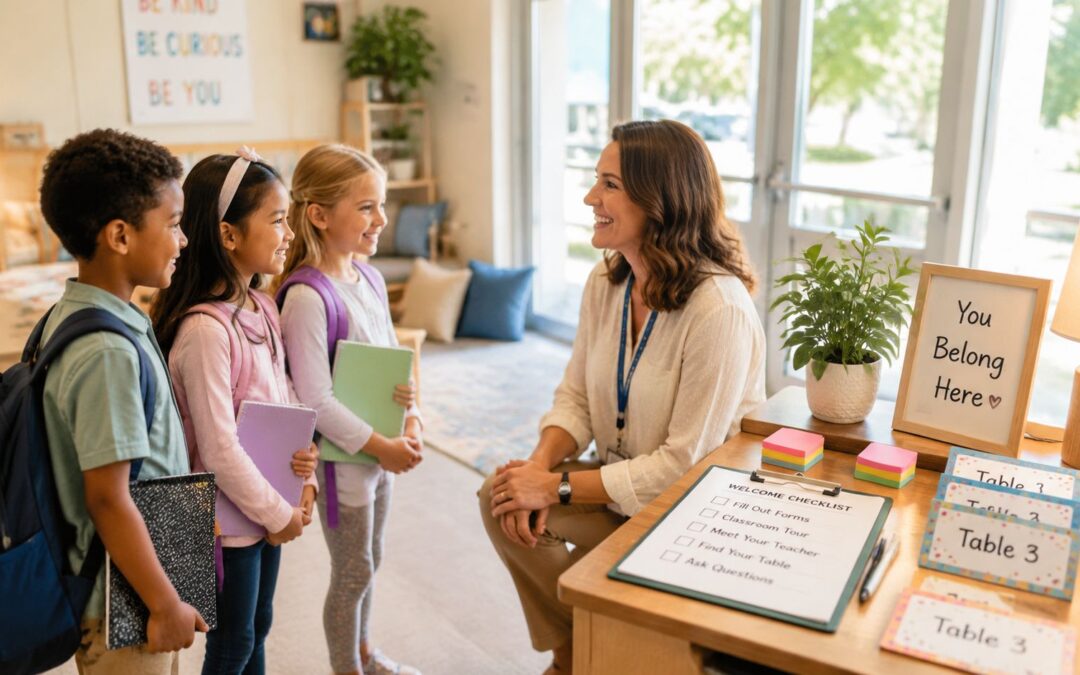
A new student steps into class at 10:17 on a Tuesday. The teacher is already mid-lesson. A few students look up, a few do not, and the student has to make fast judgments. Where do I sit? Who will talk to me? How embarrassed will I be if I get this wrong?

Educators and families see that moment all year, not just on the first day of school. New enrollments, midyear transfers, housing changes, schedule shifts, and delayed starts all put students into unfamiliar rooms with social rules they do not yet know. As noted earlier, enrollment data shows schools and campuses are continually receiving new students. Welcome practices need to work in August, in January, and during an ordinary week in October.

The problem is not only logistical. It is relational. As noted earlier, recent school climate reporting found that many students do not feel welcome enough to fully be themselves at school. That gap shows up quickly. A student who is unsure about belonging is less likely to ask for help, join a group, take an academic risk, or recover well from a mistake.

A smile at the door helps. It does not give a student a map.

Strong welcome systems do more than create a friendly first impression. They show students what to expect, who to go to, how adults will respond, and how families will be included. In practice, that means planning for three groups at once: the student entering the building, the staff members responsible for the transition, and the caregivers trying to make sense of a new setting.

That is the angle of this guide. It is not a list of vague reminders to be kind. It is an SEL-based set of school routines, family-facing supports, staff moves, age-specific adaptations, and simple tools educators can use in real conditions, including busy mornings, tight staffing, and mixed student needs. Schools that already use restorative circles in schools often understand this trade-off well. Warmth matters, but structure is what makes warmth dependable.

The eight strategies that follow are designed to help schools build a welcome process students can feel, staff can repeat, and families can trust.

1. Structured Welcome Circles and Community Meetings

A new student should not have to decode the social rules of a class by watching from the edge. A short, structured circle makes the norms visible right away. Students hear names, practice listening, and learn that this classroom expects people to notice one another.

A diverse group of students and a counselor sitting in a circle for a supportive group meeting.

In practice, this can look simple. The class gathers in a circle for ten minutes. The teacher opens with a prompt such as “share your name and one thing you enjoy after school,” then invites the new student to opt in at their comfort level rather than forcing a full introduction.

How to run the first circle well

Start light. If adults jump too quickly into “tell us about your feelings,” many students shut down, especially older ones. Safer prompts work better first: favorite snack, music, pets, a place you like, or one thing that helps you focus.

Then teach the listening behaviors explicitly. Look toward the speaker. Let people pass. Don't pile on advice. Thank people for sharing. Schools that use restorative circles in schools often do this well because the routine is not random. It has roles, agreements, and repetition.

Practical rule: Never make the new student the centerpiece of the activity. Make them part of a structure everyone uses.

A few examples by age group help:

  • K-2: Use a greeting song, a name ball toss, or “show with your fingers how you're feeling today.”
  • 3-5: Add partner shares before whole-group sharing so the student rehearses with one peer first.
  • Middle school: Use sentence stems on the board such as “A class helps me feel welcome when…” or “One thing I wish people knew about starting somewhere new is…”

Later in the week, revisit the circle and ask what's helping and what's still confusing. That second touchpoint matters. One welcome circle feels nice. A repeated community meeting feels safe.

Before moving on, some teams like to model the process in action:

2. Peer Buddy and Student Ambassador Programs

Adults can explain a schedule. Peers explain the social map. They know which lunch line moves fastest, where students hang out before class, and how a teacher likes work turned in.

That's why a buddy system works best when it's a real role, not a same-day assignment. If you pick the nearest child and say, “Show them around,” you may get compliance but not connection. A trained ambassador does more than point to the bathroom. They notice if the new student is eating alone, missing directions, or hovering at the edge of a group.

What strong buddy programs do differently

Good matching matters. Pair by shared interests when possible. If a student loves soccer, coding, drawing, animals, or manga, start there. That gives the first conversation somewhere to go besides “Where are you from?”

Training matters too. Students need short coaching on empathy, privacy, and boundaries. They should know how to include without interrogating, how to check in without becoming responsible for fixing everything, and when to get an adult involved. Schools already investing in social skills training can fold ambassador practice into that work.

A friendly student ambassador guiding a new student with a campus map inside a university building.

One practical model looks like this:

  • Morning check-in: The ambassador meets the student before class and walks in together.
  • Transition support: They help at lunch, recess, dismissal, or passing periods.
  • Connection cue: They introduce the student to one or two other kind peers instead of dragging them through a large group.
  • Adult handoff: They inform the teacher or counselor if the student seems overwhelmed.

Some students need a social bridge, not a social spotlight.

This is especially important for students who already find friendship hard to manage. Families and educators working through attention, impulsivity, or social misunderstandings may also want guidance on support for ADHD friendship challenges.

One caution: don't turn the ambassador into a mini-counselor. Rotate roles, supervise the program, and thank students publicly for inclusion work. The job is to accompany, model, and connect. The adults still carry the support plan.

3. Family Welcoming Events and Orientation Sessions

If a family leaves orientation still unsure how arrival works, who to email, or whether their child will be understood, the welcome is incomplete. Schools often underestimate how much student anxiety rides on adult confidence.

UCLA's School Mental Health Project recommends schoolwide practices such as welcoming tables, trained office staff, welcome folders, student greeters, and ongoing outreach to families in its guidance on schoolwide newcomer supports. That's a useful reminder that the first relationship is often not with a classroom teacher. It starts at the front desk, on the phone, or with the forms sent home.

What families actually need on day one

Keep the event practical. Families want to know where to park, how dismissal changes on rainy days, what support exists if their child is nervous, and how the school handles conflict, allergies, medications, and language access. They also need to meet real people, not just hear a slide deck.

A strong family event usually includes:

  • A short campus walk: Show the office, nurse, counseling space, cafeteria, pickup area, and bathrooms younger students are likely to use.
  • A human contact list: Give names by role, such as attendance, transportation, counseling, classroom teacher, and tech support.
  • A family voice component: Invite one current caregiver to share what helped their child settle in.
  • A take-home routine card: Include arrival, homework expectations, communication methods, and a few SEL prompts parents can use at home.

Trust grows faster when schools explain not just rules, but relationship norms. That's why it helps to frame orientation around building trust in relationships, especially for families entering a new system.

For younger children, send home something concrete. A simple visual schedule, a photo of the teacher, and a “what kindergarten feels like” prep sheet can reduce fear before the first morning. Many caregivers appreciate practical tools like a kindergarten preparation checklist.

Offer evening and virtual options if possible, plus translated materials and interpretation. A family shouldn't have to choose between showing up and understanding what was said.

4. Mindfulness and Grounding Exercises in Welcome Activities

Some students don't need more words on the first day. They need their body to settle. New schools can create sensory overload fast: noise, movement, unfamiliar adults, unclear routines, and the pressure of being noticed.

A brief grounding exercise helps because it lowers the demand before the social tasks begin. You're not asking the student to perform calm. You're giving them a way to find it.

Keep it short and normal

The mistake many adults make is overexplaining mindfulness. Don't launch into a lecture. Try one minute of breathing, stretching, or sensory noticing as part of a routine everyone uses.

A few examples that work in busy classrooms:

  • Five-finger breathing: Trace one hand with the other, breathe in going up a finger and out going down.
  • Chair push: Press both feet into the floor and push hands gently into the seat for a grounded body cue.
  • Room scan: Notice five blue things, four sounds, three textures, two smells, one steady breath.
  • Transition reset: Before lunch or after recess, pause for one breath in, one slow exhale, shoulders down.

Students are already familiar with AI-supported tools and digital routines in daily life. A 2025 survey reported 92% AI use among students, with 67% using AI daily or weekly, so many will adapt easily to guided audio prompts, translated calming scripts, or question-and-answer support during onboarding. But familiarity isn't the same as regulation. Students still need adults to model pacing, privacy, and when tech should step back.

For teachers, consistency matters more than variety. Use the same language every day for the first couple of weeks. If your class hears “feet on the floor, shoulders soft, one breath together,” that repetition becomes a safety cue.

A useful home-school bridge is sending families one simple strategy they can repeat in the car, at bedtime, or before the bus. If you want language to borrow, these grounding techniques for kids fit well into welcome routines.

Calm is easier to teach when adults make it ordinary instead of special.

5. Inclusive Classroom Seating and Partner Selection Strategies

“Find a partner” is easy for settled students and rough on new ones. The same goes for “sit anywhere” and “join a group.” Those directions reward social confidence, not readiness to learn.

This is one place where intentional teacher moves matter immediately. Seating and grouping are not neutral. They either reduce risk for a new student or increase it.

Assign first, release later

In the first days, assign seats and partners on purpose. Put the new student near classmates who are kind, steady, and able to include others without taking over. That doesn't always mean your most outgoing student. Sometimes the best first partner is the calm child who explains directions clearly and doesn't make a performance out of helping.

WIDA recommends family and student questionnaires, student portfolios, and an asset-based “can do” approach for multilingual newcomers. That advice translates directly to grouping. If you know a student's languages, interests, prior schooling, and strengths, you can place them where they're more likely to contribute early rather than just observe.

A few practical moves help:

  • Pre-assign cooperative roles: Reader, materials manager, recorder, timekeeper, or illustrator.
  • Teach entry language: “Can I join your group?” “What part are you on?” “Can I help with the chart?”
  • Use visible supports: Word banks, modeled examples, and visual instructions reduce social friction during group work.
  • Watch the first group task closely: If a partner dominates or excludes, change the grouping quickly.

Real examples from everyday classrooms

In a primary room, this might mean placing the new student beside a peer who narrates routines kindly: “We put our folders here, then we go to the rug.” In upper elementary, it may mean assigning triads instead of pairs so no one carries the full burden of conversation. In middle school, it often means giving table groups a simple collaborative protocol instead of asking for spontaneous discussion.

The first partner is not about friendship. It's about access.

Later, once the student has a foothold, you can widen choice. But at the beginning, structure is kinder than freedom.

6. Clear Communication of School Expectations and SEL Framework

A student arrives on day two, watches everyone else move from morning work to the rug without a word, and freezes. No one has been unkind. The problem is that the rules are still invisible.

Welcoming students well means teaching the social operating system of the school. That includes what respect sounds like, how students ask for help, what happens after conflict, and which regulation tools are available during the day. Schools often assume children will pick this up by observation. Many do not, especially when they are new, anxious, multilingual, or entering a school with unwritten norms that returning students already know.

Make the hidden curriculum visible on purpose. A one-page guide works in most settings if it covers the moments that create the most stress: arrival, transitions, lunch, recess, bathroom procedures, technology use, help-seeking, and repair after harm. For early elementary students, use icons and photos. For older students, use plain language and examples of what adults will say. For families, send translated versions and explain the why behind the routine, not just the rule.

The SEL piece matters here. Expectations land better when they are tied to skills students can practice. “Use kind words” is vague. “Say, ‘I feel frustrated. Can I have a minute?’” gives a student language they can use under stress. “Be respectful in conflict” is easy to post and hard to follow. “Listen, state what happened, hear impact, make a repair plan” is teachable.

A practical orientation script can include:

  • How we speak to each other: “We use respectful language, and if we hurt someone, we fix it.”
  • How to get help: “You can ask your teacher, a classmate, the counselor, or the office.”
  • How to regulate: “If you need a reset, here is how you ask, and here is where you go.”
  • How adults respond to problems: “We listen first, help students name what happened, and work toward repair.”

Age matters. A kindergartener may need picture cards for “help,” “bathroom,” and “break.” A middle school student usually needs clarity about hallway expectations, device rules, and what to do when peer conflict starts online and spills into class. In high school, students need direct language about attendance, academic integrity, advisory support, and where to go if stress starts affecting daily functioning. Staff should also know basic warning signs and when to refer concerns. For older students, this guide on how to spot student depression can help adults recognize when a “quiet adjustment” may be something more serious.

Consistency across adults is what makes this work. If one teacher allows a reset break, another treats it as defiance, and a third ignores it, students learn that expectations depend on the room. That inconsistency hits new students hardest. A shared SEL framework gives staff common language, common responses, and fewer avoidable power struggles.

One simple checklist helps schools implement this without adding much burden:

  • Create a one-page expectations guide for students and families
  • Translate it into home languages used in the community
  • Teach each routine explicitly in the first week
  • Model the language for help-seeking and repair
  • Review expectations in classrooms, hallways, cafeteria, and arrival spaces
  • Train all adults to respond with the same core SEL language
  • Re-teach after breaks, schedule changes, or new enrollments

Student voice strengthens the message. Returning students can record short videos, make posters, or write “What I wish I knew my first week.” That keeps the tone human and specific, which matters more than polished language.

Clear expectations do not make school rigid. They make belonging more reachable. When students know what to do, what to say, and what support is available, they can spend less energy decoding the building and more energy learning, connecting, and settling in.

7. Individualized Check-ins and Early Detection Support Systems

A new student can make it through ten school days without causing a single concern. They follow directions, say little, and stay under the radar. In practice, that profile deserves attention, not relief. Quiet students are often still working hard to figure out lunch, peer dynamics, transitions, and whether any adult in the building really knows them.

Schools need a repeatable check-in system, not a good intention. Assign one adult to each new student for the first month. That adult could be a classroom teacher, counselor, dean, advisory lead, case manager, or office staff member with time to follow through. The role matters less than the consistency.

The check-in should be short, scheduled, and documented. Five minutes is enough if it happens more than once.

What to ask in a check-in

Use the same few prompts each time so adults can spot changes instead of relying on memory. Keep the tone calm and matter-of-fact. This is student support, not an interview.

Good prompts include:

  • Connection: “Who do you spend time with at school so far?”
  • Navigation: “What part of the day still feels confusing?”
  • Regulation: “When school feels stressful, what helps you reset?”
  • Agency: “What is one thing you want adults to understand about this week?”

Those questions give schools a practical read on belonging, routines, coping, and student voice. They also help staff catch small concerns before they grow into attendance problems, shutdowns, behavior incidents, or family frustration.

Use a simple tracker. Record the student's start date, assigned adult, first family contact, key concerns, strengths, and next follow-up date. In a busy building, this kind of system protects students from being forgotten after the welcome tour ends. It also helps teams respond faster when a pattern shows up across classes.

One caution matters here. Do not confuse compliance with adjustment.

Older students, especially, may hide distress behind tiredness, irritability, isolation, perfectionism, or missing work that appears “out of character.” If a student's presentation raises concern, staff and families may benefit from guidance on how to spot student depression. Use that information carefully. The goal is early support and referral when needed, not labeling normal transition stress as a disorder.

A workable timeline looks like this:

  • Days 1 to 3: brief welcome check-in and family contact
  • End of week 1: confirm peer connection, schedule understanding, and lunch or recess experience
  • Weeks 2 to 3: review mood, work completion, attendance patterns, and help-seeking
  • After the first progress report or grading checkpoint: decide whether the student can move to standard supports or needs a stronger intervention plan

This system should look different by age group. In elementary school, adults may get better information through drawings, play-based prompts, and family updates. In middle school, ask directly about lunch, group work, and social media spillover. In high school, include schedule load, transportation, credits, and whether the student knows where to go for academic and mental health support.

Students with disabilities, multilingual learners, and students entering after a move, family crisis, or hospitalization may need more frequent contact. That is not overreaction. It is good matching. The point is to give more support where the transition load is heavier.

Done well, individualized check-ins help schools catch problems while they are still manageable. Beyond that, they tell a new student something every child needs to feel early on. Someone noticed I got here, and someone plans to keep noticing.

8. Celebration of Diversity and Affinity Interest-Based Connection Groups

A new student can make it through the schedule, follow directions, and still go home feeling alone. That usually happens when a school offers access without connection. Students need a clear path to people, places, and parts of school life that reflect who they are.

Three smiling students of diverse backgrounds holding colorful hand-drawn welcome signs outdoors on a school campus.

Celebrating diversity helps. So do affinity groups, identity-based spaces, and interest-based clubs. Together, they give schools a practical SEL system for belonging. Students see themselves in the environment, find peers faster, and build trust without waiting weeks for informal friendships to form.

Start with discovery. Ask the student and family what feels familiar, energizing, or comforting. Do not infer from a last name, home language, race, disability label, or enrollment paperwork. One student may want a bilingual lunch group. Another may care far more about band, coding, skateboarding, or a small art club that feels calm and predictable.

That difference matters.

Schools often make one of two mistakes here. They treat identity as the only connection point, or they avoid identity altogether and offer only generic club lists. A better approach includes both. Affinity spaces can give marginalized students psychological safety and relief from being the only one in the room. Mixed-interest groups create cross-group friendships and reduce social silos. Healthy school culture needs each type of connection.

A workable entry plan looks like this:

  • Use a short interest and identity survey at enrollment: Ask about hobbies, languages, music, favorite subjects, causes the student cares about, and whether they want to learn about any cultural or affinity groups.
  • Offer a curated match, not a long menu: Recommend one or two groups that fit the student's age, schedule, and comfort level.
  • Set up the first visit: Have a buddy, counselor, advisor, or club leader greet the student and walk them in.
  • Check fit after the first meeting: Ask, “Did that group feel right?” and be ready with a second option.
  • Show representation every day: Use classroom libraries, bulletin boards, examples, pronunciations, and family-facing materials that reflect the students enrolled.

For elementary students, this may look like lunch bunches, heritage story circles, playground clubs, or choice-based centers where children can connect through shared interests. In middle school, students often respond well to identity-affirming groups plus interest clubs with low-pressure entry points, such as gaming, art, service, or intramurals. In high school, students usually need clearer access to existing organizations, adult sponsors who notice who is missing, and meeting times that work with jobs, athletics, and transportation.

Families should be part of this system too. Tell them which groups exist, who leads them, when they meet, and how a student can try one without making a long-term commitment. Some families worry that affinity groups will isolate students. Others worry their child will be ignored unless a group is explicitly welcoming. Clear communication helps on both fronts.

One practical script works well: “We want your child to have both comfort and connection. We can introduce them to a group where they share experiences with peers, and we can also help them join activities built around their interests.”

Done well, this work is much more than a celebration board in the hallway. It is a repeatable belonging system that includes students, staff, and families. And for a new student, that system answers a question they are often too cautious to ask out loud. Is there a place here where I do not have to edit myself to fit in?

8-Point Comparison of Welcome Practices

Initiative Implementation complexity Resource requirements Expected outcomes Ideal use cases Key advantages
Structured Welcome Circles and Community Meetings Moderate, requires skilled facilitation and scheduling Low–moderate staff time, circle materials, facilitator training Immediate sense of belonging, shared norms, improved listening and empathy Small-to-medium cohorts, classroom or school orientation, restorative practices Rapidly builds psychological safety and shared language
Peer Buddy and Student Ambassador Programs Moderate, selection, training, and supervision needed Ongoing training, coordination, incentives, adult oversight Faster peer integration, reduced anxiety, ambassador leadership growth Large schools, secondary settings, peer-led onboarding Peer-led, relatable support; cost-effective use of student leaders
Family Welcoming Events and Orientation Sessions Moderate–high, logistics, scheduling, and outreach complexity Significant staff time, materials, translation/interpretation, venue logistics Increased family engagement, reduced home anxiety, stronger school-family partnership K–12 transitions, communities where family involvement matters Extends belonging to families; aligns home and school SEL practice
Mindfulness and Grounding Exercises in Welcome Activities Low–moderate, requires training and consistent practice Minimal materials, staff training, quiet space or routines Reduced stress, improved self-regulation and classroom focus High-anxiety transitions, classrooms needing calm routines Evidence-based regulation tools accessible to all students
Inclusive Classroom Seating and Partner Selection Strategies Moderate, needs teacher knowledge of social dynamics Teacher planning time, SEL insight, monitoring tools Prevents isolation, equitable peer interactions, fosters inclusion First weeks of class, mixed-ability group work, new student integration Proactive social integration and reduced peer rejection
Clear Communication of School Expectations and SEL Framework Low–moderate, content creation and regular reinforcement Materials, translations, staff alignment and repetition Reduced confusion, consistent norms, quicker cultural acclimation School-wide onboarding, multilingual communities, policy rollouts Creates shared expectations and clarifies SEL tools and vocabulary
Individualized Check-ins and Early Detection Support Systems High, coordination, documentation, and follow-up required Significant staff time, screening tools, data systems, training Early identification of struggles, trusting adult relationships, targeted supports Students at risk, large transitions, schools prioritizing mental health Rapid, targeted intervention and strong adult-student connections
Celebration of Diversity and Affinity/Interest-Based Connection Groups Moderate, planning, facilitation, and sustained commitment Staff advisors, event resources, PD on inclusive facilitation Greater belonging for diverse students, multiple connection pathways Diverse student bodies, students seeking identity-based community Validates identities, builds affinity spaces and student leadership

Building a Culture of Welcome, One Student at a Time

A new student arrives at 8:10 a.m. The office staff is kind, but no one is quite sure who walks them to class, where their family gets key information, or which adult will check in before the day ends. By lunch, that student has already learned something important about the school. Welcome here is either a shared practice or a matter of luck.

Schools that do this well build welcome into daily operations. The front office greeting, the classroom routine, the lunchroom support, the family communication, and the follow-up check-in all need to work together. Students notice inconsistency fast, especially when they are already scanning for safety, belonging, and social cues.

That is why a strong welcome system cannot depend on one especially caring teacher or one outgoing classmate.

It needs clear roles, predictable routines, and adult coordination. It also needs flexibility. A kindergartener may need visual schedules, a bathroom tour, and a calmer entry routine. A middle school student may care more about who they sit with, how to read the social scene, and whether there is one adult they can find without asking for help in front of peers. Families need something different too. Some want detailed orientation materials. Others need one trusted contact, translated communication, and reassurance that asking questions will not be seen as a problem.

As noted earlier, belonging affects whether students stay connected to school over time. K-8 teams do not need to copy higher education systems to act on that lesson. The practical takeaway is simpler. Early contact matters. Coordinated support matters. Students do better when adults notice small problems before those problems harden into patterns like school refusal, chronic stress, or social withdrawal.

Parents and caregivers can reinforce the same approach at home. Skip the broad question that usually gets a one-word answer. Ask, “Who did you spend time with today?” “What felt confusing?” “What felt easier than yesterday?” and “What do you want ready before school tomorrow?” Those questions help children identify friction points and successes. They also give adults details they can use.

For school leaders, the core work is alignment. Staff need a shared plan for the first day, first week, and first month. Teachers need practical tools they can use during a busy day, not one more initiative binder. Families need concise communication that explains who to contact, what support looks like, and how the school teaches skills like self-awareness, self-regulation, and relationship building in everyday settings.

That is the difference between a friendly school and a school with a working welcome system. One depends on goodwill. The other gives students, staff, and families a repeatable set of supports that can hold up across classrooms, grade levels, and transitions.

If your team wants outside support, Soul Shoppe is one relevant option for schools building shared SEL language and practical welcome routines. The organization offers programs centered on empathy, self-regulation, communication, and connection, which fit naturally with the schoolwide practices described here.

If you're ready to strengthen welcoming new students across classrooms, offices, and family touchpoints, explore Soul Shoppe for SEL programs, tools, and training that help school communities build connection, safety, and belonging in everyday practice.