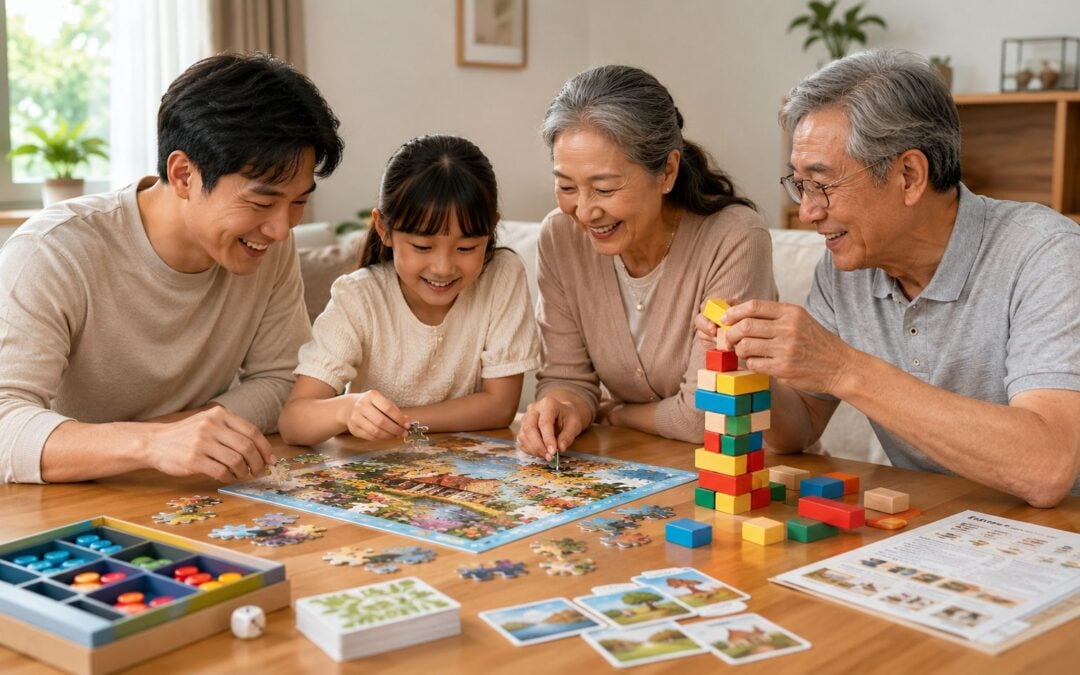
You're probably looking for something better than another family game night that ends with one child crying, one child gloating, and an adult saying, “Let's just clean up.” That's exactly where cooperative games for families can help. Instead of putting players against each other, they put everyone on the same side of the problem.
That simple shift changes the tone of play. Kids can practice taking turns, sharing ideas, and handling frustration without the pressure of beating a sibling. Adults can guide the experience without feeling like referees. For mixed-age groups, that matters even more, because a good co-op game gives younger children a real role instead of asking them to keep up with older players.
There's a broader reason these games keep showing up in homes, classrooms, and school counseling spaces. Historians widely describe The Landlord's Game as the first commercial cooperative board game, and in digital gaming, annual co-op releases on Steam rose from 647 in 2020 to 799 in 2023, a gain of 152 releases, or about 23.5 percent over three years, according to the historical overview summarized in this cooperative games history video. The format isn't a niche anymore. Families now have many more options across ages and skill levels.
The list below focuses on games that parents and educators can use. Each one includes practical examples, likely sticking points, and simple ways to keep all players involved.
1. Pandemic Board Game
Pandemic works well for families who want a true team challenge. Every player takes on a specialist role and the group tries to contain outbreaks and discover cures before the board spirals out of control. Because the game rewards planning out loud, it creates natural chances to practice listening, turn-taking, and shared decision-making.
In older elementary, middle school, or family groups with adults and tweens, this can become more than a board game. One child notices where the biggest threat is building, another tracks cards, and an adult helps the group think ahead without taking over. That division of attention gives each player a meaningful job.
For readers looking for simpler entry points before trying a strategy game like this, Soul Shoppe also shares cooperative games for kids that work well for younger groups.
Here's a quick look at the game in action:
How to keep it family-friendly
The biggest risk in Pandemic isn't the board. It's the strongest player taking over every turn. That can turn a cooperative game into a lecture.
Practical rule: Give every player a short “thinking turn” before anyone offers advice. Ask, “What do you see?” before saying, “Here's what you should do.”
A few small adjustments help:
- Start easy: Use the easiest setup first so younger players learn the rhythm before the pressure ramps up.
- Assign manageable roles: Give younger players roles with clearer tasks so they can contribute without tracking too many moving parts.
- Debrief after play: Ask, “What helped us work together?” and “When did we stop listening?”
A school counselor or after-school leader could use Pandemic with a small group and pause twice during the game to ask students how they're making decisions. At home, parents can do the same thing in a lighter way. “Who noticed the next problem?” is often a better question than “Who had the best move?”
2. Hoot Owl Hoot Board Game
For younger children, Hoot Owl Hoot is one of the easiest ways to introduce cooperative games for families. Players help owls get back to the nest before sunrise by playing color cards and moving the owls together. There's no reading load, the turns are short, and the shared goal is easy for a five-year-old to understand.
That simplicity is a strength, not a limitation. In a mixed-age family, a preschooler can match colors, an older sibling can help plan the order of moves, and an adult can model calm teamwork language. Nobody has to “go easy” on the youngest player because everyone is already on the same team.
Why it works with early learners
Children ages four to six are especially relevant here. In a study of 65 children ages four to six, researchers found that children enjoyed cooperative games more than competitive ones, and the paper also cites experimental findings showing cooperative play increased cooperative behavior and decreased aggressive behavior during play and later free play. It also reports a statistically significant condition effect for competitive behavior after competitive games, with F ∼ 4.91 and p = 0.028, as described in the open-access child development study on cooperative and competitive board games.
That doesn't mean every co-op game automatically creates harmony. It does mean the structure supports the kind of behavior most adults want to practice with young children.
Try these classroom or home moves:
- Celebrate progress: Say, “We moved two owls closer,” instead of waiting only for the final win.
- Model useful language: Use phrases like, “Let's help this owl first,” or “What do we need together?”
- Add a reflection: After the game, ask, “How did we help each other?”
A kindergarten teacher can use Hoot Owl Hoot in a morning meeting center. At home, it works well when one sibling is still learning how to lose and another gets bored by very simple games. The older child can become a helper without becoming the boss.
3. Forbidden Island Cooperative Game
Forbidden Island is a strong next step when children are ready for more planning and more tension. Players work together to collect treasures and escape before the island sinks. The game asks the group to prioritize, share resources, and decide which danger matters most right now.
That makes it useful for upper elementary and middle school families, especially when siblings are learning how to disagree without melting down. In this game, disagreement is normal. The group often has several reasonable choices, which creates room to practice respectful talk instead of rushing to the loudest answer.
A better way to manage group decisions
One of the biggest gaps in advice about cooperative games is mixed-age fairness. Many family roundups talk about teamwork, but they don't explain how to keep the oldest or most verbal player from dominating. That practical challenge is highlighted in this discussion of choosing Peaceable Kingdom cooperative family board games for mixed ages, which points to the need for low-reading games, open-hand play, and adjustable difficulty when age ranges are wide.
That idea matters in Forbidden Island. If one player always dictates the plan, younger players stop participating meaningfully.
When a child says, “I disagree because we'll lose that tile,” that's social-emotional learning in real time.
Try a simple family protocol:
- One idea each: Every player offers one suggestion before the group chooses.
- Use reasoning stems: Encourage phrases such as, “I suggest this because…” and “Let's consider another option.”
- Match roles thoughtfully: Give a cautious child a role that rewards planning. Give an impulsive child a role that encourages patience.
For school use, Forbidden Island fits nicely into small counseling groups or advisory periods focused on collaborative problem solving. A counselor can watch how students negotiate and which voices get heard. At home, parents can borrow the same lens and notice whether the group is solving the problem together or just following one leader.
4. Outfoxed! Cooperative Deduction Game
If your family likes mysteries, Outfoxed! is often an easy win. Players act as detectives, gather clues, and rule out suspects before the fox escapes. The deduction is simple enough for early elementary children, but the game still feels clever because each clue changes the group's thinking.
This one works especially well for children who don't love direct competition. There's still urgency, but no one has to outplay a sibling. The tension stays on the puzzle.
What children practice while playing
The best moments in Outfoxed! usually sound like this: “Wait, we know the fox doesn't have boots,” or “That clue means we should remove these suspects.” Those are clear acts of information sharing and collective reasoning.
A parent or teacher can make that thinking more visible with a few small moves:
- Think aloud: Model statements like, “This clue tells me we can cross out anyone with that feature.”
- Keep clues visible: Make a simple “evidence board” with the cards where everyone can see them.
- Praise specific behaviors: Say, “You listened carefully to that clue,” instead of giving general praise.
A child who struggles to speak up in free play will often contribute more easily when the evidence is right in front of them.
In a library program, Outfoxed! can follow a read-aloud mystery story. In a K to 2 classroom, it can support listening and speaking goals. At home, it's especially useful when one child likes to solve everything quickly and another needs more processing time. The visible clues slow the pace down in a helpful way and give quieter players something concrete to point to.
5. Splendor Cooperative Variant Rules
Splendor is usually a competitive game, but many families create a cooperative house version after everyone learns the base rules. In that version, players work toward a shared market goal, discuss purchases together, and treat resources as part of a group plan instead of individual progress.
This kind of adaptation works best with older elementary and middle school players who enjoy strategy but need practice with fairness and negotiation. Because the original game wasn't designed as a children's SEL tool, adults should be ready to scaffold the conversation more intentionally.
How to make the variant work
Start by teaching the standard rules so everyone understands card costs, gem collection, and long-term planning. Then shift one piece at a time. For example, the family can decide that all players are building one shared engine and must agree on priority buys.
That setup gives you a natural way to talk about economic cooperation. One child might want a card that helps them immediately. Another might notice that a different card helps the group more.
Use a few guardrails:
- Set negotiation norms: Everyone gets to propose a move before the group decides.
- Track shared goals visually: A simple notepad can help younger players follow the plan.
- Debrief fairness: Ask, “Did everyone get heard?” and “Did we choose what helped the group most?”
A social studies teacher could adapt this style of play when discussing trade, resource sharing, or group priorities. At home, this is a strong option for academically engaged kids who enjoy systems and patterns but need support learning that being right isn't the same as being collaborative.
6. Race to the Treasure Cooperative Game
Race to the Treasure is one of the clearest examples of a game that teaches “we win together.” Players build a path, collect keys, and try to reach the treasure before the ogre does. The rules are straightforward, the visual goal is obvious, and younger children can understand success almost immediately.
For families with preschoolers and early elementary children, that clarity matters. The youngest player can still participate in the plan, even if an older sibling notices strategy first. Everyone sees the same path growing on the table.
Good for short, repeatable practice
Some games are best because they're deep. Race to the Treasure is good because you can play it, talk about it, and play again without much setup. That makes it especially useful in classrooms, therapy waiting rooms, and busy homes.
Try these simple teaching moves:
- Repeat the core message: Use phrases like, “We all made the path,” and “We all beat the ogre.”
- Keep the reflection short: Ask, “What helped us today?” or “How did we build it together?”
- Use it during transitions: It fits well before dinner, after school, or at the end of a preschool center block.
A kindergarten class could use this with new students during the first weeks of school. A family with a three-year-old and a seven-year-old could use it to build the habit of shared success before trying heavier strategy games. If your goal is belonging rather than challenge, this is a very practical place to start.
7. Cascadia Board Game
Cascadia is often known as a thoughtful tile-laying game, and families who enjoy nature themes can adapt it into a cooperative experience by building toward shared habitat goals together. Instead of focusing on individual scoring, players talk through placements and try to create balanced habitats for animals such as salmon, bears, elk, and owls.
That shift makes the game especially useful for older kids who like strategy but also benefit from a broader discussion about systems. Habitat placement becomes more than a puzzle. It becomes a conversation about how parts of an environment connect.
Strong fit for family learning
This kind of cooperative adaptation also lines up with broader market movement. The global board games market is projected to grow from USD 17.22 billion in 2025 to USD 30.06 billion by 2031, and cooperative or legacy titles are forecast to be the fastest-growing game format at a 10.74 percent CAGR through 2031. The children segment is projected to grow at 10.39 percent CAGR through 2031, according to the global board games market forecast from Mordor Intelligence.
For families and schools, the practical point is simple. More games are being designed or adapted for shared, social play.
Try using Cascadia like this:
- Post a shared habitat goal: “Let's create connected spaces for these animals.”
- Ask systems questions: “Where would salmon fit best?” and “What happens if we crowd this habitat?”
- Connect game talk to group work: Older students can relate this to science class or team-building activities for youth.
This is a good choice for a family that wants game night to feel calm, thoughtful, and discussion-based instead of loud and fast.
8. Magical Peaceable Kingdom Cooperative Games Collection
Sometimes the best choice isn't one game. It's a small shelf of age-matched options. Peaceable Kingdom's cooperative line is useful for that because families and schools can choose different titles based on reading level, attention span, and social goals. A preschooler might be ready for a simple shared-path game, while an older child can handle more memory, planning, or deduction.
That matters because cooperative games for families aren't automatically fair just because they are cooperative. The fit has to be right. A game that works beautifully for two six-year-olds may fall apart when a ten-year-old starts optimizing every move.
Build a collection with purpose
In the educational board game segment, cooperative games are estimated to account for 28 percent of new product launches in 2025, up from about 18 percent in 2020, according to the educational board games market report from Dataintelo. That shift suggests designers and publishers are putting more attention on shared problem-solving formats.
For parents, teachers, and counselors, the practical takeaway is to choose by developmental fit rather than popularity alone.
A useful collection might include:
- A low-reading game: Best for younger children or mixed-age siblings.
- An open-information game: Useful when adults want to coach openly and model language.
- A variable-difficulty game: Helpful when older children need challenge without leaving younger players behind.
The educational value of a cooperative game depends on whether every player can participate meaningfully, not just whether everyone is sitting at the same table.
A school counselor might keep two or three Peaceable Kingdom games in a calm corner for lunch groups. A family might add one title a year and rotate them based on the season, the children's ages, or the skill they want to practice most.
Family Cooperative Games: 8-Game Comparison
| Game | Implementation complexity | Resource requirements | Expected outcomes | Ideal use cases | Key advantages |
|---|---|---|---|---|---|
| Pandemic Board Game | Medium–High, multi-rule cooperative play and role management | Board, role cards, 45–60 min sessions, 2–4 players, initial facilitation | Advanced teamwork, strategic planning, shared problem-solving | Family game nights, middle school SEL lessons, after-school programs | Deep strategic cooperation; scalable difficulty; strong SEL alignment |
| Hoot Owl Hoot | Low, simple rules and color-matching mechanics | Minimal components, 10–15 min, ages 4–8, low facilitation | Turn-taking, basic cooperation, color recognition | Preschool/K–2 classrooms, mixed-age family play | Age-appropriate for young children; quick rounds; inclusive |
| Forbidden Island | Medium, tile management and role coordination | Tile components, 30–45 min, 2–4 players, facilitator recommended | Coordinated decision-making, resource sharing, stress management | Upper elementary to middle school, counselors, family therapy | Urgent cooperative scenarios; clear role contributions; engaging tension |
| Outfoxed! | Low–Medium, simple deduction with shared clues | Game board, clue mechanics, 15–20 min, ages 5+, adult modeling helpful | Information-sharing, active listening, basic logical reasoning | K–2 SEL programs, library activities, family literacy events | Teaches collaborative deduction; short replayable sessions |
| Splendor (Cooperative Variant) | Medium–High, requires house rules and reframing | Base Splendor set, 30 min, 2–4 players, prep to explain variant | Negotiation, fairness, resource allocation | Gifted programs, social studies, advanced enrichment | Introduces economic concepts cooperatively; supports negotiation practice |
| Race to the Treasure | Very Low, spinner-driven, no reading required | Spinner game, 10 min, ages 3–7, minimal facilitation | Foundational cooperation, shared-success mindset | Preschool morning meetings, Head Start, family play with young kids | Highly accessible for youngest learners; guaranteed group success |
| Cascadia | Medium, tile-placement and spatial strategy | Hex tiles, tokens, 30–45 min, ages 10+, optional solo/coop | Systems thinking, spatial reasoning, environmental awareness | Science classes, environmental clubs, family nights | Combines ecology education with cooperative planning; visually engaging |
| Magical Peaceable Kingdom Collection | High, multiple systems and progressive selection | Multiple titles, budget for collection, varying play times, teacher training | Developmental progression in cooperation, consistent SEL scaffolding | K–8 districts, classroom game libraries, SEL program integration | Age-pathway approach; publisher expertise; versatile for many grades |
Final Thoughts
Cooperative games for families work best when adults treat them as both play and practice. The play matters because children learn more when the activity feels enjoyable and low-pressure. The practice matters because these games create repeated chances to share ideas, wait, compromise, recover from mistakes, and solve a problem with other people instead of against them.
The strongest game for your family depends less on popularity and more on fit. If you have preschoolers, simple shared-goal games often work better than games with deep strategy. If you have a wide age spread, look for low-reading rules, visible information, and ways to adjust difficulty. If you have older kids, games with planning and respectful disagreement can be especially useful. In every case, the main question is the same: can each person contribute in a real way?
That's also why the adult role matters. Parents and educators don't need to control the whole experience. They do need to protect space for every voice. Sometimes that means pausing before giving advice. Sometimes it means asking a quieter child what they notice. Sometimes it means choosing a simpler game so the group can cooperate rather than just watch the most confident player lead.
The broader trend supports this direction. Cooperative games have moved from a relatively narrow format into a more visible part of family and educational play, and product development continues to reflect that growth. But the value at home is still very practical. A good co-op game gives children a safe place to practice the same skills adults want during homework, sibling conflict, classroom teamwork, and everyday routines.
If you use these games in a school or family setting, keep the reflection short and concrete. Ask what helped, what got in the way, and who made room for others. Over time, those conversations matter as much as the wins.
For families and schools that want more social-emotional learning support around communication, conflict resolution, and connection, Soul Shoppe offers programs and resources designed for those goals.
If you want more practical SEL tools that support connection at school and at home, explore Soul Shoppe for workshops, family-friendly resources, and ideas you can use alongside cooperative play.