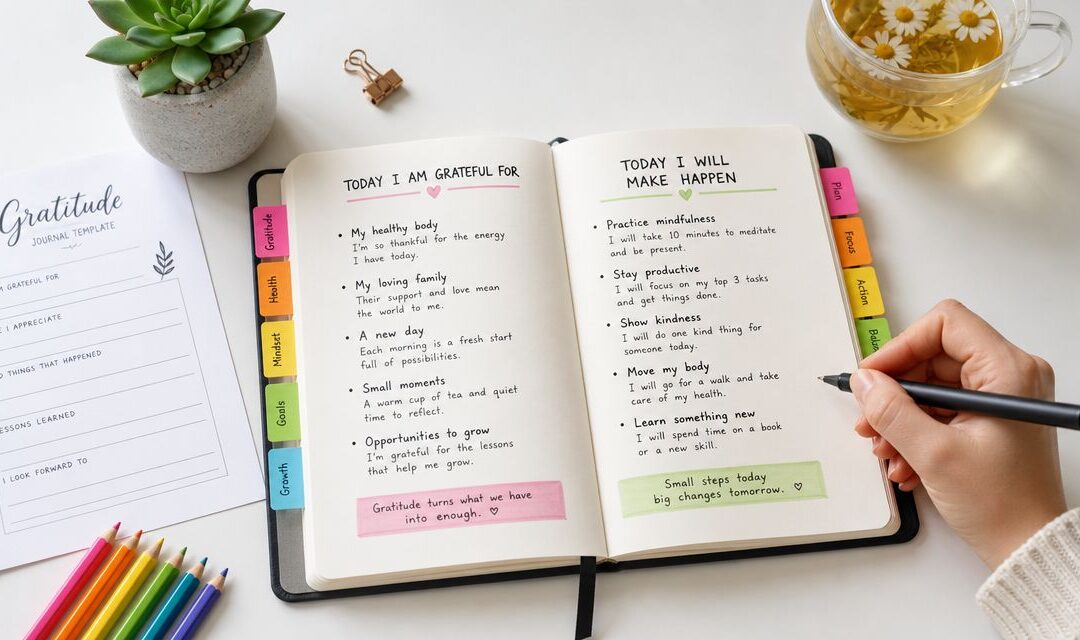
A lot of adults have lived this moment. You ask a class, your child, or a small group, “What are you thankful for?” A few hands go up. Someone says “my family.” Another says “food.” A third shrugs. The room gets quiet, and the exercise starts to feel more polite than meaningful.

That's usually not a motivation problem. It's a prompt problem.

Gratitude is more than saying thank you. It's a teachable noticing skill that can help children name support, remember moments of care, and build steadiness when school or home feels hard. In social-emotional learning, that matters because students need more than positive messages. They need repeatable practices that build self-awareness, empathy, and connection. One of the most widely used institutional versions comes from Greater Good in Action at UC Berkeley, which recommends writing down or typing up to five things you feel grateful for for 15 minutes per day, at least three times per week, for at least two weeks.

This is why gratitude journal prompts work better than vague reflection. They give children structure, language, and a safe entry point.

You can also pair gratitude work with calming practices. If you want a simple companion activity for transitions or quiet reflection, learn about meditation with Wellness Apothecary.

1. Three Good Things

This is often the easiest place to begin because it keeps the task small and concrete. Instead of asking children to feel grateful on demand, ask them to notice three good things from the day and write why each one mattered.

A first grader might write, “I'm grateful my friend shared crayons because I forgot mine.” A middle school student might write, “I'm grateful I solved one hard math problem because I didn't give up.” A teacher might write, “I'm grateful a student told me the breathing break helped because it showed me they felt safe enough to say it.”

An open journal on a wooden desk with a gratitude list written in handwritten script style.

How to use it in class or at home

The best version includes a reason. “I liked recess” is a start. “I liked recess because I finally got included in the game” builds more awareness.

Try these sentence frames:

  • Something good that happened was: “My grandma picked me up.”
  • Why it mattered was: “I felt relaxed in the car because she listens to me.”
  • What I notice about myself is: “I feel calmer when I have one-on-one time.”

That last line is where SEL becomes visible. Students start connecting events to emotions, needs, and supports.

Practical rule: Small good things count. A warm lunch, a kind look, a seat next to a friend, or finishing an assignment all belong.

What this builds

Three Good Things supports self-awareness and resilience because it trains students to scan their day for moments of support instead of only replaying stress. That doesn't mean ignoring hard feelings. It means helping children hold more than one truth at once.

For a weekly classroom ritual, ask students to write privately on Monday through Thursday, then share only one entry on Friday if they want to. That lowers pressure. At home, parents can do the same at dinner by answering first and keeping their examples specific: “I'm grateful you told me you were frustrated instead of slamming the door.”

2. Gratitude Letter or Message Exchange

Some gratitude journal prompts stay private. This one becomes relational. Students write a short letter, note, or message to someone who helped, encouraged, or steadied them.

That “someone” can be a classroom aide, crossing guard, sibling, bus driver, custodian, teammate, or parent. Children often build more empathy when they notice the people who make daily life run smoothly.

Make the appreciation specific

A useful gratitude letter names an action, not just a person.

An elementary student might write, “Thank you to our custodian for cleaning our room every day. It helps our classroom feel safe.” A middle school student might write, “I appreciate you for sitting with me at lunch when I was nervous.” A parent can join by writing, “I appreciated how you packed your backpack without being reminded. That helped our morning feel calm.”

If students struggle to start, offer sentence stems and feeling words. Soul Shoppe's guidance on how to express your feelings in words can help adults model language that is honest and clear.

Safe ways to run the activity

Not every student wants to read a message aloud or hand it directly to someone. Give choices.

  • Private delivery: Students place notes in envelopes for the teacher to deliver.
  • Anonymous appreciation: Students write kind observations without signing their names.
  • Whole-group gratitude: The class creates one shared letter for a school helper.

This prompt aligns closely with relationship skills. Children learn that appreciation isn't flattery. It's naming what someone did and how it affected you.

A strong gratitude message sounds like this: “You helped me when I was overwhelmed, and I felt less alone after that.”

That one sentence teaches emotional vocabulary, empathy, and connection all at once.

3. Sensory Gratitude Journaling

For students who get stuck in their heads, sensory gratitude journaling gives them something concrete to notice. Instead of searching for a big answer, they look at what they saw, heard, touched, smelled, or tasted.

That's especially helpful after transitions, conflicts, or overstimulating parts of the day. It brings attention back to the body and the present moment.

Take a simple approach like this:

A cozy flatlay featuring a gratitude journal, tea cup, dry leaf, photo, and chime on linen.

  • I saw: sunlight on the playground
  • I heard: my table group laughing
  • I felt: the soft sleeve of my sweater
  • I smelled: pancakes this morning
  • I tasted: cold water after PE

A grounding activity before writing

Before students journal, invite them to do a short observation walk around the classroom, hallway, or yard. Ask them to notice one steady thing for each sense. If you want a child-friendly companion exercise, Soul Shoppe offers a five senses activity for grounding and awareness.

A second-grade example might be, “I'm grateful for the smell of crayons and the sound of my friend humming because it made art feel fun.” A middle school example might be, “I'm grateful for the cold air on my face after school because it helped me calm down.”

Why this works well for overwhelmed students

This kind of gratitude doesn't force a cheerful mood. It asks students to notice what is present and steady. That's a key difference.

The broader conversation around gratitude journal prompts has increasingly emphasized trauma-sensitive variations, including prompts like “What helped you get through today?” and “What is one neutral thing that felt steady?” as discussed in this reflection on psychologically safe gratitude prompting. For many students, neutral is more accessible than joyful.

You can also add a short visual reset before writing:

This short video can help frame the moment for students who respond well to guided practice.

4. Challenge-to-Gratitude Reframing

Some of the most meaningful gratitude journal prompts begin with something hard. Not to minimize it. To help students find what they learned, what support showed up, or what strength they used.

This prompt works best when adults name the rule first. Feelings come before reframing. A child gets to say, “That was disappointing,” before being asked, “Was there anything you learned from it?”

A gentle structure

Use a three-part reflection:

  • What was hard: “My friend didn't want to play with me.”
  • What did I feel: “I felt left out and mad.”
  • What can I still appreciate: “I noticed another classmate invited me over, and I learned I can ask someone else.”

That's not fake positivity. It's emotional honesty followed by perspective.

A middle schooler might write, “I'm grateful for the group project conflict because I practiced saying what I needed without yelling.” A teacher might write, “I'm grateful for a rough lesson because it showed me students needed more structure than I had planned.”

Keep the challenge small at first

Start with manageable frustrations, not major losses. Missed turns, homework mistakes, friendship misunderstandings, or a stressful transition are enough. Students need practice with the skill before they can use it in more emotional situations.

Name the hard part clearly. Then look for the lesson, the helper, the strength, or the next step.

This prompt supports responsible decision-making and self-management because students begin asking, “What did this situation show me about what I need?”

You can also use it in restorative settings. After a disagreement, students can reflect on what the conflict taught them about communication, boundaries, or repair. In that context, gratitude doesn't erase harm. It helps children notice growth after accountability.

5. Gratitude Jar or Daily Contributions

Some children engage more when gratitude becomes visible. A gratitude jar gives the practice a physical home and turns individual reflection into a shared community habit.

A classroom can keep a jar near the door with slips of paper and pencils. A family can place one on the dinner table. A counseling office can use a quiet basket for students who don't want public sharing. The form is simple. The ritual is what makes it matter.

A glass jar filled with colorful folded paper notes sitting on a wooden table in a classroom.

Ideas for real settings

An elementary classroom might read a few notes every Friday afternoon. A middle school advisory might use a digital board with teacher moderation. A family might pull one note each Sunday and talk about the week.

If you want more school-friendly ideas, Soul Shoppe shares additional gratitude activities for kids that fit classrooms and home routines.

Try themes to keep participation fresh:

  • Peer gratitude: Students name one way a classmate helped.
  • Place gratitude: Students notice what in the school helps them feel settled.
  • Support gratitude: Students thank helpers they don't always notice.
  • Small wins gratitude: Students record ordinary moments that made the day easier.

A simple journal for organized workspaces can also work if your group prefers bound entries over loose slips.

Why jars work over time

The wider gratitude space is growing beyond static lists. The global gratitude journal app market was estimated at USD 310 million in 2024 and projected to reach USD 1.11 billion by 2033 at a 15.2% CAGR, which suggests strong ongoing interest in prompt-based gratitude tools. In schools and homes, that same lesson applies. People stick with practices that feel structured, easy to repeat, and varied enough to stay meaningful.

A jar helps because it creates a record. On a hard week, students can see that good moments have existed before and can return again.

6. People and Connection Gratitude

When children feel isolated, generic gratitude prompts often fall flat. Relationship-focused prompts tend to land better because they ask students to identify who helps them feel safe, seen, or supported.

This is one of the strongest SEL-aligned options because it reinforces belonging. It also reminds adults which relationships students are experiencing as protective.

Prompts that open real reflection

Ask questions like these:

  • Who made you feel welcome today
  • Who listened to you
  • Who believes in you when something feels hard
  • Who helps you feel calmer or braver

A younger student might write, “I'm grateful for my best friend because they save me a spot on the rug.” A middle school student might write, “I'm grateful for my aunt because she lets me talk before giving advice.” A teacher might write, “I'm grateful for my grade-level partner because we solve problems together.”

Include students with limited support systems

This matters. Some children won't have an easy answer if the only examples are parents or best friends. Widen the frame. Gratitude can be directed toward a coach, librarian, counselor, older sibling, bus driver, neighbor, or even a class pet that helps a student feel calm.

You can also let students name groups instead of individuals. “The lunch staff.” “My soccer team.” “The people who run aftercare.” That keeps the activity inclusive.

When a child says, “No one,” respond with curiosity, not correction. Offer categories and examples until something feels true.

This prompt also works well during antibullying work. Students can reflect on classmates' contributions, not just popularity. “Who helps others join in?” is often more powerful than “Who do you like most?”

7. Progress and Personal Growth Gratitude

Many children are quicker to notice what they haven't done than what they've learned. This prompt shifts attention toward effort, growth, and small signs of change.

That matters in SEL because resilience grows when students recognize their own developing skills. Gratitude here isn't about achievement alone. It's about appreciating persistence, practice, and the courage to keep trying.

Better questions than “What are you proud of?”

Some students hear “proud” and freeze. “Grateful for your growth” can feel gentler and less performative.

Try prompts like:

  • What are you getting better at
  • What felt a little easier this week than before
  • What skill helped you today
  • What effort paid off

An elementary student might write, “I'm grateful I remembered to take turns in our game.” A middle school student might write, “I'm grateful I used breathing before answering when I was angry.” A teacher might write, “I'm grateful our class transition was smoother because students used the routine we practiced.”

Make growth visible

This prompt works well with a notebook, conference sheet, or reflection wall where students can compare their work to their own earlier entries. The comparison should always be with self, not peers.

A useful routine is to have students revisit one earlier entry every few weeks and finish the sentence, “Back then I was working on ____. Now I notice ____.” That helps them see change they might otherwise miss.

An independent review summarizing intervention-based research found that gratitude exercises produce small-to-moderate improvements in well-being, with stronger effects when people practice consistently for several weeks, use active writing, and build the habit into an existing routine. For educators and families, that supports a simple plan. Keep the writing active, repeat it regularly, and attach it to a routine you already have.

If you want language that reinforces service and appreciation in community settings, these inspiring quotes for volunteers can be adapted for older students or school teams.

8. Reverse Gratitude or Empathy Through Appreciation

This prompt asks students to consider what others might appreciate about them. It can feel unusual at first, but it's one of the most effective ways to build both empathy and healthy self-worth.

Children often know how they've been corrected. They're less practiced at naming how they contribute. Reverse gratitude helps them see their role in relationships.

How to keep it concrete

Avoid broad praise like “I'm nice.” Ask for observable actions.

A younger student might write, “My friend might be grateful for me because I asked them to play.” A middle school student might write, “My teacher might appreciate that I asked for help instead of shutting down.” A teacher might reflect, “My students might be grateful that I stayed calm when the room got loud.”

Soul Shoppe's article on teaching empathy to kids and teenagers fits naturally here because this prompt asks students to imagine another person's experience without guessing wildly or blaming themselves.

A strong circle practice

This works especially well in pairs or circles when students first write privately, then receive real feedback from peers.

Try a format like this:

  • Private reflection: Students write one thing someone might appreciate about them.
  • Peer confirmation: A partner adds one specific observation.
  • Closing sentence: “One way I help my community is ____.”

The feedback has to stay specific. “You always let me go first in line when I'm nervous.” “You explain directions without making fun of me.” “You notice when people are alone.”

The field is also moving away from one static list of gratitude journal prompts and toward more varied prompt rotation by context, season, and audience, as discussed in this piece on keeping gratitude practice effective over time. That's especially useful here. If students are tired of standard gratitude questions, reverse gratitude often re-engages them because it feels fresh and relational.

Comparison of 8 Gratitude Journal Prompts

Practice Implementation complexity Resource requirements Expected outcomes Ideal use cases Key advantages
Three Good Things Low, 5–10 min daily individual practice Minimal, pen/paper or digital prompt Increased positive affect, habit formation, modest resilience gains Daily SEL routines, warm-ups, home practice Evidence-based, easy to scale, low barrier
Gratitude Letter / Message Exchange Moderate, structured sessions and delivery planning Paper/digital tools, privacy safeguards, facilitation prompts Strengthened relationships, empathy, increased psychological safety Restorative circles, community-building events, teacher/family appreciation Direct validation for recipients, creates lasting keepsakes
Sensory Gratitude Journaling Moderate, guided prompts and time for sensory noticing Templates, access to sensory experiences (outdoors/objects), teacher modeling Greater mindfulness, grounding, sensory awareness, improved self-regulation Mindfulness lessons, kinesthetic learners, grounding exercises Concrete, engaging for young/sensory learners, calming effect
Challenge-to-Gratitude Reframing Higher, requires scaffolding and emotional readiness Skilled facilitation, structured prompts, safe environment Improved resilience, cognitive flexibility, growth mindset Conflict resolution, restorative practices, resilience-building Promotes genuine growth, reduces rumination, supports repair
Gratitude Jar / Daily Contributions Low–Moderate, initial setup plus ongoing facilitation Physical jar or digital board, slips/stickers or platform, schedule Visible community gratitude, sense of abundance and belonging Classroom/school-wide culture initiatives, family rituals Tangible record, inclusive formats, easy to celebrate collectively
People & Connection Gratitude Moderate, needs sensitive facilitation in conflicted settings Prompts, safe sharing spaces, optional peer-circle structure Stronger social bonds, empathy, reduced isolation Peer mediation, anti-bullying programs, community-building Directly strengthens relationships and sense of belonging
Progress & Personal Growth Gratitude Moderate, guided reflection and tracking over time Progress trackers, reflection prompts, coaching time Increased self-efficacy, motivation, growth mindset Academic interventions, SEL coaching, recovery from setbacks Emphasizes effort, builds durable motivation and confidence
Reverse Gratitude / Empathy Through Appreciation Moderate, requires psychological safety and modeling Prompts, opportunities for peer feedback, facilitator support Greater self-worth, perspective-taking, belonging Confidence-building, pre-performance prep, restorative work Builds empathy and counters self-doubt through perspective-taking

Cultivating Gratitude as a Community Practice

These gratitude journal prompts do more than fill a page. They help children notice support, name emotions, recognize effort, and strengthen relationships. In a classroom or home, that kind of noticing changes the emotional climate over time.

The most effective gratitude practice usually isn't the longest or the most polished. It's the one people can sustain. UC Berkeley's Greater Good in Action guidance recommends a clear rhythm of writing for 15 minutes, up to five things, at least three times per week, for at least two weeks, along with prompt advice such as being specific, focusing on people, choosing depth over breadth, and varying entries over time. For educators and families, the practical takeaway is simple. Consistency and specificity matter more than making the exercise feel impressive.

That also means gratitude shouldn't be forced. Some days, a child won't be ready to write about joy. They may only be able to name one steady thing, one helpful person, or one moment that felt less hard than the rest of the day. That still counts. In many cases, that's the more emotionally safe and developmentally appropriate place to start.

A strong implementation plan can stay very small:

  • Pick one prompt: Don't launch all eight at once.
  • Attach it to a routine: Advisory, morning meeting, dinner, bedtime, or counseling check-in.
  • Model it yourself: Children trust the practice more when adults participate honestly.
  • Keep examples concrete: “I'm grateful for my family” can become “I'm grateful my brother waited for me at pickup.”
  • Allow choice: Private writing, partner sharing, drawing, dictated responses, or jar notes all work.

For school communities, gratitude becomes more powerful when it's shared language, not just an isolated activity. Teachers can use it in morning meetings, counselors can use it during regulation work, administrators can use it in staff culture, and families can continue it at home. That kind of alignment supports Soul Shoppe's mission to build connection, safety, and resilience across the whole community.

Start with one prompt this week. Repeat it long enough for students to trust it. Then rotate to another format when the group needs a new entry point. Gratitude works best when it feels real, specific, and connected to the relationships that help children thrive. To keep building those skills, explore Soul Shoppe's programs and resources designed to support emotionally safe, connected school communities.


If you want practical SEL tools that help students build empathy, communication, self-regulation, and belonging, explore Soul Shoppe. Their programs and resources can help schools and families turn simple reflection practices like gratitude journaling into lasting community habits.