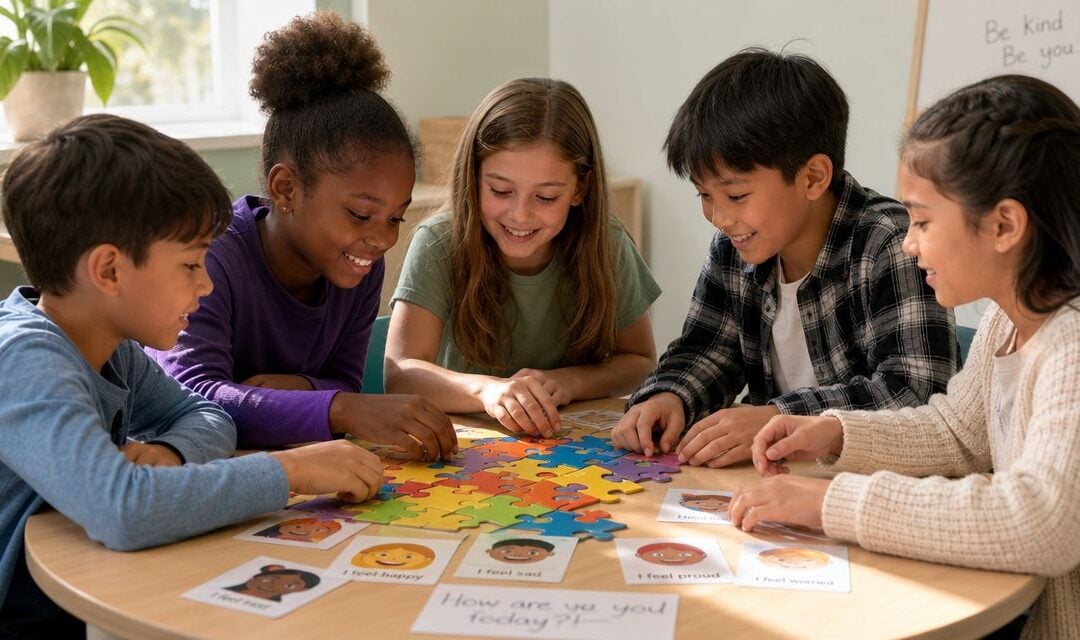
You can usually tell when a child needs social support before they say it out loud. A student hangs back during partner work. A child melts down when a game doesn't go their way. Siblings can't get through dinner without interrupting each other. At school, the problem shows up as conflict, exclusion, and constant reteaching. At home, it can look like clinginess, avoidance, or “nobody wants to play with me.”

Social skills matter because kids use them everywhere. They need them to join a group, repair a mistake, read a room, manage frustration, and stay connected when things feel hard. That's why social skills activities for kids work best when they're practical, repeatable, and tied to real situations children experience.

This isn't a matter of “just be kind.” Kids need direct teaching, guided practice, and a lot of low-stakes repetition. That need is still very real. In a 2025 Gallup survey of U.S. parents of school-age children, 45% said the COVID-19 pandemic negatively affected their child's social skills development, and 22% said those social difficulties were still ongoing.

The good news is that social growth responds to intentional practice. A 2025 meta-analysis in Frontiers in Psychology reviewed 14 studies on designed physical activities for preschoolers, screened 7,074 articles, and found a significant positive effect on social skills with a standardized mean difference of 0.63 and p < 0.0001. The same review found that interventions lasting 12 weeks showed a significant benefit. That lines up with what practitioners see every day. Structured, play-based practice works.

If you're also thinking about teamwork and belonging through movement, this piece on developing young athletes through sports connects well with the activities below.

1. Circle Discussions and Community Meetings

Circle time works because every child can see every other child. That sounds simple, but it changes behavior. Kids listen better, wait more intentionally, and start noticing that their classmates have different reactions, worries, and ideas.

A teacher sitting with a diverse group of elementary children in a circle during a classroom activity.

A strong circle isn't a free-for-all. It's structured, predictable, and short enough that kids can succeed. If you want more ways to build that routine, these classroom community building activities pair well with circle practice.

Mini-lesson plan

Objective: Build listening, turn-taking, empathy, and perspective-taking.

Materials: Chairs or floor spots in a circle, one talking piece, one prompt card.

How to run it:

  • Set agreements: Review simple norms like “one person talks at a time,” “pass if needed,” and “listen to understand.”
  • Use a low-risk opener: Try “What's one thing that made you laugh this week?” before asking deeper questions.
  • Pass the talking piece: Only the student holding it speaks. That physical cue helps younger children especially.
  • Close with reflection: Ask, “What did you hear that helped you understand someone else better?”

Adaptations that actually help

Kindergarten students usually do better with quick prompts, visual supports, and movement built in. Middle school students often respond better when circles feel purposeful, such as discussing group conflict after a project or checking in after a tense week.

Practical rule: Start shallow, then go deeper. If adults rush kids into vulnerable sharing, the circle gets quieter, not stronger.

For assessment, don't overcomplicate it. Watch for who can wait, who responds to another child's idea, and who begins to use respectful language without being prompted.

2. Role-Playing and Scenario-Based Learning

When kids freeze in a hard moment, it's often not because they don't care. It's because they haven't rehearsed what to say. Role-play gives them a script, a safe reset, and another chance.

A friendly teacher engages in a social skills activity with two elementary students in a classroom.

A common mistake is choosing scenarios that are too loaded too soon. Start with manageable moments. Joining a game. Handling an interruption. Disagreeing about the rules. Save more intense conflict for later, once the group trusts the process.

Mini-lesson plan

Objective: Practice communication, problem-solving, and perspective-taking in realistic situations.

Materials: Scenario cards, optional sentence stems, optional simple props.

Try these scenarios:

  • Joining play: “Can I join?” followed by different possible peer responses.
  • Handling exclusion: “There's no room for you” and how to respond without escalating.
  • Fixing a mistake: Bumping into someone's project or saying something hurtful.

How to run it:

  • Model first: Adults demonstrate both an unhelpful version and a helpful version.
  • Assign roles: Speaker, listener, observer.
  • Replay with coaching: Pause and let students try a stronger response.
  • Reflect: Ask observers what words, tone, and body language made the interaction work better.

Later in the lesson, a short video can reinforce the same skill set.

For differentiation, give reluctant students sentence starters like “I feel…” or “Can we try…” Older students benefit from reverse role-play, where they argue the opposite side and then discuss what changed in their understanding.

3. Mindfulness and Breathing Exercises

Some kids know the right social move, but they can't access it when they're flooded. That's where regulation matters. Social skills and self-regulation are tied together. If a child's body is in fight, flight, or shutdown, conversation skills won't carry the moment.

A young boy sitting on a floor cushion practicing mindfulness and calm breathing in a sunny room.

The best mindfulness routines for kids are concrete. Long silent meditations often backfire with younger students or restless groups. Short, sensory-based practices are more usable. Belly breathing is one example, and this guide to the belly breathing technique gives a simple model adults can teach quickly.

Mini-lesson plan

Objective: Help kids notice body signals and return to a calmer state before social situations escalate.

Materials: Floor spots or chairs, one visual breathing cue, optional pinwheel or stuffed animal.

How to run it:

  • Name the body clue: “Your shoulders are tight,” “Your face feels hot,” or “Your hands feel fast.”
  • Teach one breathing pattern: Inhale slowly, pause, exhale slowly. Keep the wording simple.
  • Pair breath with image: Smell the soup, cool the soup. Inflate the balloon, deflate the balloon.
  • Use it before stress: Practice during calm moments, not only after conflict.

What works and what doesn't

Works: brief daily repetition, visual reminders, adult modeling.

Doesn't work: treating breathing like a punishment, forcing stillness, or expecting kids to regulate on command after one lesson.

Some children regulate better with movement first. Wall pushes, stretching, or a slow walk can make breathing practice more accessible.

Assessment can be observational. Can the child identify a feeling in their body? Can they choose a calming strategy with support? Can they return to a group task with less friction than before?

4. Peer Mentoring and Buddy Programs

Kids often accept coaching from peers in ways they resist with adults. That's the value of a buddy system. A calm older student can model how to greet, how to include someone, or how to recover after an awkward moment without it feeling like a lecture.

Cross-age programs work especially well during transitions. Think fifth graders with kindergarteners, or middle school students supporting incoming students during lunch, recess, or orientation. The relationship needs structure, though. Good intentions alone don't make a mentoring program safe or useful.

Mini-lesson plan

Objective: Build connection, reduce isolation, and give students repeated practice with prosocial behavior.

Materials: Pairing list, simple activity menu, reflection sheet for mentors.

How to run it:

  • Train the mentors: Practice active listening, encouragement, and boundaries before any pairing begins.
  • Give each pair a task: Read together, solve a simple puzzle, play a turn-taking game, or do a “get to know you” interview.
  • Keep routines consistent: Same day, same place, same opening ritual helps both children settle in.
  • Debrief privately: Mentors need a place to ask, “What do I do if my buddy won't talk?” or “What if they get upset?”

Smart differentiation

Pair by interest when possible. A sports-loving older student and a younger child who also likes movement will usually connect faster than a randomly assigned pair. For students with social anxiety, start side-by-side with a shared task instead of face-to-face conversation.

Assessment can include mentor reflections, adult observation, and simple student feedback such as “I felt comfortable,” “I had fun,” or “I knew what to do.”

5. Collaborative Games and Team-Building Activities

If you want fast information about a group's social strengths, give them a shared challenge and step back. Collaborative games reveal who takes over, who disappears, who can negotiate, and who gets stuck when the plan changes.

This category of social skills activities for kids is especially useful because the learning is visible. You can watch communication happen in real time. You can also stop the game, coach a skill, and let students try again.

Mini-lesson plan

Objective: Practice cooperation, shared problem-solving, and flexible thinking.

Materials: One team challenge, such as cups and index cards, a cooperative board game, or hoops for a movement activity.

How to run it:

  • Give one common goal: Build the tallest structure, move across the room together, or solve a puzzle as a team.
  • Assign rotating roles: Facilitator, encourager, material manager, reporter.
  • Pause for coaching: If one student dominates, stop and ask the team how they'll make sure every voice is heard.
  • Debrief right away: “What helped your team?” and “What got in the way?”

One evidence-based design detail matters here. Guidance on children's activity design emphasizes that stronger social gains come from structured, cooperative formats such as role-play, turn-taking games, and joint make-believe because they directly train subskills like following rules, perspective-taking, and self-regulation. In cooperative “Islands” games, using about one hoop per three children creates the kind of negotiation and shared problem-solving you want to teach.

Real trade-offs

Cooperative games can become competitive very quickly if adults praise speed, winning, or the loudest leader. Keep the spotlight on process. Ask who invited others in. Ask who adapted when the plan failed. That's where the social learning lives.

6. Emotion Identification and Expression Practices

A lot of conflict starts with a child feeling something they can't name. When that happens, behavior becomes the message. They shove instead of saying “I felt left out.” They cry instead of saying “I'm embarrassed.” They shut down instead of saying “This feels too hard.”

Emotion practice needs to be regular and low stakes. If adults only ask kids to name feelings in the middle of a meltdown, they're asking for a skill the child hasn't learned yet.

Mini-lesson plan

Objective: Help children recognize, label, and express feelings clearly.

Materials: Feeling cards, an emotion wheel, drawing paper, or a simple “zones” visual.

How to run it:

  • Start basic: Happy, sad, mad, scared. Add more nuanced feeling words later.
  • Connect body to feeling: “Where do you feel worry?” “What does frustration look like in your shoulders or jaw?”
  • Use examples from stories or class life: “How do you think Maya felt when nobody picked her group?”
  • Practice expression: “I felt left out when…” and “I need…”

Assessment ideas

Young children: point to a feeling face and match it to a situation.

Older students: describe mixed emotions, triggers, and a respectful way to express them.

Children don't need adults to approve every feeling. They need adults to help them express feelings safely and clearly.

A practical extension is an emotion check-in board at the start of the day. It gives teachers quick information and normalizes emotional language without turning every check-in into a therapy session.

7. Conflict Resolution and Peer Mediation Training

Many adults jump into child conflict too early. That solves the immediate noise problem, but it often prevents kids from learning how to repair. Peer mediation and conflict resolution routines create a middle space between “figure it out yourselves” and full adult takeover.

The key is clarity. Children need a repeatable script. They also need to know when a problem is too serious for peer mediation. Safety issues, coercion, and strong power imbalances always go to adults.

Mini-lesson plan

Objective: Teach students to handle everyday conflict using respectful language and active listening.

Materials: Conflict steps poster, sentence stems, neutral meeting space.

How to run it:

  • Teach a simple sequence: Stop. Breathe. Each person speaks. Each person repeats what they heard. Brainstorm solutions. Agree on one next step.
  • Use I-statements: “I felt frustrated when…” instead of blaming language.
  • Practice with small conflicts: Seat choice, line order, game rules, shared materials.
  • Debrief after resolution: Ask whether both students felt heard and whether the agreement was realistic.

For adults building this system schoolwide, these conflict resolution strategies for students offer language that students can use consistently across settings.

What to watch for

If a child keeps “winning” mediations because they're more verbal, the process needs adult adjustment. Fair mediation isn't about whose argument sounds smarter. It's about helping each child state needs, hear impact, and reach a workable repair.

8. Empathy-Building Stories and Literature Discussions

Books give kids a safe way to practice perspective-taking. They can talk about a character's choices before they're ready to talk about their own. That distance helps.

This works best when adults don't stop at “Was that kind?” Better questions go further. Why did the character react that way? What might they have been feeling underneath the behavior? What else could a friend have done?

Mini-lesson plan

Objective: Build empathy, perspective-taking, and respectful discussion.

Materials: Read-aloud text, discussion prompts, optional response page.

How to run it:

  • Read with pauses: Stop at key moments of conflict, exclusion, or repair.
  • Ask perspective questions: “What does this character know that the others don't?” “How might two people see this moment differently?”
  • Connect to student life: “When have you seen a misunderstanding like this happen at school?”
  • Add a response task: Draw a better ending, write a supportive line, or role-play a repair conversation.

A strong book list matters. Diverse protagonists, family structures, identities, and abilities widen the empathy practice. For early grades, these picture books about kindness can spark concrete conversations without making the lesson feel heavy.

Different ages, different moves

Primary students often need visual cues and short prompts. Middle school students can handle ambiguity, unreliable narrators, and social complexity. Don't flatten those discussions. The point isn't to force one correct answer. The point is to help students consider another person's inner world.

9. Service Learning and Community Contribution Projects

Some children build social confidence faster when the focus isn't on themselves. Service learning helps because it shifts the question from “Do people like me?” to “How can we help?” That change reduces social pressure and gives students a meaningful shared role.

The strongest projects are not adult-designed charity performances. They solve a real problem that students understand. A campus welcome project for new students. A buddy reading program. A kindness card effort for isolated community members. A student-led cleanup tied to school pride.

Mini-lesson plan

Objective: Build empathy, responsibility, and teamwork through meaningful contribution.

Materials: Project plan, student roles, reflection tool, supplies based on project.

How to run it:

  • Let students identify a need: What feels hard, lonely, messy, or disconnected in the school or community?
  • Choose one manageable project: Keep the scope tight enough for follow-through.
  • Assign visible roles: Planner, materials lead, outreach helper, reflection reporter.
  • Reflect on impact: Ask what students learned about teamwork, community, and other people's needs.

A useful literacy tie-in is storytelling. Students can write class books, appreciation notes, or short narratives connected to the project. For teams exploring that angle, this guide to children's book creation offers a practical creative extension.

Service projects build social skills best when students have to plan together, divide work, and reflect together. The service matters, but the collaboration matters too.

10. Social Skills Groups and Friendship-Building Clubs

Whole-class activities help most children. Some kids still need a smaller, safer place to practice. That's where friendship groups, lunch groups, and counselor-led social skills clubs become useful.

The tone matters a lot. If the group feels like remediation, students resist it. If it feels like a place to connect, practice, and have some success with peers, students come back.

Mini-lesson plan

Objective: Give students targeted practice with conversation, joining play, emotional regulation, and friendship repair.

Materials: Small group space, conversation prompts, games, role-play cards.

How to run it:

  • Keep the group small: Enough peers for interaction, not so many that quiet students disappear.
  • Teach one concrete skill at a time: Greeting, asking a follow-up question, entering a group, handling “no,” or repairing after conflict.
  • Model, then practice: Adults demonstrate, students rehearse, then the group reflects.
  • Bridge to real life: Plan where the student will use the skill next, such as recess, lunch, advisory, or home.

Differentiation and assessment

Interest-based groups can lower the social barrier. A drawing club, Lego club, or game club often creates more authentic conversation than a group that only talks about friendship. For assessment, track whether students use the target skill outside the group with adult support, then with less support over time.

A final caution. Don't expect one good group session to transfer automatically to the cafeteria or playground. Generalization takes coaching across settings. That's normal.

10-Item Comparison: Social Skills Activities for Kids

Practice Implementation complexity Resource requirements Expected outcomes Ideal use cases Key advantages
Circle Discussions and Community Meetings Medium, requires skilled facilitation and consistent scheduling Trained facilitator(s), time block, circle protocols/talking piece Improved sense of belonging, empathy, listening skills Whole-class community building, restorative responses, morning meetings Equitable voice, builds psychological safety and shared language
Role-Playing and Scenario-Based Learning Medium–High, needs scenario design and facilitation Prepared scenarios, props/scripts, facilitator training, reflection time Increased confidence, practiced conflict responses, perspective-taking Conflict skills practice, peer mediation training, assemblies Experiential practice, immediate feedback, memorable learning
Mindfulness and Breathing Exercises Low–Medium, requires consistency and basic training Guided scripts/audio, short daily time slots, staff training Better attention, reduced anxiety, improved self-regulation Transitions, test prep, universal SEL supports Low cost, scalable, evidence-backed for attention and anxiety
Peer Mentoring and Buddy Programs Medium, requires careful matching and supervision Mentor training, coordination time, monitoring systems Increased belonging, leadership in mentors, support for mentees Cross-age support, newcomers, students needing social scaffolding Leverages peer influence, cost-effective, fosters leadership
Collaborative Games and Team-Building Activities Low–Medium, planning and positive facilitation needed Materials/space, facilitator, adaptable activity guides Improved cooperation, communication, group trust Class retreats, team challenges, icebreakers Engaging, inclusive, builds teamwork and problem-solving
Emotion Identification and Expression Practices Low, straightforward but needs regular reinforcement Visual tools, lesson plans, short practice time Greater emotional literacy, reduced dysregulation, better communication Morning check-ins, SEL lessons, early elementary instruction Builds foundational emotional vocabulary and self-awareness
Conflict Resolution and Peer Mediation Training High, intensive training and ongoing oversight required Extensive mediator training, protocols, supervised space Fewer referrals, better peer-led conflict resolution, leadership Peer mediation programs, restorative responses to conflicts Teaches durable negotiation skills, reduces adult intervention
Empathy-Building Stories and Literature Discussions Low–Medium, needs careful text selection and skilled facilitation Diverse books, discussion guides, class time Enhanced perspective-taking, cultural awareness, vocabulary Read-alouds, literature units, classroom discussions Deepens empathy via narratives, supports literacy and SEL
Service Learning and Community Contribution Projects Medium–High, planning, logistics, and reflection essential Project coordination, community partners, transportation, time Increased civic responsibility, purpose, stronger school climate Long-term projects, school-community partnerships Authentic, memorable impact learning; fosters belonging
Social Skills Groups and Friendship-Building Clubs Medium, targeted identification and trained leaders needed Small-group leaders, curriculum, regular meeting space/time Improved social competence, reduced isolation, practiced skills Targeted interventions, students with social anxiety or skill gaps Intensive, individualized practice with peer support and feedback

From Activities to Habits: Fostering Social Skills Daily

These activities work best when adults stop treating social learning like a special event. A one-off kindness lesson won't do much if the rest of the week is rushed, reactive, and full of correction. Kids build social strength through repetition. They need regular chances to listen, negotiate, calm down, repair, and try again.

That daily integration can be simple. A classroom teacher opens with a quick check-in and ends group work with a reflection on teamwork. A parent pauses sibling conflict long enough for each child to state what happened and what they need. A counselor teaches one repair phrase and helps staff reinforce it across recess, lunch, and dismissal. Small routines create consistency, and consistency is what turns a taught skill into a usable habit.

The trade-off is time. Every adult supporting children feels that pressure. It can seem faster to solve the problem yourself, separate the kids, or move on. In the short term, that often is faster. In the long term, it keeps the adult in the center of every disagreement. Teaching social skills takes more intention up front, but it gives children more independence later.

The other reality is that not every activity fits every child on every day. Some kids thrive in circles and hate role-play. Some will talk in a friendship club but freeze in a whole class meeting. Some regulate through breathing. Others need movement before words. That isn't failure. It's information. Effective social skills activities for kids are flexible enough to meet different developmental levels, communication styles, and sensory needs.

If you're leading a school or supporting children at home, the most useful question isn't “Which one activity fixes this?” It's “What routine can I teach, repeat, and reinforce until kids start using it on their own?” That's where progress becomes visible. You hear more respectful disagreement. You see smoother transitions. Children start including one another without being prompted. Conflict still happens, but it becomes more manageable and more teachable.

For schools that want structured support, Soul Shoppe offers social-emotional learning programs, workshops, and resources focused on practical tools for self-regulation, mindfulness, communication, and conflict resolution. The value of that kind of support is consistency. Shared language across classrooms, counselors, and families gives children more chances to practice the same skills in different settings.

Social growth doesn't come from one perfect lesson. It comes from adults building environments where connection, empathy, and repair are expected parts of everyday life.


If you want support turning these ideas into schoolwide practice or home routines that children can use, explore Soul Shoppe for experiential SEL programs, workshops, and practical resources centered on connection, safety, and empathy.