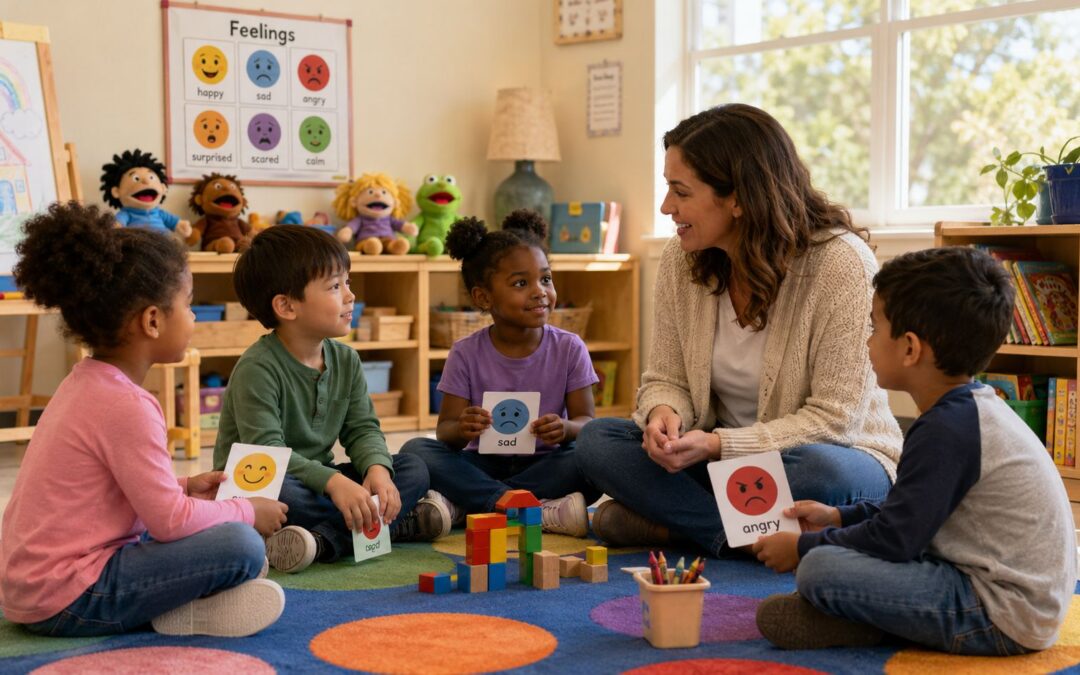
The block shelf is crowded. One child is carefully building a tower. Another reaches for the same long block. Across the room, a child who had a hard drop-off is standing close to the door, trying not to cry. If you work with preschoolers, you know these moments aren't side issues. They are the day.

Social emotional learning begins as preschoolers learn it while waiting for a turn, hearing "not yet," noticing a friend's face, or finding words for a feeling that shows up fast and loud. They don't need abstract lectures. They need repeated, concrete practice with caring adults nearby.

That matters because preschool SEL isn't just a nice extra. A Learning Policy Institute brief on evidence for social and emotional learning reports that findings from hundreds of studies across six continents show a consistent, reliable effect of evidence-based SEL programs on students' social, emotional, behavioral, and academic outcomes across grade levels, including PreK through 12. In preschool terms, that means the games, routines, and conversations you use every day can support real developmental growth.

The activities below are practical social emotional learning activities for preschool, but they go beyond a quick list of ideas. Each one includes a simple objective, materials, steps, and easy adaptations for classrooms and home. Start with one. Repeat it often. That's usually where the biggest change happens.

1. Emotion Recognition and Labeling Through Visual Cards

Some children say "mad" for every hard feeling. Others shut down when asked what's wrong. Visual emotion work helps because it gives young children something concrete to point to before they can explain it.

A simple feelings-card routine builds self-awareness. Children learn to notice faces, connect them to words, and eventually connect those words to their own bodies and experiences. That's the first step toward calmer behavior later.

What you'll need

  • Emotion cards: Real photos work especially well. Include happy, sad, frustrated, worried, excited, tired, and proud.
  • A mirror: Hand mirrors or one wall mirror lets children compare their faces to the cards.
  • A feelings board: A pocket chart, magnet board, or clothespin chart works well.
  • Optional color support: Some teachers add colors to help children sort emotions visually.

In a classroom, you might begin morning meeting by placing three photo cards in the center. Ask, "Which face looks like how your body feels today?" At home, a parent can keep a few cards on the fridge and use them before preschool, after pickup, and at bedtime.

How to do it

Start small. Put out two or three cards, not ten. Ask children to match the face, name the feeling, and copy the expression in the mirror.

Then add a short script:

  • Name it: "This face looks frustrated."
  • Notice the body: "Frustrated can feel tight in our hands."
  • Connect it to life: "When blocks fall down, some people feel frustrated."

If a child can't answer verbally, let them point, hold up a card, or place a clip on a feelings chart for kids. That still counts as strong participation.

Practical rule: Don't correct a child's feeling choice too quickly. If they choose "angry" when they seem sad, stay curious. Young children are often sorting through mixed feelings.

For extension, pair this with a read-aloud or a robot story about feelings, then ask, "How did the character feel first? What changed?" That moves children from labeling feelings in faces to noticing feelings in stories and real life.

For sensory-sensitive or nonverbal children, reduce language demands. Offer two cards instead of many, skip direct eye contact, and let them respond by pointing, matching, or moving a token.

2. Mindfulness and Breathing Exercises with Movement

Some preschoolers need help slowing their bodies before they can use words. Breathing and movement work best when they are short, visible, and tied to the daily rhythm instead of saved only for crisis moments.

Preschool guidance often recommends breathing, mirror play, and role-play, but the more useful question is how to make these activities accessible for children with different sensory and language needs. Inclusive SEL guidance highlighted in this preschool SEL overview points to predictable routines, visual supports, and explicit emotion coaching as especially important. The same resource notes that the CDC estimates 1 in 36 children in the U.S. has autism, and global estimates suggest about 1 in 100 children are autistic.

A teacher and three children sit on the floor in a circle practicing mindful breathing with plush toys.

A strong starter routine

Try belly breathing with a stuffed animal. Have children lie down or sit against a wall. Place the stuffed animal on the belly and say, "Let's help the bear ride up and down slowly."

Materials are minimal:

  • Stuffed animal or beanbag
  • Quiet floor space
  • A short cue phrase such as "Smell the flower, blow the candle"

In school, this works well after arrival, before rest, or after outdoor play. At home, it fits naturally before leaving for preschool or after a difficult transition.

Step by step

Model first. Preschoolers need to see it in a body, not just hear instructions.

  1. Put the stuffed animal on the belly.
  2. Breathe in slowly through the nose if that's comfortable.
  3. Breathe out gently and watch the toy lower.
  4. Repeat a few times, then stand up and stretch arms high.
  5. Ask one simple reflection question such as, "Does your body feel busy or calm now?"

A belly breathing technique for children can help adults stay consistent with the language they use.

For children who don't like lying down, let them breathe while seated, rock in a chair, trace a finger up and down an arm, or blow a pinwheel. For children who become overstimulated by group practice, offer the same routine in a calm corner with one adult.

Later in the day, you can reinforce the same skill with this short video cue:

3. Cooperative Games and Turn-Taking Activities

When a game has one winner, some preschoolers focus only on winning. When a game has a shared goal, children practice waiting, helping, noticing, and adjusting to one another. That's why cooperative play belongs near the center of preschool SEL.

Independent early-childhood guidance points to a practical group of high-adoption activities that are easy to repeat across school and home, including emotion charades, turn-taking games, group art projects, story discussions about characters' feelings, mirror play, and guided matching games, along with environmental supports like puppets, blocks, balls, and dress-up materials that encourage cooperative play and peer interaction in daily routines, as described in this overview of social-emotional development activities for preschoolers.

A simple game that works

Try "Build It Together." Put one container of blocks in the middle and give the group one prompt: "Let's make a home for the animals." The rule is simple. No one builds alone. Each child adds one piece, then passes the turn.

That single structure teaches waiting, watching, and shared planning. It also gives you language to coach social skills in real time: "You noticed Maya needed a turn," or "You asked before taking the long block."

Materials and steps

  • Materials: Blocks, magnetic tiles, large cardboard pieces, or even cups
  • Group size: Pairs or small groups are easiest
  • Teacher prompt: One shared goal and one visible turn-taking rule

Use this sequence:

  • Set the goal: "We're making one big bridge together."
  • Show the turn order: Use a visual card or point around the circle.
  • Coach the language: "Can I have a turn when you're done?" and "You can use it after me."
  • Reflect at the end: "What helped the group finish?"

Children learn more from the debrief than from the game alone. Name the exact social move you saw.

At home, siblings can do the same activity at the coffee table with blocks, crayons, or snack ingredients. In a classroom, you can rotate partners and add simple jobs like holder, builder, and encourager.

If you want more ready-to-use examples, social skills activities for preschoolers can help adults connect play to specific relationship skills.

For neurodivergent children, shorten the wait time, use clear visual turn cues, and allow parallel participation first. A child can hand over pieces, choose colors, or place the final block without having to sustain the full group game.

4. Role-Playing and Dramatic Play for Social Scenarios

Pretend play gives children a safe place to practice hard moments before those moments happen again. That matters because preschool conflicts are often predictable. Someone wants to join a game. Someone gets left out. Someone grabs a toy because waiting feels impossible.

A puppet or dramatic play scenario lets you slow the moment down. Children can see the problem, try a response, and replay it with a different ending.

A teacher smiles as two preschool children use animal hand puppets during a social emotional learning activity.

One everyday script

Use two puppets. Puppet A is playing with a toy kitchen. Puppet B walks over and says, "I want that." Puppet A turns away. Stop there and ask the children, "What could Puppet B say?"

Accept multiple usable responses:

  • "Can I have a turn when you're done?"
  • "Can I play with you?"
  • "Can I use the spoon while you use the pot?"

When children generate the language, they're more likely to use it later.

Materials and teaching steps

  • Materials: Puppets, dolls, stuffed animals, or dress-up props
  • Best scenarios: Sharing, joining play, accidental bumping, waiting, cleanup, disappointment
  • Adult role: Guide without giving a lecture

Try this pattern:

  1. Act out a short problem.
  2. Pause before the solution.
  3. Invite children to suggest words or actions.
  4. Replay the scene with one child helping voice the puppet.
  5. Ask, "How did the problem change?"

At home, role-play can happen with toy animals at bedtime. In school, keep a "friendship prop box" near dramatic play so you can revisit real class issues later in the week without singling anyone out.

If a child doesn't want to perform, let them direct. They can point to the puppet, whisper a line to you, or choose between two options. That's still meaningful practice.

A helpful variation is to act out not just one "good" solution but several acceptable ones. Preschool social problem-solving works best when children learn flexible scripts, not rigid lines.

5. Gratitude and Kindness Practice Rituals

Kindness becomes more visible when adults name it out loud. Preschoolers often do caring things quickly and move on. A regular gratitude or kindness ritual helps them notice those moments and connect them to belonging.

This doesn't need to become a big project board. The strongest routines are short and repeatable.

A classroom ritual that takes minutes

At closing circle, pass around a soft object and invite one sentence: "Today I felt thankful when…" or "I saw kindness when…" Some children will say something big. Others will say, "Lila gave me the red crayon." Both responses matter.

At home, try the same practice at dinner or bedtime. A caregiver might begin with, "I felt grateful when you waited while I finished helping your brother."

Materials and steps

  • Materials: A talking piece, paper strips, a jar, or a bulletin board
  • Prompt choices: "Who helped you?" "How were you kind?" "What made you smile today?"
  • Time: Keep it brief and predictable

A few ways to make it work:

  • Model specific gratitude: "I appreciated how you helped pick up the blocks."
  • Keep responses concrete: Young children do better with examples than abstractions.
  • Use visuals: Photos of classmates can help children remember social moments.
  • Never force sharing: Quiet participation is still participation.

A useful reminder: Gratitude isn't a performance. If a child is upset, start by helping them feel safe. Reflection can come later.

You can also create a kindness chain. Each time you notice a prosocial act, add one paper link with a short description. "Helped zip coat." "Invited friend to play." "Waited for a turn." The chain makes caring behavior visible without turning it into a prize competition.

For children with language delays, let them point to a photo of a peer, hand over a drawing, or choose from picture prompts. The goal is recognition, not polished speech.

6. Conflict Resolution and Peer Mediation Circles

Most preschool conflicts don't need a long investigation. They need a simple, repeatable process that children can learn by heart. When adults solve every dispute for them, children may stop practicing their own social problem-solving.

A brief conflict circle gives structure to a messy moment. It slows everyone down and helps children hear that feelings, needs, and solutions all belong in the conversation.

The three-part script

Keep the language simple enough for a four-year-old:

  • What happened
  • How do you feel
  • What can we do now

That's enough. You don't need a long restorative meeting for every argument over blocks.

Use a peace spot, small rug, or two chairs side by side. Sit close, stay neutral, and coach each child through the same pattern. If needed, offer visual cards for "sad," "mad," "scared," "want turn," and "help."

How to run it in real life

Let's say two children are both crying over a truck. You might say:

  1. "Tell me what happened."
  2. "Show me how you feel."
  3. "What can we do now so both bodies are safe?"

Possible solutions might include taking turns with a timer, using a similar toy, playing together, or asking an adult for help finding another plan. The key is that children help choose.

A NIH-hosted study of the Fun FRIENDS program found that social and emotional learning interventions in early childhood were associated with a significant decrease in both extroverted and introverted problem behaviors in the intervention group compared with the control group, with statistical significance at p < 0.05. For preschool settings, that's a useful reminder that structured SEL practice can shape the everyday behaviors that affect classroom readiness.

If children are too dysregulated to talk, co-regulate first. Breathe, move, sit nearby, or offer a sensory support. Then return to the script later.

This works at home too. Siblings can use the same three questions with adult coaching. Familiar language across settings makes the skill easier to remember.

7. Body Awareness and Self-Regulation Through Movement

Some children recognize feelings first in their bodies, not in words. Their hands clench. Their shoulders rise. They crash into play more roughly. Movement-based SEL helps them notice those signals and shift states safely.

A large 2024 meta-analysis in Child Development, summarized in NAEYC guidance on building social-emotional skills at home, found that early childhood SEL programs can improve social competence and reduce behavior problems, with stronger effects when interventions are structured, repeated, and supported by teacher practice rather than treated as occasional enrichment. That fits what many preschool teachers already know. A short routine used every day usually works better than a special activity used once in a while.

A young boy doing a yoga balance pose while his mother helps him in a bright room.

A repeatable movement routine

Try "Freeze, Feel, Breathe, Move."

Play music and invite children to move freely. Pause the music and say, "Freeze. What does your body feel like?" Then guide one regulating action such as stretching high, curling small, shaking hands out, or taking one slow breath before restarting the music.

This works because it links body awareness to action. Children begin to learn that a feeling in the body can be noticed and shifted.

Materials and adaptations

  • Materials: Music, open floor space, and simple picture cues
  • Good prompts: "Show me excited legs," "Show me worried shoulders," "Show me a calm breath"
  • Best timing: Before circle, after recess, during transitions, or before rest

At home, a parent can use the same game while waiting for dinner or switching from playtime to bath. In the classroom, keep a small movement menu on the wall with pictures for jump, stretch, stomp, squeeze, breathe, and rest.

For children who avoid imitation, don't require exact copying. Let them choose from two or three movements. For children with sensory sensitivities, avoid loud music and fast transitions. Quiet, predictable movement often works better.

The point isn't perfect yoga or perfect posture. The point is helping children notice, "My body feels like this, and I can do something about it."

8. Belonging and Inclusion Activities Through Classroom Community Building

A child can't practice empathy or problem-solving well if they don't feel safe and seen. Belonging is not separate from SEL. It's part of the condition that allows SEL to happen.

That matters even more in preschool, where children are learning whether classrooms are places where their names, bodies, languages, families, and support needs are welcome.

Start with daily rituals

Belonging grows through ordinary routines. Greet each child by name. Use family photos. Put books, dolls, and dramatic play props in the room that reflect different families, abilities, and backgrounds. Pair children thoughtfully so no one gets left on the edge of the group again and again.

A strong first move is to build a short class ritual:

  • Arrival choice: Wave, high five, hand on heart, or smile
  • Name practice: Everyone hears and says one another's names respectfully
  • Shared message: "Everyone belongs here"
  • Visual support: Picture schedule so the day feels predictable

If you want ideas for rituals and shared norms, classroom community building activities can offer a starting point, along with broader activities for student belonging.

Make inclusion active

Don't stop at posters and diverse books. Build participation paths into each activity. In emotion work, allow pointing instead of speaking. In games, shorten turns and use visual cues. In dramatic play, offer roles with different language demands. In movement, let children choose lower-sensory options.

A lot of preschool SEL advice names activities but doesn't explain adaptation. That's a gap. Predictable routines, explicit coaching, visual supports, and alternatives to verbal sharing often make the difference between a child participating and a child shutting down.

A useful classroom phrase is, "Different children need different kinds of help." When adults say that naturally, accommodations feel normal instead of stigmatizing.

Preschool SEL Activities, 8-Item Comparison

Activity Implementation complexity Resource requirements Expected outcomes Ideal use cases Key advantages Key limitations
Emotion Recognition and Labeling Through Visual Cards Low, simple to set up and scaffold Minimal: picture cards, emotion wheel, teacher time Improved emotional vocabulary and self-awareness Morning meetings, small groups, pre‑reader instruction Accessible; multi‑sensory; adaptable for diverse learners Can oversimplify emotions; needs repeated reinforcement; cultural bias risk
Mindfulness and Breathing Exercises with Movement Low–Medium, requires routine and modeling Minimal props (stuffed animals, chime, music); quiet space; facilitator skill Better self‑regulation, reduced anxiety, improved attention Transitions, calming routines, brief brain breaks Rapid calming tool; supports executive function; portable Requires consistency; some children struggle with stillness; needs skilled facilitation
Cooperative Games and Turn‑Taking Activities Medium, planning and facilitation required Simple materials, open space, devoted time Increased cooperation, prosocial behavior, reduced aggression Group circle time, outdoor play, team‑building sessions Builds peer bonds; inclusive; reduces competition Time‑intensive; requires careful facilitation to ensure inclusion
Role‑Playing and Dramatic Play for Social Scenarios Medium–High, structured planning and guidance Props/costumes, play area, teacher facilitation Improved perspective‑taking, communication, conflict practice Practicing conflicts, language development, puppet shows Active practice; highly engaging; builds empathy and confidence Some children may feel anxious; time to set up; needs debriefing to solidify learning
Gratitude and Kindness Practice Rituals Low, easily embedded into routines Minimal: charts, prompts; teacher modeling More prosocial behavior, positive classroom culture, improved mood Morning/evening circles, classroom rituals, family engagement Easy to sustain; fosters empathy and intrinsic motivation Can feel rote if not authentic; may exclude children who struggle to identify gratitude
Conflict Resolution and Peer Mediation Circles High, requires training and fidelity Time, teacher/peer training, visual supports, private space Reduced incidents, better problem‑solving, increased peer agency Restorative practice, recurring behavior interventions, peer mediation Teachable, scalable process; builds long‑term conflict skills Time‑consuming; needs skilled facilitators; not all children respond equally
Body Awareness and Self‑Regulation Through Movement Medium, space and facilitation considerations Open space, music/props, facilitator versed in adaptations Improved emotion regulation, body awareness, attention Movement breaks, sensory regulation, active learners Embodied regulation; engages energetic children; supports nonverbal expression Requires space; may challenge sensory‑sensitive or self‑conscious children
Belonging and Inclusion Activities Through Classroom Community Building Medium–High, ongoing, systemic commitment Diverse materials, curriculum adjustments, leadership buy‑in Greater sense of belonging, psychological safety, reduced exclusion Whole‑class community building, diversity initiatives, onboarding Long‑term culture change; reduces bullying; supports marginalized students Requires sustained cultural competency work and leadership support; not solved by single activities

Weaving SEL into the Fabric of Your Day

It is 8:15 a.m. A child clings to a parent at drop-off, two children argue over the same truck, and another watches from the edge of the rug. In a preschool classroom or at home, these are not interruptions to social-emotional learning. They are the practice field.

The strongest social emotional learning activities for preschool fit into moments you already have. Arrival can become a simple feelings check-in. Cleanup can teach turn-taking and teamwork. Read-aloud time can help children notice what another person might feel. A disagreement in the block area can become a guided chance to use words, wait, and repair.

That is why this article has focused on mini-guides, not just a list of games. Young children do best when adults know the goal of an activity, gather a few simple materials, teach it in small steps, and adjust it for different settings. A breathing routine used at circle time can also work in the car before preschool. A kindness ritual from the classroom can become part of bedtime. SEL sticks better when children meet the same skill in more than one place.

Repetition is key, as preschoolers learn through practice, not explanation alone. A three-year-old rarely uses a conflict script after hearing it once, just as a child does not learn to zip a coat from one demonstration. They need the same words, the same gestures, and the same sequence many times, especially during calm moments before a hard moment arrives.

Growth often looks uneven. A child may name feelings accurately during group time and then cry or shove when frustrated outside. Another may watch for two weeks before joining a breathing activity, then suddenly begin using it on their own. That does not mean the routine failed. It means the child is still building the bridge between support from an adult and self-control.

Adults help build that bridge through consistency and co-regulation. Warm tone, predictable language, visual cues, and clear steps make SEL easier for young children to use when emotions run high. This is especially helpful for children who are still developing language, have sensory differences, or need more time to shift between activities.

Adaptation belongs at the center of good teaching. If a child will not speak in a group, let them point to a feelings card. If sitting still for breathing feels too hard, add movement. If open-ended sharing causes stress, offer a sentence starter or two choices. These adjustments do not water down SEL. They make the skill reachable.

For schools and multi-classroom programs, alignment usually helps more than novelty. Shared phrases such as "use kind words," "my turn, your turn," or "let's solve it together" give children a stable map. When teachers, aides, and families respond in similar ways, children spend less energy guessing what adults want and more energy practicing the skill itself.

Start with one routine that matches a real need in your day. If mornings are hard, begin with emotion check-ins. If transitions fall apart, try a movement-and-breathing reset. If conflicts keep repeating, teach one short problem-solving script and use it every time. That is the core of the approach.

Over time, these repeated routines shape the culture around the child. SEL stops feeling like a separate lesson and starts working like the threads in a piece of fabric, holding the day together steadily, and with care.